King-Queen-Queensway-Roncesvalles Moves to Phase 2

After a long delay thanks to construction issues and utilities that were not located where they were expected to be, the King-Queen-Queensway-Roncesvalles project has moved into its second phase over three months later than planned.

This affects routes 501 Queen and 504 King.

The 501 Queen bus service was formerly diverted via Dufferin and King to Roncesvalles. It now operates both ways via Queen Street following the normal streetcar route in the west end. Separate diversions remain in place elsewhere on the route for track work east of Bathurst, and for overhead work in the east end.

The 504 King shuttle bus had been operating in two sections. One ran on Roncesvalles Avenue between Dundas West Station and Roncesvalles Carhouse. The other ran from the eastern entrance of the Exhibition via Strachan to King, and then over a large counterclockwise loop formed by Dufferin, Queen, Triller and King.

The 504 bus now operates between Dundas West Station and the Exhibition as one route with the two former segments now connected at Queen and Roncesvalles. Westbound buses continue to operate via Dufferin and Queen, while eastbound buses run via Queen, Triller and King as shown below.

Note that this arrangement means that there are no westbound buses on King west of Dufferin, just as there have been no eastbound buses on Queen since this project began. Queen Street now has two-way service.

At the time I write this (7:00 pm, November 14), the TTC has not updated its website to reflect the new routings.

Service Reliability on 94 Wellesley: September 2021

This article continues a series reviewing service quality on some of the TTC’s shorter routes.

Apologies to my regular readers who must be saying “Oh No! Not More Charts!” My intent here has been to show that poor service quality affects many routes and time periods, and occurs even on relatively simple shorter routes in the network.

When the TTC’s IT systems all come back online, I plan to continue with another (smaller) group of short routes: 12 Kingston Road, 62 Mortimer, 64 Main, 87 Cosburn, 92 Woodbine South, 121 Esplanade/River and 124 Sunnybrook. Later in the year I will return to major routes including some I have not reviewed recently or at all including: 7 Bathurst, 41/941 Keele, 43/943 Kennedy, 68/968 Warden, 89/989 Weston and 95/995 York Mills.

Overview

Route 94 Wellesley operates with both a short and long version:

  • The 94A operates over the full route between Castle Frank and Ossington Stations.
  • The 94B operates on the eastern half of the route between Castle Frank and Wellesley Stations except during evening periods on all days.

September 5 brought new schedules and improved service during many time periods.

When there are two branches, they have a common headway and are supposed to be blended. During certain periods, buses are scheduled to alternate between the branches (any time in the table above where there are “half buses” allocated to a branch). This makes both services vulnerable to disruption when there is a missing bus, or a delay/interruption on the western branch throws buses there off schedule.

All of the problems we have seen on other routes are present on 94 Wellesley including:

  • Buses missing from the scheduled service leaving gaps.
  • Traffic congestion that is sometimes predictable, but sometimes much worse than usual, with schedules that cannot accommodate the disruption.
  • Headways that are dispersed widely beyond the target range implied by the TTC’s Service Standards.
  • Buses running in pairs (or worse) for extended periods on a route that does not have many vehicles overall.
  • Irregular headways caused by two services that are scheduled to blend, but which do not do so reliably at many times.
Continue reading

Service Reliability on 72 Pape: September 2021

This article continues a series reviewing service quality on some of the TTC’s shorter routes.

Overview

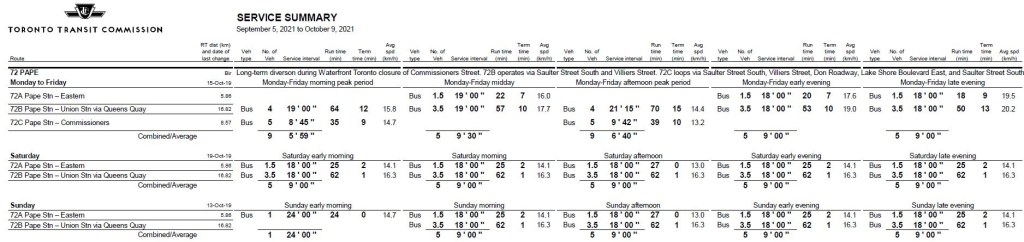
The Pape bus operates two branches one of which has a peak period extension:

  • The 72A operates from Pape Station to Eastern Avenue during all periods except the weekday peaks.
  • During the peak periods, the 72A is extended south and west as 72C to the Don Roadway via Commissioners Street.
  • The 72B operates during all periods except early Sunday morning to Union Station via Queens Quay and Yonge.

Except for peak periods, the A and B branches operate on a common headway and should in theory provide a blended service on the common portion of the route between Eastern Avenue and Pape Station. This does not occur, and the service is a mixture of wide gaps and very short headways at almost all times.

During the peaks, the 72C Commissioners headway is almost but not half of the headway of the 72B Union. This makes it impossible to schedule a one-bus-in-three blended service even assuming that the 72B could stay on time and merge gracefully into the 72C service. The result is scheduled gaps and bunching on the common portion of the route under even the best conditions during peak periods.

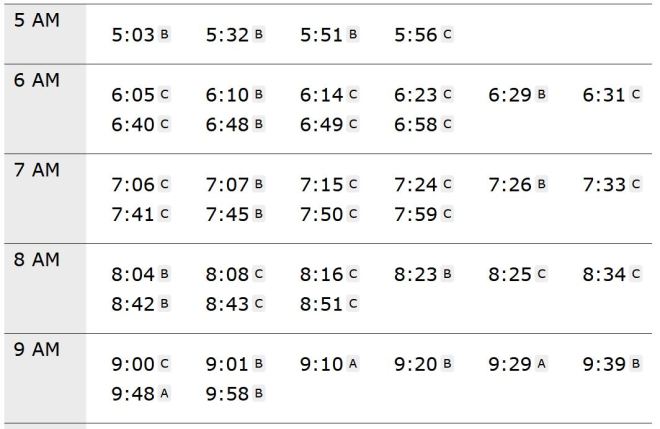
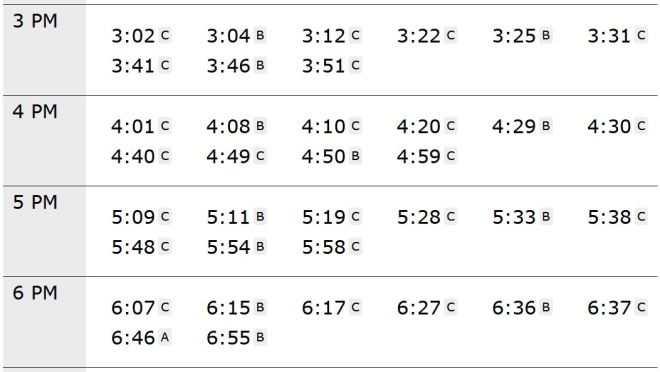
Here is the scheduled service southbound from Pape Station in the AM and PM peak periods in early November 2021. Note the scheduled headways of only one or two minutes between “B” Union Station and “C” Commissioners buses.

Continue reading

Service Reliability on 70 O’Connor: September 2021

This article continues a series reviewing service quality on some of the TTC’s shorter routes.

Overview

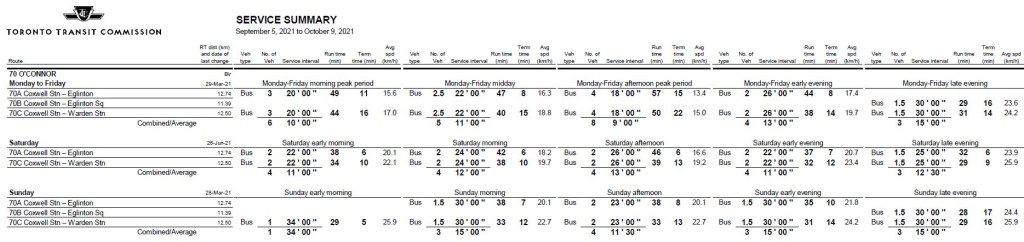
The O’Connor bus runs north from Coxwell Station and branches into a lopsided Y-shaped route. One branch, the 70A/B, goes north via O’Connor to Eglinton while the other, 70C, goes to Warden Station via St. Clair. The Eglinton service loops north of Eglinton except late evenings weekdays and Sundays.

This service design was changed in October so that all Eglinton trips operate as 70A, and the 70B Eglinton Square turnback has been dropped. However, for this analysis, it was still operating. For that reason, the screenline for southbound headways on this branch is set south of the common point for both the 70A and 70B services.

Two years ago, I reported on severe problems with bunching on 70 O’Connor.

At its meeting of December 12, 2019, the TTC Board endorsed a motion by Commissioner/Councillor Bradford whose ward includes the O’Connor bus:

Notice of Motion – Review of 70 O’Connor Bus Route

TTC Board Decision

The TTC Board, at its meeting on December 12, 2019 adopted the following:

That the Board directs staff to investigate and report back by Q1/2020 on the 70 O’Connor bus route reliability, in response to Steve Munro’s published analysis on his website stevemunro.ca on November 20, 2019.

The pandemic lockdown intervened, and the requested report did not appear. However, schedules on the route were changed to improve running times and a chronic problem of bus bunching ceased to be a problem as charts in this article will show.

In place of bunching O’Conner’s major problem in 2021 is that buses are frequently missing from service. Because of the branched nature of the route with headways ranging from 18 to 30 minutes on each branch, the effect of a missing vehicle can be quite severe. With few buses on the route, adjusting service by changing the spacing of remaining vehicles is not an option. In many cases, only one bus remains on a branch.

When all of the scheduled vehicles are in service, headways and travel times are fairly consistent, and buses often have generous layovers (considering the length of a one way trip) at both terminals.

Continue reading

Service Reliability on 75 Sherbourne: September 2021

This article continues a series reviewing service quality on some of the TTC’s shorter routes.

Overview

75 Sherbourne operates between Rosedale and Queens Quay. At the south end, it has an on street loop normally via Queens Quay, Jarvis and The Esplanade. At its north end, the loop reaches to the south end of the Glen Road bridge on South Drive.

For this analysis, the two screenlines used are located at:

  • Sherbourne just south of Bloor. This records the headways at the major subway connection point, Sherbourne Station.
  • Sherbourne just north of Front. This records headways north of the south-end loop.

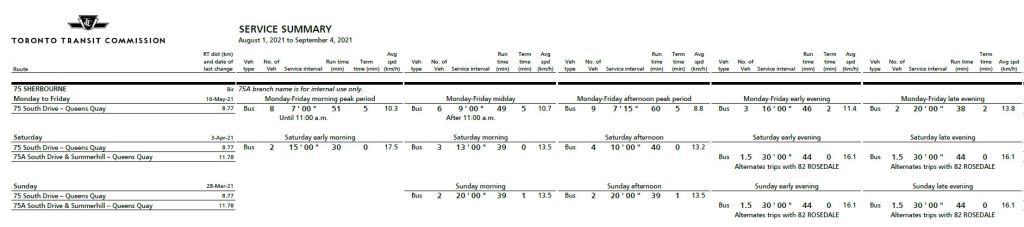
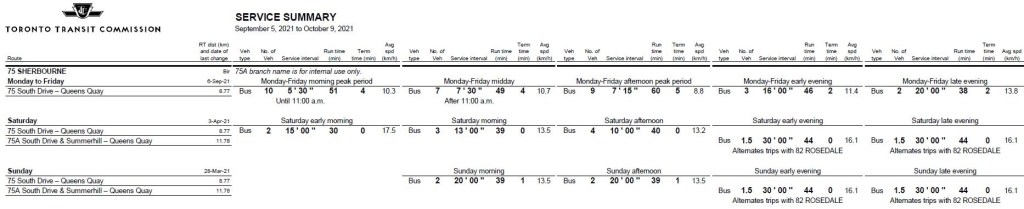
The service design during September 2021 is shown below. From September 1st to 3rd, the line operated on a summer schedule with less frequent service during the peaks and midday.

Weekend evenings the route is interlined with 82 Rosedale on a 30 minute headway using two buses over the combined route.

In these headway charts, the vertical scale is extended from the 0-30 minute range used in past articles to 0-60 minutes so that all data points will be visible.

75 Sherbourne shows all of the problems seen on other routes including missing vehicles and bunching, and, in some periods, a lack of sufficient running time to provide for recovery from minor incidents enroute. Service is often unreliable.

Continue reading

Transit and the Urban Form of Toronto

This article contains a deck with my presentation and speaking notes for a guest lecture to Professor George Baird’s class at the Faculty of Architecture, University of Toronto, “A History of Urban Form”.

It is not intended as a definitive document, but as an overview tailored to the course as a whole and to the time available.

Alas, you will not hear my dulcet tones. For some things you just had to be there.

The version linked here as of 7:00 pm, November 6, has minor corrections and typos fixed.

Service Reliability on 65 Parliament: September 2021

This article continues a series reviewing service quality on some of the TTC’s shorter routes that generally escape notice when buses like Dufferin and Finch come under fire for erratic operation.

Overview

65 Parliament is a very short route operating from Castle Frank Station on Line 2 BD south to The Esplanade. The 2022 Service Plan proposes extending the route south to Queens Quay to the loop at Corus Quay serving George Brown College.

The service design during September 2021 is shown below:

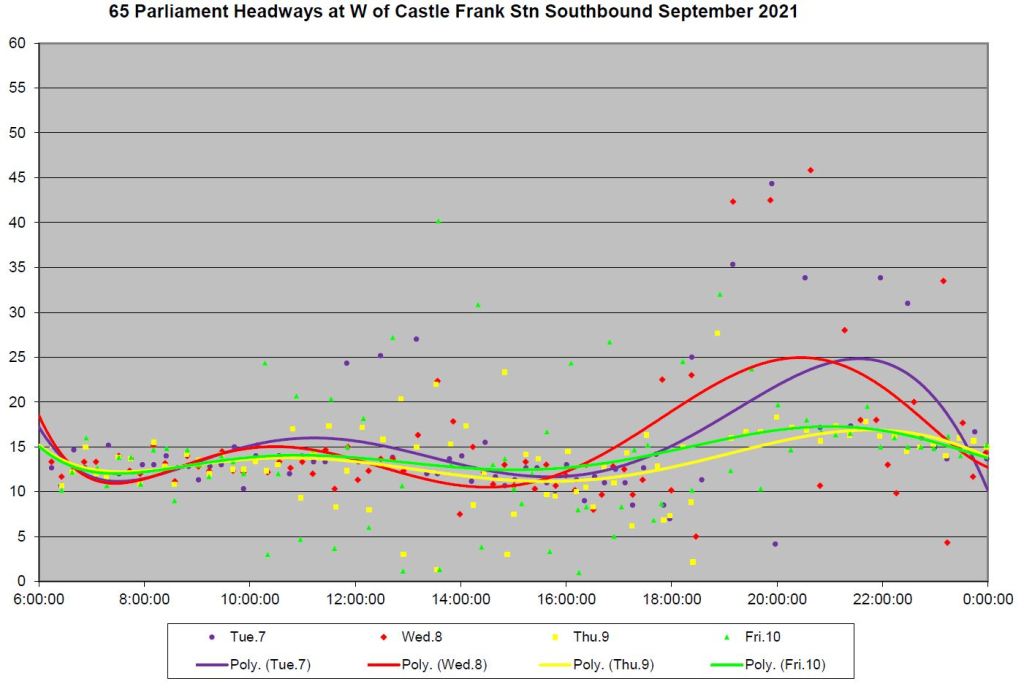
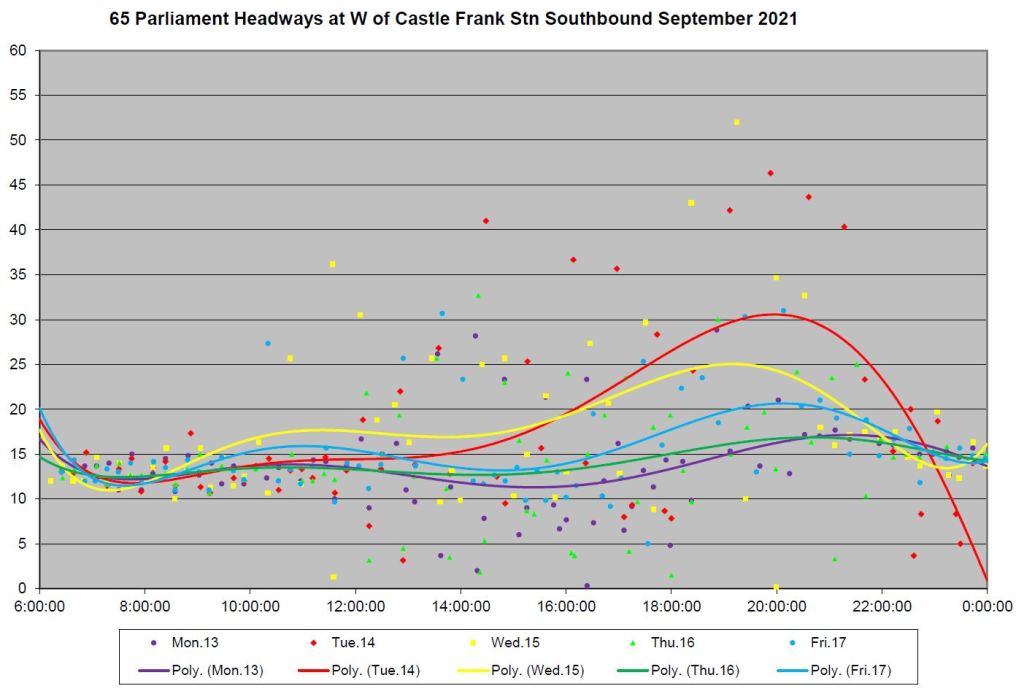
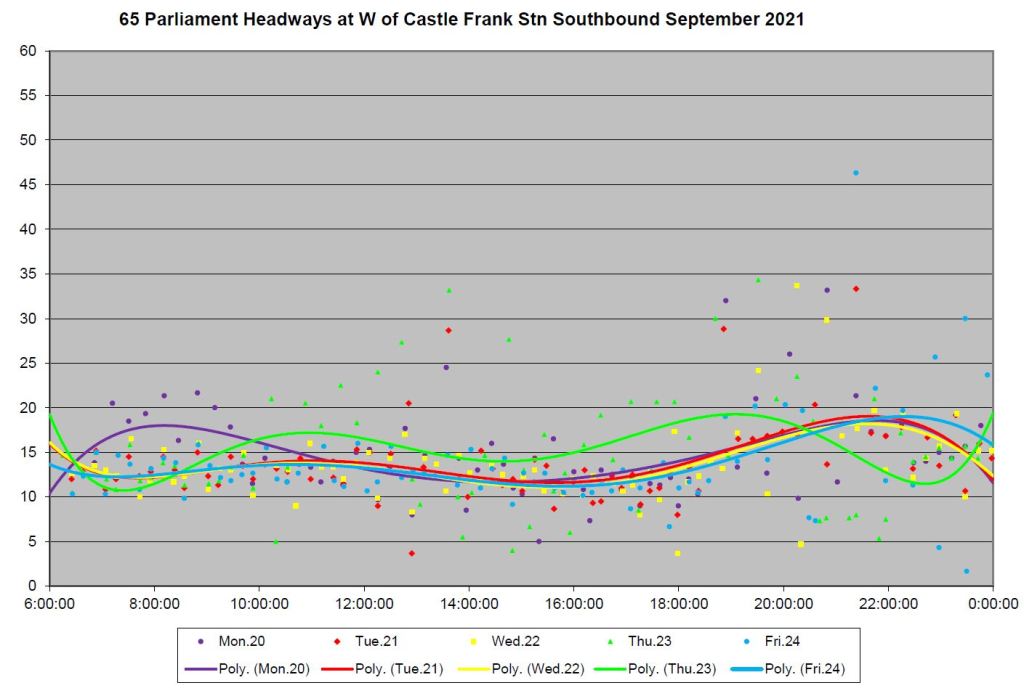
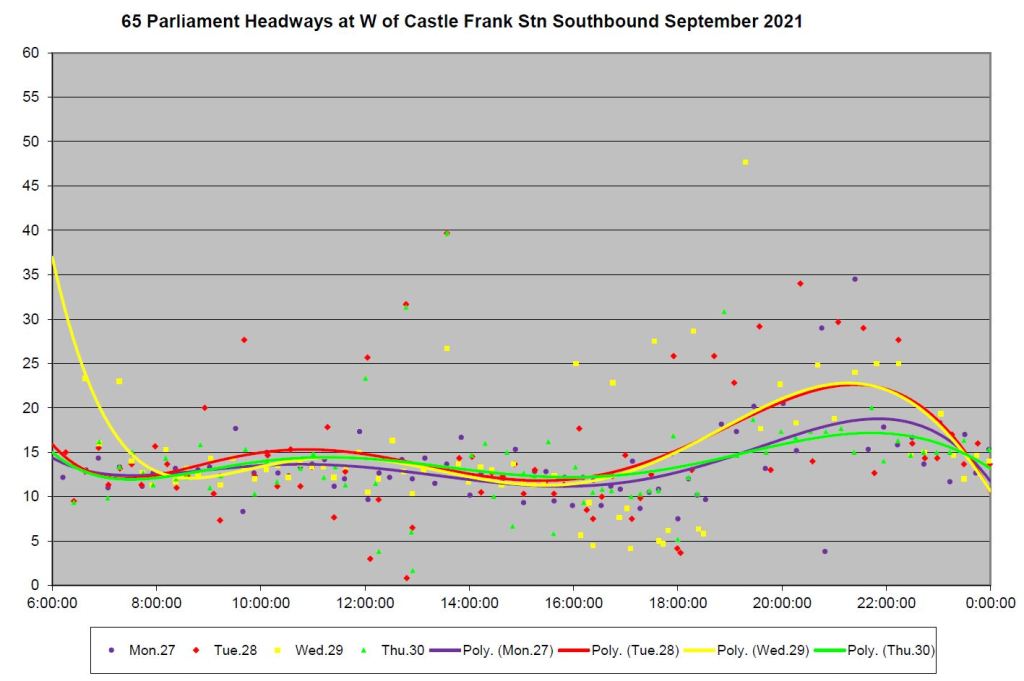
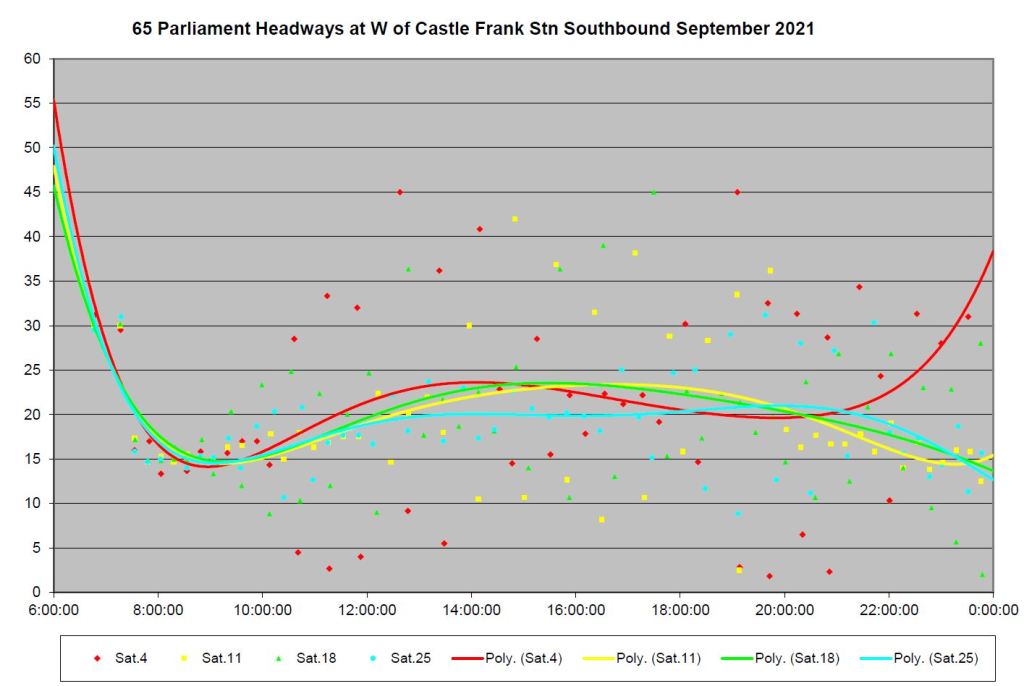
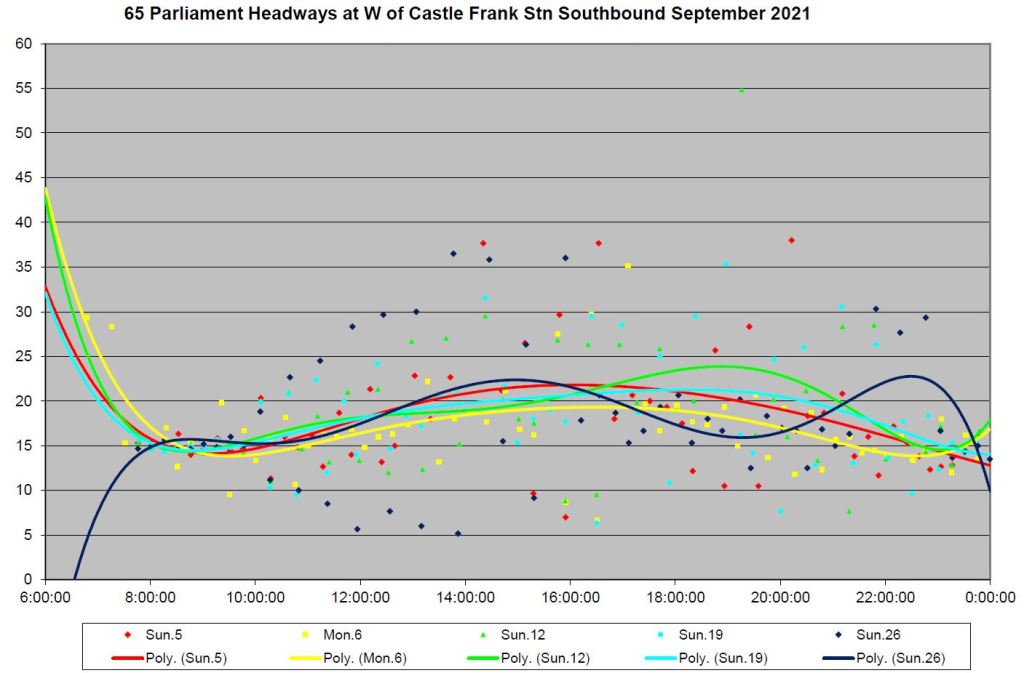
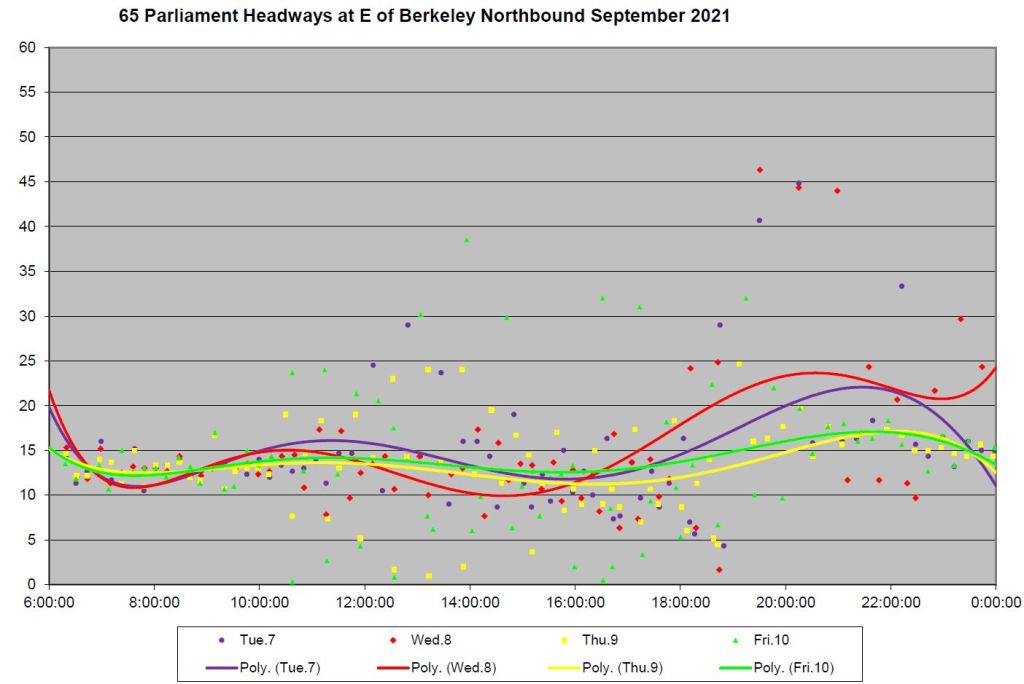
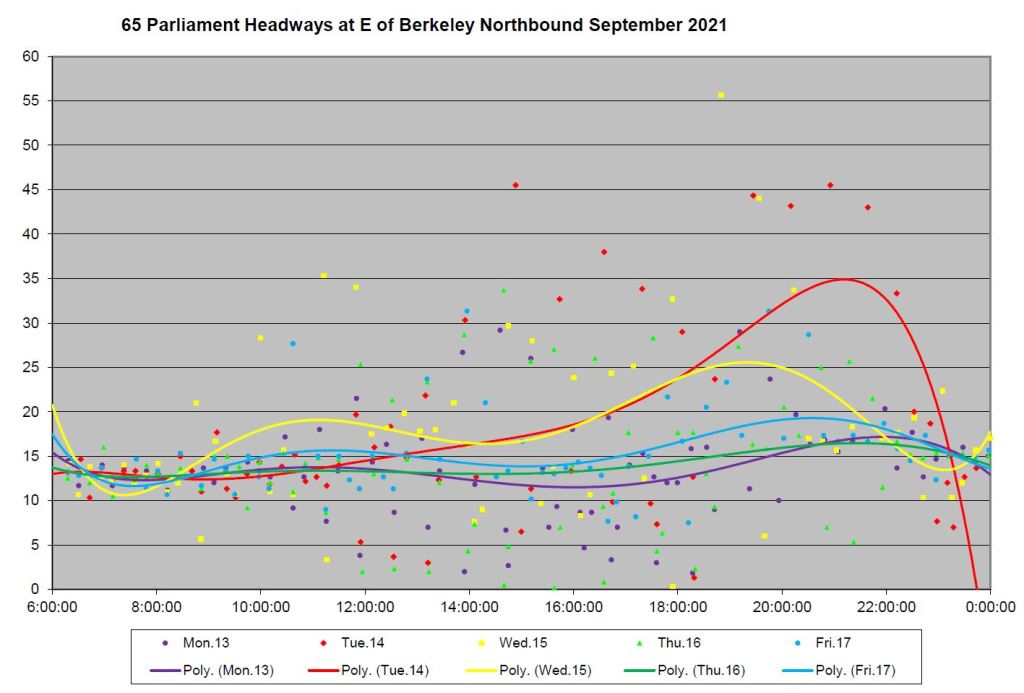
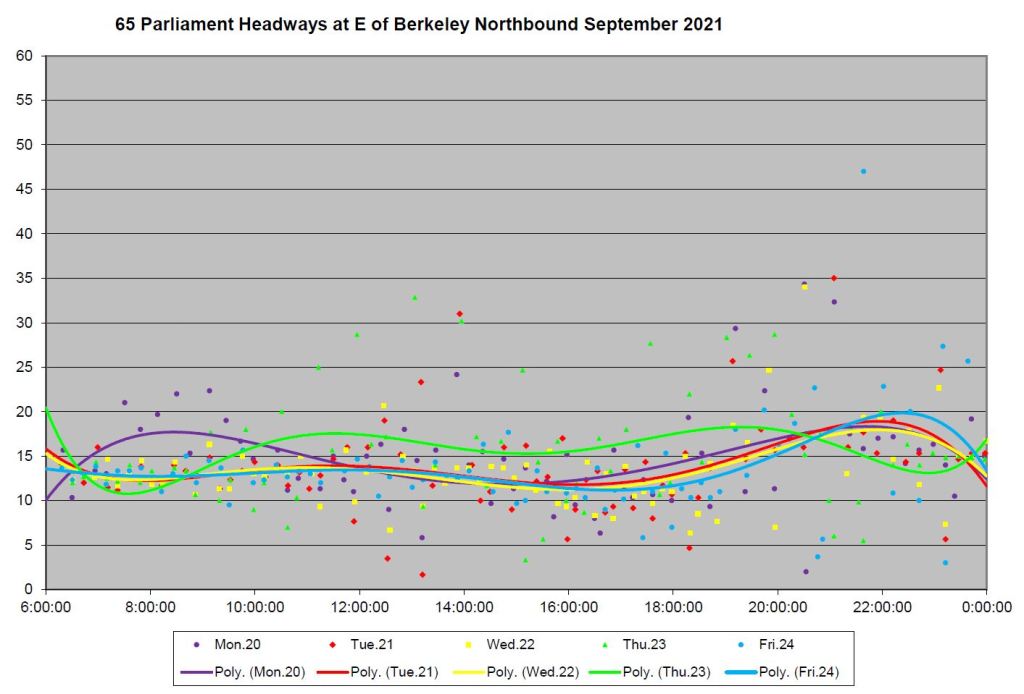
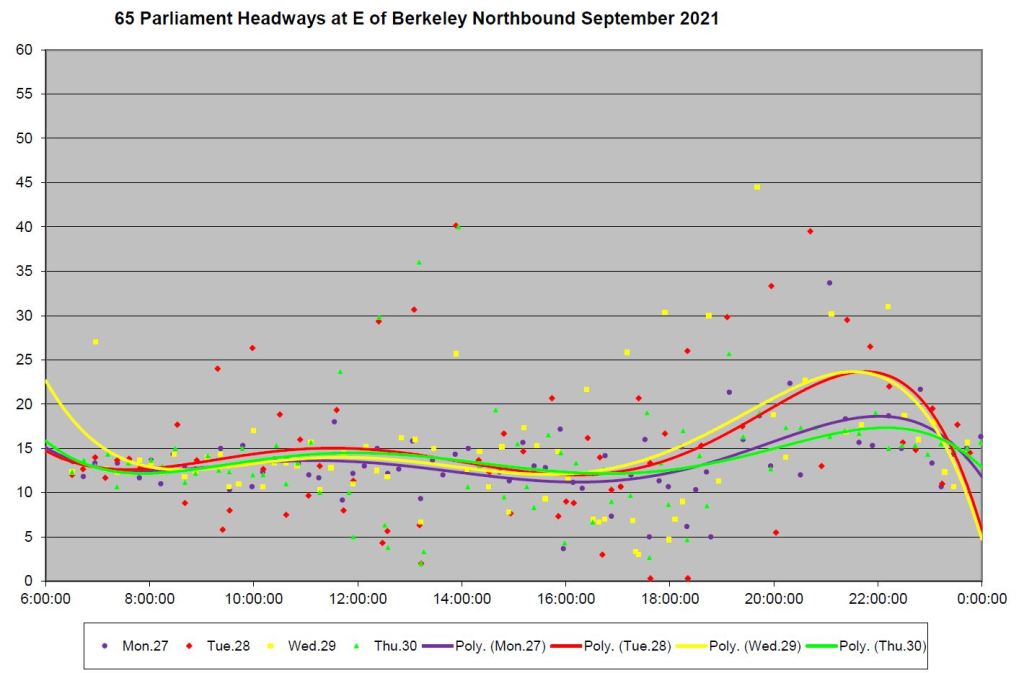
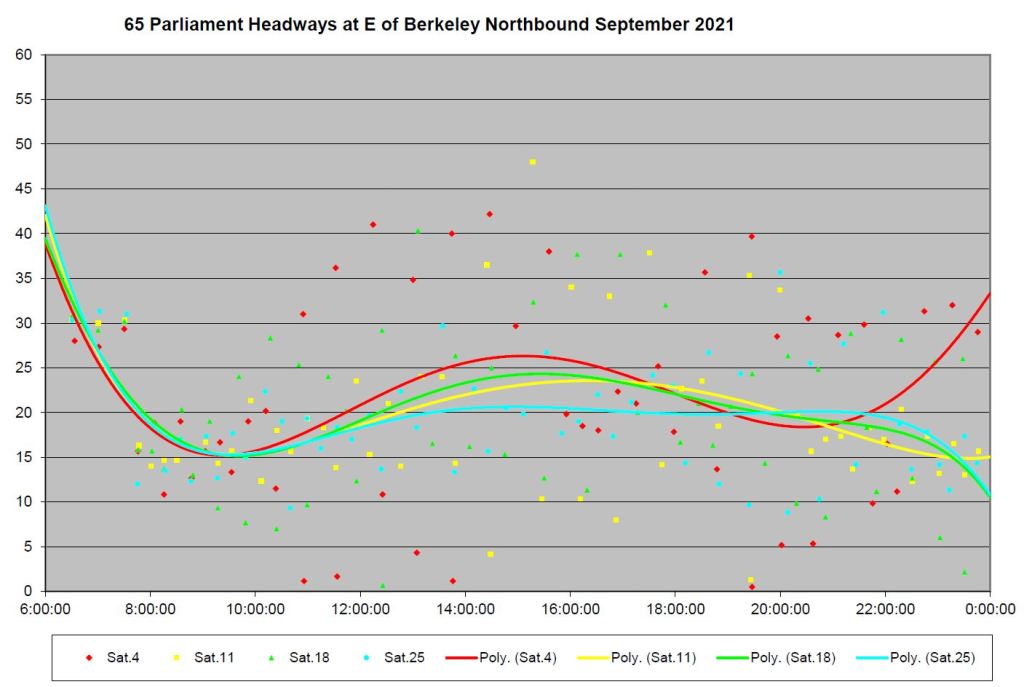
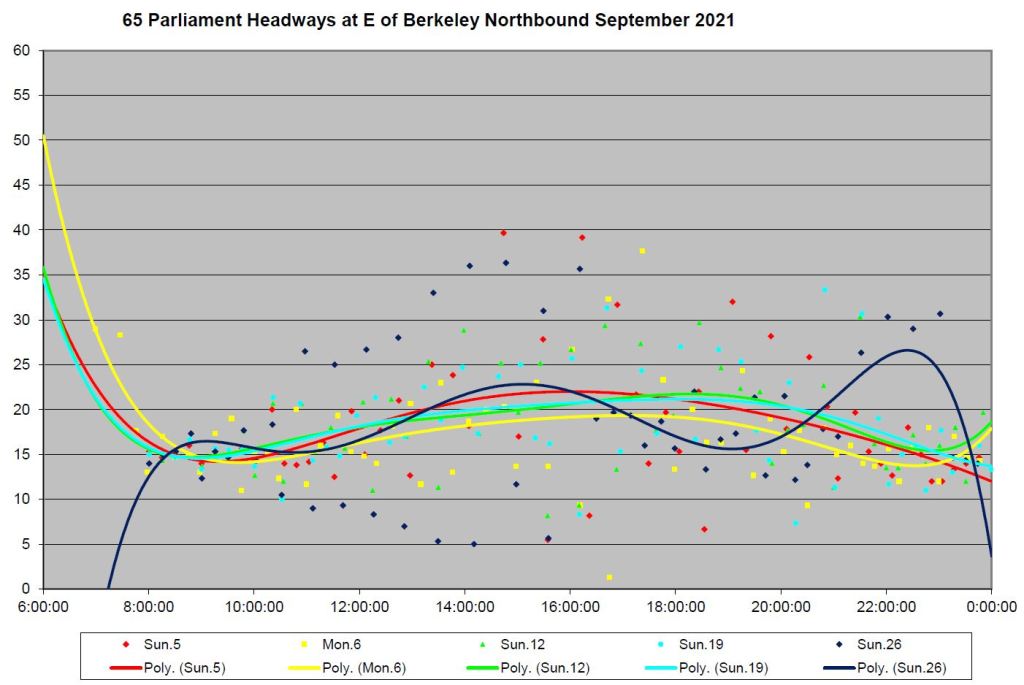
Although the scheduled headway varies from 11 to 20 minutes, the actual headway operated can at times be well over half an hour either because buses are missing from the route, or because the limited number of vehicles on the route are running in pairs.

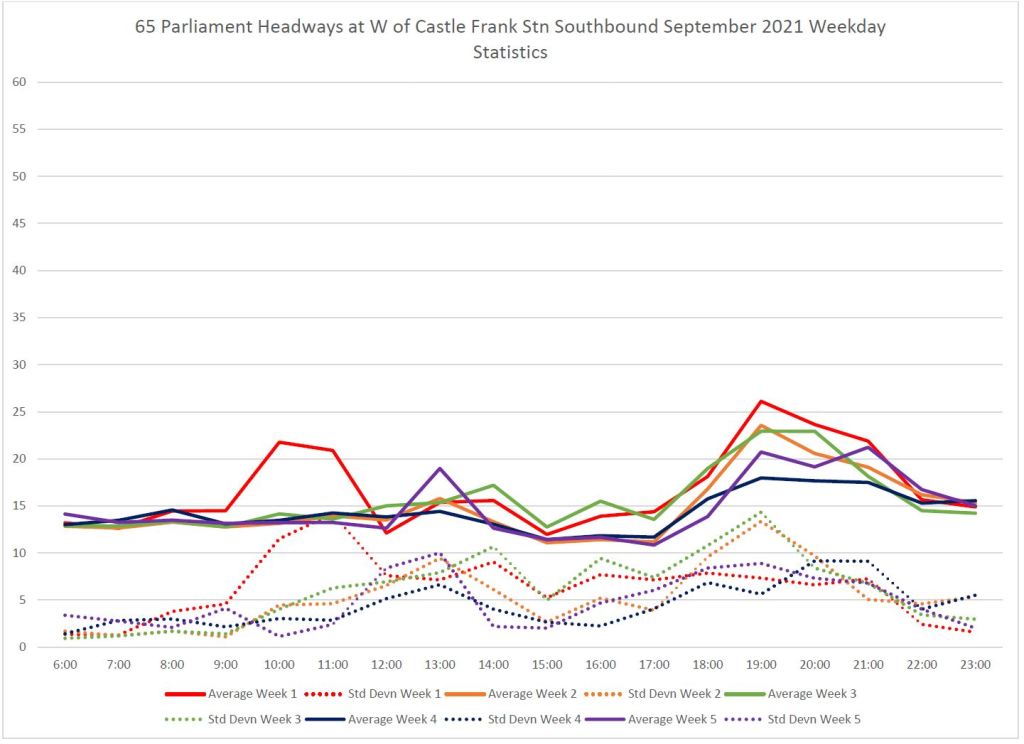
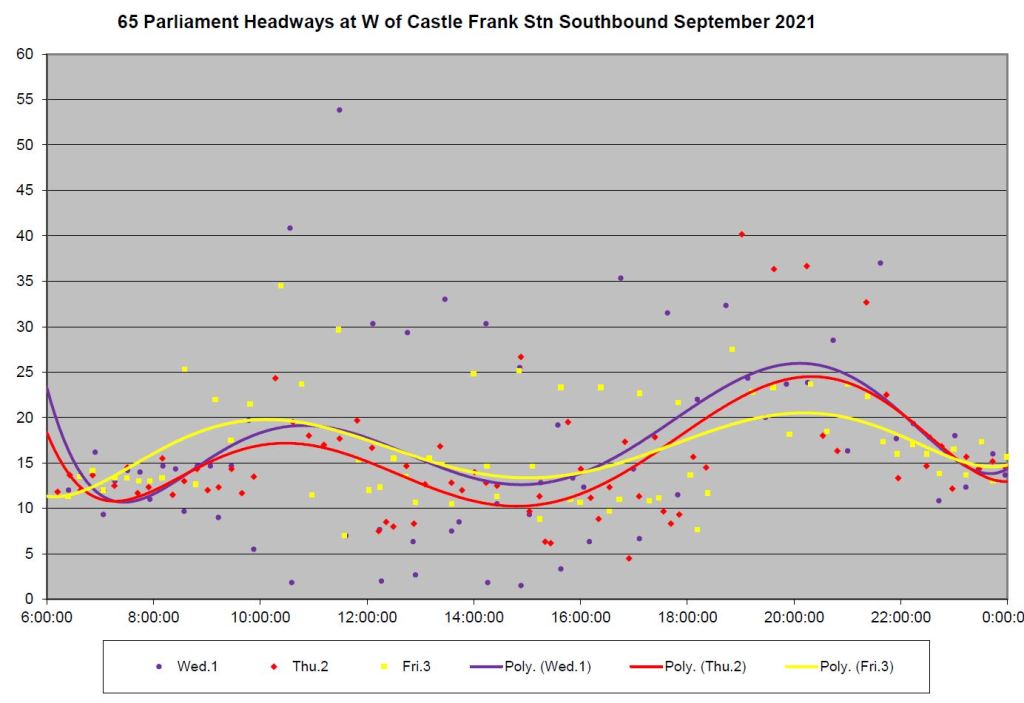
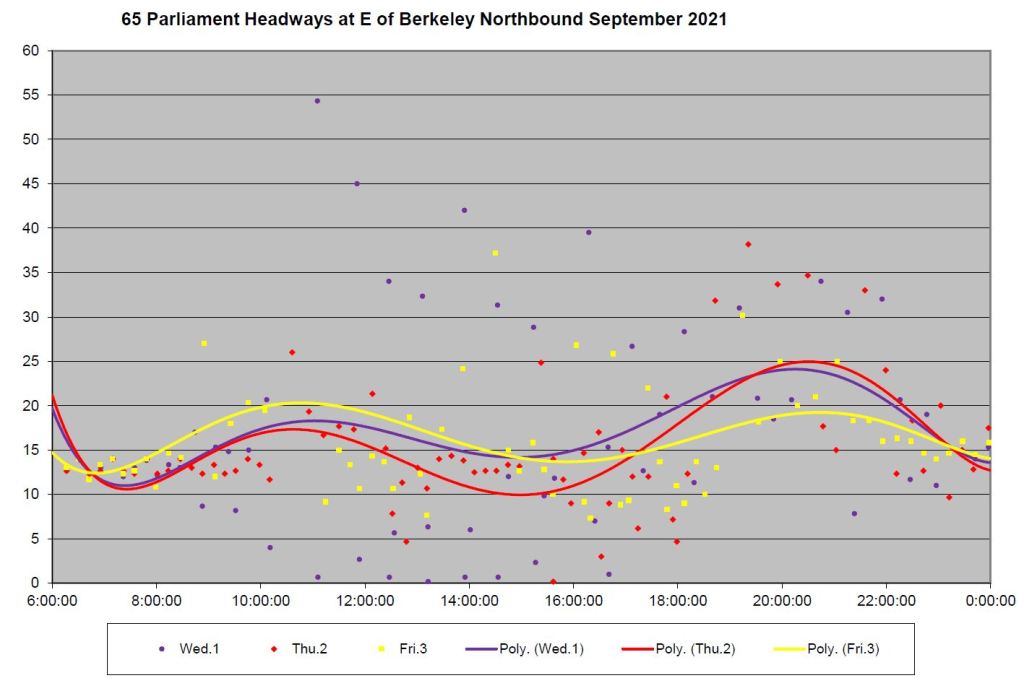
In the headway charts below, I have extended the vertical scale from the 0-30 minute range used in past articles to 0-60 minutes so that the data points will be visible.

Southbound From Castle Frank Station

The screenline for the data here is on Bloor Street west of Castle Frank Station.

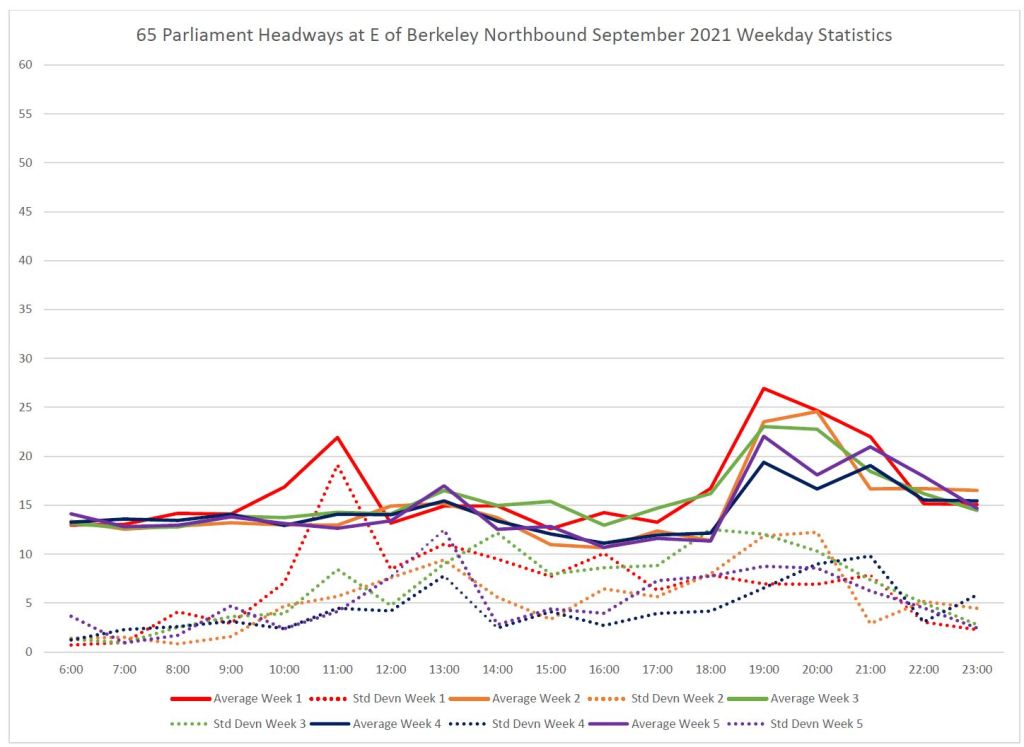
In spite of this route being short, there is a wide dispersion in headway values as the charts show. In a pattern seen on other routes, the standard deviation of the headways (dotted lines in the first chart) lie between 0 and 5 minutes for the first few hours of service, but rise substantially thereafter. This is a measure of the degree to which headways diverge from the mean value.

Those means show their own variation on a week-by-week basis indicating that the number of trips (and hence the average headway) was not consistent across the month. Day by day breakdowns are in the rest of the charts.

Days with very wide gaps and bunching are not rare oddities, but are a common situation on this route.

Northbound From Front

The screenline for the data here is on Front Street just east of Berkeley which is the start of the south end loop.

Continue reading

TTC Plans Service Trimming in November 2021

The TTC has announced that for the schedules coming into effect on November 21, 2021, service will be trimmed in response to the reduction in staff available due to the Covid vaccination mandate.

The plans are focused on protecting and maintaining scheduled service on the busiest routes

TTC Media Release, October 27, 2021

The TTC will give priority to the busiest routes in the system and the busiest times of the day, particularly bus routes where ridership has returned more strongly than on other parts of the network. The announcement cited “Wilson, Jane, Eglinton, Finch and Lawrence East, among others”.

Changes on other routes are described as similar to seasonal adjustment for summer and Christmas/New Years. The hours of service will not change. The level of service will be based on TTC Service Standards.

Operators will be made available for service in several ways:

  • Capital projects will be temporarily deferred and weekend/night-time closures will be cancelled so that shuttle bus operators are available for regular service.
  • New operator hiring will continue over “the next several months”.
  • Operators now used for moving vehicles between divisions will be redeployed to regular service.
  • Recently retired operators will be invited to return to work on a temporary basis.

Employees who are unvaccinated or have not shared their status by the end of the day on Nov. 20 will be placed on unpaid leave until they receive all their required vaccine doses, or Dec. 31, whichever comes first.

These measures do not apply to employees with an approved Ontario Human Rights Code exemption.

As of today, 88 per cent of the agency’s 15,090 active employees have shared their COVID-19 vaccination status. In total, close to 86 per cent of unionized, and 94 per cent of non-unionized employees have shared their status with the vast majority already fully vaccinated.

TTC Media Release, October 27, 2021

When I receive the detailed memo of planned service changes, I will produce the usual breakdown for readers.

Although I am sympathetic to the labour-management strain of this situation, there are a few home truths for either side.

Operators are in an essential, public-facing role. Both their vaccination and disclosure to the TTC should not be up for debate. This should not be a matter either on the basis of one’s political preference or as a side-effect of the contentious labour-management relationship.

A major problem today with service quality is that route supervision is sorely lacking, especially at evenings and weekends, as my ongoing series of route-based reviews shows. Operators who habitually run nose-to-tail with other vehicles, and supervisors who do not break up such bunching, are equally to blame.

A further problem exists in a shortage of operators for the scheduled service today. Buses vanish from service when relief operators fail to appear to take over vehicles. The missing buses compound other service reliability issues.

As for management, statistics purporting to show that good service is provided tell more about the pursuit of gold stars on their report cards, than of a real care for service quality. At the political level, the TTC Board seems utterly unwilling to demand that the organization provide reliable service and that metrics truly reflecting what riders see are used to monitor quality.

The TTC claims that they have run-as-directed buses to fill gaps. However, the prevalence of gaps on the few routes I have already reviewed in detail implies that the number of RAD buses is far fewer needed for this task. The generally laissez-faire attitude to route management suggests nobody even notices or cares when service is out of whack, much less dispatches RADs to fill in. The TTC produces no report showing how these vehicles were used, and they are difficult to track with the vehicle location data feeds. There is also a basic question of how these vehicles can fill gaps when they are also used for subway shuttles.

These will be difficult months for riders just at a time when demand on the system builds up again. The TTC refers to its Service Standards, but riders on any busy route will recount tales of overcrowded vehicles and pass-ups of waiting passengers. With erratic service it is impossible to know which of these situations are due to route overcrowding and which to poorly regulated vehicle spacing.

The TTC tells riders that service meets “standards”, but those are based on averages and have wide margins for missing targets. The effect is something like a guarantee that the sun will shine and weather will be good “on average”.

I hope that drivers who have not disclosed do so and are able to return to work as soon as possible. This is not a case of “individual rights” but of workplace and public safety. As for those who have no legitimate reason to go unvaccinated, let them find work elsewhere if anyone will hire them.

As for TTC management, it is time to acknowledge problems of bunching and gapping, and to actively work against them. The TTC Board should demand this as a basic management goal. If management is unwilling or unable, then find new management.

TTC service is only as good as the TTC makes it, and recovery, even without staffing challenges, depends on doing the best possible for riders.

Service Reliability on 63 Ossington: September 2021

This article continues a series about service quality on some of the TTC’s shorter routes.

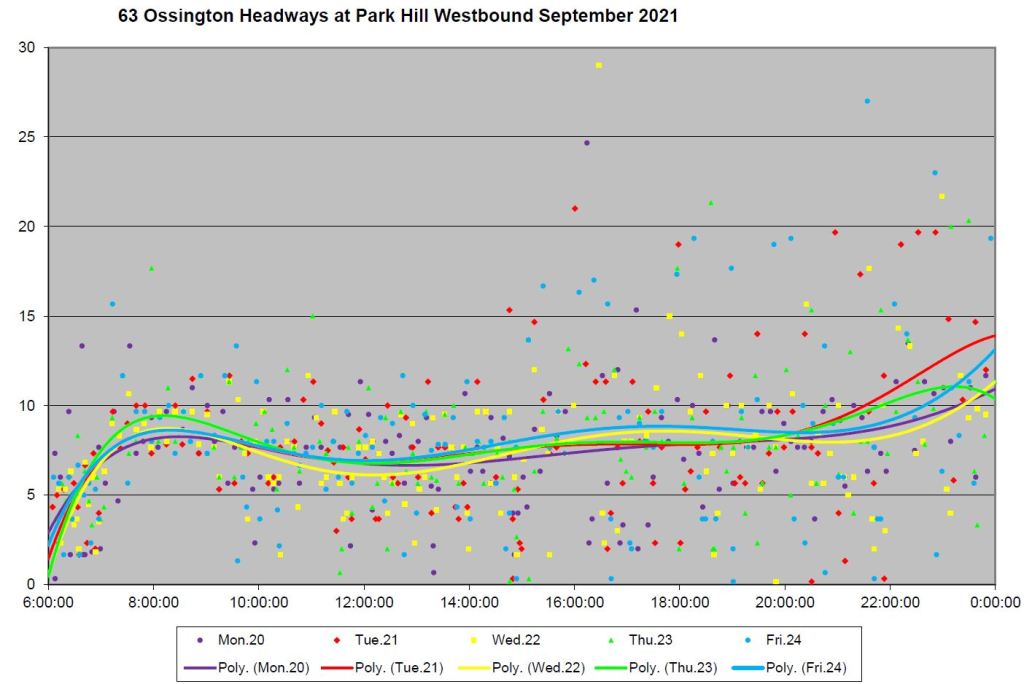
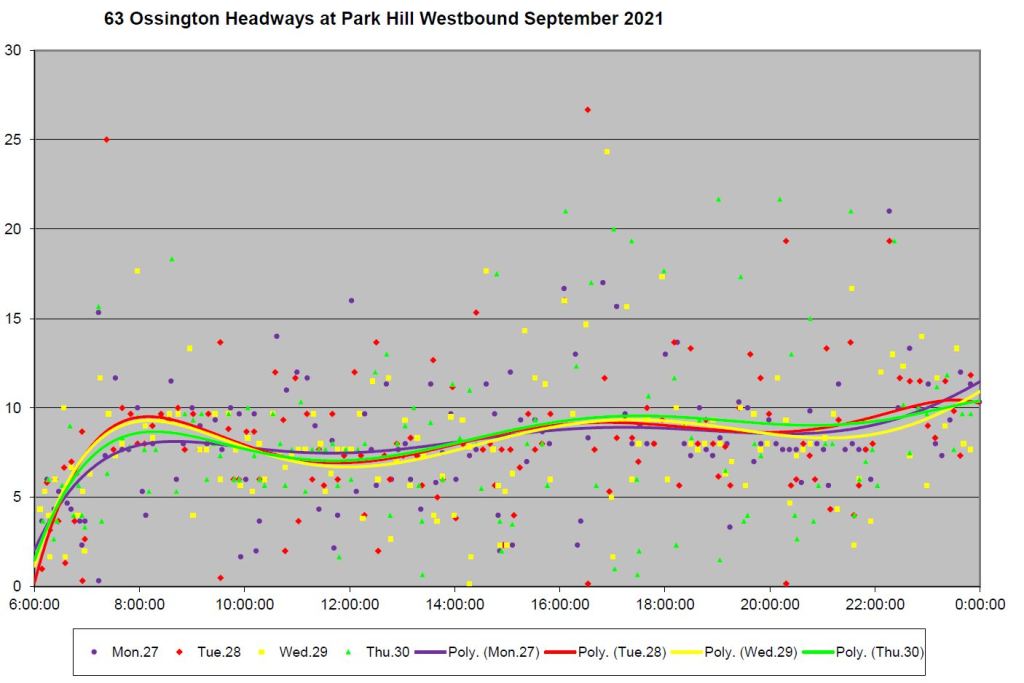
63 Ossington has a similar scale to the 47 Lansdowne reviewed in the previous article in this series. Although the service is far from ideal, this route is better behaved than its neighbour, even though it is subject to severe traffic congestion at certain times near its northern terminal due to Line 5 Crosstown construction.

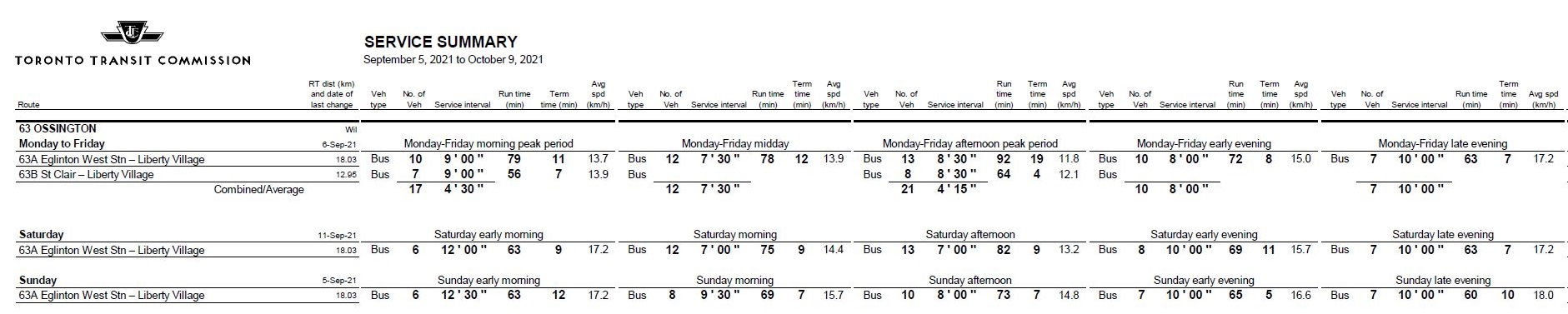
All service on 63 Ossington operates between Liberty Village and Eglinton West Station except during peak periods when half of the service turns back at St. Clair via Oakwood Loop.

The schedules were changed on Labour Day weekend, and so data shown here for the first week of September reflects the old schedule, while from Sunday, September 5 onward, the new schedules were in effect.

In most cases running times have been trimmed although in a few periods they have been lengthened. These changes allowed more frequent service to be scheduled without adding buses to the route. This is a reversal of past TTC practice which has seen headways widened as a way to provide more running time at no marginal cost.

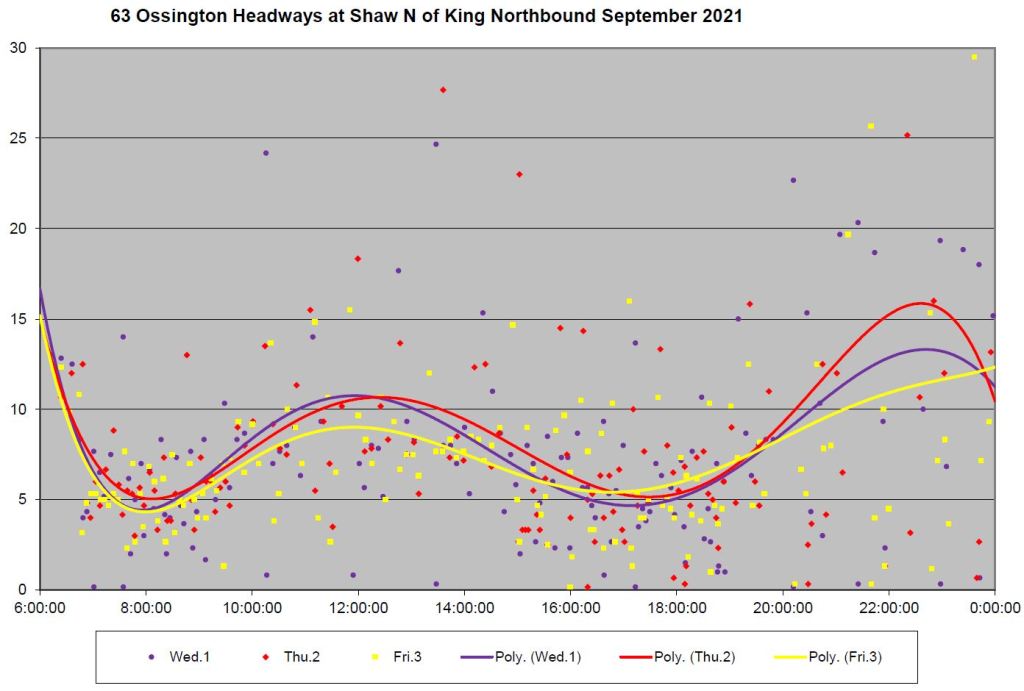
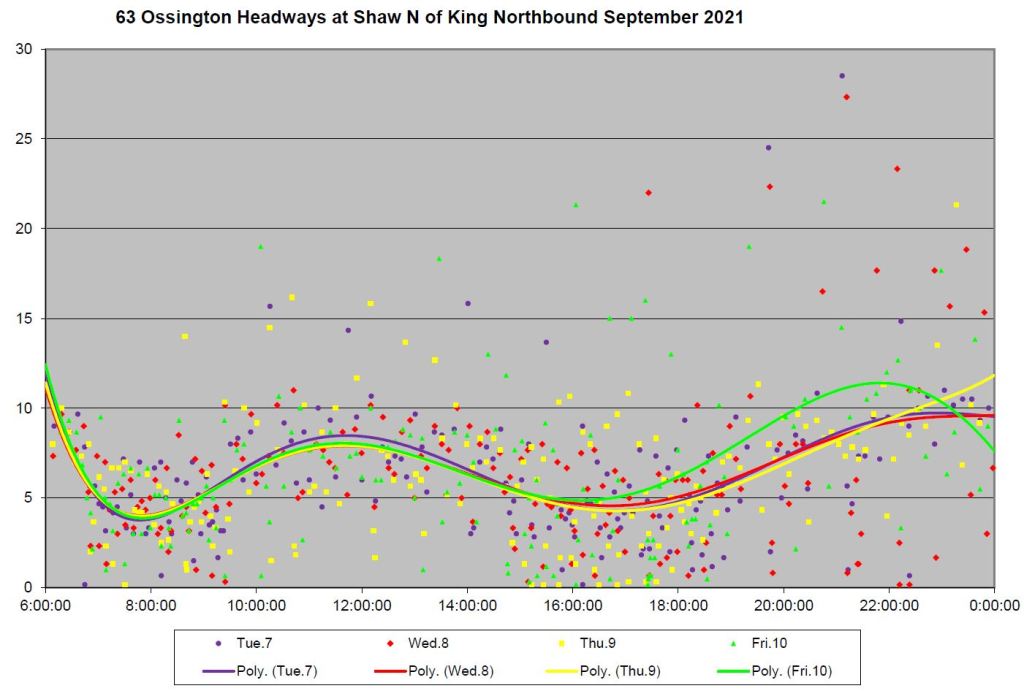
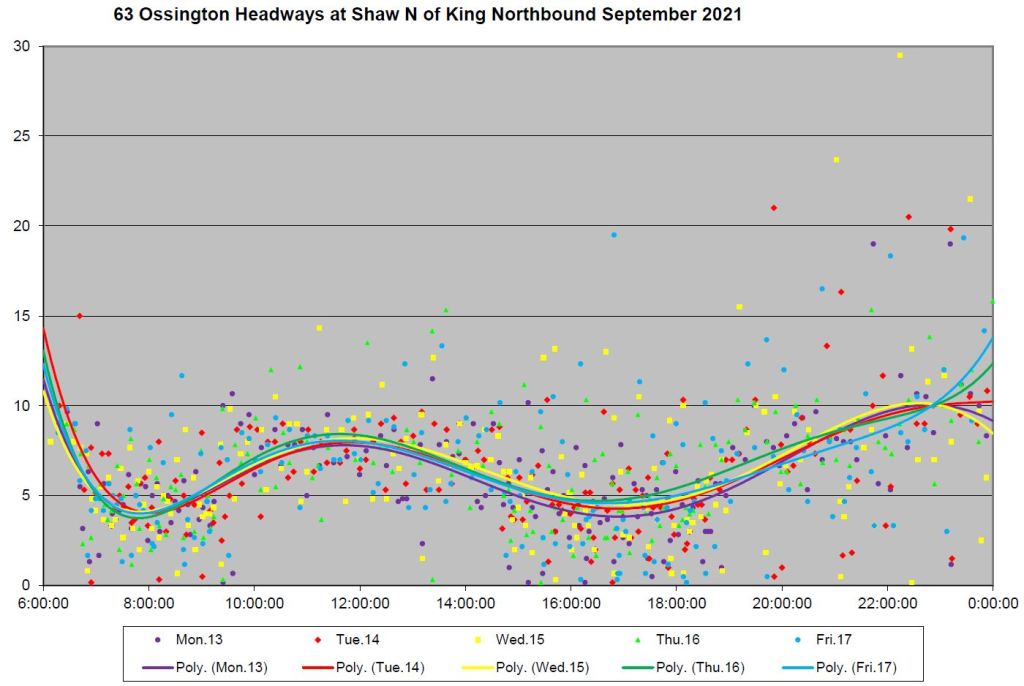
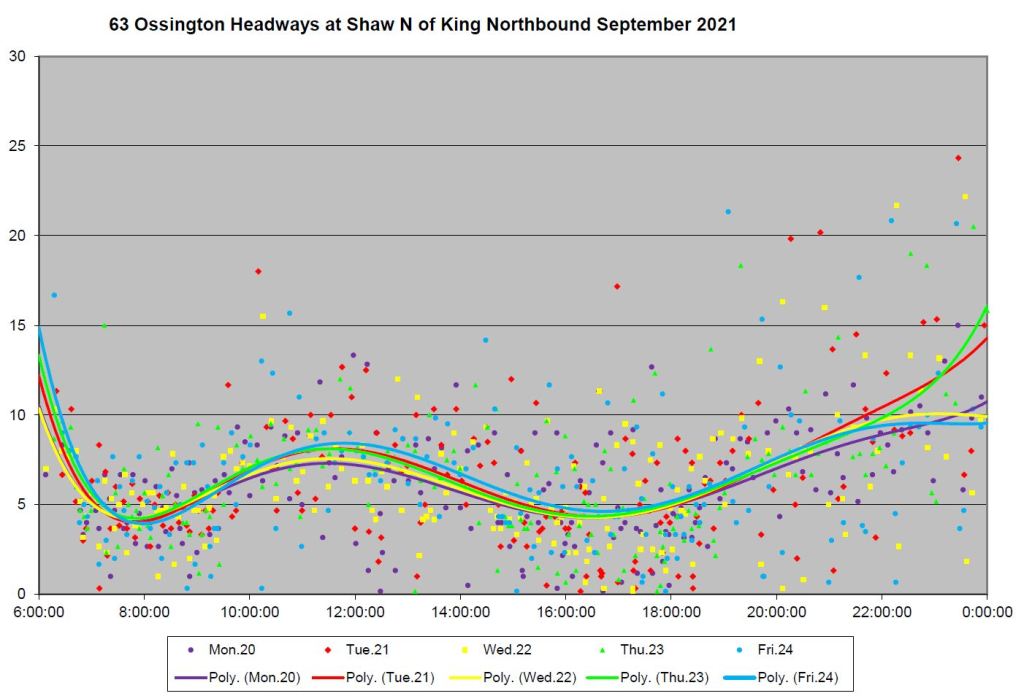
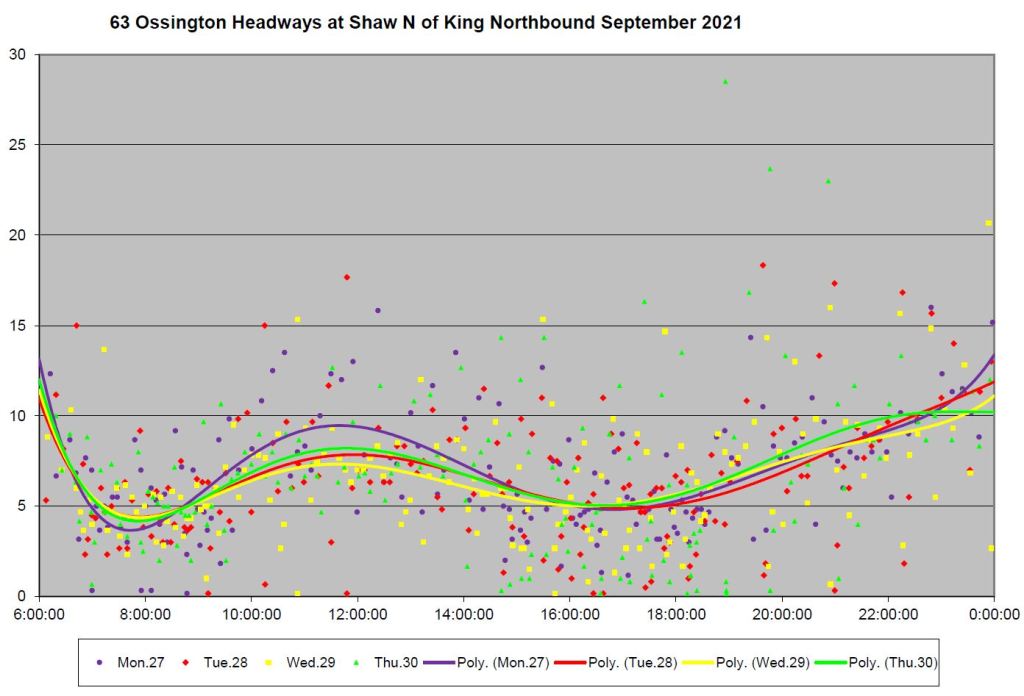
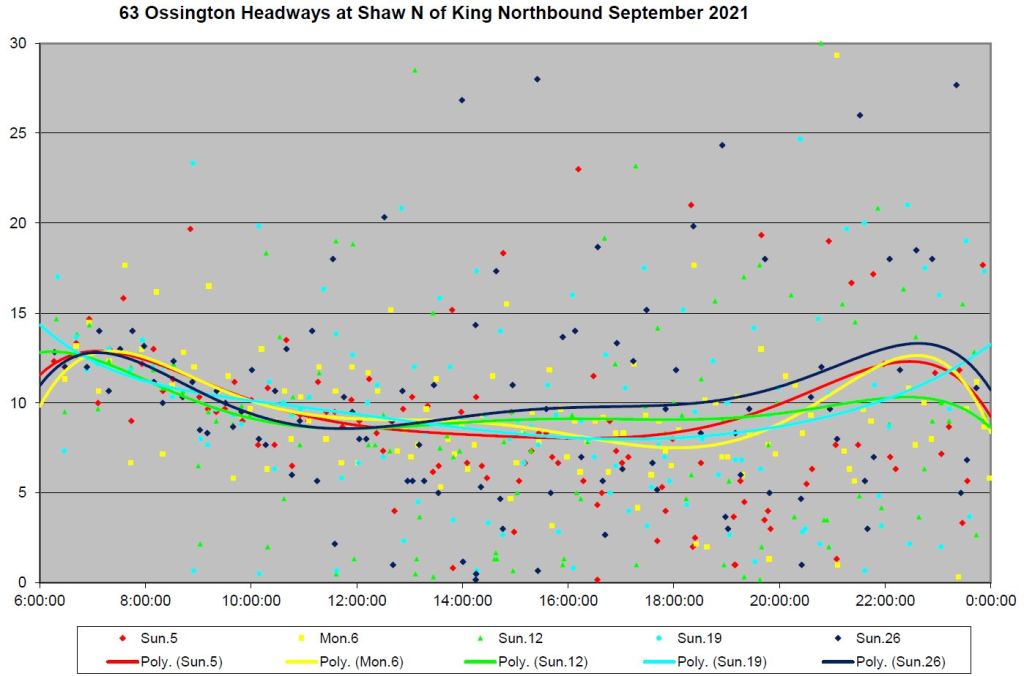
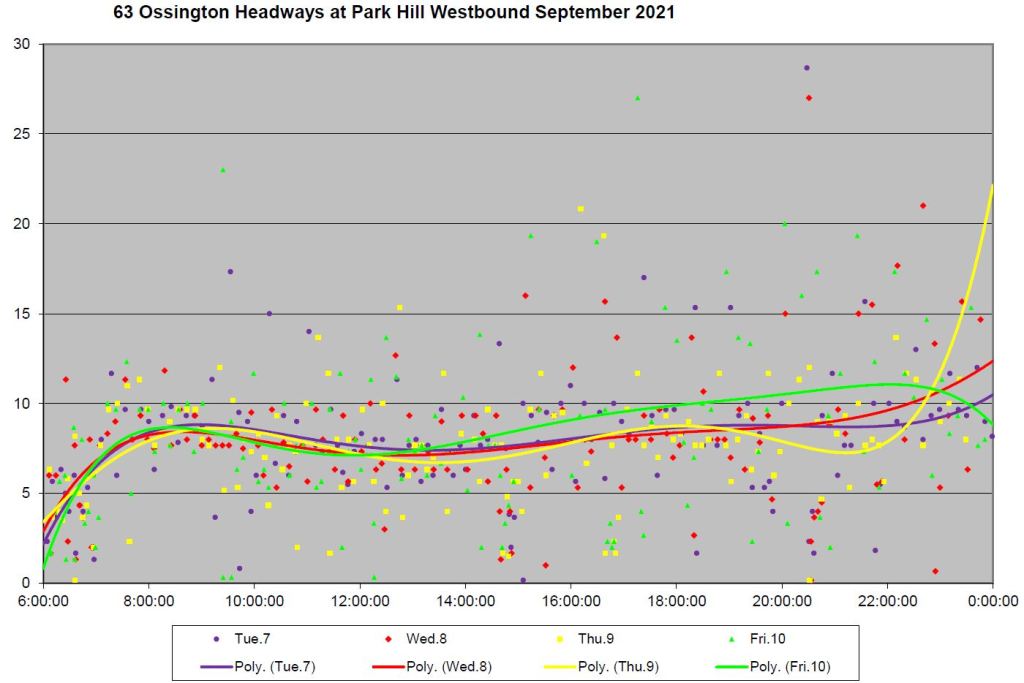
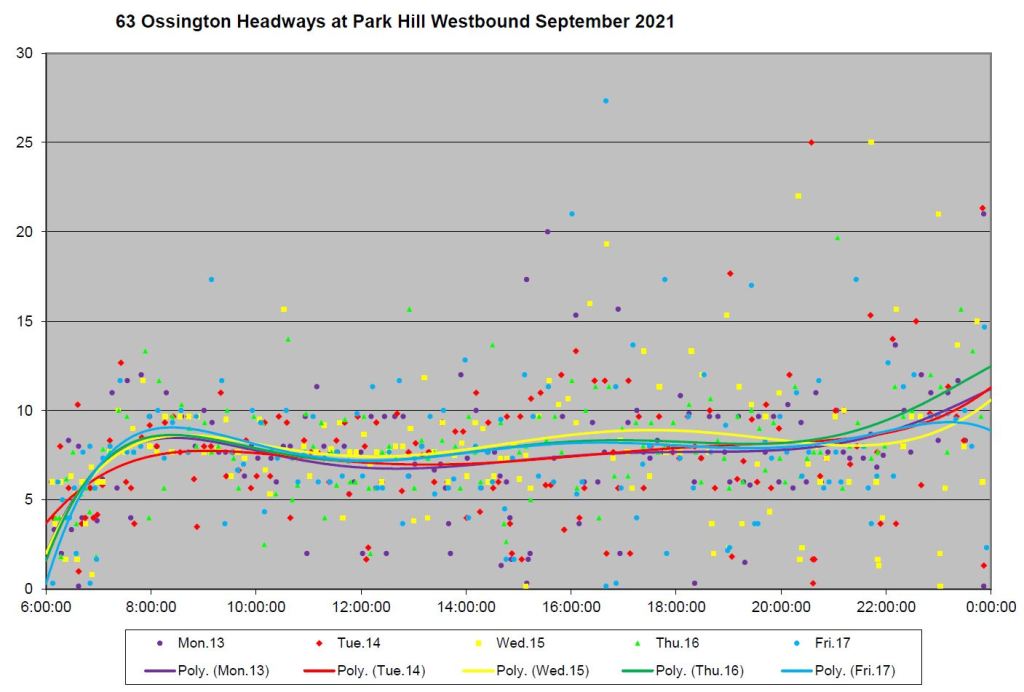
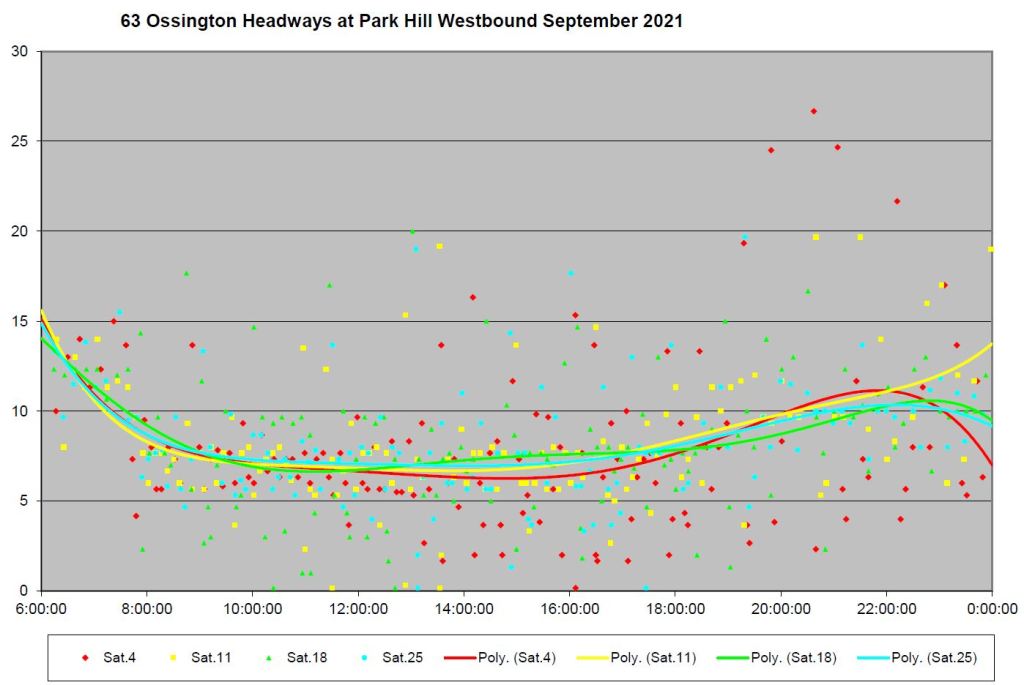
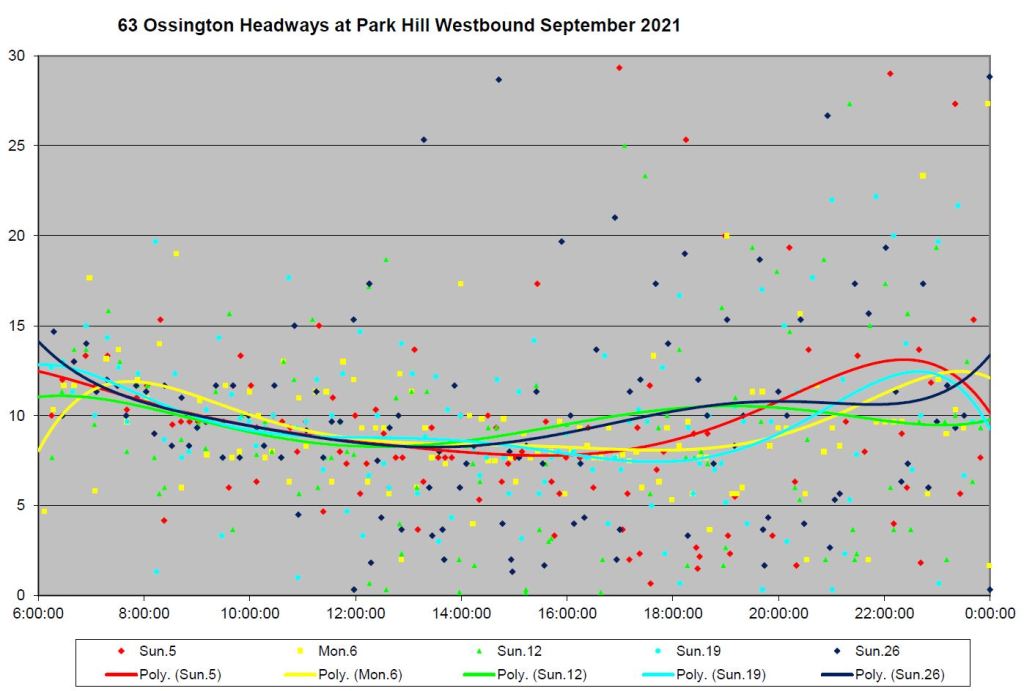
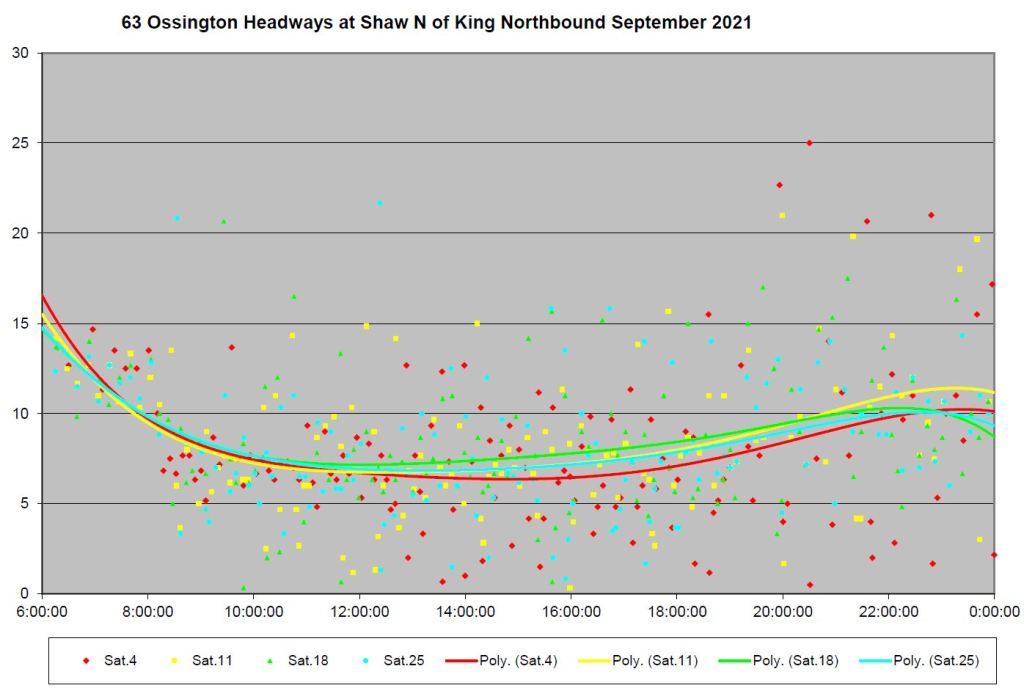
The TTC’s goal for “on time performance” is a band six minutes wide (+1 to -5 minutes relative to schedule), and in some periods, much of the service lies within this band. Nonetheless, on headways ranging from 5 to 10 minutes, bunching is possible and shows up regularly with data points near the x-axis of these charts. Wide gaps, especially at evenings and weekends, are common.

Unlike Lansdowne, this route has no branching structure during most of its operation, particularly when headways are wider. Also, as we will see later in the daily analyses, the congestion at Eglinton West Station occurs mainly during the pm peak, and buses have enough running time that they can take layovers there even after being stuck in traffic approaching the station.

Northbound from King

At the south end of the route, buses operate around a long on-street loop through Liberty Village. Their typical layover point is on Atlantic Avenue northbound south of King Street. The screenline used for these analyses is on Shaw Street just north of King where the loop begins.

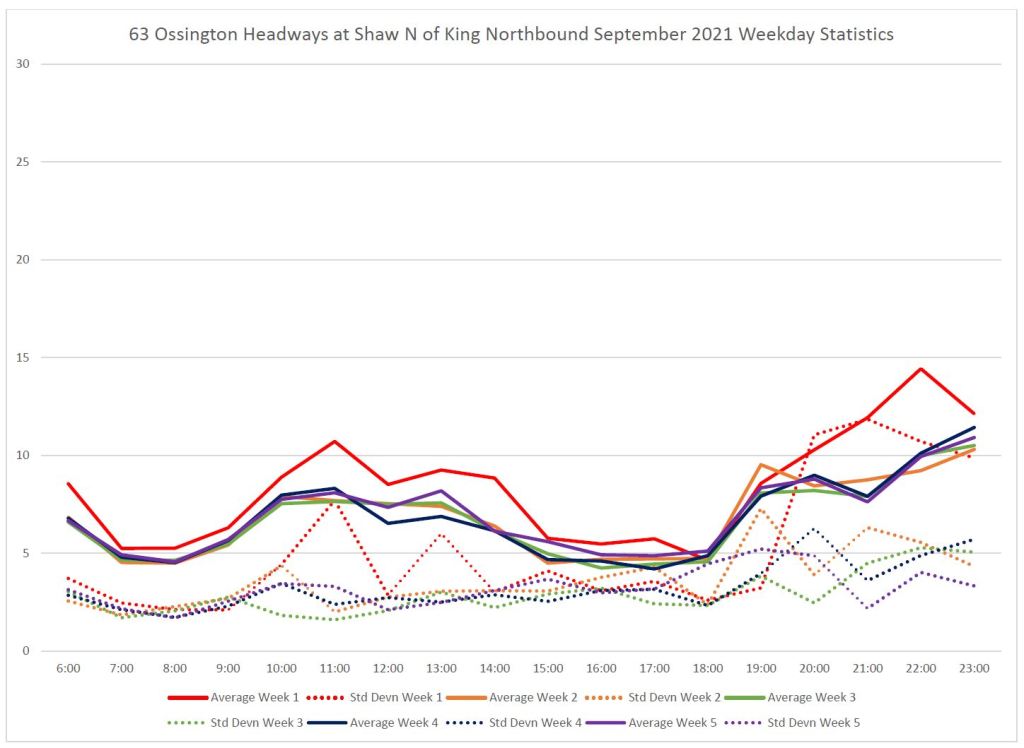
The weekly headway summary and the week-by-week charts show the schedule change with the shape of the weekly averages and daily trendlines.

Weekend data points are far more spread out than weekdays showing a very different approach to service management (assuming that there is any) especially on Sundays.

Southbound From Eglinton West Station

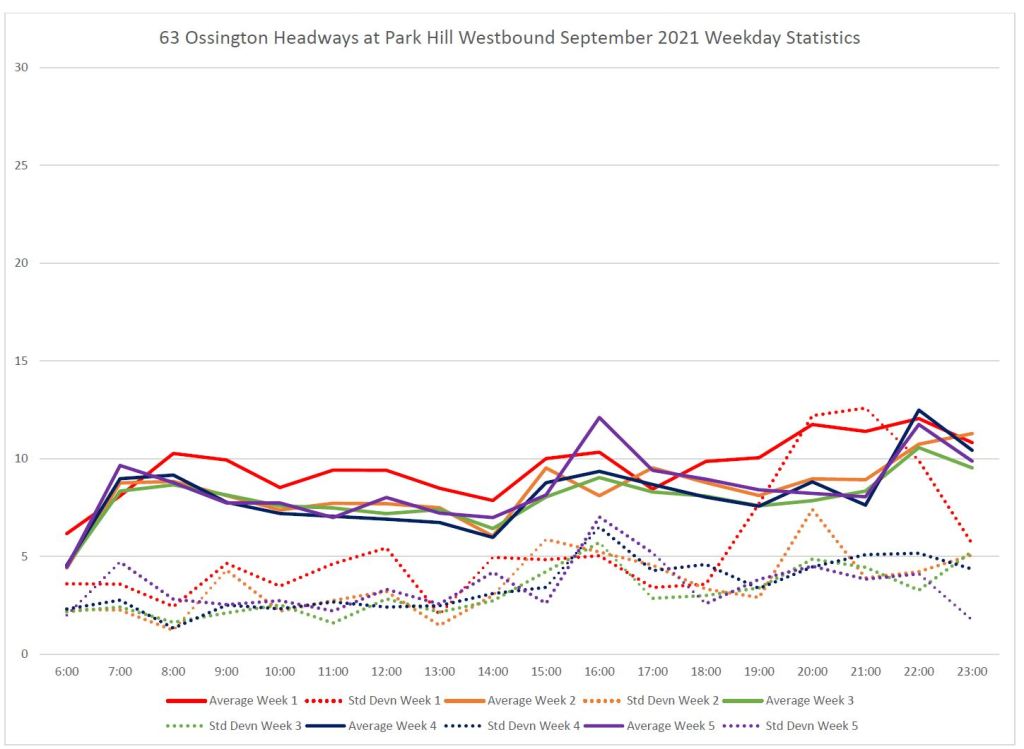
The screenline for these charts is at Eglinton & Park Hill Road, just west of the Allen Expressway. By contrast with the data at the south end of the route, weekday headways here are more scattered, especially in week 1. The standard deviation of headways begins the day in most weeks at about 3 minutes, but rises in the afternoon and evening as service reliability declines. The SD values at Eglinton West are generally higher than at King reflecting the wider scatter in headway values.

Southbound from St. Clair

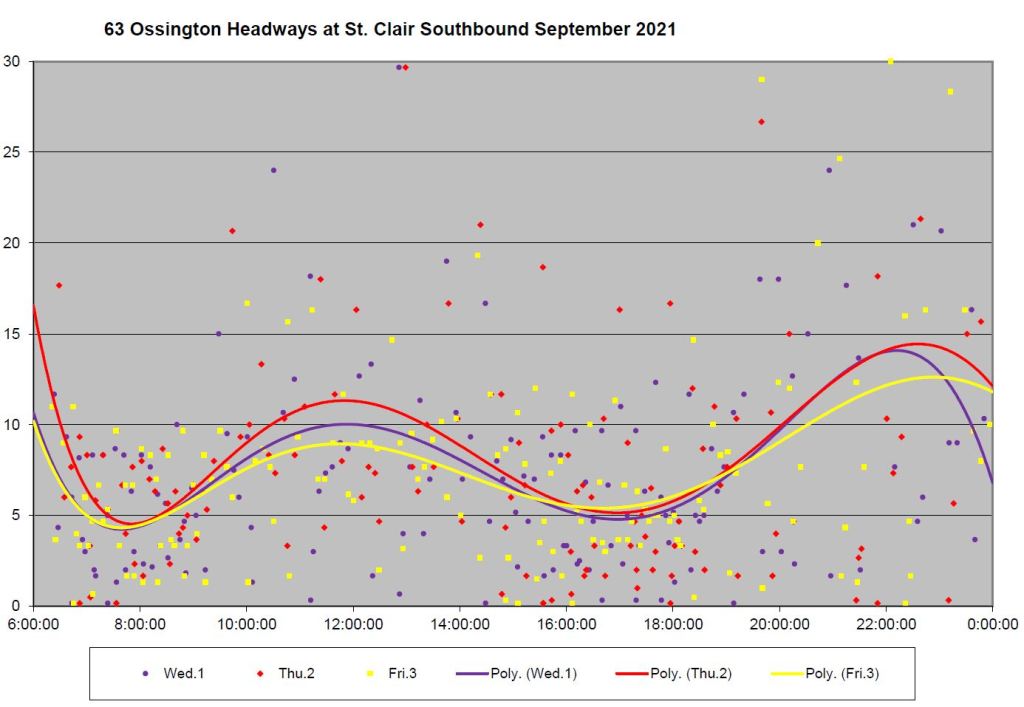
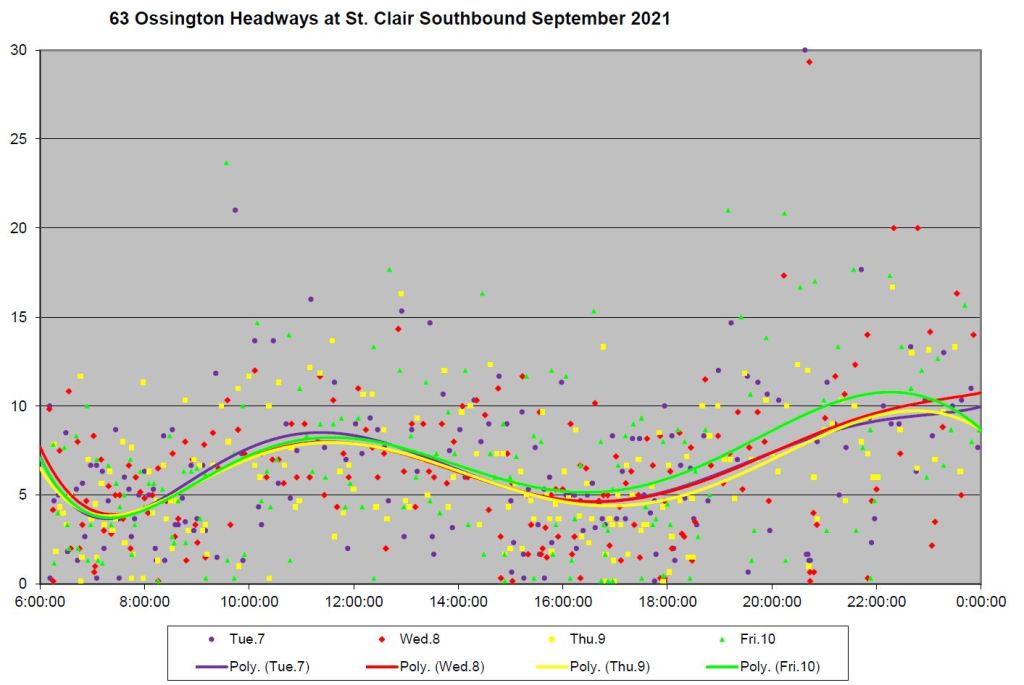
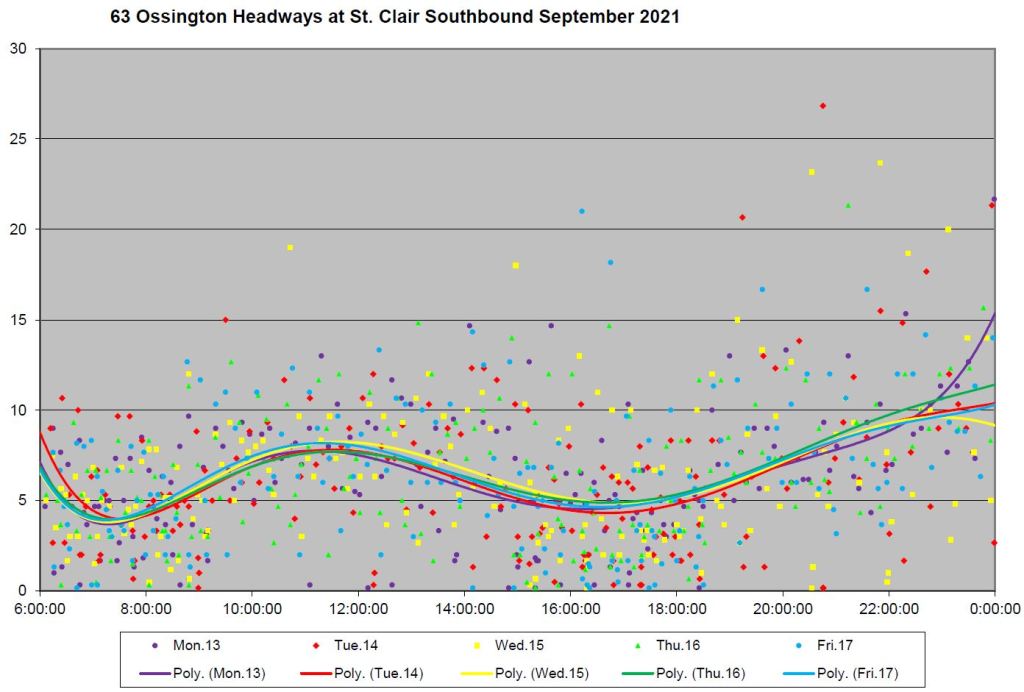
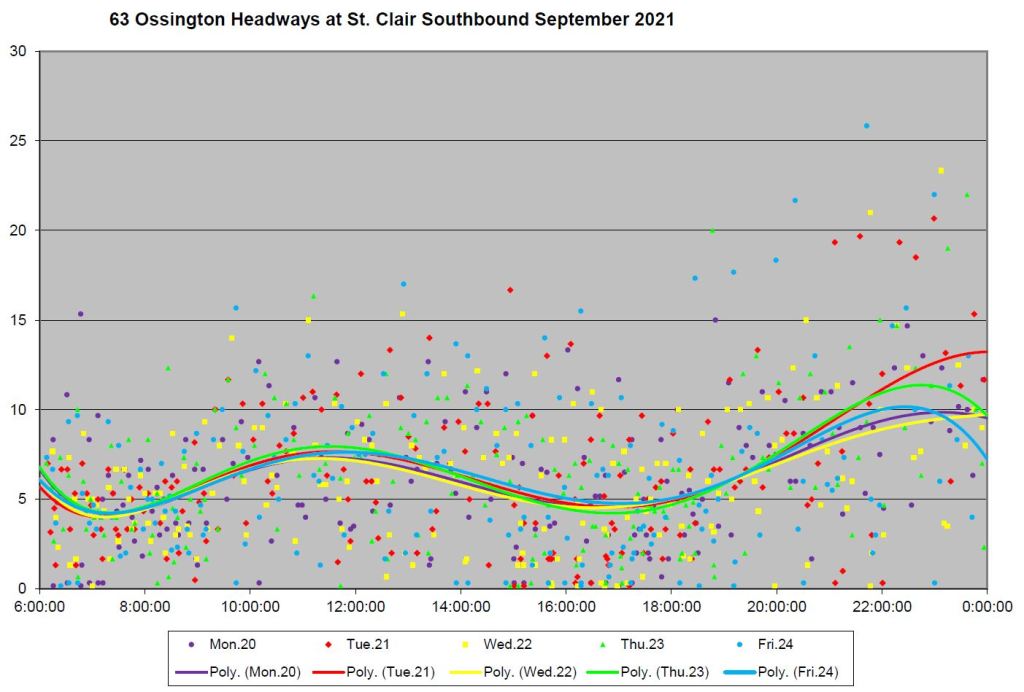
These charts are included for weekdays to show the combined 63A and 63B peak service southbound from St. Clair. With all of the service present, the headways are shorter during peak periods, and far more of them are quite short indicating that buses from the two branches probably run in pairs a lot.

Continue reading

The TTC’s New Website

Updated December 10, 2021 at 10:30pm

For ease in finding recent updates, they will now be colour coded in red as in the line above.

On October 23, 2021, the TTC’s new website went live.

The old site can be accessed on the Internet Archive. (Note that parts of the site such as schedule lookups do not work because they are not archived, and other archived pages are a tad long in the tooth.)

I have already flagged some issues with it to the TTC, and I am sure regular readers will find others.
An important reference page for readers who take photos on the TTC is under a “Doing Business With the TTC” linked from the footer on each page. It is vital for dealing with obtuse TTC staff who think that photography is not allowed on the TTC. It is banned “for commercial purposes” under section 3.17 of TTC Bylaw Number 1, or more generally if it interferes with “with the safe and orderly operation of the transit system and/or our customers”.

Major Outstanding Problems:

  • There is no search function. If you don’t know where something is, you may never find it.
    • October 25: The TTC advised: “We have disabled search deliberately until our site is indexed by search engines. This process can take a couple [of] days. When a website first launches, the pages need to be indexed (found) by search engines.”
    • Updated November 16: Attempts to locate TTC reports through Google generally do not bring pointers to the new website. It is possible that Google does not “chase” links through the dynamic menus that populate lists of meetings and reports.
    • Updated December 10: The TTC has populated its sitemap.xml file (a file that explains the site’s directory layout to search engines) with pointers to individual meetings, but some of these are dead links because the meeting date (and hence the URL) was changed. It appears that the sitemap file is not being maintained, and this will lead to drift between what is on the website and what search engines can locate.
      • Although there is an entry for the December 8, 2021 Board meeting, searches for reports on the agenda on Google bring no hits on the TTC’s site. Conversely entries on my own site are indexed within hours of publication because WordPress actively announces them.
  • There is no redirection for the many broken links that will now be encountered as people click on search engine results and links from any website pointing to a TTC article, report, etc. There is not even a website map to give a hint where things might have moved (if they are there at all).
  • Added November 21:
    • There are many posts under the Service Changes page dating from October 2021 that have been modified or reversed by changes effective November 21.
    • All of the November 21 changes are included in a single, long post that is not linked to any of the affected routes.

Other Outstanding Problems

  • There is a page for the 5 & 10 year service plan and outlook, but it is out of date with content from 2019. The 2022 plan has its own page.
  • Myttc profile problems:
    • The ability to subscribe to alerts for all routes has been removed.
      • New routes (e.g. various 9xx express bus routes) and those that have been renumbered (e.g. Bay and Avenue Road) must be manually added to the subscription.
    • The “delete a route” function (garbage can beside route names in the edit dialog) does not work.
    • Some streetcar routes (5xx) are listed in both bus and streetcar route dropdown selections.
  • Route map problems (reported by reader Jelo G. Cantos):
    • 913 Progress Express shows the pre-Feb 2021 routings. (Also flagged in a comment by Austin J)
    • The 938 Highland Creek Express map and description are not shown in the website.
    • 129 McCowan North and 167 Pharmacy North have shown the older maps.
    • Some routes that have connections with the 60 Steeles West did not update to include the 960 Steeles West Express.

Problems That Have Been Partly Fixed

  • December 10: Most of the 501 Queen issues listed below have in many cases been corrected, although the description of where the Queen streetcars and buses actually go remains out of date because of changes in recent days (with more to come soon).
  • It is not clear whether the absence of links to multiple related articles was fixed manually, or if the site contains a mechanism to automatically populate such links as articles are added or removed.
    • November 16:
      • There is a problem which, in part, was carried over from the old site where notices related to the same route appear on different pages, and they are not necessarily consolidated as links from the pages for affected routes. They could be found under:
      • Construction notices
      • Mode-specific Service Advisories (Bus, Streetcar, Subway)
      • Service Changes
      • Service Alerts
  • There was no map nor route description for new express services 943 Kennedy and 968 Warden.
    • As of October 26 at 7:45am, a map for the 943 has been added.
    • As of October 27 at 9:10am, a map for the 968 has been added.
    • November 16: This point is, for now, moot as these services will be suspended after November 21.

Problems That Have Been Fixed

  • December 10, 2021: The Major Projects page is buried several layers down, but is intact.
    • October 26 at 6:10pm: The following pages formerly linked from a “Major Projects” page have vanished:
    • Bloor-Yonge Station expansion
    • Line 1 ATC (There is a summary page about ATC, but this was migrated from another part of the old site.)
    • Line 1 Capacity Improvements
    • Line 2 ATC
    • Line 2 Capacity Improvements
    • New Western Yard
  • December 10, 2021:
    • The text for future meetings now simply says that the agenda is not available.
    • Added November 22:
      • Agenda pages for future meetings contain the text “The meeting agenda will be made public approximately prior to the meeting date.” This has been a problem since the new site went live. The page gives no indication of when the agendas will actually be posted.
  • November 16, updated November 22:
    • Various pages linked from the Service Advisories page might or might not work. Sometimes, all you get is an animated (and very large) “spinner”. Other times you will get a list. This problem also can affect pages that return lists of meetings, and it even appears to have baffled the Internet Archive on occasion. This appears to be a generic problem with list-based pages.
    • Added November 22:
      • The problem with list-based pages stalling on a “spinner” appears to be cured, but until I have not encountered this for several days, I will treat this more as good luck than an actual fix.
  • November 16: There was no diversion/construction notice for changes to the 501 Queen route downtown or in the east end, only for the work at King-Queen-Roncesvalles.
    • The information on 501 and related route diversions is now scattered across various pages under construction, service advisories, service changes and service alerts. These are not all linked to the description/schedule page for route 501, and riders who look only at that page would not know of most of the ongoing work on this route.
  • As of November 22, the following pages related to the Queen car exist. In effect, new pages have been going up for specific changes, but old ones remain in place. Only the second of five items listed below is tagged for inclusion in outstanding service advisories on the 501 Queen schedule page. Riders looking for schedule information will not see most of the notices, current or otherwise.
    • Under Service Advisories – Streetcar Service
    • Temporary route change:
      • This shows the east end Queen bus replacement, incorrectly, and the Bathurst to Dufferin diversion correctly.
    • Temporary route change:
      • This shows the east end Queen bus replacement correctly.
    • Under Construction Notices
      • This is an extremely out of date page about the KQQR project.
    • Under Service Changes
  • The agenda page for the most recent TTC Board meeting (September 15) was listed with “past meetings”, but claimed that it has not happened yet.
    • On October 25, the TTC advised: “We are aware and are looking into this and will correct it this week.”
    • As of October 26 at 7:45am, this has been fixed.
  • The Daily Customer Service Report was for September 16, 2021.
    • As of October 26 at 6:15pm, this page is now current.
  • Three pages which I thought have vanished are now listed under the “Transparency” page, although their content was out of date. Updated pages were online when I checked on October 27 at 9:10am.
    • The Planning page with various stats, service summaries, etc. (The most recent service summary was from November 2019)
  • MyTTC:
    • The password reset page included the text “Verbiage for reactivation!” where one would expect to find instructions.
    • As of October 26 at 7:45am, the list of routes subscribed to is now in ascending order with no duplicates.
  • The map for 121 Esplanade-River still reflected the old Fort York-Esplanade configuration. However, the schedule data did show the correct stop list, or at least the list as it existed before the recent route change due to one-way stretches on The Esplanade.
    • As of October 26 at 7:45am, the map has been updated, but the route description has not.
    • As of October 28 at 2:30 pm, the route description has been updated.
  • I attempted to submit a collection of problems via the “Suggestions” form on the Customer Service page, but it threw up a “Forbidden” error when I clicked on “submit”. TTC advised on October 26 that they are receiving the submission in spite of the error message. As of October 27 at 9:25am, this function appears to work with a shorter submitted text, but there is no indication of what the limit/problem might be.
    • November 16: Suggestions still fail with a “forbidden” error if a long text is submitted.
    • November 22: A long suggestion was successfully submitted.

These problems suggest that the old site was ported over about a month ago and did not pick up recent updates except where they are dynamic (e.g. schedule information).

I hate to say this, but the website migration is precisely the sort of thing I expect from an organization dedicated to “customer service” in name more than substance.

Maybe it will win an award, just like their last website did in a “contest” where sites and developers could nominate themselves, and there were so many categories, it was almost impossible to lose.