The Mysteries of TTC Subsidies (Update 2)

Updated at 3:20 pm, September 7: Metrolinx wrote pointing out that there is a ten-year cash flow for the “5-in-10” Transit City projects.  It is at pages 25-26 of their presentation[Note that Metrolinx has fouled up its website, and their presentation is no longer visible.  The link here is to the two-page cashflow taken from their report and posted on my site.]

Updated at 10:00 am, September 7: The section on funding of Transit City lines has been clarified to distinguish between announced and suspected funding strategies.

Updated at 10:40 pm, September 4: A small section has been added near the end about the problem of creative project descriptions and their effect on capital planning.

Politicians love to claim that other people don’t know what they’re talking about.  Even transit commentators and activists like me say this sort of thing, but the pols tend to be more aggressive in their tone as they play for media and public attention.  Reading the source material helps, but it can be a long slog.

As a service to my readers and would-be transit financial analysts, here is a review of how TTC subsidies work.  The primary source material for this article is the draft audited financial statements of the TTC for 2009 which were published in May.  They are “draft” only in that, when published, they had not received formal Commission approval which has subsequently been given.

A journalist whose bluster is greater than his accuracy recently implied that the TTC was hiding its financial results when in fact they have been available for months.  This sort of thing passes for penetrating analysis in some quarters.

Continue reading

Buses vs LRT: “And”, Not “Or” (Updated)

Updated September 6, 2010 at 4:50 pm:

Anna Mehler Paperny of the Globe and Mail writes about the difficulties of getting around on a bus network where service leaves much to be desired.

The better way? Don’t get Janet Fitzimmons started.

The East Scarborough resident lives less than five kilometres from her work in the Kingston Road-Galloway Road area. But the bus ride takes a good 40 minutes – once the Lawrence Avenue bus comes, if it isn’t full. If the weather’s nice, her commute is faster by foot.

“But I’m lucky: I’m able-bodied and healthy.” And, she adds, “my commute isn’t bad for Scarborough.” A colleague of hers takes three buses to traverse what’s barely a seven-kilometre direct trek.

Meanwhile, Tyler Hamilton of The Star tells of the travails of attempting to use service on Kingston Road in The Beach.

Last Tuesday I needed to head downtown – Bay St. and King St. – for an event. […] It was rush hour. I seemed to have plenty of time, so I decided to take the 503 Kingston Rd. streetcar route. Checked the schedule. Walked to my stop and arrived what I thought was 10 minutes early.

No streetcar. Twenty minutes later, no streetcar.

This is rush hour, remember. Finally a bus that would take me along Queen St. arrived and the driver encouraged me to get on. “The 503 won’t be coming. Take Queen St.,” he says. “It will get you close. Hop on.”

I hop on. A man sitting across from me leans over and says, “TTC, eh… it means take the car.” I offer a forced chuckle. The bus drives along Kingston Rd. for five minutes and then reaches Queen St. “Time to get off,” the driver says. Huh? I join a herd of passengers exiting the bus. Apparently I should have known about transferring onto a Queen St. streetcar.

Confused, I wait. I wait. I don’t see a streetcar. I see a cab. Hail it. It will be worth the $20 at this point – enough money, mind you, to drive half a month in my Honda Civic.

I share my frustration with the cab driver. “The TTC is good for the cab business,” he replies with a smile.

Of course, a regular rider would know that there is no such thing as a 503 car, at least not until September 7 when streetcar service returns to Kingston Road.  The scheduled bus service is every 12 minutes on the 502 and 503 providing a supposedly blended 6 minute headway.  Take the first thing that comes along if you’re going downtown.  If it’s a 502, change to the King car at Broadview if you want King rather than Queen Street.  This is the sort of survival tip a regular will know, but a novice won’t.

By the way, the streetcar services will run every 15 minutes, with an allegedly combined service of 7’30”.  Don’t hold your breath.  A big problem with both of these routes is that they are short-turned and wind up missing the very customers they are intended to serve.

Add to this the appalling off-peak service and you have a recipe for driving away customers.  The 502 bus or streetcar is scheduled every 20 minutes, but only a few days ago I waited 36 minutes for one to show up.  I had not just missed one, and so the gap was easily over 40 minutes.  By the time we reached Queen Street westbound, we had a light standing load even on that wide headway, and we had also passed two eastbound 502s.  That’s right:  3 of the 4 buses on the route were east of Coxwell.  This is called “line management”.

The real irony is that the 12 Kingston Road bus comes and goes at Bingham Loop every 10 minutes.  There is better service east of Victoria Park than west of it on weekdays.  Evening and weekend service on the 22A Coxwell is better than on the 502.  This is one of the few places in the TTC where weekday service is worse than at any other time, and that’s assuming the weekday service is vaguely on schedule.

An important part of improving bus services generally is that the TTC must stop thinking of the outer parts of lines as places where short turns and unpredictable, infrequent service are acceptable.

Continue reading

What’s a Fair Share?

The question of a “fair” allocation of TTC revenues between the farebox and subsidies comes up quite regularly, often at budget time, but now also in the election campaign.  Some argue that the riders don’t pay enough, while others argue that they pay too much.  Rarely does anyone look at the detailed figures.

The TTC publishes a statement, as part of the Chief General Manager’s more-or-less monthly report, showing a breakdown of revenues and costs.  The report linked here takes us to the end of May 2010.  (There are separate accounts for Wheel-Trans which is not part of this discussion.)

There are three sets of figures:  data for the current 5-week period (this interval is used to avoid variations due to lengths of months), year-to-date data, and full-year data.  These are further subdivided by actual and budget values.

On the income side, the total 2010 revenue is projected at $957.515-million against expenses of $1,412.034-million.  However, within the revenue, only $905.200m comes from the farebox, while $52.315m comes from other sources.  Charters and services operated under contract for transit systems in the 905 are on at least a break-even basis.  Although the expense of running them appears as part of the system’s total, this expense is completely offset by revenue (projected at $17.675m for 2010).

On the expense side, the total cost for subsidy purposes is reduced by two deferred items:  post-retirement expenses and accident claims.  These do not require cash outlays in the current year because they not be paid until future years.  This gets us to a net cost for operations of $1,368.684m and a projected shortfall of $411.169m.

The City has actually budgeted for a shortfall of $429.805m, but the TTC’s ridership and fare revenue held up better than expected in 2010, and the City’s full subsidy provision will not be required.  Any leftovers remain under the City’s control for year-end budgetary adjustments.

Continue reading

Catch The Spadina Bus While You Can

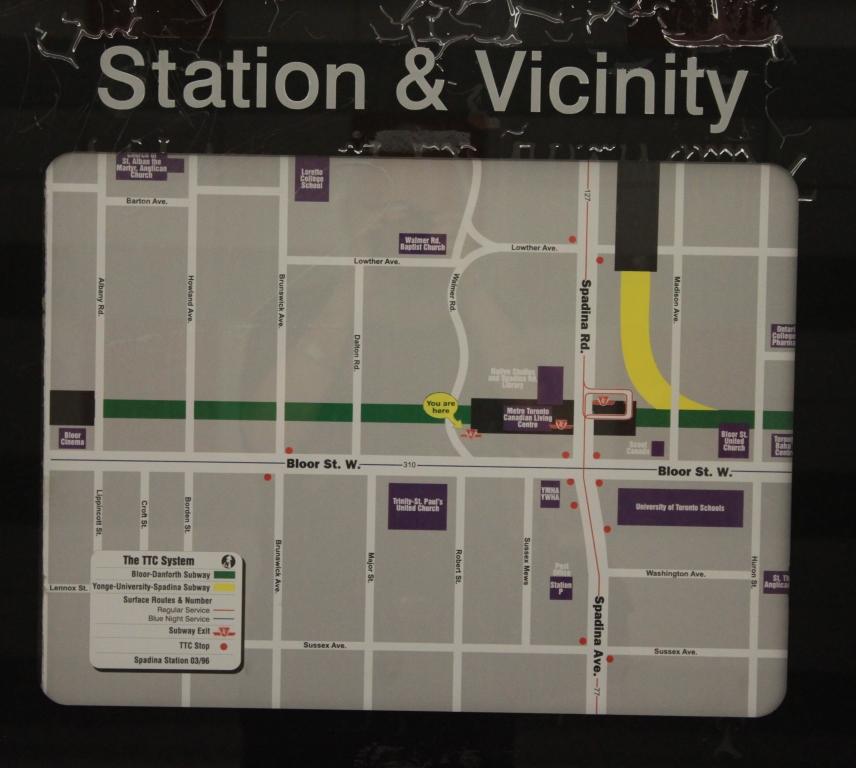
Some time ago, I wrote about the haphazard way in which station vicinity maps were replaced (never mind their content).  There are a few spots in the system that time forgot, and, while it lasts, I thought to bring you a map from before July 1997 when the 510 Spadina car began operation.

This is one of the older style of maps, back when the TTC actually put connecting surface routes on them.  If you look closely, you will see that Spadina south of Bloor is served by route 77.  The date on the map is “03/96”.

The “You Are Here” pointer gives away the location — the Walmer Road exit from Spadina Station.  This was built as part of the reconfiguration of Spadina Station to accommodate the LRT line.  Oddly enough, the route map right beside it is recent enough to include the Spadina car.

Another version of this legacy map at the bottom of the stairs from the west side of Spadina has been replaced with the new version.

Elsewhere in Spadina Station, a poster still advertises the August subway diversions for construction at St. George.

The TTC’s Visitor Centre (Updated)

Updated August 25 at 6:15 pm:

The function of a Transit Visitor Centre really needs to be understood.  A “museum” and a “visitor centre” are not the same thing.  The recent Customer Service report suggests that the TTC place information kiosks in major subway stations.  Putting info where there are actually people may be a radical concept, but it is clearly the approach needed to make “information” broadly available.  A tourist should not have to travel to Yonge & York Mills for info about how to get around the city.

There is a parallel desire for a “Museum of Toronto”.  While that project, too, may be hobbled by a lack of funding and political interest, that’s the place any exhibits looking at the TTC’s history and role in city development should go.

A major concern with the museum is the availability of space.  However, the proposed design consumes a considerable amount with static vehicle displays (although one of these is used for a theatre) and creates design problems for the new Head Office due to structural loads.  An alternative location was rejected as having insufficient space (not to mention higher cost), but the new design promptly eats up space for vehicles that might otherwise not be needed.

When Council approved exploration of this project, it approved less than $100K to finance the work.  However, the TTC actually spent about four times as much, and is now shuffling money between accounts to cover the shortfall.  This is an example of the kind of budgetary sleight-of-hand that a proposal now before Council seeks to end.

The museum as a project needs to stand on its own merits and be seen in the context of a wider museum of Toronto.  It is unclear why this project should be entirely financed by donations when other City museums receive municipal support.  That’s only a ruse to allow this project to continue without attracting attention to funding needs.

My original post on this issue from August 23 follows the break.

Continue reading

Service, Courtesy, Safety (Part I)

Since 1954, the coat of arms of the Toronto Transit Commission has proclaimed the slogan “Service Courtesy Safety”.  After the Russell Hill subway crash in 1995, safety and maintenance quality zoomed to the front of the pack.  Years of neglect, of saying “we can get by” on inadequate budgets, finally took their toll.

Much work has been done to restore a safety culture at the TTC, to the point where other important aspects of the operation were eclipsed.

The TTC hasn’t had the best of times.  Although last year’s civic workers strike was not a TTC affair, any municipal strike reminds voters of past job actions by transit workers.  By late 2009. the media were in a feeding frenzy looking for any stories to discredit the Miller/Giambrone administration.  The “sleeping collector” fell right into their laps, and became the lighting rod for a host of complaints about the TTC, its employees and its service.

In March 2010, the TTC created an independent “Customer Service Advisory Panel” to examine a range of issues, and that panel reported yesterday, August 23.  The full report is available here.

Reading through it, I was struck by many quite reasonable items, but also by a sense that parts of the document were an attempt at face saving.  Too many recommendations place the responsibility for change at the front line employee or even at the customer without acknowledging that the best employee cannot do a good job without proper support from the organization.  Management must not regard good service (in many senses of that word) as something they can’t afford.  Departments must not assume that “it’s someone else’s job” to deal with problems, or defend their turf against others while failing to provide good service.

To give TTC management credit, statements by Chief General Manager Gary Webster at the press conference, the Commission meeting and on an interview with CBC Radio were open in accepting the need for organizational change.  Yes, there are some proposals with significant costs attached, but many structural and procedural problems require only the will to change how the TTC does business.

Early in the report, the panel tells us:

[W]e were pleasantly surprised to learn that all of the TTC stakeholders are passionate about their transit system. Everyone, from employees to management to customers, truly wants a TTC of which they can be proud.  [p 2]

This should not be a surprise.  The TTC was once (as they so often told us) the envy of transit systems world-wide, a system of which the city could justifiably be proud.  But that was a long time ago.  Years of mutual back-patting among the TTC brotherhood coupled with declining financial support from governments of all parties were a poisonous combination.

If you’re perfect, it’s hard to admit that some of the lights are burned out, that the stations are getting dirty, that the trains are not maintained to quite the standards of “the old days”.  If you’re perfect, then your customer service must be ideal, a sterling example for others to follow.  Pride in the system was replaced with self-congratulation, with a view bounded by the mirror on the wall.

That desire for pride is worth remembering through the entire process.  We want to believe in the TTC, we want to show our friends (even those who think that the only way to get around is in a car) how good transit can be, we want people to say “have you heard what Toronto is doing”.  We don’t want excuses.

Another surprise for the panel was the rider expectations for TTC frontline staff:

Operators are expected to act as a tour guide, policy enforcer, fare collector, and custodian, while providing information, directions, and special assistance. All of this and much more is expected while, at the same time, they are to operate the vehicle in a safe manner – Paying attention to the road at all times, adhere to the speed limit despite a tight schedule, and practice defensive driving. And, above all, they must ensure that passengers arrive at their final destination safe, and on time. [pp 2-3]

This is a surprise? The next paragraph gives a troubling clue about the underlying thoughts:

[I]t is apparent that customers do not often consider the complexity of the huge system that operates in the background, day in and day out, to keep the TTC running. [p 3]

Yes, the TTC is large and complex, but it is by no means the largest system on the planet.  Many of them recognize the importance of good customer service despite their huge size.  They don’t depend on customers cutting them slack because the transit system is so large.  If anything, a big system should have a benefit of scale, of experience with complexity and change, that a small system might not encounter often.

Unfortunately, all the customers see is that the bus is late, or the operator did not effectively answer their questions. [p 3]

Exactly.  It is the view from the customer that’s important.  A guest in a hotel does not want to hear about the problems of repairing centuries-old plumbing, or of cooking huge dinner banquets, or of co-ordinating the unseen army of staff who keep the place running.  They want a clean, well-maintained room, elevators that work and service that is almost magically there without being asked for.

The report’s 78 recommendations are divided into eight groups.  A review of each of the 78 is not required to establish patterns, to see the underlying philosophy.

Continue reading

Regular Service Will Resume Shortly

For all of my regular readers who probably wonder why the flow of posts has dribbled to a trickle …

A combination of factors including a comparative dearth of news, the heat, a few short vacations and family issues have kept me from working as hard and regularly on this site as I prefer to.

In the pipeline are:

  • A review of plans for waterfront transit from the Don to the Western Waterfront.
  • A review (yes, finally) of Metrolinx’ Benefits Case Analsis methodology.  With the pending rework of “The Big Move” and the likelihood that many will seek justification for building or ignoring various transit proposals, any so-called methodology needs to be rigourous, defensible and well-understood.  The BCAs fail on at least two of these counts.
  • A review of the Customer Service Panel’s recommendations.
  • A recap of the TTC meeting scheduled for August 24.
  • A review of streetcar operations on Spadina for February, and for the full-length St. Clair route for July.  Both of these routes use reserved lanes, and the GPS-based data make detailed analysis much easier and revealing.
  • Later this fall, I will turn to the Carlton and Dundas routes, the only two for which I have not published operational reviews.

There is also, of course, the small matter of the coming election.

City Council Plans Improved Control Over TTC Budgets

The TTC’s operating and capital budgets are a major part of the City of Toronto’s overall budget, and a considerable amount of TTC spending is provided directly by Council.

In 2010, the operating subsidy will be paid entirely by the City with no contribution from Queen’s Park.  This subsidy will be about $420-million, and in the absence of a fare increase, this will rise to $500-million in 2011.  The final 2010 figure will not be known until the year-long effects of ridership growth and the 2010 fare increase are clear.  Notwithstanding repeated statements from Queen’s Park and various mayoral candidates, no operating subsidy flows to the TTC from the Province.

The capital budget is complex because there are many sources of subsidy.  Some of these are project-specific such as the contributions by Ottawa, Queen’s Park and York Region to the Spadina Subway Extension.  Others are intended to support a specific class of project such as security upgrades or vehicle replacements.  Still others are not earmarked, and these sources fund projects as needed.

In 2009, the capital subsidies totalled $742-million.  Of this, $333-million came from the City, $195-million from Queen’s Park and $208-million from Ottawa.  The remaining $6-million came from other sources such as Waterfront Toronto.  Gas tax revenues from Ottawa and Queen’s Park amounted to about $320-million in 2009, and of this, slightly more than half of the Provincial money was used as an operating subsidy.  In 2010, all of the gas taxes are going to the Capital Budget.  (For details on subsidy arrangements, please refer to the TTC Financial Statements for 2009.)

Whatever is left over after all of the external subsidies is funded by the City.  These monies are raised partly from debt and partly as “capital from current” in the City’s operating budget.

A critical problem going forward in capital planning for the City is that various funding programs at both senior levels are drying up, and Toronto will be left with only gas taxes and the cost sharing on Metrolinx projects.  This leaves the City open to a greater call for TTC capital in future years, a problem compounded by the growth in planned capital spending.  Recent announcements of Provincial funding for transit network expansion contribute nothing to ongoing capital requirements for system renewal.

In this context, proper control and oversight by the City over TTC budgeting is essential.  However, the TTC has a long history of operating as an independent agency managing its own accounts.  This may have been acceptable before the City was the TTC’s primary funder, but not today, especially considering the effect of unexpected changes in TTC financial results and requirements on the City’s books.

Continue reading