Toronto Contemplates Transit Funding / Reviews Transit Plans (Updated)

Updated October 9, 2012 at 5:30 pm

Toronto’s Executive Committee considered a report on transit funding mechanisms today.  In the following report, I have included only the most interesting or important of comments to give the flavour of the debate.

The proceedings were rather odd in that a presentation, cued up for City Staff, was never heard, but a “private citizen” managed to give a half-hour long deputation thanks to many friendly questions from Committee members.  That “citizen” was Dr. Gordon Chong, former head of Toronto Transit Infrastructure Limited, an all-but-bankrupt subsidiary of the TTC used to conduct a study of the Sheppard East subway extension for Mayor Ford.

Chong liberally drew on his transit experience including years as head of the Greater Toronto Services Board, a provincial agency predating Metrolinx.  Throughout his deputation, the highly misleading map of four cities’ subway system was projected to emphasize how little Toronto has done.  (That map purports to show how little Toronto has in comparison with London, New York and Madrid while ignoring the fact that these were much larger cities, much sooner.)

A “glaring omission” from the collection of transit plans in the staff report, Chong said, was his own Sheppard report and the information produced by KPMG about tax increment financing (TIF).  Chong clearly implied that the report was biased, but missed the fact that the Council motion directed the inclusion of “approved” plans for review, something Chong’s most emphatically was not.  As for TIF, it is mentioned, but rejected as a funding mechanism as staff argue that such revenue is needed for general support of city services and should not be earmarked just for transit capital projects.

Councillor Michael Thompson pursued the scheme of a Scarborough subway with a BD extension that would loop back along Sheppard to close the loop at Don Mills Station.  Chong replied that if Toronto could deal with the “money issue”, then there is no reason we can’t have the best in transit.  Thompson observed that a casino might bring in $75-100m annually and could fund transit projects.  The oddity here is that both treat any new money as a bonanza to be used for the best possible transit (where they want it) when fiscal conservatives might be expected to argue for careful husbanding of whatever loot might come their way.  There is also the small problem that the municipal share of projected revenue for a Toronto casino is probably an order of magnitude lower than the Councillor’s claim.

Various Councillors mused about a regional agency to dispense transit dollars and decide which projects should be built.  An underlying assumption was that, of course, the network of suburban Toronto subways would rank high on the list, and nobody seemed to contemplate that a 905-dominated agency might have other more pressing needs or think that the investment in all those subways was of dubious value.

Chong had only veiled contempt for the “expert panel” who reviewed his report and recommended, instead, for the LRT option on Sheppard.  He strongly supports subway construction presuming the money is available, supported by the best possible feeder bus network.  Councillor Norm Kelly asked whether the LRT plan was “an aberration”, and Chong replied that all previous TTC Chief General Managers had supported subways.  Although he invoked the name of David Gunn, he neglected to mention that Gunn boycotted the opening ceremonies of the Sheppard line.

Next the Committee turned to questions of staff. Continue reading

Metrolinx Dumps TTC as LRT Partner (Maybe)

Updated October 4, 2012 at 9:20 am:

Mr reaction to the announcement yesterday that TTC would remain as “operator” of the LRT lines is on the Torontoist website.

Although the TTC sees this as a “good news” story, I am less impressed because Toronto is still very much the junior partner.  We get to drive the trains, and that’s about all.  With all maintenance remaining in the hands of Metrolinx private partner, whoever that will eventually be, this is a big step in outsourcing transit operations.

Updated October 1, 2012 at 10:00 pm:

The Toronto Star reports that discussions continue between Metrolinx, the City of Toronto and the TTC regarding the possible operation of the planned LRT lines by the TTC rather than a private contractor.

Exactly how much “operation” would entail is not mentioned, although the TTC is known to be concerned about responsibility for safety-sensitive systems such as vehicle, signal and track maintenance.

A related issue is the amount of detail that must be worked out before a master contract is let by Infrastructure Ontario.  If the private work ends when operation begins (with possible exceptions such as building and station maintenance), then this is a much simpler contract to draft than one that would require all of the details of future operations to be bundled with a design and construction contract.

Whether Queen’s Park and Metrolinx are aware of or care about the delay inherent in needing to specify so much detail so far in advance for a single contract remains to be seen.

September 21, 2012

My thoughts on recent announcements that Metrolinx would completely take over the LRT projects formerly part of Transit City are in an article on the Torontoist website.


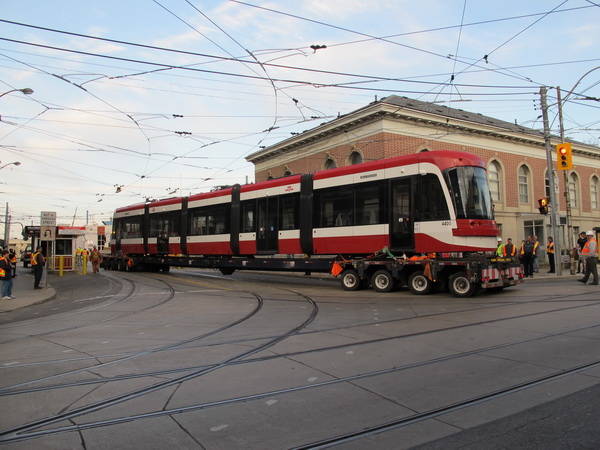
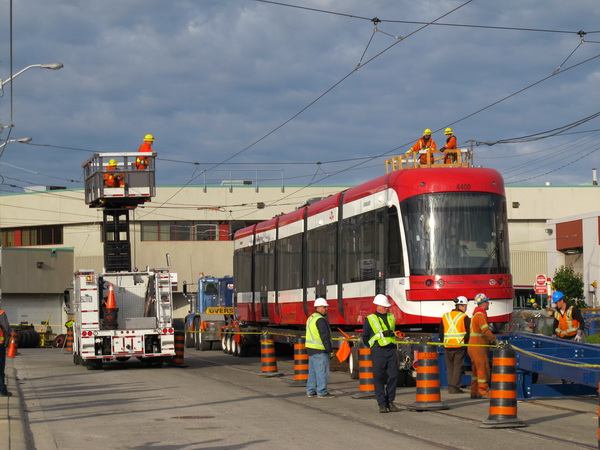
Car 4400 Is In Toronto

Updated October 4:

Thanks to Harold McMann for the following photos of 4400 arriving at Hillcrest.

A previous “first car” arrives at Hillcrest:

Updated September 28:

Thanks to Mike Filey for this photo of 4400.

Original Post of September 26

The Junctioneer reports that the first of the prototype low floor LRVs is in CPR Lambton Yard.  The car is expected to move to Hillcrest in the early hours of Saturday, September 29.

A media event will be scheduled for October.

Thanks to all who forwarded me this link.

See also the Torontoist and Randy Risling on Twitter.  Note that the car has both a trolley pole and a pantograph.

TTC Proposed Operating Budget 2013

The TTC has passed a proposed Operating Budget for 2013 including, in principle, a five-cent increase to the adult fare.  This budget now goes to the City of Toronto’s Budget Committee and Council for discussion and approval of the 2013 operating subsidy.

There are two components to the budget report: the budget for the “regular” TTC system and the one for Wheel-Trans.

Item                  Regular        Wheel-Trans
                      ($000)         ($000)

Fare Revenue          $1,061,000     $    5,546
Other Income              67,106
Total Income          $1,128,106     $    5,546
Expenses              $1,548,794     $  102,488
Subsidy Required         420,688         96,942
Subsidy Available *      410,951         96,823
Shortfall                  9,737            119

The “Subsidy Available” shown above is based on premise that the 2012 subsidy, adjusted for the cost of arbitrated labour settlements, will be provided as a “flat lined” City subsidy in 2013.  TTC management intend to continue looking for savings within the budget to whittle down the shortfall.  CEO Andy Byford is adamant that he does not want to cut service, and this is the first of many challenges for TTC supporters on Council.

The operating subsidy for the regular system in 2012 was $374.1m.  Adjusting for arbitrated pay increases going back to April 2011, the “flat line” value for 2013 is $411.0m, an increase of 9.9% to bring 2010 rates up to 2013.  It is entirely possible that budget hawks will want an absolute freeze in subsidies.  If so, then the TTC would have a big hole to fill in its budget.

Service on the regular system will be increased to meet a projected ridership of 528-million, but there is no provision for improved loading standards or minimum service levels.  This is a 2.7% increase over the projected 2012 ridership of 514m.  Projections for 2013 only months ago set ridership at 520m, an unreasonably low figure.  With the higher number, the budget does not have a built-in shortfall in planned service.

On Wheel-Trans, there is a one-time saving by the removal of ambulatory dialysis patients from the eligibility list.  This was originally intended to happen in 2012, but the decision’s effect was staved off by diverting $5m intended as subsidy for regular service to the Wheel-Trans budget.  TTC Chair Karen Stintz speaks of this as a “good news” story because it is claimed that alternative transport has been found for these riders.  Whether this is true, or to what degree costs are being transferred back onto riders, remains to be seen.  There were no deputations at the Commission Meeting on this subject.

The fare increase is half of the amount approved in principle during the 2012 budget debates when standard ten cent increases were proposed for years 2013-15.  At a five cent level, the increase is 1.9% for adult token fares.  On a weighted average basis across all fare types, the increase is 1.7%.  (Cash and child fares are unchanged; senior/student fares go up by 2.9% because a five cents is a larger proportion of the 2012 fare than for adults.)  The proposed new fare schedule is Appendix C of the budget report.

The shortfall could be eliminated by a ten cent fare increase which is projected to raise an additional $14m net of the effect of lost riding.  For many years, TTC riding tracked employment levels in Toronto, but this relationship ended at about 2009.  System usage continues to rise even though employment is stagnant through a combination of discretionary and off-peak riding.  Metropass sales continue to climb because the pricing, net of various incentives including discounts for various groups and the transit tax rebate, make passes an attractive way to purchase transit service.

Continue reading

Queen East Construction News (Updated September 21)

Updated Friday, September 21

The TTC has announced that the 501 Queen service will revert to its normal routing between Broadview and Coxwell effective Monday, September 24.  Service on Kingston Road will continue to be provided by buses for the remainder of the current schedule period.

Plans called for the 502 Downtowner to operate from Bingham Loop to Wolseley Loop at Bathurst Street, and the 503 Kingston Road will operate from Bingham to York & Wellington effective Tuesday, October 9 (the first weekday of the new schedule period).

For the next two weeks, we should see amazingly good service on the outer ends of the 501 Queen route because cars will have the extra running time for a diversion they are not taking.  This will be an interesting point of comparison once the normal running times return with the October 7 schedules.

Continue reading

TIFF 2012 Part I

The Toronto Film Festival has been back for another year, and I was distracted from transit affairs enough to be watching movies and writing reviews rather than the usual content on this site.

Reviews appear here in the order I screened films.

Included in this batch are:

  • Festival promos and observations
  • Rust and Bone
  • The Gatekeepers
  • Stories We Tell
  • Frances Ha
  • Anna Karenina
  • Seven Psychopaths
  • Capital
  • A Liar’s Autobiography — The Untrue Story of Monty Python’s Graham Chapman
  • Cloud Atlas

Continue reading

Streetcar Track Rebuilding Plans (Updated)

Updated September 20, 2012 at 6:00 am:

Correction:  The work planned for Bingham Loop is the removal of the special work at Victoria Park leading to the unused tail track.  This will eliminate a totally unnecessary wear point at the entrance to the east-to-north curve.  In the original version of the table, I listed this as the removal of the runaround track.

Update:  The question of track on Adelaide has been answered by the TTC in the following note from Brad Ross:

We’re protecting Adelaide at York, meaning that we’ll keep the utilities out of the East to North and North to East curve areas. When Adelaide is redone we’ll make provision as required at York. No timeline for Adelaide, York is in our 2013 program. We plan to remove all abandoned track including all obsolete turns at the intersection of Queen, Richmond and Adelaide – southbound track.

The intersection at York does not now include a north-to-east curve, but this would be a logical mate to a planned new curve east-to-north at King and York.  In brief, the 2013 job will see a simple straight through northbound track at Adelaide, but the TTC is allowing for installation of curves when/if Adelaide is eventually rebuilt.

Original post from September 16 follows the break.

Continue reading

Waterfront East LRT: Will This Ship Ever Sail? (Updated)

Updated September 4, 2012:

The full set of Waterfront Toronto reports and the City Manager’s recommendations arising from them are now available in the Executive Committee Agenda for September 10.

I will not attempt to summarize all of the material in these, but a few critical points deserve mention.

  • Although the revitalization of the mouth of the Don River is a central theme in this entire project, and illustrations showing the effect abound in the reports and publicity, in fact this work has been relegated beyond the 30-year timeframe of the financial projections.  The river mouth changes are in “phase 4” which is beyond the 30-year line.
  • Similarly, transit improvements to the area beyond the level of bus service, possibly but not necessarily as BRT with dedicated rights-of-way, are pushed off to phase 3 and beyond.  Transit is now described as “demand led” rather than the “transit first” policy around which much of the East Bayfront and Port Lands were being planned.
  • The connection to Cherry Street under the rail corridor is not even costed in the report and lies off in the vague future.

The fundamental problem for Waterfront Toronto and for the City is that the economics of a self-financing project simply do not work.  In the City Manager’s report, some shuffling of components allows the scheme to show a “profit” in the short term, the first decade, by the expedient of delaying or dropping expenditures to future years.

The City Manager’s Report shows the evolution of the costing model.  The first cut (page 4) used conservative assumptions and produced a net cost of $189.2m for the first 30 years.  This was reworked (page 5) with more generous assumptions to achieve a positive cash flow in the first decade, and a reduced net cost of $118m over 30 years.  Note that the tables are clearly titled “phases 1 and 2” and therefore omit costs associated with the river mouth and with the upgrade of transit services to LRT.

As someone who has been involved in many of the public discussions of these plans, I am deeply disappointed on three counts:

  • The shift of “phase 3” beyond the 30-year line was not made clear by Waterfront Toronto in its recent public meetings.  This verges on dishonesty from an organization previously well-known for plain dealing with the public.
  • The idea that Toronto would pre-build a good network of transit lines into the waterfront districts has been abandoned, and we are back to the standard TTC approach of running a bus, now and then, once a few people start to complain about service.
  • The myth that private sector development will somehow relieve the City (or other levels of government) from funding the Port Lands revitalization is exposed for what it is.  If Toronto wants to reinvigorate this huge tract of land, it will have to invest money in the process.  This issue — how to actually pay for the waterfront and what staging strategies could be taken — is completely absent.  Council is asked to approve the proposed scheme without knowing what alternatives might be available or what financing strategies would be needed to achieve them.

Building new neighbourhoods of this scale requires major investment in infrastructure and in the operating cost of providing services.  If Toronto is not prepared to pay these costs, then the Port Lands will sit empty for a long time.  Someone may propose they be rescued with a special project such as an Olympic Games or a World’s Fair.  That’s wishful thinking, and simply playing the slots at a race track may prove a better investment.  We cannot make the future of the waterfront dependent on the world’s desire to let us put on a big party.

The original article from August 12 follows the break …

Continue reading