TTC Route Ridership and Service Statistics 2004:2012 (Updated)

Updated June 16, 2013 at 10:15pm:  An epilogue comparing system statistics for 1989 has been added.

The TTC publishes statistics on its surface routes showing the most recent all-day riding count, the resources (vehicles, vehicle hours and vehicle mileage) consumed by a day’s operation, and the estimated cost of one day’s service.

For many years, this information was included in the annual “Service Plan”, but the last one of those was published for 2008.  The TTC’s Transit Planning page includes the 2008 plan, as well as the 2011 and 2012 figures as free-standing tables.

(In earlier years, the tables included a “revenue” for each route based on the ridership, although the method of calculating this varied over the years.  This was eventually dropped because there is no way to allocate fare revenue in a system like the TTC’s without producing distortions in the resulting “profitability” of routes.  Fares, especially passes which make up the bulk of adult system use, are collected on a flat basis for an entire trip or for a period of time, not for distance travelled nor number of vehicles used in a trip.)

This information becomes more interesting when viewed over time to see the evolution of ridership, service and allocated costs.

Continue reading

Waterfront West Update (Revised June 15, 2013)

Updated June 15, 2013 at 4:20 pm:

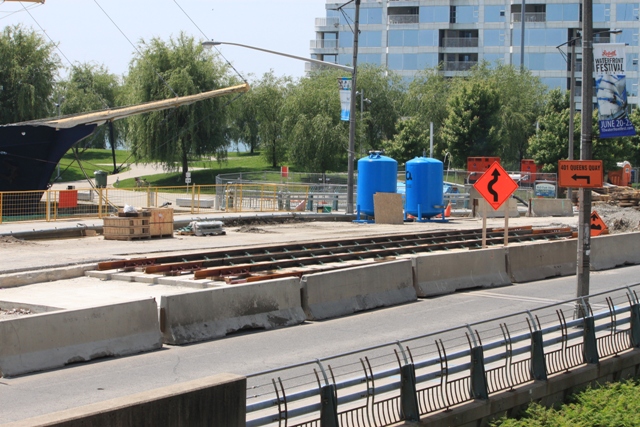
The shortest streetcar line in the world exists, albeit without service, as the first piece of new surface track appeared on the 509 Harbourfront route at the Peter Street slip.

IMG_3828w

On June 11, the eight expansion joints for the future bridge crossing were set more or less in place on the new bridge deck.

IMG_3830w

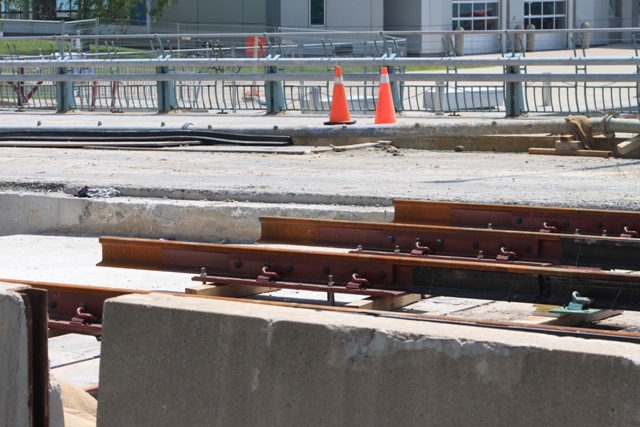
By June 13, the tangent rails had been added, although the expansion joints at the west end of the bridge (below) …

IMG_3834rw

… had not yet been attached.

Note that, like subway track, the rails are mounted directly on the bridge deck, not on ties.  This approach is needed because the bridge design does not include the depth needed for the layer of ties normally found in TTC streetcar track.

IMG_3833w

The view below shows a close up of a test section of track built just west of the corner of Bay and Queens Quay.  The use of the rubber sleeve to mechanically isolate the track  is quite clear.  Under the plastic covers (with duct tape on them) are Pandrol clips holding the track to steel plates in the slab below.  The slab containing the track is separate from the base slab so that only excavation of the top layer is needed for track replacement.

IMG_3776w

The original Harbourfront track did not have the rubber layer and was quite noisy because the whole trackbed vibrated as cars passed.  This is one of the last pieces of mainline “thunder track” to be replaced on the TTC network, a process begun 20 years ago.

Continue reading

Service Changes Effective June 23, 2013 (Updated)

Updated June 13, 2013:

Contrary to the originally announced plans, the 31 Greenwood bus will not divert to Donlands Station during reconstruction of the bus loop at its home station.  Instead, the  buses will loop via Greenwood, Strathmore, Linsmore and Danforth stopping outside of the station.

Major service changes for June 23, 2013 include:

  • Service removal or rerouting for several York Region contract operations by the TTC.  These were proposed as part of YRT’s 2013 Service Plan.  (Specific changes for Vaughan and for Markham.)
  • Seasonal changes to many routes.  The summer cutbacks are generally in line with 2012 although in a few cases routes or periods that had cuts last year are not affected in 2013.
  • Construction changes including:
    • Revised service on many routes in the Beach and in southwestern Scarborough caused by the reconstruction of Kingston Road.  Streetcar service will turn back at Woodbine Loop, and bus service will be provided eastbound only from Queen to Victoria Park.
    • Rerouting of 31 Greenwood to Donlands Station for construction at Greenwood.

The service budget for September 2013 will be about 3.4% higher than the budget for the corresponding period in 2012, and 1% higher than for March 2013.

2013.06.23 Service Changes

More Metrolinx New Math (Updated)

Updated June 8, 2013 at 12:05pm:

Metrolinx has issued a correction via Twitter (where this discussion started) clarifying that, yes, it is person-years of employment, not jobs, that they are creating, and acknowledging that the graphics and tweets using them were “shortened”.

Anne Marie Aikins ‏@femwriter

… Report explains “person yrs of construction & LT employment” pg 30. Graphs/tweets shortened. Good reminder. Thx

[Anne Marie Aikins is a Media Relations Manager at Metrolinx]

That’s putting it mildly.  Someone did a calculation to figure out how many ACCs would be needed to hold all those people, and so clearly did not understand how the numbers should be used.  Someone put that chart in the Metrolinx report.  The report survived Board scrutiny without anyone, including their members from the banking sector, spotting the problem.

Ooops.

The original post from June 7 follows below.

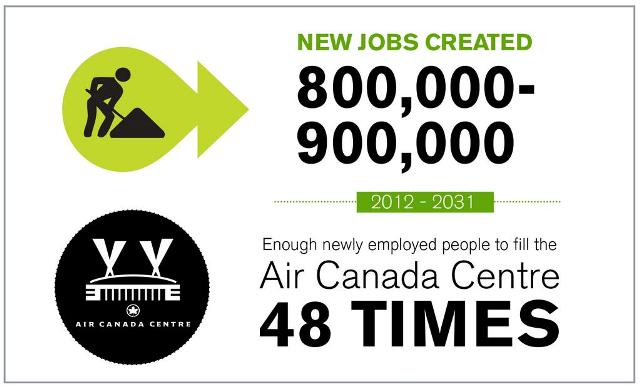
Metrolinx recently published a graphic purporting to show the employment effect of the Next Wave’s spending over twenty years.

MetrolinxNextWaveJobsWeb

These numbers are a complete fabrication and show how an organization more concerned with puffery than with accuracy can screw up basic arithmetic.

The statement here is that “enough newly employed people” would fill the ACC 48 times.  The official capacity of the ACC is 19,800, and so we’re talking about 950,400 newly employed people.  That’s roughly 1/3 of the entire population of Toronto.

The problem here is the confusion between employees and employee-years.  Metrolinx plans to raise $2b annually for twenty years.  Let’s assume that it will all be spent on job creation, not on getting more work from an existing pool of labour, nor on purchasing offshore technology such as rolling stock, control systems and managerial expertise.  We’re talking about design, engineering and construction, not the cheapest of professions and trades, and a reasonable average fully-burdened (including benefits) cost per job would be at least $80k.  (Governments have paid vastly more per new job on things like auto plants.)

The math is straightforward:  $2b/year divided by $80k gives 25,000.  If the entire amount goes to net new hires, then that’s 25k.  Do this every year for 20 years, and you produce 500k person-years of employment, but not 500k new hires.

There will be some multiplier effects in that an employed person has money to spend and that will find its way into the local economy.  How many new jobs will result is another matter.

We can look at this from the reverse angle: if there is $40b on the table, and it has to be shared among 800k new hires, then each of them will receive $50k.

In this, I have assumed that even the 25% of revenue dedicated to municipal projects creates jobs on the same basis as for the 75% allocated to the Next Wave.

Metrolinx has similar math challenges on commuting times when they routinely confuse avoided future congestion with actual savings.  Moreover, the claimed “saving” only occurs if the entire Big Move is built, something that appears vanishingly likely.  Because Metrolinx only ever discusses their fully-built scheme, we have no idea of how much “saving” will accrue for intermediate stages of the network, nor of the variation in benefits across the region.  This most basic of business analyses is totally missing, at least in any published Metrolinx papers.

Metrolinx really needs some remedial work on economic analysis and basic arithmetic.  Think about it: does it really take 1/3 of Toronto’s population to build a transit network? I have to repeat: the Metrolinx claim is not for job-years, but for newly employed people, nearly one million of them. That’s a basic reasonableness check anyone should be able to spot. How did such a claim even get out the door?

Howling errors like these job creation numbers undermine credibility not just of an incompetent agency but of the government who looks foolish for making claims they cannot possibly deliver.

 

What Does Subway Construction Cost?

An interesting article on the site Pedestrian Observations was recently linked on Twitter by Taras Grescoe (@grescoe), the author of Straphanger.  In Comparative Subway Construction Costs, Alon Levy attempts to bring together projects worldwide, adjust for currencies, inflation and other factors to derive comparable US$ values for subway construction.  The numbers are interesting in light of complaints about overpriced construction in Toronto.

The underlying problem, of course, is that no two projects are the same.  Varying proportions of underground construction, different soil/rock/water conditions, variations in station numbers/size/depth, not to mention rolling stock procurement and yard/maintenance facilities all affect the total cost and hence the cost/km.  Stir in political differences and the ease or difficulty with which projects are approved, and the number of variables is quite high.

All that said, Toronto’s costs are not wildly out of line.  This is not to say that they may not be excessive, but the cause could be our extended design and approval process and a preference for deep bore tunneling that drives up construction costs compared to shallower cut-and-cover.

The argument for LRT has always turned on the availability of a surface option where it is practical.  Whether we choose to exercise this in every possible case is another matter.

There are cases where underground construction is the only practical way to build a line, but that should not condemn Toronto to building only subways without looking at alternatives.

TTC’s Five Year Plan Reviewed

TTC CEO Andy Byford was hired by former chief Gary Webster to modernize management practices and provide focus to an organization that had lost its way.  Thanks to Webster’s ousting at the hands of the subway-loving, LRT-hating Mayor Ford, Byford unexpectedly found himself top dog.  After a year in Toronto, Byford released his five year corporate plan on May 29, 2013.

Those of use who follow the TTC closely have heard a lot about this plan as a centrepiece for the future of our transit system.  Byford’s talks at meetings around the city, most recently a Town Hall presented by Councillor Josh Matlow on the eve of the plan’s release, raised expectations for a major document, a fundamental shift in how the TTC would operate.  If this were a summer movie release, Byford’s appearances would be the equivalent of ever more tantalizing trailers and “sneak peeks” at what would come.

The plan’s release was something of an anti-climax — a press release via web and email, no additional information, no political feedback to indicate support.  The TTC board discussed the plan in its private session at their May 24 meeting, but made no public comment.  Internally, the plan was launched at staff meetings that will continue over coming weeks to reach throughout the 12,000-strong company.

Media attention is, to be generous, muted with the story completely submerged under the Ford follies at City Hall and the Metrolinx Investment Strategy.

Continue reading

TTC Meeting May 24, 2013 (Update 3)

The agenda for the TTC meeting on May 24 contains a few items of interest, but also a troubling sign that matters of public interest are being debated behind closed doors.

Items included in this preview:

Updated May 23 at 12:10 am:

Links to the TTC construction pages for the York Street, Ossington Avenue and Kingston Road reconstruction projects have been added.

A reference to a statement about the New Streetcar Implementation Plan attributed to Andy Byford at the April Commission meeting has been corrected to reflect that it was made by Chris Upfold, Chief Customer Officer, who was standing in for Byford at that meeting.  TTC’s Brad Ross has confirmed that this plan will be presented in the public session of the June Commission meeting.

Updated May 23 at 9:15 pm:

The Kingston Road construction project info has been updated to reflect the early replacement of streetcars by buses effective June 3.

Updated May 25 at 1:30 pm:

This article has been updated to reflect events at the Commission meeting.

Continue reading