Pape Station to Close for Construction August 19-30, 2013

Updated July 25, 2013:

The TTC has announced that Pape Station will be shut down from Monday, August 19 to Friday, August 30.

During the closure, subway trains will not stop at Pape Station. Announcements on board trains will advise customers of the changes to bus routings that normally serve the station. The bus diversions are as follows:

  • 72 Pape: northbound buses will operate to Broadview Station via Danforth Ave. On its return trip, it will travel north on Broadview Ave., east on Mortimer Ave., then south on Pape Ave. and back to route.
  • 81 Thornciffe Park: buses will use Donlands Station, via Pape Ave. and Danforth Ave.
  • 25 Don Mills: buses will operate to and from Donlands Station, via Donlands Ave.

[From TTC Press Release]

The strike by the workers who will build the new floors is over, and this allowed the shutdown to be rescheduled. Continue reading

An Inaugural Ride on 4401

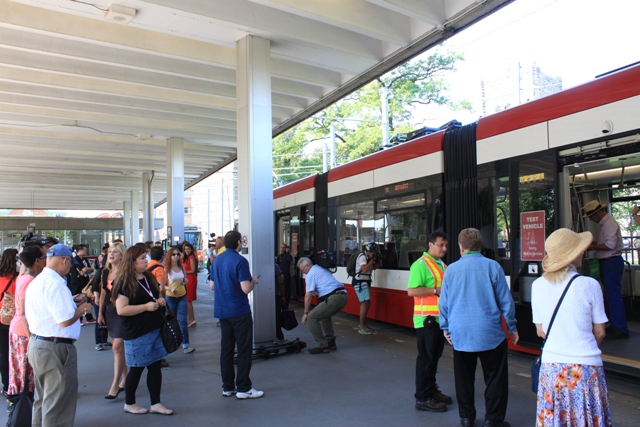
Today the TTC took the media on a short excursion with its new streetcar, 4401, from Hillcrest Yard to Bathurst Station and return.  I spent a good deal of the trip being interviewed by others, and so my photo coverage is limited.  However, over on the Torontoist site, there are lots.

Our journey was done at a leisurely pace.  This was the first daylight voyage for one of the new cars, and it attracted a lot of attention.  We seemed to arrive at Bathurst Station in almost no time, and this was in part due to the extremely smooth ride.  I made a point of sitting directly above one of the trucks (the point of where the carbody has the least ability to move independently), and even going through special work, the vibration was not annoying.

The curve into Bathurst Station from the north was more notable for the fun of seeing both ends of the five-section car at the same time (the turn is over 120 degrees) than for any sense of difficulty making the turn.

Air conditioning was quite pleasant onboard, and the car maintained a comfortable temperature even with the doors open at Hillcrest Yard.  The generously sized windows give a good view of the passing street, although it will remain until night operation to see just how much the tinted glass cuts external visibility.

Daytime test runs will become more common now that the TTC knows the vehicles work and won’t be the source of massive service tie-ups.

What I really look forward to is seeing and riding these cars in service.  How will loading times be improved?  Will the accessibility features work and be accepted as designed?  How easily will passengers adapt to the new fare collection scheme as it gradually rolls out across the system?  How long will it take for operators to drive these cars through Toronto streets with the same confidence and speed as they do with the CLRVs?

Car 4400 is about to move to Ottawa for climate testing at the National Research Council.  From there, it will return to Thunder Bay to be retrofitted with improvements developed during the test phase.  4401 and 4402 are still on the property, but they too will go back to Thunder Bay for retrofits.  The TTC is holding off giving the green light to the production vehicle run to get the greatest benefit from the testing that remains, but shipments will begin in fall 2013 for a spring 2014 rollout.

IMG_4011w

Sitting in the loop at Bathurst Station, there was (as operators of railfan charters would know it) a “brief photo stop”.  The media went crazy of course with everyone getting in each other’s shot.

No, there is nothing wrong with the destination sign.  The LEDs in the sign are not all lit at once, but the image “scans”.  We don’t see this effect (just as we don’t see flicker on a TV screen or computer monitor).  It will be almost impossible, except with a long exposure, to get a picture of these cars with all of the text in the signs readable.

A related issue is that during the daytime, glare on the side windows can make the signs above the doors difficult to read (in the photo below, the sign is in the shade).  The transit industry solved the problem of brightly-lit signs a long time ago, and I don’t understand why the TTC has taken a step back here.

IMG_4009w

More media at Bathurst Station with a few real customers mixed in.  We managed to create a minor gap in the 511 Bathurst service.

Continue reading

Rebuilding Broadview & Gerrard

Updated July 23, 2013 at 2:50pm:  TTC overhead crews finished their work earlier today and handed the intersection back to City of Toronto crews for reinstallation of the traffic signals.  North-south streetcar service resumed on 504 King and 505 Dundas just before 2:00 pm, and the 506 Carlton service is expected to be back on its normal routing for the afternoon peak.

As of 3:45 pm, the 506 Carlton route was off diversion.

Updated July 21, 2013 at 6:15pm:  The TTC has received clearance from the Ontario Fire Marshall and the City of Toronto to begin rebuilding the power distribution system and contact wire for streetcars.  As mentioned in the note below, this will take several days, and regular service will not resume until late in the week.

IMG_3933w

Continue reading

Waterfront Transit Update July 2013

Many projects affect the development of Toronto’s waterfront and transit services.  It is easy to lose track of how everything fits together, and this is an attempt to put updates for the various parts in one place.

For an overall map of the waterfront, go to Waterfront Toronto’s site and click on “View Map”.

Construction progress photos can be found on pages for individual projects, and a good overview is available in the minutes of the Waterfront Toronto Board meetings under the CEO Reports and Construction Updates.   (Scroll down to the bottom of the linked page, click on “View Details” for a meeting, and select the report you wish to view from the pop-up menu.)

Waterfront Toronto will hold a public meeting on Wednesday, July 24 from 6:00 to 9:00pm at the Toronto Fire Academy, 895 Eastern Ave (at Knox) with updates on the Don Mouth Naturalization and Port Lands Flood Protection, and the Lower Don Lands Master Plan.

Continue reading

A Subway for Scarborough — Still Not a Done Deal (Updated)

Updated July 18, 2013 at 1:10 pm:

Ontario Minister of Transportation Glen Murray announced that Queen’s Park would fund 2/3 of the Scarborough Subway, an amount of $1.4-billion (2010$).  This was described a cabinet decision taken in light of Toronto Council’s request for a subway to replace the Scarborough RT.

Murray put the political ball firmly back with Mayor Rob Ford and called on him to fight together with Queen’s Park so that Toronto could get the remaining 1/3 share of funding from Ottawa in line with federal contributions to projects in other cities.

With the press conference still in progress, TTC Chair Karen Stintz was demanding that the province pay $1.8-billion even though the lower amount has clearly been settled on by the government and isn’t likely to change.  Yesterday, Rob Ford was widely quoted that if the full funding demanded by Toronto was not forthcoming, then the subway deal is dead.

We will see just how dead the subway is, whether Ottawa can be brought to the table with bags of cash, and just how serious Toronto Council was that their subway approval was “contingent” on better funding than they will receive from Ontario.  This will all be back for debate, without question, at the October 8 Council meeting.

The original July 17 article follows the break. Continue reading

A Few Questions About the Scarborough Transit Debate

The debate about whether Toronto should undertake a Scarborough Subway in place of the proposed LRT line will occupy a good deal of Council’s time this week even though it is likely to wind up with a subway endorsement.  We will hear a great deal of information, some of it true, some of it best described as creative fiction, and some just plain wrong.

Expecting the gang of 45 to understand all of the details is a huge stretch, and this is complicated by a critical lack of  information.  Many questions have not been answered, nay have not even been asked.

How Council can undertake a $1-billion or more project without being fully informed is baffling, especially for such a bunch of right-wing, penny-pinching fiscal conservatives.  The times, however, demand a political statement, and we’re going to start by giving Scarborough a subway, no matter what it takes.

Here are a few questions responsible representatives of we, the voters and taxpayers, should be asking. Continue reading

30,000 Comments

In the midst of a major transit controversy, it is appropriate that this site has reached a new plateau of 30,000 published comments.  That’s thanks to all of you who leave thoughts on a variety of topics (even the many schemes for routing future subway lines).

The ratio of comments to articles is about 20:1, although some threads generate much more activity than others.  As with transit vehicles, articles don’t arrive evenly spaced, and certain topics invite more crowding than others.

Thanks for reading, and thanks for writing so much.  The discussions are what makes this site work.  Although my voice may be among the loudest (it is my site after all), it is not the only one heard, and the debate hones the issues for all of us.

Will Scarborough Get A Subway?

May 2013 saw Toronto Council, in a fit of almost unprecedented irresponsibility, reverse its previous support for a Master Agreement with Metrolinx for the construction of four LRT lines.  Instead, Council decided that it preferred that a subway replace the Scarborough RT rather than a new LRT line.

The primary reasons given for this change of heart were:

  • The subway is “only” $500m more expensive than the LRT option.
  • The LRT option would require a four year shutdown of service on the SRT corridor while conversion was underway.
  • The transfer between modes at Kennedy Station is an unpopular factor that would be eliminated with through subway service.
  • Greater future demand is projected for the subway option.

Without rehashing the details at length:

  • The difference in cost to the City of Toronto between the subway and LRT options is now known to be roughly $1b, although the exact components differ depending on the assumptions in the calculation.
  • The shutdown period would be at most three years, although this is still a very substantial service outage.
  • The revised transfer arrangements at Kennedy would place the LRT platform much closer to the subway platform and in a weather protected area.
  • Although subway demand is projected to be higher than for the LRT, the subway will serve a smaller walk-in market and will be more dependent on the bus feeder network.
  • Extension of the subway is highly unlikely.

Political Fallout

Metrolinx is rather perturbed that a sudden change of policy will affect procurements now in progress for the Eglinton-Crosstown project (which includes the SRT to LRT conversion) and the planned carhouse on Sheppard at Conlins Road where cars for the new Scarborough LRT would be based. Metrolinx has asked for clarification of Council’s position by August 2, 2013.

That is one day after the coming by-elections which have thrown any reasoned consideration of the issues out the window. All political parties and Councillors supporting the subway option blatantly pander to Scarborough voters. At Queen’s Park, statements by Metrolinx can be contradicted by the Minister of Transportation, if only by his absence of a definitive position. Vote-counting for both the by-election and the 2014 general election(s) has politicians falling over each other to prove their deep concern for Scarborough’s welfare.

Some of these pols held directly opposite, pro-LRT positions within 2013, but that is of little matter in the bid to give Scarborough only the best possible rapid transit money can buy.

Premier Wynne has been silent and absent from this debate, a marked contrast to her hands-on approach to her “new government” agenda. The opposition parties are no better preferring to bash the Liberal government rather than addressing the fundamental issues of the form, cost and funding of transit expansion.

Continue reading

Metrolinx Board Meeting of June 27, 2013

The Metrolinx Board met on June 27 with a full agenda.

There is a great deal of duplication between various reports, and I have consolidated information to keep like items together.  Some reports are omitted entirely from this article either because the important info is included elsewhere, or because they simply rehash status updates with no real news.  Metrolinx has a love for “good news” to the point that each manager stuffs their presentations with information that is already well known, or which parallels other presentations.

Among the more important items in these reports are the following:

  • Metrolinx is now conducting various studies all of which bear on the problem of north-south capacity into downtown Toronto.  This involves the (Downtown) Relief Line, the north-south GO corridors and the Richmond Hill subway expansion.  A related study involves fare and service integration across the GTHA.  It is refreshing to see Metrolinx taking a network approach to planning, rather than looking at projects in isolation, and recognizing that some of their own, existing routes can be part of an overall approach to solving this capacity problem.
  • The Metrolinx Five-Year Strategy includes dates for the beginning of service on various projects including the LRT replacement for the Scarborough RT.  Previous versions of these dates cited “by 2020”, and Metrolinx has indicated a desire for as short a construction/shutdown period of under three years.  However, the new strategy paper talks of an “in service date” of 2020.  Metrolinx is aiming for a three year shutdown at most, but the SRT might continue operating beyond the originally planned September 2015 date, possibly for one additional year.  This could lead to an earlier reopening than 2020.  (Correspondence from Metrolinx on this issue is included later in the article.)

Continue reading

How Many Streetcars Will Fit at King & Spadina? (Update 2)

Updated July 4, 2013 at 7:50pm:  Observations of actual operations at the intersection for one hour today have been added.  These reveal that the level of service actually operated on all routes (except 508 Lake Shore) is less than advertised.  Although traffic congestion causes some backlogs of westbound cars, the number of movements, especially the west-to-north turn, is low enough to fit within the available traffic signal cycles.  This would not be the case if 100% of the service were operated.

See the end of the article for details.

Updated June 28, 2013 at 6:30pm:  Information on traffic signal timings has been added to this article.

The original article follows the break below.

Continue reading