So You Want To Own A Subway …

November 25, 2017: As the Tories have trotted out the same uploading plan as in the last election, I’m reminding folks that their scheme simply does not hold water. The numbers here are from 2014, and in due course I might getting around to updating them with 2017 or 2018 data. But it won’t change the conclusions.

This article was originally published in May 2014.

The madness that passes for political policy in Toronto continues in the provincial election with a proposal that a Tory administration under Tim Hudak would transfer control of the rapid transit system to GO Transit as a regional asset. The conventional wisdom is that the subway on its own would be “profitable”, and that Toronto would be stiffed for the money-losing surface network.

Quite bluntly, any claim that the subway makes a profit and could be uploaded at no net cost to Queen’s Park is pure bunk, and it says something about the quality of Hudak’s advisors that they don’t seem to know this (among many other fiscal facts of life). Just like the operation of a house or a car, two things many voters must deal with day-to-day, there are two budgets:

  • Operating: Here we have the bills that roll in regularly such as taxes, utilities, insurance. Unless we are renting out our homes or vehicles, there is no offsetting revenue, but in the case of the subway, there are fares and other much smaller sources of income.
  • Capital: Now and then, major expenses come along such as a new roof or foundation repairs, a new furnace or other appliances, fixing the plumbing and electrics, building that nice new patio you always wanted. These don’t happen often, and the expense covers an asset that should last decades, but some level of capital spending is unavoidable.

I have omitted mortgage costs here because they do not have a direct equivalent in transit budgets where the cost of borrowed money is not visible. If this were included, then capital-intensive modes like the subway would have a higher operating cost with the debt service charges included.

Continue reading

TTC Service Changes Effective May 11, 2014 (Update 4)

The May 2014 schedules will bring major changes across the system mainly in response to construction projects.  Extra running time will be provided on many routes in response to construction delays.  At some times, the current headway will be maintained, while at others the headway will be stretched.  In two cases (46 Martin Grove and 94 Wellesley), no buses are available to improve PM peak service to compensate for extra running time.

The budget for construction-related service is considerably less than what will actually be required.  Although the total hours operated will be greater than the budget for May, “regular” service will be below budget while “construction” more than compensates.  Some changes in the fleet and in service levels have been deferred until later in 2014.

2014.05.11_Service_Changes

This table is broken into four sections listing miscellaneous minor changes, construction-related changes, one route restructuring and seasonal changes.

Updated May 17, 2014:

Effective Tuesday, May 20, the diversions for the Queen & Victoria track project will be changed.

  • All westbound 501 Queen cars will divert via Church-King-York.
  • 501/502/503 shuttle bus services will terminate at Church Street.

The details are on the TTC service advisory page (scroll down to see the portion effective May 20).

Continue reading

TTC & Unions Ratify Four-Year Contract

The TTC and its various union groups have ratified a four-year contract that will carry through to March 31, 2018. This mediated settlement avoids the need for arbitration which would occur given that the TTC has “essential service” designation, along with the danger for each party that an imposed settlement might not be to their favour.

Coming during both a municipal and provincial election campaigns, this is sure to spark comment, if not outright hostility, in some quarters given that the bulk of the employees in ATU Local 113 will receive 8.25% over the four-year span of the contract. The new agreement provides improved job security and limitations to contracting out, but the details were not included in the TTC’s announcement. According to the ATU’s website, the ban on contracting out is 100%.

The TTC projects that the cost of this agreement will be about $196-million over the four-year term.

The big challenge now for the TTC is to improve the quality of service it provides on the street. This will touch on policy issues at the top of the TTC and at City Council, as well as on planning and management, including a much more open and honest discussion about how service actually runs today and what can be done to improve it.

Note: I am leaving this post open to comments, but will delete any abusive material or polemics.

Neptis Reviews Metrolinx: A Critique (I)

In December 2013, the Neptis Foundation published a review of the Metrolinx Big Move plan authored by Michael Schabas. This review received prominent attention in the Toronto Star and is regularly cited in their coverage of transportation issues. Some elements also appear in recent comments by Transportation Minister Glen Murray, and it is reasonable to assume that his view of Metrolinx priorities has been influenced by the Neptis paper.

Since its publication, I have resisted writing a detailed critique in part because of the sheer size of the document and my disappointment with many claims made in it, and a hope that it would quietly fade from view. Recent Ministerial musings suggest that this will not happen.

The stated goals of the report arose from four basic questions posed shortly after The Big Move was released in 2008:

  • What evidence suggests that the projects in the Big Move will double the number of transit riders and significantly reduce congestion in the region, as promised by Metrolinx?
  • Does each project offer good value for money?
  • Do all the projects add up to a substantial regional transit network or is the Big Move just an amalgam of projects put forward by diverse sponsors?
  • How do the projects in the Big Move relate to the Growth Plan for the Greater Golden Horseshoe, its land use equivalent? [Page 2]

The report itself addresses a somewhat different set of questions and notably omits the land use component.

  • Will the Big Move projects achieve the Metrolinx objective of doubling transit ridership?
  • Are these projects consistent with Metrolinx’s own “guiding principles”?
  • Are they well-designed, consistent with international best practice, and integrated with other transport infrastructure?
  • Will they support a shift of inter-regional travel onto transit?
  • Are there alternative, more effective schemes that should be considered?
  • What changes would help Metrolinx produce better results? [Page 14]

Schabas’ work is frustrating because on some points he is cogent, right on the mark.

Metrolinx has bumbled through its existence protected from significant criticism, swaddled in a cocoon of “good news” and the presumed excellence of its work. To be fair, the agency operates in a political environment where independent thought, especially in public, is rare, and years of planning can be overturned by governmental whim and the need to win votes.

That said, Metrolinx is a frustrating, secretive organization conducting much of its business in private, and tightly scripting public events. Schabas rightly exposes inconsistencies in Metrolinx work, although his own analysis and alternatives are, in places, flawed and blinkered.

Continue reading

Neptis Reviews Metrolinx: A Critique (II)

This article is the second section of my critique of the December 2013 review of the Metrolinx Big Move Plan written by Michael Schabas for the Neptis Foundation. It should be read in conjunction with Part I and following sections.

Continue reading

Neptis Reviews Metrolinx: A Critique (III)

This article is the third section of my critique of the December 2013 review of the Metrolinx Big Move Plan written by Michael Schabas for the Neptis Foundation. It should be read in conjunction with Part I and Part II.

Continue reading

How the “Small Stuff” Can Wreck the Best Intentions

A comment arrived from a regular reader, David Crawford, about how the TTC mishandles the details of its service and information. This really belongs in a new thread, and I’m sure it will spawn a trove of examples from other parts of the system.

The TTC is, probably necessarily, a very complex organisation but seems to lack the ability or ‘culture’ to look at projects or services as a whole. This is apparent in major ‘conflicts’ between priorities where the priority to reduce overtime results in short-turns and ‘maintaining the schedule’ rather than thinking of the priority to provide ‘good customer service’ and thus ‘running to headways’. This inability to ‘think things through’ is also apparent in much smaller ‘projects’.

More minor examples are the strange absence of links to NextBus on the TTC schedules pages (because the ‘schedule folk’ don’t talk to the “Nextbus folk” or resent Nextbus?) and in the recent temporary splitting of the 72 bus route.

Splitting the route may have been a good idea but giving it a new number (172) led to (unplanned) problems. Many bus stops had the Route Number painted on them, someone had to go out and add a “1″ before the “72″, the Nextbus displays at the King Station were not working for months (and may still not be), someone was sent out to fasten new 172 route schedules to poles, but was not told to remove the ones for the 72 – which no longer ran to those stops. In addition, because the 72/172 is on a ‘temporary’ routing downtown there were also large signs along the route noting that the 72 ran there – these too had to be changed to read 172. Furthermore, there are (old) buses that do not seem to be able to display a route 172 sign so they still actually run as 72s – though are, in fact 172s. There were also references on the TTC website to the 72 bus – getting to the Distillery for example – when the new (temporary) route was the 172.

It would have been far easier and less confusing if they had simply created another branch of the 72 that would only run between King and Commissioners. When the route numbering was changed it would also have made sense to have bitten the bullet and officially changed the routing so that the bus will go permanently to the King and St Andrew subway stations. This temporary change has clearly resulted in far more ridership as the 72/172 is now a very viable alternative to the (too often short-turned) 504 streetcar.

The lack of direct links between the TTC schedule pages and Nextbus is very annoying, and you have to know your way around to use the information.  That said, there are a few challenges in presenting the information.

Both the desktop and mobile versions of the site provide the “stop number” which can be used with a text message to retrieve predicted arrival times for vehicles.  The desktop version includes a clickable “?” that is supposed to call out a help panel, but on the 504 display I tested, this has no effect. I believe the idea is that the pop-up should tell you how to use the stop id in a Nextbus call.

There is no reference to Nextbus on the general Schedules and Maps page, but it is included with much other info on a Connect With the TTC page.  If one is using either a desktop or a smart phone, it is not necessary to know the stop number as there are other paths into Nextbus, but their availability is not explained by the TTC.

Other apps, of course, use the same data feed and have their own benefits and drawbacks, but they all depend on having something beyond a basic cell phone.

As for the 172 and the Pape diversion in general, the truly annoying feature was that it was so prominently advertised in King and St. Andrew Stations while information about the 509 Harbourfront bus (a much more frequent and well-used service, especially by people unfamiliar with the area) went for a long period with only minimal signage. Visitors from other planets might be forgiven for thinking that 72 Pape / 172 Cherry are vital routes without which the city would collapse.

The problem for the TTC is inconsistency.  One day a change or diversion will get saturation coverage, another day it’s a small paper notice if you look in just the right place.

As for the 504, yes, it’s a mess. I am working on a large collection of vehicle tracking data for a series of articles on the evolution of service on this route over past years. What is abundantly clear to anyone riding the system is that managing for headway is a myth, and short turns to keep operators on time are more common than ever. Meanwhile the King route supervisors cluster outside the John Street Tim Horton’s in an obvious display of wasted manpower.

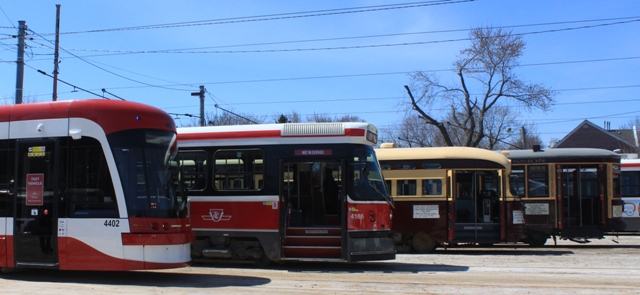
Four Generations of Streetcars for Easter (Updated)

The TTC has announced that one of the new streetcars will be in the Beaches Easter Parade along with the Peter Witt, a PCC and a CLRV.

The parade sets off at 2:00 pm westward from Munro Park [no, not mine] westward to Woodbine.

Updated with photos on April 20, 2014 at 5:00 pm.

IMG_4763w

LFLRV 4402, CLRV 4186, PCC 4549 and Peter Witt 2766 at Russell Yard before the parade.

Continue reading