Below The Line

TTC capital spending plans suffer from a basic problem: political support for funding of routine maintenance that doesn’t have ribbon-cutting, photo-ops and election prospects has been falling for years. During the same period, demand for transit service, not just for shiny new lines, but for seats on buses, streetcars and subways, has been climbing fast. Two to three percent a year might not seem like much, but when many services see no improvement, or even deliberate cutbacks, things get tight.

This is not news. The shortfall in funding the TTC’s ten-year capital plan was foreseen some years ago, and it appears regularly as part of the City of Toronto’s budgetary handwringing about the growing backlog of work. There is always hope that a new formula, a more enlightened attitude at Queen’s Park or Ottawa, will bring new money to transit and solve this problem once and for all. Meanwhile, the shortfall is, to the degree possible, pushed off into later years of the plan so that the TTC can do the maintenance and rebuilding it needs.

That, at least, was the idea a few years ago, but those “tomorrows” are now “todays” and things have not changed much.

The first problem is that the only consistent revenue stream Toronto now receives from other governments is a share of gas tax, and this is a fixed amount, one that could decline due to population shifts and reduced use of fuel. Over the ten years 2015-2024, no increase in this tax stream is included in the TTC’s budget with the obvious result that gas tax as a portion of transit spending will continue to fall in purchasing power.

The second problem is an ideological standoff over revenue tools. “Give us more money” says Toronto, while Queen’s Park replies “We gave you revenue tools, use them”. This is the same Queen’s Park that is scared to death of using its own taxing powers to fund better regional transportation systems. All governments tell fairy tales about the magic of Public-Private-Partnerships and Tax Increment Financing, schemes designed to hide the fact that costs we should pay today would be financed by borrowing against the future, but in a way that doesn’t use that dirty word “debt”.

This is not a happy situation, but the debate becomes more complex when we actually look at those unmet financing needs of the next decade and beyond. Are all of the projects now on the books reasonable? What is missing? Would additional funding, if it were available, be spent wisely?

Continue reading

How Unreliable Is My Service? (Updated January 24, 2015)

Fourth Quarter 2014 Update: Results for fourth quarter of 2014 have been consolidated into a new table below.

Route_Performance_Summary_2014Q4

The headway reliability numbers for many routes continue to lie well below the TTC’s targets for bus and streetcar operations.

Routes which have improved by more than 10% since 3Q14 are:

51 Leslie, 60 Steeles West, 125 Drewry, 126 Christie, 172 Cherry Street, 198 UTSC Rocket, 301 Queen Night, 322 Coxwell Night, and 512 St. Clair

Routes which have declined by more than 10% since 3Q14 are:

35 Jane, 36 Finch West, 55 Warren Park, 66 Prince Edward, 87 Cosburn, 88 South Leaside, 97 Yonge, 109 Ranee, 111 East Mall, 122 Graydon Hall, 133 Neilson, 141 Downtown via Mt. Pleasant Express, 160 Bathurst North, 161 Rogers Road, 162 Lawrence-Donway, 195 Jane Rocket, 224 Victoria Park North, 502 Downtowner and 508 Lakeshore

A few items worth noting:

  • Service quality has declined considerably on both of the Jane routes despite a recent reorganization into local and express services, and adjusted running times to match actual experience.
  • Reliability of the Blue Night services continues to be poor at a time when (a) there is no “congestion” on most routes as an excuse for delays, and (b) reliability is of particular importance to riders.
  • The 501 Queen car at 52% (nothing to crow about) is more reliable than the Downtown Beach Express Bus at 45%.

Looking at the data over a two-year period, a very long list of routes has seen a decline of more than 10% in headway reliability. Only a few routes, mostly night services, have improved by more than 10% since 1Q13:

  • 10 Van Horne, 52 Lawrence West (which has been reorganized since 1Q13), 90 Vaughan, 102 Markham Road, 117 Allness, 171 Mount Dennis, 301 Queen Night, 303 Don Mills Night, 308 Finch East Night, 309 Finch West Night, 311 Islington Night, 322 Coxwell Night, 353 Steeles East Night and 385 Sheppard East Night

Continue reading

Does The TTC Use “Safety” As An Excuse For Inept Management?

At the TTC Board meeting of January 21, there was a presentation based on the report Safe Service Action Plan that included several actions and proposals that are intended to improve the safety of TTC operations. The context for this report is that there have been a number of high profile incidents involving TTC vehicles in the recent past.

During 2014, two pedestrians died after being struck by streetcars. Then, in the latter half of 2014 several video recordings were made public of TTC bus operators running red lights. In response to these incidents, the CEO initiated a review of operator training, supervision and relicensing as well as a communications campaign to reinforce the need for operators to drive defensively and to adhere to the rules of the Highway Traffic Act.

Towards the end of 2014, an adult woman and a 14 year old girl died as a result of injuries in separate incidents after being struck by a TTC bus making a turn. Given the very serious nature of these tragic events, the CEO directed that the review already under way be expedited and that it include consultation with other operators for comparison and to seek out best practice. [pp 1-2]

Broadly speaking, the proposals can be grouped into three sets:

  • Operator training and recertification, including an emphasis on safe driving.
  • Monitoring systems to track and record road conditions with a view both to increase evidence when accidents occur, and potentially to monitor driver behaviour.
  • System review including issues such as stop placement, identification of accident “hot spots” and causes, and improved investigative techniques.

Continue reading

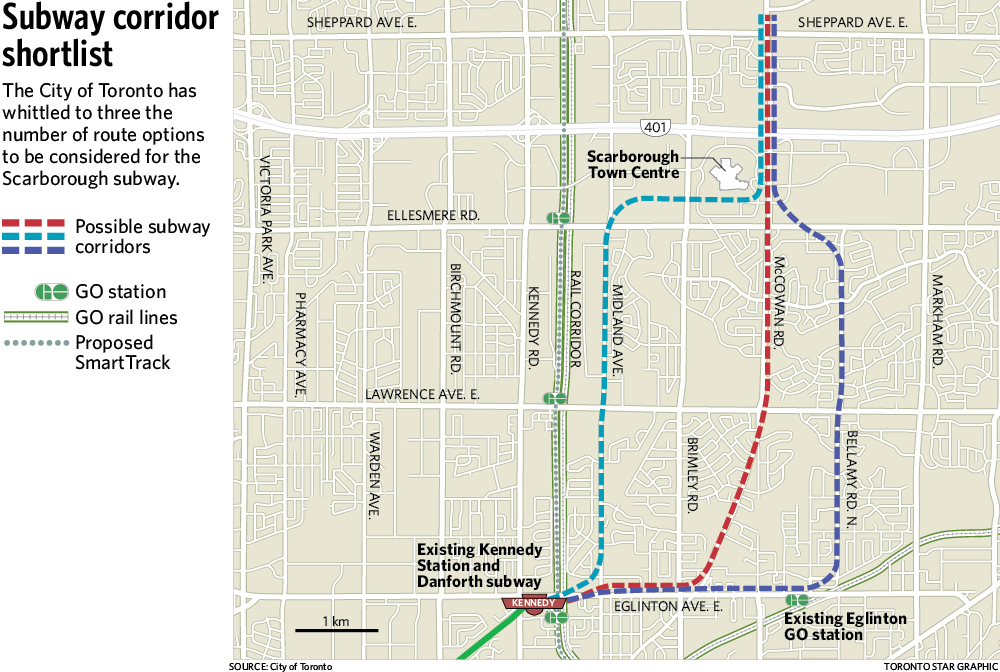
Where Is The Centre of Scarborough?

Everyone knows that the Scarborough Subway will run east from Kennedy Station, veer north at Danforth Road, and then go straight up McCowan to Sheppard. Right?

At Toronto’s Executive Committee today (Jan. 22), a major item of discussion was the study plan for SmartTrack. As previously reported, this will include a review of the effect of SmartTrack and the companion Metrolinx RER plans on other projects including the Yonge Relief Study and the Scarborough Subway.

As things turn out, there is now a worry that SmartTrack will draw so much riding from the nearby subway line that it will no longer be viable. Whatever can we do?

The answer, believe it or not, is to extend the study area further east looking for a new home for the subway far enough from SmartTrack that the subway has a chance of surviving on its own. Markham Road, 1.7km further east, could raise the attractiveness of the subway to some parts of Scarborough, but it would also move the line well away from Scarborough Town Centre and development plans for the lands around STC.

With an extra roughly 2km of line to reach Markham Road, the project may never reach across the 401 to Sheppard Avenue unless a very generous angel adds to the City’s share of the project cost.

Does this make sense? Yet another route would be included in the subway study in the hope that it will eke out enough ridership if it lies further east. What does this say about any claims the McCowan route is best because of the areas it serves?

This is what passes for planning in Scarborough, and it shows that the subway advocates are far from certain that their project has lasting, solid support.

CPR Obico Yard: A chance for TTC Expansion?

According to the Globe and Mail, the CPR plans to redevelop surplus lands in many cities. Among the land that is up for grabs is the Obico Yard near Kipling Station in Etobicoke.

Why does the TTC need more yard capacity?

For starters, they have more trains than will fit within existing yards and the problem will only get worse with the construction of any new lines such as the Scarborough extension or the Downtown Relief Line. The yard at Keele Station has been pressed back into service to hold the overflow from Greenwood Yard that was triggered, in turn, by the T1 car fleet at Wilson Yard being pushed out by the new TR fleet.

The Scarborough project includes budget room for a new yard, but exactly where the TTC would put this in Scarborough is a bit of a mystery.

A west end yard on the BD line would allow service to be split between both ends of the line, and it would free up space at Greenwood. The property is already a railway yard, and it sits in the middle of an industrial area.

Toronto talks a lot about preserving industrial lands, but if this property turns into a new subdivision, this will be a major failure by the TTC (or GO Transit) to grab an ideal spot for expanded system capacity.

New Fares and Service Improvements Coming to the TTC (Updated)

On January 19, 2015, Mayor John Tory, TTC Chair Josh Colle and TTC CEO Andy Byford held a press conference to announce major changes for TTC riders in 2015.

  • Adult fares will rise by 10 cents (from $2.70 to $2.80, or 3.7%) with proportionate increases for passes, senior and student fares.
    • Children under 12 will ride free (the current fare is $0.75 cash or a ticket for $0.60).
    • The cash fare will remain at $3.00.
  • All day, every day services that were cut in 2011 will be restored.
  • A network of key bus and streetcar routes will have 10 minute service except overnight (after 1:00 am).
  • Crowding and wait times off peak will be reduced by modifying the loading standards.
  • Proof-of-payment and all-door loading will be extended throughout the streetcar network.
  • Twelve new Blue Night routes will be added to the 22 now in operation.
  • Fifty new buses will be acquired for service improvements.
    • Crowding and wait times during the peak periods for 21 busy routes will be improved.
    • Four new express bus routes will be added.
    • The pool of buses available for maintenance will be increased.
    • Temporary storage will be obtained to house the buses pending new garage construction.
  • Trains on the YUS and BD subways that are now held on standby for emergencies will be scheduled into the regular service.
  • Route management will be improved for streetcar routes to provide more reliable service and better utilize the capacity of vehicles in service.
  • The reliability of signals, track and communication systems will be improved with more resources for maintenance.

Updated Jan. 19, 2015 at 4:00 pm: One sour note in the announcement is the fact that the Metropass multiple will go up from 49 to 50 giving a new price of $141.50 vs the existing $133.75, an increase of 5.8%. In the midst of an otherwise upbeat, positive set of recommendations, it was a poor choice not to mention that frequent users would pay a higher increase for TTC fares. This continues TTC management’s desire to bump the pass pricing up on the basis that frequent users are getting too high a subsidy. If that’s the official position of the Mayor and TTC Chair, they should have said so in the press release.

FareIncrease2015

Much of this program arose from the August 2014 “Opportunities” report from TTC management.

At the time, then-candidate Tory argued against these proposals on the grounds that they were unfunded, and behind the scenes, the Tory camp complained that the TTC was supporting another candidate’s platform. To his credit, now-Mayor Tory recognizes the importance of better transit service that can be delivered in the short term, and he has embraced advice from Andy Byford wholeheartedly. Among the lessons he learned was that TTC’s off-peak ridership is higher and growing faster then peak demand, and that investments in off-peak service will benefit a very large number of riders throughout the city. This is an important change from a focus just on peak period, core-oriented capacity.

Tory has reluctantly dropped his proposed fare freeze saying that Toronto cannot do this and get on with improving transit. He now argues that fares will go up a bit more, but that riders will get a lot more service.

During the press conference, the Mayor made pointed, repeated references to “my predecessor” and “the previous administration” saying that the policy of service cuts and subsidy freezes was wrong. One can be gleeful seeing the Ford era openly criticized by the new Mayor, but that’s not the important point. Simply by making the statement, Tory puts allies inherited from the ancien régime on notice. Better TTC funding is not simply a predictable request from the usual activists and left-wing Councillors, but part of the Mayor’s program.

The financial proposal is that the TTC’s budgeted subsidy from Toronto will rise from $440.1-million in 2014 to nearly $479m in 2015. The fare increase plus added ridership (projected at 545m in 2015, up 10m from 2014) will bring in $43m more, net of the elimination of children’s fares ($7m). (The subsidy includes approximately $90m in provincial gas tax revenue which is paid to the City. This amount has not changed in many years.)

Further details will be revealed in the City Budget Launch on January 20, and at the TTC Board’s own budget meeting on February 2. Implementation of this plan is contingent on Council approval, although the new fares (which can be approved by the TTC itself) will take effect March 1. Service changes require lead time for planning, staffing, and in the case of the new buses, acquisition of vehicles and a storage yard. In practice, the changes will likely roll out beginning later this spring with the majority of service improvements coming in September or later. This will also limit the cost of new services to a smaller part of the year, although full-year costs will have to be absorbed in 2016.

The maps in the Opportunties report (linked above) show the range of routes that will likely be affected by the various proposals. I checked with TTC officials at the press conference, and although there may be minor changes, these maps give substantially a good idea of where the improvements will be.

Of the many opportunities proposed in August, the one which is notable by its absence is the two-hour fare. There is only so much money to spend on a new fare structure, and rebuilding service takes priority this year. However, the need for a simpler “transfer” mechanism on the TTC will be forced by the Presto implementation which Andy Byford is pressing Metrolinx to complete by the end of 2016. This will more-or-less force the question as part of next year’s budget planning.

During the scrum, the inevitable question to Mayor Tory was “how will you pay for all of this”. Tory demurred saying all would be revealed at the Budget Launch. An important point, however, is that he plans to keep tax increases to inflation, but the Scarborough Subway tax will be outside of that “inflationary” envelope.

This is a very good start for the Tory/Colle era of TTC policy-making. Rather than cherry-picking a handful of improvements that might benefit only a small segment of Toronto, they have opted for a variety of changes addressing many submarkets within the TTC’s ridership. If this continues in future years, by the time the TTC and Metrolinx open new rapid transit lines, Toronto will have a much improved surface network linking riders to new and improved trunk routes.

Planning for SmartTrack

At its meeting of January 22, 2015, Toronto’s Executive Committee will consider a report (SmartTrack Work Plan 2015-2016) recommending a work plan for the study of Mayor Tory’s SmartTrack proposal together with other related transit projects. This is intended to dovetail with Metrolinx’ work on their Regional Express Rail (RER) network, and will have spillover effects on studies of both the Downtown Relief Line (DRL) and the Scarborough Subway Extension.

The most important aspect of this report is that, at long last, a study is reviewing transit options for Toronto on a network basis rather than one line at a time. Factors such as alternative land use schemes, fare structures and service levels will be considered to determine which future scenarios best support investment in transit. Rather than starting with a “solution”, the studies are intended to evaluate alternatives.

If this outlook actually survives, and the studies are not gerrymandered before they can properly evaluate all strategies, then the process will be worthwhile and set the stage for decisions on what might actually be built. The challenge will be to avoid a scenario where every pet project on the map is untouchable rather than making the best of the network as a whole. The term “best” will be open to much debate.

Continue reading

TTC 2015 Budget Preview: Business As Usual or Transit Renaissance?

Toronto will get a sense of where its new Council and TTC Board are headed next week when the City launches its budget for 2015 on Tuesday, January 20. This will be followed by debates at Budget Committee and the TTC’s own budget meeting on Monday February 2.

After months of election campaigns and an early honeymoon, our politicians will have to pick which “Transit City” they really want.

  • Do we face more of the small-minded penny-pinching, the false economies of the Ford era, or a view of Toronto and its transit services where policy is more than drawing fantasy subway maps and stuffing more people in fewer buses?
  • Will Toronto be a city with expanding, attractive transit service for riders on the network as a whole?
  • Will Council spend money on transit today and make real changes, or do we face four more years of making do with inferior service?
  • Will capital spending focus only on megaprojects (ideally ones paid for with other governments’ money), or will Council recognize the needs of the existing system for maintenance and improvement?

Continue reading

GO Transit Pilots Cut Rate Fare For Short Trips

Today, Metrolinx announced that GO Transit will offer a pilot low-cost fare on its Lake Shore line between Exhibition, Union and Danforth Stations. For $60, riders can buy a monthly sticker that would be added to their Metropass much as the Premium Express stickers for TTC services are today.

This is a substantial discount from the $181.60 that it would cost for the 20 days’ commuting trips based on the fares effective February 1, 2015. ($5.09 for each of rides 1-35, and $0.69 for rides 36-40.) The scheme began with a call for cheaper fares between Liberty Village and downtown Toronto, given that Exhibition Station is at the south end of the neighbourhood. Not to be outdone, east end Councillors jumped on the bandwagon, and Danforth Station was added to the request. GO’s announcement responds to these two “squeaky wheels”, but falls short on a number of other points.

  • Having a Metropass is a pre-requisite to using the lower GO fare. Depending on a rider’s travel pattern, a Metropass may be more expensive than pay-as-you-play token purchases.
  • The further one lives from Exhibition Station, the less attractive a walk to GO will be, especially during off-peak periods when finding space on the King car would be less of an issue.
  • One advantage touted for the scheme is offloading subway demand. In fact, this requires passengers to walk from Main Station to the GO Danforth Station, roughly a seven minute journey from the subway platform, plus the wait time added by the transfer connection. Ironically, many of the peak trains stopping at Danforth will also serve Kennedy Station which would be a much simpler transfer point for many east end riders, but the cheaper fare will not be available there.
  • The fare from Danforth to Union is the same as the fare from Scarborough, Eglinton, Kennedy, Weston, Etobicoke North, Oriole, Old Cummer and York University Stations. It is higher than the fare from Bloor, Long Branch, Mimico and Kipling. However, the cheaper “integrated” fare is offered only to those riders who have the least potential time saving by switching from TTC to GO for their commute trips.

Many peak period trains now run express and skip Danforth and Exhibition Stations. As of January 16, 2015, service is provided only by Lakeshore corridor trains (all Stouffville trains run express).

  • Danforth to Union
    • AM Peak: 6:36, 7:01, 7:16, 7:55, 8:27, 8:55.
  • Union to Danforth
    • PM Peak: 15:43, 16:30, 17:05, 17:20, 17:35, 18:18
  • Exhibition to Union
    • AM Peak: 6:27, 7:00, 7:37, 7:58, 8:24, 8:56, 9:04
  • Union to Exhibition
    • PM Peak: 15:43, 16:13, 16:43, 17:10, 17:43, 18:13

The schedules will change effective February 2:

  • Stouffville line trains will stop inbound at Danforth at: 6:15, 7:36, 7:48, 8:20, 8:46, 9:46
  • Stouffville line trains will stop outbound at Danforth leaving Union at 16:18, 16:48, 18:00

Some counter-peak Lakeshore trips that now run express will stop at Danforth. Details are on the GO website.

No additional trains will stop at Exhibition Station.

At the press conference announcing this pilot project, Metrolinx President & CEO Bruce McCuaig spoke of how this would be a “revenue neutral” undertaking. No additional trains will be operated. Whatever handful of commuters who now pay the full GO fare from Exhibition or Danforth to Union will get a big discount, but any new riders are found money for GO Transit. Whether this would be the case if the arrangement were extended throughout GO’s inner fare zones is another matter.

This is supposed to be a one-year pilot, and riders who originate in, say, Scarborough might reasonably ask why they have been left out in the cold even though there are many GO stations including those in the future SmartTrack corridor. How this pilot will establish much about the actual market for an integrated TTC/GO fare is a mystery, but the announcement provided yet another photo op for the politicians.

As of 1:45 pm on January 16, I await a formal response from Metrolinx to a query about the scope of the pilot and the absence from it of many potential stations.