The Dubious Economics of the Union Pearson Express

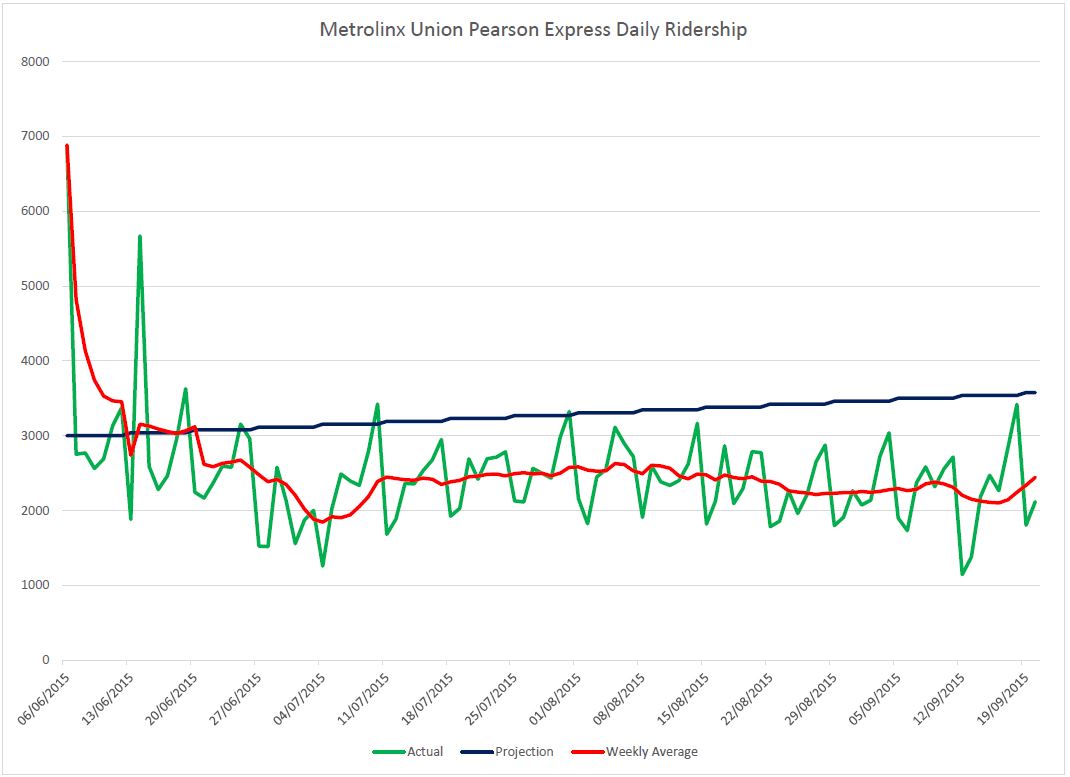
In today’s Toronto Star, Tess Kalinowski writes about recently released Metrolinx reports concerning the Union Pearson Express (UPX).

The items of interest are down at the bottom of the Reports & Information page and they include ridership forecasts from December 2011 and May 2013. The latter report was cited as background to the Auditor General’s 2012 Report on Metrolinx [beginning on p. 6 of the pdf].

Given that the projection is almost two years old, one might be tempted to say “maybe things have improved”, but that’s a tad hard to believe in the absence of any newer studies from Metrolinx.

There are great hopes, and even greater hype, for the UPX, and getting some basic information on the table is certainly worthwhile. Continue reading

Recent Updates Sidebar

As topics evolve, articles on this site are updated from time to time. Notice of these updates will appear in the sidebar with hotlinks to the articles so that regular readers do not have to go hunting for the changes.

Articles will retain their original URL after the updates so that existing links to them will not break.

Leslie Street Update

Track work on Leslie Street linking from Queen Street south to the new Leslie Barns is finally underway on the last remaining blocks of this project.

For a gallery of construction photos from 2014, please visit Building The Connection To Leslie Barns.

New Streetcars Come To Harbourfront

With the shutdown of the Spadina line for track work, the Flexitys have shifted to the 509 Harbourfront route. Here are a few images of these cars in a new context.

Green trees would make these so much better!

A New Way To Measure Service Quality?

At its recent Board Meeting, the TTC received a presentation [scroll to p. 3] from Chief Service Officer Richard Leary on plans to update management and measurement of surface route service quality.

The monthly CEO’s report includes a number of “Key Performance Indicators” (KPIs) intended to track various aspects of the transit system. However, the methodology behind some of the KPIs, notably those related to service quality, leaves a lot to be desired. Moreover, information that could track basic issues such as vehicle reliability is not included. This begs the question of whether the indicators exist more as a security blanket (“we have KPIs therefore we are good managers”) than as meaningful management tools, not to mention as reports to the politicians and public.

A telling chart on page 6 of the presentation shows how badly the TTC has drifted from transit industry norms:

ServiceKPIsAssessment

The TTC aims to have almost enough vehicles available for service relative to actual needs, and operates with a lower spare ratio than the industry overall. This has two effects.

  • When unusual demands for service arise, there is no cushion to roll out extras.
  • Vehicles are not maintained often enough to prevent in service breakdowns. This shows up in a mean distance between failures that is very much lower than the industry average.

The situation is actually compounded by an internal measure of service delivery: a garage counts a bus as “entering service” if it makes it across the property line onto the street. Whether the bus runs for an entire day or breaks down a block from the garage, it counts toward service provided. This is complete nonsense, but shows how the construction of a metric can induce behaviour that is counterproductive. Actually keeping the bus in the garage could allow it to be repaired and improve reliability, but that’s not what the garage is measured for.

Moving to a higher spare ratio and more frequent routine maintenance on vehicles is expected to yield better service with fewer in service breakdowns. Late in 2014, the TTC began this shift by slightly increasing spare ratios at each garage, and the MDBF for the bus fleet has risen to 7,000km. This will have to be tracked over a longer time, however, to ensure that the improvement is permanent and can be linked to further increases in spares and maintenance work.

This has a non-trivial cost for the TTC. With a total scheduled service of about 1,500 buses, a 6% increase in spares represents 90 vehicles, or a substantial portion of a typical yearly bus purchase, not to mention a fair amount of garage space.

Continue reading

The Evolution of TTC Signaling Contracts (Updated)

Updated April 19, 2024 at 10:40 am: The links to TTC reports have been updated again to reflect the current URL structure of the TTC’s website.

Updated September 29, 2022 at 1:30 pm: Links to TTC reports have been updated to point to the “new” TTC website except in cases where the report is no longer online. In those cases, a copy from my archives is linked on this site.

Updated April 4, 2015 at 6:00 am: The review of options for consolidation of the signal contracts by Parsons is now available as part of the TTC’s report online. Comments have been added at the end of this article.

Recently much attention has focused on the runaway project to extend the Spadina Subway north to Vaughan with a flurry of questions about project management, scope creep and cost controls. Another of the TTC’s megaprojects, one that is actually far more critical to the subway as a whole, is the replacement and upgrading of the signal system controlling the movement of trains. This project has dragged on for years while riders endure service problems with antique equipment and line shutdowns for installation and testing of the replacement system.

At its recent meeting, the TTC Board approved a proposal to restructure existing contracts for new signal systems and to simplify the signaling technology that will emerge as the standard on Yonge-University (Line 1) by 2020 with the remainder of the subway system to follow.

In order to make sense of the evolving design for new TTC signals, this article will begin with a short history of the system as it existed and the limitations the new system is designed to remove.

Continue reading

TTC Board Meeting March 26, 2015 (Update 2)

The TTC Board met on March 26, and considered a meaty agenda that begins to address some important policy issues.

Updated March 29, 2015 at 3:45 pm: The presentation on One Person Train Operation (OPTO) given at the meeting has been added along with comments.

Updated March 24, 2015 at 8:10 am: After this was published, the TTC posted the CEO’s Report.

In a previous article, I wrote about the Spadina subway extension project update. This will undoubtedly be the main attraction both for board members and the media. Other items of interest include:

  • An overhaul of system key performance indicators (KPIs)
  • A door monitoring system for Toronto Rocket trains and one person train crews (Updated March 29)
  • Revision and consolidation of the resignalling contract for the Yonge-University line
  • A study of express bus routes
  • CEO’s Report

Continue reading

How Much Will The Spadina Extension Cost? (III) (Update 3)

Updated April 13, 2015:

The TTC has issued a press release regarding the management of the Spadina subway extension project:

The Toronto Transit Commission has entered into an agreement with Bechtel Canada Co. for project management of the Toronto-York Spadina Subway Extension (TYSSE) for up to $80 million.

The contract value to Bechtel is based on staffing costs, management fees and incentives to open the subway extension by Dec. 31, 2017. Bechtel staff begin work today and will form an integrated team with existing TTC personnel. The Bechtel contract will expire March 31, 2018. Bechtel’s project director will report directly to TTC CEO Andy Byford.

On March 26, the TTC board approved a report from staff that recommended TTC enter into a sole source agreement with a project manager with a proven track record of delivering similar-sized projects on time, and with experience working with multiple contractors, in order to have the TYSSE in service by Dec. 31, 2017.

Toronto City Council subsequently authorized the expenditure of $90 million, while the Regional Municipality of York authorized the expenditure of $60 million, for a total of $150 million (third party contractor, plus in-house project costs), to fully deliver TYSSE by the end of 2017.

The release is silent on the issue of what might be done with the remaining $70m of Toronto/York’s $160m authorization.

Original article of March 29, 2015:

In a previous article, I reviewed information from a media briefing by Andy Byford on the status of the Toronto York Spadina Subway Extension (TYSSE) project. At the TTC Board meeting on March 26, 2015, further information was made public both in Byford’s presentation, and in additional material appended to his report.

Updated March 30, 2015 at 1:30 pm: The slides from Byford’s presentation are now available starting at page 58 of the linked pdf.

Updated March 30, 2015 at 11:30 pm: A new report from the Toronto City Manager to Council advises that the interest earnings on the “Move Ontario Trust” (the repository for provincial contributions to the TYSSE project) have not achieved the target rate of 4% resulting in an $85m shortfall. Oliver Moore reports in the Globe that Ontario has refused to make up this amount as per the original agreement between the funding partners. Toronto and York Region are on the hook for this additional cost estimated at $51m for Toronto and $34m for York Region. This expense is over and above the cost overruns on various contracts, but at least Council cannot blame the TTC because the trust fund is not under TTC control.

Appendix F (beginning at page 33 of the linked PDF), is a presentation given to the Executive Task Force who oversee the project on behalf of the sponsoring governments on July 28, 2014. The presentation was given by Parsons Brinkerhoff who had been retained by the TTC to review the project.

Appendix G (beginning at page 56) is a two-page summary of Bechtel’s work reviewing PB’s original study and a subsequent APTA (American Public Transit Association) peer review. APTA concluded that an earlier completion date would be possible than PB had projected, but only with major changes to the project management structure. Bechtel concurred in these findings.

It is abundantly clear from this material that the TYSSE’s problems were known at the top level of the project in mid-2014 at the latest. At the time, their severity was so great that the project would still be incomplete by the time of the next municipal and provincial election cycles, and that considerable additional cost could be facing the funding partners. This very serious issue did not arise in public discussion until six months later, notably after Toronto’s 2015 budget cycle was complete.

Continue reading

40,000 Comments

The approved comment odometer rolled over to 40,000 today with an observation from Robert Wightman.

40000

A big “thank you” to everyone who has been contributing their thoughts to this site over the years. Some of you are more prolific than others, some of you just lurk in the shadows, some I meet when they say hello on the subway, some are mysteriously “out there” in the ether.

A dinner party that never seems to end — even if some guests don’t know when it’s time to leave!

All the best to my readers!