Updated on July 5, 2018 at 8:00 am: Minor typos corrected. Explanation of replacement service as Flexitys displace older cars clarified.
Over the past day there have been a number of media comments, articles, tweets triggered by the announcement that 67 of Toronto’s new streetcars must return to Bombardier to repair bad welding. This started with an article by Ben Spurr in the Star, with a followup by Spurr and a Globe article by Oliver Moore. I’m sure there are others, but they will do for now.
The problem is described, briefly, in the TTC CEO’s Report released on July 4 as part of the agenda for the Board’s July 10 meeting.
As of June 25, the TTC has 80 Bombardier low-floor streetcars available for service. Unfortunately, we have learned that frame imperfections were found on assembled sections of the 67 vehicles manufactured before 2017 at Bombardier’s facility in Mexico. It is important to note that these welding deficiencies pose no safety threat. Bombardier has agreed to make the required repairs by removing cars from service and sending them to the Bombardier Welding Center of Excellence in La Pocatière, Quebec for repair.
We are working with Bombardier on a repair schedule that will have minimal to no impact on our service to customers. All vehicles will be repaired by the end of 2022.
[From “current issues” on p 6]
There is an inconsistency in the size of the fleet reported by Spurr and repeated by Moore. Although the CEO’s report says they have 80 cars, the number 89 has been used in media reports. This discrepancy is likely due to how Bombardier and the TTC count deliveries. Car 4488 was delivered to TTC Hillcrest today (July 4), and this makes a total of 88 cars in Toronto. (4401 was a prototype and is back at Bombardier for retrofits.) However, the highest car number actually in revenue service, and therefore formally accepted by the TTC, is 4482. This may seem like railfan trivia, but keeping track of just how deliveries are going is an important part of knowing how the roll out of new vehicles is actually progressing day-by-day, not in infrequent updates from the TTC.
The chronology of the problem has also been confused somewhat, and I have to own up to misinterpreting Spurr’s recounting of TTC information until this was sorted out in emails with TTC spokesperson Brad Ross.
- 2015: TTC and Bombardier identify welding problems at the plant in Mexico where frames for the new cars are manufactured. This was one of the key problems that delayed the early shipments of cars to Toronto. TTC refused to accept cars whose parts would not fit together when they arrived at Thunder Bay for final assembly. In time, this manufacturing problem was corrected, or so it was thought.
- June 2017 (quoting Spurr): “Company representatives said the problem is a “lack of fusion” in some of the welds on the car’s skeleton, particularly around bogie structures and the articulated portals where different sections of the articulated vehicle are joined. The company says it brought the issue “under control” last June and it won’t be repeated in future deliveries.”
- October 2017: The TTC becomes aware that repairs would be required according to Ross as quoted by Spurr. One must ask what the TTC’s quality control inspectors were doing in Mexico between June and October.
- February 2018: 4466, presumably the last car completed with bad parts, is delivered to the TTC. This is a rather long span after Bombardier’s claim that the issue was under control in June 2017.
- July 2018: TTC and Bombardier announce the need to send the defective cars to a Bombardier plant in Québec which is their “world centre for excellence in welding”. In other words they are giving the job to people who should know what they’re doing.
There is a further inconsistency in that the TTC CEO’s report talks of 67 vehicles manufactured before 2017 in Mexico. This is clearly a typo and the date should be 2018.
If the problem finally escalated to TTC management in October 2017, this was during the Byford era, but there was no report of the problem publicly. If we are to believe tweets from members of the TTC Board, Councillor Mihevc in this case, he was unaware of the need for cars to return to Bombardier until this report broke a few days ago. This begs the question of how much the Board is actually in touch with critical issues on the system they govern.
Teething problems with new equipment are common, although Bombardier has a particularly checkered record in that regard and was dropped from a subway car bid by New York City due to problems with a previous batch of cars. In Toronto, the new TR subway trains continue to have problems, although the worst of these have been ironed out. On subway car orders, riders do not usually see the effect of equipment troubles because the TTC has its older fleet to fall back on, not to mention a generous pool of spare trains, and service gets out to the lines. The streetcar network, starved far too long for new cars, does not have this luxury, and Bombardier’s screwups are in plain sight affecting the transit network.
(One might also recall reliability problems with hybrid buses that could be regularly found parked around the city after going disabled. Again, the full effect is not visible to riders because the TTC maintains a large spare pool to cover for these failures.)
Both Bombardier and the TTC state that the problem is not a safety issue for existing cars, but that over time the poor welds would led to premature failure of cars that are supposed to last 30 years. In a particularly bizarre comment, Bombardier spokesman Eric Prud’Homme is quoted by Moore as saying that this recall spurs interest only because of previous problems with the order and that welding problems are “not uncommon” in the industry. Well, yes, maybe, but when they are on a scale requiring that cars be shipped back to the manufacturer, this is a different problem from minor corrections that can be performed at the customer’s site. And, of course, any retrofit that takes cars out of service reduces the pool available to replace the aging CLRV and ALRV streetcars.
The process is expected to require 19 weeks which is subdivided as:
… 19 weeks total for the repairs: 2 weeks to ship the cars to La Pocatière, 12 weeks for maintenance, 2 weeks to ship back to TO, and then 3 weeks for commissioning. [Tweet from @benspurr]
If the cycle time at Bombardier is 12 weeks (delivery each way and commissioning can take place in parallel with repair work), and there are 17 cycles (4 cars x 17 cycles = 68 cars), then this will take almost 4 years (204 weeks) and will complete in 2022. (I include this detail because the initial impression was that the repairs alone would take 19 weeks, not 12, leading to a mismatch between the proposed end date and the length of the project anyone could calculate.)
If there are only about ten cars out of the fleet at any time (in transit either way, or in commissioning activities when they return), the TTC will get by with the proviso that some of the older cars, likely the smaller CLRVs which although older are more reliable than the ALRVs, will stay in service longer. Ideally, they should be scheduled on peak-only runs so that most of the service is provided by the Flexitys on hand.
Politicians and others with their own agendas have seized on this latest setback to say “maybe we should bus some routes permanently” or just get rid of streetcars. With a hostile government in Queen’s Park, this could be a problem especially if Doug Ford decides to meddle in control of the TTC.
It is important to understand what is possible with the fleet the TTC should have available as well as the planning issues about the streetcar corridors in Toronto.
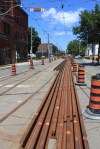
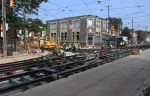
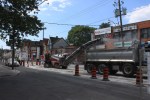
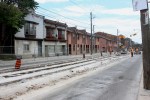
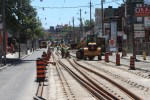
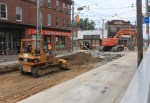
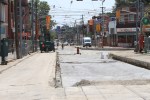
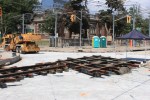
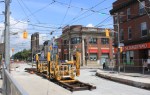
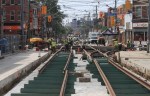
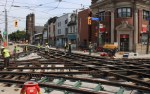
Buses are now operating on the 505 Dundas and 506 Carlton routes, as well as on a Broadview shuttle replacing a small part of 504 King during track work. Streetcars will return to Carlton in September, possibly with some bus trippers, and likely to Dundas sometime in the fall depending on car availability. 511 Bathurst will revert to bus operation in September because of major construction work on the bus roadway at Bathurst Station, and the 502/503 Kingston Road service will also go back to buses. It should be noted that between them, the peak requirement for streetcars on 502, 503 and 511 is only 28 CLRVs plus spares, and this makes these routes easy candidates for bus substitution because relatively few vehicles are needed for any one route.
The streetcar system has been fleet constrained since the mid 1990s. Ridership losses of the early 90s recession allowed service to be cut back to the point that the 510 Spadina line could open using existing spare cars in the fleet, and the planned rebuild of about 20 PCCs was not required. Since then, there has been no capacity for growing demand, and if anything this has fallen through added congestion on major routes and the gradual decline of fleet reliability and availability. The TTC would like to retire the last of its old cars in 2020, although that may not now be possible.
Toronto is fortunate in that the order for Flexitys represents a considerable addition to potential capacity over the fleet it will replace. The old fleet contained 196 CLRVs and 52 ALRVs. Counting the ALRVs as 1.5 cars, this is the equivalent of 274 CLRVs. The 204 Flexitys counting as 2.0 cars each represent 408 CLRVs. This means that the TTC can improve service capacity rather than simply replacing it one-for-one.
This has been a boon on King Street where the capacity of service provided is now considerably improved even though the number of cars operating has stayed almost unchanged.
The 204-car fleet (or 194 if one takes 10 out of the pool for rotation to Bombardier), can provide service improvements, but it cannot replace the full streetcar service on a 1:1 basis. The table below shows the vehicle requirements for all routes assuming streetcar operation at current service levels, or at a recent level when streetcars were in use. The total cars is 214 which clearly cannot be handled by the Flexity fleet if old cars are substituted 1:1. (Allowing for spares at 20%, the total fleet would have to be 257 cars, and this is roughly the level that an added 60 cars would provide.)
However, that would represent a doubling of capacity on the affected routes, and this is well above what is needed in the short-to-medium term. The tradeoff, if replacement is less than 1:1, is that headways (the time between cars) would widen.
For example, on a 2:3 basis (two new cars for three old ones, a capacity increase of 33%), the fleet requirement would go down by 50 cars (one third of the 153 CLRV/ALRV total below). This would bring the total requirement, just barely, within a 204-car fleet. Headways on affected routes would grow by one third. For example, the peak headway on 511 Bathurst would go from 4.5 to 6.0 minutes. This will inevitably affect ridership just as the replacement of CLRVs by ALRVs did years ago on Queen.
A more generous replacement rate of 3:4 (a capacity increase of 50%) lessens the effect on headways, but requires more cars than are available while maintaining a spare pool of 20%.
An important question is the degree to which additional peak service could be provided by the surviving CLRV fleet, or if bus trippers or replacements are the only viable solution. The smaller the replacement vehicle, the more are required. Moreover, if buses are used, this draws vehicles from an already-strained fleet that cannot meet demands on the bus network.

“Why use streetcars” is a question posed by some. A vital issue for City Planning is that growth in the population and in travel demand will occur disproportionately in the old city and along the streetcar corridors. Service will have to be substantially improved to handle future demand that is expected within the next decade.
The streetcar network once provided considerably more service on some routes than it does today. Demographic shifts and ridership lost to service cuts, not to mention a declining fleet of streetcars, have stretched peak headways in some cases quite substantially. But the capacity is there to carry more riders if only the TTC had the vehicles to operate and the City had the will to fund transit service at higher levels on key routes. (This is also an issue on the bus network which has its own artificial, budget-driven limitations.)
Ed Keenan, writing recently in The Star, noted that the 506 Carlton car once carried 60,000 riders per day, but has fallen back by 2014, the last year for which the TTC has published ridership stats, to 39,700. In all the hand wringing about the effect of fare systems on ridership, the TTC has lost track of a basic driver of demand: the quality and quantity of service. The infrequent publication of stats does not help in tracking of demand, but even those numbers hide latent demand that simply does not show up out of frustration. The King Street Pilot has shown what can happen when service and capacity improve, and the TTC is proud of their success, but substantial movement beyond King is a political minefield.
Fortunately for Toronto, the streetcar infrastructure is in good shape unlike the situation years back when it declined through less-than-ideal maintenance from which the system has only recently recovered. Likewise, Toronto lost its trolley coaches (electric buses to those too young to remember) in part because the system was allowed to decay by management who wanted rid of this mode and colluded with alternate technology providers to bring this about.
Another requirement for new streetcars waiting in the wings comes from the proposed Waterfront extensions west to Humber Bay and east at least to Broadview. This perennial wallflower project has not attracted funding support, and Waterfront Toronto is reduced to planning for a BRT right-of-way that might, someday, mirror the Queens Quay West design with streetcars.
Toronto’s challenge now will be to decide whether Bombardier can be trusted with an extension to its existing Flexity order (the fastest way to get more cars and build up service), or if a delay to seek bids from other builders is the way to go. In the best political tradition, the Board will consider a recommendation from management that this decision be put off to early 2019 when the financial situation for new streetcars will be clearer.
This brings me to funding from Queen’s Park which is unlikely from an avowed streetcar hater, Doug Ford, now Premier. But, that said, Toronto needs to remember that many capital projects have little provincial money in them, and there is also funding from the Federal government. Toronto needs to decide what it needs, and cobble together funding for its many projects where this can be done. It won’t be easy with competing demands for subway expansion and for the renewal of the existing Line 2 Bloor-Danforth, a great deal of which is “below the line” in the unfunded portion of the City’s capital plans.
Expansion of streetcars or LRT, whatever one might want to call them, has always been an uphill battle in Toronto for various reasons including the idea that streetcars are old fashioned and just get in the way. Tell that to major cities around the world running and expanding their networks. Toronto needs more capacity to move people on many corridors with easy access to transit, something a few subway lines alone can never achieve. Buses at the density required to replace streetcars will only worsen congestion, not relieve it.
Bombardier, through its ongoing cock-ups with provision of new streetcars, has been no friend to the Toronto system. We must get past this with, if need be, a new supplier of vehicles so that the system can grow. Bombardier’s incompetence should not be used as the justification to retrench and, by implication, eventually dismantle the streetcar network.