The Travails of Cherry Street

A recent meeting of the Corktown Residents’ and Business Association included a discussion of problems with the new 514 Cherry service. As reported by thebuletin.ca

… a resident of the King/Sumach area … commented that the screech of the streetcars turning at King and Sumach was so loud as to prevent sleep. Apparently the issue has been ongoing since the inauguration of the 514 (Distillery Loop–Dufferin) line on June 19.

The issue—which took the meeting somewhat by surprise—was amplified by other attendees, who also noted that there were substantial problems with streetlight timings at the Cherry/Front and Cherry/Eastern intersections, as well as with poorly-delineated turning lane stripes which have led to vehicles accidentally getting onto the streetcar right-of-way and then being unable to get off. (There have been earlier, similar incidents with the slightly older right-of-way at Queen’s Quay.)

Deputy Mayor and area councillor Pam McConnell’s office was aware of the issues and noted that streetcar service was now suspended (replaced with shuttle buses) between 10 p.m. and 7 a.m. A public meeting was subsequently scheduled with the councillor’s office and the TTC.

Problems at King & Sumach have continued since the 514 opened for service including:

  • dewirements causing overhead to be pulled down
  • derailments
  • traffic signals that do more to delay transit service than “prioritize” it (this is also a problem further south on Cherry)

When the TTC began rerouting the 514 service late in the evening, the alleged purpose was “railgrinding” and this is still reflected in the URL for the service notice which is called “514_railgrinding.jsp”. The activities underway at the intersection were clearly aimed at the derailment problems by altering the rail profile on the curves.

There is a long-standing slow order for east-west operation on King that has nothing to do with this, but is no doubt related to a few cases of overhead failure.

Meanwhile, the traffic signals here and at other locations on Cherry appear to be on a fixed cycle that has no relationship to whether transit vehicles are present. So much for “transit priority”.

On the subject of wheel squeal, the TTC’s official line is that the new streetcars are supposed to be self-lubricating, and that this would be triggered by GPS information. That’s a good line, but it does not fit with actual conditions.

  • There is a wheel greaser on the southbound approach to Distillery Loop.
  • The GPS-based automatic greasing has not yet been turned on for the new cars. (Anyone with contrary information is welcome to correct me in the comments.)
  • Most of the service on 514 Cherry is provided by CLRVs that do not have automatic greasers.

I have outstanding requests for further information on these issues to both the TTC and to City Transportation, and will update this post as and when they reply.

TTC Service in 1928

A recent comment sent me looking for service levels early in the TTC’s existence (post 1921), and I was pleasantly surprised to rediscover that this information is in a book, now long out-of-print, by John F. Bromley called TTC ’28. This book provides a view of the system when the electric street railway in Toronto was at its height.

In a recent presentation to the TTC Board, staff argued that the streetcars were an integral part of the growth of Toronto, but their viewpoint was comparatively recent, from the 1950s onward, and even that did not fully show the former extent of the transit network which was once almost entirely operated with streetcars.

I often get questions about the streetcar system as it was, and this article is intended to consolidate the bits and pieces in one place. The route histories will give some indication of why there is so much streetcar track in apparently odd places today. Remember also that the downtown one-way streets date from the 1950s when the DVP/Gardiner recruited several streets as on/off ramps to the expressway network and “optimised” them for use by motorists.

Information for 1928 is taken mainly from Bromley’s book. Other sources are Rails From The Junction by James V. Salmon, Riding the Radials by Robert M. Stamp, and The Toronto Trolley Car Story by Louis H. Pursley.

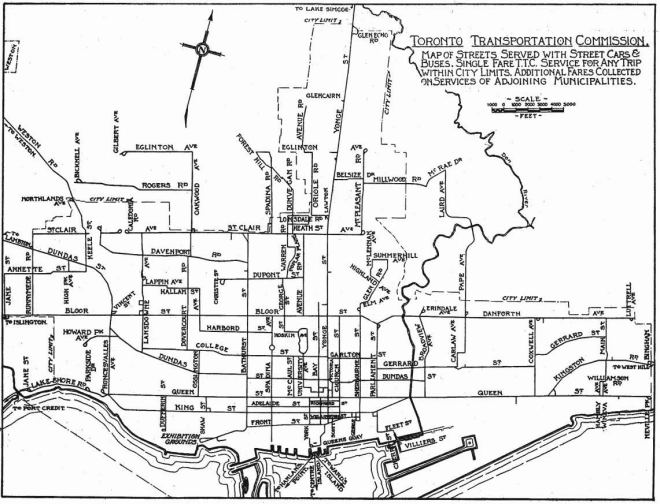
The following map shows TTC routes in August 1928. It was scanned by Pete Coulman from a guidebook, and the original scan lives on the TransitToronto website’s maps page.
ttc-map-1928-08-22

Only a few routes on this map are bus operations, generally small lines on the periphery of the system.

Serving Downtown

Anyone born in the past half-century is used to the idea that the Yonge-University and Bloor-Danforth subways (now known as Lines 1 and 2 respectively) provide the lion’s share of transit capacity into the core area, supplemented by the streetcar network and GO Transit. However, before the subways opened, their role was provided not just by streetcars on their namesake streets, but on parallel routes that fed into a common area. This was an essential part of service design not simply to spread out the network through many neighbourhoods, but because all of the streetcars needed to serve the core could not fit onto one street.

“Downtown” was quite different from the area we think of today, and much of the development was concentrated south of Dundas with areas to the north more residential than commercial. Construction of Eaton’s College Street store began in 1928, and it was thought to be a huge risk building so far away from downtown. The building is much smaller than original plans because of the combined effect of its location and the recession.

The land around the port and the railway corridor was used mainly for industrial purposes, and the large workforce in these areas required a lot of transit service. This land is now home to tens of thousands as the condo boom recycles the old city and changes travel demands.

Services to downtown in 1928:

  • Bathurst cars ran south from Vaughan Loop at St. Clair to Front, then east to Frederick Loop at Sherbourne Street. (Although there was track linking Bathurst to the Exhibition ground, it was used only during special events such as the CNE or Royal Winter Fair.)
  • Bathurst trippers (peak period cars) ran from Caledonia Loop on St. Clair east to Vaughan/Bathurst, south to Adelaide and then east to Church.
  • Bay cars ran from Caledonia Loop on St. Clair east to Avenue Road, then south to Bloor, east to Bay and south to Ferry Loop (York & Queens Quay where the circular ramp from the Gardiner is today).
  • Beach cars ran between Neville Loop on Queen to Sunnyside Loop west of Roncesvalles. Today the route is 501 Queen.
  • Beach trippers ran from Neville Loop to King & Bay looping via Bay, Wellington and Sherbourne. Today’s 503 Kingston Road Tripper is a descendant of this route.
  • Queen cars ran initially from Bingham Loop on Kingston Road (still in use by routes 502, 503 and 12) looping downtown via Victoria, Richmond and York. During 1928, service was extended east to Birchmount Loop, but streetcar service was cut back to the City of Toronto boundary in 1954 with the creation of “Metro Toronto”. Today’s 502 Downtowner is a descendent of this route.
  • Bloor cars ran between Luttrell Loop (between Dawes Road and Victoria Park on Danforth) and Jane Loop (south side of Bloor opposite the foot of Jane Street).
  • Danforth trippers ran from Luttrell Loop west to Church & Bloor, then south to Queen looping via Queen, York and Richmond.
  • Carlton cars ran between Luttrell Loop and High Park over almost the same route as today’s 506 Carlton. College Street ended at Lansdowne, and so streetcars jogged south to Dundas to continue their trip west.
  • Carlton tripper cars followed the east end route to Parliament, then jogged south to Dundas and west to loop via Victoria, Adelaide and Church.
  • Church cars began at Christie Loop (corner of Dupont & Christie) and ran east via Dupont, Avenue Road and Bloor to Church, then south to loop via Front, Yonge and Wellington.
  • College cars took a rather scenic route from Royce Loop (southeast corner of what is now Lansdowne & Dupont, formerly Royce Street) via Lansdowne, College, Bay, Dundas, Broadview, Gerrard, Carlaw, Riverdale and Pape to Lipton Loop (current site of Pape Station).
  • Harbord cars also originated at Royce Loop, but took a different route into downtown via Lansdowne, Lappin, Dufferin, Hallam, Ossington, Harbord, Spadina and Adelaide to Church looping via Richmond and Victoria. Sunday service followed much of the College route from downtown to Lipton Loop. This evolved eventually into a consolidated Harbord route which was its form until 1966 when the BD subway opened.
  • College trippers ran from Royce Loop to College and McCaul where they turned south and then east to York looping via Richmond, Bay and Adelaide.
  • Dovercourt cars ran from Townsley Loop at St. Clair & Old Weston Road (the loop still exists as the western terminus of 127 Davenport) then later in 1928 from Prescott Loop (a small parkette west of the railway at Caledonia). They operated via Old Weston, Davenport, Dovercourt, College, Ossington, Queen, Shaw to loop via Adelaide, Crawford and King. This route served the Massey-Ferguson industrial district which is now the eastern part of Liberty Village. Peak period service extended via King looping via Church, Front and George Streets. The most substantial remnant of the Dovercourt car is the 63 Ossington bus which was once operated with trolley coaches taking advantage of the electrical system already in place.
  • Dovercourt Trippers originated at Davenport & Dovercourt (reversing using the wye at that location as there was no loop) and followed the main route to King & Church.
  • Dundas cars operated between Runnymede Loop (now the western terminus of 40 Junction) and City Hall Loop (from Bay via Louisa, James and Albert Streets). This route has operated through to Broadview Station (now as the 505) ever since part of City Hall Loop disappeared under the Eaton Centre development.
  • King cars operated over essentially the same route as they do today between Vincent Loop (across the street from Dundas West Station) and Erindale Loop (one block north of Broadview Station). Peak service was extended in the west to Jane Loop and in the east to Danforth & Coxwell with some trippers looping downtown via Sherbourne, Front and Bay.
  • Parliament cars ran from Viaduct Loop (now a parkette at Bloor & Parliament) south to Queen then west to loop via Church, Richmond and Victoria.
  • Sherbourne cars ran from Rosedale Loop (at Rachael Street) south to King and then west to York and Front to Station Loop (Simcoe, Station and York Streets). Peak service operated east to Danforth & Coxwell rather than to Rosedale Loop.
  • Spadina operated with double-end cars between crossovers at Bloor and Front.
  • Yonge cars operated between Glen Echo Loop (east side of Yonge, just before the hill down to Hogg’s Hollow, the originally proposed name for York Mills Station) and Station Loop. Short turn services operated as far north as Lawton Loop (now a parkette on the west side of Yonge north of Heath Street) and AM peak trippers originated at Eglinton Carhouse (of which parts remain in the bus garage now recycled into a “temporary” bus terminal).

This is a huge number of routes that collectively linked the commercial and industrial core of Toronto to the residential neighbourhoods, some of which were comparatively recent “suburbs”.

The level of service was equally impressive. In the table below, numbers under “Two-Car Trains” give the number of trains (a motor car plus a trailer) operated followed by the total number of runs so that, for example, the Beach car has 44 runs of which 37 operated with trailers.

Route                 PM Peak      Two-Car
                      Headway      Trains

Bathurst                2'00"        3/30
Bathurst Tripper        5'00"        9/14
Bay                     1'15"
Beach                   2'30"        37/44
Beach Tripper           3'00"
Bloor                   3'00"        All 41
Carlton                 3'00"
Carlton Tripper         4'00"        14/17
Church                  4'00"
College                 4'00"        2/23
College Tripper         7'00"
Danforth Tripper        7'30"        7/10
Dovercourt              2'45"
Dovercourt Tripper      4'00"
Dundas                  2'00"
Harbord                 2'30"
King                    2'00"        31/54
King Rush               4'00"
Parliament              3'00"
Queen                   5'00"        16/17
Queen Tripper           5'00"
Sherbourne Tripper      2'45"        10/26
Spadina                 2'45"
Yonge                   1'45"        All 42

The West End and Suburbs

In addition to many routes listed above, a few were entirely “local” to their areas, and others were part of separate suburban network, the lines called “radials” that had been built separately from the “city” system.

  • The Davenport route was a remnant of a longer route on the Toronto Suburban Railway, but by 1928 was reduced to operating a shuttle service from Bathurst to Dovercourt. It survived until 1940 when it was replaced by a bus.
  • Lansdowne operated as two separate routes because of the railway level crossing (now an underpass) north of Dupont (Royce). The Lansdowne North route operated as a shuttle from St. Clair to the north side of the railway. Service from Royce Loop southward was provided by the College car weekdays and Saturdays, but there was a Lansdowne South Sunday service from Royce Loop to Dundas.

The TTC operated routes for York Township under contract.

  • Oakwood cars operated from Oakwood Loop at St. Clair (still existing) north to Eglinton and west to Gilbert Loop (west of Caledonia Road).
  • Rogers Road cars also operated from Oakwood Loop north to Rogers and west to Bicknell Loop (east of Weston Road).
  • Lambton cars, a remnant of the Toronto Suburban Railway, operated from Runnymede Loop west to Lambton Park. The line did not carry well, and it was converted to a bus route in August 1928.
  • Weston Road cars operated from Keele & Dundas north to Humber Street in Weston. This was another TSR line that originally had operated to Woodbridge (1914-1926). The line was converted to TTC gauge in stages, and for a time ended at a loop at Northland Avenue (at the City limits).

The Oakwood and Rogers routes eventually became trolley coach lines as part of what is now 63 Ossington, although Rogers Road has been extended and split off from Ossington for many years. The Weston Road route also became a trolley coach, although streetcar service remained as a peak-only extension of St. Clair until 1966. That extension was not possible until the opening of the “St. Clair Subway” under the Weston rail corridor in 1932, and the streetcars originally operated to Northland Loop. That is the reason why St. Clair cars were signed “Northland” even after they were extended to Avon Loop at Rogers Road.

Another leftover from the radial system was the line on Lake Shore Boulevard West.

  • Mimico cars operated from Roncesvalles Carhouse via the old trackage on Lake Shore (pre-Gardiner Expressway) west to Stavebank Road, just east of the Credit River in Port Credit. In the fall of 1928, the city trackage was extended to Long Branch, and the “Mimico” route disappeared. “Port Credit” cars ran on the remaining “radial” line until February 1935.

Updated: I have been remiss when listing routes operating in 1928 by omitting the Toronto Suburban’s line to Guelph. This was not a TTC operation, but remained part of CN’s electric operations to the end.

The line began at Keele & St. Clair, but was abandoned in 1931. This electric railway was never extended into downtown and suffered from its “suburban” nature even though its terminus was on the CN corridor now used by GO’s Kitchener-Waterloo service. The small station building remained for decades after. A fragment of the line still sees streetcar operation as the Halton County Radial Railway museum.

The East End and Suburbs

Most of the services in the east end ran to the downtown area and they are included in the main list above.

  • Coxwell cars shuttled between Danforth and Queen with Sunday/Holiday service extended via Queen and Kingston Road to Bingham Loop. This route exists almost unchanged today.

Service on Kingston Road east of Victoria Park was provided by the Scarboro radial car to a point east of Morningside Avenue where Kingston Road and Old Kingston Road diverge today. In late 1928, the line was double-tracked to Birchmount, the city routes were extended into Scarborough and the radial service operated from there east. Rail service ended in two stages: east of Scarborough Post Office in 1930, and the rest of the line in 1936 to allow highway widening.

The North End and Suburbs

The northernmost of the remaining streetcar lines is on St. Clair. In 1928, it operated from Caledonia Loop to Mt. Pleasant Loop at Eglinton, although service on St. Clair was also provided by the Bay and Bathurst cars west to Caledonia (see above). Eventually, the line was extended west to Keele Loop (replaced now by Gunn’s Loop) when the underpasses at Caledonia (1931) and at Weston Road (1932) opened. Caledonia and Prescott Loops were no longer needed.

By far the most extensive of the radial lines was the Metropolitan Division of the Toronto & York Radial Railway. This was not taken over by the TTC until 1927. Cars ran from Glen Echo Terminal north to Richmond Hill and Lake Simcoe with the line ending in Sutton. Service operated every 15-20 minutes during peak periods to/from Richmond Hill with some cars running through to Newmarket every 45-60 minutes all day. Cars to and from Sutton operated every two hours or so leaving from Sutton between 5:50 am and 10:25 pm with a running time of 2 hours and 25 minutes. The Lake Simcoe route was cut back to Richmond Hill in 1930.

TTC Board Meeting March 23, 2016

The TTC Board will meet on March 23, 2016 at 1:00 pm in Committee Room 1 at City Hall. The agenda includes many items of interest:

Continue reading

TTC Fleet Plans 2016

This is the first article in a series reviewing the details of the TTC’s 2016-2025 Capital Plan. The topic here is the plan for the TTC’s three “conventional service” fleets: subway cars, streetcars and buses.

The Capital Plan provides for two types of spending: vehicle acquisition and major overhauls. No transit vehicle lasts until its design life without overhauls, and these are a substantial portion of the annual budget

The fleet plans for each mode are summarized in the charts linked from each section of the article. The information in them has been adapted from the TTC’s Capital Plan “Blue Books” which contain details on every project. In some cases, the numbers have been reformatted for clarity, and information has been consolidated from multiple charts.

Continue reading

TTC Budget Meeting: November 9, 2015 (Updated)

Updated November 10, 2015 at 6:00 pm:

The Budget Committee meeting was not the best-organized or well-informed of TTC meetings thanks to a combination of factors. It was held in the boardroom at TTC headquarters which is no longer configured suitably for such events and cannot handle a large presence by the media who were out in force anticipating a story about 2016 fares. Almost all of the material was presented by one person who, unfortunately, trusted to memory rather too often and got the odd fact wrong as the meeting wore on. Moreover, there simply was too much material to absorb in the manner it was presented.

Committee members, for their part, tended to view the situation through their personal lenses of which hobbyhorse needed attention. This did not necessarily make for a broad view of TTC issues, and many erroneous assumptions, often uncorrected, crept into the debate.

We will go through this and much more all over again at the November 23, 2015 meeting of the full Board when we can also expect a very long parade of deputations on the subject of fares.

The entire exercise of having a Budget Committee has been useful, up to a point, in that some Commissioners have been exposed to the gory details, but they remain confused, and we have yet to see an actual philosophical discussion of just what the TTC should be as a basis for the budgets for 2016 and beyond.

The following motions were approved by the Committee:

Continue reading

TTC Will Take Legal Action Against Bombardier, Demands Explanation

At its meeting of October 28, 2015, the TTC Board unanimously passed the following motion regarding the order for Flexity streetcars from Bombardier:

  1. Authorize the TTC General Counsel to immediately commence a claim or legal action against Bombardier for all damages sustained by the TTC relating to or arising from the schedule delays in the delivery of the streetcars and any other non-performance related issues.
  2. Direct the Chair to write to the CEO Bombardier requesting he appear before the Board at its November Commission meeting to explain Bombardier’s failure to meet past deadlines and its delivery commitments for streetcars going forward.
  3. Request TTC management to consult with alternative suppliers for delivery of the remaining TTC streetcars, should Bombardier be unable for whatever reason to fulfill this order within contractual timelines.
  4. Request TTC staff to report back on the financial and operational impacts on the TTC should Bombardier not be able to fulfill their contractual obligations to deliver streetcars.
  5. Request TTC staff to seek the advice of an outside business analyst to present to the Board on their assessment of Bombardier’s corporate outlook.
  6. Request TTC staff, in any negotiations on damages, liquidated or otherwise, to consider as a priority additional LRV’s as compensation.
  7. Direct the Chair to write to the Premier of Ontario requesting the Province’s support in facilitating the completion of the City of Toronto’s order for streetcars from Bombardier.

This motion came out of a confidential session of the Board which led to the text approved here. Point 1 was the staff recommendation in the report on the agenda, and the remaining points were added.

The story of constantly shifting delivery timelines and excuses from Bombardier has gone on for a very long time, and they have exhausted the TTC’s patience. Several comments in public session suggested that if Bombardier expects ever to be awarded work by the TTC in the future, they will have to try very, very hard to win their trust.

This is something of an empty threat, at least in the short term, because the TTC will not be ordering more subway cars until the early 2020s. Moreover, Bombardier has long been Queen’s Park’s vendor of choice for rail car orders that receive provincial funding, and it would take a major upheaval to dislodge them from this position.

Whether the Bombardier CEO actually shows up at the November 23, 2015, meeting remains to be seen. Indeed, it would be an odd situation should the TTC action have already been commenced to make such a presentation, let alone subject himself to questions he could not reasonably answer without compromising his own company’s position.

Chair Josh Colle noted that clause 7 recognizes the fact that he has already been contacted by the head of Bombardier Transportation in Germany, three Cabinet Ministers, the Mayor of Thunder Bay, and others, and that this is a politically high profile file. It will be interesting to see whether the union representing Thunder Bay workers shows up with tales of incompetence at their plant, or at least first hand descriptions of the quality problems with material received from Bombardier’s plant in Mexico. Such a move would be to establish their own credibility and fight for their jobs, a situation akin to what happened during the Canadian content debates when the contract was awarded.

Queen’s Park also has an interest through Metrolinx where concern about on time delivery of cars for the Kitchener-Waterloo ION line (whose cars will come from the Metrolinx share of teh Toronto order), and there are effects further down the line for other LRT projects if the contract completely collapses.

No doubt there will be updates on this story in the regular media in coming days.

TTC Board Meeting July 29, 2015 (Updated August 3, 2015)

The TTC Board will meet on July 29, 2015, and various items of interest are on the agenda. These include:

  • The monthly CEO’s Report (Updated August 2, 2015)
  • A presentation by Toronto’s Chief Planner Jennifer Keesmaat (Updated August 3, 2015)
  • Faregates for PRESTO implementation
  • Purchase of new buses and implications for service growth (Updated August 1, 2015)
  • Improved service standards for off peak service on “frequent” routes
  • Proposed split operation of 504 King during TIFF opening weekend (Updated August 2, 2015)
  • An update on Leslie Barns
  • Excluding Bombardier from eligibility for future contracts (Deferred to September Board meeting)
  • Council requests related to Lake Shore West streetcar service (Referred to TTC Budget Committee)

Continue reading

The State of TTC Streetcar Track Switches (Updated)

Updated June 28, 2015: Additional historical information from TTC Budgets has been added to the end of this article.

Ever since the introduction of the articulated streetcars back when the earth was still cooling, automatic track switches have been plagued with less-than-ideal reliability of the new system that was installed to operate them. This was triggered by the different lengths of ALRVs and, hence, the different distance from the front of the car to the point where the trolley pole sits on the overhead. A system based on a contactor on the overhead simply would not work with the ALRVs. The new system uses antennae at the front and rear of each car together with antennae in the pavement. This system allows the “front” of the car (rather than the rear) to signal the direction it wants to turn, and also provides a lock-unlock logic based on the rear end antenna passing the switch.

A project to replace this system has been on the books for years, but with little progress. Meanwhile, many switches that should be automatic (and through that automation interface with traffic signals) are manual. At the newly opened Queens Quay and Spadina, a pointman operates the switches.

I wrote to the TTC about this situation. Here are my questions and their replies.

Q: With the Queens Quay project finishing, an issue has shown up (again) that the switches at Queens Quay and Spadina are still being manually operated usually by a point duty operator, sometimes by the streetcar ops themself.

A: We are in the process of prioritizing restoration of a number of out-of-service switches in the network. Resources will be made available to restore the four (4) switches on Spadina and Queens Quay as a top priority.

Q: This delays service and also means that the transit priority signals cannot work as intended because they don’t “know” where a car intends to go.  Two points:

For years there has been a budgeted project to update the switch electronics because the old equipment has never been reliable.

A: We would not characterize the equipment in those terms. We are short of replacement parts due to the OEM changing ownership, losing interest in supplying parts, and that the original design files were lost in a major fire.

Q: If I remember correctly, this was one of the projects sloughed off to 2016 due to budget cuts. Is this correct?

A: We are still working on a new equivalent design and taking steps to secure its safety certification. Our objective is to create a controller with identical functionalities and a design that we own and take control.

Q: A commenter on my blog claims that there are long delays because Hydro must to an inspection when a switch is activated. Switches that are ready to be energized sit for months in manual mode. Is this correct?

A: New installation of wiring and controller must be performed in accordance with Hydro’s electrical safety code. Safety inspection by Hydro can indeed be a lengthy process. We would normally submit our application for inspection partway through the Work to reduce wait time gap.

There really is only one obvious question left here: if this were a subway signal system, would the problem have been left outstanding this long?

Updated June 28, 2015:

On the afternoon of June 27, an eastbound streetcar on Queens Quay at the entrance to Queens Quay Loop took an open switch and turned into the side of a westbound car. As luck would have it, this was one of the new LRVs, 4404. The story was covered in brief by CBC and several photos appeared on Twitter including this overhead view. The Star also has an article.

Continue reading

TTC Subway and Streetcar Plan Updates

At its meeting on June 22, 2015, the TTC Board will consider two reports affecting the future subway and streetcar fleets in Toronto.

In the case of the subway fleet, plans have been updated to provide for implementation of four-car Toronto Rocket (TR) train operation on the 4 Sheppard subway line.

For the streetcar fleet, there is an update, albeit with some doubts on the TTC’s part, regarding delivery of the new Flexity fleet by Bombardier.

Continue reading

TTC Board Meeting Wrapup: May 27, 2015

The TTC Board met on May 27, 2015 with an unusually rich agenda that took the public session straight through from 1:00 to 7:30pm, except for a break of roughly half an hour to discuss some items in camera. Rather than the relentlessly cheery, swift, but vapid meetings of the ancien régime, this one had some substance.

Reports on the Scarborough Subway, and on the surface route improvements are discussed in separate articles.

This article deals with:

  • TTC Governance
  • TTC and City Joint Transportation Initiatives
  • Draft Financial Statements
  • CEO’s Report

Continue reading