Updated February 11, 2014 at 10:00 am: Questions & answers related to trackwork plans and new streetcars have been added.
Spadina / Queens Quay Update
To nobody’s great surprise, the restoration of streetcar service south of King Street on Spadina will not occur until June 21 rather than with the schedule change in late May as originally hoped. This is a direct result of the bad weather and poor construction conditions. The TTC’s position is:
Due to the delays in Waterfront Toronto’s work and the need for TTC work to follow in series (i.e. overhead), it is not anticipated that the loop will be available for service for the May Board Period. Once we have greater clarity, we will reflect that online.
Some preliminary work on suspension for the new overhead has already been done, but this cannot be completed until the track is in and overhead vans can drive on the new pavement at the loop.
As plans now stand, service will resume on both the 510 Spadina and 509 Harbourfront routes with the re-opening of new streetcar track on Queens Quay rather than in two stages as originally hoped.
I await detailed info from Waterfront Toronto on updates to their construction plans. Much of the utility work on the south side of Queens Quay is now completed, and traffic is shifting to that side of the road at least as far west as Rees Street. This move will allow work to begin on the new streetcar right-of-way in the middle of Queens Quay and the construction of the new permanent roadway on the north side.
Detailed construction news updated weekly is available on Waterfront Toronto’s Queens Quay project page.
No sooner will streetcar service resume on southern Spadina, but the route will convert to bus operation for two track projects likely in August. The intersection at Dundas will be rebuilt this year (the one at College has been deferred because of scheduling conflicts), and there will also be work at Spadina Station.
When the line reopens on August 31, service will be provided, at least in part, by the new low-floor streetcars.
Updated February 11, 2014:
Q: What work is planned at Spadina Station? Track? Platform – especially provision so that two new cars can be on the platform at once – one loading, one unloading. Only 3 CLRVs fit there today.
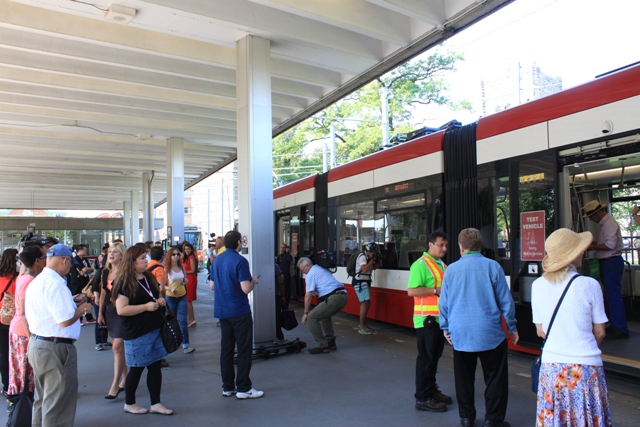
A: The TTC has placed two low floor streetcars at Spadina already. They can physically fit inside the station, although the lead module of the lead car would have to be positioned opposite the five pillars with glass curtains, and that the lead door would be on curved track with a wider gap between the vehicle and the platform. We are reviewing operating procedures and possible alterations that are necessary to allow two new cars to be on the platform at the same time if necessary.
This implies that the work to be done in August will be trackwork, not platform changes.
New Streetcars
Recently, I sent questions to the TTC about the status of new car production and the implementation of these vehicles. Here are the replies:
Q: What is the status of the order and when will production deliveries begin?
A: Production deliveries will begin in March.
Q: What will be the rate of deliveries?
A: As always planned, there will be a ramp up to the production rate of 3 per month (36 per year). Once stabilized at this rate there are opportunities to transition to a higher rate and this is currently under investigation.
Q: What effect will this have on planned retirement of the problem ALRVs before the next winter season?
A: ALRVs will begin retirement at the end of this year and throughout 2015 as more new streetcars enter service.
What is still unclear is how the TTC will adjust service on 504 King and 501 Queen as the ALRVs [the existing two-section streetcars] disappear from the fleet and these routes continue operation with the remaining CLRVs [the shorter, single-section cars].
Updated February 11, 2014:
Q: Are there outstanding issues still to be dealt with on the ramps in the new streetcars, or have whatever design tweaks were necessary been incorporated in the production versions we will receive?
A: There are still a number of outstanding issues to be resolved. The production vehicle will have the necessary structural changes made to receive the new ramps. However, there is a transition phase between cars going into revenue service and when the final version of the ramp is delivered. For a number of vehicles that will go into service, an interim ramp will be incorporated to improve on accessibility – with improved transition between the ramp, the door threshold and the interior car floor. The final production version will be lighter in weight, less demanding on the drive mechanism (hence more reliable), and will have faster deployment and retrieval times. Initial production cars that do not have the latest ramp configuration will be retrofitted with the final version as part of the configuration control process.
Capital Budget Cuts
Among the City-imposed cuts in the Capital Budget was a $10-million/year cut in surface track maintenance for 2014 to 2018 with an equal cut to subway track in 2019 to 2023. I asked about the effect of these cuts.
State of good repair, which track replacement is clearly part of, will not be affected. If we need to further cut the capital budget to do track work, we’ll find that money elsewhere.
Queen East Major Track Projects
Two major projects will affect streetcar service on Queen Street East this spring.
At Queen and Leslie, the new sewer line must be tied into existing infrastructure under Queen Street, and then the new special work for the track leading to Leslie Barns must be installed. Tentative plans are for this work to begin in mid-May and run to the end of June.
While Queen Street is closed, service will operate with bus replacements and streetcar diversions:
- A 501 Queen bus will run from McCaul Loop to Woodbine Loop (at Kingston Road) diverting around construction via Jones, Dundas and Greenwood.
- 501 Queen, 502 Downtowner and 503 Kingston Road Tripper streetcars will divert via Broadview, Gerrard and Coxwell.
- Carhouse trips for 504 King and 505 Dundas that now operate west from Russell Carhouse via Queen will use Coxwell and Gerrard.
Beginning at the end of June and running through July, the special work at Broadview and Queen will be replaced. This intersection is in poor condition with long-standing slow orders and one switch (west to north) permanently out of service due to a danger of derailments.
During this work, service will operate as below:
- The 501 Queen bus will divert via River, Dundas and Carlaw.
- 501 Queen, 502 Downtowner and 503 Kingston Road Tripper streetcars will divert via Parliament, Gerrard and Coxwell.
- 504 King cars will divert via Parliament and Dundas.
- Carhouse trips to Russell will continue to operate via Coxwell.
Normal service on all routes resumes in August.
King Street Diversion
New February 11, 2013:
Q: The 504 King diversion around construction at the Don Bridge is now listed as running to August due to additional work in the area. I understand that the track connection at Sumach to the new Cherry Street line is to go in this year. Will this be done while the 504 is on diversion (ie before August), or will there be yet another shutdown for this trackwork too?
A: The Sumach/King connection work is scheduled for March 30.
Transit Priority for Diversions:
Q: With the extended period of various diversions, why has there been no change to implement transit priority or at least advance greens for left turns at various locations?
A: We continue to work with the City on transit priority signalling. There are no new installations to date; where there, they are in use. Advance greens and the like is a question better put to the City.
I am meeting with Stephen Buckley, Toronto’s General Manager of Transportation Services, on February 12 and will discuss this issue with him.
[TTC comments provided by Brad Ross via email on February 7, 2014. Updates by email on February 11, 2014.]