TTC Board Meeting June 17, 2020

The TTC Board met on June 17, 2020 with several items on their agenda. Chief among these was recovery plan for the transit system as the effects of the Covid-19 lockdown recede and transit demand builds.

Updated June 18, 2020 at 1:30 pm: Charts from the service recovery presentation that were originally taken as screen captures from the meeting video have been replaced with higher resolution versions.

CEO’s Report

Many of the usual metrics for system performance are meaningless in the Covid-19 era because service and ridership are completely different from original budget forecasts. Even the “on time” statistics fail because the TTC reports this relative to scheduled times, not as a measure of service reliability. Detailed ridership tracking was reported separately under the Covid recovery report (below).

CEO Rick Leary reported that modifications to the operator’s area on buses are in development including extension of the plastic barrier forward to the windshield and altering airflow within the cab to be a “positive pressure” area where air is always pushing out rather than being drawn in from the main passenger area.

As reported elsewhere, the TTC is taking advantage of lower demand to accelerate capital and maintenance programs. The northern part of the Yonge subway (Line 1) will be closed for various periods during coming weeks including:

  • Sat/Sun June 20/21 all day: Sheppard-Yonge to St. Clair for Metrolinx construction at Eglinton and track repairs elsewhere.
  • Thu/Fri June 25/26 all day: Finch to Sheppard-Yonge for maintenance including ATC installation.
  • Sat/Sun June 27/28 all day: Finch to Lawrence for maintenance including asbestos removal and ATC installation.

The TTC has not announced whether completion dates for the ATC project will be moved forward thanks to the extra work.

The rebuild of streetcars to correct welding problems and other retrofits will also be accelerated with 19 more streetcars available for maintenance. This will allow the entire fleet to come up to standard 18 months sooner than originally planned.

Reliability of the streetcar fleet continues to improve. There are two measures of this with one based on contractual requirements (failures due to manufacturing issues) and one based on operational behaviour (including all failures). The contractual measure is running at over 70,000 km mean distance to failure on a monthly basis with the 12-month average sitting just over 40,000 and growing. The operational measure is running just under the 35,000 km target.

In the subway, vehicle reliability is mixed. On Line 2 BD, the T1 fleet is running far above the target level with MDBF values in the millions of vehicle kilometres compared to a target of 300,000. On Lines 1 and 4, the TR fleet is not faring as well. The 12-month rolling average is above the 600,000 target for this fleet (which is younger and therefore is expected to perform better), but numbers for both February and April 2020 were below the target, particularly in April.

The reliability of the electric bus fleet is improving although it is not yet at the 24,000 km MDBF target. The BYD fleet was still not in revenue service within the period of the report, and so no reliability stats for these vehicles are available.

The hybrid bus fleet is running at or above 30,000 km MDBF while the diesel bus fleet is at or above 20,000. It is not clear how much of the improvement is due to inherent reliability as opposed to the sidelining of problem vehicles in the fleet.

Covid Recovery / Bus Priority Lanes

Please see my previous article TTC Preps For Covid Recovery for a review of the main part of this report.

The Board considered this report together with a notice of motion regarding proposals for five bus transit priority corridors. Please see my article Transit Priority Lanes Can Help, But They Are No Panacea and other related articles for background analyses of the potential benefits and limitations of priority lanes as a way to improve bus service.

Covid Recovery

New information was added to the original report showing how demand is building across the TTC network.

Bus riding has been growing from its nadir in mid-April. Although 70,000 more boardings per day may not be much on the usual scale of TTC operations, it is a very large growth on a base of 288,000 (blue line in the chart below). Across the bus network, the TTC is now carrying on average 30% of its former load, a key point in the recovery where capacity and distancing requirements vie with each other. There is a growing problem with overcrowding relative to the current standard with 12% of trips now running about 15 passengers per standard sized bus, and 1.5% above 25 per bus. The system cannot handle more growth without a combination of additional service and social practices, mainly masking, that will improve safety on more crowded vehicles.

More service on Jane today than in Feb

The map below shows where the “hot spots” were in the bus network in mid-May when total boardings were at 25% of normal, and 7.6% of trips exceeded the 15/bus loading standard.

By June, this had evolved with over capacity conditions on several major routes. Many extra buses built into the May schedules were dispatched to supplement regular service, and on the key routes shown below, the scheduled service will be improved effective June 22. The TTC plans to have more service on 35 Jane in late June than it did in February, although this claim does not take into account the 935 Jane Express buses in the “before” service.

Eventually, the TTC will return to “100% service”, but this will be based on the count of vehicles, not simply a return to original schedules. Some routes still have weaker demand, and buses formerly assigned to them will be used to add service on the busy lines. The express bus routes serving the core where demand is weakest will remain suspended.

The TTC’s plan does not address the issue of using its considerable pool of spare buses to push service beyond the 100% level, nor of the degree to which the streetcar network can be fully operated with that mode once various construction projects are out of the way.

Although TTC management did not say this explicitly in the discussion, the move back to 100% service appears to be contingent on funding from the provincial or federal government that will insulate the City from the extra cost.

Bus Priority Lanes

According to TTC management, “significant” work has already been done with their City colleagues on the bus lanes which were proposed in the Five Year Service Plan last December. Eglinton East is the top priority, and there will be a report on it in July 2020. It is unclear just how quickly we will see detailed proposals for other corridors, especially with a desire by some affected Councillors to have public consultation, and the very real possibility that opposition to these lanes will block their implementation.

The TTC does not help its own argument on this point.

Staff advised that the Eglinton-Kingston-Morningside lane would save 7 buses overall for the routes operating in this corridor, and spoke first of this as a budgetary saving, not as an opportunity for improved service. This is exactly the same position staff took in the early days of the St. Clair proposal where residents and riders were dismayed that after so much upheaval there would be no improvement in service.

This position does not align with the statements by Commissioner Brad Bradford who spoke of “flooding the street” with buses taking advantage of the new transit priority, and while that may be a great sound bite, it does not reflect what the TTC is likely to do, or can do with limits on its fleet and staff constraining bus network growth. Moreover, a 7 bus saving is not a huge change at the scale of the full network. This is unsurprising given that the likely change in travel time is not going to bring as much saving as many think.

Bradford asked how the transit priority scheme would help in the Covid fight, and again staff’s response was lacklustre claiming that shorter travel times would reduce the time spent on board, rather than speaking to improved crowding conditions through additional service.

There is a stark disconnect between the hoped-for benefits of transit priority for riders and the manner in which the TTC appears poised to scoop any savings in the budget, not for better service.

Bradford spoke of the importance of the bus  network and the “underserved” neighbourhoods where bus lines run. It is odd for a TTC Commissioner to openly talk of “underserved” areas while the very Board and Council he sits on refuses to address the problem of bus route capacity.

The hoped-for September 1 implementation will be a stretch for anything beyond one corridor, and that with little more than paint and signs.

Commissioner/Councillor McKelvie proposed an amendment that the study of future corridors also include Lawrence East from Victoria Park to Rouge Hill. The report with this amendment passed unanimously.

Rider Attitude Survey

The Covid recovery report includes an extensive section on rider attitudes and the potential recovery of transit demand. I will deal with this in a separate article.

Streetcar Track Noise at King and Sumach

An ongoing issue at the intersection of King and Sumach has been streetcar noise and vibration ever since the Cherry Street branch began operation. Several issues contributed to this problem including wheel squeal on curves and noise from track switches tongues “slapping” in their castings as cars passed over them.

Various changes have been made to address components of the problem, but more work is pending.

  • With the removal of CLRVs from Cherry Street service, the noisiest cars were no longer making turns at King and Sumach.
  • A wheel lubricator was installed at Distillery Loop, although this is of no benefit for cars turning east to south off of King.
  • Wheel vibration dampening rings have been installed on 10 streetcars and these reduced noise on curves by 5-7 dBA. A further 60 cars will receive dampeners over 2020, and the rest of the fleet will be completed in 2021. Cars with these devices will be assigned to the 504A King route to the Distillery.
  • On board wheel lubricators are already installed on the first half of the fleet, and the TTC plans to add them to the remainder.
  • Curve track geometry has been adjusted, and will be further refined as part of the 2021 Capital Budget plan for track repairs.
  • Switch tongues that did not sit flush have been ground to reduce the slapping effect as cars pass over them.
  • A new design for flexible switch tongues is under review with plans to install one on the trailing eastbound switch where noise has been a problem. A trial installation is already in place at College & Lansdowne eastbound.

Although King & Sumach has been the focus of complaints and testing, many of these changes will benefit the streetcar system as a whole.

Waterfront LRT Design

The TTC Board approved a contract for $15 million for design work on the underground portion of the proposed Waterfront East LRT/streetcar extension. This work is being done jointly with Waterfront Toronto who are responsible for the surface portion of the route from a portal near Yonge Street to Cherry Street including a connection to the existing Distillery Loop.

This contract will take the design of the underground portion to 30% with a project cost estimate leading to a request for Council approval in the second quarter of 2022. Whether this project will actually proceed remains to be seen.

Part of the work will involve staging plans to determine whether and how the project can be built to stretch out spending based on the rate of growth of demand in the eastern waterfront. This statement was a bit puzzling considering the scale of changes required at Union and Queens Quay Stations including lowering the track elevation to provide more space for air circulation to meet modern fire code.
Starving the Bus Network for Service

My recent article for NOW Toronto, TTC Bus Service Losing Ground, reviewed the problem of passenger congestion on TTC bus routes and the long-standing failure of service to keep up with the rising population and employment in Toronto. This article presents the details and the wider context.

When Transit City was proposed back in 2007, the TTC expected that over the course of its implementation a large number of buses would be replaced by an LRT network that would, by today, be substantially complete. In turn, this would reduce the need for new bus storage and maintenance facilities because the growth would occur in suburban LRT barns at the Mount Dennis yard on the Eglinton line, on Finch near Highway 400, and on Sheppard East at Conlins Road.

One new garage was planned in Scarborough, although the project was delayed by Mayor Rob Ford. The garage on McNicoll will finally open late in 2020. However, the demand for storage space at existing overcrowded garages simply means that McNicoll will be full the day it opens and the TTC will be back in a situation where fleet expansion requires garages to have more buses than they were designed for. A ninth bus garage sits in the long term plans with a 2031 opening date, but there is no funding for it and the TTC has yet to identify a potential property. They will remain short of garage space for the coming decade.

This creates an odd sort of response to requests for more service: we have no place to store the buses. That, of course, is a chicken-and-egg situation where the TTC (and the City) can avoid the cost of providing more service by claiming that they couldn’t run more buses if they wanted to. Unfortunately, this does not accelerate the provision of more garage space, and the service vs storage deadlock remains.

The amount of service the TTC fields every day is affected by several factors:

  • the size of the fleet
  • the average capacity of a bus
  • the average age and reliability of the fleet
  • the proportion of the fleet needed for maintenance spares
  • the number of buses required to supplement the streetcar network
  • the number of buses reserved for extra service, especially to handle subway emergencies
  • the budget for service

As the TTC migrated from a fleet of high-floor to low-floor buses, the capacity of vehicles dropped by about ten percent. This meant that more buses were required to provide the same level of service, a process that occurred gradually until late 2015 when the last of the high-floor buses were retired. Conversely, low-floor two-section articulated buses can carry about 50% more passengers than a standard bus. These vehicles began to appear in the TTC’s fleet in 2014, but they make up less than 10% of the fleet today. The only planned expansion is for the TTC to buy 68 more in 2021.

Older buses tend not to work as reliably as young ones, and if a fleet is not regularly replaced, a higher proportion of it can fall into those “twilight years” when maintenance needs are higher and buses are more likely to fail in service. The TTC used to keep its buses for about 18 years and overhauled them twice during their lifespan. The argument for this was that the overhauls were cheaper than simply buying a new bus.

However, the bus building industry no longer produces vehicles with a long intended lifespan, and 12 years is a more common retirement age. This also avoids the need for that second overhaul to keep an older bus on the street.

The TTC has shifted to a 12 year replacement cycle for buses, and took advantage of federal “stimulus” funding to replace many older vehicles that otherwise would have remained in service. This gets over the one time “hump” of changing to a shorter life-cycle, but it also accelerates the need for ongoing spending because the annual replacement rate is now 50% higher – about 180 buses per year, rather than 120. This budget effect is compounded by the shift to more expensive hybrid or all-electric vehicles.

The newer generation of buses is also more technically complex, and a larger proportion of the fleet is required for spares to ensure that maintenance is preventative, fix-before-break work rather than gambling that a bus will continue to run even after it should have come into the shop for a check-up. A few years ago, the TTC changed its maintenance practices so that buses cycled through routine inspection and repair more frequently with the aim of reducing in-service failures. This had the desired effect, but at a cost of taking a larger maintenance pool from the fleet than in past years.

Finally, new buses often go through retrofit programs during their warranty period, and this further increases spare requirements if there is a sudden influx of new buses in a short time period.

That’s just the story on the maintenance side, but there is also the dreaded line whenever service is discussed: “subject to budget availability”. In other words, even if there are enough buses to improve service, there may not be the operating budget dollars (and the drivers this would pay) to actually field more vehicles.

Both the streetcar and subway networks make demands on the bus fleet.

It is no secret that the TTC has had problems with both its old and new streetcar fleets, but the biggest problem now is that growing demand on the streetcar routes exceeds the capacity of the new streetcar fleet.

  • When there were too few streetcars to operate that network, buses substituted to make up the difference.
  • Traffic congestion continues to worsen leading to slower service.
  • Construction projects shut down parts of the streetcar network from time to time.

At various times over recent years, there have been buses running on portions of Carlton, Dundas, Queen, King, Kingston Road and Bathurst. Some of these cases have been complete replacements while others are on portions of lines affected by construction.

With the streetcar shortage, construction work provided a rationale to bus a route and free up vehicles, but this grew beyond beyond construction season to semi-permanent replacements.

During the summer, the TTC has surplus vehicles and streetcar substitutions do not affect the availability of buses on bus routes.

Long-running projects (such as the water main reconstruction on Dundas) and route conversions due to a shortage of streetcars (such as on Kingston Road) are another matter. These take buses away from the bus network during the peak season. That said, the number of buses involved has been overplayed in some circles primarily as a way of carping about the Bombardier cars or about streetcars in general.

Subway shuttles place their greatest demand on the bus fleet when emergencies occur during the peak period. There are some vehicles at each garage that are “run as directed” buses, but these are nowhere near enough to make up for losing a busy part of the subway system. If there is a peak period shuttle, it requires not just the spare buses but vehicles and operators “borrowed” from other routes.

There is always a balancing act between having enough spare buses and staff to drive them for most emergencies, and the cost of having unused resources that are always a target for the budget hawks looking for “waste” in the TTC.

All of these factors affected and constrained the growth in bus service over the past decade, and will continue to do so without a significant change in TTC planning and funding policy.

Continue reading →

TTC Board Meeting: February 25, 2020

The TTC Board meets on February 25 to discuss several reports and proposals. Among items on the agenda are:

I will add to this article following the Board meeting with additional information from the discussions.

Notable by its absence from the CEO’s Report is any information on route crowding or improved metrics for service quality.

Trials of electric buses are in early days, and Toronto is a long way from seeing an entirely zero-emission fleet. My column this week in NOW Toronto present some of the history of evolving bus technology.

Commissioner Brad Bradford has a Notice of Motion which seeks to link spending on improved transit service to potential funding for new vehicles. While the recently improved City Building Fund provides more money for transit vehicles, this covers only one third of their cost and none of any future increase in operations. Bradford’s motion requests:

The TTC Board request that the TTC Chief Executive Officer, when engaging in negotiations with the provincial and federal governments for funding for the TTC’s vehicle procurement priorities, tie funding requests to the implementation of the TTC’s 5-Year Service Plan and service levels as prescribed by the strategy.

There are two problems with this stance.

First, if the TTC and Council choose not to actually fund the added service, this would imply that the capital funding should not come from other governments. I doubt that is Bradford’s intent, but the real issue is that there is no Council commitment to fund better TTC service. Other factors such as the jump in operating budgets to fund new lines such as Eglinton Crosstown and increased fare subsidies could crowd out spending on service.

Second, the scale of service increases proposed in the Service Plan is quite modest, and it really should be revisited. Sadly, the TTC chose not to include more aggressive options for expansion in the Plan even if only on an aspirational basis. Back in 2003, the strength of David Miller’s Ridership Growth Strategy was that it addressed what Toronto could do for modest increases in spending, but this approach has never been repeated.

Bradford also has a Notice of Motion that seeks to consolidate updates on two reports so that both sides of the revenue protection and enforcement issue can be seen by the Board together.

  • Auditor General’s Report – Review of Toronto Transit Commission’s Revenue Operations
  • Ombudsman Toronto Enquiry Report Review of the TTC’s Investigation of a February 18, 2018 Incident Involving Transit Fare Inspectors

Further discussion of fare issues and Presto are likely at the meeting.

TTC Board Meeting Wrap-Up: January 27, 2020

The TTC Board met on January 27 with a full agenda and several reports of interest including:

Despite its importance, the air quality study report was squeezed out for time and there was no discussion. I will turn to this in a future article with additional information from background reports.

CEO’s Report

The CEO’s Report also received only brief consideration by the Board. Among items of interest:

  • Although year-to-date ridership for 2019 to the end of November was below budget, the trend has been upward since the summer.
  • Presto ridership accounted for 394.2 million of the 484.6 million rides taken during this period, or 81.3%. Now that sales of “legacy” media have ended, the TTC expects that this proportion will grow over 2020.
  • Reliability of the new Flexity streetcars continues to be high based on contracted requirements. The “operational” metric, which includes issues that are beyond the manufacturer’s control, is running at a much lower rate and fell slightly in November. A target for this value will be established through a peer review of vehicle performance.
  • Reliability of the CLRV fleet continued to fall through November reflecting the age of the cars and the limited maintenance that cars near retirement would receive. This could be among the last reports in which the CLRVs appear as part of the fleet and service review.

The usual metrics about service quality (“on time” departure from terminals, short turns, etc.) are in this report, but the CEO advised the Board that these will be revised early in 2020. I will comment on the new charts and metrics when they appear.

Capital Investment Priorities

For details about this report, please refer to my articles:

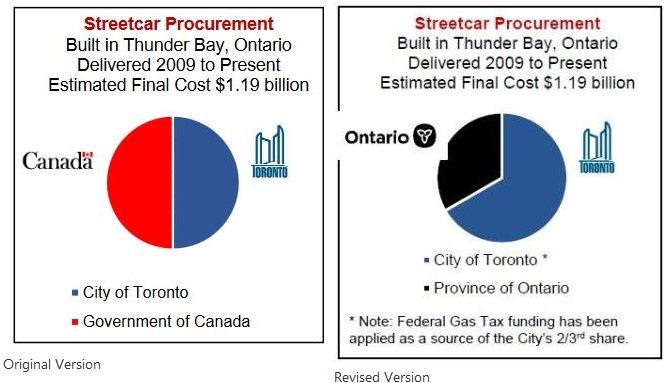
The version of the report now posted on the TTC’s website includes an amendment to the chart showing how the Flexity streetcar order was funded. The Canadian government of the day, through the “Honourable” John Baird, famously told Toronto to “fuck off” when they sought a federal contribution, although he later apologized. As a fig leaf to hide their embarrassment, federal gas taxes were allocated by the City to this project.

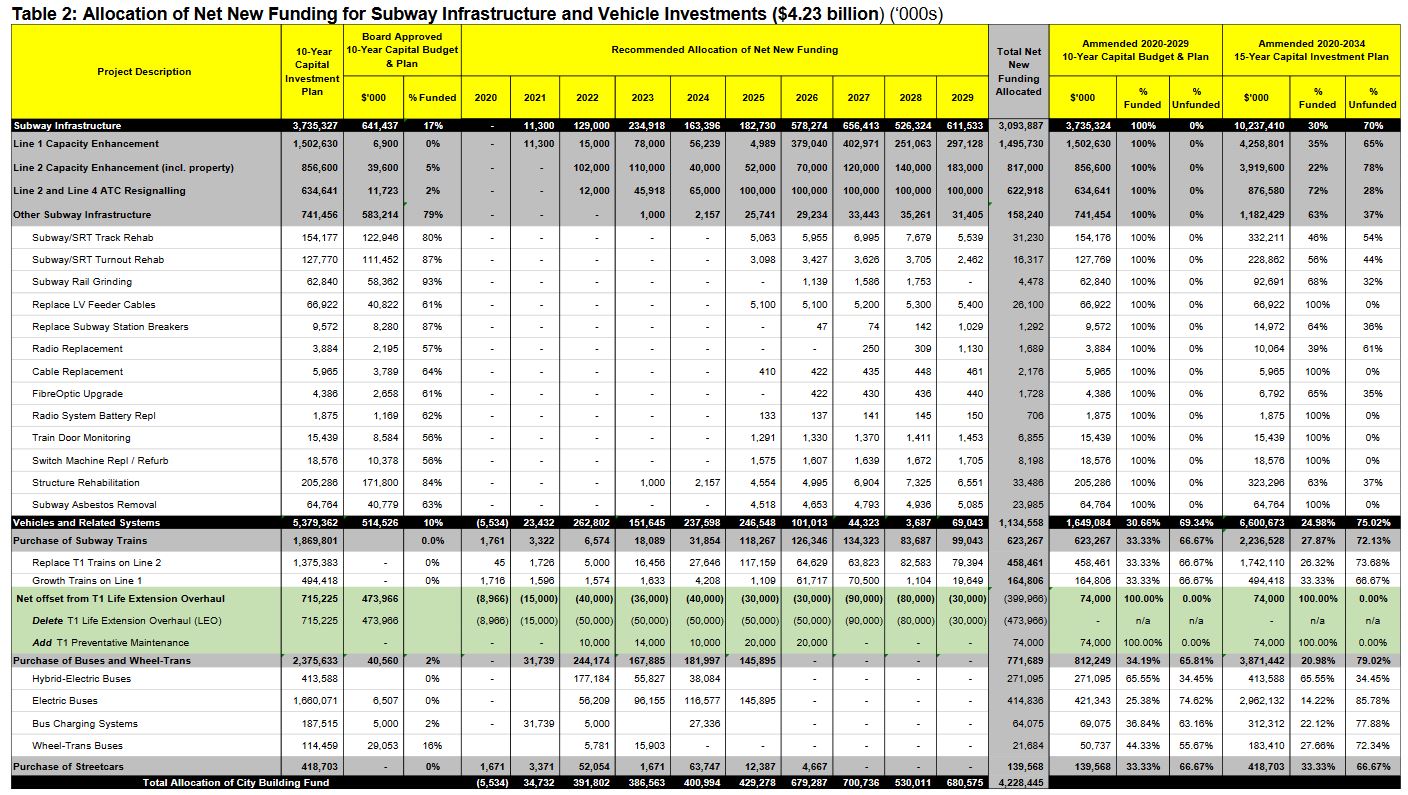
Discussion of the report covered a lot of territory, and some Board members were confused about just which projects were fully funded and which were not. The problem lies in the way the information has been presented. Spending is cited for the ten year capital plan, but in many cases a project’s timelines extend beyond that horizon. There might be “100 per cent” funding for an initial stage of a project, but not for the whole thing. As the chart below shows, the spending on Subway Infrastructure, $3.7 billion from 2020 to 2029, is fully funded, but there is a further $6.5 billion lurking in the unfunded portion from 2030 onward. The degree to which various line items are funded over the full 15 year span varies with the lowest among them, the Line 2 Enhancement, sitting at only 22%.

This gives the short term impression that Toronto is well out of the woods, but in fact we have only reached a clearing.

The distinction between the “fully funded” subway projects and the one third funding allocated to surface vehicle projects was not lost on the Board. Ironically, it is with surface improvements that riders (and taxpayers) can see changes fairly quickly, but the plan is not organized to achieve this.

Some Commissioners argued that a way forward with streetcar purchases should be found, while others were concerned with the bus fleet.

Staff advised that a report on buses including an update on the electric bus test program will come to the March 2020 Board meeting. However, there is no meeting scheduled for that month. I have asked for clarification on this issue.

Councillor Carroll, with an amendment by Deputy Mayor Minnan-Wong, moved and the Board approved:

1. That the TTC Board directs the TTC CEO to submit to the May 2020 TTC Board meeting a business case analysis for action on an expedited procurement plan for 20 and up to 60 streetcars included in the revised 2020 Capital Budget.

2. That the TTC Board directs the TTC CEO to report back to the Board by Q3 2020 on a vehicle procurement strategy for implementation to be included as part of the 2021 Capital Budget for the outstanding vehicles identified in the revised 2020 Capital Budget.

The motion originally spoke of only 20 streetcars (the portion funded in the plan), but Minnan-Wong argued against this on the grounds that a small order would have a higher unit cost, and that this would be a de facto sole source purchase. He is hoping for a larger order to attract interest from bidders other than Bombardier, and his amendment expanded the scope of the review to 60.

Councillor Carroll noted that the wording of this motion was worked out in discussions over the past weekend with both the CEO and the Mayor’s Office, and so the ground had been prepared.

The second part of the motion addresses the general issue of vehicle procurement and budgeting, and directs staff to include this in the 2021 Capital Budget. The purpose of this is for the TTC to maintain control of the discussion rather than ceding ground to City staff and Council. Previously, TTC management recommended a longer timeframe with a 2022 target, but this leaves important discussions of system planning, supposedly a crucial issue, in the background for far too long.

A key issue, mentioned by nobody, is that there is money in two City reserves for transit that have not been allocated:

  • The Scarborough Subway Levy, at 1.6% on the property tax, was supposed to finance the City’s share of the Scarborough extension, a project that has been taken over by the Province. It is unclear how this money will be used.
  • The original City Building Fund was to finance the City’s Smart Track contribution to the Metrolinx GO RER program. However, the actual scope of that program may change, and it is not clear that all of the SmartTrack stations will be built. With the three-stop Scarborough subway extension, the need for a Smart Track Lawrence East Station disappears, and the Gerrard Station may conflict with the Ontario Line.

With Metrolinx looking for developer contributions to station projects, it is not clear which Smart Track stations still are viable even with the City contribution.

To underpin calls for federal and provincial support of Toronto’s transit projects, Commissioner Di Laurentiis moved and the Board adopted:

That TTC staff conduct an economic benefit analysis in partnership with appropriate City staff that will identify the specific and broad underlying impetus that a properly funded and maintained Toronto transit system provides to business competitiveness and job creation in the Toronto region specifically, and Ontario as a whole.

The whole package now moves through the City’s Budget Committee to the Council meeting on February 19.

Automatic Train Control Alstom Contract Amendments

The report on the public agenda includes a substantial history of the ATC project on Line 1 Yonge-University including the changes in project scope and timelines. The current project schedule was approved by the Board in April 2019 (See: Automatic Train Control Re-Baselining and Transit Systems Engineering Review in Attachment 2, p 11 of the pdf.)

The current report provides funding for the revised scope, although the dollar value of this is not public.

Commissioner Lalonde moved an amendment that was adopted by the Board:

That staff conduct an extensive lessons-learned review of the Automatic Train Control (ATC) project prior to presenting a business case for the implementation of ATC on Line 2.

While a thorough review of major projects such as ATC are definitely worthwhile, there is a timing issue here. The Line 1 project is not supposed to be fully implemented until September 2022 and this coincides with the point where work on the Line 2 project is supposed to begin (see spending plan in the table above). The review really needs to be underway well before full implementation in order that the Line 2 project is not delayed.

Related issues are the timing of new subway car purchases and construction of a new yard for Line 2 relative to the timing of the Scarborough extension project. This is now pegged at 2029-30 in provincial plans, but there is strong pressure to pull this back closer to the original 2026-27 timeframe. Such a move would have a domino effect on the Line 2 renewal.

Keele Yard Derailment

On the morning of Wednesday, January 22, 2020, subway service on Line 2 was severely disrupted by a derailment at Keele Yard.

Four trains originate from this yard early in the day, and the fourth of these was pulling onto the main line when one axle on the fourth car of the train derailed. The train was already foul of the main line, and it was impossible to maintain service. 116 buses provided a shuttle between Jane and Ossington Stations. This disrupted bus service on other routes as vehicles and operators were redirected to the subway shuttle.

Staff report that preliminary investigation shows that two factors in combination were responsible:

  • Localized wear on rail at a switch
  • A new wheel on the axle that derailed

The wheel, with less wear than would be found on a typical wheel, was able to climb over the worn area in the track rather than following it.

Use of Keele Yard has been discontinued pending a complete review of tracks there and repairs/modifications as needed.

Presto Contract Discussion

The ongoing dispute with Metrolinx over the Presto contract continues, and this was discussed in the morning’s private session. An intriguing tidbit raised by Deputy Mayor Minnan-Wong was that the TTC had made a Freedom of Information request to Metrolinx, but this was rejected. If negotiations have reached that level, this process is neither harmonious nor is it likely to be resolved soon.

TTC Announces Capital Spending Plan For City Building Fund (Update 2)

Updated January 23, 2020 at 12:10 pm: The TTC has responded to queries about the acquisition of land for new yards for subway lines 1 and 2. The updates are flagged within the text of the article.

Updated January 27, 2020 at 9:30 am: The section on new streetcars has been corrected to state that 60 more cars is the limit on what the TTC could handle, including the use of Exhibition Loop for storage and the renovation of Harvey Shops at Hillcrest as a carhouse for central routes like 512 St. Clair. Previous text stated that 20 was the limit on fleet growth.

The TTC has released a report detailing its planned spending of the newly-allocated funds from Toronto’s City Building Fund. This will be discussed at the TTC Board meeting on January 27, and will go to Toronto Council for incorporation in the 2020-2029 Capital Budget.

Major changes in capital spending include:

  • A return to renewing and upgrading Line 2 Bloor-Danforth as a project for the current decade. This work had been postponed thanks to a lack of funding and, until recently, was replaced with a proposed overhaul of the existing T1 fleet aimed at an eventual lifespan of 40 years. Replacement of the 1960s-era signal system with Automatic Train Control (ATC) has also been restored so that new trains, not to mention the Scarborough extension, can operate under modern technology within this decade.
  • Additional funding for capacity enhancement on Line 1 Yonge-University-Spadina.
  • A large commitment to bus purchases including electric vehicles.
  • Partial renewal of the Wheel-Trans bus fleet.
  • Purchase of 20 new streetcars.

Three quarters of the newly-available funding goes to subway renewal, and even then, the subway projects will require additional money to be completed. Many items in the TTC’s 15 Year Capital Plan remain unfunded, and there are obvious opportunities for generous governments to come to the table and fund aspects of the plan.

Line 2 Renewal

When the TTC deferred the projects associated with Line 2 Renewal, they created a potential collapse of that route thanks to aging vehicles and infrastructure. The T1 trains serving Line 2 were delivered between 1995 and 2001, and replacement of them should have begun in the mid-2020s corresponding to their 30 year design life. The alternative plan to extend this by 10-years depended on an as-yet unproven major overhaul. If the TTC has learned anything from its experience with the streetcar fleet, there are limits to the new life that can be breathed into old equipment especially if the overhaul is more cosmetic than a thorough replacement of technical components.

The other major component of Line 2 Renewal is the replacement of the signal system which dates from the mid 1960’s. If this did not get underway within the coming decade, the TTC could be left with a 65 year old signal system on Line 2 and all of the reliability problems that represents as we know from experience on Line 1. The non-ATC territory on Line 1 dates from the early 1950s (from Eglinton south) to the early 1970s (north to Finch), and problems with this technology are a common source of delays. (ATC will be extended “around the U” from St. Patrick to Queen Station within the first quarter of 2020, and the section from Queen to Rosedale will follow later in the year. Completion to Finch is scheduled for 2022.)

An important factor in plans for Line 2 is the timing of the Scarborough Extension originally planned for 2026, but now pushed out to 2029-30 in Provincial plans. This extension should be built and operated with modern trains and signalling technology, but deferral of the Line 2 Renewal would have meant that the extension to Sheppard would have to be built with provision for co-existence of old and new trains and signalling. This is precisely the sort of plan that complicated the Vaughan extension which, astoundingly, did not include ATC in its original design.

The plan now calls for 62 new trains for Line 2 for delivery between 2026 and 2030. This is a full replacement for the existing fleet and considerably exceeds the 46 peak trains now required for the line even allowing for 20% spares making provision for future growth. There is also the matter of additional trains for the Scarborough extension, although these should be funded by Ontario as part of that project. Whether they actually will be is another matter.

The money allocated from the City Building Fund will only pay for one third ($458 million) of the anticipated cost of the new trains. This is a clear invitation for joint funding from other governments.

The T1 fleet will receive a minor overhaul necessary to extend its life until the new trains arrive.

There is an odd description of this project in the report’s recommendations:

$458 million, representing approximately 1/3 of the 10-year cost for 62 trains, to replace the legacy fleet of T1 trains on Line 2 required for delivery in 2026 through 2030, and which will require an additional $122 million to fund the 1/3 cost between 2030 and 2034. [p 3]

It is not clear whether all of the trains are supposed to arrive in Toronto by 2030 (which would fit with the completion of ATC conversion and opening of the Scarborough extension), or in later years as the funding described above implies. The yearly spending breakdown clearly shows the majority of the spending on new Line 2 trains beyond 2029, and this does not fit with the renewal plans. (See chart at the end of the article.)

The ATC project for Line 2 now lies in the same period as the delivery of new Line 2 trains so that by 2030 the trains, the signals, and the extended subway are all running up-to-date technology.

Line 2 will also require a new carhouse on land that the City of Toronto is acquiring (or may already have bought) southwest of Kipling Station, the old Obico Yard. The plan provides for acquisition and design, but not yet construction which is unfunded.

Updated January 23, 2020: In response to a query about the status of the city’s acquisition of Obico Yard, the TTC replied:

Yes it has already been acquired by the City but the market value assessment is being contested so funds are being secured for potential settlement. We’re also in negotiations to secure a second parcel of land to maintain access to the site. [Email from Stuart Green, Jan. 23/20]

Greenwood Shops will require changes to host new 6-car trains similar to the TRs now operating on Line 1. Originally, the plan was for this yard to be the carhouse for the Relief Line as well as for some of the work car fleet. The detailed plans for Greenwood are not included in this report.

Other funding for Line 2 includes a variety of projects in the state of good repair category that were previously unfunded, but most importantly the upgrade of the power supply system which needs both modernization and additional capacity for projected extra load from more trains.

Even with all of the new money, there is still a funding gap to complete all of the work that has been identified.

Line 1 Renewal and Upgrades

The existing TR fleet serving Line 1 does not require replacement within the timeframe of the Capital Plan, but more trains are needed to provide additional capacity on the route. The report allocates $165 million to one third of the cost of 18 trains to be delivered in 2026-2027. Again, this is a clear budget provision for other governments to come to the table with funding.

The compete conversion to ATC in 2022 will allow a reduction in round trip time on Line 1 so that the existing fleet can provide slightly more frequent service, but the proposed additional trains will allow full exploitation of ATC’s capabilities.

This, however, triggers capacity problems with stations, notably at Bloor-Yonge but also at major stations downtown where the flow of passengers to and from platforms will increase with more frequent service. As on Line 2, there is a need to upgrade power supply systems both to bring infrastructure up-to-date and to provide added capacity for more frequent service.

Also, as on Line 2, there is a gap between the funding allocated and the total cost of various projects.

Line 1 will require a new subway yard, and the TTC proposes to acquire land for it in York Region and design the facility. Why this is part of the Toronto City Building Fund spending is a mystery.

Updated January 23, 2020: In response to a query about Toronto paying for a yard that would be on the Richmond Hill extension, a provincial project, the TTC replied:

Referring to page 14 of the report, it is projected that additional vehicles beyond the 18 trains required in 2026 will be needed for growth of TTC’s existing system. As pointed out, the additional trains serving the Line 1 extension into York Region will also require new facilities for storage and maintenance. The TTC and MX are working together to scope requirements both independently and for a joint solution that meets the needs for Line 1. Whether the land can be found to serve future needs of both Line 1 Extension and TTC’s future growth needs remains to be seen but either way we need to budget for land. [Email from Stuart Green, Jan. 23/20]

Line 4 ATC

The plan include provision of ATC on Line 4 Sheppard. The trains there are ATC-capable, but software changes are required for the 4-car consists to move over the rest of the subway system which is designed for 6-car trains. This becomes an issue once ATC on Line 1 extends north of Davisville Yard where Line 4 trains are serviced.

Buses

The plan allocates $772 million to the purchase of buses and associated infrastructure:

  • $686 million for the procurement of 614 of the estimated 1,575 new buses required over the next decade.
  • $64 million for eBus charging stations at garages.
  • $22 million for the purchase of 232 Wheel-Trans buses of the estimated 498 required.

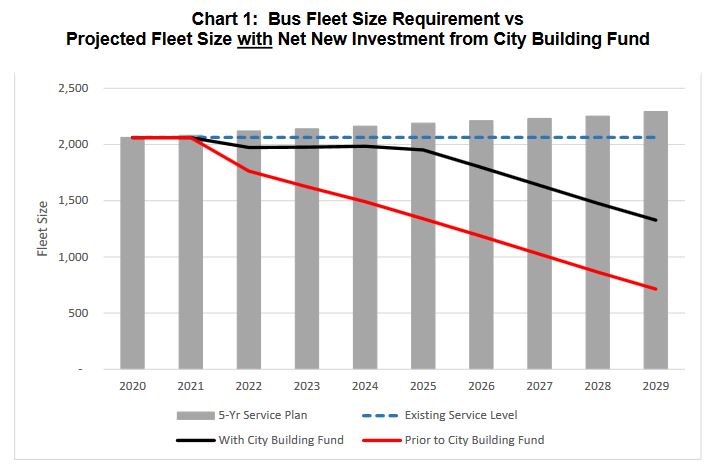
As with the subway projects, the bus projects require additional funding. There is a further problem in that the existing fleet will reach its retirement age, and without full funding, the number of vehicles available for service will drop precipitously as shown in the chart below.

The TTC has not yet published a consolidated plan for the conversion of its bus garages and fleet from diesel/hybrid to full electric operation, and so we do not know what other capital requirements lurk in future years to complete this work.

Streetcars (Corrected)

The report retains the proposal from the 15 Year plan for 60 more streetcars, but as with many other aspects of the scheme, only allocated funding for one third of this project, or 20 cars. As with so much else in the report, this is a clear invitation for participation by other governments.

These 60 cars would take the TTC to the limit of what it can handle with existing carhouses, including conversion of Harvey Shops as a small carhouse for central routes and the overnight storage of cars at Exhibition Loop.

20 cars would bring the total fleet to 224 assuming that the warranty repairs on the existing fleet will be completed by the time new cars arrive. This would support a peak service of about 186 cars assuming 20% spares, or 26 cars more than the current peak streetcar service. This would allow full restoration of the streetcar system, but would not leave much room for improved service, and the remaining 40 cars in TTC plans should not be ignored, let alone another 40 projected for growth in the 2030 timeframe.

A related issue here is the status of the Waterfront LRT extensions east to Cherry and south to Villiers Island, as well as west to the Humber Bay. More cars will be required for these extensions and that will add to pressure for carhouse space.

Miscellaneous Subway Infrastructure

The plan includes considerable spending in the second half of the 2020s on state of good repair for subway infrastructure. This relieves a looming problem where the subway could begin to fall apart through lack of maintenance and the attempt to worn-out equipment in service. The plan also accelerates work such as asbestos removal as part of overall efforts to improve subway air quality and as a prelude to structural renewal for the aging tunnels.

Overall Spending Plans

The chart below shows the overall capital plan including the detail of the subway infrastructure spending. This is not the total budget, only those portions paid for through the City Building Fund. The TTC’s shopping list for additional contributions is quite clear with many of these lines only partly funded from the CBF.

Indeed, there is an implicit assumption that many of these works can be launched with the expectation of more funding to come, a lot of which is not even required until after election cycles at all level of government. Will our future masters will be more inclined to fund transit?

Toronto Budget 2020: More Transit Money, But How Will It Be Used?

The City of Toronto launched its 2020 budget process on January 10, 2020 with a presentation by senior management and a short question-and-answer session with some members of Toronto Council. At this point, the material was quite high level, including some management puffery, but the real meat of the budget lies in the departmental and agency Budget Notes to be discussed at meetings on January 15-17. The TTC budget will be discussed on January 17.

Useful links:

Major Issues

Much has been made of the City Building Fund and its rising property tax levy to finance substantial growth in the TTC and Housing capital budgets. The changes to the TTC’s ten year capital plan between its original launch in December 2019 and the version presented in the January 2020 Budget Note are detailed later in this article. Within those changes are two major categories:

  • It was only one year ago, that TTC management proposed, and the Board approved, a significant change in the timing of Line 2 Bloor-Danforth renewal pushing out the installation of Automatic Train Control, construction of a new yard and purchase of a new fleet by a decade. The new Capital Plan shifts this work back into the 2020s and better aligns with the timing of the Scarborough Subway Extension. It also removes a reliance on older technology whose longevity was uncertain, notably the signal system.
  • The original Capital Plan included no money for new vehicles beyond purchases now in progress. There is a new item for “Vehicles”, but this is not subdivided by mode. Significant spending is budgeted for 2022 and beyond. Expanding any of the fleets also triggers a need for garage/carhouse facilities and there is a substantial increase in the planned spending on facilities.

On the Operating budget, the changes are much more modest because the additional revenue mainly keeps up with inflationary pressures, but does not go beyond for an aggressive expansion of service.

The TTC plans to hire 88 more operators and has budgeted more service hours, but the purpose of this is described differently depending on which part of the budget report and presentation one reads/hears. In December 2019, the Operating Budget and its presentation talked of relieving overcrowding that placed some routes beyond the Service Standards. However, the same addition to the Service Budget is used to handle other factors and the list makes no mention of reduced crowding.

I await clarification from the TTC on this important issue – does the TTC plan to reduce crowding or not? Will they burn up new service hours mainly to pad schedules for better service “resiliency”, or will they actually add service on overcrowded routes?

Continue reading →

Streetcar Service During the CLRV Era

With the retirement of the CLRV fleet on December 29, 2019, this is a good time to look back at how service on the streetcar network has evolved during the lifetime of those cars.

When they first entered service on the Long Branch route in September 1979, the new cars marked a real sign that Toronto was keeping its streetcar system.

Although Toronto decided to keep streetcars in late 1972, there was no guarantee that without renewal of the fleet and infrastructure the system could last very long. The last-built cars in the PCC fleet (the 4500s) dated to 1951 and, despite their simplicity compared to what we now call “modern” cars, they would not last forever. Second hand cars from other cities were older than the most recent “Toronto” cars. They were retired over the years even while the TTC undertook major overhauls on its own, younger fleet.

In 1980, the streetcar service was still dominated by PCCs as much of the CLRV order was still to come, and the ALRVs would not arrive until the late 1980s.

Yes, I know. What are all of those acronyms? Not every reader is a die-hard railfan with all of this information at their fingertips.

PCC: The President’s Conference Car was the product of work by a consortium of street railways to update streetcar design in competition with the rise of the private automobile. This was a large research project, especially for its time in the 1930s, and it produced a totally re-thought vehicle. The TTC was working with Hawker Siddeley on an updated PCC design in the mid-1960s, but nothing came of this thanks to a provincial fascination with new, high-tech transit. A license agreement for updated PCC patents held, in the 1960s, by the Czech manufacturer Tatra was never signed, and work on a new PCC for suburban routes stopped.

PCCs on King Street at Atlantic Avenue

CLRV: The Canadian Light Rail Vehicle. This car was designed partly by the TTC and partly by a provincial agency, the Ontario Transportation Development Corporation (later renamed as “Urban” to remove the explicit local reference). The design, from the Swiss Industrial Group (SIG), was very different from the car the TTC had worked on, but the UTDC needed a viable product after their magnetic-levitation project ran aground with technical difficulties. As a city streetcar, it was overbuilt in anticipation of high-speed suburban operation, notably in Scarborough. That scheme was supplanted by what we now know as the “RT”.

CLRV at High Park Loop

ALRV: The two section “Articulated” version of the CLRV was designed to run on heavy routes, notably the Queen car. These vehicles were never as reliable as the original CLRVs, and they were the first to be retired. At various times over the years, they ran on Queen, Bathurst and King.

An ALRV at “Old” Exhibition Loop

Flexity: This is the generic product name for Bombardier’s low-floor streetcars. It exists in many formats with Toronto’s version being designed to handle tight curves and steep grades. Delivery of the 204-car fleet was almost complete at the end of 2019.

Flexity on King Street at University Avenue

When the TTC decided to keep streetcars in 1972, they were still enjoying a long period of post-war ridership growth with constant expansion into the suburbs of bus and subway lines. Getting new riders was a simple task – just run more service. The downtown streetcar system was still bulging with riders thanks to a stable population and a robust industrial sector.

By 1980, however, the TTC hit something its management had not seen before, a downturn in ridership, thanks to the economic effect of the first Middle Eastern oil war and its effect on energy prices. Although the TTC continued to grow through the 1980s, a mindset of running just enough service to meet demand took over. This would be particularly unfortunate when the ALRVs entered service, and the new schedules merely replaced the capacity of former CLRV/PCC service on wider headways. With cars 50% bigger, the scheduled gap (headway) between cars increased proportionately. This combined with the TTC’s notoriously uneven service to drive away ridership, and the Queen car lost about a third of its demand.

The real blow came in the early 1990s with an extended recession that saw the TTC system lose 20% of its ridership falling from about 450 million to 360 million annual rides over five years. The effect was compounded when Ontario walked away from transit subsidies when the Mike Harris conservatives replaced the Bob Rae NDP at Queen’s Park.

The TTC planned to rebuild and keep a small PCC fleet to supplement the LRVs in anticipation of vehicle needs on the Spadina/Harbourfront line. However, when it opened in 1997 service cuts had reduced peak fleet requirements to the point that the PCCs were not required and the network, including 510 Spadina, operated entirely with CLRVs and ALRVs. This locked the TTC into a fleet with no capacity for growth, a situation that persisted for over two decades and which the new Flexity fleet has not completely relieved.

The combination of rising demand, in turn driven by the unforeseen growth of residential density in the “old” City of Toronto, and of commercial density in and near the core, leaves Toronto with unmet transit needs, latent and growing possibilities for transit to make inroads in the travel market, and a customer attitude that “TTC” means “Take The Car” if possible.

The problem with service inadequacy and unreliability extends well beyond the old city into the suburban bus network, but this article’s focus is the streetcar lines. I have not forgotten those who live and travel in what we used to call “Zone 2”, but the evolution of service on the streetcar system is a tale of what happens when part of the transit network does not get the resources it should to handle demand.

The evolution of service and capacity levels shown here brings us to the standard chicken-and-egg transit question about ridership and service. Without question there have been economic and demographic changes in Toronto over the years including the average population per household in the old city, the conversion of industrial lands (and their jobs) to residential, the shift of some commuting to focus outward rather than on the core, and the shift in preferred travel mode.

Where service has been cut, ridership fell, and it is a hard slog to regain that demand without external forces such as the population growth in the King Street corridor. The lower demand becomes the supposed justification for lower service and what might have been “temporary” becomes an integral part of the system. However, the level of service on any route should not be assumed to be “adequate for demand” because that demand so strongly depends on the amount of service actually provided.

This is a challenge for the TTC and the City of Toronto in coming decades – moving away from just enough service and subsidy to get by to actively improving surface route capacity and service quality.

Continue reading →

The Early Days of the CLRVs

As I write this, it is Christmas morning in 2019, and the TTC’s fleet of CLRVs, now 40 years old, has only a few more days to run in revenue service.

Here is a gallery of photos culled from their early years. There is a preponderance of photos showing construction activities because that is what I tended to focus on in those days. Although the TTC had decided to retain its streetcars and bought a new fleet, track construction techniques had not caught up with the idea that things should be build to last. Untreated ties and rails that were only spot welded at the top, not with a solid top-to-bottom thermite weld, were not the most robust.

This design combined with the vibrations from the original Bochum wheels on the CLRVs led to the quick disintegration of roadbeds leaving the TTC by the mid 1990s with a double-dose of track repairs. Not only did they have to rebuild track that was 20-30 years old, they had a fresh batch that was 10-15 years old. The overall track repair program caught up with this backlog a few years ago for tangent (straight) track, but the adoption of panel-based and properly welded special work (intersections) took longer to get underway. Some major intersections, notably Queen & Roncesvalles, are falling apart leading to slow orders on various parts of the streetcar system. (Ironically, because this is a blanket order, there are slow orders on all special work whether it needs it or  not.)

Back in the 1980s, the CLRVs were brand new, and after many teething problems they became the workhorses of the network as the PCC fleet was gradually retired.

Continue reading →

501 Queen: Streetcars vs Buses November 25-29, 2019

During the last week of November, the first to see streetcars return to The Beach after almost three months’ absence for construction at Kingston Road, the line had a major disruption thanks to a broken rail near Roncesvalles. This rail damaged the track brakes on 22 Flexity cars, and while the TTC searched for the problem, the line was completely switched to bus operation.

Streetcars ran on Monday and Tuesday, November 25-26, and on Wednesday November 27 until midday. Buses ran from the afternoon of November 27 to the end of service on Friday,November 29 (actually Saturday morning).

There have been calls from certain quarters on City Council for a comparison of the operation of both modes. I published an analysis of route 505 Dundas in May 2018. Broadly speaking, it showed that buses outrun streetcars only when there is no traffic in the way and operators can drive as if they are on the suburban streets they are used to.

The substitution on 501 Queen gave an opportunity to compare the two modes over the entire route, not just over a segment running with buses due to construction. This article reviews the data from November 25-29 for 501 Queen.

Methodology

The TTC has two vehicle tracking system, CIS and VISION. The streetcar fleet (and a small number of buses that often run on streetcar lines) is tracked by CIS, while most of the bus fleet is tracked by VISION. The entire system will be on VISION probably in a few years, but for the moment there are two data sources.

Until quite recently, I was unable to obtain finely-grain information about vehicle locations from VISION, but this changed in October 2019. It is now possible to get comparable data tracking vehicles from both systems. This meant that comparable data were available for both the streetcar and bus operations on 501 Queen.

The process for converting data from snapshots with GPS co-ordinates to a format suitable for analysis is described at length in Methodology For Analysis of TTC’s Vehicle Tracking Data.

In this case, we are interested in three aspects of streetcar and bus behaviour:

  • How long does each type of vehicle take to get from one point on the route to another?
  • What are the speed profiles for each vehicle type along the route?
  • What are the dwell times for each vehicle type along the route?

For the comparatively coarse measurement of travel times between points, the route is divided by screenlines. Tracking when each vehicle crosses a screenline gives both the headways at each line, and the travel times between them.

For fine measurement of vehicle speed, the tracking data are used to calculate each vehicle’s speed as it moved along a route. The route is subdivided into 10m segments, and the speeds of every vehicle passing through that segment in each hour are averaged. This reveals locations where vehicles spend a lot of time stopped or travelling slowly, and of course locations where they move much faster.

For dwell times, the points of interest are those where vehicles are stationary. The “tick” of the clock for tracking data is every 20 seconds, and so the length of a vehicle’s stay at a point can only be calculated to a multiple of that interval. This is a fairly coarse measurement relative to the length of time most vehicles take to serve stops, and the resulting data give only a broad outline of comparative dwell times. Note also that “dwell time” is not necessarily all “stop service time” because vehicles can be awaiting a green traffic signal, or be stuck in traffic at the stop.

The distance scale to which I convert GPS positions is measured in 10m increments. Given that vehicles will not necessarily stop at exactly the same place every time, the charts here give moving averages of dwell times over 30m.

All of the analyses presented here are subdivided into hourly intervals recognizing that a route’s behaviour at 6am is vary different from midday, the two peaks, and the evening. Far too much data presented by the TTC is summarized on an all-day basis, and even on an all-route basis. This masks variations in behaviour by location and time of day, and does not give a detailed picture of what is happening.

Summary

The data reveal various aspects of bus and streetcar operation on 501 Queen, and by extension, on other routes where a substitution might be contemplated. The results for 501 echo those seen in the 2018 article on the 505 Dundas route.

  • Across the entire route, buses travel faster than streetcars, but their performance varies from place to place, hour to hour.
  • On sections of the route where traffic is not free flowing, and where stops are busy, buses do no better than streetcars and during some periods they are worse.
  • Where traffic is free flowing, some of the advantage buses have arises from driving at above the speed limit which is 40 kph within the old City of Toronto, and 50 kph on the Lake Shore section west of the Humber River.
  • The effect of streetcar slow orders at numerous locations is clearly evident in the data.
  • Dwell time for buses appears to be slightly longer than for streetcars. This could be due to loading delays, but in turn that could be caused by the bus service being overwhelmed by streetcar-level demand. (There were complaints about the quality and capacity of the replacement service.) Also, buses lose time getting to and from curbside stops, but this is not necessarily reflected in “dwell times” because they are merely slow, not stopped during these moves.
  • I am unable to comment on service quality with buses because many vehicles were not logged on to VISION with the 501 route number. Therefore, their data do not appear in the extract I received. However, there were enough vehicles to get a sample of their behaviour and determine travel times.

Continue reading →

TTC Capital Budget 2020-2029 and 15 Year Plan (Updated)

Updated December 17, 2019 at 12:00 nn

This item has been updated to reflect actions taken at the TTC Board meeting of December 16 to accelerate decisions on priority projects in light of new funding that will be available through the Mayor’s proposed City Building Fund. The new information is in a postscript at the end of this article.

The link to the “Blue Pages” has been updated to point to a revised version that corrects formatting problems with some amounts in the table, and corrects the names of several budget lines. Among these was a line called “Purch 496 LF 40 ft Diesel Buses”. This has been revised to “Purchase Conventional Buses”. The section on “Buses” within the “Fleet Plan” has been revised to reflect this and include some information from discussion at the meeting

Introduction

At its meeting on December 16, 2019, the TTC Board will consider its Operating and Capital budgets for 2020. The Operating Budget was my subject in a previous article, and here I turn to the Capital Budget and 15 Year Plan. There are two related documents on the TTC’s website:

The TTC has various ways of presenting its capital budget and plans, and navigating these can be tricky for the uninitiated. There are:

  • The 15 Year Capital Investment Plan (CIP)
  • The 10 Year Capital Plan
  • The current year Capital Budget
  • Variations on the budget and plan that do not include “below the line” projects that have no committed funding
  • Estimated Final Costs (EFCs) for projects beginning within the 10 or 15 year window, but stretching beyond

For anyone making comparisons with the opaque budgets and plans at Metrolinx, that agency does not include inflation over a project’s life in cost projections, while the TTC does. The simple fact is that Toronto borrows real dollars to fund projects at then-current prices, not a some years-old notional cost. City financing plans must be based on future year spending at future prices.

The Capital Investment Plan

The Capital Investment Plan was introduced in January 2019 to bring some reality into capital planning that had been absent at the TTC, City and Provincial levels for years. In an attempt to make its future exposure to large capital expenses and possible borrowing look better than it really was, the TTC and City produced 10-year capital budgets that omitted a growing list of critical and expensive projects essential to the health of the system. The CIP pulled up the rug, so to speak, under which all of these had been hiding, and revealed officially what anyone following the TTC already knew – the difference between available funding and needed investment was an ever-deepening hole.

This arrangement suited many parties because the City could make its future debt problems look less intimidating that they really were, and advocates of big spending on new projects did not have to contend with needed spending on repairs and renewal for funding. At the Provincial level, the cost of taking over the TTC, and especially the subway network, looked manageable, but that myth exploded when the real exposure to system renewal costs emerged. Toronto, now happily back in charge of all existing TTC assets, faces the bill for a mountain of projects that Ontario might otherwise have taken off their hands.

The 2019 CIP showed that there was a $33.5 billion investment requirement over the 15 years to 2033, of which over $20 billion had no identified source of funding. A gap that incoming City Manager Chris Murray though was a few billion exploded by an order of magnitude as he noted at a recent speech at the Munk Centre. This was not something that could be fixed with a nip here and a tuck there in the City and TTC budgets.

We must now have faith that the total amount shown in the CIP really is an exhaustive tally of needed spending. However, this could be subject to upheavals such as changes in policy about renewal cycles for equipment, service levels affecting fleet size, technology selections affecting vehicle costs and the timing of major projects paid for by others but affecting the existing network such as the Scarborough and North Yonge subway extensions.

Until quite recently, future spending on TTC capital projects other than rapid transit expansion faced a big downturn in the mid 2020s corresponding to the point where the City’s ability to borrow net new funds crashed into the City’s debt ceiling. In order to maintain a good credit rating and thereby save on borrowing costs, the City limits its debt service charges (interest) to no more than 15% of the revenue stream from property taxes. Other sources of revenue do not count toward this calculation either because they are earmarked (e.g. TTC fares or targeted subsidies from other governments), or because they cannot be counted on to survive as long as the debt they might pay for (government transfers that come and go with a Premier’s whim).

Mayor John Tory has proposed a substantial increase in the City Building Levy, an extra property tax just like Rob Ford’s Scarborough Subway Tax, that will allow the City to borrow $6.6 billion more to cover its share of transit and housing projects. There is a catch, of course, in that we have no idea what other governments might contribute, if anything. Toronto has already burned through its infrastructure stimulus money from Phase I of the federal government’s PTIF (Public Transit Infrastructure Fund), and the Phase II money will go substantially to a few major rapid transit projects as approved by Council. Asking for more effectively opens up the question of better support nationally for public transit, not just for Toronto. As for Queen’s Park, Ontario’s Ford government, not exactly a friend of Toronto, could well say “we are paying for your new subway lines, but you want more”, and dismiss any request. Both Toronto and Ontario are guilty of wasteful spending on big ticket projects while underfunding basic maintenance.

When the 2019 CIP was approved by the TTC Board, it included a recommendation that the Board:

Direct the CEO to begin steps required to prioritize critical base capital needs in advance of the Board’s consideration of the 2020 Capital Budget [Minutes of January 24, 2019, Item 10, point 3]

There is no sign of prioritization among the various projects as an indication of what any new funding, should it appear, would be spent on.

The 2020 CIP includes a recommendation that the Board:

Direct the CEO to update the Capital Investment Plan on an annual basis based on refined cost and schedule estimates as projects progress through stage gates and to prioritize critical base capital needs in advance of the Board’s consideration of the 2021 budget process

The situation with the budget is too critical, and the need for action now by Council and the TTC to identify critical projects that should be first in line for funding cannot be overstated. Without a priority list that identifies the core requirements, Toronto risks losing at least another year to debate and indecision, hallmarks of the City’s transit planning.

In the intervening year, the CIP has grown by about eight percent to $36.1 billion. This is a troubling development because a good chunk of the recently announced “new” money for transit could vanish into supporting cost overruns, not to building and renewing the system.

This growth is summarized in a chart from the TTC’s report. The top portion shows the original CIP presented in January 2019 with $9.7 billion in funded projects and $23.8 billion unfunded.

The bottom portion shows the changes moving forward one year:

  • The project to add capacity at Bloor-Yonge Station has grown by 45% with an additional $500 million above the $1.1 billion shown for this item in the 2019 CIP.
  • SAP ERP is a project to replace legacy IT systems with a modern, integrated suite of software. The added $200 million arises from a combination of scope change and higher estimated cost for the work already committed.
  • ATC resignalling has grown by $900 million due to a scope change in the Line 1 project, and a rise in the estimated cost of Line 2 ATC from $420 million cited in the 2019 CIP. It is not clear whether this includes funding for the retrofit of the T1 fleet that will, under current plans, continue to operate during the ATC era on Line 2, notably on the Scarborough extension (assuming it is built with ATC from day 1, unlike the Spadina Vaughan extension where this was an afterthought). Line 4 has been added to the scope of this project.
  • Lighting in Open Cut refers to the replacement of existing lighting along the above-grade portions of the subway much of which is decades old. This item was included in the 2019 CIP as part of a bundle of subway upgrades, and at a much lower cost.
  • It is not clear from the report just what is involved in the $300 million for “Subway Signal System Alterations” beyond the work under other projects to implement ATC.
  • The last line moves year 2029, originally part of years 11-15, into the years 1-10 column.

This should be a cautionary example that the full cost of maintaining and renewing the system is not written in stone, and increases are inevitable. This also does not include potential changes related to a fleet plan that focuses on replacing vehicles and expansion rather than making do with rebuilds of existing buses and trains.

The original CIP did not include funding for the major expansion projects such as the Scarborough Subway Extension even though in January 2019 this was a City project not yet assumed by Metrolinx. The reason for this is that the major projects have their own, separate budgets and funding streams and, therefore, they were not part of the CIP to begin with. This can lead to confusion when other major projects such as Waterfront Transit show up in the TTC/City project list, even though they are not in the CIP which, therefore, understates total future funding requirements.

Continue reading →