Funding for New Streetcars (Updated)

Update June 19 at 10:20 am:  My interview today with Metro Morning is now available online.

The Toronto Star and Globe & Mail report that Premier Dalton McGuinty and Mayor David Miller will announce that the purchase of 204 new streetcars Toronto will proceed.  This is expected to occur on Friday in Thunder Bay.

There is no word at present on the status of funding from Ottawa.

Meanwhile, a study prepared for Bombardier shows that there would be significant benefits to both Queen’s Park and Ottawa both for job stimulus and for tax revenue that would come back to them from this order plus the follow-on option for Transit City cars.  The study is available on the Globe & Mail’s Toronto Blog (in small print down at the bottom of the article).

An important component of the calculation is the premise that the Transit City fleet will have 50% Canadian content, not 25% as in the initial 204 cars for the “legacy” streetcar system.  This substantially increases the economic impact of the combined order.

One troubling comment in the Star’s article is that the existing cars are “failing so fast, the TTC anticipates having to use buses on some routes later this year”.  Well now, if memory serves, TTC staff were asked to produce a report on fleet availability and planning back around the start of 2009.  This was expected to surface in April, and the latest I have heard is that we might see it in July.

Considering that the TTC will have parts of various lines shut down for track or other repairs, the idea that they don’t have enough cars that work is laughable.

  • 512 St. Clair won’t see service west of Bathurst until late 2009 at best
  • 504 King is cut back to Queen and Roncesvalles this Sunday until late 2010
  • 505 Dundas is cut back to Bathurst Station for July and August
  • 502 Downtowner and 503 Kingston Road will be replaced by buses for the August and September periods due to track replacement at Bingham Loop (why this is taking so long is a total mystery, and I cannot help thinking that it is a handy excuse)

The reliability problem with our streetcar fleet is known, but what is alarming is the lack of information about what is really happening.  The TTC wrings its hands about problems with adding service to accommodate new demand, and they don’t even have enough working cars, they claim, to run the existing service.

Why are they failing?  What is happening here?  What’s the big secret?  Are we simply trying to save money by cutting back on maintenance?

Answers please!

Bombardier Markets Streetcars

Normally, I wouldn’t use my site to plug a manufacturer’s products, but with some recent discussions here about the relative merits of ICTS/Skytrain and streetcar/LRT technology for Scarborough, I have to make an exception.

LRT is well established all over the world, and Bombardier uses its market presence to great effect in their promotional material.  The jumping off point is a press release for the “Olympic Line” in Vancouver, a streetcar line (and that’s the term Bombardier uses) that will operate during the 2010 winter games using cars loaned by the Brussels system.

But it gets better:  more details are on Bombardier’s Vancouver 2010 Streetcar page which proclaims “The Streetcar Returns to Vancouver”.  You can view the information, photos and videos in the pulldowns yourself.

If anyone thinks that Bombardier might be ashamed of its streetcars, that it needs a Toronto ICTS line to justify its existence as a major vehicle supplier, well, just look at this site.  This is not just a Vancouver page, but a catalogue of Bombardier’s technology, almost all streetcars, worldwide.

Toronto, that “world class city”, lost decades in transit progress to an attitude typified by former megamayor Mel Lastman who said “real cities don’t use streetcars”.  We have a lot of catching up to do.

Port Lands Carhouse and Maintenance Facility

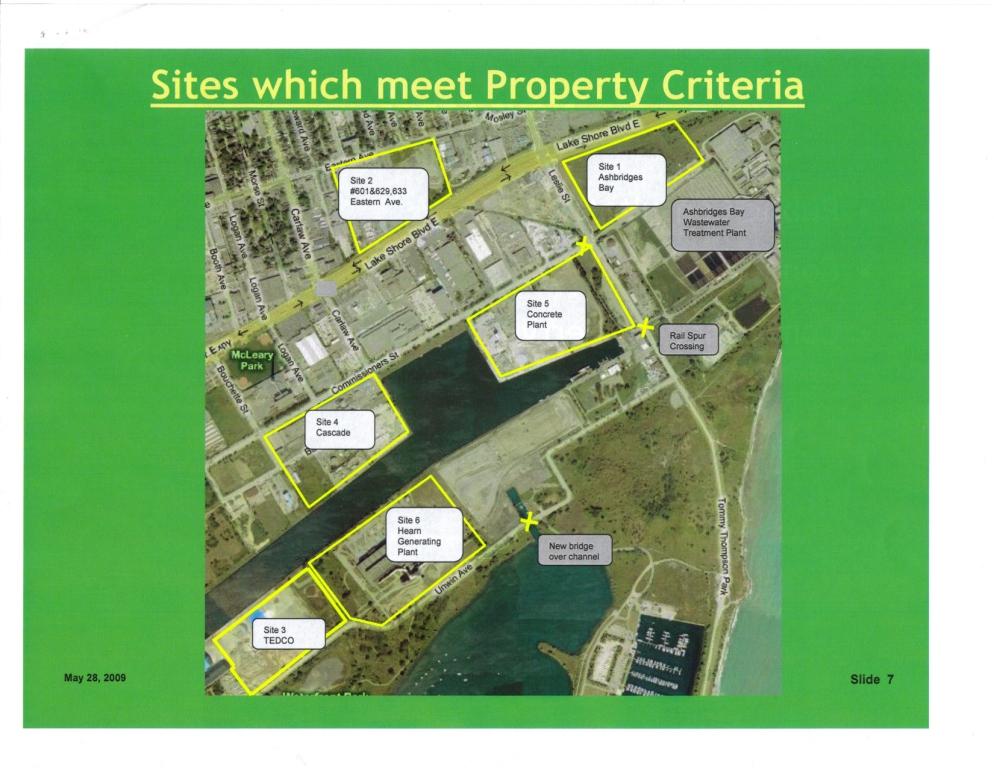
The TTC has been examining several possible sites for a new carhouse and shops to store and maintain the fleet of new streetcars.  A status report appeared on the May 28 supplementary agenda, but this does not include the presentation materials.

Map of sites considered

Of the fourteen sites considered, only six, all in the Port Lands, were large enough to hold both the maintenance shops and storage space for cars.

Short list of sites

Of these sites, the more northerly ones are most likely to be of greatest interest as they require the shortest connection to the existing system.  Site number 1 immediately north of the Ashbridges Bay water treatment plant brings some local controversy because the space, although not formally parkland, is green space in the community.

Future plans call for retention of Russell and Roncesvalles carhouses.  In the short term, these will be needed for the remaining ALRV and CLRV fleets.  Longer term, they would require major changes or rebuilding to house cars from the new fleet.

Sheppard East LRT Funding Announced (Updated)

Updated May 19:

The question of turnback points and storage tracks on the Sheppard East LRT has come up in the comment thread on this post, and I have now received some details from the TTC.

There will be a crossover at “regular intervals” along the line for turnbacks.  As for storage tracks, there are two potential locations that were shown in the preliminary designs at public meetings.  Neither of these is confirmed yet, and their inclusion will be subject to detailed design and costing.

  • Don Mills Station (third track)
  • Malvern Garage (spur)

No three-track section on Sheppard itself is planned.

Details of the Don Mills Station configuration will be included in a report on the TTC agenda for May 28. Continue reading

My Ride on the King Car

A few days ago, my travels took me to Parkdale for a presentation near Jameson Avenue in the early afternoon.  The obvious route for someone like me living near Broadview Station was the King car.  That journey gave several examples of how service can be delayed that have nothing to do with traffic congestion, and illustrate the changes that will be possible when the TTC moves to low-floor cars and all-door loading.

Just south of Danforth, we picked up a load of students from Moncrest School on their way to Thomson Hall.  They filled up the back half of the car.  Just loading them all took a while, and I wondered to myself how the TTC will handle fare collection for this type of group when they move to self-service.  Now we were slightly late.

By the time we were westbound on King, the car was filling up.  A man had boarded with a shopping buggy, and he took a single seat just ahead of the rear vestibule on the left side of the car.  This started a plug in the aisle that worsened when a group of five boarded.  There were not enough seats for all of them, and they wound up partly seated and partly standing right across the aisle from the shopping buggy.  Needless to say they were not going to “move to the rear”.

At Sherbourne, we passed up the first group of would-be customers even though there was still room in the rear vestibule.  This continued at Jarvis, Church and Victoria.

At Yonge, the crowd turned over, but the car was now quite late and we still didn’t manage to fully use the capacity.  By University we were again leaving people at the stops.  The students piled off the car at Simcoe, and by Spadina the car had cleared out reasonably.  All the same, we left an unhappy customer running for the car at Bathurst because getting back on time was more important than waiting, and the next car was only a block behind us.

While this may have been a particularly bad example of how service can be screwed up by loading delays, it’s not uncommon.  The combined effect of many factors interferes with the travel time of TTC vehicles, and this has nothing to do with whether they are in a private right-of-way.

Loading delays caused by inadequate service can cause a downward spiral where line capacity drops even as ridership grows because cars spend longer at stops and onboard crowding slows or blocks movement of passengers.  We hear far too much about traffic congestion as the root of all evil.  Yes, it exists, but it’s not the only problem.

A Few Details About New Streetcars

Based on some of the comments here as well as a few of my own interests, I recently posed three questions to the TTC about the new Bombardier cars.

1. What are the “specified options” mentioned in the report, and when will we know which of these, if any, will actually be included in the order?

Specified options include security camera system, wheel flange lubrication, pantograph current collector, cab training simulator etc. 

Timing for ordering optional equipment depends on:

  • better definition of scope of work and system offered (e.g. camera system);
  • technical and noise necessity (e.g. flange lubricator);
  • system compatibility (e.g. pantograph); and,
  • completion of negotiation of the design and scope of work (e.g. cab simulator).

 2. When will a plan showing the interior layout be available which accurately reflects the dimensions of the Toronto car? Will there be an opportunity to fine tune this, or will that be done as part of the prototype operation when there’s a real car for people to walk around in? I have to assume this must already be available for discussions with ACAT.

While the exterior dimensions are fairly well set, the interior layout can be an evolving process. As noted at the April 27, 2009 Commission Meeting, there are four cost-neutral layouts that would afford flexibility in the final configuration. The current schedule calls for completion of the Conceptual Design Phase four (4) months after Notice of Award (NOA); Preliminary Design Phase twelve (12) months after NOA.

There will be opportunities to review the design through computer modeling and presentations during the design phases. A full-scale, half-car mock-up is scheduled for delivery in 18 months NOA. This would offer a “real car” feel for stake holders including ACAT to critique. The actual Prototype Car No. 1 is scheduled for delivery 26 months [after] NOA.

3. For the transit city network, will this be built to TTC gauge or to standard gauge? In other words, will the two systems and fleets be physically able to interoperate (assuming the TC cars stay away from “tricky” parts of the legacy network) or will the two systems remain disjoint?

This has a specific application to the St. Clair line because there has been talk of connecting it to Jane and operating it out of a TC carhouse. This would require that the 512’s trackage be made compatible with the TC fleet. This has obvious and immediate implications if the specs for the TC fleet have to be nailed down within the next year.

The Transit City network will be built to TTC gauge. Note that once the carbody structure, bogies, articulations etc. of the legacy system vehicles are proven through design, Finite Element Analyses, testing and validation, there will be savings in “proven” equipment and configuration for the TC vehicles, as well as savings through common tooling, manufacturing and quality control processes, if negotiation with the base vehicle carbuilder is successful.

TTC’s wider gauge also offers a wider aisle width and roomier interior, with little incremental construction cost, compared with a “standard gauge” vehicle.

Interoperability obviously involves more than track gauge. If Jane cars are required to operate on St. Clair, a whole host of challenges will have to be addressed, including tight radius curves and steep grades at St. Clair West station and short turn loops en route.

 Thanks to Brad Ross, Director, Corporate Communications at the TTC for this information.

After receiving Brad’s reply, it occurs to me that if St. Clair cars are to be based at a TC carhouse via Jane Street, this would be done by keeping some “city” cars at the new Eglinton West carhouse and running them over the TC network down to St. Clair.  This assumes, of course, that the Jane line is on the surface and makes a physical connection with an extended 512.  All of that is many years in the future, and St. Clair cars will be based at downtown carhouses for many years to come.

Who Will Pay for New Streetcars?

A great deal of bilge was pumped out by Ottawa and Queen’s Park over the past few days about the TTC’s proposed order of new streetcars from Bombardier.

In today’s Globe & Mail, John Barber did a particularly nice job of eviscerating George Smitherman, the Minister of Infrastructure, for his apparent total ignorance of the TTC’s funding needs and requests.

It’s no secret that the TTC is looking for new streetcars.  The original bid process had to be halted when no vendor came up with a technically and commercially compliant proposal, and more recently the whole process of getting a second set of bids has been well covered in the media.

Many of us will remember walking through Bombardier’s mockup display at Dundas Square which happens to be in Smitherman’s riding.  Maybe he was out of town at the time and missed it.

Smitherman claims that the City can’t make up its mind what its priorities are.  Strange that in a letter to Dalton McGuinty, copied to Smitherman, dated December 16, 2008, Mayor Miller wrote of upcoming meetings of Finance and First Ministers:

Toronto’s first priority for infrastructure is to build Transit City, the 21st century modern public transit network that our city needs.  The Government of Ontario has demonstrated foresight and leadership in its support for Transit City.  Toronto City Council has unanimously agreed to request the Government of Canada to provide:

  • $368 million toward the streetcar fleet’s replacement and expansion; and
  • the federal $6 billion share of Ontario’s $17.5 billion Move Ontario 2020 commitment for the Metrolinx Regional Transportation Plan.

The streetcar fleet replacement also shows up in the list of funding requests under the stimulus program by the Federation of Canadian Municipalities.

Other related letters to both Queen’s Park and Ottawa can be found on the City’s website.

Meanwhile, Smitherman’s comment that the TTC shouldn’t be awarding a contract without knowing funding is in place shows that he is badly out of touch.  First off, the TTC has not signed the contract, and its execution is dependent on funding being in place.

Second, there is a long history of agencies such as Metrolinx (a provincial body) announcing plans for which they have no funding, and for which even discussion of proper funding won’t happen for years into the future.  There are two subway extensions (Spadina/Vaughan and Richmond Hill) of which the first was not fully funded until long after the project was announced, and the second still does not have full commitments.

That’s how projects like this work.

The streetcar purchase will run over a 10-year period, and funding it can hardly be called a short-term stimulus.  Funding would likely come from some other program, but the funding should come.  Toronto is asking, in effect, for $40-million a year from Ottawa and from Queen’s Park to re-equip the core of central Toronto’s transit system and to anchor the expansion of LRT in our city.

Bombardier Recommended for Low Floor Streetcar Order (Updated)

Updated April 25, 9:30 am.  I have added material from the media briefing and the staff report that I did not have time to incorporate in the original article.  The additional material is appended below after the break. 

On April 24, the TTC announced that Bombardier has won the competition for an order for 204 new low floor streetcars for Toronto.  The staff recommendation will go to the Commission itself for approval on Monday, April 27.

Both Bombardier and Siemens bid on this tender, and the proposals from both vendors were considered to be compliant both on technical and financial grounds.  Therefore the question came down to cost and with Siemens’ bid over 50% higher than Bombardier’s, there was no question about the winner.

The vehicles will be a modified version of the Flexity car with three powered two-axle trucks and five car sections.  Bombardier has not yet updated their site with information about the vehicles (as of 2:00 pm EDT April 24).  An illustration of the proposed car is in the Toronto Star’s article posted earlier today.

Although not guaranteed, this contract places Bombardier at the front of the line for supplying cars to the much larger Transit City system, especially if that builds out to anything near its full extent.  The contract includes provision for add-on orders, but the TTC will be negotiating their price separately as the Transit City cars will have significant differences affecting their cost:

  • Transit City will be built to specifications that allow off-the-shelf cars to operate on it — no tight curves or steep grades.
  • The TC cars will be double-ended and double-sided.
  • The TC cars will likely have only two powered trucks rather than three.

Subject to funding, a process still under negotiation with the Federal and Provincial governments, the first prototypes would arrive in Toronto in mid-to-late 2011 for non-revenue testing.  Production deliveries would start in 2012 and stretch out to 2018 by which time the last of the existing CLRV and ALRV fleets would have been retired.  A new carhouse, likely in the Port Lands, will be required to house this fleet while the older cars would run from Russell and Roncesvalles.

Postscript:  I cannot help mentioning that the illustration of the new car shows a vehicle facing westbound on Queen at Bay signed “Neville”. Continue reading

Praxis II Showcase 2009 at U of T

When:  Wednesday, April 15 from 9:00 am to 7:00 pm

Where:  Bahen Centre Lobby, 40 St. George Street

What:  First year engineering students spent half a term identifying and researching issues of usability, accessibility, and sustainability within the TTC system.  This led to 80 “Requests for Proposals (RFPs)” of which the top six were selected as design challenges to be solved during the second half of the course.

Topics:

  • Improving Passenger Safety Near TTC’s Exposed Subway Tracks
  • Solving the Heat Loss Problem
  • Improving Wayfinding Signage on the TTC
  • Service Delays Caused by the inefficiency of Passenger Dynamics Into and Out Of Subway Cars
  • Revising TTC Bus Interiors to Maximise Space and Boost Passenger Satisfaction
  • Improving the Emergency Response System on the TTC Subways to Decrease Delay Time and Increase Safety

For more information, please see the full invitation.

Trolley Buses? Not For Toronto (Update 2)

The TTC commissioned a report from Dr. Richard Soberman on the economics of trolley bus operation in Toronto.   Cutting to the chase, the conclusion is that creating a new system from scratch is uneconomic, and we should wait for coming improvements in electric vehicles.

Soberman’s report makes a strong case against trolley buses on its basic economic arguments, and that’s a debate worth having.  However, electric vehicles have yet to make a substantial dent in the personal car market, let alone for vehicles the size of a city bus.

I have one simple reply:  Remember CNG?  The saviour of the enviroment for the TTC?  We lost the old system through neglect and through belief in an unproven technology, not to mention political machinations.

For your reading pleasure:

Commission report and summary

Dr. Soberman’s report

Updated February 15:

A detailed review has been added to this post.  Some of the document is reasonably accurate, but there are enough outright mistakes and misdirections to cast the whole thing in an unsavoury light.  This is a report that tries to sound balanced while hoping we won’t notice what it gets wrong either by accident or by design.

Update 2, February 16: My long-time Vancouver friend Angus McIntyre pointed out two issues with the Soberman report.

  • Vancouver will order an additional 34 articulated trolley buses funded from the Federal gas tax.  This adds to the new fleet of 188 standard and 40 articulated buses.  These plans are not reflected in the TTC report even though the press release is over a month old.
  • The substation spacing of 1.5 to 2km is a measure used on “feederless” systems such as Seattle’s where small local stations feed directly into the contact wires rather than the Toronto or Vancouver model with large substations feeding a local network of services.  Has the report used Seattle’s close spacing, but Toronto’s costs for larger substations?

Continue reading