Metrolinx “Big 5” Update (November 2009)

Today’s Metrolinx Board Meeting was notable both for the update, in public session, of the project status for five major lines as well as for supplementary information that came out in a press scrum after the public session.

Five projects now have funding and are at various stages in their approval/construction process.

Continue reading

Yonge Subway Yard Study (Revised)

At its meeting on November 17, the TTC will consider a report on the yard needs for the Yonge-University-Spadina subway. 

Updated November 15 at 6:10 pm:

A reference to the replacement dates for the BD signal system and the T1 fleet has been corrected.  This triggers a discussion of whether the TTC will concoct an excuse to retire the T1’s early on the grounds that it is not worth installing ATO on them.

Updated November 15 at 4:30 pm:

The Subway Rail Yard Needs Study (aka SRYNS) proposes that future operations of the Yonge-University-Spadina line through 2030 be provided through a combination of various facilities:

  • Expansion of Wilson Yard
  • Storage of 6-8 trains at Davisville Yard
  • Consolidation of all non-revenue equipment (work trains) at Davisville Yard
  • Provision of online storage for additional trains at Richmond Hill
  • Sheppard Subway equipment (four 4-car T1 sets plus a spare) would be serviced at Greenwood

However, looking beyond 2030, staff foresee a need for additional storage and are asking the Commission for perimission to protect for a new yard on the Yonge line with purchase of property, should it become available.  This is a rather oddly worded request to which I will return.

The SRYNS was funded by York Region in recognition of the storage and servicing issues that a Richmond Hill subway extension would create for the YUS line.  The study explicitly does not look at requirements for the Bloor-Danforth line, but the report recognizes that this too must be examined.  The restructuring of the fleet and storage requirements for YUS trigger a move of all T1 subway cars to Greenwood, but that yard is not large enough to hold all of them.  In the short term, the TTC owns more T1s than would be required to operate both the BD and Sheppard subways, but this fleet will reach 30 years in 2026 and replacement with newer cars will occur within the timeframe of any projected yard requirements. Continue reading

TTC Capital Budget 2010-2019 (3): Bus Fleet Plan (Update 3)

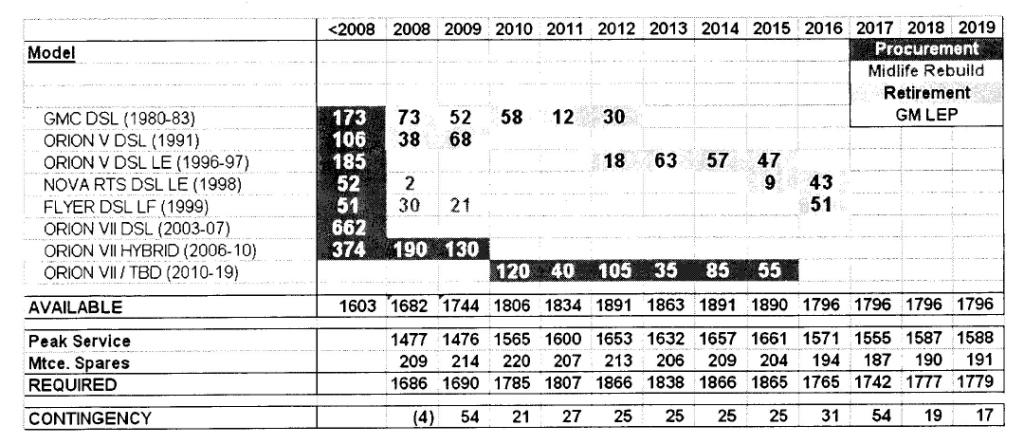
Updated October 28 at 12:45 pm:  A revised fleet plan appears on the Supplementary Agenda for the TTC meeting on October 29 as an appendix to a report regarding the purchase of new buses for 2011 and 2012 delivery.  This version differs from its predecessors mainly in the removal of vehicles for the Transit City Bus Plan, offset by the additional vehicles required due to deferral of the Transit Signal Priority project for the bus network.  Accounting for maintenance spares and contingency buses has also changed.

The net effect is that bus purchases originally planned have been scaled back by 50 and the remainder are rescheduled:

  • from 40 to 35 in 2011,
  • from 105 to 60 in 2012,
  • from 35 to 60 in 2013,
  • from 85 to 40 in 2014,
  • from 55 to 75 in 2015

An order already placed for 120 buses for 2010 is not affected.

I will comment on this in detail after the Capital Budget Update report also on the October 29 agenda is available.

Updated October 24 at 10:00 pm:  A postscript has been added with notes about other known or possible events affecting the bus fleet.

Updated October 24 at 3:45 pm:  Provision for bus route changes triggered by the Spadina Subway Extension have been added to the projection.

The TTC’s proposed 2010-19 Capital Budget includes an ongoing plan to rejuvenate and expand the bus fleet.  While these may seem to be laudable goals, the actual plans leave much to be desired.

The Bus Fleet Plan is a marvellous document that changes in every iteration.  Barely is the ink dry on one version when it is revised again.  There are three different versions of this plan within the Capital Budget documents alone, and these are a substantial revision from the version shown in the 2009 Capital Budget.

Bus Fleet Plan [From Appendix E of TTC Capital Budget Report, September 24, 2009]

However, two different sets of numbers appear in the version of the plan in the Capital Budget “Blue Books” (the detailed report of all capital projects).  One is in the project covering purchase of new buses, and another in a project for temporary accommodation of an enlarged bus fleet (about which more later).

A major change in the TTC’s fleet planning came earlier in 2009 when, with little fanfare, the TTC decided to get out of the Hybrid Bus business for new purchases starting in 2010.  The special subsidies available to “encourage” hybrid purchases are no longer available, and at the time of the decision, the hybrids were problem children in the fleet.  A project to replace the original lead-acid batteries with lithium-ion batteries will complete within the next half year, but TTC staff have not yet reported on the improved reliability and performance, if any, of vehicles with the new batteries.

Rather than paring the capital cost of future purchases down, the Capital Budget now uses this money to purchase more buses than originally planned.  This can be seen in comparing the projected fleet size in 2018 for different versions of the fleet plan.

  • 2009 plan:  1549
  • 2010 plan (as seen in the Commission Report, Appendix E):  1796
  • 2010 plan (as seen in the project description for bus purchases, Blue Books Page 954):  1793
  • 2010 plan (as seen in the project description for temporary bus storage, Page 927):  1748

In short, the TTC now aims for its 2018 fleet to be roughly 250 buses larger than what it projected only a year ago.  What generates this additional requirement? Continue reading

TTC Capital Budget 2010-2019 (2): Subway Fleet and Service Plans

The TTC Capital Budget contains many projects related to subway fleet, capacity and future operations.  Collectively, these projects amount to billions of dollars and many of them are not yet funded.

There are two major problems faced by subway planners:

  • Everything has a very long lead time, and plans made today need to balance between overspending on capacity we might not need and underspending that could produce future constraints on service.
  • Everything costs a lot of money, and unexpected additions to the budget can crowd out other necessary projects.

Large organizations and projects share issues familiar to many:

  • Left hand, right hand.  One department plans on the assumption that another project will actually happen in the announced manner and on a definite timescale.  Plans change, but co-ordination is less than perfect, and plans go out of sync.
  • In for a penny, in for a pound.  A project is “sold” politically on the basis of improvements it can bring.  However, actually achieving these improvements triggers the need for many follow-on works that are not budgeted.  Proponents of the first project in this chain innocently claim that they were simply creating the ability for some future enhancement.  Privately the attitude may be that the politicians would never approve something if they knew how much it would actually cost.  In a robust economy, the extra funding is always found somewhere, but when times are tight, budget surprises are unwelcome.

Both of these effects can be seen in the TTC’s subway fleet and service plans. Continue reading

Portlands Carhouse Proposal

[My thanks to the Transit Toronto site from which I picked up this information.  With the Film Festival in progress, I’ve been a bit distracted.]

The TTC recently presented details of its preferred location and proposed layout for a new carhouse in the Port Lands.  Of several sites considered, the now-vacant land at the south-east corner of Leslie and Lake Shore wins out.  The land is close to Queen Street (only a few blocks to the north), and as vacant land can be easily redeveloped.

The presentation linked from the project’s website gives an overview of the site selection process as well as drawings of the new carhouse.

The big issue now will be funding.  Over the past year, the debate centred on getting and paying for 204 new streetcars, but nobody talked about the carhouse they would need.  That’s one of the outstanding issues going into the capital budget planning for coming years.

One item of great interest is that the drawing on page 15 clearly states that the yard capacity is 100 cars, plus 36 cars inside the carhouse.

The long-term status of Roncesvalles and Russell is undecided at this point.  In the short term, they will be needed to house the existing CLRV/ALRV fleet.  However, the proposed new carhouse is clearly too small, and the TTC must intend to use another site, possibly the nearby Russell Yard, as a spillover location.

Trolley Coaches for Toronto?

One side effect of retirement is that I am finally dealing with years of accumulated files.  Yes, I admit it, I have more paper than I need (especially now that so much is available in electronic format), and some of those old reports about obscure parts of the system really are not high points of my bedroom reading.

In the course of sorting through things, one always bumps into items that are misfiled, that faded from memory.  One of these was an envelope I had kept because of the postmark dated May 4, 1972.

TTCPostmark4V72c

So much has changed.  Postage is a lot more than eight cents, and the postal code of “Toronto 7” is positively quaint.  The slogan “Ride With Us No Traffic Fuss!” is classic, but the real gem is the trolley coach as the symbol of progressive transit.

Back in 1972, the trolley coaches had a future.  Vehicles soon to be displaced from the 97 Yonge route by the opening of the Yonge Subway to York Mills were destined to replace streetcars on St. Clair (even though there were nowhere near enough of them to actually do that).  The TTC was still committed to electric operation, and the equipment in these coaches would be recycled into new bus bodies from Flyer.  Nobody had heard of Natural Gas Buses.

Today, the TTC resists calls to re-examine trolley coaches on the grounds that pure electric buses without wires are just around the corner.  I remain unconvinced, and look forward to a day when a modern trolley coach will appear in TTC literature.

Why Streetcars?

Tom Jurenka sent in the following note, and it raises questions that deserve a debate.

Hello Steve

As a non-native Torontonian (grew up in Winnipeg, but have lived in Toronto for 24 years now) I have always been puzzled — and often infuriated — by streetcars (and the absolutely terrible traffic light timing in Toronto, but that is another story).

My question is an honest one — WHY? All I can see is the negatives of streetcars:

  • they tear up streets (I’ve lived through Queen Street E, Gerrard, now St. Clair, being torn up utterly to undo the damage of streetcars pounding the rails)
  • they are slow as molasses (as a bicyclist, I routinely pass 5 or 6 streetcars on Queen Street heading from AC Harris to downtown)
  • because of their slowness and immobility they delay traffic all the time, causing snarls and the attendant idling pollution
  • they are super expensive (witness the recent funding mess)

So I’m really curious why streetcars are a better alternative to trolley buses or just plain old buses, which move fast, are mobile, and are less expensive per unit to buy. Would you be able to point me at some links/articles/studies/whatever to help me understand this issue?

Thank you for your time.

Best regards,

Tom Jurenka

This is a far more complex question than just the list above, but I will use this as a jumping off point. Continue reading

Who Will Build Transit City’s Fleet?

In a press scrum after today’s TTC meeting, Chief General Manager Gary Webster was asked about the follow-on order of streetcars for the Transit City lines.  Given the planned opening dates, these vehicles must be ordered fairly soon.

Webster replied that the optional order had not yet been placed, and that with the new legal framework around Metrolinx, that agency has approval powers over acquisition of cars to be used on lines funded by Queen’s Park.  Brad Ross, TTC’s Director of Corporate Communications piped up that the cars may not even be built by Bombardier.

Metrolinx certainly has chutzpa!  Quite recently, Prime Minister Stephen Harper announced funding for the Sheppard East LRT, and proudly claimed that jobs would be created at Bombardier to build cars for this line.

More to the point, do we really need to go through the entire procurement cycle all over again?  What does Metrolinx hope to bring to a repetition of the bidding process?  Are they just throwing their weight around, or are unseen interests bent on derailing the Bombardier deal?

Toronto Will Finance Its Own Streetcars (Updated)

Updated June 26 at 10:15 pm:

Today, Toronto Council voted 36-6 to proceed with funding of the purchase of 204 new streetcars as described in my original post (below the break).

During debate on the proposal, a few items of clarification were brought out that were not in the initial report.

  • The bus midlife refurbishment project has not been completely dropped, but cut back by 70% of the original allocation.  The TTC will perform a trial refurbishment of one bus in 2011 in anticipation of the first of the recently purchased buses reaching its 9th year.  Based on what is found (body condition, etc.), the future funding for this program will be readjusted.  The new fleets are expected to be much more robust than the older generations of buses, but we won’t know for sure until they actually reach the age when rebuilding would normally be expected.
  • The paving project has been cut back by 50%, and is subject to review based on actual conditions.
  • The fire ventillation upgrade program has been cut back by 50%, but this work has also been consolidated with the second entrance program in stations where this is applicable.
  • All other projects (Eglinton bus terminal, station modernization, Collectors’ booth renewal) have been cut by 100%.  The Eglinton terminal may not actually be needed, or at least at the originally planned size, because the number of routes connecting at Eglinton Station will be far lower after the Eglinton LRT is in operation.

From a financial point of view, all of this is a big shuffle.  For the time being, the TTC defers work that was currently planned for funding via City borrowing.  This is replaced in the capital budget with borrowing for the new streetcars.  In parallel, the City will make application to Ottawa for over $600-million worth of projects that would have been financed by the City, and which can be completed within the timeframe to qualify under Ottawa’s rules for “stimulus”.  On a 1/3 share basis, this will yield about $200-million in federal funding.  Additional funding is expected to be available from other non-stimulus programs.

The net effect is that future City spending will be reduced by an amount roughly equal to the funding for the new streetcars.

Furthermore, the TTC will review its capital budgets for the coming years, and it is possible that parts of some deferred projects could reappear based on then-current funding availability and priorities.

This decision is even more important that the original 1972 move by Toronto Council to save the streetcar network.  Not only does this ensure that network’s continued existence, it will expand the fleet and underpin the Transit City routes.  Indeed, a suburban LRT network was the goal behind Streetcars for Toronto’s activism on behalf of the streetcar system.

We’re not quite at the end of a long road, but I would like to share today with the Streetcars for Toronto Committee, some of whom contribute in the comments on this site from time to time:

  • Andrew Biemiller (original chair), John F. Bromley, Mike Filey, Robert Wightman, Howard J. Levine, Chris Prentice, Ros Bobak and Greg Gormick.  (Apologies if I have omitted anyone in the fog of time.)
  • In our work we were strongly supported by former Aldermen Paul Pickett and the late William Kilbourn, as well as by the office of then-mayor David Crombie.

With luck, we will ride new streetcars and even a new line or two before the 40th anniversary of the decision to retain the streetcar network. Continue reading

How Many Streetcars Do We Need?

Recent comments by Adam Giambrone, Chair of the TTC, suggest that 30 to 40 percent of the streetcar fleet is out of service in the shops, and that bus substitution will be required on some routes come the fall.

Those of us who follow the TTC have been waiting for a definitive fleet plan for some time, and hope to see one, finally, in the July Commission Meeting Agenda.  Meanwhile, I thought that I would set the stage by reviewing the current scheduled service to see how it may evolve over coming months.

The fleet contains 195 CLRVs (one of the original 196 has been scrapped) and 52 ALRVs.  The scheduled service beginning June 21 is 123 CLRVs and 38 ALRVs.  This is 63% of the CLRV fleet and 73% of the ALRV fleet.

Peak AM requirements by route are:  Bathurst (9), Carlton (32), Dundas (14), Queen (31 ALRV), Lake Shore (3), Downtowner and Kingston Road (11), King (27 CLRV + 7 ALRV), Spadina (15), Harbourfront (6), St. Clair (6).

What we don’t know is the number of cars that are permanently out of service with problems that cannot be or are too expensive to fix.  In effect, we don’t know what the true size of the available fleet might be.  A CLRV overhaul program is in progress (the affected cars are those with the new entrance layout and revised rear seating), but this is not as extensive as the original plans to replace major subsystems such as the electronics package.  This program takes some number of cars out of the pool, but should gradually replenish the fleet.  We don’t know how quickly this is happening, nor how reliable the “new” cars are.

In August, peak requirements will drop by another 11 cars when the 502/503 routes are converted to bus operation, although this will be offset in the fall when the 505/506 routes revert to their standard arrangement in the west end.  The May schedules for these routes required 53 cars in the AM peak compared to 46 today.  A further 9 cars will be needed to restore the 504 King line to its May schedule.

Late in 2009, the 512 St. Clair line’s service will be restored at least to Oakwood, later to Lansdowne.  However, this route is now using a captive pool of cars trapped north of the underpass work at Dupont and Bathurst, and there are, I believe, enough cars in that pool to handle this extension (combined with appropriate schedules where cars spend more time in motion than laying over at terminals).

The TTC needs to explain how it plans to manage streetcar service over the next three years, not to mention service improvements for capacity and the commencement of service in the eastern waterfront.  How long will new streetcars simply make up for failing CLRVs and ALRVs rather than contributing net new capacity to the network?