In the first part of this article, I looked at the origins of Transit City. Here, I will turn to that plan’s various components and to other transit schemes that have some or all of their funding in place. Continue reading
Vehicles
Flexity Cars Running in Vancouver
Stephen Rees blog has an article about the two Bombardier Flexity trams loaned from Brussels for operation in Vancouver during the Winter Olympics. These cars are similar to those Toronto will see, but with a few important differences.
- The Brussels cars are 2.3m wide because, as with many European systems, they run on a streetcar network built for smaller cars. The Toronto “legacy” cars will be 2.54m wide, the same as the CLRVs. When you look at interior shots from Vancouver, remember that there will be slightly more room on the Toronto cars.
- The Transit City fleet may be wider still than the legacy cars, but this has not yet been decided.
- The interior view from Vancouver shows the front entrance right beside the operator’s cab. This is not the layout currently planned for Toronto because of the different placement of the front truck. This change, visible in the standard shot of the proposed cars, was required to deal with clearance and derailment issues on our system and its tight curves.
As for the Transit City fleet, I understand that Metrolinx will decide whether Bombardier will, in fact, get the add-on car order in the near future. This matter needs to be settled so that cars will be available by the time the first Transit City line opens.
Streetcars for Toronto: 1952 (Updated)
Updated January 8 at 7:30 pm: Links have been added at the end of this article to Transit Toronto’s site.
Back in 1952, the TTC was about to open its first subway line and was contemplating the future of the streetcar system. Options included rehabilitation of its Peter Witt car fleet as well as the acquisition of more PCC cars.
By that time, new PCCs would be expensive as the market for them had more or less disappeared thanks to the onslaught of bus conversions in North America. However, many used fleets, some quite new, were on the market and Toronto was quick to snap them up.
A fascinating report to the transit commission dated June 3, 1952, was written by W.E.P. Duncan, Operations Manager, and it recommends among other things the acquisition of used streetcars from Cleveland and Birmingham.
This report is also interesting for what it tells us of demands on various major routes and the number of streetcars assigned to each line. The Bloor route, carrying 9,000 per peak hour/direction, would require 174 cars. Today’s network requires 192 cars in total, of which 38 are ALRVs. Demands have changed quite a lot.
The report includes strong language about the retention of streetcars, not a common approach in the 50’s.
There is obvious justification for the abandonment of streetcars in smaller communities but the policy of the abandonment of the use of this form of transportation in the larger communities is decidedly open to question. In fact it is hardly too much to say that the results which have occurred in a good many of these larger cities leaves open to serious question the wisdom of the decisions made.
It may be not wholly accurate to attribute the transit situation in most large American cities to the abandonment of the streetcars. Nevertheless the position in which these utilities have now found themselves is a far from happy one. Fares have steadily and substantially increased, the quality of the service given, on the whole, has not been maintained, and the fare increases have not brought a satisfactory financial result. Short-haul riding, which is the lifeblood of practically all transit properties, has dropped to a minimum and the Companies are left with the unprofitable long hauls. Deterioration of service has also lessened the public demand for public passenger transportation. The result is that the gross revenues of the properties considered, if they have increased to any substantial degree, have not increased anything like the ratio of the fare increases, and in most cases have barely served to keep pace with the rising cost of labour and material. It is difficult to see any future for most large American properties unless public financial aid comes to their support.
These facts being as they are, Toronto should consider carefully whether policies which have brought these unfortunate results are policies which should be copied in this city. Unquestionably a large part of the responsibility for the plight in which these companies find themselves is due to the fact that the labour cost on small vehicles is too high to make service self-sustaining at practically any conceivable fare.
Why then did these properties adopt this policy? It is not unfair to suggest that this policy was adopted in large part by public pressure upon management exerted by the very articulate group of citizens who own and use motor cars and who claim street cars interfere with the movement of free-wheel vehicles and who assert that the modern generation has no use for vehicles operating on fixed tracks but insists on “riding on rubber”. If there is any truth in the above suggestion it is an extraordinary abdication of responsibility by those in charge of transit interests. They have tailored their service in accordance with the demands of their bitter competitors rather than in accordance with the needs of their patrons.
Two important points made here still apply today.
First, the importance of the short-haul rider. These are the cheapest to serve. In the flat-fare environment of the 50’s, they would also yield the greatest revenue per passenger and were most sensitive to quality of service. We know this today — people love the ability to jump on a vehicle for a short trip provided that they don’t have to wait very long for it. If they can walk faster, they do, but deeply resent the poor service.
Second, is the attitude that motorists should not be catered to as fellow users of the road. Transit should not adjust to accommodate them, but should address them as rivals. In today’s context, this churns up the “war on the car” rhetoric, and the days when transit could demand precedence are long gone. All the same, transit gives up too easily too often because politicians talk a good line about priority measures but go to great lengths to avoid hurting motorists.
The plan set out in the report set the stage for the eventual elimination of streetcars by 1980 on the assumption that the major routes would be replaced by at least one of the Bloor or Queen subways, even though the latter would be initially operated with streetcars. This leads directly to the suburban rapid transit plan of 1969, described in the previous article.
Updated January 8:
For an excellent article on the many sets of second-hand streetcars acquired by the TTC, please see Transit Toronto’s site. The two photos linked below are also on that site.
Photo of a train of two ex-Cleveland cars westbound on Bloor entering the transferway at Bloor Station (where, until recently, Bloor street widened out for the streetcar station removed after the BD subway opened in 1966). A train of ex-Lousiville cars passes eastbound. The westbound train is a Danforth Tripper headed for Bedford Loop (now St. George Station and the OISE building).
Photo of a train of two ex-Louisville, ex-Cleveland cars on Bloor Street at Bedford from Transit Toronto. These cars were ordered by Louisville, but the city abandoned its streetcar system before they were delivered. Cleveland bought them, but later in the throes of abandonment itself, resold them to the TTC who acquired almost-new cars at a very attractive price.

Do You Want To Buy A Bus?
Metrolinx “Big 5” Update (November 2009)
Today’s Metrolinx Board Meeting was notable both for the update, in public session, of the project status for five major lines as well as for supplementary information that came out in a press scrum after the public session.
Five projects now have funding and are at various stages in their approval/construction process.
Yonge Subway Yard Study (Revised)
At its meeting on November 17, the TTC will consider a report on the yard needs for the Yonge-University-Spadina subway.
Updated November 15 at 6:10 pm:
A reference to the replacement dates for the BD signal system and the T1 fleet has been corrected. This triggers a discussion of whether the TTC will concoct an excuse to retire the T1’s early on the grounds that it is not worth installing ATO on them.
Updated November 15 at 4:30 pm:
The Subway Rail Yard Needs Study (aka SRYNS) proposes that future operations of the Yonge-University-Spadina line through 2030 be provided through a combination of various facilities:
- Expansion of Wilson Yard
- Storage of 6-8 trains at Davisville Yard
- Consolidation of all non-revenue equipment (work trains) at Davisville Yard
- Provision of online storage for additional trains at Richmond Hill
- Sheppard Subway equipment (four 4-car T1 sets plus a spare) would be serviced at Greenwood
However, looking beyond 2030, staff foresee a need for additional storage and are asking the Commission for perimission to protect for a new yard on the Yonge line with purchase of property, should it become available. This is a rather oddly worded request to which I will return.
The SRYNS was funded by York Region in recognition of the storage and servicing issues that a Richmond Hill subway extension would create for the YUS line. The study explicitly does not look at requirements for the Bloor-Danforth line, but the report recognizes that this too must be examined. The restructuring of the fleet and storage requirements for YUS trigger a move of all T1 subway cars to Greenwood, but that yard is not large enough to hold all of them. In the short term, the TTC owns more T1s than would be required to operate both the BD and Sheppard subways, but this fleet will reach 30 years in 2026 and replacement with newer cars will occur within the timeframe of any projected yard requirements. Continue reading
TTC Capital Budget 2010-2019 (3): Bus Fleet Plan (Update 3)
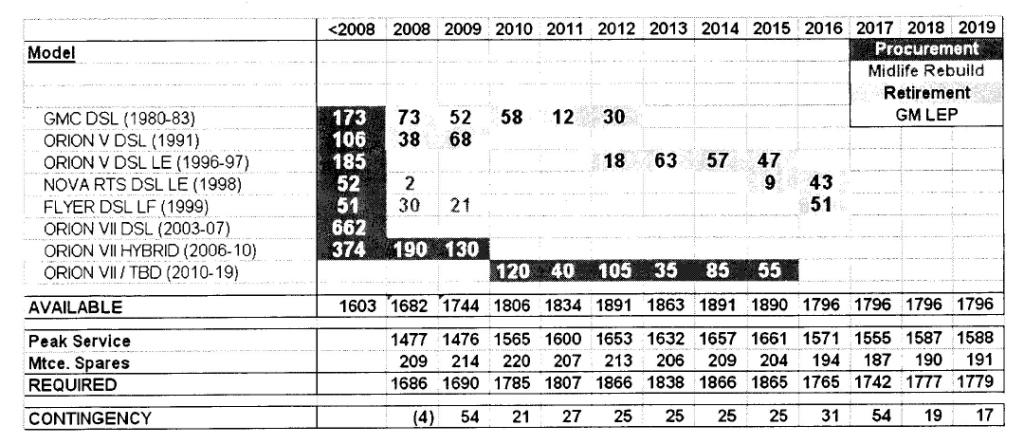
Updated October 28 at 12:45 pm: A revised fleet plan appears on the Supplementary Agenda for the TTC meeting on October 29 as an appendix to a report regarding the purchase of new buses for 2011 and 2012 delivery. This version differs from its predecessors mainly in the removal of vehicles for the Transit City Bus Plan, offset by the additional vehicles required due to deferral of the Transit Signal Priority project for the bus network. Accounting for maintenance spares and contingency buses has also changed.
The net effect is that bus purchases originally planned have been scaled back by 50 and the remainder are rescheduled:
- from 40 to 35 in 2011,
- from 105 to 60 in 2012,
- from 35 to 60 in 2013,
- from 85 to 40 in 2014,
- from 55 to 75 in 2015
An order already placed for 120 buses for 2010 is not affected.
I will comment on this in detail after the Capital Budget Update report also on the October 29 agenda is available.
Updated October 24 at 10:00 pm: A postscript has been added with notes about other known or possible events affecting the bus fleet.
Updated October 24 at 3:45 pm: Provision for bus route changes triggered by the Spadina Subway Extension have been added to the projection.
The TTC’s proposed 2010-19 Capital Budget includes an ongoing plan to rejuvenate and expand the bus fleet. While these may seem to be laudable goals, the actual plans leave much to be desired.
The Bus Fleet Plan is a marvellous document that changes in every iteration. Barely is the ink dry on one version when it is revised again. There are three different versions of this plan within the Capital Budget documents alone, and these are a substantial revision from the version shown in the 2009 Capital Budget.
Bus Fleet Plan [From Appendix E of TTC Capital Budget Report, September 24, 2009]
However, two different sets of numbers appear in the version of the plan in the Capital Budget “Blue Books” (the detailed report of all capital projects). One is in the project covering purchase of new buses, and another in a project for temporary accommodation of an enlarged bus fleet (about which more later).
A major change in the TTC’s fleet planning came earlier in 2009 when, with little fanfare, the TTC decided to get out of the Hybrid Bus business for new purchases starting in 2010. The special subsidies available to “encourage” hybrid purchases are no longer available, and at the time of the decision, the hybrids were problem children in the fleet. A project to replace the original lead-acid batteries with lithium-ion batteries will complete within the next half year, but TTC staff have not yet reported on the improved reliability and performance, if any, of vehicles with the new batteries.
Rather than paring the capital cost of future purchases down, the Capital Budget now uses this money to purchase more buses than originally planned. This can be seen in comparing the projected fleet size in 2018 for different versions of the fleet plan.
- 2009 plan: 1549
- 2010 plan (as seen in the Commission Report, Appendix E): 1796
- 2010 plan (as seen in the project description for bus purchases, Blue Books Page 954): 1793
- 2010 plan (as seen in the project description for temporary bus storage, Page 927): 1748
In short, the TTC now aims for its 2018 fleet to be roughly 250 buses larger than what it projected only a year ago. What generates this additional requirement? Continue reading
TTC Capital Budget 2010-2019 (2): Subway Fleet and Service Plans
The TTC Capital Budget contains many projects related to subway fleet, capacity and future operations. Collectively, these projects amount to billions of dollars and many of them are not yet funded.
There are two major problems faced by subway planners:
- Everything has a very long lead time, and plans made today need to balance between overspending on capacity we might not need and underspending that could produce future constraints on service.
- Everything costs a lot of money, and unexpected additions to the budget can crowd out other necessary projects.
Large organizations and projects share issues familiar to many:
- Left hand, right hand. One department plans on the assumption that another project will actually happen in the announced manner and on a definite timescale. Plans change, but co-ordination is less than perfect, and plans go out of sync.
- In for a penny, in for a pound. A project is “sold” politically on the basis of improvements it can bring. However, actually achieving these improvements triggers the need for many follow-on works that are not budgeted. Proponents of the first project in this chain innocently claim that they were simply creating the ability for some future enhancement. Privately the attitude may be that the politicians would never approve something if they knew how much it would actually cost. In a robust economy, the extra funding is always found somewhere, but when times are tight, budget surprises are unwelcome.
Both of these effects can be seen in the TTC’s subway fleet and service plans. Continue reading
Portlands Carhouse Proposal
[My thanks to the Transit Toronto site from which I picked up this information. With the Film Festival in progress, I’ve been a bit distracted.]
The TTC recently presented details of its preferred location and proposed layout for a new carhouse in the Port Lands. Of several sites considered, the now-vacant land at the south-east corner of Leslie and Lake Shore wins out. The land is close to Queen Street (only a few blocks to the north), and as vacant land can be easily redeveloped.
The presentation linked from the project’s website gives an overview of the site selection process as well as drawings of the new carhouse.
The big issue now will be funding. Over the past year, the debate centred on getting and paying for 204 new streetcars, but nobody talked about the carhouse they would need. That’s one of the outstanding issues going into the capital budget planning for coming years.
One item of great interest is that the drawing on page 15 clearly states that the yard capacity is 100 cars, plus 36 cars inside the carhouse.
The long-term status of Roncesvalles and Russell is undecided at this point. In the short term, they will be needed to house the existing CLRV/ALRV fleet. However, the proposed new carhouse is clearly too small, and the TTC must intend to use another site, possibly the nearby Russell Yard, as a spillover location.
Trolley Coaches for Toronto?
One side effect of retirement is that I am finally dealing with years of accumulated files. Yes, I admit it, I have more paper than I need (especially now that so much is available in electronic format), and some of those old reports about obscure parts of the system really are not high points of my bedroom reading.
In the course of sorting through things, one always bumps into items that are misfiled, that faded from memory. One of these was an envelope I had kept because of the postmark dated May 4, 1972.
So much has changed. Postage is a lot more than eight cents, and the postal code of “Toronto 7” is positively quaint. The slogan “Ride With Us No Traffic Fuss!” is classic, but the real gem is the trolley coach as the symbol of progressive transit.
Back in 1972, the trolley coaches had a future. Vehicles soon to be displaced from the 97 Yonge route by the opening of the Yonge Subway to York Mills were destined to replace streetcars on St. Clair (even though there were nowhere near enough of them to actually do that). The TTC was still committed to electric operation, and the equipment in these coaches would be recycled into new bus bodies from Flyer. Nobody had heard of Natural Gas Buses.
Today, the TTC resists calls to re-examine trolley coaches on the grounds that pure electric buses without wires are just around the corner. I remain unconvinced, and look forward to a day when a modern trolley coach will appear in TTC literature.