A Debut Party for Car 4400

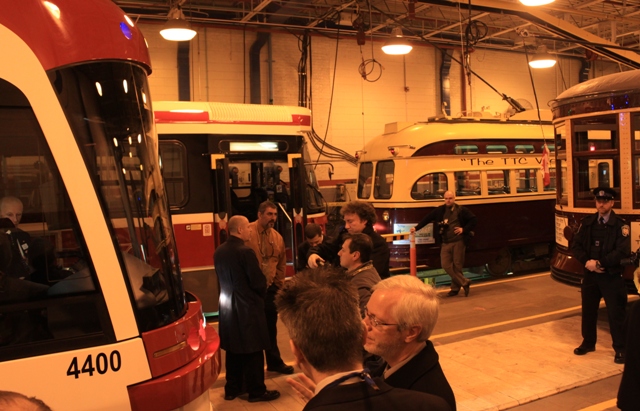
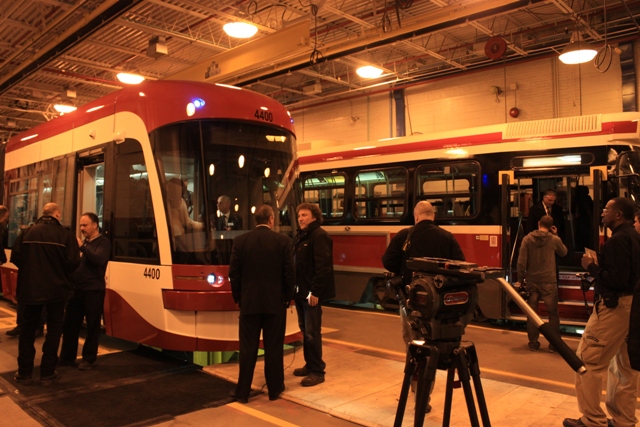
The TTC unveiled the real car 4400 — not the imitation, half-car mockup seen on an earlier occasion — at its Hillcrest Shops today to a crowd of press, politicians and staff.

Representatives of all governments were present.  Councillor Karen Stintz as TTC Chair, Ontario Minister of Transportation Bob Chiarelli, Metrolinx CEO Bruce McCuaig, and Peter Van Loan representing the Federal Government.

Van Loan’s inclusion was rather odd considering that his government famously told Mayor David Miller to get lost (in somewhat earthier terms) when Miller asked for a 1/3 federal share in funding these cars.  Now we learn than some of the federal gas tax transit revenue in Toronto has been earmarked for the streetcar project.

  • City of Toronto share: $662m (55.8%)
  • Ontario share: $416.3m (35.1%)
  • Ottawa share:  $108m (9.1%)
  • Total $1,186.3m

In fact, Toronto gets a flat annual allocation from the federal gas tax that now runs at $154m.  In 2012, the total TTC capital spending (not including projects with their own accounts such as the Spadina extension) will be $1,034m.  This puts the federal gas tax at about 15% of current spending although the proportion rises in future years when the currently planned rate of spending tails off.

I have asked the TTC to explain how they came up with the $108m figure, and as I write this (2:20 pm, November 15), I have not received a reply.  Federal capital grants go into the general pot of capital funding (see pdf page 36 of the TTC Capital Budget).

During her remarks, TTC Chair Karen Stintz joked that she hopes to see Van Loan back soon with a big cheque for the Downtown Relief Line.
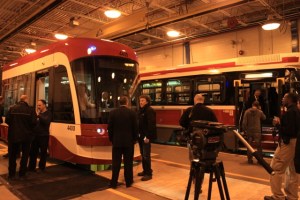
This is a fully working car, although we won’t see it out on the street for several months, and even then only for test runs, not in passenger service.  Cars 4401 and 4402 will arrive over coming months to add to the test fleet.
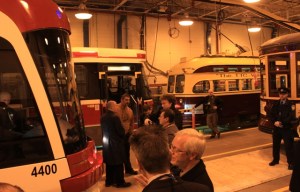
The 4400 sat among representatives of three earlier generations of streetcars each of which represented the technological pride of its age — the Peter Witt (1920s), the PCC (1930/40s), the CLRV (1970s).  That CLRV (and its relative, the articulated ALRV) is odd man out, in a way, because it was, in part, the product of an era when Ontario thought it needed to reinvent the streetcar.  Only one other buyer was ever found for these vehicles as compared with Witts, PCCs and now Bombardier Flexities running all over the world.

The car’s interior is divided into sections, each with its own door very much like a subway car.  All-door loading will spread out the demand through the interior.  Space dedicated for large objects such as shopping buggies, baby carriages, wheelchairs and bicycles will allow them to be carried without plugging circulation.

Although the cars are “low floor”, there is still one step up from the ground into them unless one boards from a platform or widened sidewalk (as on Roncesvalles).  However, that’s the only step, and riders will be able to flow into and out of the cars quicker than they do on the earlier models.

Presto readers are mounted on either side of the entryways.  The rules for Presto use on TTC are not yet decided including whether there will be any need to “tap in” for transfer connections or to “tap out” when leaving a vehicle.  [That’s a separate debate and I would prefer that the comment thread on this article not fill up with a discussion on that topic.]

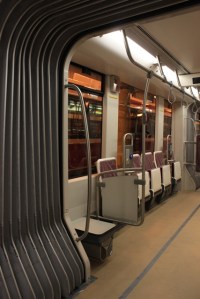
Visible in the photo below is a small pedestal (left side, just ahead of the articulation) which will hold the fare equipment.  This will be used by passengers who need to pay a cash or token fare while the system is in co-existence mode between current practices and Presto.  Machines will also be provided at busy stops along the routes as the new cars roll out.

The box under the pedestal is a heater/blower (another is located under the seat just inside the door) whose purpose is to keep the vestibule warm even in the winter and an attempt to dry out the floor.

Stop displays hang from the ceiling through the length of the car, not just at the front as on the retrofitted CLRV/ALRV fleets.

Notable by their absence is any provision for advertising on either the interior or exterior of the car.  Something may be fitted in the coves between the top of the windows and the lighting strip, but there is nothing on the 4400.  This would change the look of the cars inside and out.

Here is another view through the articulation showing the fare machine pedestal.  Note that the window has a separate panel at the top.  This is a “flip in” window similar to those on the CLRVs intended for situations where the AC fails and some ventillation is required.  The flip-up seating in the area beyond keeps it clear for use by wheelchairs in a similar format to that already used on the subway.
At the doors, there is a red button for passengers to open them when they are activated by the operator.  Actual operation will likely vary from stop to stop and car to car just as it does today with the CLRVs.  At some stops, the operator will simply open all doors; at others, only doors passengers want to use will open.  This is a common practice elsewhere to which Torontonians will, I am sure, adapt.

This door is also the wheelchair location, and the blue button is intended for a request to deploy the wheelchair ramp.  That ramp has two levels — one is a short bridge to get from a car to a nearby platform, the other is a longer ramp to get down to pavement level.  The operator controls which version is deployed.

Not visible in these photos is an LED strip mounted on the trailing edge of each door.  This will be brightly lit when the doors are open as a warning to passing motorists and cyclists that they should stop.  I hope to get a photo or video of this in operation from the TTC and will add it here when available.

Low-floor design brings seating above the wheel sets, and a mixture of forward and rear facing seats.

The front of the new car, in profile, can be read as a face, here in contemplation of a human.  The paint treatment at this end is different from the rear (see the next photo) with the white stripes swinging down.

The rear end of 4400 seen from the transfer table.  The white stripes at this end simply wrap around the car.

Finally, a view along the runway for the transfer table that moves cars and buses between the shop entrance and the various repair bays.  The mockup version of 4400 is visible in the middle distance.

I must say that having a genuinely new streetcar in Toronto, one that is based on a proven international design, gives me good feelings.  All the same, there remain questions of how the vehicle will perform in service, how riders will adapt to the new layout and fare collection tactics, and whether the TTC will actually improve service capacity (as implied in the Fleet Plan that I reviewed recently) and improve line management so that expected wider headways are not compounded by ragged service and short turns.

The fight for better streetcar service is far from over.

Postscript: What The Design Panel Did

I was one of the members of design review panel recruited by the TTC to tweak the new car design.  The physical layout of the cars was more-or-less settled by the time we came on board, and our opportunity for influence was limited.  The factors we affected were mainly aesthetic including:

  • The use of a different, patterned seat fabric rather than the standard TTC red.
  • The use of a darker red than the bright cherry found on the CLRVs.  It is not as dark as the colour used with cream trim on the PCCs and Witts, but not as bright as the CLRVs.
  • The presentation of a distinct “front” and “back” to the cars by bringing the white stripes down at the front of the car.
  • The presentation of a uniform black stripe down the side of the car (the original version made the doors look like a mouth with missing teeth).

One thing we hoped to see was interior surfaces that had some texture and variation from lighter off-white on the ceiling to a darker gray on the floor.  That idea did not become part of the final version probably for a combination of cost and maintenance issues.

Eventually the cars will go into service and we will see how their layout works in practice and whether it can be improved.

An idea I would particularly like to see would be a subset of the fleet as “art cars”.  We came up with this idea before GO Transit started its own program, but given the state of transit funding and municipal attitudes to non-essential “gravy”, this was an idea that has gone into a deep sleep.  Could we find a sponsor to underwrite a competition for, say, ten cars each with its own “total wrap”, a set of “one of” cars whose designs would change from season to season, year to year?

Car 4400 Is In Toronto

Updated October 4:

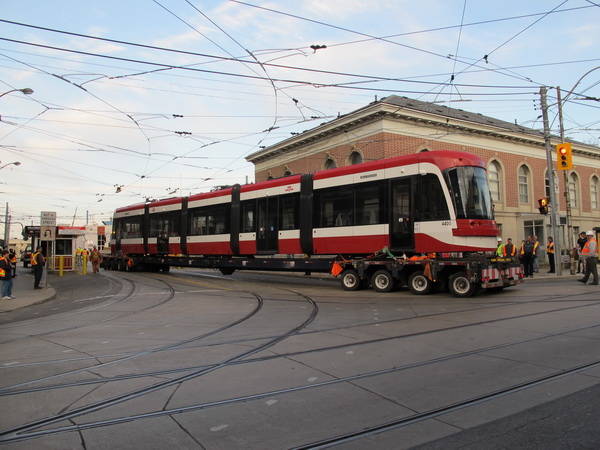
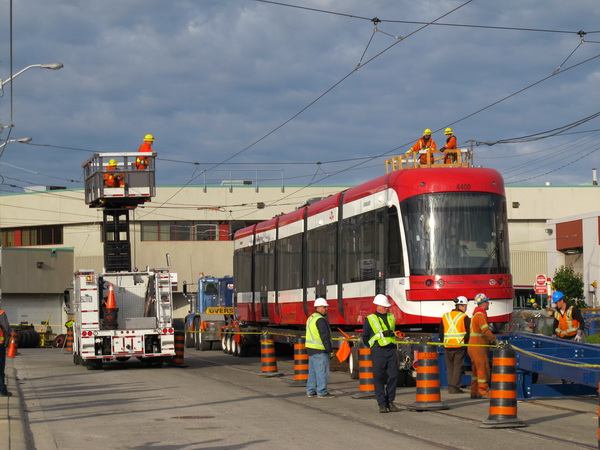
Thanks to Harold McMann for the following photos of 4400 arriving at Hillcrest.

A previous “first car” arrives at Hillcrest:

Updated September 28:

Thanks to Mike Filey for this photo of 4400.

Original Post of September 26

The Junctioneer reports that the first of the prototype low floor LRVs is in CPR Lambton Yard.  The car is expected to move to Hillcrest in the early hours of Saturday, September 29.

A media event will be scheduled for October.

Thanks to all who forwarded me this link.

See also the Torontoist and Randy Risling on Twitter.  Note that the car has both a trolley pole and a pantograph.

Zero Percent Is Not Acceptable

Recent press coverage of the opening salvos in Toronto’s 2013 budget process tell us that the Budget Chief, Mike Del Grande, is trying for another year in which he, the Mayor and the City Manager dictate a zero percent increase in city funding to all agencies.  This is not playing well with some members of Council according to The Star, and with some luck this will extend to boards of agencies like the TTC.

The dynamics of Council have changed since the 2012 budget launch a year ago when the Mayor and City Manager issued a zero-percent edict and drove through cuts to many city services while claiming a massive, if fictional, deficit threatened the city’s integrity.  Trying for a repeat performance may play well as part of the already-in-progress 2014 election campaign, but such an attempt runs counter to the will of many on Council.  This is a delicate time for management at the City and its agencies like the TTC, and the leadership for a different world view must come from Council and the agency Boards.

This will not be as easy as holding a press conference to announce a $30-billion plan for a fairytale network of rapid transit lines that would be paid for through as-yet unknown future taxes and contributions from other governments.  This is the real world where the City and its agencies must raise real money from existing revenue streams today, must make decisions that will affect real service levels today, must be prepared to fight for policies that will deliver results today, not decades in the future.

The Operating Budget in Brief

The Operating Budget covers the day-to-day cost of running and maintaining the transit system.  Major repairs, new vehicles and infrastructure come out of the Capital Budget (about which more later).  Generally speaking, expenses and funding cannot be moved between the two budgets.

2012 Budget (Revised)        Operating     Wheel-Trans
                               ($m)          ($m)
Farebox & Other Revenues      1,069.9           5.3
Expenses                      1,444.0         100.2
Subsidy                         374.1          94.9

2012 Projected

Farebox & Other Revenues      1,076.6           5.3
Expenses                      1,447.4         101.4
Subsidy Required                370.8          96.1
Subsidy Available               374.1          94.9
"Surplus"                         3.3        (  1.2)

Source: CEO's Report for April 2012 (Published June 2012)

The projected figures are always different from the budget for various reasons.  The most common is that expenses never work out exactly as expected due to actual conditions including unexpected changes in major cost centres such as fuel and vehicle repairs.  Some details are in the CEO’s report (see compendium of links at the end of the article).  Revenue is affected by ridership, but can also be hurt or helped by fluctuations in advertising and rent revenues.  While these are small numbers in the larger budget scheme, all of the political debates about transit funding revolve around such small amounts and discuss service cuts or adds in millions of dollars.  A bad year for ad revenue coupled with a Council unwilling to backstop the loss with subsidies translates to worse service for riders.

The 2012 budgets were amended twice.  In June 2012, Council approved increasing the regular expense budget by $2.1m to provide additional service beginning this fall with funding to come from increased revenues.  Earlier, when the Commission was still dominated by Ford-friendly appointees, an attempt by Council to fund $5m in added service was thwarted by the Commission who diverted the funding to Wheel-Trans.

Continue reading

TTC To Order Artic Buses from Nova Bus

NOW magazine’s Ben Spurr reports that the TTC will award a contract to Nova Bus for 153 articulated buses.  The award is already shown on the TTC’s website with a date of August 2, and this will be confirmed by the Commission at its meeting on September 27.

Plans to buy artics have been in the works for a while at TTC, but this is a particularly large order, roughly the equivalent of two years’ of past bus purchases.  NOW lists many routes where these might run (the topic has been discussed in past reports to the Commission), and there are no surprises.

The critical point in any rollout will be the degree to which service capacity is actually increased.  For decades, riders on Bathurst and Queen streetcars have put up with wider headways (which are compounded by delays and short-turns) from the use of articulated streetcars.  The TTC bases service levels on the alleged demand and capacity of the route.  Demand that gives up and walks, cycles or drives isn’t counted.  Vehicles that never show up because of short turns, or which appear in a parade and run little-used, are of no benefit to riders but count toward the scheduled capacity.  TTC service standards were changed thanks to the Ford administration’s penny-pinching to stuff more people on routes that provide frequent service, and there is no sign this decision will be reversed.

With luck, by the time the new buses arrive, a more enlightened transit funding policy will be in place at Council, but until then, riders on major routes shouldn’t count on any improvement.

CLRVs Visit Boston

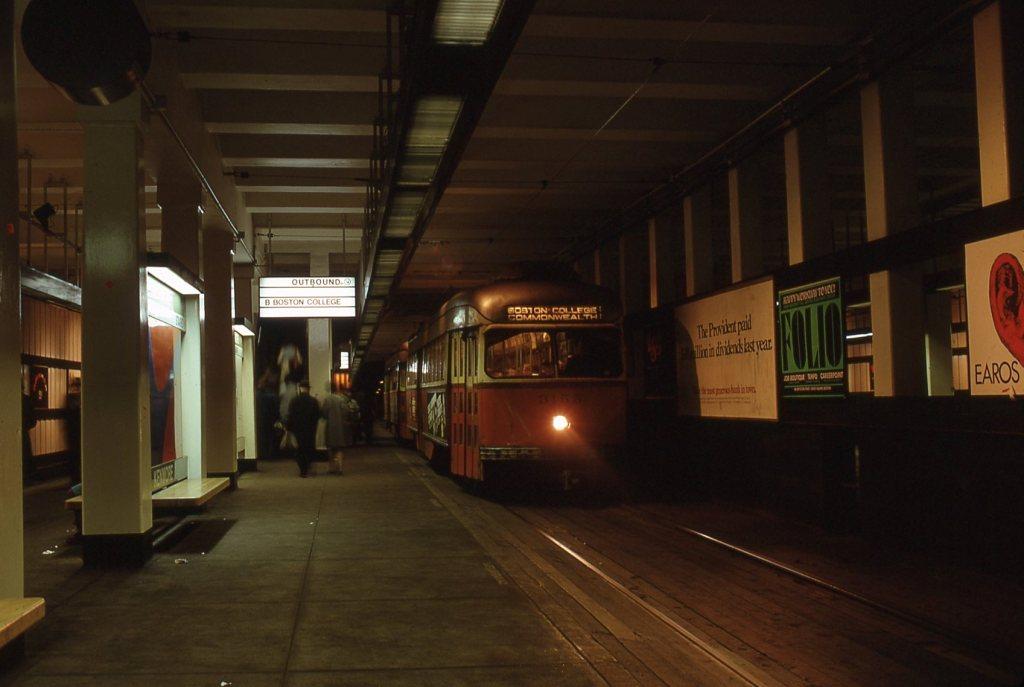
Back in 1980, the Urban Transportation Development Corporation (UTDC) had suffered the demise of their planned magnetic levitation train system in Toronto, and the “Intermediate Capacity Transit System” (ICTS) we know as the Scarborough RT had not yet been foisted on Toronto.

During a brief period when the only viable UTDC product was its new light rail vehicle, the CLRV, they shopped the design around to various systems.  The only taker they ever got was San Jose, California, for a small order.  Three CLRVs found their way to Boston for a demonstration, and I was lucky enough to catch them out on the Riverside line in May 1980.

A train of 4027 and 4029 prepares to leave Riverside Yard (the outer terminal of the line which includes a large parking lot and the carhouse/shops for the route.  A train led by Boeing car 3400 sits beside the CLRVs.  The overhead in Boston at this point was set up for operation by cars with either trolley poles (the remaining PCC fleet) or pantographs (the Boeing cars).

The CLRV train pulls out of the yard.

… and onto the main line.

The Riverside Line was build on an abandoned railway corridor, the Highland Branch, and opened in 1959.  A new connection into the existing central subway (a streetcar subway dating from 1897) was built to bring cars through downtown.

Here the CLRVs pass outbound through Reservoir Yard.  The larger part of this yard and an old carhouse are out of shot to the left, and they serve the Cleveland Circle line which terminates there.  Work cars in the yard include a PCC converted for use as a line car, and several “Type 3” passenger cars adapted as snow plows, essential equipment for a network with so much private right-of-way.

Outbound at Newton Centre station.

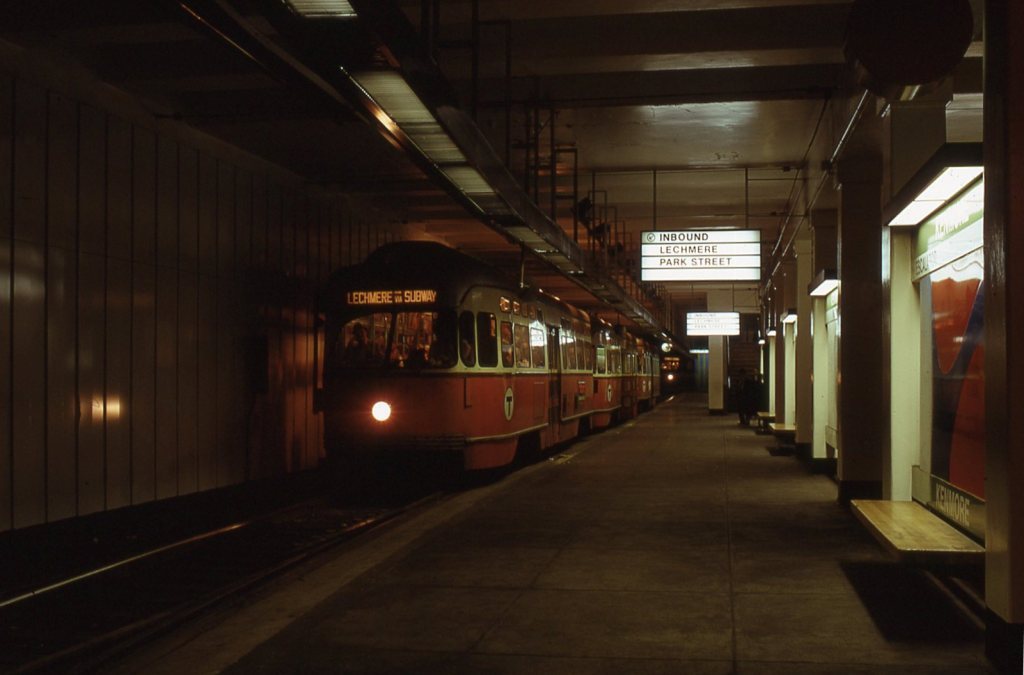
The shot below is from May 1972 at Kenmore Station which opened in 1932.  Readers with eagle eyes and long memories will recognize this shot which I loaned to the UTDC for inclusion in a brochure advocating the wonders of LRT which, at the time, the Ontario Government was actually pushing as a product, if not as a “solution” for Toronto.  It didn’t last long, and they went back to their old lies about how there was nothing to fill the gap, the missing link, between buses and subways — hence the need for an “intermediate” capacity system.

Kenmore Station is a busy place and has separate platforms for routes which diverge here.  Boston cars have doors on both sides so that they can serve island platforms like this.  Needless to say, the CLRVs served only stations with right-side platforms.  (The sign in the front window says “All stops except Kenmore” because the Riverside trains used the outside tracks at this station.)  Yes, that’s a three-car train of PCCs sitting at the platform.

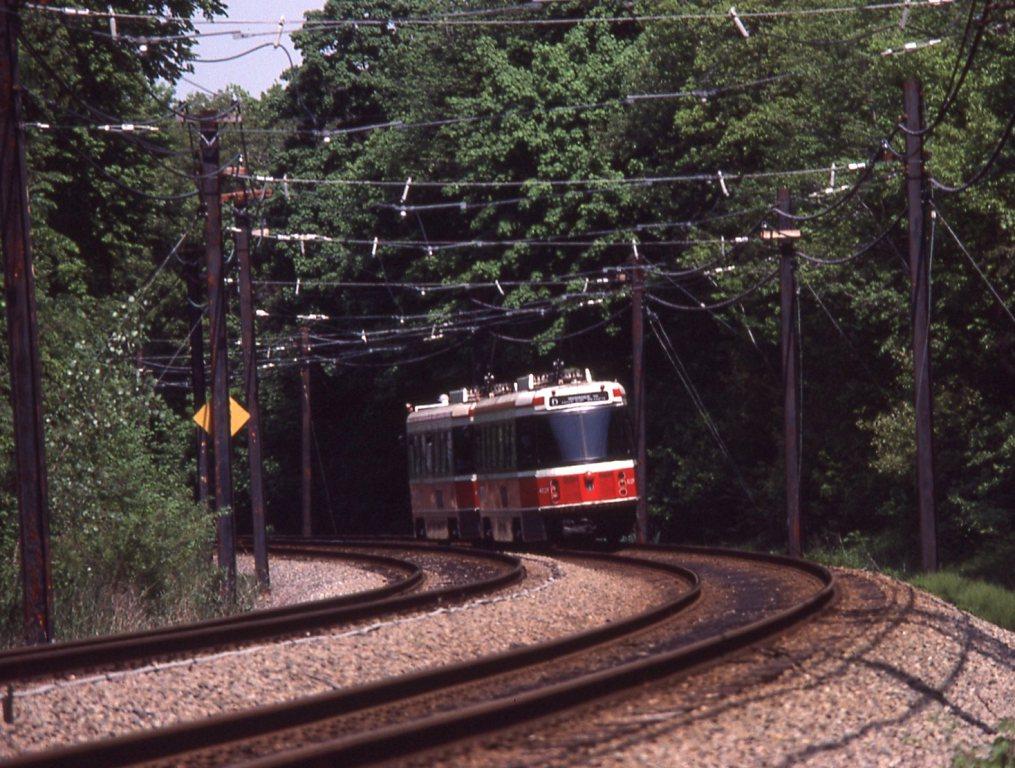
Finally, a look outward towards Riverside terminal (off to the left behind the trees in the distance)  in October 1968.  The small building on the right is an abandoned railway station.  This line could have been a model for the Scarborough RT, an implementation of “LRT” at the high end of what this technology can accomplish with almost complete grade separation, rapid transit station spacing, and speedy operation.  (Although the CLRVs are capable of 70mph operation — itself a design excess by the UTDC — they were limited to 50mph operation on the Highland Branch.)

By the time the SRT and its expensive ICTS opened at a cost more than double the original estimate for LRT, the Riverside line had been operating for 25 years.

TTC Meeting Preview: May 30, 2012

The Toronto Transit Commission will meet on May 30, 2012.

CEO’s Report

The scoreboard which begins the CEO’s Report includes the Key Performance Indicators (KPIs) about which I have written elsewhere.  Subway performance continues to be monitored against schedule ±3 minutes 96% of the time.  It remains unclear how a systemic delay — where many trains are one or more headways out of place but service is otherwise well-spaced — affects this metric.  Surface routes aim to be within 3 minutes of the scheduled headway 65% of the time for buses and 70% of the time for streetcars.  Considering the headway on which all major routes operate, 3 minutes represents close to if not more than one headway, and much service will easily hit that target even though the rider sees disorganized bunching service with many short turns.  I will address this problem in separate articles looking in detail at specific routes’ behaviour.

Riding is up relative both to actual results in 2011 and to budget in 2012 (see following section on additional service to handle growth), and the offpeak increase is running ahead of peak as it has for some years.

The top source of complaints continues to be “Other” with “Surface Delays” and “Discourtesy” coming next in that order.  The TTC has initiated a rolling survey of customer satisfaction, but it has not yet accumulated enough data to produce a metric that shows a trend over time.  One big challenge of “customer service” is that some initiatives have an effect at limited points — clean and well-maintained washrooms may be appreciated by those who use them, but they don’t make any difference to overall service for most riders.  Pervasive changes — more frequent and regularly spaced buses, improved station cleaning and escalator/elevator maintenance — require changes in how the system thinks about its operation as a whole, not in discrete chunks that are easily targeted. Continue reading

Russell Carhouse Track Construction Plans (Updated)

Updated February 16, 2012 at 6:05pm:  The Public Works & Infrastructure Committee deferred consideration of the report on Eastern Avenue’s reconfiguration until March 21, 2012, “to enable the Acting General Manager, Transportation Services, to explore further alternatives that will maintain the capacity of parking on the roadway”.

Original post from February 13 below:

TTC’s Russell Carhouse at Queen and Connaught will see major track reconstruction this year.

A project to rebuild track Queen Street and Connaught Avenue was deferred from 2011 at the Mayor’s request, but the work is now out for tender.  This will include the replacement of all of the special work on the north side of the carhouse including the yard accesses and the intersection at Connaught.  On Connaught itself, the track layout will be changed by the removal of the existing crossover between the northbound and southbound tracks.

At Eastern Avenue, the roadway will be rebuilt to isolate the streetcar ladder tracks from the rest of the pavement and raise their level.  This change will reduce the effect of the combined curve and grade between Eastern Avenue and the yard tracks which is especially pronounced at the carhouse itself.  A report on the recommended layout for the street is on the Public Works agenda for February 15, 2012.

This work is part of the overall preparation of the streetcar system for the arrival of the new LFLRVs.

TTC Meeting Preview for January 31, 2012

The TTC agenda for January 31, 2012 contains a few items of interest.

The proposed disposition of an additional $5-million in subsidy is discussed in a separate article.

Eglinton Scarborough Crosstown Project Update

A long report giving an update on the Eglinton Crosstown LRT does not address any of the issues currently swirling in the media, and it gives only a basic sense of where various parts of the project sit.  The most important part comes in Recommendation 3 in which the TTC would ask the Minister of Transportation and Infrastructure to hold off on any decision regarding overall project management and delivery until outstanding issues are resolved.

The critical paragraph (on page 7) reads:

Recently, Metrolinx has indicated that it is considering a different project delivery and governance arrangement for the Crosstown Project which could involve project management by another entity, rather than the TTC, a more extensive role for Infrastructure Ontario and one large alternative financing and procurement contract including final design and construction of all stations, the SRT, yards, and systems.

Infrastructure Ontario and Metrolinx have been trying to muscle into the Eglinton project for some time.  That’s no surprise considering the billions at stake and the desire by IO and Metrolinx to show that they can do a better job than what is perceived as the TTC’s historical ham-fisted project management and control.  How this attitude fits with current experience on the Spadina extension, and why we should believe another agency will do better, remains to be seen.

Moreover, the question of what, exactly, we are building on Eglinton has yet to be answered.  Queen’s Park and Metrolinx are dodging the question and claiming that they just want agreement between the TTC, Council and the Mayor.  Well, two out of three is likely, but unanimity is impossible after the highly misleading and misinformed post by Ford on his Facebook page.  The Pembina Institute (a somewhat left of Ford think tank) has responded to misrepresentations Ford makes about their position on their own site.

The meddling from Queen’s Park puts the Commission and Council in a position where a definitive policy for Toronto on the Eglinton corridor is needed soon.  Beyond that, the disposition of any leftover money (presuming that Queen’s Park would leave it on the table) needs informed debate by all concerned, and a compromise that won’t be worked out overnight.

Various factions argue for the Finch and Sheppard LRT lines, for some or all of the Sheppard subway extensions, and for the Finch BRT.  Everyone has a set of magic markers and their own map.  This is no way to plan a transit system.

Ashbridges Bay Carhouse and Shops

The Commission will award a contract for construction of the new yard, carhouse and shops at Ashbridges Bay in the amount of $237.4m.

Roncesvalles Carhouse

The Commission will award a contract for revisions to Roncesvalles Carhouse to accommodate the new LFLRV fleet in the amount of $9.9m.

Town Hall Update

There will be a presentation on the results of the recent “town hall” on TTC customer service and plans for future events.  This item is not yet available online.