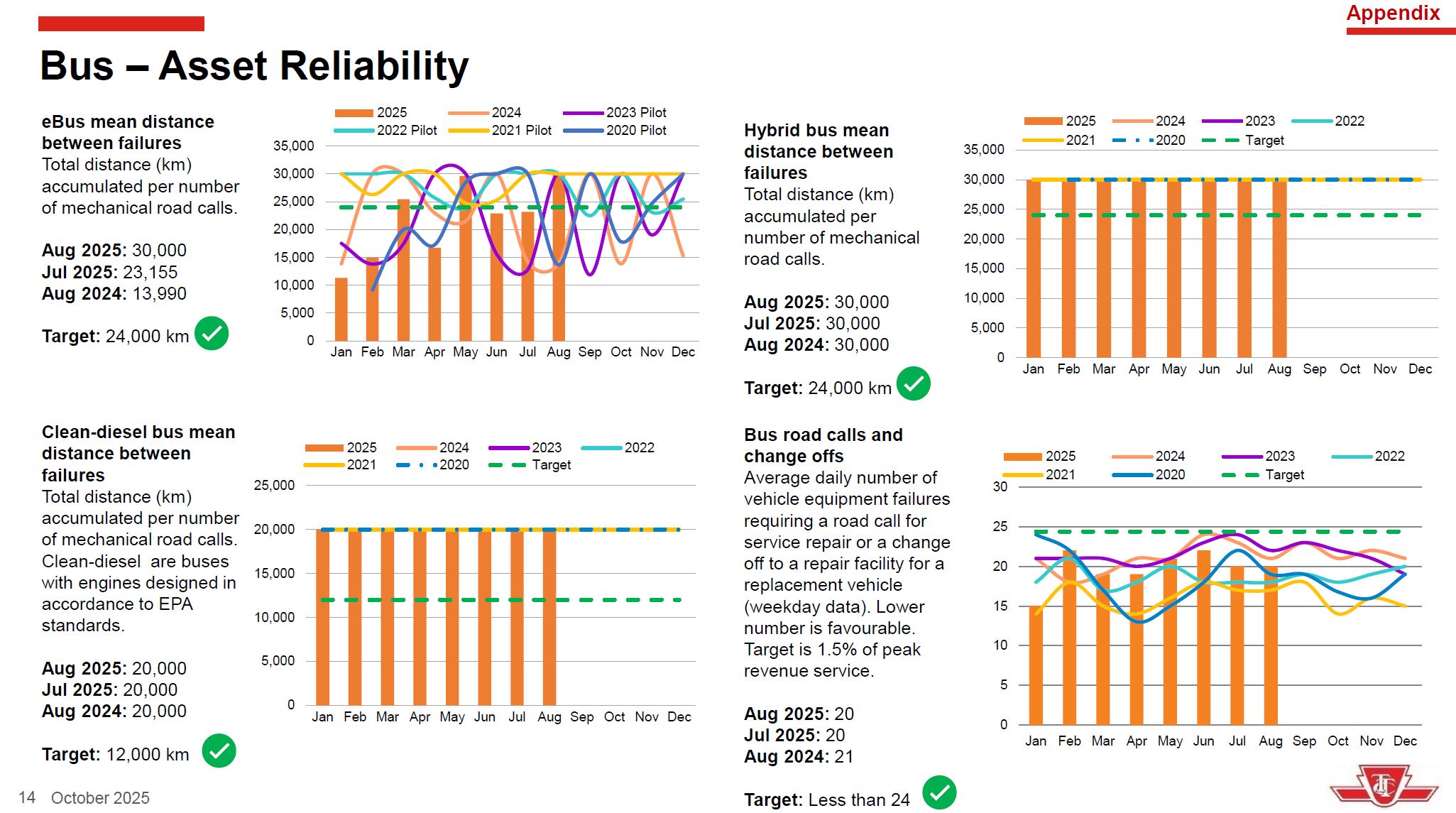
For many years, the TTC reported bus reliability as a mean distance before failure (MDBF) as shown in the charts below.
A fundamental problem with these charts is that the values for Hybrid and Clean Diesel buses are capped at 30,000km and 20,000km respectively, although the actual values could be higher. This makes the values shown for eBuses which lie in the 15,000-30,000km range look similar by comparison.
In the October 2025 CEO’s Report, on the agenda for the TTC Board Meeting of October 6, 2025, the values are not capped. Indeed, the CEO comments on the particularly good results for diesel buses.
Industry-Leading Asset Performance
When it comes to vehicle reliability, our fleet continues to outperform expectations. Across all vehicle types, our buses are achieving Mean Distance Between Failures (MDBF) well above North-American standards. Clean Diesel, in particular, is showing exceptional results, demonstrating industry-leading reliability across our entire bus portfolio. [CEO’s Report at p. 2]
The numbers cited by the CEO for September 2024 to August 2025 are:
Mean Distance Between Failures
Ebus 117 buses 24,554km (12m rolling avg) Target 24,000 Diesel 1165 buses 46,336 km(12m rolling avg) Target 12,000 Hybrid 766 buses 36,218km (12m rolling avg) Target 24,000
[CEO’s Report at p. 5]
The MDBF values affect key aspects of service provision including the number of vehicles required for spares and the probability of a failure affecting service.
Not included in the stats is the mean time to repair which can have as severe an effect as MDBF. If the failures for one type of equipment are more complex putting a bus out of service for a longer period, this can compound the MDBF rate because each failure represents a longer outage. The TTC is somewhat insulated from this effect because it maintains a larger spare ratio than the industry average (see below).
I will review the new format of reported stats (only bus and subway are available so far, with streetcar to come in November) as part of my general write-up of the Board agenda.
The TTC appears to have been under-reporting the reliability of diesel and hybrid buses for many years, and this suggests that they wanted to make their eBus program appear as successful as possible. The historical stats should be restated with the caps removed so that the public can see just what the comparison over past years actually looked like.
Recently, operational issues regarding the deployment and charging for an eBus fleet have come to light, and it is clear that conversion to battery buses is not going to be as straightforward as thought when this program began.
Different fleet counts are cited in the August 31 Scheduled Service Summary and the CEO’s Report.
CEO’s Report September 2025
Scheduled Service Summary August 31, 2025
Diesel
1,165 (56.9%)
1,165 (55.3%)
Hybrid
766 (37.4%)
766 (36.3%)
eBus
117 (5.7%)
177 (8.4%)
Total
2,048
2,108
Peak Scheduled
1,588
1,588
Spare Ratio
29%
33%
Only 1,588 of these buses are scheduled in peak service [effective August 31, 2025] giving the TTC roughly a 29% spare ratio (three buses spare for every 10 scheduled), still above industry standards if the pilot eBus fleet is excluded. If they are included, the spare count is even higher, but that could be misleading depending on how many of the pilot buses actually remain in service.
How much of this is due to budget limits on service growth, and how much is due to keeping a high number of spares to offset poor reliability?
233 eBuses remain to be delivered on current orders, and the TTC proposes a further 200 hybrid buses to continue replacement of older vehicles while eBus technology matures. The portion of the fleet now being retired is not the diesels, but the earlier hybrids acquired in 2006-2008. [Source: TTC Scheduled Service Summary effective August 31, 2025 at p. 58]
A through review of the eBus program is needed to understand its effect on future operating and capital budgets without the rose-coloured lenses applied to “green” projects. Emission reductions are a key goal for Toronto, but they should not come at the expense of higher cost and reduced reliability for the transit fleet.
Much of the review concerned asset management, inventory of system components, condition tracking and planning for maintenance and replacement. There is also a concern that subway and streetcar maintenance could be better integrated due to common technologies. I will leave a full review of this until after the A&RM Committee considers the UITP report at its September 22, 2025 meeting.
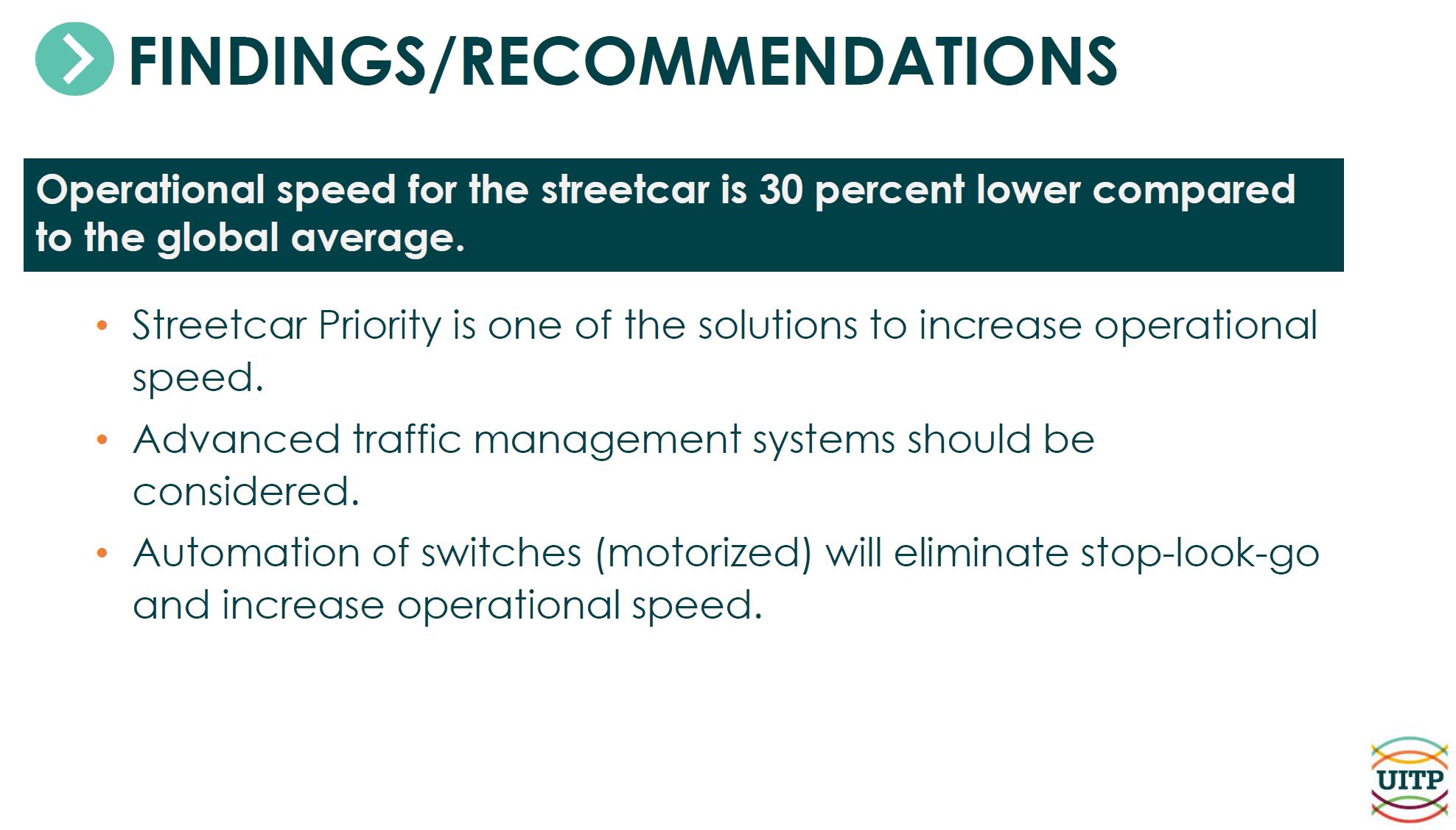
One slide in the UITP’s presentation deck speaks to streetcar operations and notes the glacial pace of Toronto streetcars compared to other systems.
The gradual slowdown of streetcar speeds evolved over a long period, and some of the history is not well known by current TTC Board members nor, I suspect, by many in TTC management. Many readers will remember the sprightly operation of the previous generations of CLRV streetcars and of the PCCs before them. The slowing of streetcar operations is not just a question of traffic congestion, but of other factors including TTC policy decisions. Any move to speed up operations needs to address as many of these issues as possible.
These include:
Electric switch operation
Track condition at intersections and associated slow orders
Overhead condition notably at underpasses
Flexity door operations
Nearside vs farside stops
Transit priority at signals especially for turning movements
Reserved transit lanes
The full version of the UITP report is not available and it will be discussed in private session at the committee meeting.
The TTC has a Request for Bid open on merx for the retrofit of pantographs on up to six legacy streetcars.
The base bid is for one car, with an option for five additional.
If this work goes forward, Toronto might still see its legacy fleet returned to occasionally active duty, but there is no further information in the request.
Despite the premise of an open, competitive bid among potential carbuilders for new subway trains, various politicians have openly argued that the work should go to the historical provider, the Alstom (formerly Bombardier) plant in Thunder Bay.
On August 15, all three funding governments, Canada, Ontario and Toronto announced that a sole-source contract will be awarded to Alstom Transport Canada. This is intended to support Canadian jobs and an existing manufacturing facility. All bidders have been notified that the former bid process has been cancelled.
To ensure that Alstom delivers state-of-the-art trains at a fair market price, maximizes the creation of Canadian jobs, and benefits Toronto, Alstom must:
• deliver a product that is compliant with the TTC’s original requirements; • maximize Canadian content and create Canadian jobs; • have its pricing subject to an independent third-party market price assessment.
It is expected that negotiations will occur over the next few months with a report back to the TTC Board on the status of negotiations by the end of the year.
The proposed contract would provide 70 new trains
55 trains to replace the existing Line 2 fleet
15 trains for the North Yonge and Scarborough extensions
There is also provision for future train orders that would support expansion of service on both Lines 1 and 2. The 55 trains are sufficient to operate Line 2 at the capacity supported by its existing signal system, but more trains would be needed to exploit the capabilities of CBTC (Computer Based Train Control) which will be installed in coming years. Similarly, the existing Line 1 fleet will support the pre-CBTC service level of 140 seconds (25.7 trains/hour), but more trains are needed to go beyond that level. There is no funding for the additional trains in current budgets, nor for the added maintenance facilities a larger fleet will require.
The award of additional trains to Alstom is dependent on their performance on the 70-train order.
The new release states:
The TTC is working diligently to ensure the aging Line 2 fleet operates safely and reliably until new trains arrive.
Originally, the TTC had planned to replace the Line 2 trains by 2026, but that scheme was shelved by former CEO Rick Leary who claimed the trains could be life-extended to 2040. That solved a budget pressure for funding, including the proposed new maintenance yard at Kipling, but created a potential crisis in subway reliability and fleet availability.
The TTC has more than 55 of the current T-1 stock used on Line 2 due to changes over the years in the scope of automatic train control implementation on Line 1. These would, if all trains were working, have allowed the Scarborough extension to open using the existing fleet, but only barely. The delay in the Scarborough project bought the TTC time to procure new trains.
The challenge now is to keep the T-1 fleet operating reliably until new cars arrive. TTC management reported at a Board meeting earlier this year that some cars are being used as a source of spare parts. There are obvious limits to how far this practice can go, and if carried too far will limit the TTC’s ability to restore full pre-pandemic service on Line 2.
Despite the extensive catalogue of issues with the Green Bus program, the TTC Board wasted no time in adopting the report without debate on an enthusiastic motion by Commissioner/Councillor Saxe. There was a sense that they could not wait to get this item off of the table.
However it is likely to come up again at the Strategic Planning Committee in discussions of future service improvements and the resulting fleet size, and the City Auditor’s review of the program will land on Saxe’s Audit & Risk Management Committee agenda sometime in 2026.
In the meantime, the TTC needs honest reporting of the performance of its growing eBus fleet as more buses arrive. In the short term, they can paper over range issues by using these vehicles on blocks of work that do not tax their capacity (buses that are only in service for part of the day, and on less stressful routes). The disparity between charging capacity and fleet size discussed in the report will also affect availability, and “performance” metrics should include not just how far a bus can travel, and how reliable it is from failure, but also whether it is even available for service.
Meanwhile, major systems elsewhere in North America continue to hedge their bets on eBuses with parallel orders of hybrids as Toronto is now doing.
This is a long report, and some key information is buried down in the appendices. It reveals, among other things, that:
Delivery of the battery-powered eBuses is running late. This is an industry-wide supply chain problem.
The TTC plans to buy 200 more hybrid buses as an interim step to allow retirement of their oldest vehicles.
The reliability of the eBuses is below the originally hoped-for “long range” capacity and they are only achieving about 250km per charge. That is with a new battery, and the value is expected to drop as batteries age.
Much of the TTC’s currently scheduled service cannot be operated with standard range eBuses, and planned change-offs will be needed to cover the span of service typical on TTC. This will add to mileage and operator hours.
Charging operations at garages are constrained by a shortage of installed charge points compounded by limitations of electrical capacity.
The problem of shorter range and limits on charging fundamentally change how garages operate for diesel/hybrid buses where refuelling is quick and is performed as part of routine servicing as buses come out of service.
The need to shuffle buses between charge points and storage locations will add to staffing requirements at garages.
eBuses cannot replace hybrids on a 1:1 basis because of the charging constraints.
There is a possibility that the TTC will have to store new buses unused because of charging limitations.
The policy decision to deploy eBuses at all garages simultaneously requires that maintenance equipment, staffing and training must be provided everywhere at once rather than a garage by garage transition, and that concurrent support for hybrids must also exist at all sites.
On route charging (using charge points at key locations to permit buses to “top up” their charge) was considered early in the project, but was rejected for various reasons including a desire to be up and running quickly to secure special eBus subsidies. It is now treated as a possible option, but with implementation five years away.
The comparative performance of hybrids and eBuses in the CEO’s monthly Metrics Report artificially understates the hybrid numbers and makes the eBuses appear to perform closer to hybrid buses than is actually the case.
The TTC does not address garage capacity issues and, indeed, speaks of shifting the need for a 10th garage off by over a decade through a “garage enhancement” project. This scheme echoes other past budget juggling to shift major infrastructure requirements and their funding needs off of the current planning calendar.
The report contains no discussion of the implications of technical limitations for the future of bus service especially in the context of any desire to drive up ridership with significant service improvements.
Overall, the report describes a project that has finally addressed the technical realities of eBuses, something that has been glossed over for years. Some aspects of eBus migration, notably charging capacity, time and garage management issues, are presented almost as new discoveries even though they are not new to the industry. Whether this is wilful ignorance or downplaying of problems on a high-profile project, the effect is the same. As with a few other major Toronto projects, the TTC is saved from some pitfalls because schedule extensions give them more time to deal with issues that should have been foreseen.
The project began in 2017 when, shamefully, the TTC Board under then Chair Josh Colle, allowed reps from BYD to pitch their wares in the guise of a “deputation”. This was “facilitated”, to use City Hall speak, by then TTC Board member Minnan-Wong with behind the scenes support from then-Mayor Tory. The video is still available on YouTube. The original hype from BYD, who hoped for a large untendered contract, is falling away, but the implications for the future of TTC bus service are only now coming out in the open.
(Those of us with long memories will recall the combined efforts of TTC management, MTO “innovative technology” staff, the gas industry and Ontario Bus Industries to replace the TTC’s trolleybus system with “clean” natural gas buses on a sole-source contract. We have been here before.)
As the 60-bus pilot project wore on, BYD was only able to supply half of the 20 buses originally allocated to them. Proterra, now out of business, got 25 and New Flyer got the other 25. At the point I write this article (July 13 at 3:00 pm, none of the BYD buses is reporting a position on the vehicle tracking system. (14 of 25 Flyers, and 8 of 25 Proterras are active.)
New Flyer is supplying eBuses to the TTC, and of the fleet numbers 6000-6203, the highest number reporting its location is 6141. Fewer than half of the delivered buses is reporting a location. Nova Bus deliveries on a 136 bus order are slower, and only 6 buses are reporting locations. (See Appendix E later in this article for information on delivery progress.)
An important issue when considering reliability stats is that a bus that never runs never fails, and so does not contribute to MDBF (Mean Distance Before Failure) stats. These buses do, however, count as part of the TTC’s active fleet and inflate its apparent size including chest-beating claims to the number of eBuses Toronto has. Having them and operating them are two different issues.
When there are only a few trial vehicles in the fleet, how well they work has little effect on service, especially through the pandemic era when service was not running at 100% of former levels. The situation is much different as recovery to full service, notably on the bus network, is in sight, and both City Council and some TTC Board members talk of an aggressive increase in transit service to wean motorists out of cars and accommodate population growth.
The TTC has already reached the point where it must keep elderly vehicles in service to compensate for performance issues with the new fleet, and this situation will compound as more eBuses arrive. There is even a question of where to store all of these buses if they cannot be actively, reliably used. The planned order for hybrids does not simply buy time while supply chain issues are worked out and battery technology improves. It is an admission that the electric fleet plan is not working out and that service at current levels is threatened. Major service expansion is simply not possible.
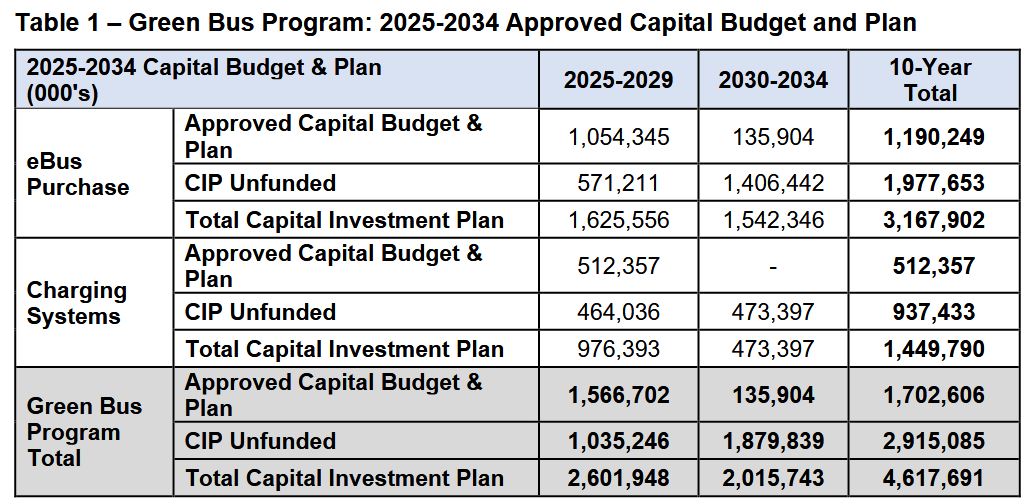
On the financial side, migration to eBuses is not cheap, and the project is funded only to about 37%. An important discussion nobody at the City or TTC seems willing to address is whether it is better to lower emissions by converting the fleet and all facilities to electric operation, or if buying and operating more buses to get riders out of their cars and improve mobility in the city should take precedence. Capital projects are seductive because they are often funded with “other people’s money”, but even the special eBus subsidies only go so far.
It is both ironic and sad that the electric streetcar system has many surplus vehicles thanks to service cuts, but also from a shortage of operators. The TTC plans to move to a six-minute service on three routes in Fall 2025, but may have to bus one line (503 Kingston Road) for want of streetcar drivers.
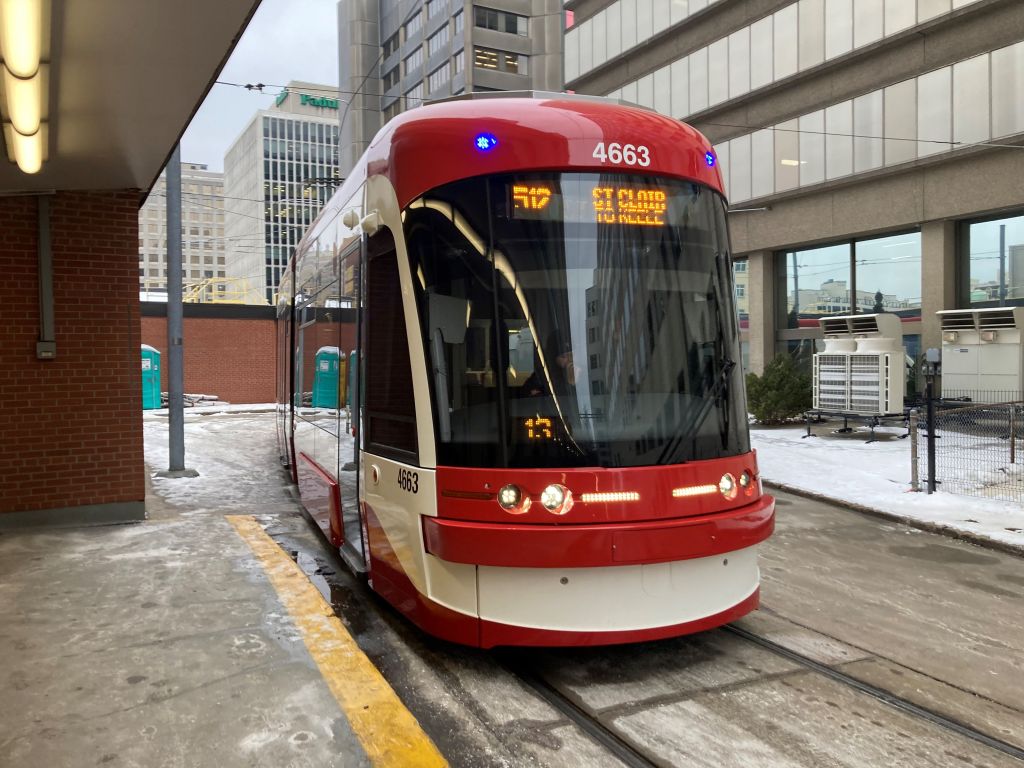
Peak streetcar service in July 2025 is 170 cars (on Saturday afternoons, not during the weekday peaks!), but the fleet will soon number 262 cars when the last of the new Flexitys arrives. 50 of the 60 new streetcars, 4603-4662, are actively reporting locations, and the highest of these, 4655, shows how close to complete the deliveries are.
In the rest of this article, I will explore issues with the eBus project and plans in more detail, but the last Appendix deserves to be here, “above the fold”.
A review commissioned by the TTC Board from Deloitte in 2023 flagged issues with “project management improvement in the areas of schedule, cost, scope, reporting, risks and issues, governance, and interdependencies management”. Of the 37 recommendations, 18 are closed and 19 are in progress.
An APTA (American Public Transit Association) peer review is planned to begin in September 2025, and the City’s Auditor General plans to review the eBus program.
It is quite clear reading through the report that the TTC eBus project is in trouble both because of external factors (industry conditions) and because the implications of the technology were not fully understood or appreciated. Moreover, the transition will require far more than buying some new buses and plugging them in. The TTC loves to claim that is a leader in the field, but this is likely only true in comparison with smaller systems that do not have the capacity. Within the industry, TTC is not at the front of the pack.
The RFP was issued in December 2024 and was intended to go through several stages including:
Pass/Fail screening: January
Confidential cybersecurity meetings: March to April
Commercial confidential meetings: April to early July
Proposal submission deadline: July 22, 2025
We have just reached the point where early discussions with would-be vendors are to get underway, and actual submissions are three months off.
This means that no details of potential bids such as Canadian content, manufacturing plans or, of course, pricing are known to the TTC.
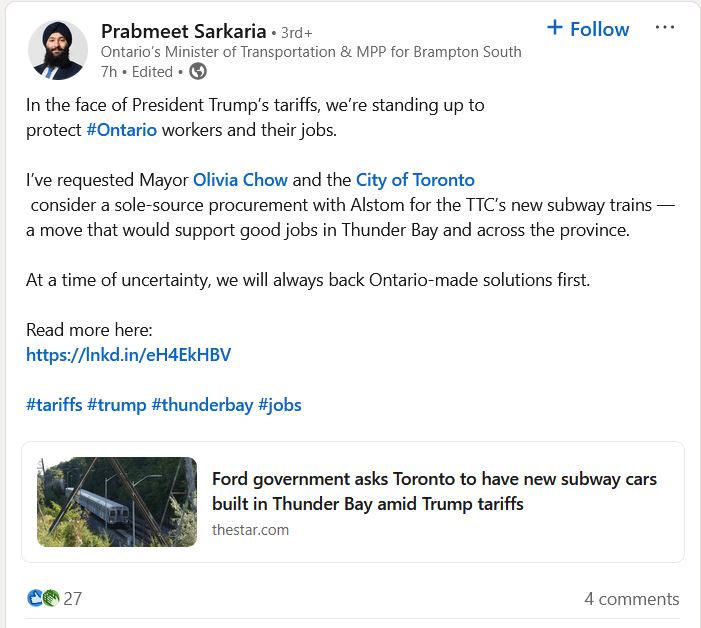
On April 23, 2025 (yesterday as I write this), Ontario’s Minister of Transportation, Prabmeet Singh Sarkaria, wrote to Mayor Chow asking:
I am writing to you about the importance of standing up for Ontario workers as a critical consideration during the procurement of the 55 new subway trains for TTC’s Line 2, which our government is supporting with a $758 million investment.
[…]
I am requesting that the City of Toronto recognize this historic opportunity and consider a sole-source procurement with Alstom, which would support Ontario workers in Thunder Bay and across our province.
Coverage of this appeared in The Star on April 24. In an unusual move for a government so enamoured of media exposure, this was not accompanied by a formal press release or media conference, but by a posting on the Minister’s LinkedIn feed.
Mayor Chow issued the following statement in reply:
Mayor Chow supports Buying Canadian whenever possible. With President Trump attacking Canada’s economy, we need to support local workers, jobs and businesses. We are working in collaboration with the provincial and federal government to deliver public transit for Torontonians and to support Canadian jobs. A Request for Proposal was issued in December. The Mayor speaks regularly with Minister Sarkaria and we will work collaboratively with the province and assess the feasibility of their request.
Past comments at both the Provincial and Federal level have suggested that this contract should automatically go to Alstom’s Thunder Bay plant, and yet the TTC issued an open RFP with all of the cost and complexity that entails. Of course, Trump’s machinations against Canada had not begun in December.
This RFP proposes not just the 55 replacement trains for the current Line 2 fleet, but trains for extensions to Scarborough and Richmond Hill, growth in demand, and eventually replacement of the current Line 1 fleet (all as options). Whoever gets this contract can well lock in decades of work supplying the Toronto subway system.
Sarkaria hints at the possibility that a sole-source contract to Alstom might require some adjustments:
The Ontario government will work with the city and the federal government to ensure the successful delivery of the trains should this decision lead to any changes in the project scope.
With a Federal election in progress, we will not know soon how much more funding might be on the table, but any extra cost would likely come out of Toronto’s allocation of the 10-year Federal funding plan already in place. It could be a stretch to get net new funding.
We have already seen the effect of cost projections on this project which was originally scoped at 62 trains, but was cut back to 55 to stay within the requested funding.
For the record, the Canadian content requirement in the RFP is 25%, and much of this contract could go offshore based on the RFP specs. If we are really going to “buy Canadian”, that number must be higher to the degree possible. (Some components, notably electronics, are not made in Canada.)
Vendors who are already involved in the RFP process will, no doubt, be upset that “the fix was in” for Alstom and resent the waste of their time. What added economic benefits might have come with an alternate vendor we will never know. Any such proposal would have to be weighed against the possible closure of Alstom’s facilities for lack of work.
Updated April 24, 2025 at 11:30 pm: TTC responses to my questions have been added at the end of the article. One questions remains outstanding.
Back in 2018, the City of Toronto bought the lands southwest of Kipling Station formerly known as the CP’s Obico Yard. This land was to be used for a new Maintenance and Storage Facility for Line 2 trains in anticipation of:
Space at Greenwood being reallocated to serve the Downtown Relief Line,
Greenwood’s layout being inappropriate for permanently coupled six-car trains,
The planned increase in the Line 2 fleet to accommodate both extension and increased service.
The existing Line 2 fleet comprised 372 T-1 subway cars dating from 1995-2001, and they will reach the end of their 30-year design life starting this year. The cars are in married pairs that can be easily uncoupled from their trains. Greenwood’s layout is based on short maintenance bays, not on six-car trains. (When Greenwood was designed, operation of four-car trains was common.) Back in 2018, the expected new trains for Line 2 would be similar to the TRs on Line 1 running in permanent six-car sets.
The original plan was to buy 62 New Subway Trains (NSTs) to replace the T-1 fleet. This would give enough trains to operate Line 2 through to Scarborough, albeit likely with a short turn during peak periods at Kennedy Station. The NST order has been scaled back to 55 trains (the number required for the existing Kennedy-Kipling line) with extras to be purchased as part of the Scarborough and Yonge North subway projects.
The NST design has changed to retain the style of the 6-car TRs with open gangways, but the cars will come in married pairs. Each end of the train will have a pair with one cab plus hostler controls on the “blind” end of the pair. The middle pair will have hostler controls at both ends. This will allow the 6-car sets to be broken up for movement of individual pairs in yards and shops. (See: TTC Requests Proposals for New Line 2 Trains and Signalling)
The Ontario Line replaced the Relief Line, and will have its own fleet and MSF at Thorncliffe Park eliminating Greenwood as its home base.
These factors led to a rethink of Greenwood Shops and the need for a new yard west of Kipling Station.
In 2022, the City bought property east of the Western Yard lands at 780 Kipling as a site for their next bus garage, although current plans will not require it immediately. The two properties are adjacent, but are separated by the link between the Metrolinx Lakeshore West corridor to the CPKC Milton line at Kipling Station.
TTC proposes to use this site not just for a garage, but to consolidate other operations that are now in leased space around the city.
The map below shows the two sites. The Milton corridor is at the upper left, and Kipling Station is out of frame at the upper right.
Source: Figure 1 from “MASTER PLAN – STUDY OF KIPLING INDUSTRIAL LANDS” TTC RFP March 2025
There are two RFPs (Requests for Proposals) on the street for consulting services:
The Master Plan for the Kipling Industrial Lands
Consultant services for design of the proposed Western Yard
The Master Plan work entails looking at the various possible uses for the site and how they would be accommodated.
The Western Yard RFP includes two documents from the Line 2 Capacity Enhancement Program as reference information. Both were prepared by HDR and Gannett Fleming.
Greenwood Yard Workflow and Processes Analysis, Final Report, June 13, 2023
Western Yard Concept of Operations & Maintenance Report, Draft, January 24, 2025
The Need For Another Yard
Although it may seem like the distant past, only six years ago the subway system was bulging with passengers, and planning focused on how to accommodate more riders. This led to proposals including new trains, automatic train control and a general increase in capacity of both Lines 1 and 2. The services now operating on Lines 1 and 2 are not yet back to pre-covid levels.
Line 1 Time Period
Trains (Headway) January 2020
Trains (Headway) April 2025
Capacity Difference
AM Peak
65 (2’21”)
56 (2’52”)
-22%
M-F Midday
42 (3’49”)
35 (4’34”)
-20%
PM Peak
65 (2’36”)
54 (2’59”)
-15%
M-F Early Eve
46 (3’30”)
38 (4’11”)
-20%
M-F Late Eve
32 (5′)
26 (6′)
-20%
Sat Afternoon
42 (3’41”)
34 (4’34”)
-24%
Sat Early Eve
30 (5′)
30 (5′)
Nil
Sun Afternoon
35 (4’20”)
34 (4’34”)
-5%
Sun Early Eve
30 (5′)
25 (6′)
-20%
Source: TTC Scheduled Service Summaries. Note that M-F services include trippers and gap trains.
Line 2 Time Period
Trains (Headway) January 2020
Trains (Headway) April 2025
Capacity Difference
AM Peak
46 (2’21”)
42 (2’38”)
-12%
M-F Midday
33 (3’20”)
30 (4’04”)
-22%
PM Peak
43 (2’31”)
34 (3’23”)
-34%
M-F Early Eve
29 (3’42”)
25 (4’52”)
-32%
M-F Late Eve
20 (4’52”)
19 (5’23”)
-11%
Sat Afternoon
26 (4’15”)
26 (4’15”)
Nil
Sat Early Eve
19 (5’30”)
19 (5’30”)
Nil
Sun Afternoon
22 (4’52”)
22 (4’52”)
Nil
Sun Early Eve
20 (4’52”)
19 (5’30”)
-13%
Source: TTC Scheduled Service Summaries. Note that M-F services include trippers and gap trains.
TTC expects to be back to the pre-covid peak service in 2030. Line 2 will require 46 trains plus 7 spares (at TTC’s minimum of 15%) for a total of 53, or 9 spares (at 20%) for a total of 55. Spares include both trains ready for deployment as replacements or extra service (ideally 4), as well as those in maintenance programs.
Service more frequent than 140 seconds will not be possible on Line 2 until it fully converts to automatic train control in the early 2030s. The Scarborough extension’s opening date is currently claimed to be 2030, although whether like so many other projects it will come in late is unknown. Extra trains for that extension, and for ATC conversion will be needed starting in 2030.
Thus far, this article has covered basics and readers might ask about the title’s question – will a western yard ever be built?
The Western Yard design RFP incorporates the Greenwood Yard study which speaks of construction of a new yard originally planned for 2034, but now pushed to 2038 or beyond by the TTC. No reason for this is given. No estimate of construction time, and hence availability of the new facility, is given either.
Can Greenwood handle the transitional state between its current role and various steps on the way to complete delivery of the new trains, not to mention a new yard?
Back in 2018, the transition looked relatively straightforward with a planned new yard to provide capacity. Now this is constrained by several factors even allowing for the DRL/OL fleet shift out of Greenwood. There is no provision in the TTC’s 10 Year Capital Plan for construction of a western yard, only for preliminary work such as design.
The issues go beyond space for train storage. They include capacity for ongoing servicing and maintenance, major overhauls, spare parts storage and workforce scheduling. For many years, the TTC had a surplus of space and maintenance capacity, but as the number of active trains grows concurrently with delivery of new trainsets, much more will be expected from staff and facilities.
This situation arose in part because TTC management opted to defer the new yard with no acknowledgement of its critical role as the system grows. Simultaneously, contracts for new trains and ATC conversion also were pushed out into the future. This delayed capital expense, helped to keep taxes down, and left headroom for other projects.
All of this bumps into assumed go-live dates for the Scarborough extension, automatic train control and headways below 140 seconds. The pandemic pushed many dates for transit’s growth into the future thanks to lost riding. However, if events drive demand up faster than the TTC’s projections, they will not be able to handle the pressure. Considering that the City of Toronto often cites transit growth as an essential part of fighting traffic congestion, the City and TTC plans could be out of whack.
The project to reconfigure Harvey Shops at TTC’s Hillcrest facility was formally launched today. The work involves rejuvenation of the 100-year old property so that it can host up to 25 streetcars serving 512 St. Clair and, at least to some extent, 511 Bathurst greatly reducing dead-head time from carhouses for these routes.
This change in use is triggered by the new longer cars and the shift of major streetcar maintenance to Leslie Barns which is designed for them. Hillcrest was built in an era of Peter Witts, later PCCs, that are half the length.
This project is long overdue because the extra capacity is needed for streetcars to be delivered over the coming year. The situation is compounded by the loss of capacity at Russell Carhouse where major reconstruction is still incomplete. The TTC has improved overnight streetcar service as a means of “storing” surplus cars, although this has the added benefit of generating new riding and providing more convenient service for users of the night routes.
The Hillcrest project will be done in two phases allowing it to begin carhouse operation before the planned end date in 2029.
The eastern portion of the shops will be converted so that tracks run through from north to south. The current arrangement is oriented south to north, and most car movement within the building uses a transfer table to shift cars between the entry at the east side of the building and stub tracks further west.
The views below look west along the transfer table runway from the east side of the building in 2012 when CLRVs were the dominant form of vehicle. The runway will be filled in, and tracks which are now separated by it will be connected to provide a through route.
And here are views in earlier days showing the transfer table itself, and Peter Witt 2894 undergoing restoration for Tour Tram service. (This car is now at the Halton County Radial Railway Museum.)
Tracks around Harvey Shops will be reconfigured to provide a clockwise loop rather than the counter-clockwise arrangement now in place. Most of the storage area will be east of the building replacing some employee parking.
The TTC Board met on February 24, 2025 with an agenda that seemed light going in, but the meeting itself ran well into the afternoon partly due to a long in camera discussion and partly to debates that expanded the scope of the items on the agenda.
Notable by its absence was a report on establishment of a Strategic Planning Committee, an item approved by the Board on January 10 with an implementation plan due at the February 24 meeting. (See minutes at p. 3) Such a committee is vital so that consultation and planning can occur before and while the 2026 budget is in preparation, a process that gets underway in roughly June-July each year. If there is to be some brave new vision of what transit can become, there is no point in asking that it be included in an already final budget in December.
A follow-up on the report re Subway Streetcar Fleet and Infrastructure
The proposed interim wayfinding strategy
An update on fare collection technology
A new procedure for handling complaints about CEO misconduct
I will cover the 2025 Annual Service Plan and the Corporate Plan Update in a separate article.
Location of Reports Changed
Effective with this meeting, the agendas and reports for Board meetings have shifted to the City’s meeting management site which hosts Council and Committee meetings. This will also host documents for Board committees such as Audit & Risk Management. Information for past meetings continues to be available on the TTC’s own site.
In Fall 2024, the CEO’s Report was reorganized with the Key Performance Indicators split off from the main report. There are now separate pages on the TTC site for accessing monthly CEO’s Reports and KPI reports.