Will Line 2 Ever See Its Western Yard?

Updated April 24, 2025 at 11:30 pm: TTC responses to my questions have been added at the end of the article. One questions remains outstanding.

Back in 2018, the City of Toronto bought the lands southwest of Kipling Station formerly known as the CP’s Obico Yard. This land was to be used for a new Maintenance and Storage Facility for Line 2 trains in anticipation of:

  • Space at Greenwood being reallocated to serve the Downtown Relief Line,
  • Greenwood’s layout being inappropriate for permanently coupled six-car trains,
  • The planned increase in the Line 2 fleet to accommodate both extension and increased service.

The existing Line 2 fleet comprised 372 T-1 subway cars dating from 1995-2001, and they will reach the end of their 30-year design life starting this year. The cars are in married pairs that can be easily uncoupled from their trains. Greenwood’s layout is based on short maintenance bays, not on six-car trains. (When Greenwood was designed, operation of four-car trains was common.) Back in 2018, the expected new trains for Line 2 would be similar to the TRs on Line 1 running in permanent six-car sets.

The original plan was to buy 62 New Subway Trains (NSTs) to replace the T-1 fleet. This would give enough trains to operate Line 2 through to Scarborough, albeit likely with a short turn during peak periods at Kennedy Station. The NST order has been scaled back to 55 trains (the number required for the existing Kennedy-Kipling line) with extras to be purchased as part of the Scarborough and Yonge North subway projects.

The NST design has changed to retain the style of the 6-car TRs with open gangways, but the cars will come in married pairs. Each end of the train will have a pair with one cab plus hostler controls on the “blind” end of the pair. The middle pair will have hostler controls at both ends. This will allow the 6-car sets to be broken up for movement of individual pairs in yards and shops. (See: TTC Requests Proposals for New Line 2 Trains and Signalling)

The Ontario Line replaced the Relief Line, and will have its own fleet and MSF at Thorncliffe Park eliminating Greenwood as its home base.

These factors led to a rethink of Greenwood Shops and the need for a new yard west of Kipling Station.

In 2022, the City bought property east of the Western Yard lands at 780 Kipling as a site for their next bus garage, although current plans will not require it immediately. The two properties are adjacent, but are separated by the link between the Metrolinx Lakeshore West corridor to the CPKC Milton line at Kipling Station.

TTC proposes to use this site not just for a garage, but to consolidate other operations that are now in leased space around the city.

The map below shows the two sites. The Milton corridor is at the upper left, and Kipling Station is out of frame at the upper right.

Source: Figure 1 from “MASTER PLAN – STUDY OF KIPLING INDUSTRIAL LANDS” TTC RFP March 2025

There are two RFPs (Requests for Proposals) on the street for consulting services:

  • The Master Plan for the Kipling Industrial Lands
  • Consultant services for design of the proposed Western Yard

The Master Plan work entails looking at the various possible uses for the site and how they would be accommodated.

The Western Yard RFP includes two documents from the Line 2 Capacity Enhancement Program as reference information. Both were prepared by HDR and Gannett Fleming.

  • Greenwood Yard Workflow and Processes Analysis, Final Report, June 13, 2023
  • Western Yard Concept of Operations & Maintenance Report, Draft, January 24, 2025

The Need For Another Yard

Although it may seem like the distant past, only six years ago the subway system was bulging with passengers, and planning focused on how to accommodate more riders. This led to proposals including new trains, automatic train control and a general increase in capacity of both Lines 1 and 2. The services now operating on Lines 1 and 2 are not yet back to pre-covid levels.

Line 1
Time Period
Trains (Headway)
January 2020
Trains (Headway)
April 2025
Capacity
Difference
AM Peak65 (2’21”)56 (2’52”)-22%
M-F Midday42 (3’49”)35 (4’34”)-20%
PM Peak65 (2’36”)54 (2’59”)-15%
M-F Early Eve46 (3’30”)38 (4’11”)-20%
M-F Late Eve32 (5′)26 (6′)-20%
Sat Afternoon42 (3’41”)34 (4’34”)-24%
Sat Early Eve30 (5′)30 (5′)Nil
Sun Afternoon35 (4’20”)34 (4’34”)-5%
Sun Early Eve30 (5′)25 (6′)-20%
Source: TTC Scheduled Service Summaries. Note that M-F services include trippers and gap trains.
Line 2
Time Period
Trains (Headway)
January 2020
Trains (Headway)
April 2025
Capacity
Difference
AM Peak46 (2’21”)42 (2’38”)-12%
M-F Midday33 (3’20”)30 (4’04”)-22%
PM Peak43 (2’31”)34 (3’23”)-34%
M-F Early Eve29 (3’42”)25 (4’52”)-32%
M-F Late Eve20 (4’52”)19 (5’23”)-11%
Sat Afternoon26 (4’15”)26 (4’15”)Nil
Sat Early Eve19 (5’30”)19 (5’30”)Nil
Sun Afternoon22 (4’52”)22 (4’52”)Nil
Sun Early Eve20 (4’52”)19 (5’30”)-13%
Source: TTC Scheduled Service Summaries. Note that M-F services include trippers and gap trains.

TTC expects to be back to the pre-covid peak service in 2030. Line 2 will require 46 trains plus 7 spares (at TTC’s minimum of 15%) for a total of 53, or 9 spares (at 20%) for a total of 55. Spares include both trains ready for deployment as replacements or extra service (ideally 4), as well as those in maintenance programs.

Service more frequent than 140 seconds will not be possible on Line 2 until it fully converts to automatic train control in the early 2030s. The Scarborough extension’s opening date is currently claimed to be 2030, although whether like so many other projects it will come in late is unknown. Extra trains for that extension, and for ATC conversion will be needed starting in 2030.

Thus far, this article has covered basics and readers might ask about the title’s question – will a western yard ever be built?

The Western Yard design RFP incorporates the Greenwood Yard study which speaks of construction of a new yard originally planned for 2034, but now pushed to 2038 or beyond by the TTC. No reason for this is given. No estimate of construction time, and hence availability of the new facility, is given either.

Can Greenwood handle the transitional state between its current role and various steps on the way to complete delivery of the new trains, not to mention a new yard?

Back in 2018, the transition looked relatively straightforward with a planned new yard to provide capacity. Now this is constrained by several factors even allowing for the DRL/OL fleet shift out of Greenwood. There is no provision in the TTC’s 10 Year Capital Plan for construction of a western yard, only for preliminary work such as design.

The issues go beyond space for train storage. They include capacity for ongoing servicing and maintenance, major overhauls, spare parts storage and workforce scheduling. For many years, the TTC had a surplus of space and maintenance capacity, but as the number of active trains grows concurrently with delivery of new trainsets, much more will be expected from staff and facilities.

This situation arose in part because TTC management opted to defer the new yard with no acknowledgement of its critical role as the system grows. Simultaneously, contracts for new trains and ATC conversion also were pushed out into the future. This delayed capital expense, helped to keep taxes down, and left headroom for other projects.

All of this bumps into assumed go-live dates for the Scarborough extension, automatic train control and headways below 140 seconds. The pandemic pushed many dates for transit’s growth into the future thanks to lost riding. However, if events drive demand up faster than the TTC’s projections, they will not be able to handle the pressure. Considering that the City of Toronto often cites transit growth as an essential part of fighting traffic congestion, the City and TTC plans could be out of whack.

Continue reading

TTC Hillcrest Update: March 2025

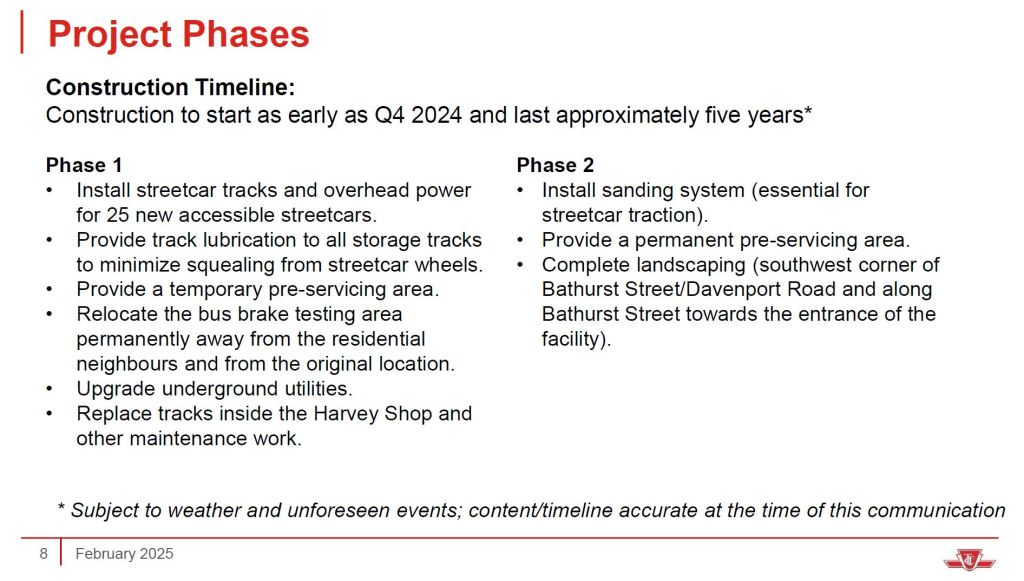
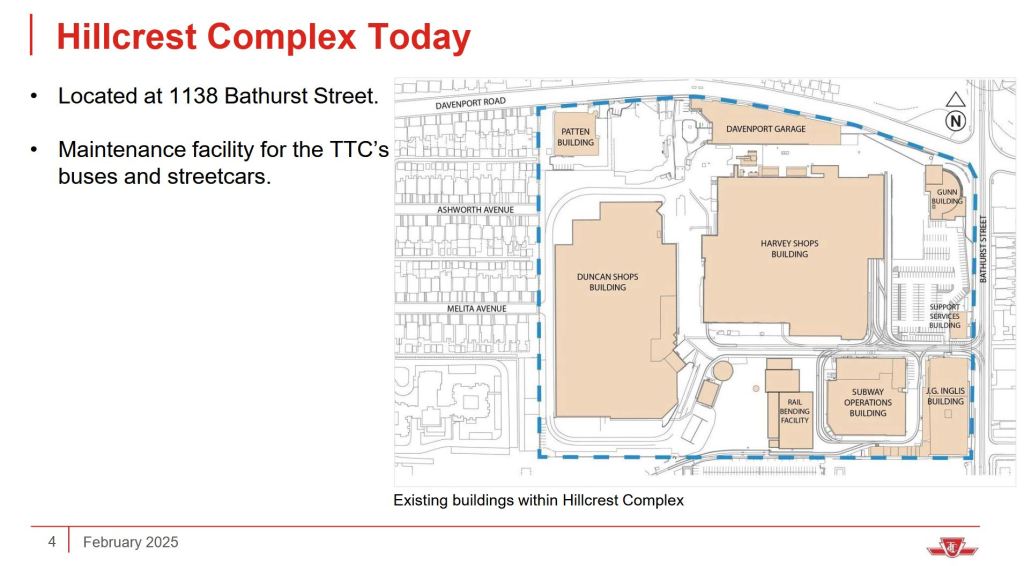
The project to reconfigure Harvey Shops at TTC’s Hillcrest facility was formally launched today. The work involves rejuvenation of the 100-year old property so that it can host up to 25 streetcars serving 512 St. Clair and, at least to some extent, 511 Bathurst greatly reducing dead-head time from carhouses for these routes.

This change in use is triggered by the new longer cars and the shift of major streetcar maintenance to Leslie Barns which is designed for them. Hillcrest was built in an era of Peter Witts, later PCCs, that are half the length.

See also:

This project is long overdue because the extra capacity is needed for streetcars to be delivered over the coming year. The situation is compounded by the loss of capacity at Russell Carhouse where major reconstruction is still incomplete. The TTC has improved overnight streetcar service as a means of “storing” surplus cars, although this has the added benefit of generating new riding and providing more convenient service for users of the night routes.

The Hillcrest project will be done in two phases allowing it to begin carhouse operation before the planned end date in 2029.

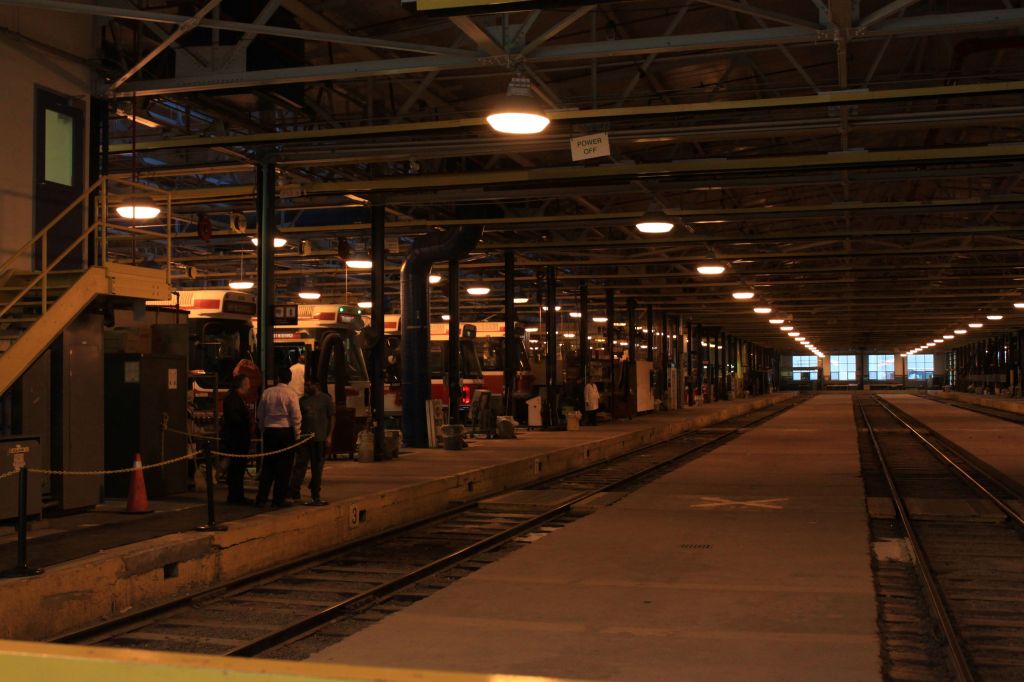
The eastern portion of the shops will be converted so that tracks run through from north to south. The current arrangement is oriented south to north, and most car movement within the building uses a transfer table to shift cars between the entry at the east side of the building and stub tracks further west.

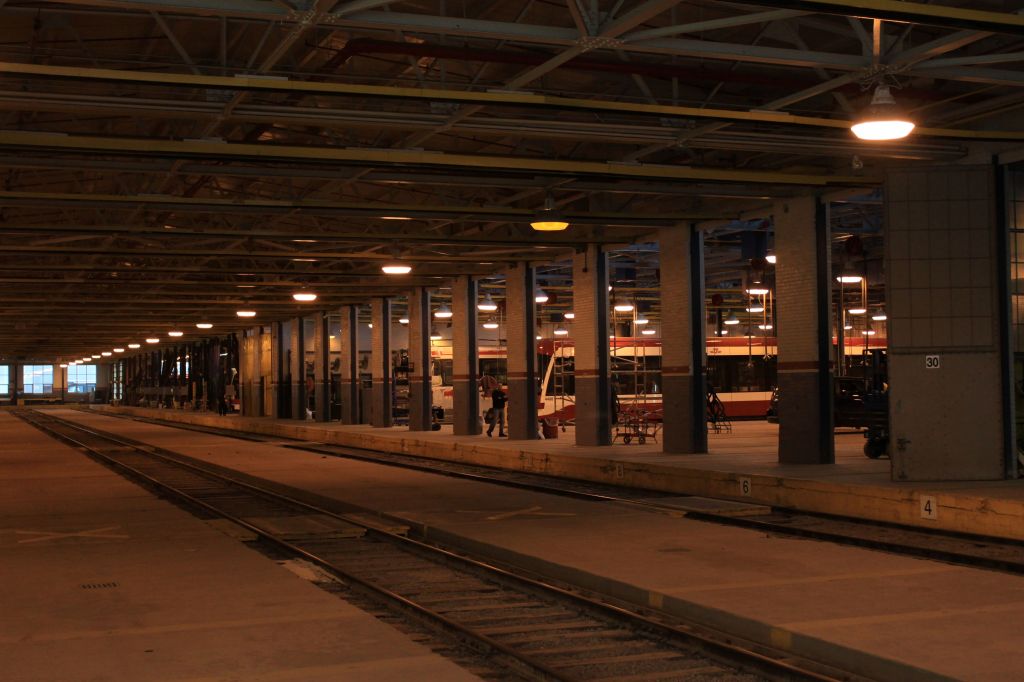
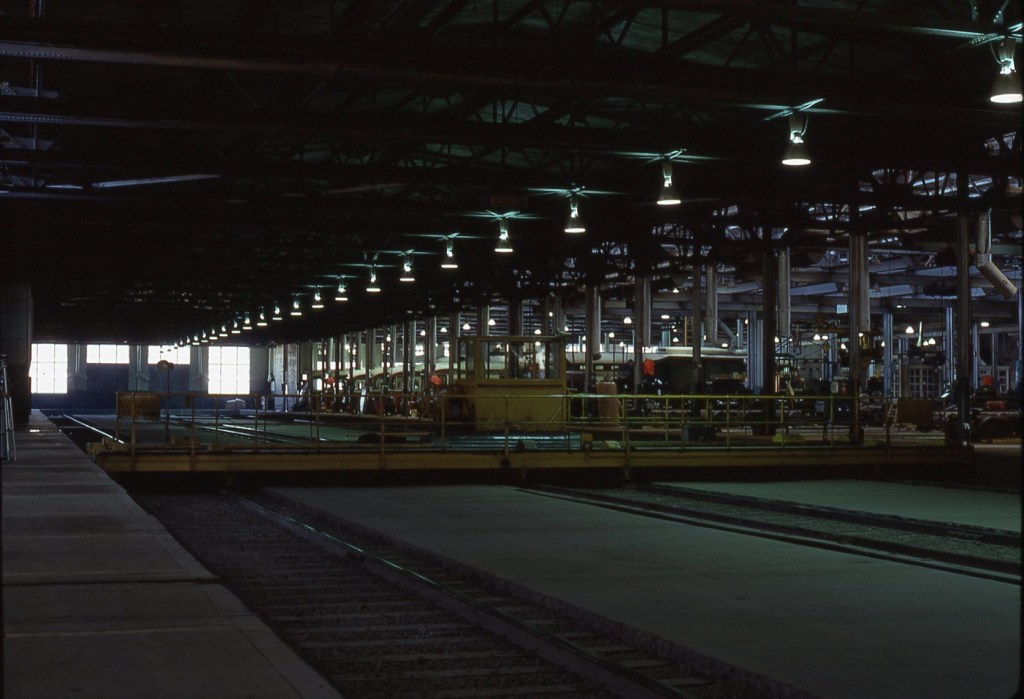
The views below look west along the transfer table runway from the east side of the building in 2012 when CLRVs were the dominant form of vehicle. The runway will be filled in, and tracks which are now separated by it will be connected to provide a through route.

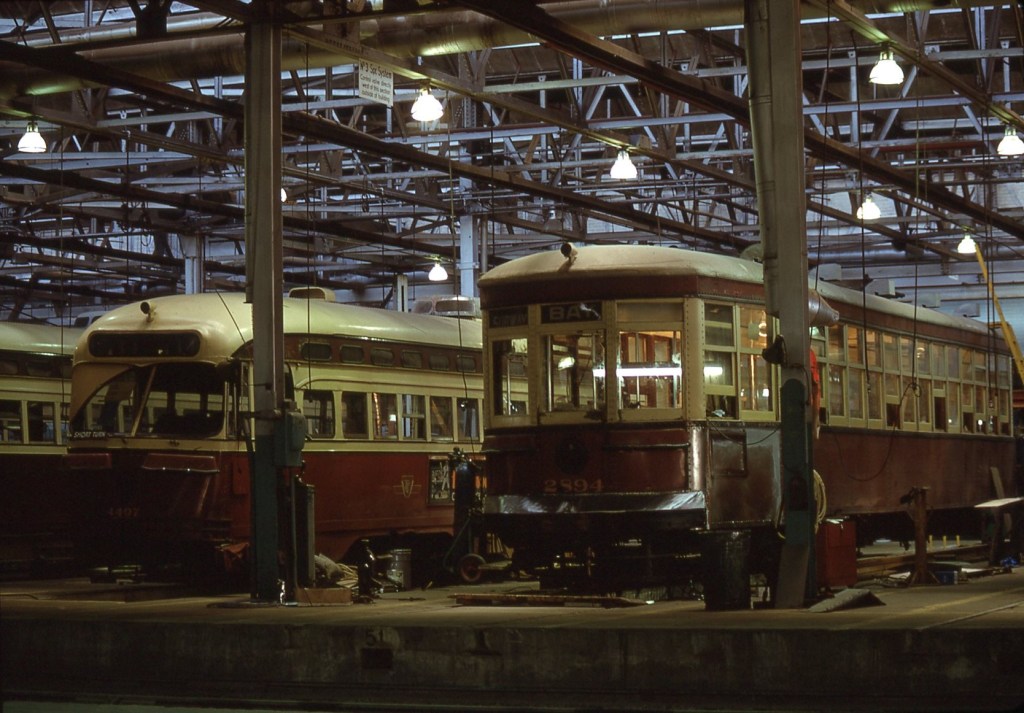
And here are views in earlier days showing the transfer table itself, and Peter Witt 2894 undergoing restoration for Tour Tram service. (This car is now at the Halton County Radial Railway Museum.)

Tracks around Harvey Shops will be reconfigured to provide a clockwise loop rather than the counter-clockwise arrangement now in place. Most of the storage area will be east of the building replacing some employee parking.

TTC Board Meeting: February 24, 2025

The TTC Board met on February 24, 2025 with an agenda that seemed light going in, but the meeting itself ran well into the afternoon partly due to a long in camera discussion and partly to debates that expanded the scope of the items on the agenda.

Reports of interest:

    No Strategy for the TTC?

    Notable by its absence was a report on establishment of a Strategic Planning Committee, an item approved by the Board on January 10 with an implementation plan due at the February 24 meeting. (See minutes at p. 3) Such a committee is vital so that consultation and planning can occur before and while the 2026 budget is in preparation, a process that gets underway in roughly June-July each year. If there is to be some brave new vision of what transit can become, there is no point in asking that it be included in an already final budget in December.

    Continue reading

    TTC Board Meeting Wrap-Up – January 27, 2025

    This article covers:

    • The January 2025 CEO’s Report
    • A follow-up on the report re Subway Streetcar Fleet and Infrastructure
    • The proposed interim wayfinding strategy
    • An update on fare collection technology
    • A new procedure for handling complaints about CEO misconduct

    I will cover the 2025 Annual Service Plan and the Corporate Plan Update in a separate article.

    Location of Reports Changed

    Effective with this meeting, the agendas and reports for Board meetings have shifted to the City’s meeting management site which hosts Council and Committee meetings. This will also host documents for Board committees such as Audit & Risk Management. Information for past meetings continues to be available on the TTC’s own site.

    In Fall 2024, the CEO’s Report was reorganized with the Key Performance Indicators split off from the main report. There are now separate pages on the TTC site for accessing monthly CEO’s Reports and KPI reports.

    Continue reading

    TTC Historic Fleet Moves to Streetcar Museum

    Updated January 29, 2025 at 7:35am: I have just received a note from the TTC stating that the historic fleet will return to Toronto following completion of reconstruction at Hillcrest. Good news, eventually.

    From time to time, readers ask when or if the TTC will retrofit its historic streetcar fleet with pantographs so that cars can operate on the new pan-only overhead. That question is now answered with the move of these cars to the streetcar museum at Rockwood, the Halton County Radial Railway.

    Peter Witt 2766 and PCC 4500 are already at the museum as of January 28. 4549 will move on January 29, and the CLRVs will move on February 3 & 4.

    Here is car 4549 sitting at Hillcrest ready to leave.

    Photo by an anonymous reader
    Continue reading

    TTC Fleet Utilization

    From time to time, a discussion arises about the makeup of the TTC’s surface fleet, how it is utilized and the effect on service levels. This article presents details broken down by vehicle type to show variations across the system.

    My apologies to readers if this seems a tad nerdish, but any discussion of future service requires an understanding of the fleet’s makeup and how it is used. Any fundamental differences between vehicle types will affect future planning, but equally there are inherent differences in types of routes and schedule designs that have nothing to do with the vehicles.

    The charts in this article are based on tracking data accumulated by Darwin O’Connor at TransSee for the months of November and December 2024, less a few days around Christmas when the site was offline.

    First, a basic question about how many vehicles were actually active over the two-month period. The chart below shows the daily count of vehicles that were observed in service by the TTC’s tracking system and TransSee during the period.

    The peak number of buses (blue) is higher than the peak service requirement shown on the Scheduled Service Summaries for these months. The difference is due both to “Run as Directed” buses which do not show up in the assigned vehicle counts, and to buses that only work for part of the day and are replaced by other vehicles for various reasons.

    The situation for streetcars (red) is similar, but with a smaller difference because there are few “RAD” streetcars and most cars stay in service all day, as shown in the detailed stats later in the article. Another important difference for streetcars is that weekend service is close to weekday service in terms of the number of vehicles used.

    The bus fleet is in flux as old vehicles are retired and replaced by new deliveries. If anything, this should increase availability by removing the least reliable vehicles from service. The streetcar fleet is growing with deliveries of new cars that will continue through 2025. Service levels for both modes have yet to catch up with fleet size and availability, although some improvements are planned later this year.

    The remainder of this article looks at the stats for individual vehicles, grouped by type.

    Continue reading

    TTC Requests Proposals for New Line 2 Trains and Signalling

    On December 9, 2024, the TTC issued Requests for Proposals for two major contracts affecting the future of Line 2 Bloor-Danforth: one for new trains, and the other for a new signalling system.

    Although the documents for these RFPs total over 2,700 pages with detailed specifications for cars and signals, round one of the process is intended to establish the basic capabilities of would-be suppliers to actually handle the contract without getting into the nitty-gritty. Following rounds will get into the technical details and negotiations.

    The RFP process for round one closes on January 28, 2025 (trains) and on January 27 (signals). Contract awards will occur in 2026.

    Major points:

    • The two projects/contracts are linked because implementation of Automatic Train Control on Line 2 requires a new fleet. ATC installation can run concurrently with new train deliveries, but the benefits of ATC operation are not possible until the existing Line 2 fleet of T-1 trains is replaced.
    • As a separate project, the T-1s will be overhauled to keep them running into the 2030s, although they will be retired as new trains are delivered.
    • The new trains RFP includes provision for additional equipment including trains needed for extensions of Lines 1 and 2, and for improved service on Line 1. The timing of train deliveries for Line 2 could bump into requirements for Line 1 trains thereby delaying the Line 2 cutover to ATC. Additional trains for Line 1 also trigger the need for a new carhouse which is not yet a funded project.
    • Growth in capacity of Lines 1 and 2 beyond 2019 levels could be constrained by the availability of fleet and infrastructure. This has already shown up in the planned completion of the ATC cutover on Line 2 in 2035. This date conflicts with TTC projections of demand growth.
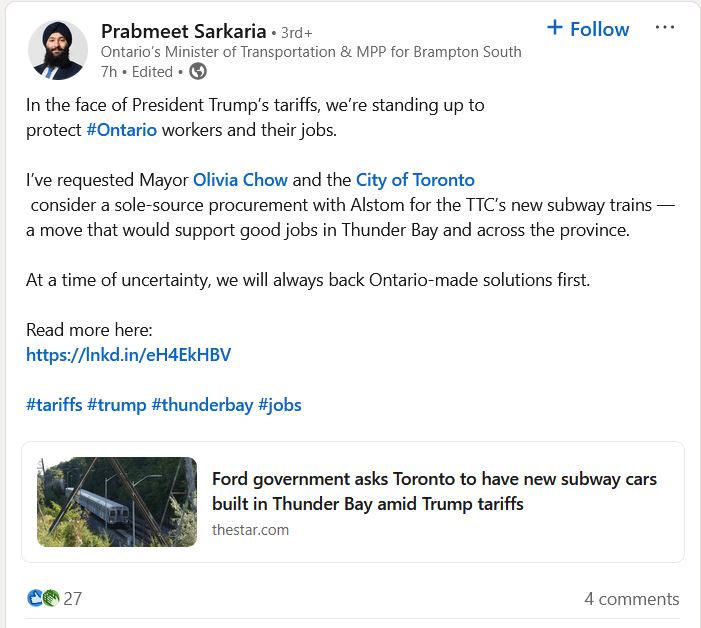
    • Although the RFP for new trains is theoretically open to all bidders, both the provincial and federal governments have made statements about how this will guarantee work for Thunder Bay. Bidders might well ask if any firm but Alstom actually should bother participating. Options within the RFP include future replacement of the Line 1 TR fleet which, based on a 30-year lifespan, would stretch from 2039 to 2047.
    • The Line 2 ATC RFP is also an open bid, and it explicitly states that if a different vendor from Line 1 (Alstom) is chosen there will be Line 1 and 2 trains with different vendors’ ATC gear. The trains will not be able to interoperate between the lines except in manual (“emergency”) mode at restricted speed.
      • Work cars need dual capability and the TTC intends to equip them with gear that can work with either the Line 1 or 2 system. What this might entail both for physical space on the cars, operating procedures and complexity is not discussed.
    • If train frequencies are improved beyond 2019 levels (less than 140 seconds), there will be capacity issues at terminals and turnbacks. The ATC RFP includes a performance requirement for faster turnarounds (as low as a 100 second headway) but it is not clear whether this is possible with existing track geometry.
    • The Scarborough Subway will be built with conventional block signals, and will be retrofitted with ATC in a later, as yet unfunded, project. It is not yet clear whether full service will operate during peak periods on the SSE during peak periods, and the ATC RFP provides for turnback operations in a tail track east of Kennedy Station.
    • Funding for future stages beyond 70 cars (55 for Line 2, plus 15 for the Scarborough and Yonge North extensions) is not guaranteed.
    Continue reading

    TTC Board Meeting Dec. 3, 2024: Follow-Up

    This article is a follow-up to TTC Board Meeting: December 3, 2024. The following items are covered here:

    • Accessibility Plan and Family of Services
    • Work Car Hydraulic Leak Incidents
    • Seasonal Prohibition on Lithium-Ion Battery Powered E-Bikes and E-Scooters
    • Retirement of Legacy Fare Media

    See also:

    Continue reading

    The 2017 Line 2 Renewal Program

    Back in 2017, there was a proposed renewal program for Line 2 that covered many aspects including fleet planning, extensions, future demand growth, signalling and maintenance yard requirements.

    Most regular transit followers in Toronto will scratch their heads and ask “what renewal program”. The problem was that it was too rich for political blood at the time and most of it was ditched after CEO Andy Byford was replaced by Rick Leary.

    A fundamental premise of the plan was that all of its components would be handled through one master schedule and common overall project management. The TTC had learned from experience on Line 1 that a piecemeal approach was fraught with conflicting timetables and specifications, not to mention the danger that each piece had to be funded separately with little appreciation for the big picture.

    A Rail Amalgamation Study was conducted for the TTC by HDR and Gannett Fleming starting in 2015, and it was expected to finish in 2017. The intent was to review the line’s needs based on various future scenarios. For maintenance and storage facilities, it would consider:

    • The use of 2-car sets rather than the 6-car TR train configuration.
    • Possible line extensions
    • Expansion of the work car fleet to support expanding infrastructure
    • Implementation of ATC (Automatic Train Control) signalling

    A preliminary report from the study showed that capacity would be a major problem. Note that in the context of this study, the Ontario Line did not yet exist, and the intent was that Greenwood Yard would host the Downtown Relief Line trains. Even without the DRL, Greenwood would not be able to handle expected growth in demand on Line 2.

    The remainder of this article shows the details of the resulting plan, notably proposals for a new Line 2 fleet and expansion of the work car fleet that might have been set in motion had this scheme not been sidelined.

    The TTC had a consolidated plan for Line 2 (and for the DRL), but this fell victim to budget cuts, the idea that we could “make do” rebuilding old trains and signal systems, and then the Provincial intervention with Metrolinx showing how they “knew better” how to plan and build rapid transit lines. We all know how that worked out.

    Continue reading

    TTC Board Meeting: December 3, 2024

    The TTC Board will meet on December 3 with several items of interest on their agenda.

    • CEO’s Report and Key Performance Indicators
    • Notice of Motion: Proposed deferral of legacy fare retirement
    • Financial and Major Projects Update
    • Easier Access Program Update

    In a previous article, I reviewed the report on subway work car hydraulic leaks. See:

    After this agenda was published, the Federal Government announced its one third support for the purchase of 55 new Line 2 subway trains. See the Major Projects Update below for more details.

    Continue reading