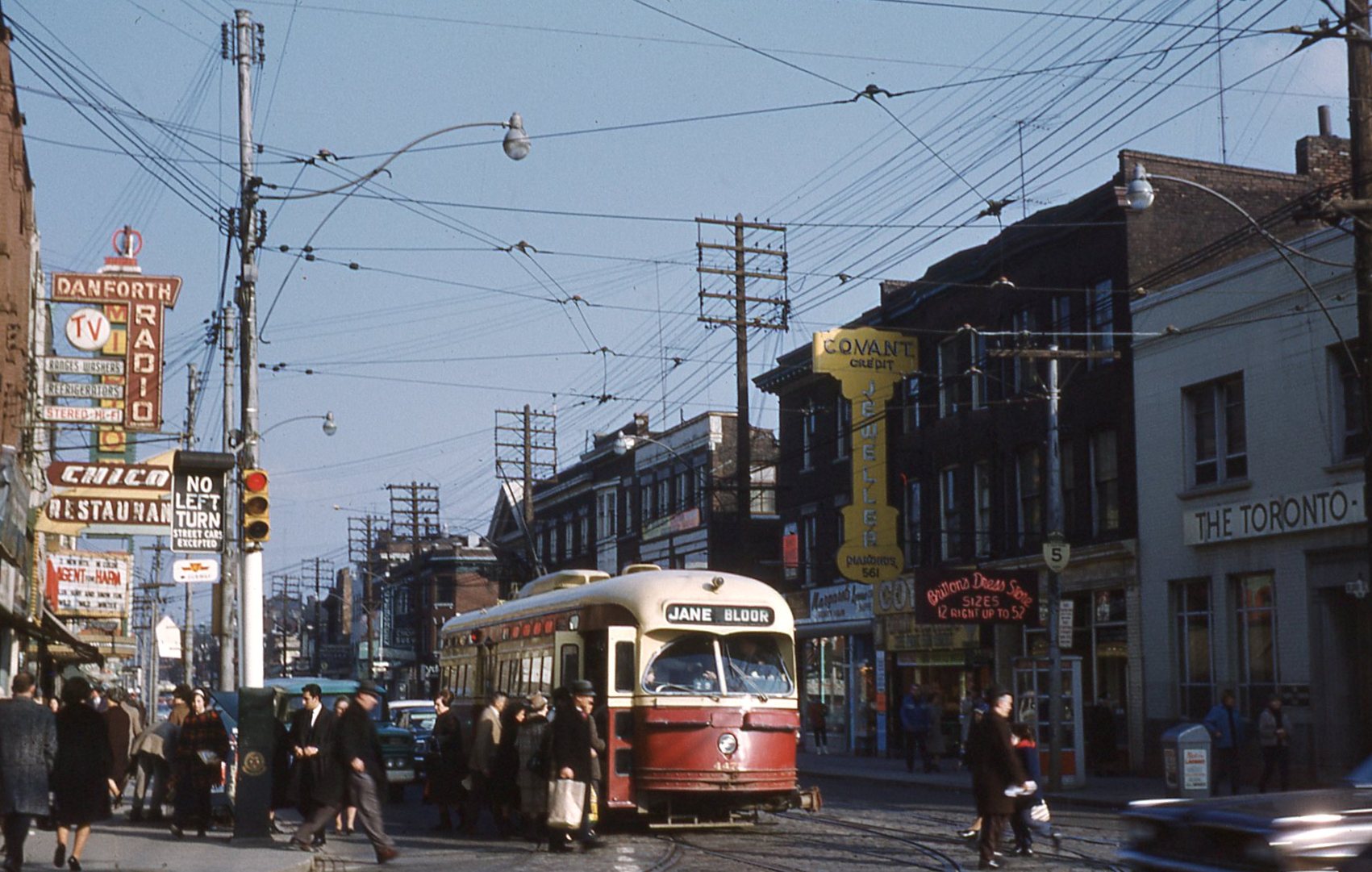
A Look Back: February 1966

img024a

Bloor and Bathurst looking east.

The brand new subway will open in about one week, and the Bloor streetcar is about to vanish into history.  Much else in this photo would disappear as well.  The buildings are still there, but their use has completely changed.  The TD bank is now a coffee shop, Danforth Radio is no more, and the Midtown cinema is now the Bloor.

Street signs have changed a lot since the 60s.  Toronto outlawed the overhanging signs decades ago, and the few that remain are grandfathered.  Traffic regulations are spelled out rather than shown as graphics.  A demure “TTC Subway” sign with a small arrow directs passengers who might be looking for the Bloor car to the subway station just up Bathurst Street.

The hydro wiring is still in overhead box structures, and the classic Toronto acorn luminaires had yet to be replaced by sodium vapour lighting on higher poles.  There’s a phone booth on the sidewalk and a pre-Astral garbage bin.

Whither the Port Lands? Waterfront Toronto Public Meeting

With all the brouhaha over the Port Lands, and the Fords’ failed coup d’état on the Waterfront, attention now shifts to actually “getting something done”.

The Port Lands cover a large area south and east of the mouth of the Don River that is comparable in size to downtown Toronto.  This is a huge opportunity for redevelopment, but also a huge chance to screw things up pretty much forever.

Do we want a boring, car-oriented suburb complete with megamall, or do we want a new neighbourhood that brings a 21st century twist on downtown living?

Will we redevelop the river mouth as a striking park, a signature piece for Toronto’s waterfront, or will it simply become Exhibition Place East complete with Ferris Wheel and monorail?

How will we move people to and from this area?  Will transit be an afterthought or, for once, will we actually invest in capacity and service before the new buildings go up?

Waterfront Toronto begins its public consultations on the future of the Port Lands on Monday December 12 between 6:30 and 9:00pm at the Toronto Central Library (Yonge north of Bloor) in the Bram & Bluma Appel Salon on the second floor.

Moving People: Responses to Congestion (Updated)

Updated November 3, 2011:  Video, audio and the presentation materials from this event are now available.  I have added a few written comments to expand on my presentation deck.

On Tuesday evening, October 25, 2011, I gave a talk with Eric Miller as part of the University of Toronto’s Cities Centre series “Toronto In Question”.

Please visit the event page on the Cities Centre’s site for video, audio and powerpoints.

For those who want a smaller version, here is a pdf of my slide deck.

As a quick overview, and to expand on a few points that were left out of the talk, a quick runthrough of the slides follows the break below.

Continue reading

Three Platforms, Little Promise (Update 4)

Updated September 30, 2011 at 5:40pm:  Urban Toronto’s interview with Conservative transportation critic Frank Klees has now been posted.

Updated September 29, 2011 at 2:35pm:  Urban Toronto’s interview with NDP transportation critic Cheri DiNovo has now been posted.

Updated September 28, 2011 at 12:00nn: Urban Toronto will be posting interviews with the three parties about their transportation platforms.  The interview with Liberal Kathleen Wynne is now online.  I will link to the others as they appear.

The NDP has announced that they would commit to electrifying the Air Rail Link from opening day rather than implementing it as a diesel operation and converting later.  This is an ambitious plan, but it has the advantage of forcing GO Transit’s hand.  We hear a lot from Metrolinx about “if” they will electrify, but “when” is a target somewhere in the mists of the future.

Updated September 20, 2011 at 10:45pm:  The calculation of the effect of the NDP proposal has been revised to take into account additional revenue from new transit riding, presuming that this actually materializes in the face of constraints on service.

The original post from September 11 follows below.

Election time in Ontario brings out a fresh batch of promises from political parties, promises they hope will lure our support on voting day, promises that will inevitably be broken no matter who is elected.

Transportation is not at the top of anyone’s priority list in an era of bad economies.  The big ticket items (both for votes and for dollars) are health care, education and jobs.  Transit gets the leftovers if it is mentioned at all.  For many ridings, transit isn’t even an issue, if transit has any presence.

What would the three major parties bring us after October 6?

Continue reading

No, We’re Not There Yet

Many recent reports and proposals talk about the problems of long commuting trips, of the futility of attempting to move quickly around our increasingly congested city.

Back on August 24, Statistics Canada published their commuting study based on 2010 data.  The study reviews not only comparative commuting times by mode, but also the attitudes of motorists to the transit alternative.

The average commuting time for all of Canada was 26 minutes, but this rises to 30 minutes for CMAs (“Census Metropolitan Areas” which are generally larger than actual municipalities) of 1-million or more population.  Toronto and Montreal average 33 and 31 minutes, but this doesn’t tell the entire story as any Toronto commuter will tell.  27% of Toronto commutes take over 45 minutes, and 29% are caught in traffic jams.

When the data are subdivided by car and transit, the transit trips take longer, and this difference is heightened in lower density areas.  That’s no surprise because low density areas tend to have poor transit service as a direct result of lower demand.  Waiting times are an important part of transit trips when service is poor, and this is compounded by any need to change between routes that may not directly serve all travel patterns.  The average transit commute in large CMAs is 44 minutes while the average car trip is 27 minutes.  The figures are even worse for Toronto.  Missing from this is any discussion of the length of the trip or the differences caused by trip location and density of demand.

Neither transit nor car users like traffic congestion, but the presence of rapid transit  networks means that some trips are congestion-free (even though they may be subject to transit delays that were not part of this study).  The proportion of commuters who were satisfied with their commute times is understandably high where these times are short and congestion is comparatively rare.  Transit riders put up with longer commute times better than car drivers, but those with short trips tended to be less happy with transit than motorists were with their cars.  This is easy to understand when one considers that a short transit trip is more likely to have a relatively large proportion of wait time, while at least some of the longer trips (notably commuter rail) allow the commuter to relax enroute.

The vast majority of motorists view public transit unfavourably, but this statistic is not broken down by region, let alone by sub-region where variations might be seen due to the availability and quality of the public transit option.

Media reaction to this report was quite predictable with stories about how bad Toronto’s commuting times are.  Less clear is the question of what, if anything, can be done about the situation.  Indeed, the most simplistic analysis might suggest that car trips are inherently faster and “better” than transit trips based on their average length.  This would completely mask the effect of averaging together trips over a wide variety of roads and transit lines and the cost, broadly speaking, of increasing capacity for either mode.

Continue reading

Are We Losing the Eastern Waterfront?

Most Torontonians know we have a lake and its better-known attractions such as Harbourfront, the stadium, Exhibition Place, and of course the wall of condos stretching from Yonge to beyond Bathurst.  However, the Eastern Waterfront isn’t part of the “mental map” many people in Toronto carry around.

For the past century, the lands east of Yonge, and particularly those south of Lake Shore and east of the Don River, have been industrial properties known only to those who work there, the neighbouring communities, intrepid explorers, and visitors to a few clubs and supermarkets.  The size and potential of the space — as big as the existing downtown — simply don’t register as part of “Toronto”.

Waterfront Toronto has plans to change all of that and, in the process, to undo some of the disastrous choices of the past century.  Developments proceed along Queen’s Quay, and there is much more to come, but even these get us only to the Don River.  The big prize is the Don River mouth and the port lands to the southeast.

Plans to redesign Queen’s Quay, reducing it to a two-lane road with cycling and pedestrians replacing cars where the eastbound roadway now lies, are threatened.  Mayor Ford’s desire to maximize capacity for road users may sabotage a scheme many years in the making.

There was a time when “transit first” was the defining call for waterfront development, and the eastern branch of the Harbourfront streetcar was planned as an integral element in the build-out east from downtown.  As with so many great schemes, this has run aground on funding limitations at Waterfront Toronto and substantial growth in TTC cost estimates.

The proposed line on Cherry Street that was to serve development in the West Don Lands, may not be built for several years because of concern that it might impede Pan Am Games related development, the very development it was intended to serve.

The worst knot in the transit scheme lies at the tangle of roads where Cherry, Lake Shore, Queen’s Quay and Parliament all meet around the mouth of the Don.  Sorting this out was to be part of the plan for creation of parkland and flood control at the Don, but this project has no funding, and no burning interest from any level of government.

From a transit perspective, it’s as if the Spadina car ended at King Street, and there were no Harbourfront car on Queen’s Quay.  This is no way to develop a transit-oriented neighbourhood.

Waterfront Toronto is under attack from some in Mayor Ford’s circle.  Yesterday, John Campbell, president and CEO, appeared on Metro Morning commenting on some criticisms.  He was rather diplomatic in saying that the debate is simply a matter of a new government finding its legs and learning what’s really going on.  The problem with this outlook is that many in Ford’s inner circle have been on Council for some time.  Whether they actually paid attention to Waterfront Toronto, or saw it only as one more Miller legacy to be dismantled, is hard to say.

The real agenda becomes much clearer when one reads Councillor Doug Ford’s musings about waterfront development.  That prize I mentioned earlier, a piece of land roughly equivalent to the block bounded by Yonge, Bathurst, Bloor and Queen, is lusted over by many public agencies and not a few developers.  This is an ideal time, after all, to hope for a municipal fire sale.  The city wants to liquidate its assets, and developers would love to get a free hand to build on the eastern lake shore in the same unfettered manner we have already seen west of Yonge Street.

Ford thinks the city should not be in the development business, but fails to understand that the whole Waterfront Toronto scheme was to provide the infrastructure and the overall design that would increase land values and build the foundation of a new downtown neighbourhood.  That’s not something any private developer, concerned only for the land he develops and the immediate neighbourhood, cares about or will invest in.  A beautiful park would make him money, but he wants the public sector to pay for it.

Another wrinkle comes from the competing agendas of agencies such as Infrastructure Ontario and the Port Lands corporation who would love to elbow Waterfront Toronto aside and develop their lands without the overburden of regional planning and design goals.  The idea of a waterfront park, of wetlands, cycling and pedestrian realms, isn’t embraced by those who see only acreage and more development.  Indeed, some would simply channel the river and build over it rather than exploit what it could be as the focus of public open space.

Worst of all is the City of Toronto’s appetite for money.  Much of the improvement in the waterfront was to be funded from proceeds of development, but if this is scooped by the City to pay down debt, or to fund pet projects like the Sheppard Subway, the ugly, inaccessible waterfront will remain, and the land will be lost to public hands forever.  If we sell quick and cheap, we gain a short term pile of cash, but leave the bulk of future appreciation in private hands.  (I cannot help thinking of another cash-strapped, right-wing government that sold Highway 407 in similar circumstances, a sale many have regretted ever since.)

The waterfront is on the edge of the city, and to many it’s as out of sight as Malvern or Rexdale are to downtowners.  Voters want slogans and quick fixes, and only care about the details when they are personally affected.  Do we want a beautiful waterfront?  Do people even care?  Will we wake up in ten years asking “how did this happen”?

Liberty Village Planning Studies

The City of Toronto has three planning studies underway that will affect Liberty Village, and they will hold a combined open house on March 1 for the next stage of the public consultation.

Dufferin Street Bridges

The south end of Dufferin Street has two bridges — one over the rail corridor, and one over the Gardiner Expressway.  Both are in need of replacement, and future plans require a new design.  This project had its first meeting last year, and now the City is back to discuss alternative schemes.

Projects related to this include expansion of the GO Lake Shore corridor, provision of clearance for electrification and connection of the streetcar system from Exhibition (East) Loop west to Dufferin.  The streetcar extension is part of the proposed Waterfront West LRT line, although it is far from clear whether any of the alignments shown on the drawings for the bridge project would actually be built.  The WWLRT is not exactly at the top of anyone’s list of transit projects, but whatever is decided for the new Dufferin bridges may preclude some of the WWLRT options.

New King-Liberty Pedestrian/Cyclist Link

The Georgetown rail corridor creates a long barrier between Strachan Avenue and the west end of the King Street underpass at Atlantic Avenue.  With the redevelopment of lands to the north, current and future plans for lands to the south, this barrier isolates the two neighbourhoods from each other.  Some crossings are now made illegally, but plans to increase the number of active tracks and the frequency of GO service will make this much more dangerous.

At the first open house last year, various alternatives were presented, and two of these were carried forward for detailed study.  The results will presented at the March 1 open house.

Liberty Village New Street

A new street is proposed along the south edge of Liberty Village from just west of Strachan Avenue to Dufferin Street.  This road would occupy what was originally planned to be the Front Street Extension, but as a purely local street.

The March 1 meeting will launch this project for comment.

Let Them Ride Buses

In case anyone missed the latest word from City Hall, here is Mayor Ford talking about transit to Rexdale in today’s Globe:

“Eventually, I’m sure we can build the subways. It’s more expensive, but that’s what the people want. People in North York and Scarborough, they want that line connected to the Scarborough Town Centre. If I heard it once, I’ve heard it a thousand times.”

Even if that means cancelling or postponing indefinitely rapid transit in his own former ward of Etobicoke North?

“They have transit,” he laughed. “It sounds like we’re – we have transit. People get to the slots, they get to Woodbine racetrack, people get to Humber College. There are buses that run up there.

“Eventually, I’d like to have subways running through the whole city. But what we can afford realistically, right now, is just Sheppard, right?

People will wait a long time for their pet transit lines, and all those fine words about the importance of transit to Toronto’s economy are just so much hot air.

Cake, anyone?

How Essential is the TTC?

In the past week, the TTC board and City Council have voted to ask the Ontario government to make the TTC an “essential service”.  During the debate, this action was opposed by both the TTC’s management and union on the grounds that this will only complicate labour negotiations.  Issues will go to arbitration that might otherwise be bargained between the parties, and costs will increase through the typically higher wage settlements granted to workers who do not have the right to strike.

Those who favoured essential service status argued that this is, de facto, the way things work anyhow.  When a transit strike occurs, it takes a few days, but the machinery of back-to-work legislation doesn’t take long to restore service.  Why, then, endure the upheaval of a short work stoppage if legislated arbitration will be the result?

This is an attractive argument, except when one looks at the context.  Toronto Council and the Mayor’s office has changed from the most pro-labour group any union could expect to see to an administration that makes little secret of its will to reduce the influence and effect of organized labour in Toronto.  Got a problem with garbage workers?  Privatize the service.  Got a problem with transit workers?  Make them “essential”.

Such actions may satisfy the urge to show the unions who is boss at City Hall, but they may not be the best policy for the city.

There is no question that the civic workers’ strike of 2009 was a turning point in Toronto politics.  Not only was it a lengthy strike, but one which saw contentious relations between union members and the very people — the voters — those members needed to gain political support for their position.  They failed miserably.  Much was written about who “won” the strike, and the union managed to convince everyone that they came out on top even though they conceded on the key issue of future sick benefit payouts.  The problem, at the end, was that voters endured a strike that seemed to have solved little (although the outgoing administration and city finance officials will tell you differently), and the voters were fed up.

Stir into this the wide perception that TTC workers are at odds with the people they serve.  The “sleeping collector” front page [RIP] was not the Toronto Sun’s finest moment, but the photo and the anti-union sentiment it provoked cut right across the city.  Relations between TTC staff and riders took on an “us vs them” feel that has reduced somewhat, but they remain less than ideal.  Some operators, a few, really are jerks.  Stories of buses held hostage while an operator claims harassment by a passenger still crop up.

Service on the street isn’t what it might be.  We can always use more buses and streetcars, but there are enough cases of operators fouling up service that this minority can easily be blamed for many service problems.

All that said, making the TTC an “essential service” won’t improve manners among the rotten apples, and won’t make the Queen car or the Dufferin bus run on time.  That takes an organizational will to provide service that’s as good as possible rather than always blaming problems on someone or something else.

The TTC and its new Chair, Councillor Karen Stintz, hopes to make Customer Service a top priority in the coming term.  The TTC must regard its customers as vital, its raison-d’être, not as pesky travellers who need to be taught how to behave properly on transit vehicles.  This is a question of attitude, not of labour negotiations.  Indeed, the organizational culture isn’t only on one side of the bargaining table.

Finally, the problem will land back in Council’s lap with the inevitable call for better transit funding, if only to keep up with inflation, system growth and the inevitable wage increases arbitration will bring.  How “essential” will transit be then?

The opportunity for a vindictive attack on transit workers and labour relations was probably the most “essential” part of this whole affair.  The new regime had a chance for chest-beating and a quick win that will probably do little, on balance, to improve transit.

In coming months, we will hear budget debates at the TTC and at Council.  Those who worship the holy grail of tax cuts will give long speeches about efficiency and belt-tightening, about how riders will have to make do with less service and higher fares, about how “the taxpayers” (as if they are not also transit users themselves) cannot be expected to bear a greater burden.

If transit really is essential to the economic health of Toronto, then Council must be prepared to spend and spend generously on this service as an investment in the city’s future.  We will see just how “essential” transit is to our new Council when the bills come due.

Apologize, Now!

In a piece of political theatre utterly unworthy of Toronto, Mayor Elect Rob Ford invited Don Cherry, a loudmouth sports celebrity who is paid a small fortune to pontificate about hockey, to address the inaugural meeting of Council today.  Cherry proceeded to insult over half the population of Toronto, those who didn’t vote for Ford, those “left-wing kooks” and “pinkos”.

If I or any member of the public, let alone a member of Council, had made remarks like that, they would have been summarily silenced by the chair and possibly thrown out of the room.  This bozo was there as the Mayor’s guest, telling it like it is.

Mayor Ford allowed the important ceremony of his investment in office to be cheapened into a political slam against all those folks, the downtowners, the latté-sippers, the people who like streetcars, and who knows how many other groups who have yet to learn just how small-minded our Mayor really is.

The words may have been Don Cherry’s, but they were said with Mayor Ford’s blessing.

Cherry is an asshole who has no place in Council Chamber, a clown who cannot understand the difference between the entertainment of a break in a hockey game and the serious business of Canada’s largest municipal government.  He is no doubt thrilled to death with the exposure.

The Mayor has a duty to all of the people, and to the Council itself.  He ran on a campaign of respect for taxpayers.  That doesn’t mean just the ones who voted for him, but all of us.  I shouldn’t have to produce a photocopy of my ballot to get attention at Rob Ford’s City Hall.

The institution of Council has already been sideswiped by Ford’s one-man show on municipal policy, the attitude that his “mandate”, all 47% of of it with a 53% voter turnout, gives him the right to rule by edict, not by agreement.  Now, by inviting Cherry to speak and failing to censure what was said, Ford has insulted all of Council and the voters — all of them.

Mayor Ford:  Prove to us that you’re not the boneheaded idiot 53% of Toronto thought you would be when they voted against you.  Apologize, unreservedly, now.