The TTC has issued an updated plan for implementation of the new Flexity streetcars.
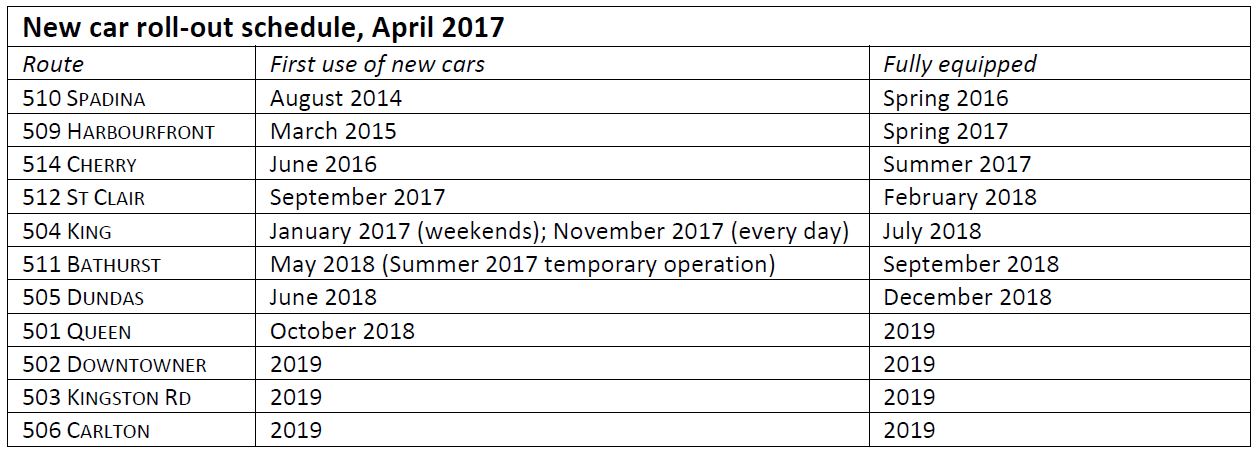
This is taken from a Briefing Note that details recent revisions to the plan plus details of the service to be operated on 512 St. Clair once it is fully converted to the new cars.
As of mid-2016, plans were somewhat different for the conversion of routes to the new cars:
- By the end of 2016: 510 Spadina, 509 Harbourfront, 514 Cherry, 511 Bathurst, 505 Dundas and 501 Queen (part)
- By the end of 2017: 501 Queen (complete) and 504 King
- By the end of 2018: 512 St. Clair and 502 Downtowner (part)
- During 2019: 502 Downtowner (complete), 503 Kingston Road and 506 Carlton
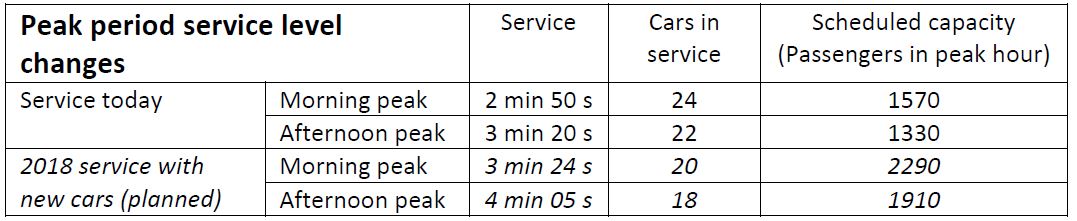
The 512 St. Clair line has moved up in the sequence with conversion beginning in September 2017 and finishing (assuming Bombardier’s deliveries stay on schedule) in February 2018. This route is now overcrowded and needs more capacity. The only way this can be provided is with more and/or larger cars.
The planned service level will use fewer cars, although they will be much larger than those now in service on St. Clair, with the result that greater capacity will operate on the route. The scheduled capacities shown below are based on 74 passengers/car on the existing CLRVs and 130/car on the new Flexitys.
It is worth asking here how many other TTC routes are in this condition, and why a report detailing the degree of the shortfall was not an essential part of the budget when Toronto was told that the TTC’s planned service was adequate to meet demand.
What does exist in the Capital Budget (albeit in the detailed “Blue Books” which are issued after the budget is finalized) is the fleet plan. Although the timing of route conversions has changed, what remains constant is the planned peak vehicle requirement for each route.
In the table below, the CLRV and ALRV figures are the PM Peak scheduled service for various dates when these routes were operating entirely with streetcars and with no diversions.
| Date | CLRV | ALRV | Flexity | Capacity Ratio | |
|---|---|---|---|---|---|
| 501 Queen / 508 Lake Shore | Mar 2016 | 6 | 33 | 34 | 1.1 (*) |
| 502 Downtowner | Sept 2015 | 7 | 8 | 2.0 | |
| 503 Kingston Road | Sept 2015 | 6 | 6 | 1.8 | |
| 504 King | May 2017 | 33 | 7 | 24 + ALRVs | (*) |
| 505 Dundas | Jan 2017 | 19 | 19 | 1.8 | |
| 506 Carlton | Jan 2017 | 29 | 24 | 1.5 | |
| 509 Harbourfront | May 2017 | 8 | N/C | ||
| 510 Spadina | May 2017 | 16 | N/C | ||
| 511 Bathurst | Sept 2016 | 11 | 11 | 1.8 | |
| 512 St. Clair | May 2017 | 22 | 18 | 1.4 | |
| 514 Cherry | May 2017 | 9 | N/C |
Notes:
- The actual capacity change on Queen will be greater than 1.1 because many of the “ALRV” runs are now operated with the smaller CLRVs although there has been no adjustment in the schedule to reflect the reduced capacity of the route.
- The capacity change for King will depend on how many of the 30 ALRVs that will be overhauled for service until 2024 are assigned to this route. The fleet plan indicates that these ALRVs will have to be replaced in a future order. If the TTC were to operate 24 Flexitys plus 20 ALRVs, this would add approximately 65% to the route’s capacity. Other gains might be obtained through transit priority measures now under study, but the actual quantity remains to be seen.
The total of Flexitys in the table above is 177 vehicles which, allowing for 15% spares (a relatively low level for the TTC which uses a higher number for its bus fleet) brings the total to the 204 vehicle fleet now on order. A five percent increase in the spare factor is equivalent to 10 more cars.
Additional cars will be needed to handle ridership growth, replacement of the ALRV fleet, and new routes in the Waterfront. The Fleet Plan provides for 15 Waterfront vehicles, but this number was based on a smaller version of the LRT network than may eventually be built considering the Unilever site development and plans for the Western Waterfront line.
The Fleet Plan notes that the 264-car combined capacity of Leslie, Russell and Roncesvalles will be exhausted by 2027 when a new carhouse will be required. This would not likely be a large facility and could be more of a satellite storage yard. The TTC will have to begin thinking about its need for more streetcars and storage within this decade.