114 Queens Quay East and Its Red Lanes

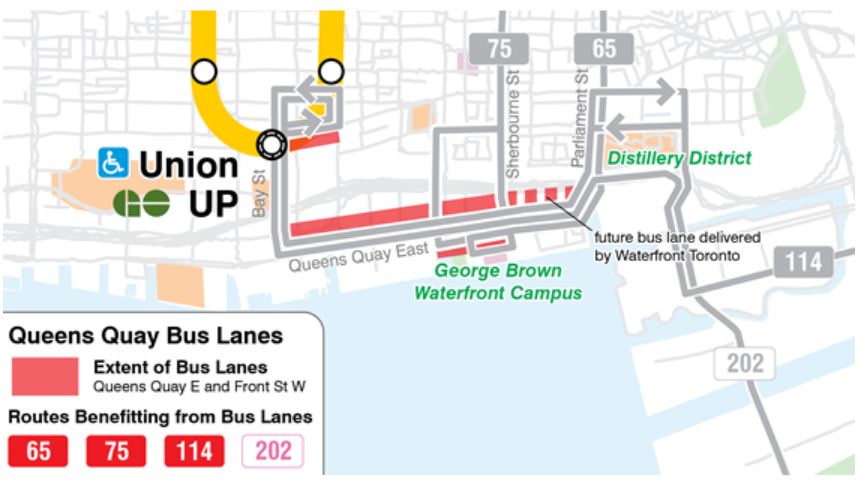
On June 4, 2025, new reserved bus lanes were installed on Queens Quay westbound from Sherbourne to Bay, and eastbound from Jarvis to Sherbourne. The TTC projected travel time savings of up to 5 minutes, and more reliable service for riders using routes on this roadway including 114 Queens Quay East, 75 Sherbourne, 65 Parliament and 202 Cherry Beach.

Now that the June 2025 tracking data are available, this article reviews the actual change, if any, in travel times and headway consistency. For historic context, the data presented here go back to May 2024 when the 114 Queens Quay East route was split off from the south end of 19 Bay.

Here is a map showing the affected routes and location of the new red lanes.

Source: TTC

Over the period before red lane implementation, the 114 Queens Quay East service suffered from schedule problems with an unrealistic high scheduled speed. This was reduced in October 2024, and then raised again recently in anticipation of red lane benefits. The current scheduled speed is not as high as the original design in May 2024. Service frequency has also been changed from time to time mainly in response to seasonal fluctuation, but in some cases to “stretch” buses over a longer running time. (Details later in the article.)

The original eastern terminus was an around-the-block loop via Logan, Lake Shore and Carlaw to Commissioners. This was changed to Lake Shore Garage (the Wheel-Trans garage on Commissioners west of Leslie) to provide a better, off-street location.

Service until the October 2024 schedule change was extremely erratic, especially in the PM peak, as buses could not maintain the original running times. Since October, there has been little change at most times of the day including in June 2025 after red lane implementation.

There is a very strong day-of-the-week effect in the PM peak for westbound travel times on Queens Quay with midweek days being the worst. In June, the worst of the peaks are down from April levels, but that month was unusually bad. There is not yet enough accumulated data to establish whether there will be a permanent “shaving” of peak travel times through the red lane area.

There is an analogy here to the King Street project where the travel times under normal circumstances changed little, but the peaks on days when there was a disruption or special event were shaved off improving overall reliability.

Any analysis of the benefits of the red lanes must be careful not to cherry pick “good” and “bad” days for comparisons.

The data here provides mainly a “before” view of service on 114 Queens Quay East. I will update these charts in the Fall when full traffic conditions have resumed.

Continue reading

Does TTC Mid-Point Route Management Work? (Part II)

This article continues the analysis of service on routes where the TTC claims to be implementing mid-route headway management. The routes included here are:

  • 24/924 Victoria Park
  • 25/925 Don Mills
  • 29/929 Dufferin

See Part I for a general introduction and details of 7 Bathurst, 100 Flemingdon Park, 165 Weston Road North, 506 Carlton and 512 St. Clair.

A common factor evident in the charts for these routes is that service near the origins of routes is barely within the target range for headways, and more commonly well beyond it. AM peak service might squeeze within the target, but service falls apart from midday onward and does not recover in the evening.

Although the TTC reports performance based on “on time” departure from terminals, they actually have a headway standard, but never report on how well routes meet it. Note that the standard actually is very generous and allows a wider range of headways than the “on time” standard. For example, a bus operating every 10 minutes is allowed a 50% headway deviation either way meaning that the actual headway could be anywhere from 5 to 15 minutes, and 40% of the service can be even worse. This is a standard designed to make management look good to those who don’t peer “under the covers”.

For services that operate between 5 and 10 minutes, passengers do not rely on printed schedules, but expect vehicles to arrive at prescribed headways. Therefore, on-time performance for frequent service is measured by how well actual headways correlate to scheduled headway intervals. Trips are monitored at a location based on arrival time, without regard to whether the trip that arrived was scheduled for that time slot. The vehicle is considered on-time when the headway deviation is less than 50% of the scheduled headway. For example, a service that operates every 6 minutes is deemed on-time if the headway deviation falls between 3 minutes and 9 minutes. TTC’s goal is to have 60% of all trips operated within +-50% of the scheduled headway over the entire service day. [Service Standards at pp 15-16]

The TTC plans a review of its Service Standards in coming months. That review and much-needed reporting on service quality are long overdue.

Express routes can have very wide ranging headways making their benefit to riders dubious. The wait for an express bus can be longer than the travel time saving from skipped stops. Meanwhile riders at “local” stops cannot benefit from the express vehicles. The TTC plans a review of its Express Network later this summer, and service reliability should be a major issue. It is not enough to advertise a faster trip, but the network must actually provide it, including waiting time, reliably.

Another factor that appears in some of these charts (as well as in Part I) is that for some periods there is more service on a route than is scheduled. This is due in part to the assignment of the “run as directed” buses to supplement regular routes. However, the base schedule is not adjusted, and the RADs do not create a uniform combined headway. They can even contribute to bunching by running close to a scheduled run.

TTC still has not deigned to release detailed data from their APCs (Automatic Passenger Counters) and only coarse information (corresponding to the three levels of loading shown on their real time info) is publicly available. I have asked many times, but this request goes nowhere. Without detailed data it is impossible to know the loads on buses or to differentiate between a modest seated load and a partially standing one. Considering that the Service Standards call for at most a few standees in the off peak, this distinction is crucial to evaluating how service matches the standards.

When the use of RADs to supplement service began, the intent was to soak up spare bus operators (not to mention spare buses) without committing to a permanent service improvement. There has been no external report on whether the added service improved ridership, or the effect of its withdrawal.

Continue reading

TTC’s 2026 Network Plan: Round One

The TTC “Annual Service Plan” has been rebranded as the “Network Plan” in the interest of clarity, but based on the 2026 edition’s meagre content so far, this is an infinitesimal network. In particular, it really does not deal with the transit network as a whole, but only small tweaks at the edges. Big decisions such as long range, city-wide plans, budgets, service levels and the future of transit as part of Toronto are all made elsewhere.

Issues such as strategies for improving ridership and budget reviews which bear directly on the amount of service riders see are not in this plan. Nor is any discussion of basic service quality and management, nor of the fractured nature of TTC information for and communications with its riders.

Round One of the Network Plan consultation addresses only a handful of proposed route changes. More substantial work including an Express Bus Network review and discussion of construction-related service changes won’t appear until Round Two in August.

The Network Plan presentation lists several parallel studies under development parallel to but not included in the Annual Network Plan consultations. Only those keen transit watchers know about all or most of these, and it is a hard slog keeping up. The table below is from the Round One presentation deck.

  • 2026 Annual Service Budget
    • Sets service levels for each board period in 2026
    • Includes number of vehicles, service hours and distance
  • 2026-2028 Ridership Growth Strategy (RGS)
    • Cost-benefit analysis of service, fare, infrastructure and customer experience initiatives
    • Could achieve ridership growth over the next 3 years (if funded)
  • RapidTO Transit Priority Lanes
    • Completed: Queens Quay East
    • Next: Dufferin St and Bathurst St corridors (pending July 2025 Council approval). Target: ready for 2026 FIFA World Cup
    • Feasibility and design studies are on-going for the Jane Street, Finch Avenue East, and Lawrence Avenue East roadways
  • FIFA World Cup Transit Service Plan
    • Increased service on key downtown routes
    • Additional service on match days and during Fan Festival
  • Reducing bunching and gapping
    • Efforts to reduce bunching and gapping on 10 of the most problematic routes with enhanced on-street presence as well as scheduling related changes

There are also:

This may suit the TTC’s fragmented internal structure, but it drives people outside of the TTC mad. One does not have to be a seasoned transit advocate, merely a daily rider, to rail at the frustration of “consultation” on a handful of minor route changes. Basic service issues across the system must wait for the budget (no public consultation there at all), the Ridership Growth Strategy (budget limits again) and a Board that, until recently, actually believed (or chose not to challenge) management claims about quality.

Two burning issues are service quality (with associated crowding and unpredictable waits), and the effect of construction projects on routes (not to mention abjectly poor and inaccurate communications to riders). We will have to wait until Round Two in August to address at least some of these problems.

Consultation

An online survey opens July 7-16. There are separate consultations with the Advisory Committee on Accessible Transit (ACAT) and the TTC’s Planning Advisory Group which after many years now has a formal name. (Full disclosure: I am a regular contributor to that group.)

Pop-Ups will be held from 4-6pm at the following dates and locations:

  • July 9th: University of Toronto Scarborough Campus
  • July 10th: St. George Station
  • July 15th: Sherbourne & Rosedale Stations
  • July 16th: Lawrence West Station & Sunnybrook Hospital
Continue reading

Does TTC Mid-Point Route Management Work? (Part I)

In February-March 2025, the TTC added on-street supervisors on eleven routes in an attempt to reduce the incidence of gaps and bunching. This is described in the June 2025 CEO’s Report and the associated Metrics Report containing performance stats for the system.

Bunching and gapping of TTC service

Last March, the TTC expanded a pilot to improve service reliability on 11 key bus and streetcar routes. Working through the Transit Control Centre, uniformed Supervisors have been deployed mid-route to ensure our service frequency meets customer expectations and that we reduce the bunching and gapping of our buses and streetcars, which is a source of frustration for riders.

The pilot involves the following routes: 7 Bathurst, 24/924 Victoria Park, 25/925 Don Mills, 29/929 Dufferin, 100 Flemington Park, 165 Weston Rd North, 506 Carton, and 512 St Clair.

Starting in July, the CEO’s Report will include a Hot Topic that will provide news and updates on the progress – and challenges – related to this important issue. [CEO’s Report, p. 9]

Also:

TTC expanded a pilot to improve service reliability on key bus routes. Mid-route Field Supervisor presence on the nine priority bus routes was increased throughout the February and March Board Period, where the focus is on reducing bunching and gapping, in order to improve the reliability of service. Bunching and gapping is measured by “Headway Adherence”: the vehicle is considered on-time when the headway deviation is less than 50% of the scheduled headway. [Metrics Report, p. 15]

Mid-route Field Supervisor presence on the two priority streetcar routes continued throughout the February and March Board Period, to reduce bunching and gapping and improve the reliability of service. Bunching and gapping is measured by “Headway Adherence”: the vehicle is considered on-time when the headway deviation is less than 50% of the scheduled headway. [Metrics Report, p. 16]

Although there is a Service Standard for headway adherence, this is not measured and reported publicly, and results are never cited in ongoing service quality reports. For many years, the TTC clung to the concept that if routes were on time at terminals, the rest of the line would look after itself. However, the “on time” standard is sufficiently lax that badly bunched and gapped service can meet the target. That, combined with reporting only average results, hides the real character of service that riders experience day-to-day.

At the June 23 Board meeting, management gave the impression that they would not report on all routes in July and might have to farm some of the analytical work out.

This is a sad admission considering the years of articles I have written on service analysis showing what could be done with the hope that the TTC would develop internal tools to perform similar tasks. Sadly, however, I have been told by some at TTC they have what they need, and, in effect that I should run along and not bother them.

Partly to hold their feet to the fire, and to provide the type of information that should be routinely available to the Board, management and the public, this article will do the work the TTC claims they cannot. Here are headway reliability analyses for the routes involved over much or all of the period from January 1, 2024 to June 30, 2025.

In a very few cases, it is possible to see a change in service quality (measured as a smaller spread between minimum and maximum headways, or gaps between vehicles) around the beginning of March 2025. These are rare, and short-lived. February was a really bad time to try to implement any new practice as the city was digging out (or not depending on where you live) of a huge snowstorm. (The extended effect of the City’s poor snow clearing on transit routes is evident in the multi-day peaks in irregular service on some routes.)

I have presented 18 months of data to show that problems with headway reliability have existed for some time. There is more data going further back, but 18 months makes the point. Moreover, a consistent pattern is that headways might be well-behaved in the AM peak and Midday, but evening service does not fully “recover” from PM peak conditions, and erratic service is common.

Quite bluntly, service on all of these routes was poor, well beyond the TTC’s own Service Standards, for 2024 and early 2025, and showed little sign of improvement through to mid-year. It will be interesting to compare whatever stats TTC comes up with to the performance shown on charts here.

Part I of this series includes data for 7 Bathurst, 100 Flemingdon Park, 165 Weston Road North, 506 Carlton and 512 St. Clair. Part II will include 24/924 Victoria Park, 25/925 Don Mills and 29/929 Dufferin.

There are a lot of charts and this is a long read. I will put the “more” break here. Those readers interested in specific routes can soldier on. Thanks for reading!

Continue reading

King-Dufferin Construction Plans

Starting after Labour Day in September, the TTC will rebuild the track at the King-Dufferin intersection. This work is expected to take about six weeks.

See: Transit Priority Measures to Support Transit Diversions During King Street West and Dufferin Street Intersection Closure

The project is left over from work on King West in 2024 when it could not be completed as planned due to supply problems. It was erroneously reported that the 2024 project finished “early” when in fact this was due to the scope change.

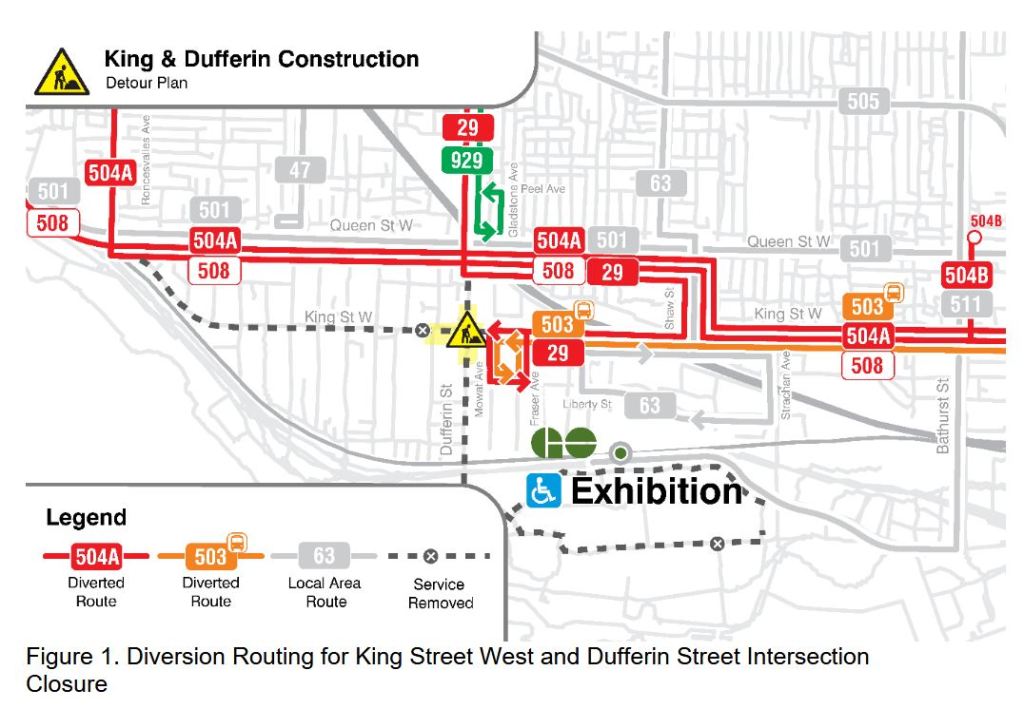
Transit services will be significantly changed in this area.

Source: City of Toronto Report at p. 5

Note that the diversions for King-Church construction are expected to end before King-Dufferin work begins, and transit services on the eastern part of King will be back to normal.

Route changes at King-Dufferin:

  • Routes diverting east of Roncesvalles via Queen and Shaw to King:
    • 504A King streetcars from Distillery Loop to Dundas West Station
    • 304 King night cars from Broadview Station to Dundas West Station
    • 508 Lake Shore streetcars from Long Branch to Broadview Station
    • No service on King between Mowat and Roncesvalles
  • 504B King streetcars will operate from Broadview Station diverting from King via Bathurst to Wolseley Loop (at Queen).
  • Kingston Road services:
    • 503 Kingston Road converted to bus operation and cut back from Dufferin to loop via Mowat and Fraser.
    • 303 Kingston Road night service suspended (it is not yet clear what will replace the 303 on Kingston Road)
  • Dufferin bus services:
    • 29 Dufferin buses will divert via Queen, Shaw and King looping via Mowat and Fraser.
    • 929 Dufferin Express buses will terminate at Queen looping via Queen, Gladstone and Peel.
    • No service on Dufferin south Queen nor through Exhibition Place to Princes’ Gate.

Parking and stopping provisions will change on Queen from Roncesvalles to Shaw, and on Shaw between Queen and King. Stopping will be prohibited on both sides of these streets seven days/week from 7:00 to 11:00am and 2:00 to 7:00pm.

Left turns will be banned from Shaw northbound at Queen and southbound at King. Left turns are now banned from King eastbound onto Shaw weekdays from 7:00 to 10:00am, and from 3:00 to 7:00pm. This will be extended to a ban from 7:00am to 7:00pm on all days.

Some existing parking spaces will be removed to make room for transit vehicles on Dufferin north of Queen, Peel, Mowat, Liberty, Fraser, and King. Details are in the report.

These changes will only last for the duration of the construction project.

The TTC plans to “conduct comprehensive targeted engagement to inform and educate customers, residents, local businesses, and other partners of the pending changes.” However, major changes are unlikely as this project is only two months away and temporary transit routes are already decided. The TTC does not yet have a page on its own site for this project.

This issue will be at Toronto & East York Community Council on July 8, 2025.

King/Church Update: June 26, 2025

Two proposals before City Council attempt to deal with congestion issues downtown brought on by the King/Church water main and track reconstruction.

MM31.17 – Speeding Up Streetcars: Traffic Amendments on Adelaide Street, King Street and York Street – by Mayor Olivia Chow, seconded by Deputy Mayor Ausma Malik

This motion proposes the relocation of parking and loading zones from Adelaide Street to nearby streets to free up capacity on Adelaide.

Currently, the Financial District Business Improvement Area and their stakeholders use loading zones on the south side of Adelaide Street West, from Yonge Street to York Street, between 10:00 a.m. to 3:00 p.m., Monday to Friday. Based on the travel time data, streetcar operations are negatively impacted when the loading operations are in effect.

In consultation with the Toronto Transit Commission, Transportation Services and the Financial District have agreed that temporary loading zones will be established on the west side of York Street, between King Street West and Wellington Street, and on the north side of King Street West, between Yonge Street and York Street.

Delivery drivers will queue in the new loading zones, where Traffic Control Persons will marshal the delivery drivers into the loading bay only when it is clear. With the temporary loading zones in place, stopping will be prohibited on Adelaide Street West from 7:00 a.m. to 7:00 p.m., Monday to Sunday.

Mayor Chow proposed an amendment to her own motion authorizing payment “to deploy additional paid duty officers at seven locations near the King and Church worksite to manage traffic flow”.

MM31.18 – Re-Opening King Street for Business: Keeping Toronto’s Downtown Core and Canada’s Financial District Moving – by Councillor Brad Bradford, seconded by Councillor Stephen Holyday

This motion proposes the reopening of through traffic on King Street where streetcars are not operating during the construction diversion.

City Council direct the General Manager, Transportation Services, to make any necessary changes to reopen the portion of King Street between Spadina Avenue and Church Street to vehicular traffic for the duration of the King Street East and Church Street intersection closure, where streetcars are not currently in service.

Mayor Chow proposed an amendment limiting the reopened area to portions where “streetcars and buses” are not operating. This effectively neuters the motion because the only portion of King with no transit service now is east of Yonge Street.

The debate was mired by a combination of political rivalries, lack of familiarity with the affected area and transit services, and disinformation either through ignorance or misrepresentation.

The Mayor’s motion MM31.17 and amendment carried on a show of hands.

The Mayor’s proposed amendment to MM31.18 carried by 16-5. The motion as amended carried on a show of hands.

The debate was hampered by the absence of basic information such as a map and detailed information on items such as existing transit services, traffic pinch points and loading zone locations.

In support of his claim that King Street could be reopened, Councillor Bradford showed a photo looking west on King from Simcoe with the street completely devoid of traffic. The photo was taken at 6:30pm on Monday.

  • Monday is a very light day for office-bound traffic due to work-from-home patterns. This is also reflected in day-of-the-week travel time differences shown later in this article.
  • The theatre district (Roy Thomson Hall, Royal Alexandra and Princess of Wales Theatres, TIFF) are dark on Mondays, and there is little tourist traffic. There was no major event at the Rogers Centre.

Although an empty road can be found at times, the photo is deeply misleading, and Bradford should know better.

Among the most striking pieces of disinformation was the claim that replacement bus service carries far fewer riders than the streetcars did along the King Street corridor. When asked, staff gave riding figures of 24,000 on the King Street replacement bus, and 60,000 per day for the streetcars. These are all day values for the entire route, not for riding on the King Street transit corridor itself. At no point was there any discussion of the frequency (and hence capacity) of service. These numbers were cited by various Councillors to claim that transit priority was not needed on King because so many fewer people were riding there.

City staff should be chastised for failing to correct this point and for giving an answer that did not properly illuminate the comparison between service levels.

For the record, the scheduled service on the central portion of King Street with streetcars and buses is shown below. Note that there is substantially less scheduled capacity with the replacement bus service. Buses on King are quite crowded, and service is bunched and erratic.

It is quite likely that there are fewer riders on the buses than on the streetcars, although a major contributing factor will be the level of service provided by the TTC. From a capacity viewpoint, a service of 18 buses/hour with 50/bus (greater than the Service Standard level) would be 900 riders per hour past a point. The streetcar service would have a capacity more than double that level.

PM Peak ServiceStreetcar Service (Apr/25)Bus Service (June/25)
504A Distillery-Dundas West10′ (6 cars/hour)
504B Broadview-Dundas West10′ (6 cars/hour)
503 Kingston Road
(EB from York)
10′ (6 cars/hour)
508 Lake Shore20′ (3 cars/hour)
504D Broadview-Bathurst5′ (12 buses/hour)
504C Distillery-Bathurst10′ (6 buses/hour)

In the course of the debate, Mayor Chow noted that work at King & Church is progressing well and should be finished by August 8. This may allow the road to reopen, but resumption of streetcar service depends on the TTC finishing their work including reconstruction of streetcar overhead at that intersection and along King Street East.

The remainder of this article updates previously-published charts about streetcar travel times on Richmond and Adelaide Streets.

Continue reading

501/503/507 Diversions and Bus Replacements

Effective Monday, June 23 at 7am until Thursday, June 26 at 7am, all streetcar service on Queen Street East will divert both ways via Coxwell, Gerrard and Broadview for emergency water main repairs at Vancouver St. just west of Russell Carhouse.

Notice of this change has not yet been posted on the TTC’s site.

Source: Councillor Paula Fletcher

Also effective June 23 at 11pm until Tuesday, July 8 at 4am, buses will replace streetcars on the Queen and Long Branch routes west of Humber Loop for track work.

Source: TTC

King Trackwork Diversion Effective June 22, 2025

Updated June 24, 2025: The TTC has now standardized the 504 King and 503 Kingston Road diversions so that both routes (and associated night services) operate via Queen and Shaw Streets

The diversions for track reconstruction on King Street will change again on Sunday, June 22. The TTC has posted conflicting information both on its website and in its weekly update memo regarding construction and special events. I have asked TTC for clarification and will update this page if and when they reply.

In an email on June 19, the TTC announced:

From 6 a.m. on Sun., June 22, until 4 a.m. on Sat., Jul. 12, the 503/303 Kingston Road streetcars will divert to accommodate streetcar track work on King St. between Shaw St. and Spadina Ave. 503/303 Kingston Road streetcars will run along Queen St. between Shaw St. and Dufferin St. 504D King replacement buses will be extended to run from King St. and Bathurst St. to Dufferin Gate Loop.

Affected routes:

  • 503/303 Kingston Road cars which now operate via Queen, Spadina and King to Dufferin Loop will change to run via Queen Street to Dufferin and then south to Dufferin Loop. This changed on June 24. See below.
  • 504D shuttle buses (Broadview/Bathurst) will be extended west from Bathurst via Queen and Dufferin to Dufferin Loop. In fact the buses ran west via King, not Queen.

Here are the original TTC maps.

It appears that whoever designed this change notice is unaware that the 503 does not now operate via Queen and Shaw, but in fact runs on King from Spadina westward.

Updated Monday, June 23 at 10:45pm: The erroneous map of the 504D diversion has been replaced on the TTC’s site. Here is the corrected map.

Updated Tuesday, June 24 at 5:00pm: The diversion of 503/303 and 504/304 services has now been standardized via Queen and Shaw Streets, and the notice/map also include the 504D bus extension west from King and Bathurst to Dufferin Loop.

Source: TTC

Changes happening at the same time are:

  • 511 Bathurst cars resume service to Exhibition Loop and will not operate east on King from Bathurst to Charlotte Loop at Spadina.
  • 508 Lake Shore service is discontinued for the summer.

There is no reference to the existing 504 streetcar route which operates via Queen and Shaw to King, nor is there any explanation of why the 503 and 504D services cannot use the same route. (Corrected effective June 24.)

Here is the construction plan included in the June 22, 2025 service change memo clearly showing where the 503 car runs today, but this will not, in fact, be how the routes operate starting June 22.

Taking the TTC notices at face value, this means that service on parts of King will be affected in different ways:

  • From Spadina to Bathurst, only the 504C/D shuttle buses will operate and will, presumably, dodge around construction as they have been doing in recent weeks during track margin repairs along King Street.
  • From Bathurst to Shaw, there will be no transit service. This affects stops at Tecumseth, Niagara and Strachan. Updated: The 504D buses are supposed to run west on King from Bathurst to Dufferin, but few of them actually get beyond Bathurst.
  • From Shaw to Dufferin depends on the continued operation of 504 King cars. As of June 24, 503 Kingston Road cars were also running via Queen, Shaw and King.

This is a repetition of the classic TTC communications cock-ups of past years where diversions are poorly or inaccurately explained. They are supposed to be “doing diversions differently” this year, but this is not a sterling example.

Updated 4:50 pm June 20: There are separate pages on the TTC website describing the 503/504 diversions which make no mention at all of the change effective June 22. They refer to the summer suspension of the 508 Lake Shore, but assure riders there are no other changes:

Starting Monday, June 23, 508 Lake Shore streetcar service will be suspended until early September for seasonal service adjustments. There will be no changes to 503/303 Kingston Rd, 504/304 King streetcars or to 504/304 King replacement bus routing. [Source: TTC Streetcar service changes.]

As of Tuesday, June 24, the separate streetcar diversion pages for the King and Kingston Road services still make no mention of the changes west of Bathurst Street.

Night Bus On Time Charts: Request For Comment

In a recent article, I detailed the headway reliability of night buses on several routes. In a comment, a reader asked if I could relate that data to “on time” performance.

There are a few problems with that concept, not least that the TTC’s own standard is so lax. The charts presented here are an attempt to show the degree to which departure times on two routes are scattered (307 Bathurst) or more closely bunched in a more-or-less reliable group (335 Jane).

Depending on reader feedback, I will include these charts, or possibly a modified version of them, in future articles about night services.

Updated June 20, 2025: The charts for 307 Bathurst Night Bus have been modified to show the advertised times of buses to show the degree to which service is “on time” or not.

A separate set of charts has been added to show the evolution of departure times northbound over the route from Front to Steeles.

Continue reading

A Review of Blue Night Services May 2025 (Part I)

This article begins a series to review the TTC’s overnight services, aka the Blue Night network. Most of these are bus routes, but a few of the older lines still operate with streetcars.

Included in this article are:

  • 307 Bathurst
  • 329 Dufferin
  • 332 Eglinton West
  • 335 Jane
  • 336 Finch West
  • 341 Keele
  • 352 Lawrence West

Other routes will follow in future installments.

It’s worth reviewing the TTC Service Standards regarding their Blue Night network.

Purpose of night service:

The overnight network is designed so 95% of the population and employment is within a 1,250 metre walk (15 minutes) of transit service. Consequently, overnight services may be provided on different routes than the base network in order to meet these requirements. Where possible, however, overnight routes will follow daytime routing and be identified in a manner consistent with the daytime route. The overnight network is an important part of the TTC’s commitment to maximizing the mobility of people in the City of Toronto and meeting all of their diverse travel needs.

  • Hours of service: 1:30am to 6:00am (8:00am Sunday)
  • % of population and employment served: 95%
  • Within walking distance: 1250 metres
  • Within walking time: 15 minutes
  • Minimum service frequency: 30 minutes
  • Headway performance: Service is considered to be on time if it is no more than 1 minute early and no more than 5 minutes late. TTC’s goal is to have 60% of all trips meet the on-time performance standard.

The one minute early standard was informally dropped in early 2025 and on time performance is now measured by TTC against a -0/+5 scale. That applies to on-time departure at terminals, but not to headways. The standard allows a swing of headways between 25-35 minutes for a half-hourly service as shown below. The service is “on time”, but unreliable, especially when the compounding effect of the swings is considered at transfer points.

Moreover, the “standard” need only be achieved 60% of the time, and then only at terminals. Almost half of the service is held to no standard at all.

TripScheduled Time / HeadwayActual Time / Headway
12:002:00
22:30 / 30m2:35 / 35m
33:00 / 30m3:00 / 25m
43:30 / 30m3:35 / 35m
54:00 / 30m4:00 / 25m

The TTC does not have any planned meets in its night network, and these would require scheduled, protected departure times enroute, not the current catch-as-catch-can arrangement. On a half-hourly base and with long routes, the gaps between buses can vary a lot, and riders cannot count on their arrival. This is a common annoyance on the daytime network, but on the night routes where a missed bus can make a large difference in trip time, this should be unacceptable.

Most night services operate every 30 minutes, although there are exceptions on both the bus and streetcar networks. That service level is provided generally from 2am onward to about 4am, later on some routes depending on when demand begins to build up for the morning. There is also some overlap of daytime and night time route number usage, although the TTC has been sorting out its schedules for consistency in past months.

Some routes do achieve a narrow band of headways around 30 minutes for terminal departures, although this band widens along the route just as it does with daytime service. However, some routes have erratic headways even near their terminals, but the standards are lax enough that these still can count as mostly “on time” in reports of service quality.

For all that the night services are supposed to be for shift workers and the night economy, reliability leaves much to be desired because, like so much TTC service, the time a vehicle will arrive is unpredictable. The situation varies from route to route as the sample in this article will show. Some routes are not too bad, but still leave riders vulnerable to missed trips and connections. Others are a real mess with 307 Bathurst taking the prize here. (There are likely competitors for that title, but I have not worked through every route yet. Be patient, gentle reader.)

May is an ideal month usually free of major storms, hot or cold, and conditions are about as good as one can expect. Service in February will not be as good as the examples shown here.

The TTC’s common bugbear/excuse for erratic service, traffic congestion, does not apply to these night services. Uneven headways are caused by lack of line management, the absence of a policy to maintain on time performance along routes, and in a minority of cases by schedules that are too tight to allow for terminal recovery time.

Through this series, I will review the quality of night service provided on the TTC system. This will take a while, and the articles will appear as time permits in between other topics.

Note: This is a long article with a lot of charts. I don’t expect most people to read every word or review every route. For some, this might validate their own experience. For others, it will show the variations across the network. Happy reading.

Continue reading