With the June 23, 2024 schedule change, buses were replaced with streetcars running from St. Clair Station at Yonge to Gunn’s Loop west of Keele Street. Buses operated mostly in the regular traffic lanes, not on the streetcar right-of-way.
This article reviews the travel times on the 512 St. Clair bus and streetcar services to compare travel times over the route.
Although the streetcars in week 4 of June (beginning on June 23) are overall faster than the buses they replaced, the degree of this advantage varies by location and direction.
The overall observation here is that although travel times are now shorter for many riders, headway reliability is very poor and gaps can undo the benefit of a faster trip.
With the June 23, 2024 schedule change, streetcars were replaced with buses running from Spadina Station at Bloor to Queens Quay. Buses operated in the regular traffic lanes, not on the streetcar right-of-way.
To no surprise, during periods when Spadina Avenue is congested, primarily with traffic queued for the westbound Gardiner Expressway ramp at Lake Shore, the buses made glacial progress. This was not, however, the only place where buses were delayed by traffic.
The TTC has announced that it will change the south end loop in an attempt to speed service during the PM peak. No buses will operate between Blue Jays Way and Queens Quay, but instead they will loop via Front eastbound, then south and west via Blue Jays Way to Spadina. Traffic Wardens will assist with the turn at Front Street.
However, the congestion on the south end of Spadina can extend north to King and sometimes beyond Queen Street. It is not clear whether the new loop will address much of the problem. Buses will not be using the streetcar right-of-way, even though it has no centre poles north of Bremner Blvd. to bypass the traffic jam.
The TTC advises that this is an interim arrangement, and that they are working with the City on further, unspecified, changes to the bus operation.
It’s Not Just the Gardiner
An effect unexpected by some, I am sure, was that at uncongested parts and times, the buses make faster trips than the streetcars had only a week before the changeover. Anyone who rides the 510 Spadina car will know of their glacial progress through intersections thanks to the system wide slow order on all special trackwork. Spadina has many intersections. This type of pervasive delay is seen all over the streetcar system, but is worst on rights-of-way where one would expect streetcars to operate as quickly as possible.
Buses have a further advantage in that they are stopping nearside, and therefore can serve stops while awaiting a green signal, and then leave without a second farside stop.
The absence of priority with extended green phases for Spadina transit service affects the modes differently because an extended green would allow streetcars to reach their stops before a signal turns against them. Even if bus is caught on the nearside of an intersection, it will be stopping to serve passengers.
The left turn phase for auto traffic that blocks streetcars also blocks buses, and so this particular delay is common to both modes.
In addition to congestion at the south end of the route, buses also encounter problems during some periods approaching Bloor Street northbound.
The remainder of this article reviews travel times and service reliability on the main part of the 510 Spadina route over June 2024. (There is a companion article about the return of streetcars replacing buses on 512 St. Clair.)
In comments on a recent article, a reader asked me to review the 100 Flemingdon Park bus route. As it happens, I have been tracking the route for almost a year and so have lots of data.
The picture is not a pretty one. This route has been affected by construction at various times, but the major problem is with headway management, or rather a lack of any, on some days. Very large gaps with bunches of three or more buses are common.
If nothing else, the Flemingdon Park shows that you don’t need streetcars fighting downtown traffic to have chaotic service. Too often there are assumptions about “typical” problems without looking too hard for the details.
Service on this route is unreliable during most of the 11 months covered by the data here. Erratic headways also generate uneven loads on buses. The theoretical capacity of a route might be capable of providing comfortable service, but with bunching most riders have longer than scheduled waits and crowding that is worse than the theoretical average. Riders complain about actual service conditions. Management responds with averages that hide the problems while claiming that they meet the “board approved” service standards most of the time.
Scheduled Service
The schedules in effect on June 1, 2023, saw the Flemingdon Park buses running between Don Mills & Eglinton south to Broadview Station. A former link west to Eglinton Station was replaced by a separate 34C Eglinton East bus to isolate the 100 service from construction delays on Eglinton.
On June 18, 2023, the southern terminus shifted from Broadview Station to Pape Station and the route was interlined with 72A Pape. This change was part of a general restructuring of routes during construction at Broadview Station and the surrounding neighbourhood.
On November 19, 2023, the Flemingdon Park buses returned to Broadview Station, and this has been their terminus ever since. Although a new schedule was issued in May 2024, the service details are the same except that the route now operates from Eglinton rather than from Birchmount garage.
The remainder of this article looks at various months over the June 2023 to May 2024 period in detail to see what the service actually looked like from a rider’s point of view.
The TTC has announced that streetcar service will be restored on St. Clair with the June 23, 2024 schedule changes. This follows a long period of reconstruction at several points along the route:
Upgrade of overhead power systems for pantographs along the route, at loops and junctions.
Worn rail replacement at some stops.
Improved lubricators for Oakwood and Earlscourt loops to reduce wheel squeal.
City of Toronto work at the Barrie corridor west of Caledonia.
Toronto Water construction.
Reconstruction of St. Clair West Station loop will continue through the summer and fall, and streetcars, like the interim bus service, will not enter the station. Riders connecting to/from the subway will have to walk to nearby stops at Bathurst or Tweedsmuir.
This chart gives an overview of the various projects along St. Clair. For complete description of the project, see the TTC’s project page.
Full details of the service changes planned on June 23 have not yet been released, but the electronic version of schedules used by trip planning apps were posted recently.
Weekdays
Saturdays
Sundays
AM Peak M-F Early Morning S-S
8′
10′
11′
Midday M-F Late Morning S-S
8′
8′
9′
PM Peak M-F Afternoon S-S
8′
8′
8′
Early Evening
8′
9′
9′
Late Evening
10′
10′
10′
Night service will also change. Streetcars will operate as 312 St. Clair from Yonge Street to Gunn’s Loop west of Keele matching the daytime service. A separate 340 Junction night bus will operate from Gunn’s Loop to Dundas West Station via St. Clair, Jane and Dundas.
Updated June 13, 2024 at 8:00 am: A table comparing scheduled service levels on Queens Quay has been added.
Updated June 13, 2024 at 2:00 pm: A table comparing scheduled service levels on the 510 streetcar with proposed bus service has been added.
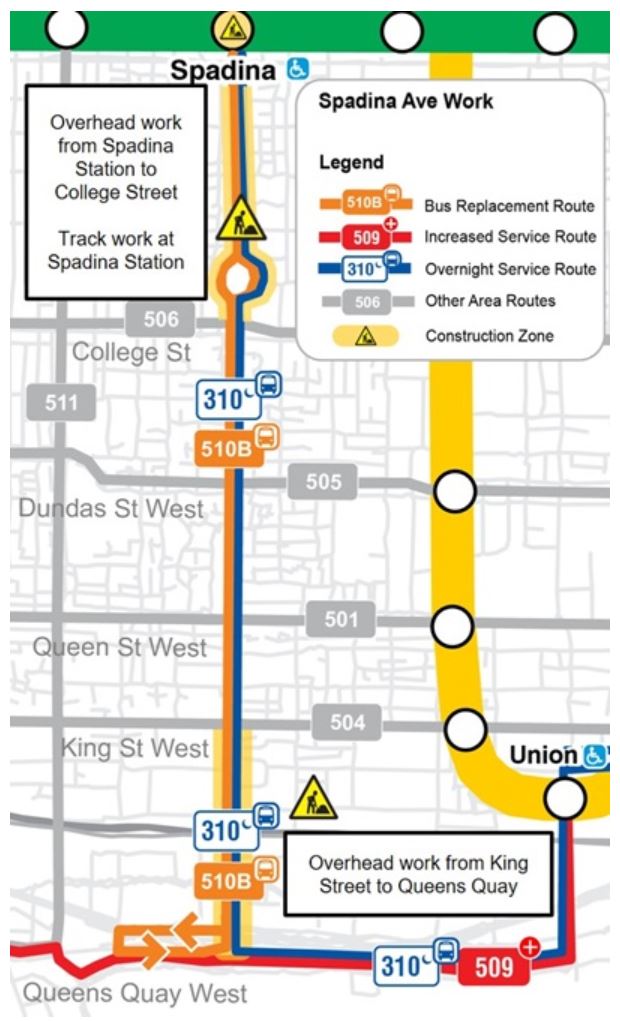
In April, I reported TTC plans to replace 510 Spadina Streetcars with buses from June 23 through the summer and fall. The TTC has now updated the announcement and extended the program from October into December. Here are the April (left) and June (right) versions of the maps for comparison.
Enabling works for Spadina Station Loop expansion. Condo construction east of the station will expose part of its structure, and the TTC will make provision for extending the streetcar loading platform.
Overhead reconstruction from Spadina Station to College Street, and from King to Queens Quay.
There is no information about the segment from College to King which was omitted due to resource limitations according to the TTC. It is unclear whether there will be another shutdown in 2025 to finish the work. I await clarification on that issue from the TTC.
Buses will operate in mixed traffic, not on the streetcar right-of-way. According to the Transit Notice:
The City will be deploying traffic wardens to assist bus operations on Spadina Avenue.
Narrow lane width and centre overhead poles in certain sections preclude bus service on the streetcar right-of-way.
Overhead crews will be actively working in the right-of-way in different sections of Spadina Avenue.
Operating in both the streetcar right-of-way and in mixed traffic lanes would require new signals and limit any travel time benefits.
Some of this does not entirely make sense. There are centre overhead poles only south of Front Street. No work is planned between College and King. It is not clear that completely new signals would be needed for buses to shift between the streetcar right-of-way and curb lanes, especially at College and at King where there are already priority signals for streetcar turns northbound and southbound. Some reprogramming would be necessary.
As for traffic wardens, they will be little use on lower Spadina where traffic is regularly backed up from the Gardiner Expressway. I would not be surprised to see many buses short turn at Adelaide rather than attempting the trip south to Queens Quay.
Service on 509 Harbourfront will be improved, but the details have not yet been published.
I will update this article as more information is available.
Comparison of Service Levels on Queens Quay
The table below shows the existing scheduled service on Queens Quay until June 22 with the 509 Harbourfront and 510 Spadina cars, and from June 23 with the revised 509 service. It is quite clear that there will be less service on Queens Quay from June 23 onward.
The values shown below are headways in minutes and seconds, and vehicles/hour e.g. “10′ (6)”.
509 Harbourfront to June 22
510 Spadina to June 22
Combined 509/510 to June 22
509 Harbourfront effective June 23
Percent Change
Weekdays
AM Peak
7’15” (8.4)
10′ (6)
4’10” (14.4)
6′ (10)
-31%
Midday
9’30” (6.3)
10′ (6)
4’53” (12.3)
7′ (8.6)
-30%
PM Peak
9’30” (6.3)
10′ (6)
4’53” (12.3)
6′ (10)
-19%
Early Evening
9’15” (6.5)
10′ (6)
4’48” (12.5)
7′ (8.6)
-31%
Late Evening
10′ (6)
9’30” (6.3)
4’53” (12.3)
8′ (7.5)
-31%
Saturdays
Early Morning
8’30” (7.1)
9’30” (6.3)
4’49” (13.4)
8’30” (7.1)
-47%
Late Morning
9’15″(6.5)
8’30” (7.1)
4.25 (13.6)
7′ (8.6)
-37%
Afternoon
8’15” (7.3)
7’45” (7.7)
4′ (15)
4′ (15)
Nil
Early Evening
9’15” (6.5)
5’15” (11.4)
3’21” (17.9)
7′ (8.6)
-52%
Late Evening
10′ (6)
9’30” (6.3)
4’53” (12.3)
8′ (7.5)
-39%
Sundays
Early Morning
15′ (4)
15′ (4)
7’30” (8)
10′ (6)
-25%
Late Morning
8’45” (6.9)
9’45” (6.2)
4’35” (13.1)
7’30” (8)
-39%
Afternoon
8’15” (7.3)
9′ (6.7)
4’17” (14)
5′ (12)
-14%
Early Evening
9’15” (6.5)
6’15” (9.6)
3’44” (16.1)
7′ (8.6)
-46%
Late Evening
10′ (6)
9’30” (6.3)
4’53” (12.3)
8′ (7.5)
-39%
Comparison of Service Levels on Spadina
The table below compares the existing streetcar service on 510 Spadina between Spadina Station and Queens Quay with the proposed level of bus service. Note that streetcars carry two to three times the load of a standard bus. Values are shown in minutes and seconds, with vehicles per hour in brackets.
In the previous article, I reviewed travel times on 505 Dundas for the month of April 2024. Now, here are charts of the headway data.
Service on this route comes nowhere near meeting the TTC’s own rather lax standards for service quality. The TTC measures On Time Performance (“OTP”) with the assumption that if cars are on time, then regular service will take care of itself. However, there is considerable leeway in the words “on time”.
OTP is measured only at terminals and compares the scheduled trip time to the actual one. If a car leaves no more than 1 minute early or 5 minutes late, it is “on time” for the stats. There is no measurement of OTP along the route, and the spacing from terminals is rarely maintained.
The six minute window this provides allows service to be quite erratic, but still counted as “on time”. For example, on a route like Dundas with a 10 minute headway, cars could alternately be 5 minutes late and 1 minute early. This would produce the following departure pattern:
Scheduled
12:00
12:10
12:20
12:30
12:40
12:50
1:00
Actual
12:05
12:09
12:25
12:29
12:45
12:49
1:05
Headway
4′
16′
4′
16′
4′
16′
The cars on short headways would inevitably catch up with the cars on wide headways, and pairs 20′ apart would travel across the route. There is nothing in TTC standards to measure this. and reports will blissfully say that service is “on time”. In fact, the TTC does not even achieve its own lax standard.
There is also no metric for missed trips caused by absent cars. Conversely, a trip at a terminal can legitimately be missing if a car was short-turned to restore regular service. The TTC’s focus on OTP stats to the exclusion of any other metric is one reason for the no short-turn policy. This can do much damage by blocking legitimate service management techniques. In the article on travel times, there are many examples of short turns to preserve service on the central part of the route rather than letting vehicles pile up at terminals.
This article shows how service leaving the terminals of 505 Dundas is disorganized from the outset, and how this evolves along the route. For an organization that hopes to win back riders, this is not an ideal example of what service should look like.
On the Toronto Council agenda for May 22, 2024, there was a motion asking for Transportation Services to investigate changes in traffic regulations on Dundas Street in anticipation of coming work on Spadina Avenue and at Spadina Station. This will replace streetcars with buses for a period from late June to mid-December, 2024, and the buses will not operate on the streetcar right-of-way.
Community Council Decision Advice and Other Information
The Toronto and East York Community Council requested the General Manager, Transportation Services to report directly to the May 22, 2024 meeting of City Council on recommended temporary parking, loading and traffic amendments on Dundas Street West that would support timely and reliable streetcar service on Dundas Street West between Spadina Avenue and McCaul Street during construction at Spadina Station.
Summary
During the June to December 2024 closure of the 510 Spadina streetcar for construction at Spadina Station, the Toronto Transit Commission (TTC) wishes to enhance alternate routes for customer movement to and through the Chinatown neighbourhood. One key alternate route is the 505 Dundas streetcar. Unfortunately, this streetcar is frequently delayed by acute traffic congestion between Spadina Avenue and McCaul Street. To improve timeliness and reliability of 505 Dundas streetcar service through Chinatown during the Spadina closure, TTC is requesting that Council temporarily modify left-turn prohibitions, reduce on-street general-use parking, and add no stopping restrictions in strategic locations and timeframes along Dundas Street West between Spadina Avenue and McCaul Street. Designated loading zones may also help to reduce conflicts with streetcar service while supporting local businesses.
Transportation Services has replied to this request with a recommendation for changes in parking, stopping and turning restrictions on Dundas between McCaul and Spadina. Current curb lane restrictions are for no parking or stopping only in peak periods, with a mixture of paid and unpaid parking allowed at other times. There are also various turning restrictions (see the reply for details). The proposed changes are:
Between McCaul and Spadina, Dundas would be a No Stopping zone in both directions at all times.
Between University and McCaul, the peak direction (eastbound AM, westbound PM) would be a No Stopping zone.
Left turns eastbound and westbound at Dundas and Spadina would be banned between 7 am and 10 pm on all days.
A coach loading zone will be preserved in front of the Art Gallery (south side of Dundas, west of McCaul), and “consultation will be undertaken with the Chinatown BIA to identify areas where loading zone could be designated”.
Council amended the staff recommendation to asked for a “report back to the Toronto and East York Community Council by the fourth quarter of 2024 on the effectiveness of these changes for streetcar operations and a recommended long-term plan for parking, loading and traffic regulations on Dundas Street West between Spadina Avenue and McCaul Street.”
How much these changes will contribute to the Dundas car’s operation remains to be seen. There are already peak period restrictions on Dundas, and so there would be no change at those times. As always, the question of enforcement in practice vs regulation in theory is a problem. Moreover, 505 Dundas service is much less frequent than the combined services on King, and transit’s presence on Dundas is nowhere near as dominant. At most times, the scheduled service is every 10 minutes, and the most frequent service, 7 minutes, is on Saturday afternoons.
There is much more to the 505 Dundas route than the short section east of Spadina, and any review of the route should look at it over all. The travel time between University and Spadina, even on “bad” days, is under 10 minutes and the likely saving of any restrictions will be at best 4 minutes, likely less. Focus on a single segment will not address wider problems along the route.
The remainder of this article looks at travel times for 505 Dundas cars in April 2024 as a “before” point of reference, and to high light other areas where cars are (and are not) delayed.
Route 506/306 Carlton will operate as a bus route east of Parliament Street for two weeks beginning late on May 25. Worn curves at Gerrard & Bowmore (between Coxwell and Woodbine) and at Coxwell & Upper Gerrard will be replaced.
Updated June 6, 2024: The diversion that was expected to last until June 6 finished a day early, and normal service was restored to Main Station on June 6, not June 7 as originally planned.
Updated May 31, 2024 at 4:30pm: On the afternoon of Tuesday, May 28, the TTC announced that the 506 Carlton route would be extended east to Woodbine Loop via Queen Street. This would soak up the very substantial unused scheduled time for trips through to Main Station. Although some cars did operate over this routing on May 28, many turned back at Broadview. From May 29 onward, all service ran east to Woodbine Loop via Broadview and Queen, returning westbound via Queen and Parliament. None of the cars operating off route, nor any of the replacement shuttle buses appear on the tracking apps.
There service diversion varies as work progresses:
From 11pm Saturday May 25 to 4am Monday May 27:
The first stage of the work will be at Gerrard & Bowmore.
From 4am Monday May 27 to 4am Friday June 7:
The second stage of the work will be at Upper Gerrard & Coxwell.
Toronto’s Infrastructure and Environment Committee will consider a report at its May 2, 2024 meeting which updates Council on the status of the King Street corridor.
A notable shortcoming in the report is the absence of a map showing locations of proposed or completed works, and how King Street relates to other nearby sites where roads have limited capacity or are completely blocked.
As previously reported, the City implemented new measures late in 2023 to resolve traffic gridlock at several intersections along the corridor between Bathurst and Jarvis streets. Many overlapping construction projects reduced road capacity and caused severe backlogs on King Street rendering transit service, especially eastbound, almost worthless. Charts later in this article update my previous reports on the situation and how travel times on King have returned to preconstruction levels.
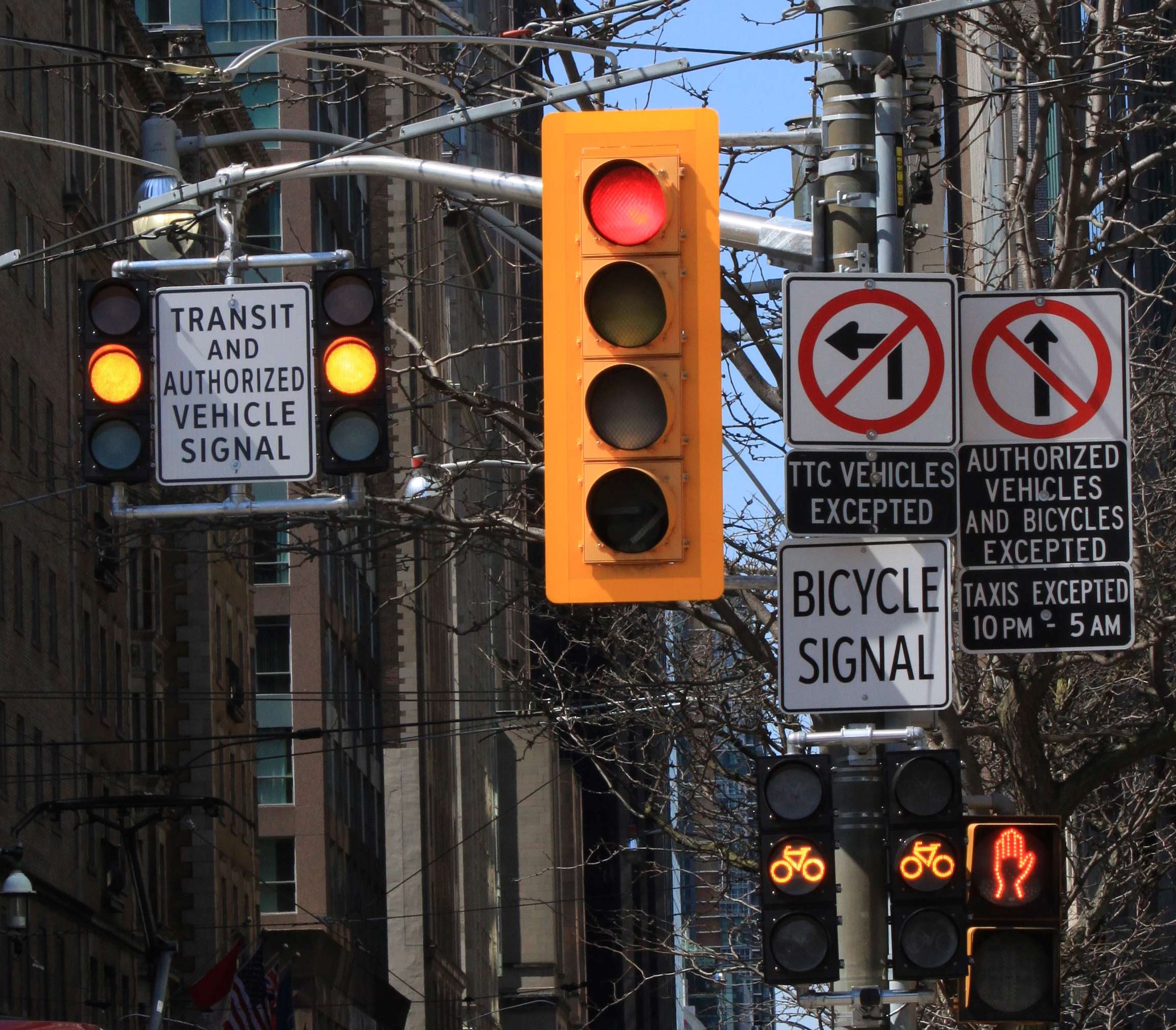
Recently, new traffic signals have been installed at the King/Yonge and King/Church intersections where through movements by most traffic is prohibited. A constant red signal with green arrows for permitted turns is intended to make through movements a “red light running” offense, although the arrangement and signage confuse motorists. The intent is that the arrangement, together with red light traffic cameras, will deter motorists from driving straight through, although it remains to be seen how well this will work.
A complication is that “authorized vehicles” (i.e. licensed taxis) are allowed through between 10pm and 5am, but to the casual observer a car is a car is a car, especially when it is operating for a service like Uber as opposed to a branded taxi with company colours. When traffic agents are present to manage the intersections, motorists go where they are told, but at other times the signals are often ignored. Driving through a full red signal is not a behaviour that should be encouraged, especially out of frustration.
Facing west at King and Church, northwest corner
Travel times across the priority corridor dropped substantially after traffic agents prevented motorists from blocking intersections, and a further improvement is expected when work is complete on parallel streets related mainly to the 501 Queen diversion tracks for Ontario Line construction. Some eastbound traffic now attempting to use King will shift north to Adelaide.
The date for the 501 Queen shift to Richmond/Adelaide is not yet certain. However, track repairs are planned at King & Church in August, and it would make sense to have an alternate streetcar route across the core available by then. Whether it will be is quite another matter.
The effectiveness of these improvements is being monitored and, if successful, Transportation Services is proposing to implement similar changes at other locations along the King Street corridor. It is anticipated that these measures, if successful, may also mitigate the need for Traffic Agents at two or more locations.
Update Report at p. 4
In the short term, there is a budgetary issue because Toronto Police are providing direction and enforcement at some locations. This provides an incentive for technological solutions.
The City intends to purse automated enforcement, but current legislation only allows this for red light running, but not for entering and blocking an intersection because there is no space clear on the far side. “Blocking the box” cannot currently be charged against a vehicle owner, only against a driver. This must change to match red light enforcement where the owner is charged regardless of who is actually driving.
Also under consideration (and subject to the same legislative requirements) are offenses such as blocking bicycle and reserved transit lanes. (Note that there are no reserved transit lanes on King.)
What is painfully clear since the priority corridor was installed is that motorists will do whatever they damn well like unless there is enforcement. Toronto’s laissez-faire attitude undermines whatever bylaws Council might enact.
Since their installation, the curb lane pedestrian areas at stops have deteriorated. After a mid-2023 inspection, 180 missing or badly damaged yellow tactile mats and five bollards were replaced. Other needed work includes basic street cleaning, graffiti removal on barriers, pothole repair and repainting of pavement markings. These are to be addressed in 2024. Another annoyance not mentioned in the report is the relocation of stops without concurrent shifts in transit shelters and benches. The gradual decline of the pedestrian facilities on King tells its own story about the City’s real priorities.
A trial raised platform for passengers was installed at Peter Street and at Portland Street in 2019, although the latter was removed for adjacent construction activity. That platform will be “redeployed” elsewhere. Of the 20 stops along the corridor, some can accommodate platforms without any utility conflicts. Five-to-seven will be installed in fall 2024 (locations not yet named). The remaining stops require co-ordination with utilities for the effect of a platform on their access with the intent of installing these in 2025.
Some mid-block curb extensions for public realm improvements will be designed in 2024 and built in 2025. However, major work to reconfigure King Street is not planned until after 2030, presumably when the Ontario Line is open (or at least substantially complete) and its construction disruptions end. In the meantime, improvements will be made where possible in co-ordination with other construction in the area.
The bylaw governing the corridor will be amended to include the Billy Bishop Airport Shuttle as a service that is permitted to use King Street as a transit vehicle.
Once again, streetcar service in the east end will be disrupted for construction diversions, although this will not be as long lasting as projects in recent years.
Updated April 27, 2024: The diversion for work at the Don Bridge on Queen Street finished early and all streetcar routes returned to their normal routes today.
505 Dundas Late Night Diversion
On Friday, April 19 and Saturday, April 21, service after 11pm on 505 Dundas cars will divert both ways via the Carlton route (College, Carlton, Parliament, Gerrard) between Bay and Broadview. Replacement bus service will cover the missed portion of the streetcar route. This work is for track drain repairs at Mutual Street.
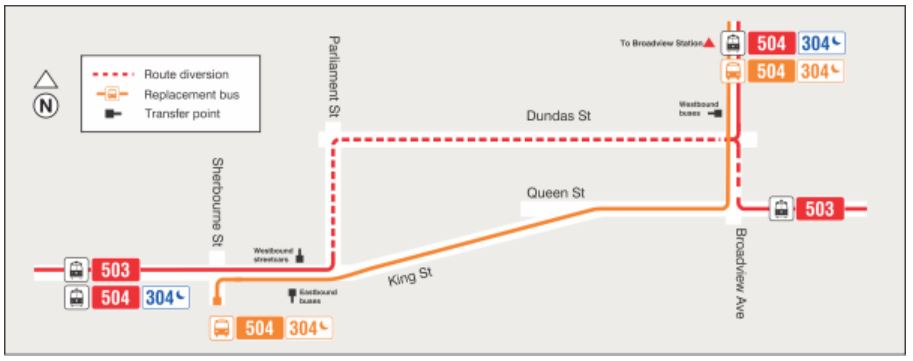
501/503/504/508/301/304 Don Bridge Diversion
From Monday, April 22 at 4am to Monday, April 29 at 4am, all streetcar service will divert via Dundas between Broadview and Parliament to bypass expansion joint replacement on the Queen Street bridge at the Don River. The work finished early and normal routings across the bridge were restored on April 27.
Shuttle bus service will operate on Queen between Carlaw and Sherbourne, and on the King route between Broadview Station and Sherbourne.
As of 7am on April 20, the TTC has posted a Service Change notice for King Street services (503, 504 and 304), but has not yet posted one for 501/301 Queen or 508 Lake Shore although these are also affected. The 501B bus service between Broadview and Bathurst should continue on its normal route. There is also an item on their News page describing this change.
Although not shown on this map, the diversion should not affect the 504A Distillery service.
Expansion joint replacement on this bridge occurs from time to time as this is a high traffic area, and the bridge can be damaged if the joint is in poor condition from vibration of passing streetcars.