Travel Times on RapidTO Corridors – December 2023 Update – Part I

This article updates tracking charts of travel times on three proposed RapidTO bus corridors with data to the end of 2023. The routes covered are:

  • 29/929 Dufferin from King to Wilson
  • 35/935 Jane from Eglinton to Pioneer Village Station
  • 39/939 Finch East from Victoria Park to McCowan
  • 54 Lawrence East from Victoria Park to PortUnion

I will turn to other RapidTO corridors including the existing Eglinton-Kingston red lanes in Part II of this series.

Without going into a lot of interpretive detail, the purpose of these charts is:

  • To show the travel times under “best case” conditions of low road traffic in Spring 2020 (the covid pandemic onset), and the changes since that time.
  • To show the variation in travel times day-by-day and at varying times of the day.

If RapidTO can flatten out variations in travel times and get the typical time to a consistently lower level, bus service should not only be faster but more reliable. That was the goal on King Street which, for a time, achieved it’s purpose of improving transit.

The focus of too much transit politics is on saving time getting from point “A” to “B” and not enough on ensuring that this time is consistent from day-to-day, hour-to-hour. This includes both on-vehicle travel time and reliability of the interval between buses, a frequent topic on this site.

Toronto’s Executive Committee will consider a report RapidTO: Surface Transit Network Plan at its meeting on January 30, 2024. I will report on the full document after their discussion and additional information, if any, from the meeting.

Continue reading

How Slow Is My Streetcar: Part I

At its November 2023 meeting, Council passed a motion proposed by Councillor Chris Moise whose ward covers the east side of downtown, and who also sits on the TTC Board:

1. City Council direct the General Manager, Transportation Services, in consultation with the Toronto Transit Commission, the Toronto Police Service, and the City Solicitor to review and report back to the Executive Committee in the second quarter of 2024, including:
a. an update on streetcar performance over the last five years;
b. suggested improvements to the public realm along King Street until the permanent capital project can be delivered; and
c. the feasibility of implementing automated traffic enforcement on the King Street Transit Priority Corridor, including details on what legislative amendments would be required to provincial legislation including, but not limited to, the Ontario Highway Traffic Act.

This article addresses point “a” with a review of streetcar lines over the past five years. It is important to go back to 2019 before the pandemic fundamentally shifted traffic and transit patterns downtown as a point of reference.

From time to time, there are calls to expand a “King Street” redesign to other parts of the network, but there are two “cart before the horse” issues to address first:

  • Figure out how to make King Street operate as it was intended and return at least to its pre-pandemic behaviour, if not better, as a model.
  • Understand how other streets operate including where and when problems for transit performance exist.

An update on transit priority will come to Council in February 2024, although this will look more widely at the city, not just downtown. In previous articles I have reviewed the growing problem of transit travel times as traffic builds on the proposed RapidTO corridors, some of which exceeded pre-pandemic levels some time ago. In future articles I will refresh these analyses with data through to the end of 2023.

An important distinction between most RapidTO bus corridors and the downtown streetcar system is the design of suburban vs downtown streets. In the suburbs, the streets are mostly wide, have relatively few points of access (e.g. driveways) or pedestrian oriented uses (e.g. shops), and travel distances tend to be longer. In the core, streets are narrow, mostly four lanes with no possibility of widening, access points are more frequent, there is a strong pedestrian orientation, and trips tend to be short. Even if buses were running, express operations would be almost impossible and would save very little time on the downtown routes.

There are exceptions such as some older parts of the inner suburbs that bring physical challenges for transit priority, but also the political challenge that the transit share of road use is lower as one moves outward from the core. King Street is a very different place from Steeles, and Dufferin is somewhere in between depending on which section one considers.

An important message in all of this is that “congestion” (put in quotes because it is so often cited as a get-out-of-jail-free excuse for all transit woes) varies from place to place and time to time. Simply putting transit priority everywhere will not solve all problems and could even be overkill (even assuming that it is true “priority” and not a sham to keep transit vehicles out of motorists’ way). It is simple to colour a bunch of key routes end-to-end on a map, but much harder to identify changes that will actually make a difference. Meanwhile, a focus on “priority” could divert attention from badly-needed improvements in headway reliability and more reliable wait times.

This article begins with a comparison of scheduled travel speed on each route, and then turns to actual travel speeds by route segment. In the interest of length, I will leave a discussion of headway reliability to future articles. This is an important component of total travel time, especially for short trips or trip segments.

I have also included tables showing the constant change in route configurations on the four major east-west corridors thanks to a never-ending procession of track and water main work, rapid transit construction, and overhead changes for pantograph operation. Some of this work was accelerated to take advantage of lighter traffic conditions during the pandemic, and some to bring forward work to keep staff employed.

However, the rate of route changes persisted well beyond the heart of the pandemic and threatens the credibility of transit service on major corridors leaving riders constantly wondering where their streetcar or replacement bus might be. Some changes occurred without the planned work actually taking place, or work started and ended later than announced (sometimes much later as in the never-ending KQQR project).

An important change over recent years, separate from the pandemic, has been the move to larger streetcars on wider headways. What might have been a tolerable unevenness in service when streetcars arrived every 4 or 5 minutes simply does not work for scheduled headways of 10 minutes with much wider swings. Bunching when it occurs leaves much bigger gaps between vehicles. A laissez faire attitude to route management, and especially the assumption that routes under construction cannot be managed, has led both to unreliable service and basic questions of how or if the TTC can recover the quality riders expect.

For all the talk of project co-ordination, the last people who seem to count are the riders. Simply studying raw travel times be they scheduled or actual does not capture the frustration, delay and despair from the ever-changing and unreliable services, be they by streetcar or bus.

Continue reading

36 Finch West: Travel Times Between Keele and Humber College

In a recent thread on X/Twitter (and no doubt other venues) there has been some controversy about the relative speed of 6 Finch LRT versus the bus service it will replace. Writers have based their arguments on speeds published in the Scheduled Service Summaries, although these are not always reliable for various reasons:

  • The speeds shown are over the full route. For the 36 Finch West service west of Keele Street (Finch West Station), this includes the portion south of Humber College to Humberwood Loop.
  • Actual speeds vary from the scheduled ones, and there is a fair amount of scatter around these averages. An important factor in any reserved lane implementation, regardless of technology, is the hope that, as on King Street originally, better reliability can be brought to travel times and hence to service quality.

The purpose of this article is to review actual travel time data on weekdays for selected months between 2017 and 2023. The specific months were chosen both for variety, but also within the limitations of data that I have been collecting for several years. 36 Finch West fell off my radar, so to speak, in 2022 and I was not tracking it, but began again in 2023 in anticipation of the LRT opening to get some “before” data.

The data are shown in two formats.

  • Weekly average travel times by hour together with the standard deviations in data values, a measure of the scatter in the data.
  • The raw data points to give readers a sense of the range of travel times that can occur on a day-by-day, hour-by-hour basis.

The challenge for the LRT line is to both reduce the averages times, and to narrow the band in which these times lie.

The section measured is from west of Keele Street to Humber College. This is chosen to ensure consistent data for departures from Finch West Station in the post-TYSSE era, and coincides roughly with the LRT portal from Finch West Station. This also eliminates station time which can vary considerably, especially for the bus service, due to the station’s location.

Data for October 2017 and April 2018 precede the opening of the TYSSE and the start of construction on Line 6, and they are included as a stating point against which any improvement might be compared.

Westbound and eastbound data are shown side by side, and the charts move forward in time from top (2017) to bottom (2023)

Continue reading

King Street Travel Times: May-December 2023

This article is an update to King Street Travel Times: May-November 2023 incorporating data for December 2023. The charts here show the variation on a day-to-day basis for selected hours of service including the morning peak 8-9am, midday 1-2pm, and hourly from 3pm to 11pm.

Items of note:

  • The problems in late 2023 were predominantly eastbound caused by a combination of auto traffic entering the King Street corridor and filling all available capacity, and by delays eastbound at Church for TTC vehicles making left turns on diversion routes.
  • There are early signs of this problem in the hour from 1 to 2pm, but it worsens dramatically from 3pm onward and travel times do not settle down to normal values until after 7pm.
    • This shows the need for traffic management over an extended period, not just for a short “peak within the peak” interval.
    • The problem receded somewhat in December with the implementation of traffic wardens, but various construction projects, some unplanned, also affected the street.
  • The day-to-day variation in travel times, and by extension in the amount of competing traffic, generally peaks on Wednesday.
    • This was already evident in Spring and Summer data indicating a problem brewing for later in the year as construction affected parallel roads.
    • The peaking within the week, and the different behaviour by time-of-day and direction show the folly of citing “average” values. By extension, the quality of service varied substantially depending on the level of congestion, and this affected entire routes, not just the downtown portion.
  • There is a regular increase in travel times in the evening, notably on Fridays, corresponding to the busy day in the Entertainment District. This is not as severe as the peak period delay eastbound, but it is a quite regular occurrence.

When the January data are available, I will update these charts to show how consistently the December improvements have survived past the holidays and without major construction works on Adelaide Street.

Continue reading

Downtown Route Changes Effective December 11, 2023 (Updated)

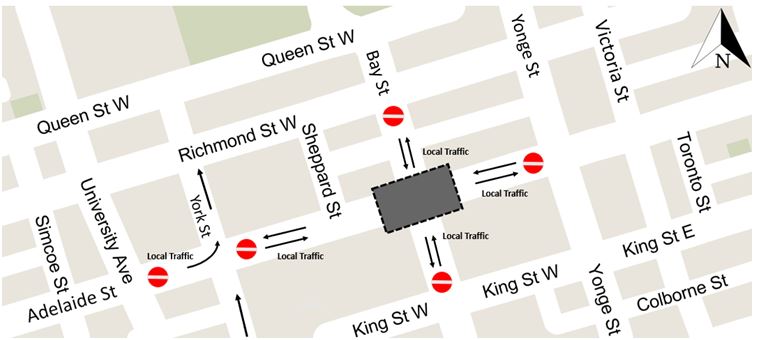
The City of Toronto will completely close the intersection of Bay & Adelaide from 7am Monday, December 11 to 7am on Saturday December 16 to all vehicles. Bay and Adelaide Streets will be open only for local traffic in the immediate area of the closure. This continues the work of (re-)installing streetcar track on Adelaide for the eastbound 501 Queen streetcar diversion around Ontario Line contruction.

Updated: Work at Bay and Adelaide actually completed on the afternoon of Friday, December 15 and the intersection reopened earlier than planned.

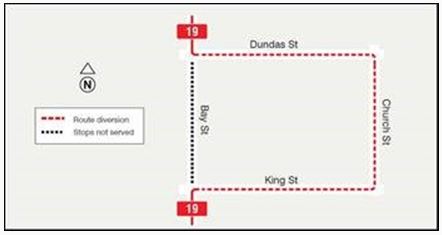
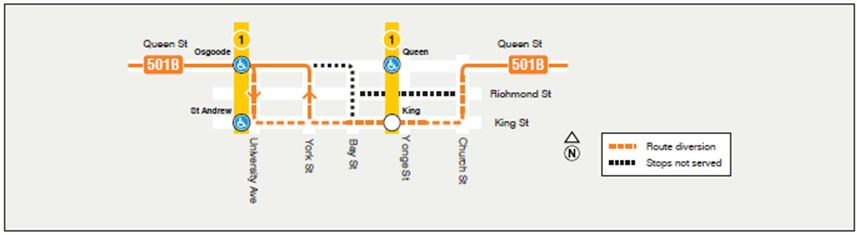
This will require diversion of the 19 Bay and 501B Queen bus routes.

The 19 Bay bus will divert via Dundas, Church and King both ways.

The 501B Queen bus which normally operates on Bay from King to Queen will use York Street for north/westbound trips and University Avenue for south/eastbound trips. Buses will operate both ways via King Street, and there will be no westbound service on Richmond Street

[Apologies for the soft images. They are from a City construction notice, and I used what is available.]

End of the King East Diversions

As the map for 501B Queen above shows, service is supposed to resume the normal routes east of Church with the completion of water main and Hydro work on the coming weekend which has a December 10 end date. This means that:

  • 501B Queen buses return to Queen Street east of Church
  • 503 Kingston Road streetcars return to King Street between the Don River and Church
  • 504 King streetcar service to Distillery Loop resumes

Updated December 11, 2023 at 4:15 pm

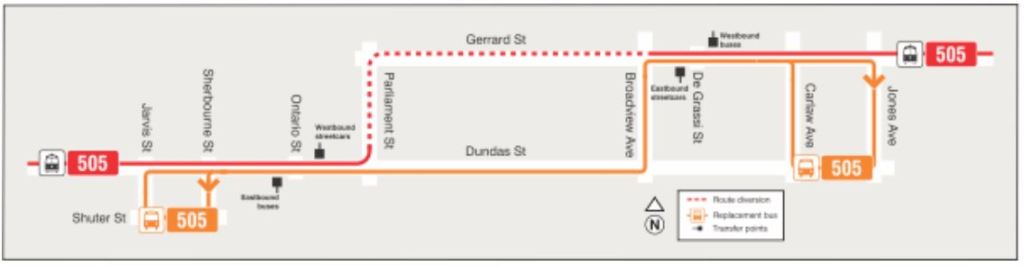
Another diversion has been added to the list. The 505 Dundas cars will divert both ways via Parliament and Gerrard. A 505 shuttle bus will run from Jarvis to Jones.

This diversion is required for track repairs, and will last until Thursday, December 21, 2023.

Updated: This diversion ended on Tuesday, December 19.

Analysis of 903 STC Express: September-November 2023

This article is a preliminary look at the service offered by the 903 express bus which replaced Line 3 SRT.

Until Saturday, November 18, the 903 buses provided very frequent service between Scarborough Town Centre and Kennedy Station. On Sunday, November 19, eight other routes were extended from STC to Kennedy Station, the 903 was extended to Centennial College replacing the 134/913 Progress bus, and much existing service on route 903 was reallocated to the extended routes.

I will review the other routes serving this corridor in early 2024 when they have accumulated a few months’ experience.

Travel Times

The charts here show how travel times between STC and Kennedy Station have changed over the past three months. The screenlines for these measurements are located:

  • Leaving STC Loop
  • Just north of Eglinton on Midland and on Kennedy

Note that this excludes time spent navigating roads and construction near Kennedy Station, and any time spent in STC Loop. I will review terminal operations when more data for all of the routes in this corridor have accumulated.

The charts below show monthly data, by week and hour, with North/Eastbound service on the left and South/Westbound service on the right. Note that there are no data for September, Week 1 because the service was provided with untracked extras until the schedule change on Labour Day weekend.

The solid lines show the average headways, and the dotted lines show the standard deviation, a measure of the scatter in the values. The closer the SD values are to zero, the more reliable the service is.

In the early weeks of operation, the transit priority measures were not in place, and service was more affected by traffic sharing the road. This settles down by November, although some peak period effects are still visible.

The TTC had anticipated that a trip between Kennedy Station and STC would take 15 to 18 minutes depending on conditions. Considering that the times shown below do not include access time to and from terminals, the service is close to the TTC’s target.

Service from November 19 Onward

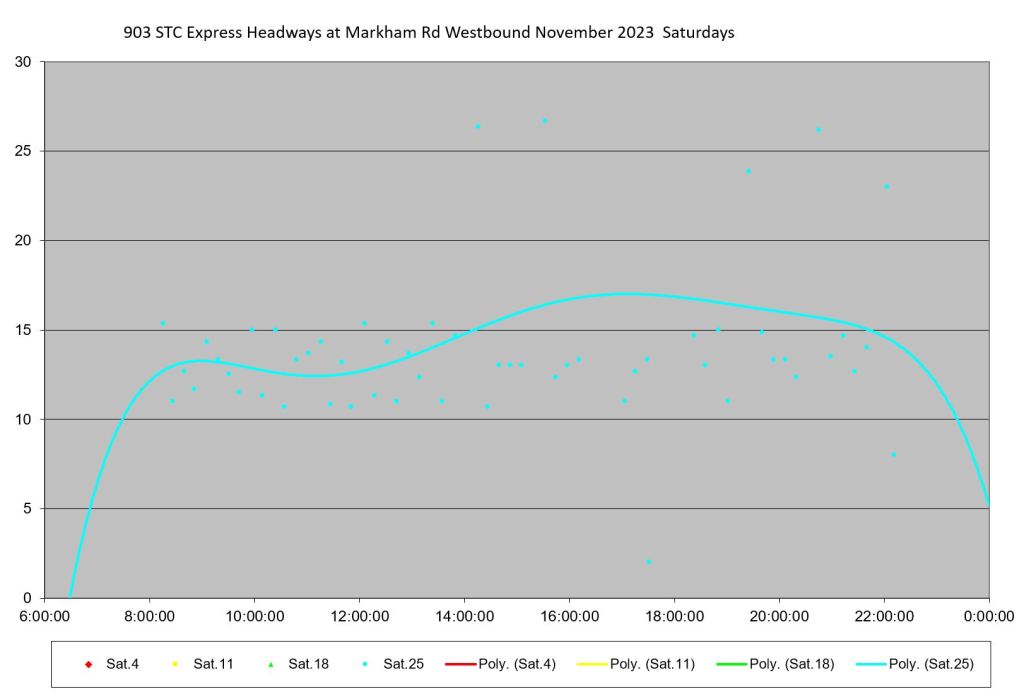
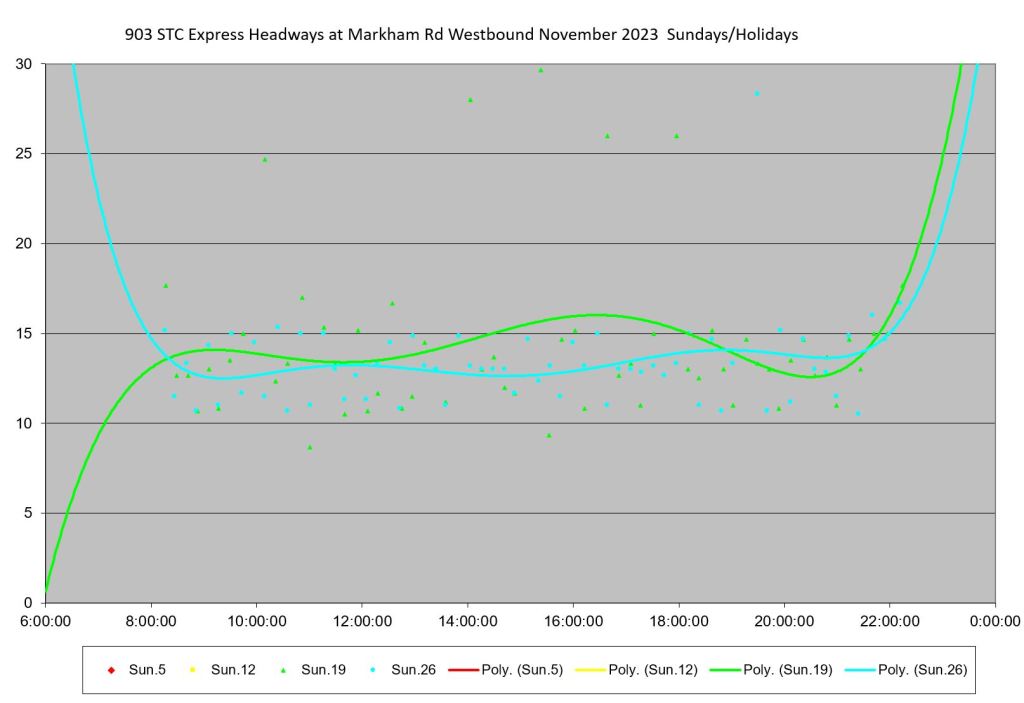
After November 19, the 903 STC Express became more typical of other routes with less frequent service. Variations show up that are similar to other parts of the system. The charts below show headways westbound at Progress and Markham Road, and northbound from Eglinton and Kennedy for the last two weeks of November. The scatter of data points shows the type of service that someone waiting for a 903 bus would experience.

  • Some data are missing on the morning of Friday, November 24.
  • Some of the wider headways (dots higher on the charts) have no correponding short headway (dot near the horizonal axis). This indicates that a bus was missing, as opposed to two buses running close together after a long gap.
  • The weekend charts at the south end of the line include data for the early part of the month when 903 service was much more frequent.
  • Although much of the weekend service stays close to the target headway, there are data points showing wide gaps where a bus was missing from the service. This is a concern for service east of STC to Centennial College.

East End Route Diversion Update

This post consolidates information about the diversions affecting east end bus and streetcar services as a convenience for readers.

Construction projects affecting these routes include:

  • Water main repairs on King between George and Sherbourne. This is a permanent repair for the problem that diverted all service in late October due to a sinkhole.
  • Reconstruction of Broadview Station Loop.
  • Adelaide Street reconstruction for the Ontario Line streetcar diversion.
  • Ontario Line construction at Queen and Yonge.

Routes as of Tuesday, December 5

501D Queen East streetcars run between Neville Loop and Distillery Loop via King west of the Don River. The easiest way to connect with these cars is to take any route headed east out of downtown that goes far enough to make a transfer connection with the 501D. Note that this is tricky at King and Sumach because stops are not well-located for a transfer connection eastbound there.

503 Kingston Road streetcars run between Bingham Loop and (officially) King and Spadina diverting via Queen between the Don River and Church Street. In practice, much of this service turns back via the traditional 503 downtown loop via Church, Wellington and York to King. If you want a 503 eastbound from anywhere west of York, it is best to get on any eastbound service and transfer to the 503 at Bay or Yonge. If you transfer at York, the 503 stops on the SE corner. Note that at Church and King Streets, eastbound 503 streetcars stop on Church just north of King. [Corrected 6:05 pm, Dec 5]

501B Queen buses that run between Bathurst (Wolseley Loop) and Broadview and Gerrard have swapped their route east of Church with the 503 cars. The 501Bs run on King Street, and the 503s run on Queen.

504 King streetcars are all turning back at Church Street looping via Church, Richmond, Victoria and Adelaide because they cannot run east on King.

504/505 King/Dundas shuttles operate from King and Parliament to Broadview and Danforth making on street stops on the NW and SW corners of that intersection. Subway connections are via a walking transfer. These buses continue west across the Viaduct to Castle Frank Station.

Both the 501B and 504/505 buses do not stop eastbound on Queen at Broadview, but instead stop northbound on Broadview beside the parking lot. Westbound buses stop at the usual southbound stop on Broadview at Queen.

504 King shuttles to the Distillery run from a downtown loop of Church, Wellington and York Streets, and they serve the eastbound stops on King at Bay and Yonge Streets, among others. At the Distillery, they are supposed to loop west from Cherry via Mill, Parliament and Front to Cherry. They do not serve Distillery Loop.

508 Lake Shore streetcars normally operate east on King looping via Parliament, Dundas and Broadview. They are diverting via Queen and Church. This is a peak only service.

There is no change to the 505 Dundas streetcars which continue to operate to Woodbine Loop via Gerrard and Coxwell east of Broadview.

Beware of TTC notices posted at stops as they are almost certainly out of date, incomplete or inaccurate thanks to the frequent route changes. There is a particular problem with outdated notices remaining at stops sometimes without a current replacement, or the “new” sign might be found in a different location (pole, transit shelter) than the “old” ones.

King Street water main work is supposed to be completed by the coming weekend, Sunday, December 10, and routes should go back to a somewhat less chaotic arrangement.

Effective Wednesday, December 6

Although Broadview Station Loop is still closed for construction, Broadview Avenue itself is open. Effective December 6, the 62 Mortimer and 8 Broadview bus routes will resume operation on Broadview stopping at Danforth at the NW (southbound) and SE (northbound) corners for subway connections.

These buses will continue south on Broadview to Gerrard, but will run out of service and loop via Gerrard, St. Matthews and Jack Layton Way. Riders making a transfer between these routes and the 504/505 King/Dundas shuttle should note that this does not stop at the same stops as the 8 and 62 buses. Southbound 8/62 riders would get off on the NW corner at Danforth and cross to the SW corner to catch a 504/505. Northbound 504/505 riders would get off on the NW corner (farside) at Danforth and walk back to the SE corner to catch a northbound 8 or 62 bus.

Effective Monday, December 11

For one week, the intersection of Bay and Adelaide will be completely closed to traffic. The TTC has not yet announced diversions for 19 Bay and 501B Queen (eastbound) buses.

Traffic congestion on King will no doubt be even worse during this period.

King Street Travel Times: May-November 2023

This post reviews the evolution of travel times for 504 King streetcars across downtown between Bathurst and Jarvis Streets, the scope of the so-called transit priority zone. There are many problems with how this zone actually operates, but matters reached the meltdown stage in recent months with the combined effect of the Queen Street closure at Yonge for the Ontario Line, the Adelaide Street reconstruction for utilities and an eventual streetcar bypass track for Queen cars, and emergency utility work on King east of Jarvis.

There were other contributors, but there are two important issues. First, everyone assumes that their project won’t bring chaos, often because they only look at local effects for their site (e.g. a new condo construction project with a curb lane occupancy), not for the network as a whole. Second, not only is enforcement of the transit priority rules missing in action, but the added management needed for extra volumes of turning transit vehicles meandering on their temporary routes is also absent.

I recently received the detailed TTC vehicle tracking data for 504 King for November, and have crunched this into a chart that long-time readers will remember from the days when the “King Street Pilot” was in its infancy.

The main set of charts here show travel times for eastbound and westbound streetcars in May through November 2023. Later in the article, there are a few charts to show the historic context for the effects of various changes on King Street over the years.

As in all of these articles about service quality and operations, the data come from the TTC, with much thanks for a long-standing arrangement. The programs to condense the data into manageable charts are all my own, as is the analysis of what they might mean.

Continue reading

Yet Another King Diversion (Updated)

Not long ago, traffic and transit service on King Street were tied in knots thanks to a sinkhole that undermined the track east of Jarvis Street.

Starting Monday, December 4 and running to Sunday, December 10, the diversions are back, albeit in a slightly modified form for water main repairs.

Updated December 4, 2023 at 12:05 pm: The TTC (@TTCNotices on X) advises that there is a hydro cable installation today that runs until 5pm. After that time, the 501D Queen East service will run to Distillery Loop.

Updated December 4, 2023 at 11:20 am: The notice in the “Updates” section of the TTC’s site has been changed to show a December 10 end date. Meanwhile, as of this morning, the 501D Queen East cars are still running to York & Wellington, not to the Distillery Loop as shown on the map below. I suspect this will change as the day wears on and congestion builds up on King Street.

Updated December 3, 2023 at 8:15 pm: In the best TTC tradition there are conflicting notices on their website. Under “Service Changes” this diversion is to end on December 10, but under “Updates” it will only run to December 7. I will attempt to find out which of these is correct, and post an update here.

Apologies for the soft images. This is the condition in which they were published by the TTC on its Service Changes page. Also note that as of December 3, this information is not included on the omnibus Streetcar Service Changes page. Click on any image to open the gallery.

The changes are:

  • 501D Queen East streetcars will only come as far west as Distillery Loop via King.
  • 501B Queen buses which normally run east from downtown via King, Church and Queen to Broadview will instead remain on King Street
  • 503 Kingston Road streetcars will divert from King via Queen between the Don River and Church Street.
  • 504 King streetcars will loop via Church, Richmond, Victoria and Adelaide.
  • 504 King buses will operate from York Street to the Distillery district looping downtown via Church, Wellington and York, and at the Distillery District via Mill, Parliament and Front.
  • 508 Lake Shore streetcars which normally operate on King will divert via Church and Queen to their normal loop at Parliament, Dundas and Broadview.

In other news, Broadview Avenue has opened between Danforth and Pretoria following completion of track and paving work, but transit service has not yet returned to Broadview Station as work on Erindale and in the station is not yet completed. This is expected to change soon, but the TTC has not announced any details.

The intersection of Bay and Adelaide will completely close to traffic between 7am Monday, December 11 and 7am Saturday, December 16 for track installation. Service diversions have not been announced.

There is no word on whether any special effort will be made to unsnarl the intersection of King and Church with the many additional turning transit vehicles. King is already a total mess thanks to the lack of traffic management at University, among other intersections, and the added turns at Church will only compound this. In the following week, with Adelaide completely closed at Bay, traffic on King is likely to be even worse.

TTC 2024 Service Plan Update

The 2024 Service Plan was presented and approved at the November 22, 2023 TTC Board meeting.

Construction Plans for 2024

The presentation includes a chart showing major construction plans in 2024. The overhead projects are for the completion of migration to pantograph-only overhead. (It is hard to believe that they would take Queens Quay and Fleet out of service during the CNE in Q3, but I’m not planning the City’s infrastructure projects.)

The overhead projects raise the question of whether they will actually occur on time. Past work has been scheduled, diversions implemented, and then nothing happened. Riders should not have to put up with disorganized project scheduling.

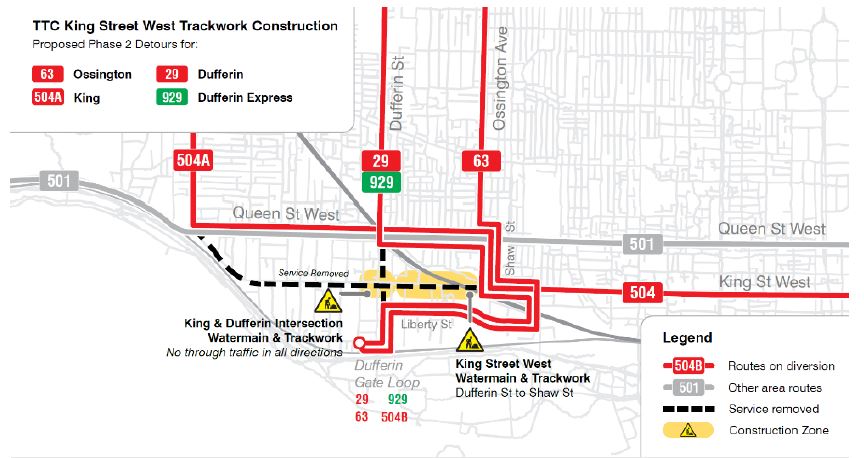
The only major track project (beyond completion of St. Clair West Station and the 501 Queen via Adelaide connection) is on King West from Dufferin to Shaw. In the Service Plan report, one set of diversion routes was shown for the 504 King, 29/929 Dufferin and 63 Ossington routes. This has been revised, and there are now two options under consideration, both different from the one in the report.

Here is the original plan which has two phases with the second being for the duration of the intersection replacement at Dufferin planned for June/July 2024. Note the removal of service on King west of Dufferin in this version.

For phase 1 (mid-February to late June, August to late October) there are two new options which preserve service on King between Dufferin and Roncesvalles by extending 63 Ossington buses west to Sunnyside Loop. In both options, the 504 King service diverts north via Shaw to Queen, but the difference lies in what happens at Dufferin Street.

In option 1 (left below), the 501A Queen cars divert south to Dufferin Loop. Service on Queen west of Dufferin is provided by the 504 King cars with the 504B service running to Humber Loop until late evening. Late evening service through to Long Branch will be provided by the 501C as it is today.

In option 2 (right below), the 501 Queen cars stay on Queen Street, and the 504B diverts south to Dufferin Loop.

508 Lake Shore cars operate via Queen and Shaw in both options.

The 29/929 Dufferin bus service only diverts for the period that the King/Dufferin intersection is closed (not shown here).

The TTC is conducting a survey to determine which of these is preferable to riders.

Their King West project page is here.

Service Reliability

Service reliability will be addressed on various fronts. The phrase “expanding beyond on-time performance and adding emphasis on consistent, well-spaced, and completed service” is very gratifying. If the TTC actually pulls off this change in focus, it should repair many long-standing issues that the simplistic terminal departure metrics completely ignore.

With the change in ridership patterns, there are new periods requiring better service. Even with the system as a whole running at less that 100% of pre-covid ridership, there are routes and time periods that are over 100%. This is compounded by traffic congestion that is, in some places, worse than in 2019.

Budget Directions

The chart below shows two possible futures for TTC service. On the left is at best a stand pat scenario where service is trimmed to reduce the call on City subsidy and savings, if any, might go to reduce deficits, not to support operations. On the right is a scenario for improvement with better funding and service quality.

The 2024 budget will likely appear at the TTC Board in December, but the final choice will be up to Council and, indirectly, to other governments and their support for municipal spending.