This post reviews the evolution of travel times for 504 King streetcars across downtown between Bathurst and Jarvis Streets, the scope of the so-called transit priority zone. There are many problems with how this zone actually operates, but matters reached the meltdown stage in recent months with the combined effect of the Queen Street closure at Yonge for the Ontario Line, the Adelaide Street reconstruction for utilities and an eventual streetcar bypass track for Queen cars, and emergency utility work on King east of Jarvis.
There were other contributors, but there are two important issues. First, everyone assumes that their project won’t bring chaos, often because they only look at local effects for their site (e.g. a new condo construction project with a curb lane occupancy), not for the network as a whole. Second, not only is enforcement of the transit priority rules missing in action, but the added management needed for extra volumes of turning transit vehicles meandering on their temporary routes is also absent.
I recently received the detailed TTC vehicle tracking data for 504 King for November, and have crunched this into a chart that long-time readers will remember from the days when the “King Street Pilot” was in its infancy.
The main set of charts here show travel times for eastbound and westbound streetcars in May through November 2023. Later in the article, there are a few charts to show the historic context for the effects of various changes on King Street over the years.
As in all of these articles about service quality and operations, the data come from the TTC, with much thanks for a long-standing arrangement. The programs to condense the data into manageable charts are all my own, as is the analysis of what they might mean.
Not long ago, traffic and transit service on King Street were tied in knots thanks to a sinkhole that undermined the track east of Jarvis Street.
Starting Monday, December 4 and running to Sunday, December 10, the diversions are back, albeit in a slightly modified form for water main repairs.
Updated December 4, 2023 at 12:05 pm: The TTC (@TTCNotices on X) advises that there is a hydro cable installation today that runs until 5pm. After that time, the 501D Queen East service will run to Distillery Loop.
Updated December 4, 2023 at 11:20 am: The notice in the “Updates” section of the TTC’s site has been changed to show a December 10 end date. Meanwhile, as of this morning, the 501D Queen East cars are still running to York & Wellington, not to the Distillery Loop as shown on the map below. I suspect this will change as the day wears on and congestion builds up on King Street.
Updated December 3, 2023 at 8:15 pm: In the best TTC tradition there are conflicting notices on their website. Under “Service Changes” this diversion is to end on December 10, but under “Updates” it will only run to December 7. I will attempt to find out which of these is correct, and post an update here.
Apologies for the soft images. This is the condition in which they were published by the TTC on its Service Changes page. Also note that as of December 3, this information is not included on the omnibus Streetcar Service Changes page. Click on any image to open the gallery.
The changes are:
501D Queen East streetcars will only come as far west as Distillery Loop via King.
501B Queen buses which normally run east from downtown via King, Church and Queen to Broadview will instead remain on King Street
503 Kingston Road streetcars will divert from King via Queen between the Don River and Church Street.
504 King streetcars will loop via Church, Richmond, Victoria and Adelaide.
504 King buses will operate from York Street to the Distillery district looping downtown via Church, Wellington and York, and at the Distillery District via Mill, Parliament and Front.
508 Lake Shore streetcars which normally operate on King will divert via Church and Queen to their normal loop at Parliament, Dundas and Broadview.
In other news, Broadview Avenue has opened between Danforth and Pretoria following completion of track and paving work, but transit service has not yet returned to Broadview Station as work on Erindale and in the station is not yet completed. This is expected to change soon, but the TTC has not announced any details.
The intersection of Bay and Adelaide will completely close to traffic between 7am Monday, December 11 and 7am Saturday, December 16 for track installation. Service diversions have not been announced.
There is no word on whether any special effort will be made to unsnarl the intersection of King and Church with the many additional turning transit vehicles. King is already a total mess thanks to the lack of traffic management at University, among other intersections, and the added turns at Church will only compound this. In the following week, with Adelaide completely closed at Bay, traffic on King is likely to be even worse.
The presentation includes a chart showing major construction plans in 2024. The overhead projects are for the completion of migration to pantograph-only overhead. (It is hard to believe that they would take Queens Quay and Fleet out of service during the CNE in Q3, but I’m not planning the City’s infrastructure projects.)
The overhead projects raise the question of whether they will actually occur on time. Past work has been scheduled, diversions implemented, and then nothing happened. Riders should not have to put up with disorganized project scheduling.
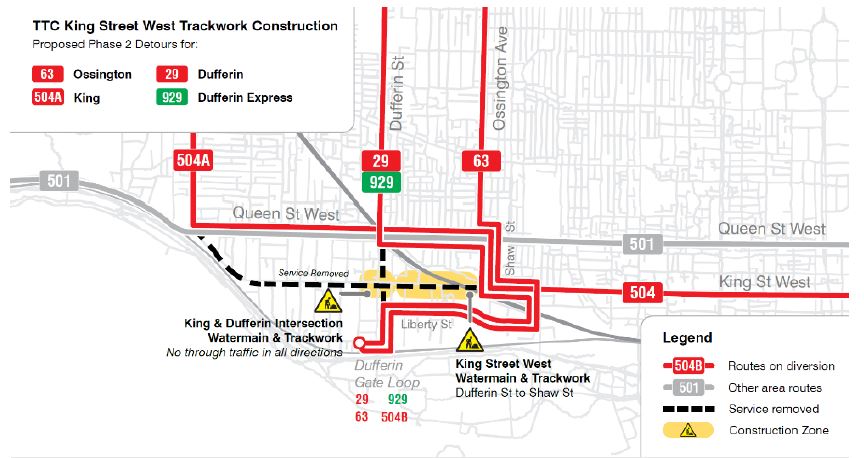
The only major track project (beyond completion of St. Clair West Station and the 501 Queen via Adelaide connection) is on King West from Dufferin to Shaw. In the Service Plan report, one set of diversion routes was shown for the 504 King, 29/929 Dufferin and 63 Ossington routes. This has been revised, and there are now two options under consideration, both different from the one in the report.
Here is the original plan which has two phases with the second being for the duration of the intersection replacement at Dufferin planned for June/July 2024. Note the removal of service on King west of Dufferin in this version.
For phase 1 (mid-February to late June, August to late October) there are two new options which preserve service on King between Dufferin and Roncesvalles by extending 63 Ossington buses west to Sunnyside Loop. In both options, the 504 King service diverts north via Shaw to Queen, but the difference lies in what happens at Dufferin Street.
In option 1 (left below), the 501A Queen cars divert south to Dufferin Loop. Service on Queen west of Dufferin is provided by the 504 King cars with the 504B service running to Humber Loop until late evening. Late evening service through to Long Branch will be provided by the 501C as it is today.
In option 2 (right below), the 501 Queen cars stay on Queen Street, and the 504B diverts south to Dufferin Loop.
508 Lake Shore cars operate via Queen and Shaw in both options.
The 29/929 Dufferin bus service only diverts for the period that the King/Dufferin intersection is closed (not shown here).
The TTC is conducting a survey to determine which of these is preferable to riders.
Service reliability will be addressed on various fronts. The phrase “expanding beyond on-time performance and adding emphasis on consistent, well-spaced, and completed service” is very gratifying. If the TTC actually pulls off this change in focus, it should repair many long-standing issues that the simplistic terminal departure metrics completely ignore.
With the change in ridership patterns, there are new periods requiring better service. Even with the system as a whole running at less that 100% of pre-covid ridership, there are routes and time periods that are over 100%. This is compounded by traffic congestion that is, in some places, worse than in 2019.
Budget Directions
The chart below shows two possible futures for TTC service. On the left is at best a stand pat scenario where service is trimmed to reduce the call on City subsidy and savings, if any, might go to reduce deficits, not to support operations. On the right is a scenario for improvement with better funding and service quality.
The 2024 budget will likely appear at the TTC Board in December, but the final choice will be up to Council and, indirectly, to other governments and their support for municipal spending.
The construction work on Broadview north of Danforth has not run particularly quickly with a few intervals where nothing happened at all for over a week. This appeared to be not the TTC’s problem, but rather the contractor, Sanscon, who simply did not have anyone working on site at times.
As of November 16, they have only now reached the point of excavating the north end of Broadview Station Loop. Both track and concrete are incomplete, albeit progressing, on Broadview and at the loop entrance. Broadview Avenue cannot reopen until this track work has finished and the pavement is restored.
The reopening of the station for bus service is now expected in December (exact date unspecified).
The schedules for “normal” operation at Broadview Station are already in place, but service will operate in an interim configuration pending completion of work at the station.
8 Broadview will operate from Broadview & O’Connor Mortimer to Warden Station. It will no longer interline with 62 Mortimer. [Corrected 6:35 pm, November 16]
62 Mortimer will operate from Broadview & Mortimer to Main Station. It will no longer interline with 8 Broadview.
87 Cosburn will continue operating to Pape Station via Mortimer and Pape.
72 Pape will no longer provide replacement service for Broadview Avenue, but this will be taken over by a 504/505 shuttle. 72A Pape will no longer be interlined with 100 Flemingdon Park.
100 Flemingdon Park will operate from Pape Station independently of 72A Pape.
The 504/505 Broadview shuttle will operate from Castle Frank Station to King & Parliament via Bloor, Danforth, Broadview, Queen and King, and it will use on-street stops at Broadview & Danforth.
304 King Night Bus will operate from Castle Frank Station east to Broadview and then over the 504 King daytime route to Dundas West Station.
322 Coxwell Night Bus will divert to Pape Station.
When Broadview Station Loop reopens, routes 8, 62, 87, 100, 504/505, 304 and 322 will resume their normal routes to that loop.
The TTC has not yet published information about on street stops for the temporary western terminals of 8 Broadview and 62 Mortimer.
Here are two views of construction work at the north end of Broadview Station on November 16.
Looking SW from Erindale to BroadviewLooking S into Broadview Station from Erindale
Streetcar operation to Broadview Station will resume in mid-February 2024 following sewer rehab work by Toronto Water.
This is the final article in a series reviewing the effects of diversions around various construction and road repair project downtown during the month of October 2023, and especially the period from October 18 to 25.
In the third installment, I look at the effect of the route changes and congestion on the quality of service on affected major routes: 501 Queen, 503 Kingston Road and 504 King.
Service was badly disrupted not just downtown, but on other parts of these routes which already suffered from erratic headways (the interval between vehicles) in “normal” TTC operations. A major problem with TTC service quality reporting is that it does not consider the fine-grained detail, and yet that is the level at which riders experience the system.
“Congestion” is something the City talks about in the abstract, but does not really address especially in acknowledging that some roads are full.
There are many detailed charts in this article, more than I would usually publish. They show how the view of data changes as one moves down from broad averages to specifics, and how seriously unreliable service was on routes affected by the sinkhole diversion even without that extra layer of problems.
Equally importantly, these charts show that problems are not occasional, but a chronic feature of TTC operations.
Data here goes only to the end of October, although the effects of the diversion carried over into early November. Even after service returned to “normal”, regular congestion effects remained on parts of King Street showing the underlying issue that was compounded by the diversion and its delays. I will turn to that in early December when I have all of November’s data.
From October 19 until early November, there was a major disruption of transit service downtown due to concurrent construction activities and the complete absence of transit priority or traffic management.
A sinkhole of King east of Jarvis blocked all streetcar service from the afternoon of Wednesday, October 18 to Tuesday, October 24. From October 25 onward, streetcars diverted only weekdays until 7pm.
Construction on Adelaide Street for the Ontario Line 501 Queen eastbound diversion track continued including the relocation of several underground chambers. This work closed York Street northbound at Adelaide.
Construction on Queen Street at Yonge for the Ontario Line closed that street from James to Victoria.
This event showed what can happen when a transit service and the streets it runs on are nearing the point of gridlock, and are pushed over the edge by loss of capacity. It also showed, quite starkly, how Toronto’s talk of managing congestion is much more talk than action.
This is a vital lesson in planning for future diversions and special events.
An important issue here is that some of the congestion problems pre-dated the sinkhole. Moreover, congestion did not occur in the same time at all locations, and some of it did not correspond to traditional ideas of peak periods.
The volume of turning movements overloaded the capacity of the intersections to handle transit, road and pedestrian traffic. A detailed list appears later in the article.
Streetcars and buses stop to serve passengers at many intersections, a fact of life for transit vehicles which behave differently from other traffic. Often two traffic signal phases would be consumed per vehicle: one for it to pull up to the stop, and one for it to make the turn. This limited the throughput of some intersections to fewer cars/hour than the combined scheduled service of the routes.
The electric switch southbound at King and Church was unreliable, and operators had to manually throw it so 501 Queen cars could go straight south to Wellington while other cars turned west on King. On its own, this would be an annoyance, but it compounded other delays.
Only 501 Queen ran on its scheduled route looping south on Church to Wellington, then west to York, north to King and east to Church. During some periods, the congestion was so great that the 501 Queen service was redirected from the Don Bridge westward via King to Distillery Loop. Off-route operation plays havoc with trip prediction apps adding to riders’ woes in finding when and where the service they needed would be.
In this article, I review the vehicle tracking data and travel times over the route from Queen and Parliament, west to Church, south to King and west to Peter (east of Spadina) using the 503 Kingston Road car as the primary subject. This was the only route that travelled the full length of the area during the diversion. Some cars did short turn, but most operated west to Charlotte Loop (King, Spadina, Adelaide, Charlotte) and they give a good representation of travel times experienced by all routes.
In the third and final part of this series, I will review the effect the delays downtown had on service of the three streetcar routes. This type of event has effects far from where it occurs, and these are not always acknowledged. A related problem is the inherent irregularity of TTC service even without a major diversion and congestion added to the mix.
After the break, there are a lot of charts for people who like that sort of thing, but there is also a summary for those who want the highlights.
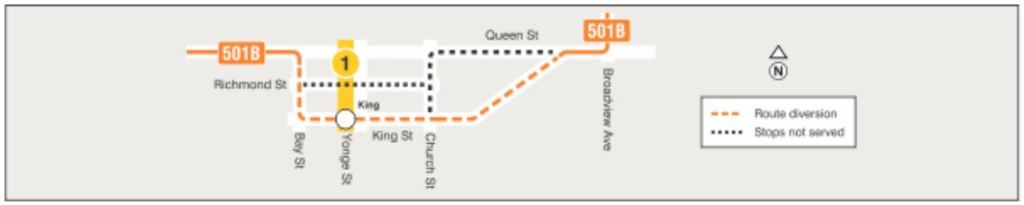
Starting on October 19 mid-afternoon, streetcar service on King Street east of Church was blocked by a sinkhole caused by a broken watermain. Streetcar service was diverted from King to Queen, and the 501B Queen bus was shifted south to King.
The sinkhole repairs completed a few days ago, and effective October 25, the diversions are only in effect until 7pm while water main repairs continue. While this arrangement does improve evening service, it perpetuates the operational problems caused by the total lack of transit signal priority and traffic management at key intersections.
Updated Oct 27 at 11:15pm: The modified routes will not be in operation over the weekend, but will resume on Monday morning, October 30 according to the @ttchelps X account.
A separate problem occurs at the transition back to “normal” service in the evening. The buses revert to normal or run back to the garage, but it takes some time for the congestion to abate and normal streetcar service to resume. This puts a large gap between the two services.
Diversion AnnouncementThis diversion announcement linked below has disappeared from the TTC site. As the TTC updates their info, I will amend this article.
Diversions in Effect Daytimes on 501, 503 and 504 Services
In summary, here are the normal (now evening only) and modified (daytime) routes through the affected area:
501B bus: Bathurst to Broadview/Gerrard
Normal: Via Queen, Bay, King/Richmond (EB/WB), Church to Queen
Diverted: Via Queen, Bay, King to Queen at the Don River (Both ways)
501D streetcar: Neville to York & Wellington
Normal: Via Queen, Church, Wellington/York/King loop
Diverted: No route change, but many Queen cars never get to York street and are short turned further east including to Distillery Loop during the most congested periods.
503 streetcar: Spadina to Bingham
Normal: Via King, Queen, Kingston Rd
Diverted: Via King, Church, Queen, Kingston Rd
504 streetcar:
Normal: From King West to Distillery Loop via King, Sumach and Cherry
Diverted:
Streetcars short turn at Church via Church, Richmond, Victoria, Adelaide, Church
Bus shuttle to Distillery looping downtown via Bay, Adelaide, Yonge to King
This arrangement has extremely severe effects on transit and traffic in general notably at locations where streetcars must turn. There is no Transit Signal Priority (TSP), no Traffic Warden (aka “Agent”), and no attempt to manage the conflicts between turning streetcars, other traffic and high pedestrian volumes at affected intersections. Concurrent work on Adelaide Street diverts traffic to Yonge Street and adds to congestion on streets used for the bus diversion.
Travel times of half an hour and more between Spadina and Church are common.
The situation makes total mockery of the City’s recent Congestion Management Plan by showing how they are utterly unprepared and unwilling to respond to an event that requires major reallocation of road space and time among various types of users, and active management in place of passive acceptance of chaos.
A fundamental part of traffic planning is to determine intersection capacity. This is not rocket science. If there are “N” green phases per hour, and in practice it is only possible for at best one streetcar to turn per cycle, this sets an upper bound on capacity. In fact, one per cycle is amazingly optimistic and could only likely be achieved with both TSP signalling (a “white bar” transit only phase) and a Traffic Agent to ensure the TSP was respected.
Service frequencies on the streetcar routes, and the equivalent cars/hour are:
This translates to the following demands by turning cars/hour:
King/Church
Eastbound left: 35
Southbound right: 25
Queen/Church:
Westbound left: 20
Northbound right: 20
Church/Richmond:
Northbound left: 15
A typical traffic signal cycle time is 80 seconds, or 45 times per hour. It is self-evident that attempting to turn 35 cars/hour would be a challenge. This is compounded by the fact that many cars will stop to serve passengers before turning and will almost certainly lose one cycle for that purpose.
Another source of delay is that the electric switches for turns do not always work requiring operators to manually set their route where some cars turn and others go straight through. This can also affect TSP signals where they do exist because the switch electronics “tell” the signals that a transit phase is needed.
This is a crisis-level example of why TSP should be installed everywhere that streetcars might need it, not just for standard scheduled movements (e.g. eastbound at Queen and Broadview, turns at King & Sumach). It is precisely during events where operations go off kilter that the best possible priority is needed. If the facilities were sitting there, they would benefit occasional diversions and short turns, as well as major service interruptions like this one.
The City’s plan is utterly silent on this need, and that must change. For its part, the TTC must insist on improved TSP for streetcar and bus routes. This is not a panacea, but an important contribution to transit reliability and credibility.
At its meeting on October 25, 2023, Toronto’s Infrastructure and Environment Committee will consider a report about the City’s Congestion Management Plan. I will review that in a separate article, but to set the scene, it is worth looking back at the success and failure of the King Street transit priority pilot.
The original idea was to establish King Street, by far the busiest streetcar corridor downtown with consistently high demand, as a mostly-transit street to speed trips through the core area. A combination of forced right turns, enlarged boarding areas at stops, together with other road changes would make travel by car between Jarvis and Bathurst Streets difficult, if not impossible.
The scheme was quickly watered down thanks to protests from the taxi industry, including carriers like Uber whose vehicles were not branded, and this presented an immediate problem for enforcement. That problem was compounded by the lackluster efforts of Toronto Police who had more important things to do with their time. Occasional blitzes were separated by long periods of laissez-faire non-enforcement.
Despite these limitations, the changes actually did improve travel times, and in particular, the reliability of travel times, over the affected section. Then came the pandemic, and traffic downtown evaporated along with any vestigial efforts to enforce traffic laws. Motorists became used to driving as they pleased, and that has survived into the post-pandemic period along with the unsurprising result that many benefits of the transit priority scheme have been lost.
This article looks back at the actual data for 504 King cars operating through the core to show how travel times have evolved. I have included data going back well beyond the implementation of the King Street transit priority pilot in November 2017. Some of these charts appeared in earlier reviews of King Street, but they are included here for “one stop shopping”.
All data for the analysis here were supplied by the TTC from their CIS and Vision vehicle tracking systems, for which much thanks. The presentation and conclusions are my own.
The weekend of Sept 23-24 saw another shuffle in the streetcar diversion list on which I last reported a few weeks ago. This round of changes is triggered by two events:
Metrolinx work on the Lakeshore East corridor at Queen & Degrassi streets prevents streetcar operation through the underpass, and at times the road will be closed to all traffic.
Toronto Hydro work on Queen West has completed to the point that streetcars are no longer diverting via King Street through Parkdale.
Services now operating on Queen Street include:
501L (aka 507) Queen bus from Long Branch to Dufferin. These buses do not appear on transit apps.
501B Queen bus from Bathurst to Broadview & Gerrard, with downtown diversion around Ontario Line construction.
501 Queen streetcar from Sunnyside Loop to McCaul Loop.
501D (aka 513) Queen bus from Victoria Street (looping via Church, Richmond and Victoria) to Neville Loop. These buses appear on transit apps as 513 Queen East.
503 Kingston Road bus between the Don River and Kingston Road.
During certain periods, the underpass at Degrassi will be closed to all traffic and the 501/503/513 services will divert via Broadview, Dundas and Carlaw.
Complete closures are planned for Sunday, September 24 all day, and from Friday, September 29 at 10pm to Monday, October 2 at 4am.
The 504 King car operates only west of Distillery Loop pending completion of road and track construction on Broadview from Gerrard to Broadview Station Loop. Heavy construction at the loop will begin on Monday, September 25. Paving in the curb lanes on Broadview south of Danforth has begun following completion of track work.
The 72A Pape bus serving King Street East will use the same diversion around Queen & Degrassi as the Queen services, and will not serve stops south of Dundas nor on Queen east of Broadview during periods when the underpass is closed.
The 505 Dundas car no longer serves Queen Street East except between Coxwell and Woodbine Loop. It now operates via Broadview, Gerrard, Coxwell and Queen to Kingston Road.
There is no map of the current route arrangement in the east end on the TTC’s Streetcar Service Changes page, and some maps for 505 Dundas reflect its route before the shift north to Gerrard Street. The 505 Dundas section also still includes a reference to the 506C bus from Castle Frank Station which no longer operates.
The 506 Carlton car is unchanged with normal service except at the west end where cars divert to Dundas West Station due to water main construction on Howard Park Avenue.
Routes 509 Harbourfront, 510 Spadina and 511 Bathurst are operating normally.
Further to my recent post about planned service changes effective September 3, the TTC has issued a revised set of route arrangements thanks to a change in the schedule for Metrolinx work at Queen & Degrassi.
There will be four stages to the service modifications:
Sunday, September 3 to Friday, September 22 at 10 pm
Friday, September 22 at 10 pm to Friday, September 29 at 10 pm
Friday, September 29 at 10pm to Monday, October 2 at 4 am
Monday, October 2 at 4am to Sunday, October 8
October 8 falls on Thanksgiving weekend which is the October TTC schedule change date. Service arrangements beyond that point have not been announced.
The information here is adapted, with corrections, from the TTC’s website Streetcar Service Changes page. As I write this (4:50 pm, August 29), there are several inconsistencies or errors on the TTC’s site. This article is an attempt to consolidate the available information.