How Slow Is My Streetcar: Part I

At its November 2023 meeting, Council passed a motion proposed by Councillor Chris Moise whose ward covers the east side of downtown, and who also sits on the TTC Board:

1. City Council direct the General Manager, Transportation Services, in consultation with the Toronto Transit Commission, the Toronto Police Service, and the City Solicitor to review and report back to the Executive Committee in the second quarter of 2024, including:
a. an update on streetcar performance over the last five years;
b. suggested improvements to the public realm along King Street until the permanent capital project can be delivered; and
c. the feasibility of implementing automated traffic enforcement on the King Street Transit Priority Corridor, including details on what legislative amendments would be required to provincial legislation including, but not limited to, the Ontario Highway Traffic Act.

This article addresses point “a” with a review of streetcar lines over the past five years. It is important to go back to 2019 before the pandemic fundamentally shifted traffic and transit patterns downtown as a point of reference.

From time to time, there are calls to expand a “King Street” redesign to other parts of the network, but there are two “cart before the horse” issues to address first:

  • Figure out how to make King Street operate as it was intended and return at least to its pre-pandemic behaviour, if not better, as a model.
  • Understand how other streets operate including where and when problems for transit performance exist.

An update on transit priority will come to Council in February 2024, although this will look more widely at the city, not just downtown. In previous articles I have reviewed the growing problem of transit travel times as traffic builds on the proposed RapidTO corridors, some of which exceeded pre-pandemic levels some time ago. In future articles I will refresh these analyses with data through to the end of 2023.

An important distinction between most RapidTO bus corridors and the downtown streetcar system is the design of suburban vs downtown streets. In the suburbs, the streets are mostly wide, have relatively few points of access (e.g. driveways) or pedestrian oriented uses (e.g. shops), and travel distances tend to be longer. In the core, streets are narrow, mostly four lanes with no possibility of widening, access points are more frequent, there is a strong pedestrian orientation, and trips tend to be short. Even if buses were running, express operations would be almost impossible and would save very little time on the downtown routes.

There are exceptions such as some older parts of the inner suburbs that bring physical challenges for transit priority, but also the political challenge that the transit share of road use is lower as one moves outward from the core. King Street is a very different place from Steeles, and Dufferin is somewhere in between depending on which section one considers.

An important message in all of this is that “congestion” (put in quotes because it is so often cited as a get-out-of-jail-free excuse for all transit woes) varies from place to place and time to time. Simply putting transit priority everywhere will not solve all problems and could even be overkill (even assuming that it is true “priority” and not a sham to keep transit vehicles out of motorists’ way). It is simple to colour a bunch of key routes end-to-end on a map, but much harder to identify changes that will actually make a difference. Meanwhile, a focus on “priority” could divert attention from badly-needed improvements in headway reliability and more reliable wait times.

This article begins with a comparison of scheduled travel speed on each route, and then turns to actual travel speeds by route segment. In the interest of length, I will leave a discussion of headway reliability to future articles. This is an important component of total travel time, especially for short trips or trip segments.

I have also included tables showing the constant change in route configurations on the four major east-west corridors thanks to a never-ending procession of track and water main work, rapid transit construction, and overhead changes for pantograph operation. Some of this work was accelerated to take advantage of lighter traffic conditions during the pandemic, and some to bring forward work to keep staff employed.

However, the rate of route changes persisted well beyond the heart of the pandemic and threatens the credibility of transit service on major corridors leaving riders constantly wondering where their streetcar or replacement bus might be. Some changes occurred without the planned work actually taking place, or work started and ended later than announced (sometimes much later as in the never-ending KQQR project).

An important change over recent years, separate from the pandemic, has been the move to larger streetcars on wider headways. What might have been a tolerable unevenness in service when streetcars arrived every 4 or 5 minutes simply does not work for scheduled headways of 10 minutes with much wider swings. Bunching when it occurs leaves much bigger gaps between vehicles. A laissez faire attitude to route management, and especially the assumption that routes under construction cannot be managed, has led both to unreliable service and basic questions of how or if the TTC can recover the quality riders expect.

For all the talk of project co-ordination, the last people who seem to count are the riders. Simply studying raw travel times be they scheduled or actual does not capture the frustration, delay and despair from the ever-changing and unreliable services, be they by streetcar or bus.

Continue reading
Downtown Route Changes Effective December 11, 2023 (Updated)

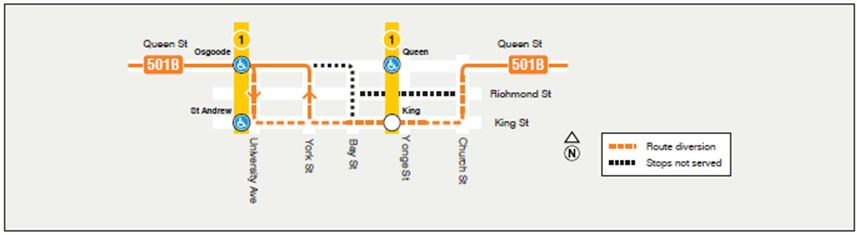
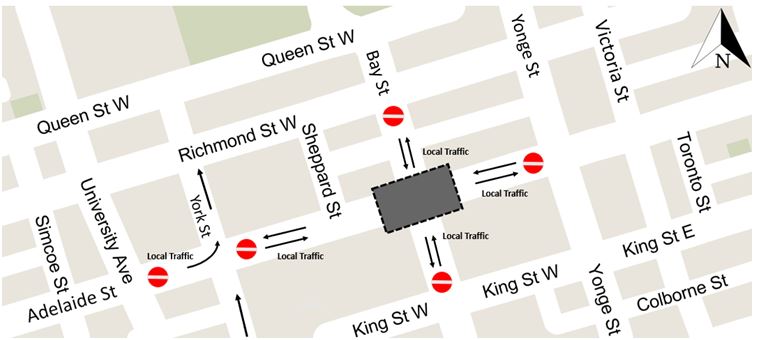
The City of Toronto will completely close the intersection of Bay & Adelaide from 7am Monday, December 11 to 7am on Saturday December 16 to all vehicles. Bay and Adelaide Streets will be open only for local traffic in the immediate area of the closure. This continues the work of (re-)installing streetcar track on Adelaide for the eastbound 501 Queen streetcar diversion around Ontario Line contruction.

Updated: Work at Bay and Adelaide actually completed on the afternoon of Friday, December 15 and the intersection reopened earlier than planned.

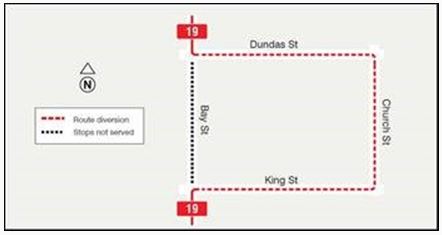
This will require diversion of the 19 Bay and 501B Queen bus routes.

The 19 Bay bus will divert via Dundas, Church and King both ways.

The 501B Queen bus which normally operates on Bay from King to Queen will use York Street for north/westbound trips and University Avenue for south/eastbound trips. Buses will operate both ways via King Street, and there will be no westbound service on Richmond Street

[Apologies for the soft images. They are from a City construction notice, and I used what is available.]

End of the King East Diversions

As the map for 501B Queen above shows, service is supposed to resume the normal routes east of Church with the completion of water main and Hydro work on the coming weekend which has a December 10 end date. This means that:

  • 501B Queen buses return to Queen Street east of Church
  • 503 Kingston Road streetcars return to King Street between the Don River and Church
  • 504 King streetcar service to Distillery Loop resumes

Updated December 11, 2023 at 4:15 pm

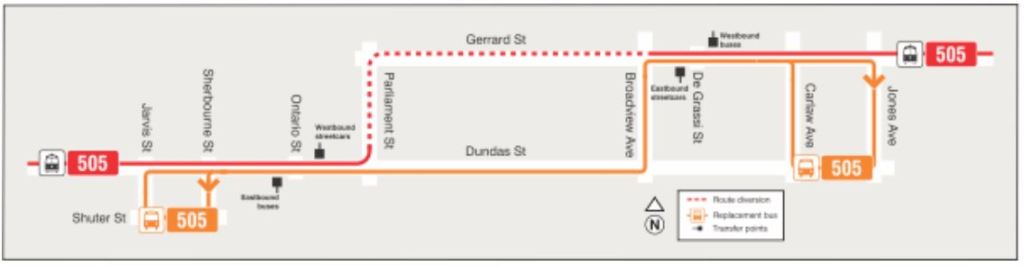
Another diversion has been added to the list. The 505 Dundas cars will divert both ways via Parliament and Gerrard. A 505 shuttle bus will run from Jarvis to Jones.

This diversion is required for track repairs, and will last until Thursday, December 21, 2023.

Updated: This diversion ended on Tuesday, December 19.

Broadview Station Reopening Delayed

The construction work on Broadview north of Danforth has not run particularly quickly with a few intervals where nothing happened at all for over a week. This appeared to be not the TTC’s problem, but rather the contractor, Sanscon, who simply did not have anyone working on site at times.

As of November 16, they have only now reached the point of excavating the north end of Broadview Station Loop. Both track and concrete are incomplete, albeit progressing, on Broadview and at the loop entrance. Broadview Avenue cannot reopen until this track work has finished and the pavement is restored.

The reopening of the station for bus service is now expected in December (exact date unspecified).

The schedules for “normal” operation at Broadview Station are already in place, but service will operate in an interim configuration pending completion of work at the station.

  • 8 Broadview will operate from Broadview & O’Connor Mortimer to Warden Station. It will no longer interline with 62 Mortimer. [Corrected 6:35 pm, November 16]
  • 62 Mortimer will operate from Broadview & Mortimer to Main Station. It will no longer interline with 8 Broadview.
  • 87 Cosburn will continue operating to Pape Station via Mortimer and Pape.
  • 72 Pape will no longer provide replacement service for Broadview Avenue, but this will be taken over by a 504/505 shuttle. 72A Pape will no longer be interlined with 100 Flemingdon Park.
  • 100 Flemingdon Park will operate from Pape Station independently of 72A Pape.
  • The 504/505 Broadview shuttle will operate from Castle Frank Station to King & Parliament via Bloor, Danforth, Broadview, Queen and King, and it will use on-street stops at Broadview & Danforth.
  • 304 King Night Bus will operate from Castle Frank Station east to Broadview and then over the 504 King daytime route to Dundas West Station.
  • 322 Coxwell Night Bus will divert to Pape Station.

When Broadview Station Loop reopens, routes 8, 62, 87, 100, 504/505, 304 and 322 will resume their normal routes to that loop.

The TTC has not yet published information about on street stops for the temporary western terminals of 8 Broadview and 62 Mortimer.

Here are two views of construction work at the north end of Broadview Station on November 16.

Streetcar operation to Broadview Station will resume in mid-February 2024 following sewer rehab work by Toronto Water.

Streetcar Diversion Update, Sept. 24, 2023

The weekend of Sept 23-24 saw another shuffle in the streetcar diversion list on which I last reported a few weeks ago. This round of changes is triggered by two events:

  • Metrolinx work on the Lakeshore East corridor at Queen & Degrassi streets prevents streetcar operation through the underpass, and at times the road will be closed to all traffic.
  • Toronto Hydro work on Queen West has completed to the point that streetcars are no longer diverting via King Street through Parkdale.

Services now operating on Queen Street include:

  • 501L (aka 507) Queen bus from Long Branch to Dufferin. These buses do not appear on transit apps.
  • 501B Queen bus from Bathurst to Broadview & Gerrard, with downtown diversion around Ontario Line construction.
  • 501 Queen streetcar from Sunnyside Loop to McCaul Loop.
  • 501D (aka 513) Queen bus from Victoria Street (looping via Church, Richmond and Victoria) to Neville Loop. These buses appear on transit apps as 513 Queen East.
  • 503 Kingston Road bus between the Don River and Kingston Road.

During certain periods, the underpass at Degrassi will be closed to all traffic and the 501/503/513 services will divert via Broadview, Dundas and Carlaw.

Complete closures are planned for Sunday, September 24 all day, and from Friday, September 29 at 10pm to Monday, October 2 at 4am.

The 504 King car operates only west of Distillery Loop pending completion of road and track construction on Broadview from Gerrard to Broadview Station Loop. Heavy construction at the loop will begin on Monday, September 25. Paving in the curb lanes on Broadview south of Danforth has begun following completion of track work.

The 72A Pape bus serving King Street East will use the same diversion around Queen & Degrassi as the Queen services, and will not serve stops south of Dundas nor on Queen east of Broadview during periods when the underpass is closed.

The 505 Dundas car no longer serves Queen Street East except between Coxwell and Woodbine Loop. It now operates via Broadview, Gerrard, Coxwell and Queen to Kingston Road.

There is no map of the current route arrangement in the east end on the TTC’s Streetcar Service Changes page, and some maps for 505 Dundas reflect its route before the shift north to Gerrard Street. The 505 Dundas section also still includes a reference to the 506C bus from Castle Frank Station which no longer operates.

The 506 Carlton car is unchanged with normal service except at the west end where cars divert to Dundas West Station due to water main construction on Howard Park Avenue.

Routes 509 Harbourfront, 510 Spadina and 511 Bathurst are operating normally.

Route 512 St. Clair will remain a bus operation until summer 2024 for various construction projects.

Yet Another Change to East End Streetcar Services

Further to my recent post about planned service changes effective September 3, the TTC has issued a revised set of route arrangements thanks to a change in the schedule for Metrolinx work at Queen & Degrassi.

There will be four stages to the service modifications:

  • Sunday, September 3 to Friday, September 22 at 10 pm
  • Friday, September 22 at 10 pm to Friday, September 29 at 10 pm
  • Friday, September 29 at 10pm to Monday, October 2 at 4 am
  • Monday, October 2 at 4am to Sunday, October 8

October 8 falls on Thanksgiving weekend which is the October TTC schedule change date. Service arrangements beyond that point have not been announced.

The information here is adapted, with corrections, from the TTC’s website Streetcar Service Changes page. As I write this (4:50 pm, August 29), there are several inconsistencies or errors on the TTC’s site. This article is an attempt to consolidate the available information.

Continue reading

TTC Service Changes Effective Sunday, September 3, 2023 (Preliminary)

This is a preliminary version based on GTFS data (the standard format for transit schedules used by online services) and some Service Advisories on the TTC site. I expect to receive the full list of September service changes early in the week of August 28 and will update this article accordingly including the usual detailed comparison of service levels.

Updated August 26 at 9:15 pm: 512 St. Clair updated to reflect complete bus replacement for work at various locations on the line.

Updated August 27 at 4:30 pm: At 10:30 am on August 28, the Mayor, TTC Chair and CEO will hold a press conference at STC Station to “outline how the TTC will increase service beginning September and into the fall.”

Updated August 29 at 5:30 pm: Due to changes in the Metrolinx schedule for work on the Lake Shore East Queen Street bridge, there has been a further revision of planned service. Please see this post for details.

Continue reading

Short Turns and Wait Times on Streetcar Routes

At the TTC Board meeting on July 12, 2023, there was a brief discussion of the problem of short turns on streetcar lines. The information provided by management was, shall we say, less than a full accounting of what is actually going on.

This issue flared up many years ago particularly with short turns of service in The Beach among other areas, and in general a problem with erratic, gap-filled service on the outer ends of routes. TTC management committed to reducing or eliminating this problem, and to that end there was a “no short turns” policy that everybody seemed to know about at the operational level, but which was officially denied.

The stats did go down, but looking under the covers showed that not all was well:

  • Short turns are a bona fide service management tactic for dealing with delays to restore even spacing of service. There is nothing wrong with a short turn of some cars in a parade because this will restore service sooner than if every car trundles to the terminal and they return in a pack.
  • The official count of short turns fell to almost zero. However, this was due in part to selective reporting that was clear to (a) anyone actually riding the system and (b) anyone looking at vehicle tracking data.

Rick Leary got the equivalent of a gold star from the Board who frankly did not know any better, but occasionally wondered why claims of improved service did not align with complaints from constituents. The standard excuses for occasional upsets due to congestion and construction were regularly trotted out even though service could be erratic at times and locations when these were clearly impossible.

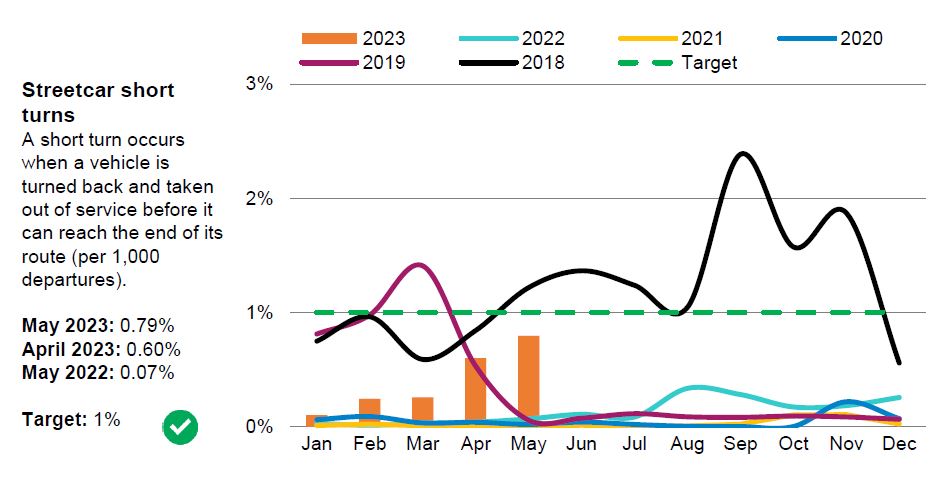
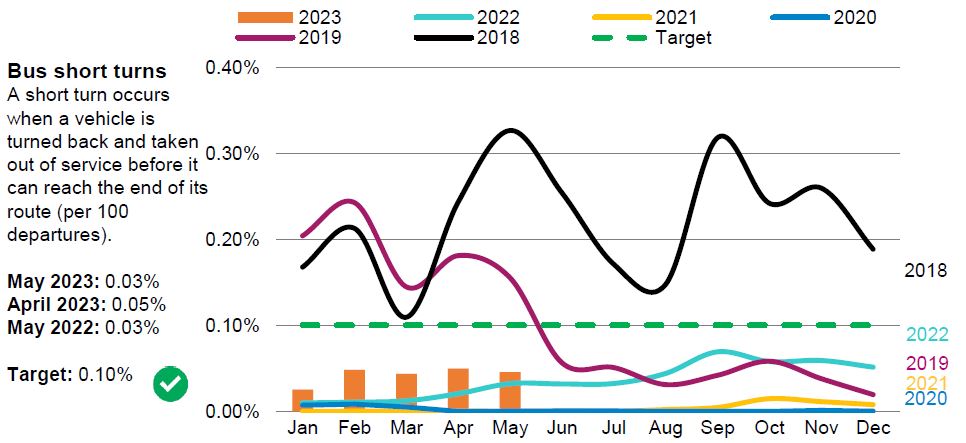
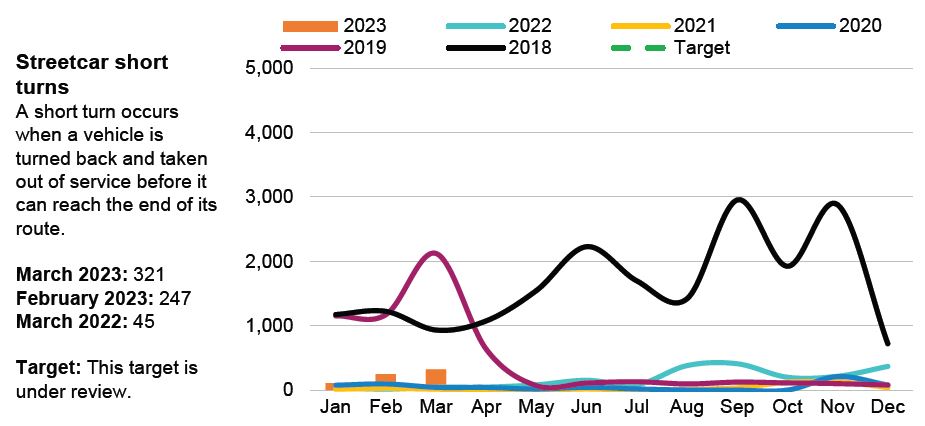
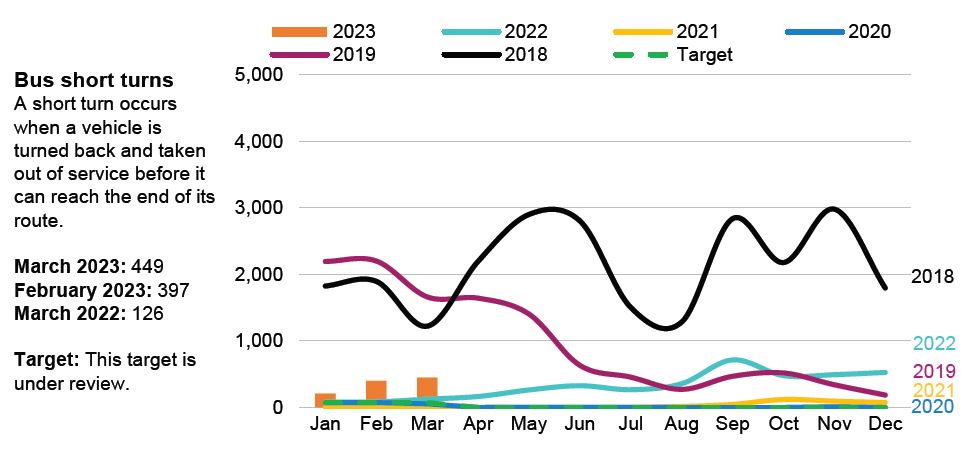
The charts below from the July 2023 CEO’s Report show the official count of short turns on the streetcar and bus network. An important factor in comparing the two is that the buses overall have many routes where congestion and construction do not affect most, if any, trips. The figures are not broken out by route to flag the “bad actors”. Moreover, the values are presented as a percentage of all trips so that time-of-day effects are hidden.

The “no short turns” policy implementation is quite clear in the data from Fall 2018 through Spring 2019. In reviewing actual short turn counts from tracking data, I have found that the values are consistently under-reported, and they do not represent actual conditions. For example, the proportion of service outbound on 501 Queen from downtown (as counted at Woodbine vs Greenwood) reaching Neville Park ranges from 100% to below 50% in January to June 2023.

Updated July 15, 2023: In June 2023, the TTC changed its reporting of short turns from an absolute number to a percentage. The scale of these charts does not make sense because the streetcar chart claims it is per 1000 departures, but cites a percentage (per 100). For comparison, the May 2023 charts are below.

I have written many times on this site about service quality and there are many factors at play including:

  • Unreasonably short or long scheduled travel times. This may sound like an odd pairing, but both can produce erratic service.
    • Too short times lead to short turns to keep operators on time especially for crew changes.
    • Too long times lead to extended layovers at terminals.
  • Lack of headway discipline at terminals and along routes.
  • Lack of headway management for vehicles re-entering service from a short turn to “split” a gap rather than simply running behind a through vehicle and carrying few passengers.

There are, of course, ad hoc situations where accidents, short-term construction or special events produce conditions that are not “standard”. These are normal and have to be managed to the degree possible. One side effect of the overall reduction in service on streetcar lines to a 10 minute level on many routes is that there is no spare capacity when delays occur, and wider headways make the effect on riders of any missing vehicle (either not in service or short-turned) greater.

This is not the first time the system encountered that problem, and tuning out surplus capacity has been a generic issue across the network any time budget “efficiency” takes precedence over service. The phrase “adjusting service to meet demand” goes back over four decades.

Service standards that allow for some empty space on vehicles are important because they guarantee some flexibility to absorb small problems without service collapsing. An analogy for motorists is that a highway totally jammed with cars does not move traffic at all well, and some empty space is necessary to ensure the road is usable. On transit, empty space is viewed as waste while on our roads no congestion is a holy grail.

The remainder of this article reviews the short-turning situation on most streetcar routes and the underlying causes.

Continue reading

Service Analysis of the 505 Dundas/Bingham Diversion (Part I)

On May 7, 2023, the eastern terminus of 505 Dundas shifted from Broadview Station to Bingham Loop due to sewer work, track construction and road paving on Broadview north of Gerrard. This will continue into at least the late Fall 2023.

This operation was not a success by any measure with extremely erratic service on Kingston Road where the 505 replaced the 22 Coxwell bus and the 503 Kingston Road streetcar. Service on the main part of 505 Dundas from Broadview to Dundas West Station has also become less reliable.

July 4, 2023, service changes (505 Dundas was cut back to Woodbine Loop and 503 Kingston Road buses (running as unscheduled extras) provided service to Bingham until 8pm to correct this problem, but riders endured almost two months of bad service. This affected not just Kingston Road but the entire 505 Dundas route.

This article reviews service during the May-June 2023 period when 505 Dundas cars ran to Bingham with comparisons to the “before” conditions on routes 505, 503 and 22. It is a long article with many charts for those who are interested in the details of how this service has behaved over the past six months. In Part II I will turn to reviews of operations on a sample of days in May-June.

In brief, the May schedules unwound improvements made in February that adjusted travel times to better match conditions. Moreover, Februrary saw major service cuts to the 505 Dundas route which compounded with less reliable service to make for much wider gaps between cars. In many ways, this was an “own goal” by the TTC.

Continue reading

Where Is My Diversion Notice (July 2/23 Edition) (Update 2)

Oh the irony! The TTC’s Annual Service Plan consultations are all about how to handle a few (but not all) of the construction projects coming in 2024, but the elephant in the room remains bad communications and changes on the fly.

The new routes implemented in May and June 2023 were in cases impractical thanks to a combination of unduly optimistic running times in schedules, less than adequate transit priority and line management whose priority was not the provision of well-spaced, reliable service. Several changes will take effect on July 4 and 5 to correct some of these problems, but the information is scattered through the TTC’s website, if you can find it at all.

First, a summary of the changes:

  • The 501/504 shuttle bus (an ad hoc service implemented to cover for the absence of the 503 Kingston Road car to King Street downtown) will be rebranded as “503” and will serve Kingston Road to Bingham Loop until 8pm every day. This will become a scheduled bus service at the end of July, and will revert to 503 streetcars likely in October.
  • The 505 Dundas car will only operate east on Queen from Broadview to Woodbine Loop, except after 8pm when service to Bingham will be provided by streetcars.
  • The 506 Carlton car will only operate to Queen and Broadview and will return west to route via Queen and Parliament Streets without running east to Woodbine Loop.
  • The 512 St. Clair car will be restored, temporarily, west of Lansdowne to Gunns Loop. While it lasts, this will correct for the erratic service now provided there by the 47 Lansdowne extension.

The challenge is to find out that this is happening to your route. The TTC website is very poorly organized with information in many places that is inconsistently placed and linked (or not) to the main route pages affected. Some items are out of date, but remain in place to confuse riders. Some items describe major changes but are hard to find if you don’t know the site in detail.

These are the hallmarks of a site maintained by many groups each with its own (probably jealously guarded) responsibility for providing information. Nobody appears to care about overall site consistency and ease of navigation, or if they do, are in any position to change what is a clearly broken process. Some information is just plain wrong indicating that whoever created or updated the page was either sloppy, or does no know what is actually happening.

Updated July 4, 2023 at 7:10am: Changes to the TTC website since this article was posted are noted in various places below.

Updated July 5, 2023 at 4:30pm: Changes to the TTC website since the July 4 update are noted throughout the article.

Continue reading