
On May 7, 2023, the eastern terminus of 505 Dundas shifted from Broadview Station to Bingham Loop due to sewer work, track construction and road paving on Broadview north of Gerrard. This will continue into at least the late Fall 2023.
This operation was not a success by any measure with extremely erratic service on Kingston Road where the 505 replaced the 22 Coxwell bus and the 503 Kingston Road streetcar. Service on the main part of 505 Dundas from Broadview to Dundas West Station has also become less reliable.
July 4, 2023, service changes (505 Dundas was cut back to Woodbine Loop and 503 Kingston Road buses (running as unscheduled extras) provided service to Bingham until 8pm to correct this problem, but riders endured almost two months of bad service. This affected not just Kingston Road but the entire 505 Dundas route.
This article reviews service during the May-June 2023 period when 505 Dundas cars ran to Bingham with comparisons to the “before” conditions on routes 505, 503 and 22. It is a long article with many charts for those who are interested in the details of how this service has behaved over the past six months. In Part II I will turn to reviews of operations on a sample of days in May-June.
In brief, the May schedules unwound improvements made in February that adjusted travel times to better match conditions. Moreover, Februrary saw major service cuts to the 505 Dundas route which compounded with less reliable service to make for much wider gaps between cars. In many ways, this was an “own goal” by the TTC.
A Core Problem: Inadequate Scheduled Trip Times
Although the service was supposed to operate to Bingham, many 505 cars short turned at Woodbine Loop causing large gaps, sometimes over an hour, on Kingston Road. This behaviour can be traced directly to schedules which did not provide enough time for cars to make their full trip.
The ratio of round trip mileages for the standard and diverted routes is 1.44:1. In other words, the route to Bingham is 44% longer than the route to Broadview Station. Other complications included:
- Although the City made much of plans to limit traffic disruption on the central part of Dundas, they ignored outlying portions of the diversion shared by Dundas, Queen and Carlton cars. These three routes all operated in a common segment on Broadview from Dundas to Queen with every car scheduled to make left turns north-to-west at Dundas and south-to-east at Queen. Advanced green arrows to assist streetcars in making these turns were not installed and active until late May.
- While this diversion began, the Queen/Don River bridge was closed to streetcar traffic for repairs. When it reopened in late May, Carlton cars had the option of running westbound via Queen and Parliament to their route at Gerrard rather than via Broadview, Dundas and Parliament. This reduced the volume of left turning streetcars and, together with traffic wardens who sometimes appeared at Dundas/Broadview, contributed to fewer backlogs of traffic between Dundas and Queen Streets.
- Early works began on the bridge at Queen & Degrassi where Metrolinx will raise and widen the GO corridor as part of the Ontario Line construction. This constrained Queen Street three months before the bridge project was scheduled to begin according to overall traffic plans.
- Kingston Road has well-known locations of traffic congestion due to traffic volume and queues for turns unlike the normal eastern leg of 505 Dundas to Broadview Station.
If anything, these conditions should have justified disproportionate increases in times on the diversion, but as the table below shows the actual ratios for the standard vs diverted routes range from 1.25 to 1.38 including recovery time. This means that streetcars has less scheduled driving and recovery time relative to the route length for the Bingham service than for the standard route to Broadview Station. The shortfall comes mainly from reduction in recovery time which saves one car for the extended route during most periods.
The scheduled driving and recovery times were adjusted in February generally making them longer in response to conditions on the route. The benefit of these changes was reversed with the Bingham schedules in May.
| Broadview Stn Service Jan-Feb | Broadview Stn Service Feb-May | Bingham Loop Service May-June | Driving Time Ratio May:Feb | Trip Time Ratio May:Feb | |
| Round Trip Distance (km) | 21.71 | 31.21 | 1.44 | ||
| Driving Time + Recovery (mins) | |||||
| Weekdays | |||||
| AM Peak | 122+8 | 120+10 | 166+4 | 1.38 | 1.31 |
| Midday | 122+13 | 127+13 | 176+4 | 1.39 | 1.29 |
| PM Peak | 132+8 | 138+12 | 192+8 | 1.39 | 1.33 |
| Early Evening | 108+11 | 119+11 | 165+5 | 1.39 | 1.31 |
| Late Evening | 94+13 | 106+14 | 147+3 | 1.39 | 1.25 |
| Saturdays | |||||
| Early Morning | 95+15 | 96+14 | 133+7 | 1.39 | 1.27 |
| Late Morning | 110+14 | 114+16 | 158+2 | 1.39 | 1.33 |
| Afternoon | 126+11 | 128+12 | 177+3 | 1.38 | 1.38 |
| Early Evening | 113+6 | 125+5 | 172+8 | 1.38 | 1.38 |
| Late Evening | 99+11 | 111+9 | 154+6 | 1.39 | 1.33 |
| Sundays | |||||
| Early Morning | 84+16 | 97+13 | 133+7 | 1.37 | 1.27 |
| Late Morning | 101+11 | 111+9 | 158+2 | 1.42 | 1.33 |
| Afternoon | 113+9 | 125+15 | 173+7 | 1.38 | 1.29 |
| Early Evening | 94+11 | 117+13 | 162+8 | 1.38 | 1.31 |
| Late Evening | 84+16 | 103+7 | 143+7 | 1.39 | 1.36 |
At the same time that trip times were improved in February, service on the 505 Dundas car was substantially reduced.
| Jan-Feb Headways | Feb-June Headways | |
| Weekdays | ||
| AM Peak | 8’40” | 10′ |
| Midday | 9′ | 10′ |
| PM Peak | 7’45” | 10′ |
| Early Evening | 8’30” | 10′ |
| Late Evening | 9’45” | 10′ |
| Saturdays | ||
| Early Morning | 10′ | 10′ |
| Late Morning | 7’45” | 10′ |
| Afternoon | 6’30” | 10′ |
| Early Evening | 8’30” | 10′ |
| Late Evening | 10′ | 10′ |
| Sundays | ||
| Early Morning | 10′ | 10′ |
| Late Morning | 8′ | 10′ |
| Afternoon | 7’11” | 10′ |
| Early Evening | 9’30” | 10′ |
| Late Evening | 10′ | 10′ |
At the end of July, the diversion will switch from Queen to Gerrard Street because Metrolinx will be working on the underpass at Queen & Degrassi Streets. Whether left turn priority signals will be added westbound on Gerrard at Broadview, northbound on Coxwell at Gerrard and southbound on Coxwell at Queen remains to be seen.
Scheduled Service on Kingston Road
Service at Bingham Loop in 2023 was scheduled every ten minutes during almost all periods before and after the change in route design.
| 22A Coxwell | 503 Kingston Rd | 505 Dundas | |
| Weekdays | Until May 6/23 | Until May 6/23 | From May 7/23 |
| AM Peak | 8′ | 10′ | |
| MF Midday | 10′ | 10′ | |
| PM Peak | 8′ | 10′ | |
| Evening | 10′ | 10′ | |
| Saturday | |||
| Early Morn | 10′ | 10′ | |
| Late Morn | 9′ | 10′ | |
| Afternoon | 9’30” | 10′ | |
| Evening | 10′ | 10′ | |
| Sunday | |||
| All Day | 10′ | 10′ |
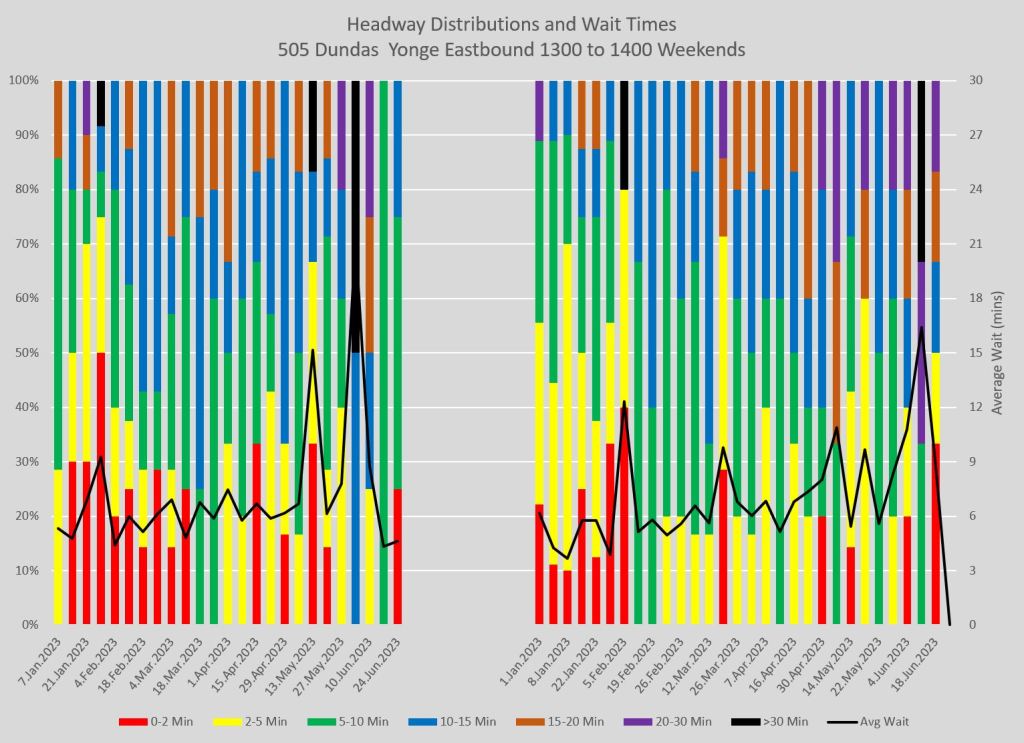
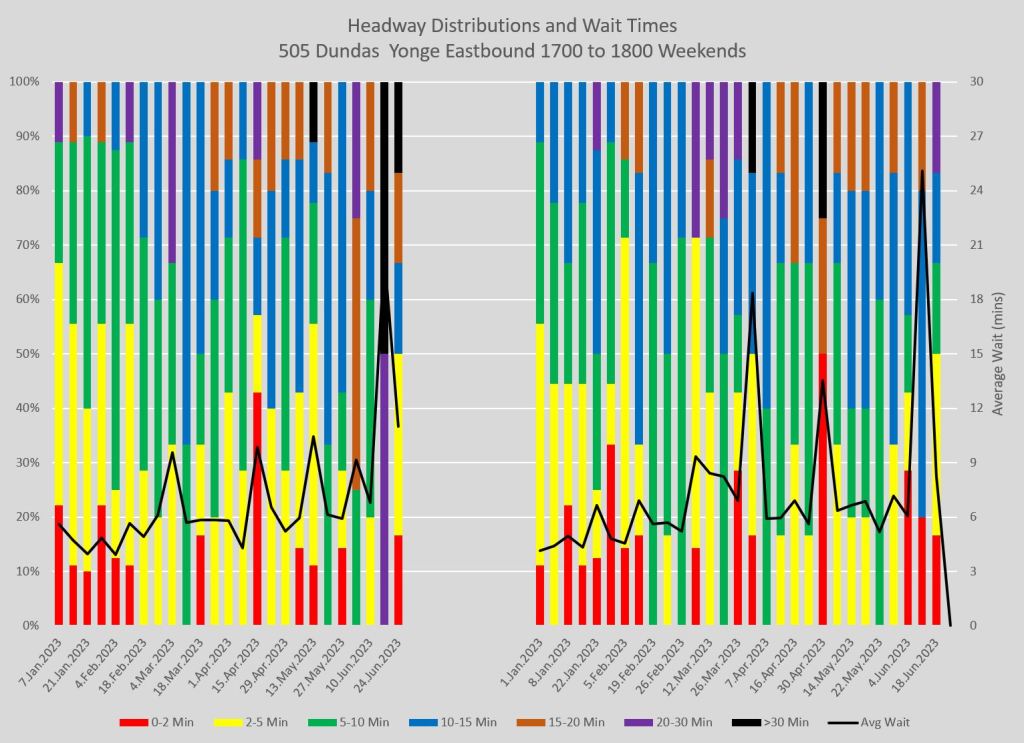
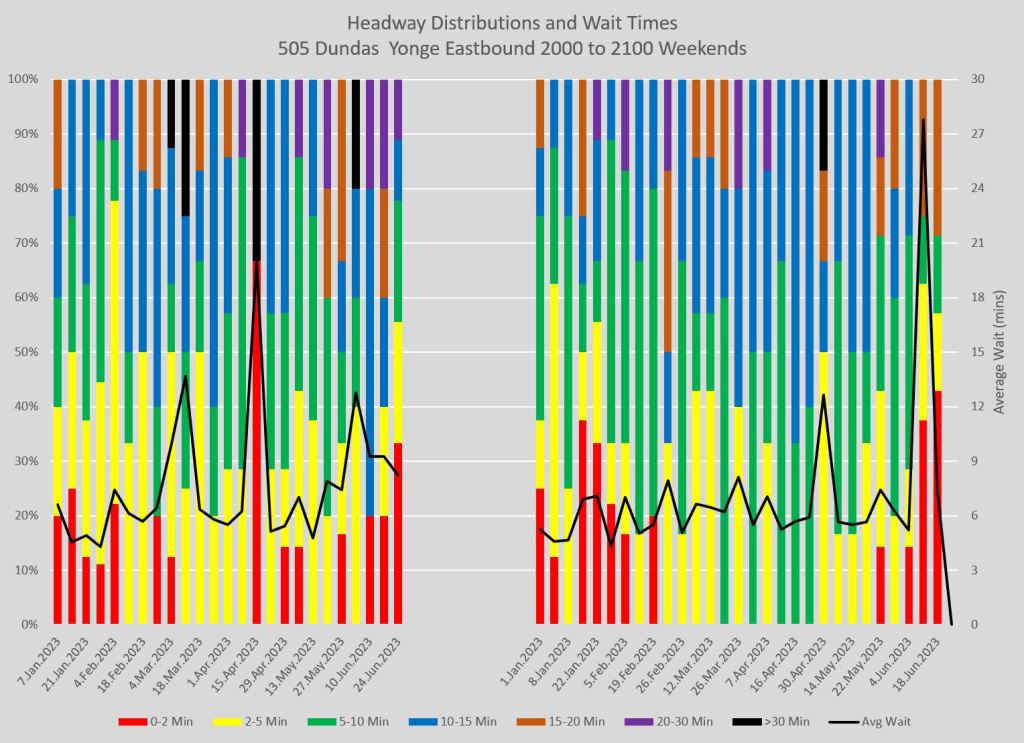
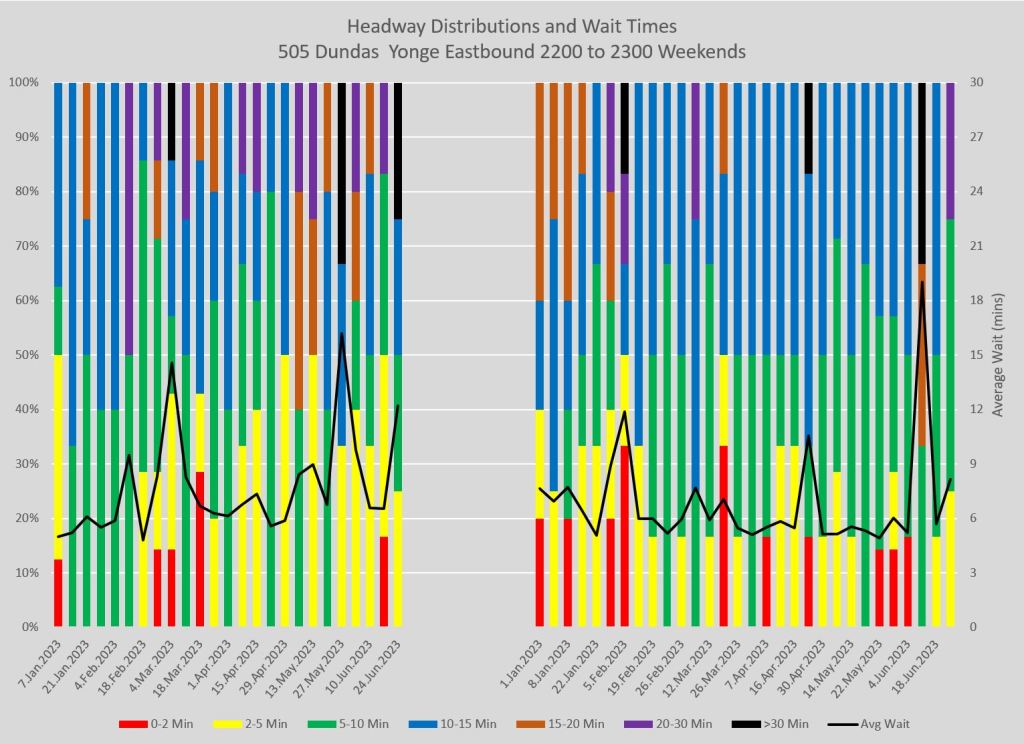
Chart Format
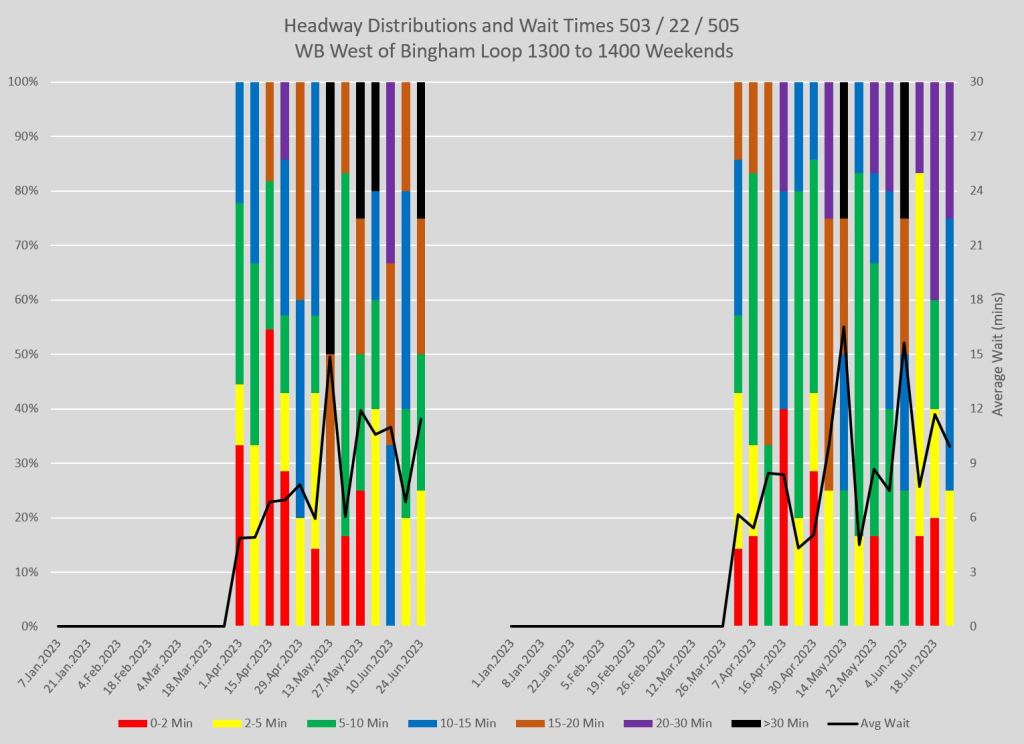
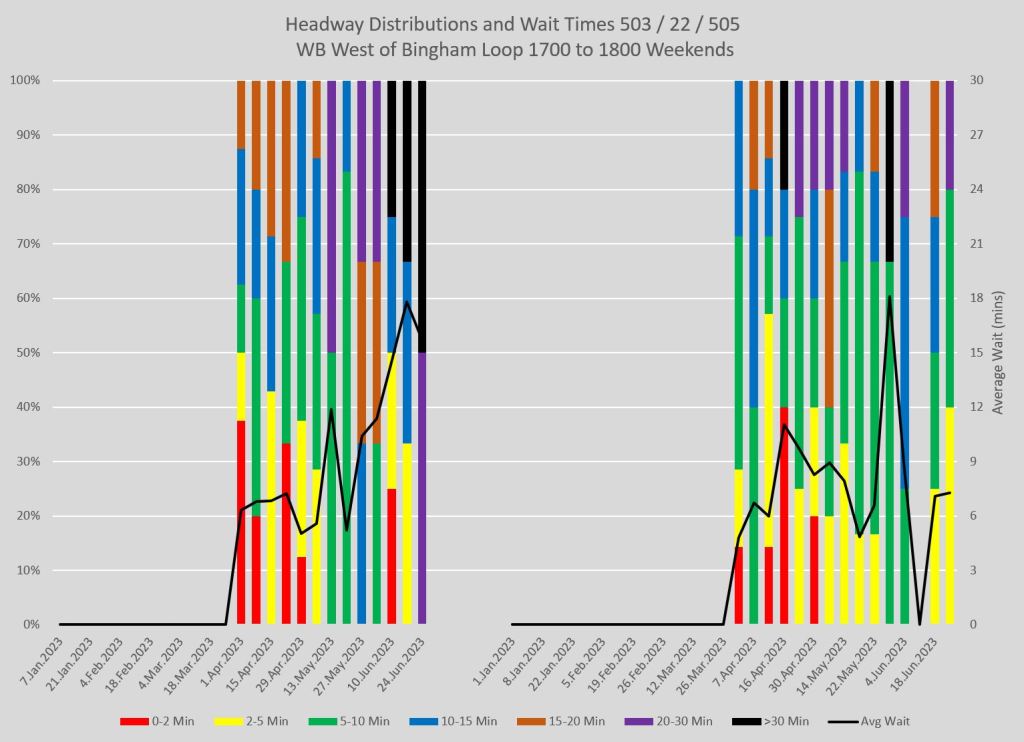
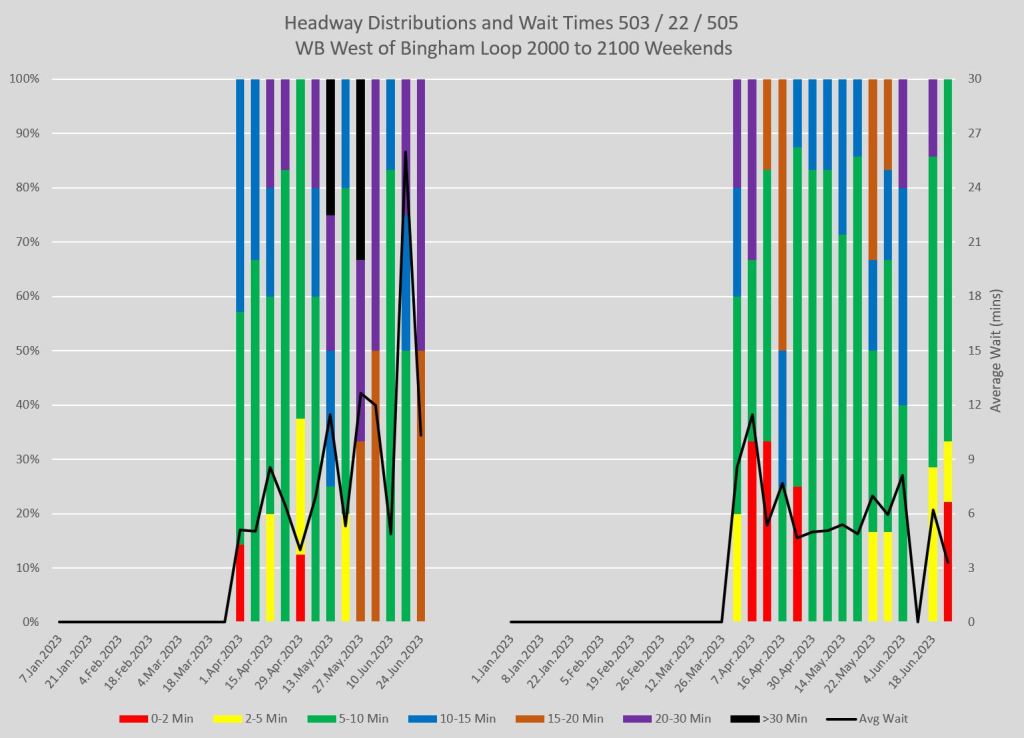
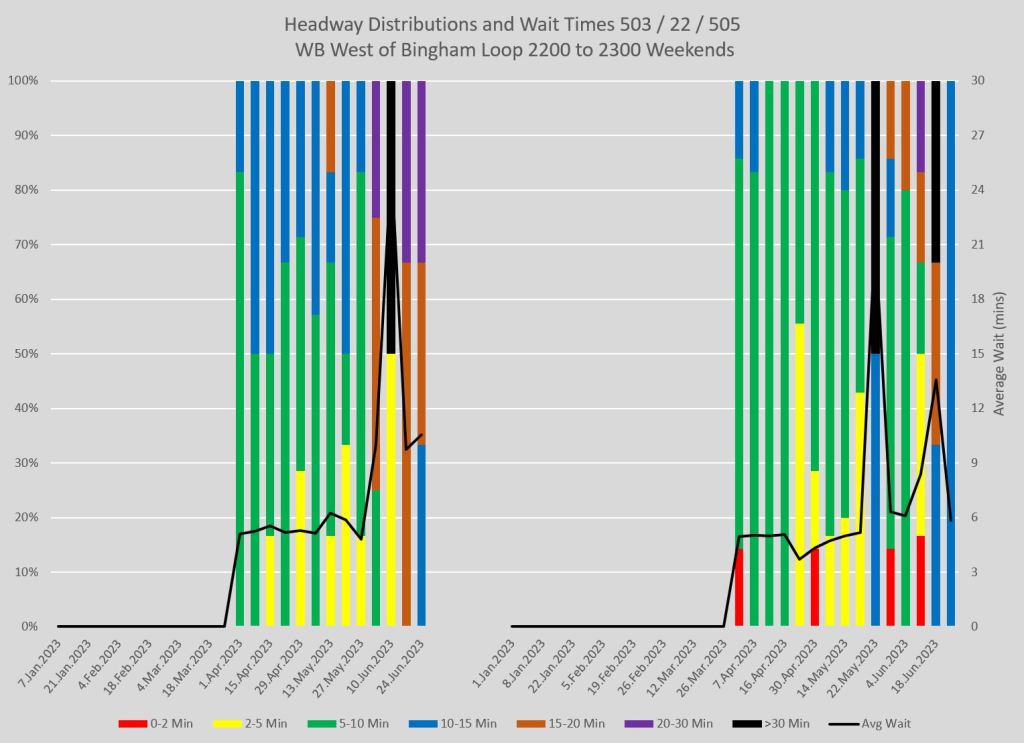
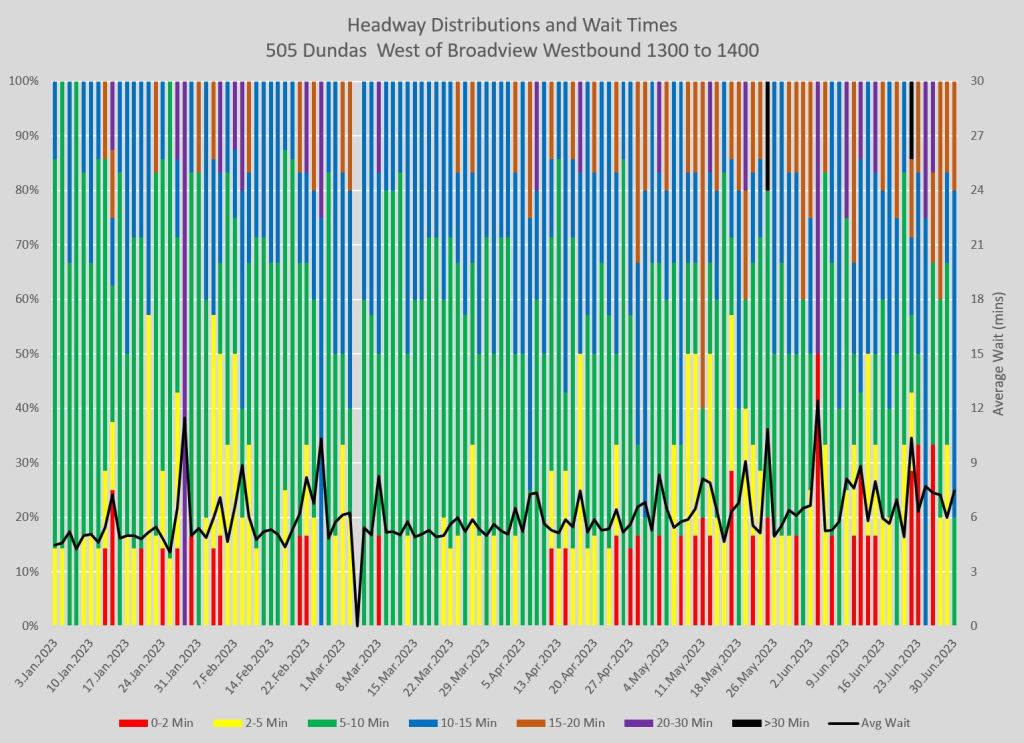
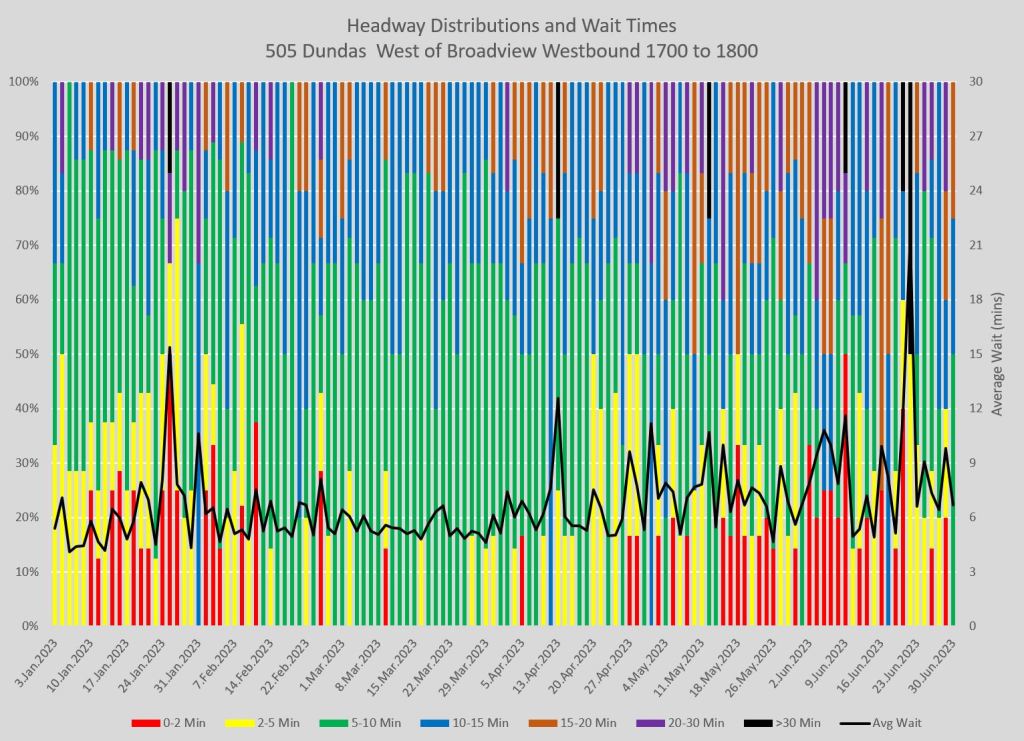
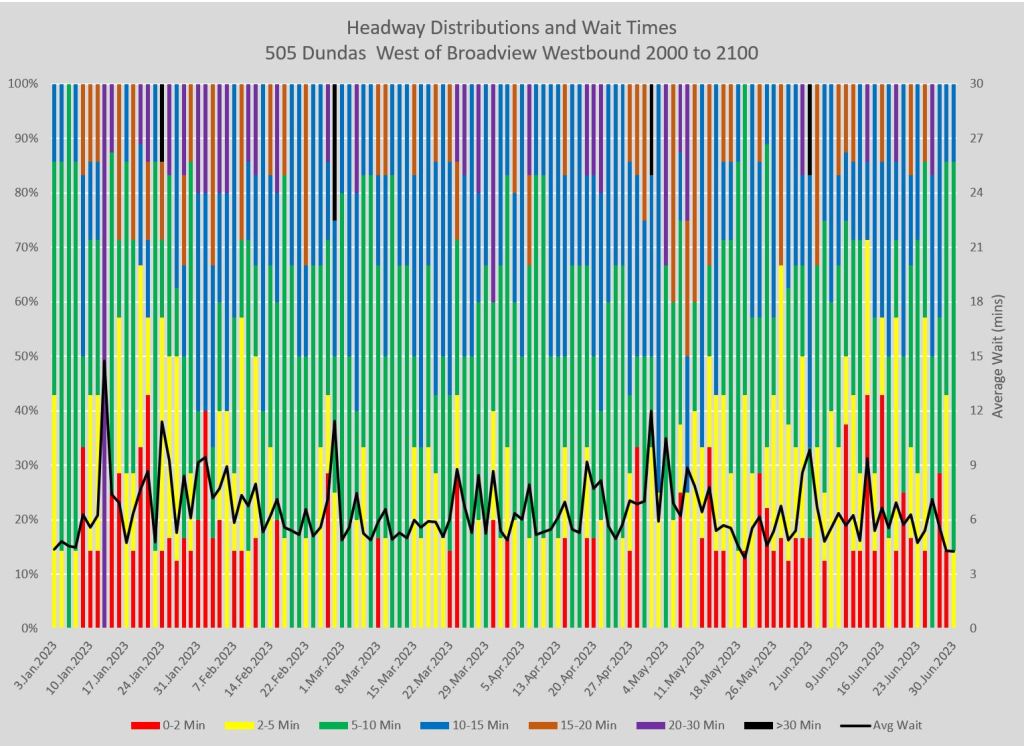
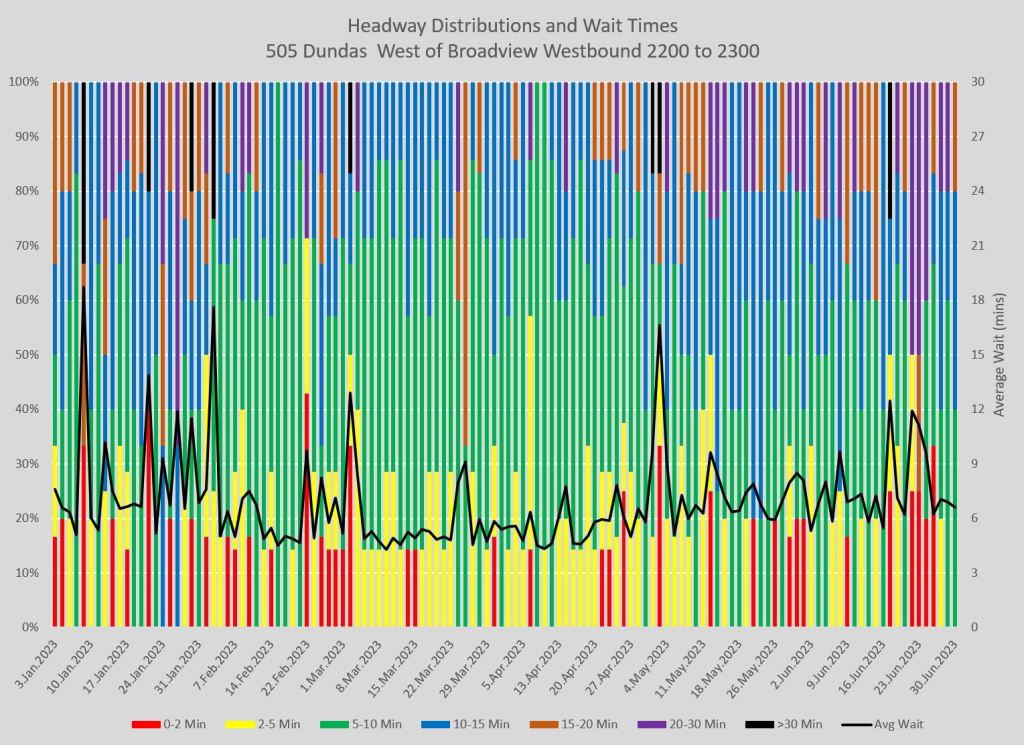
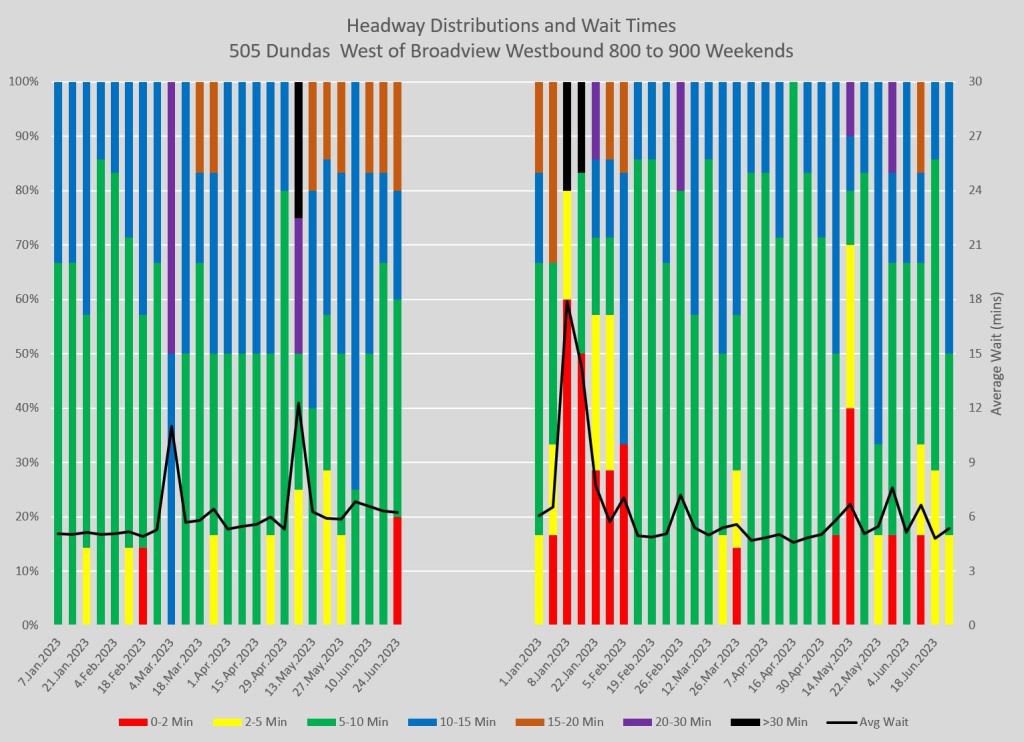
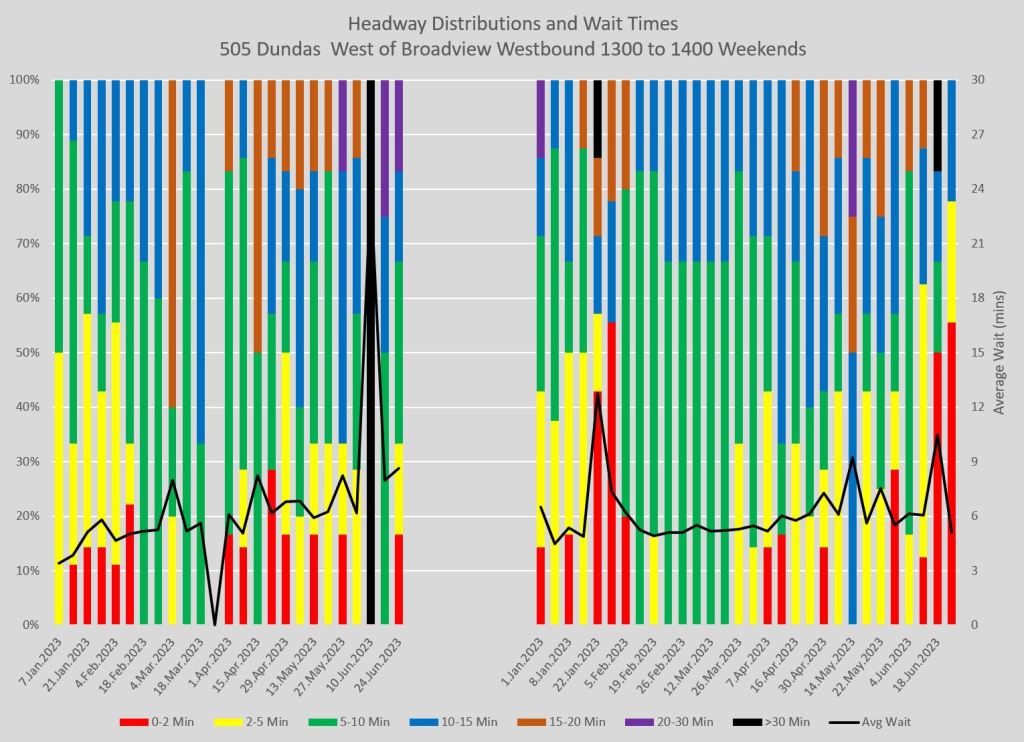
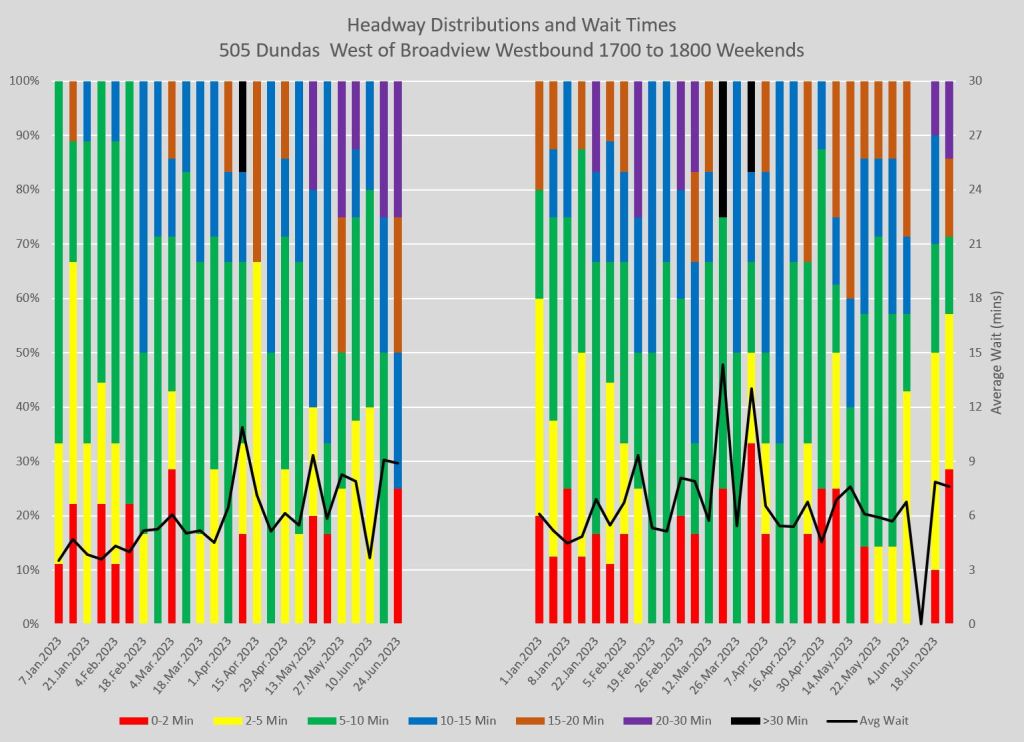
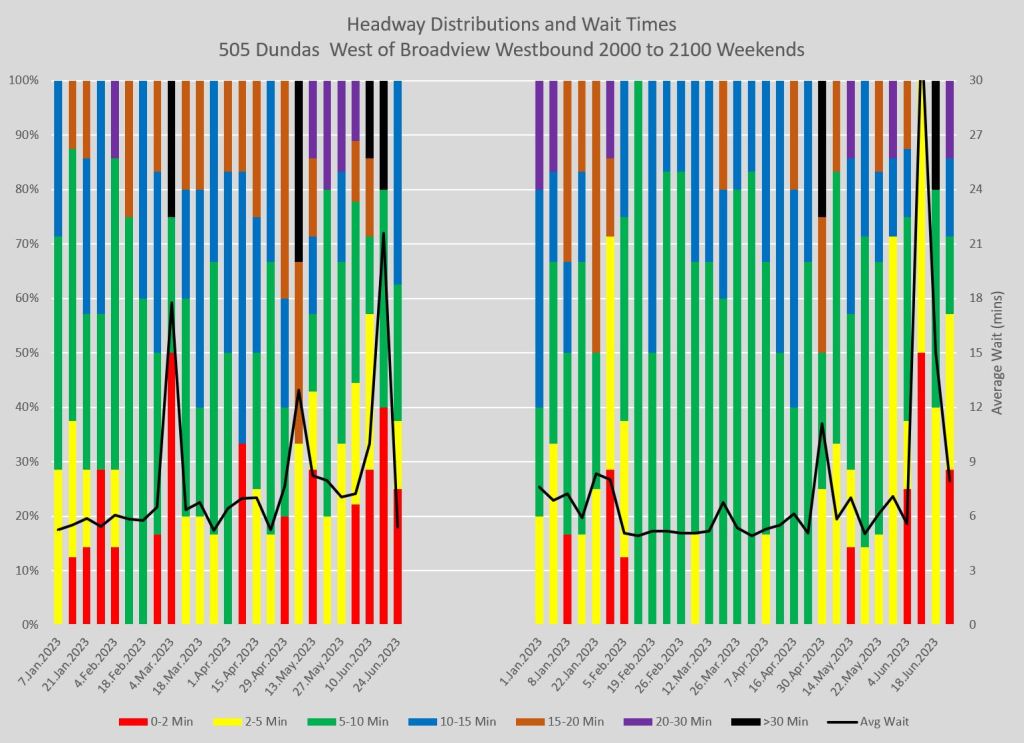
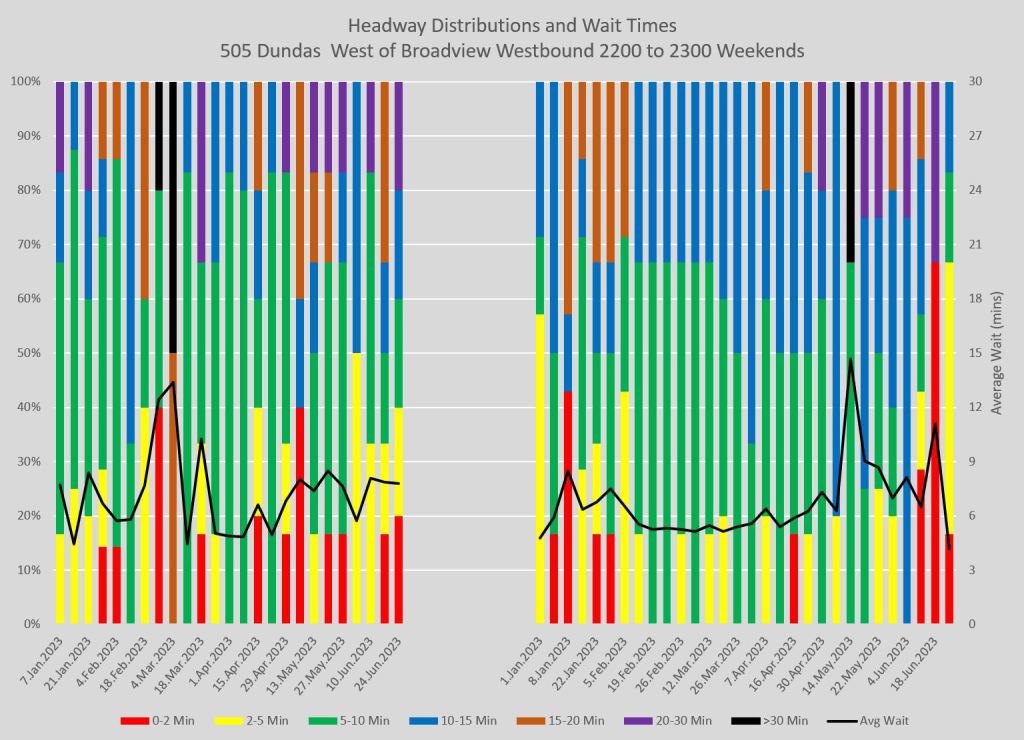
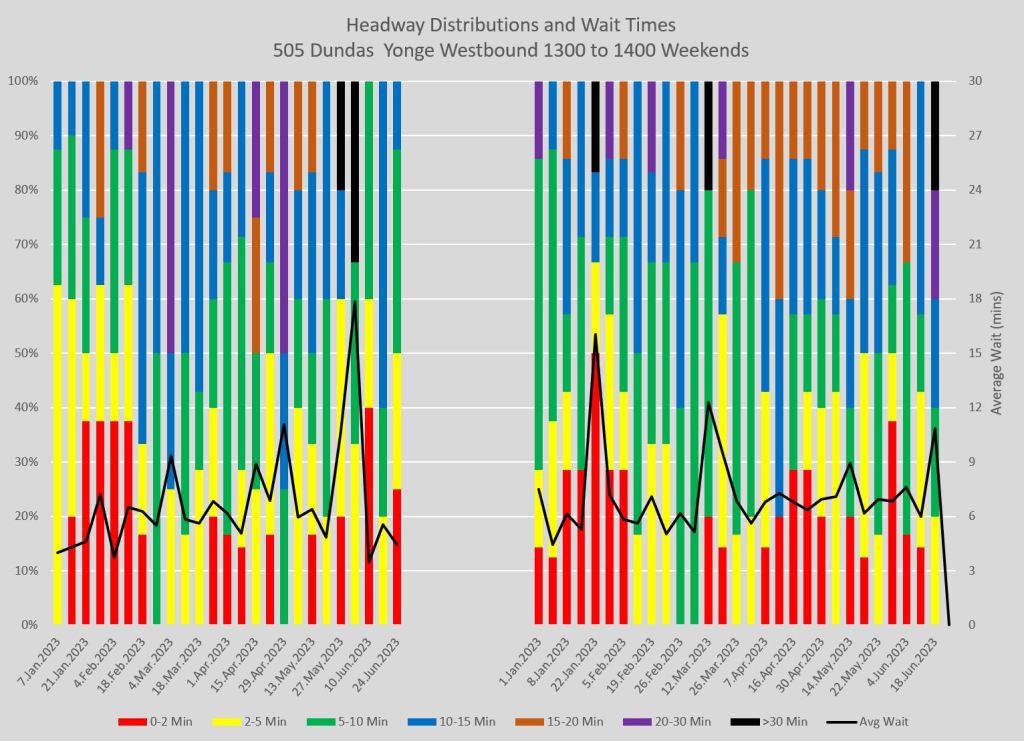
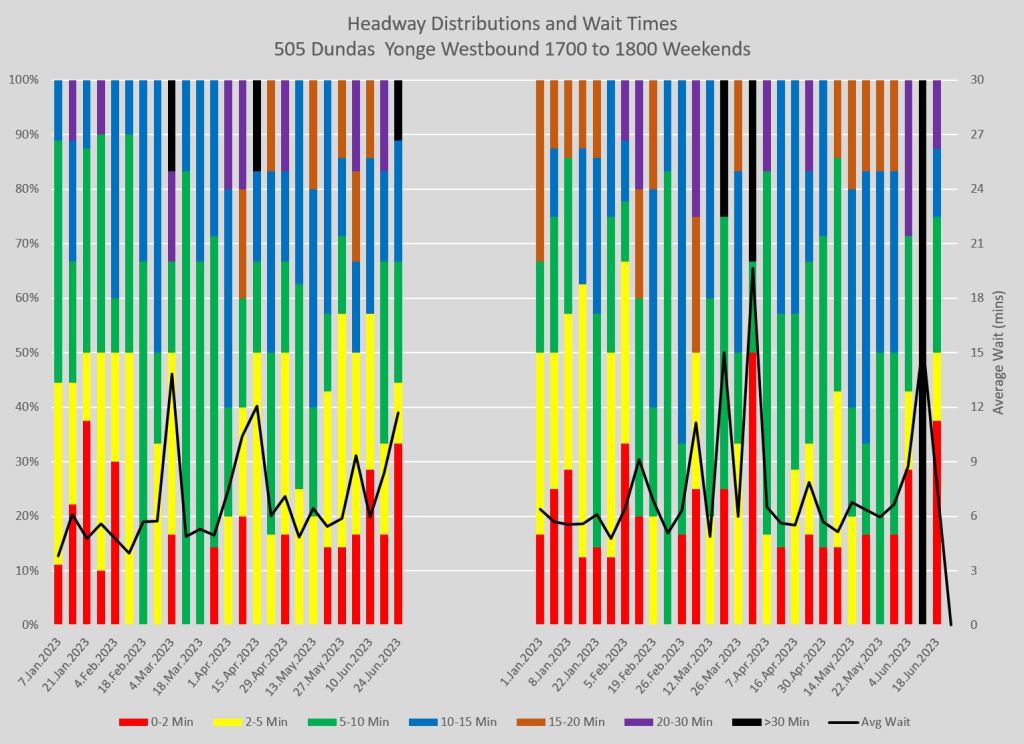
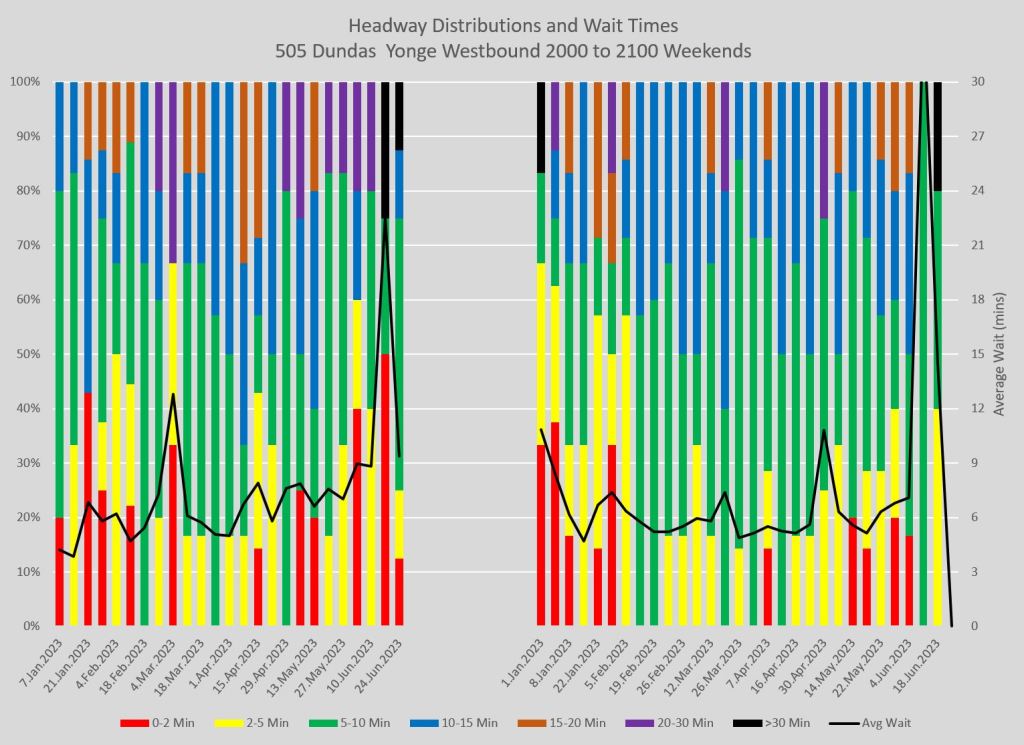
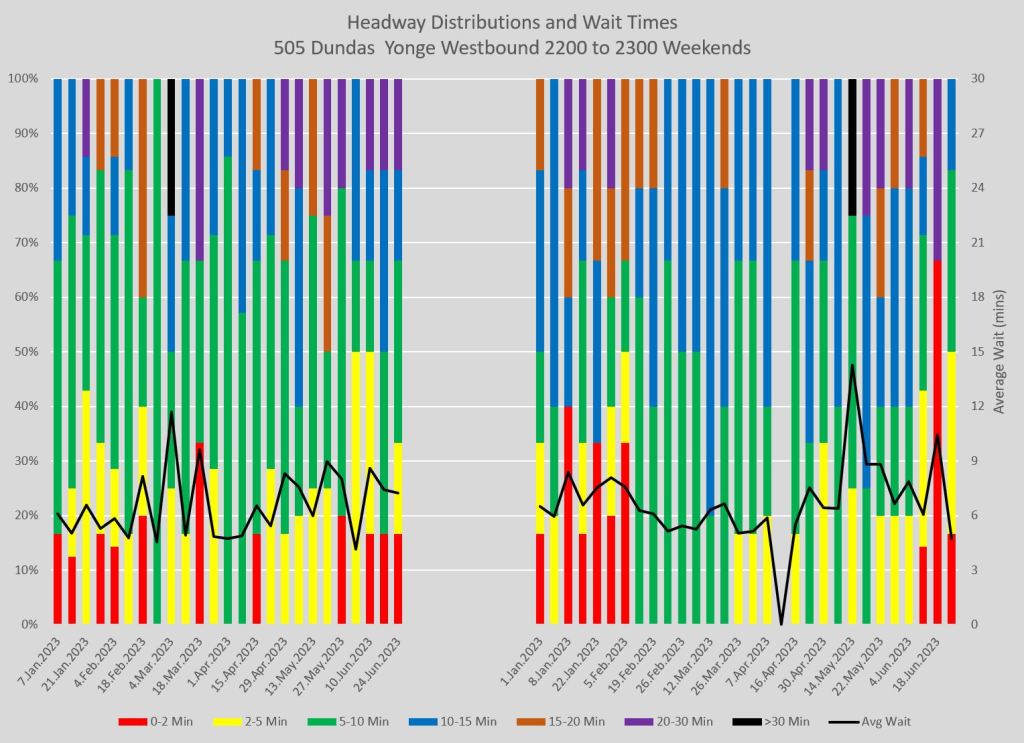
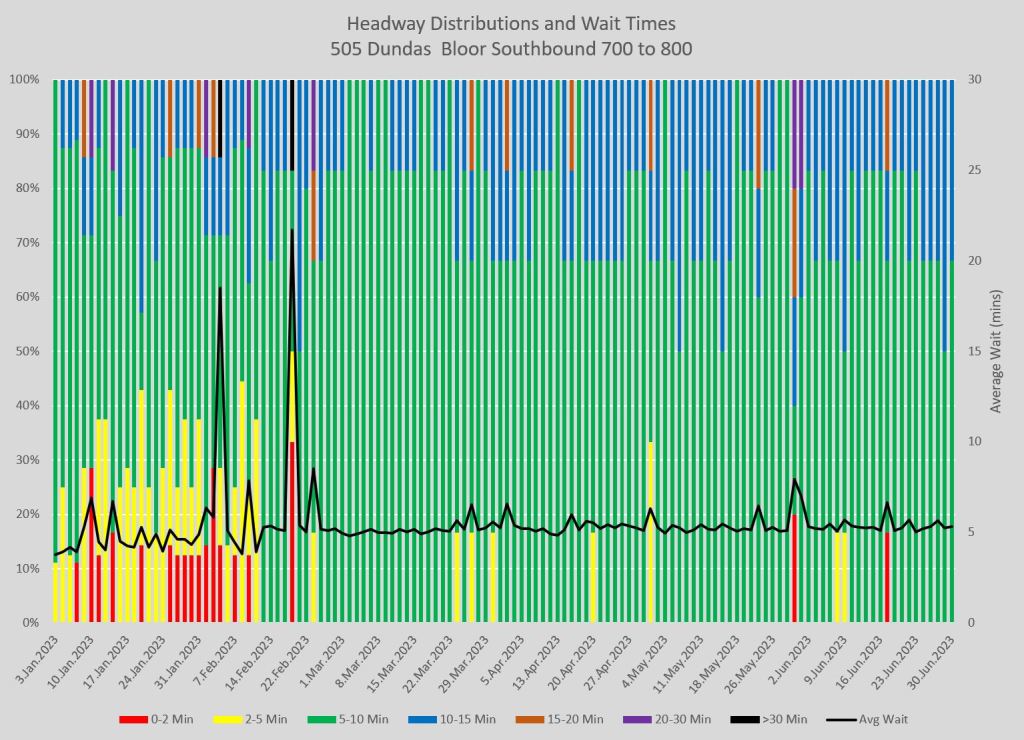
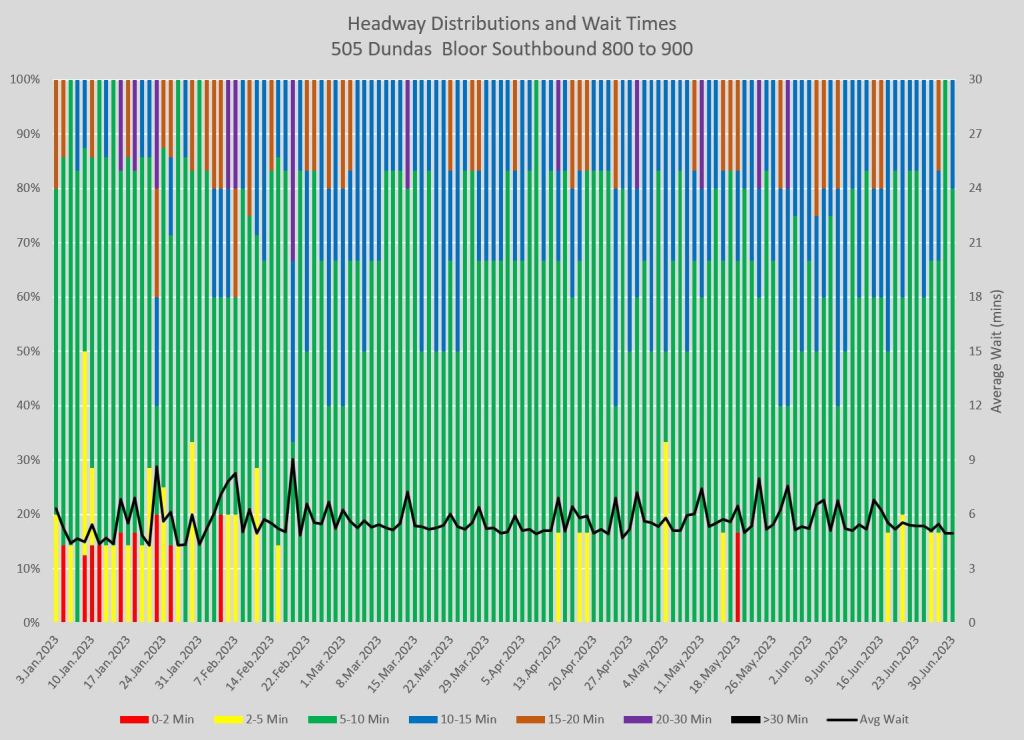
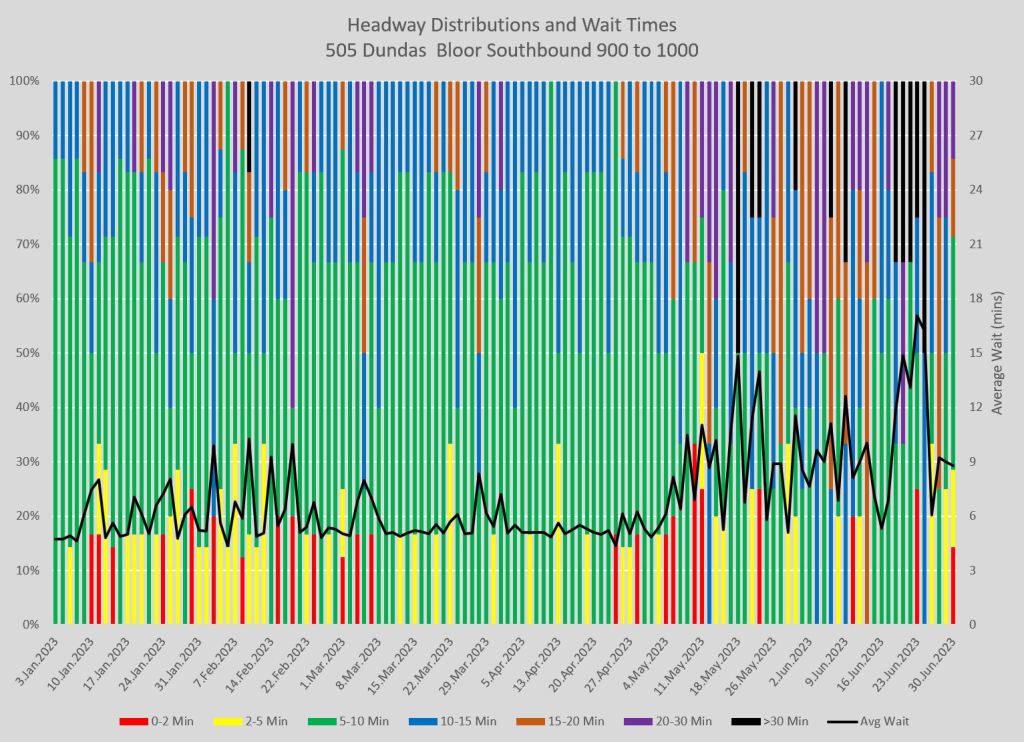
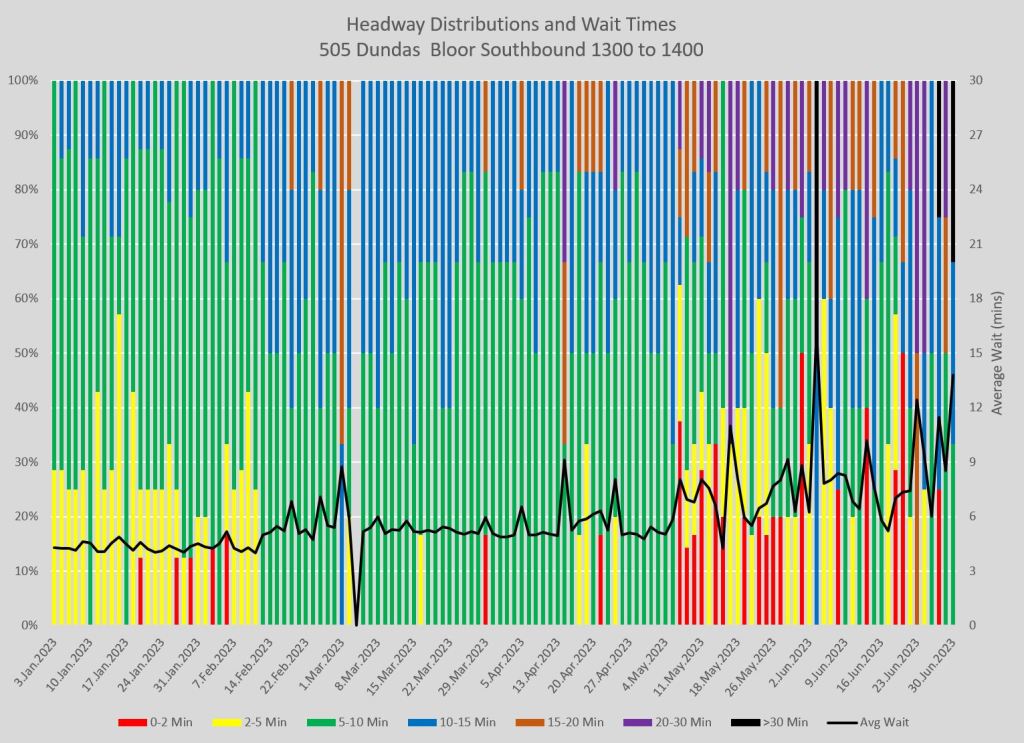
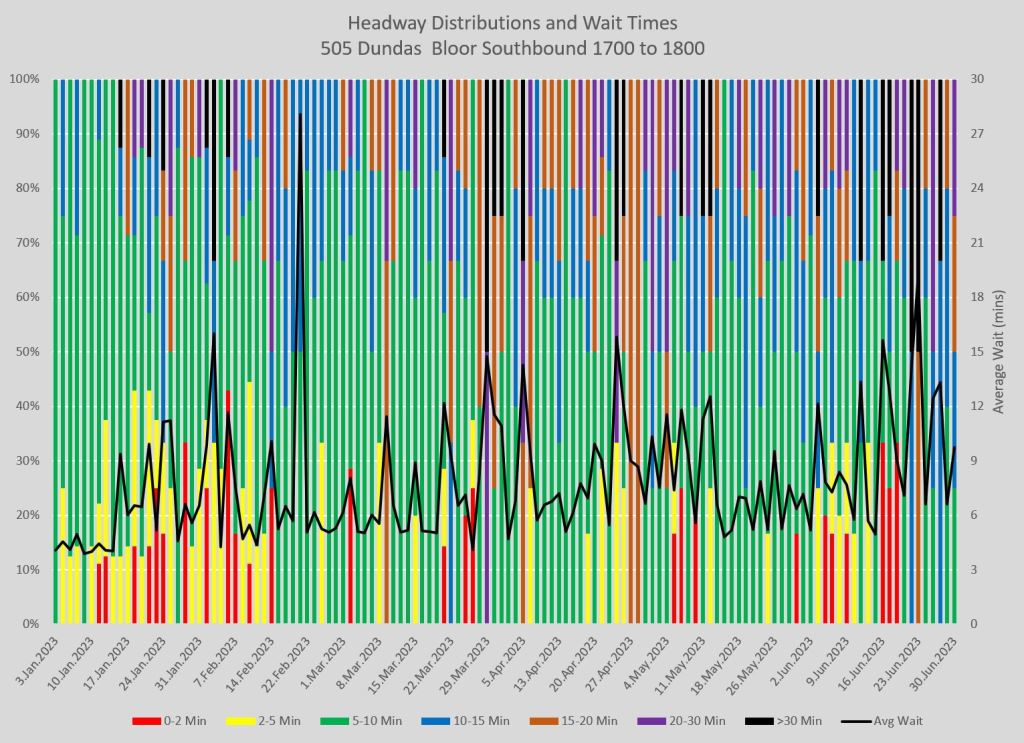
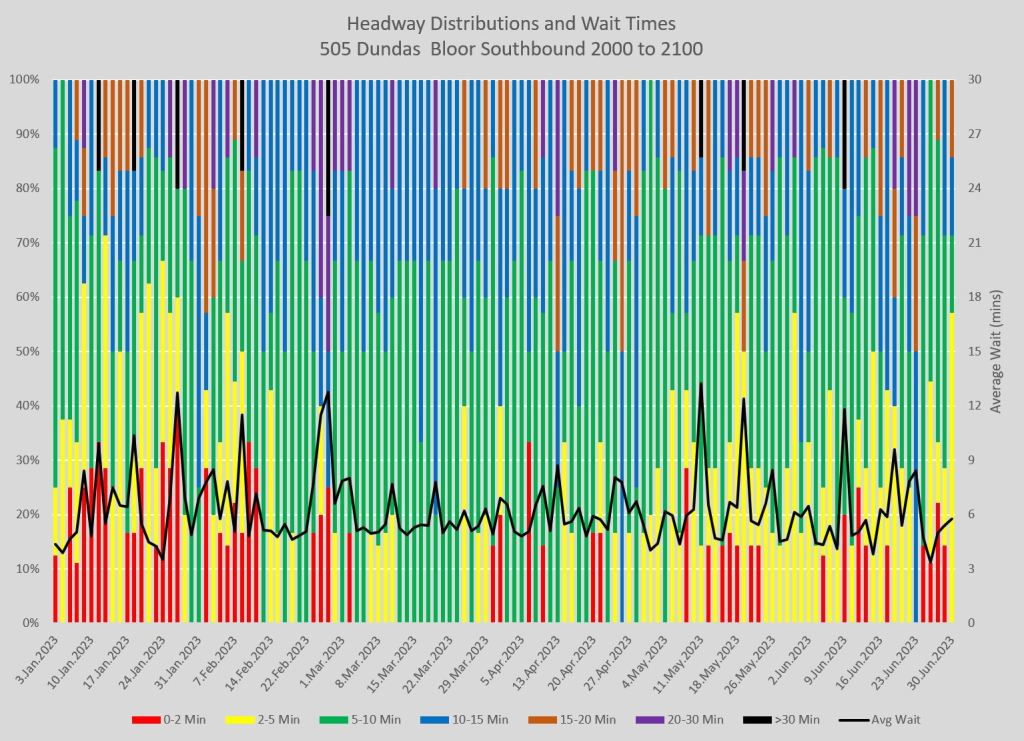
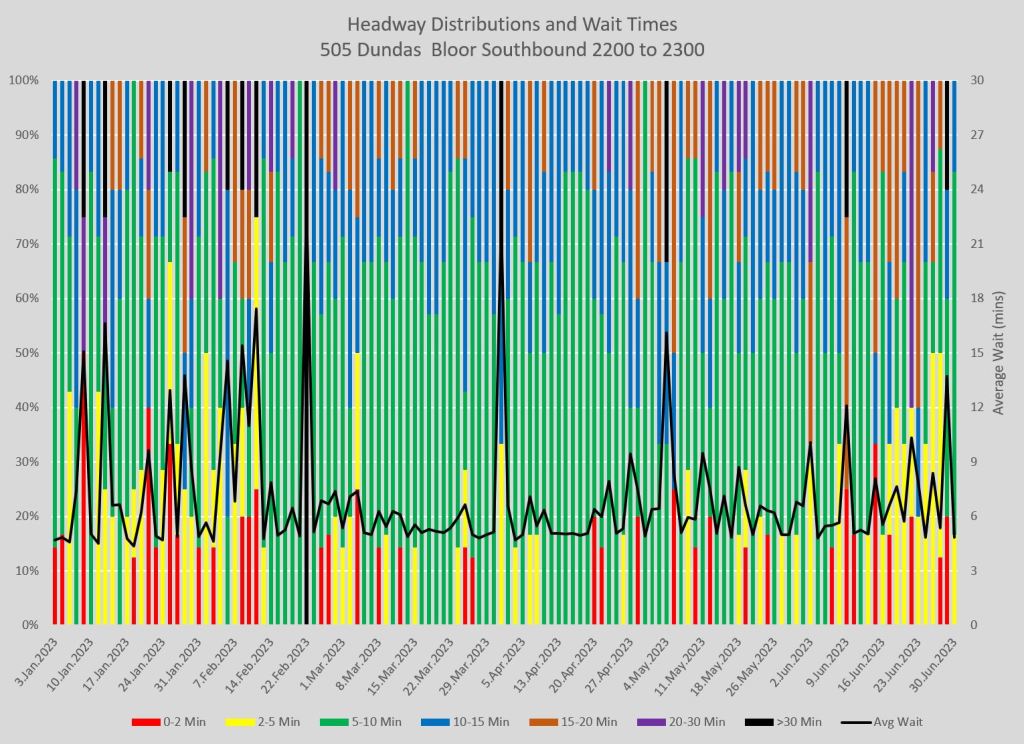
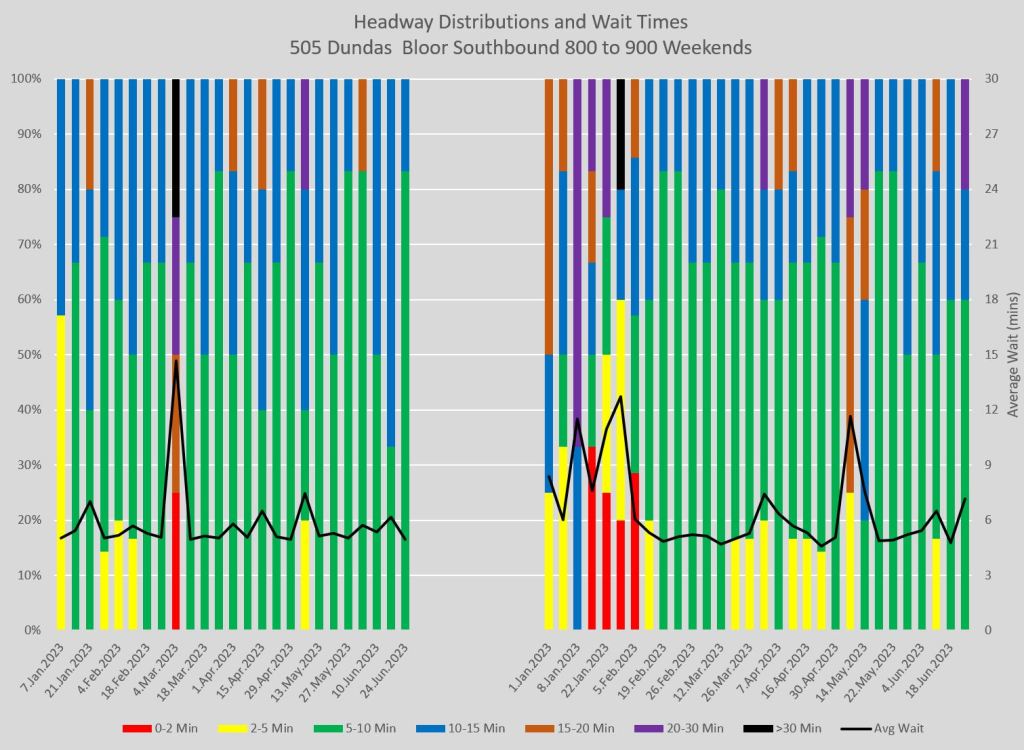
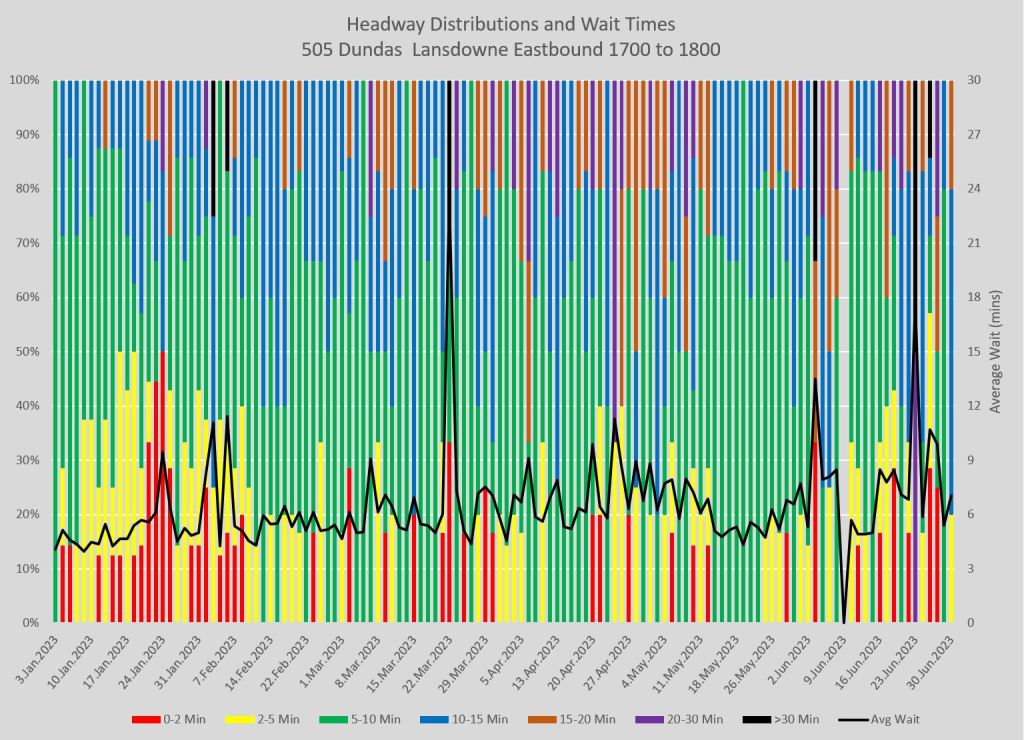
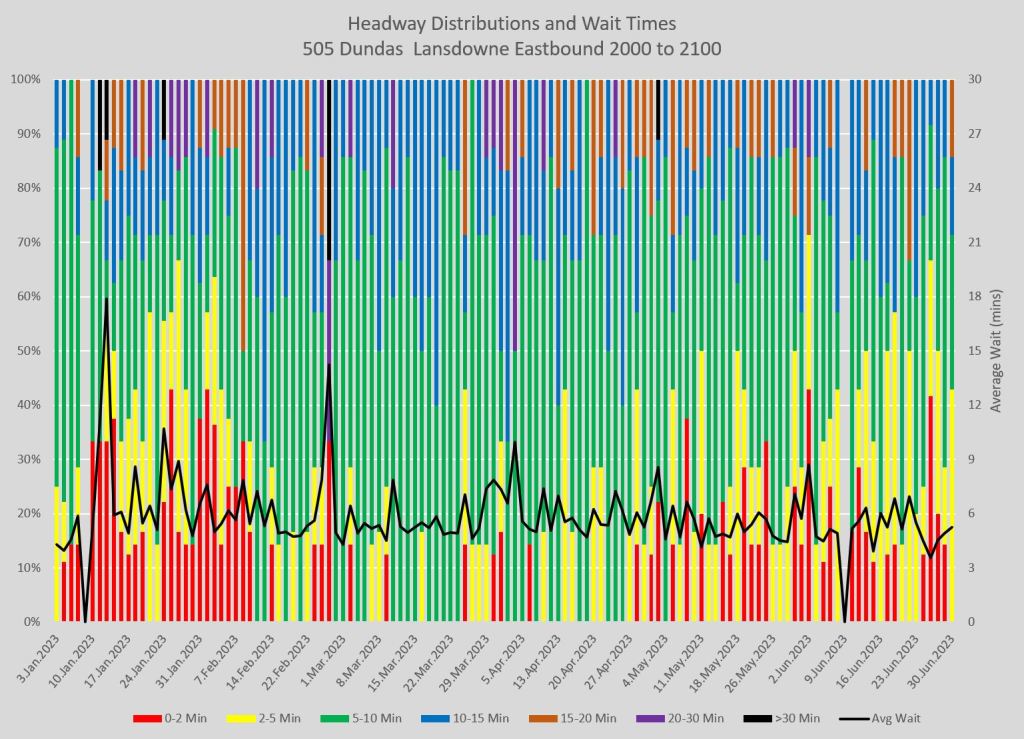
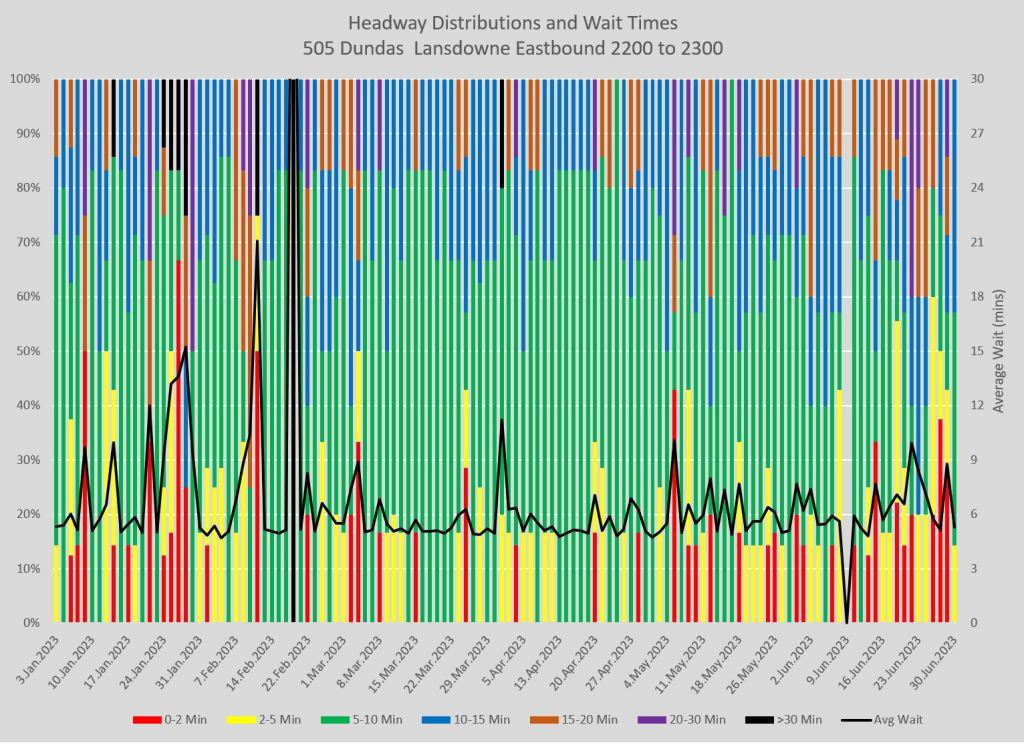
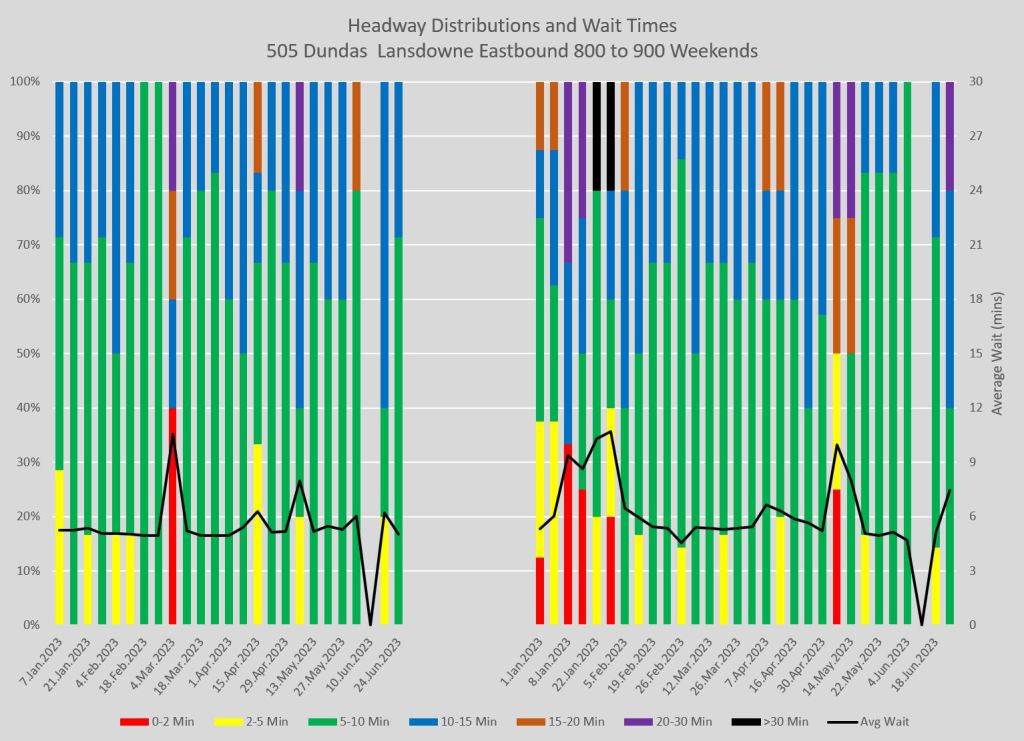
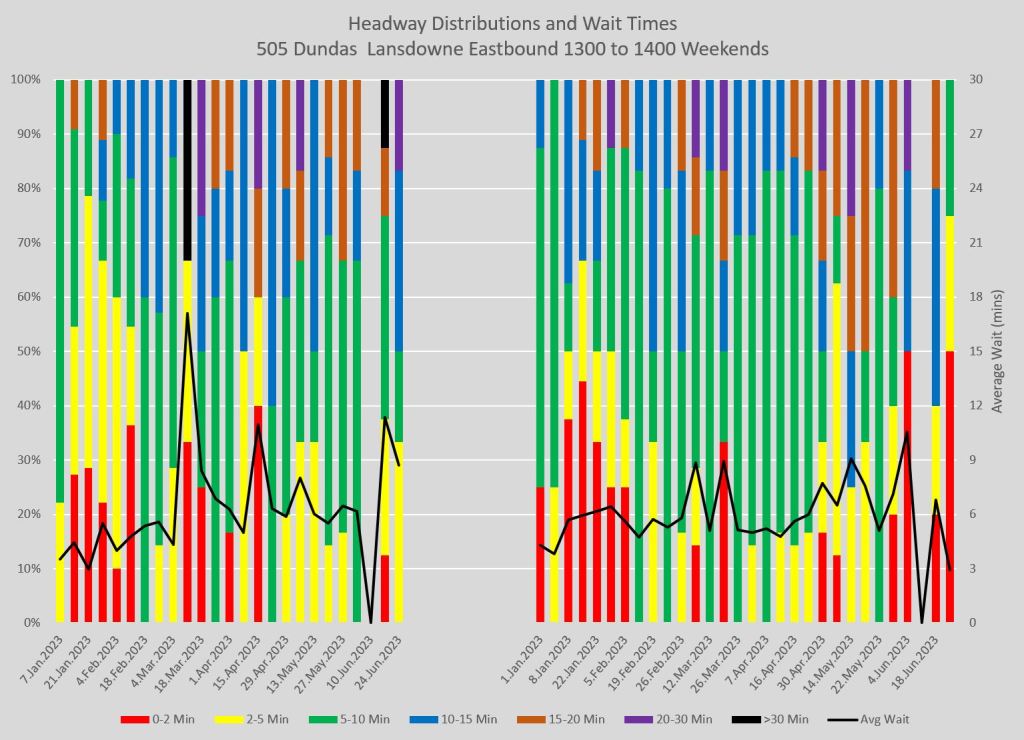
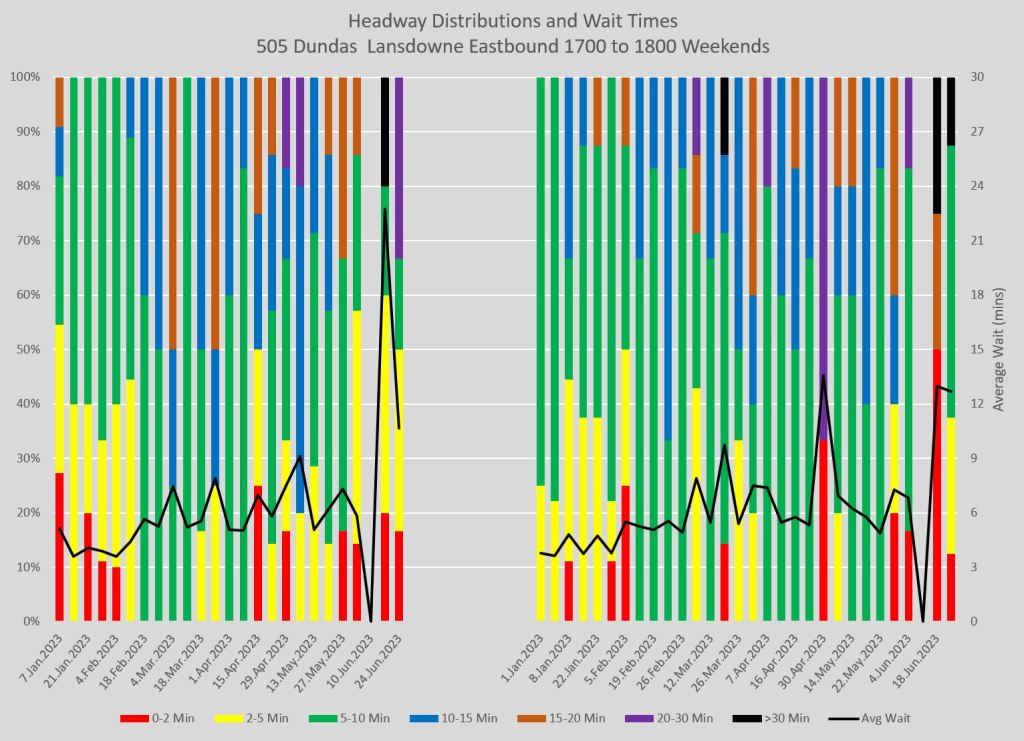
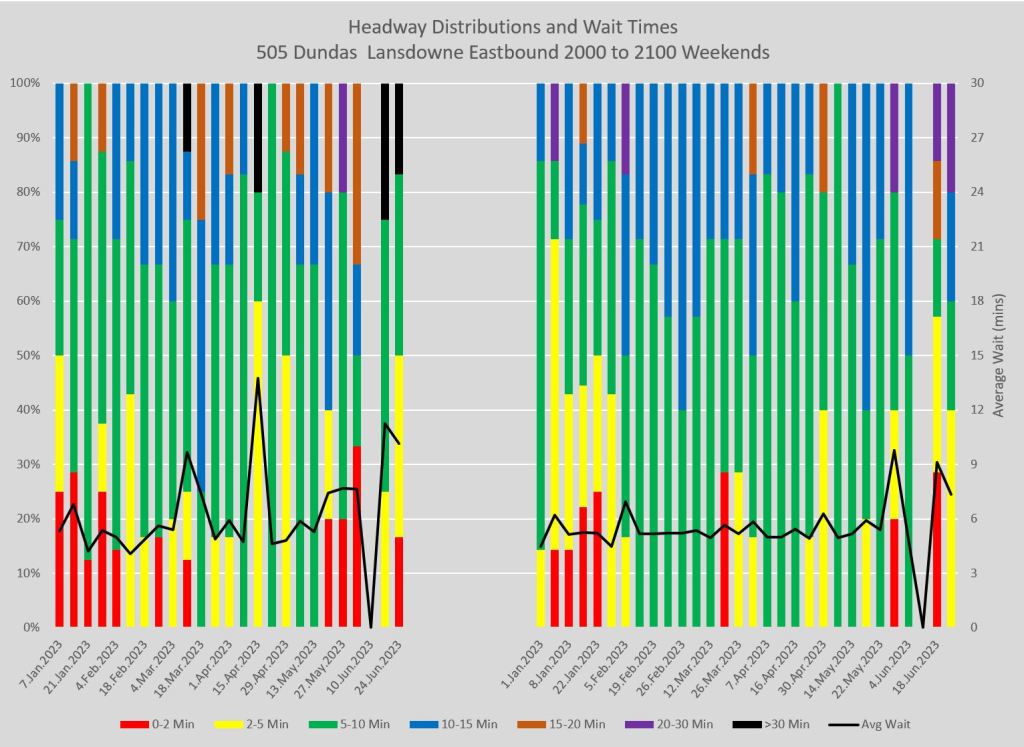
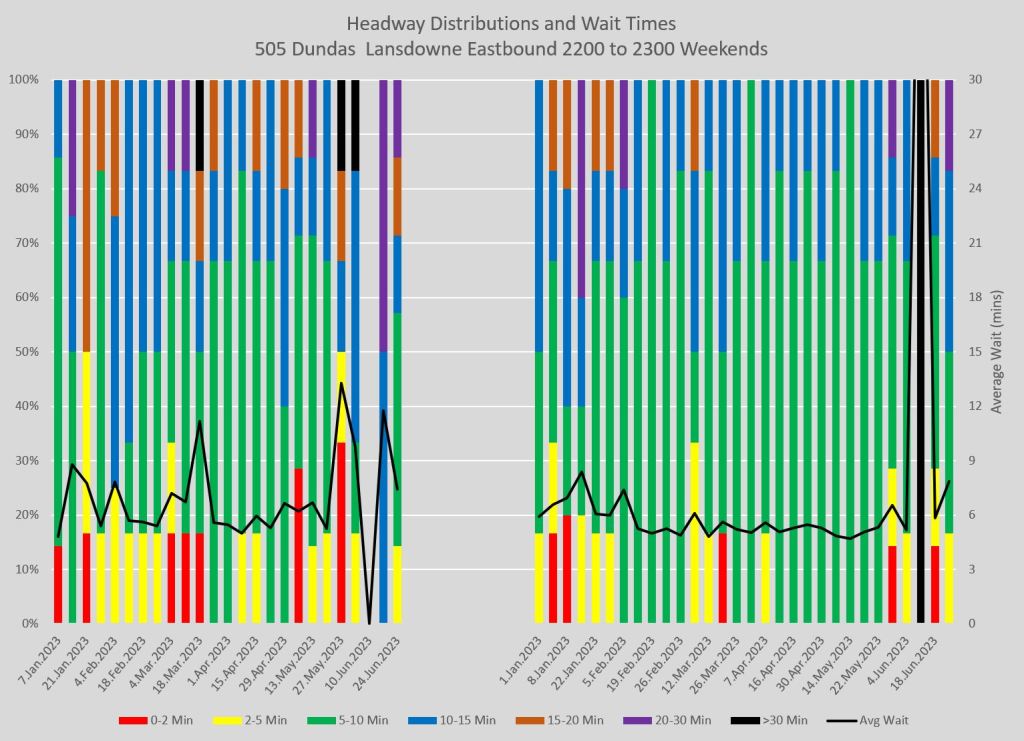
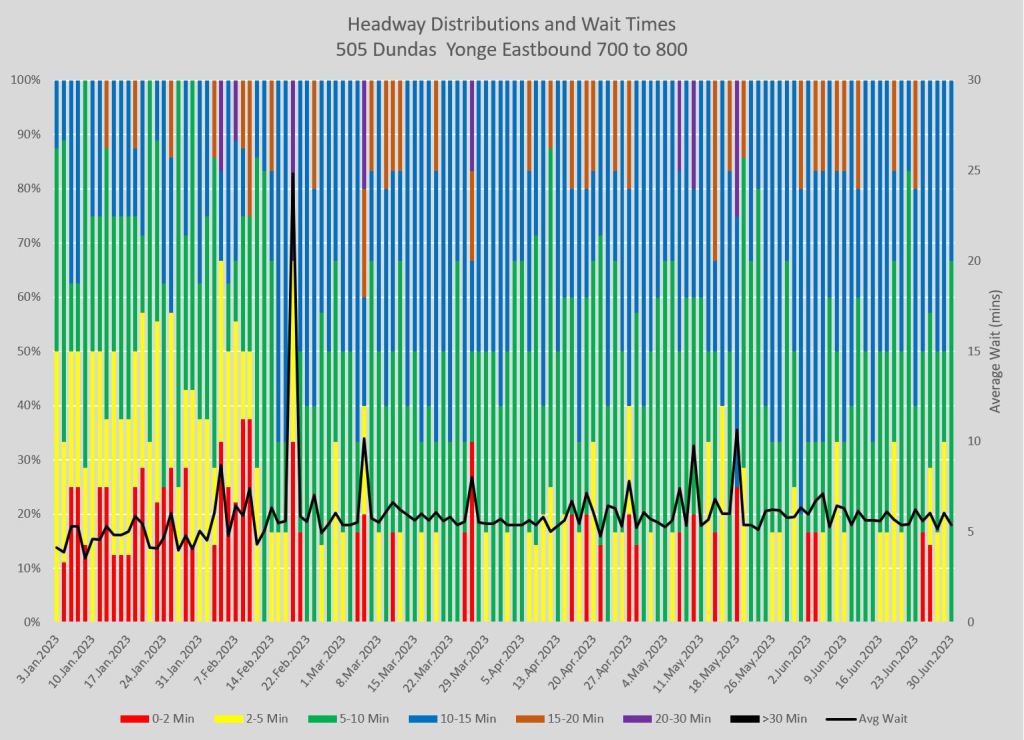
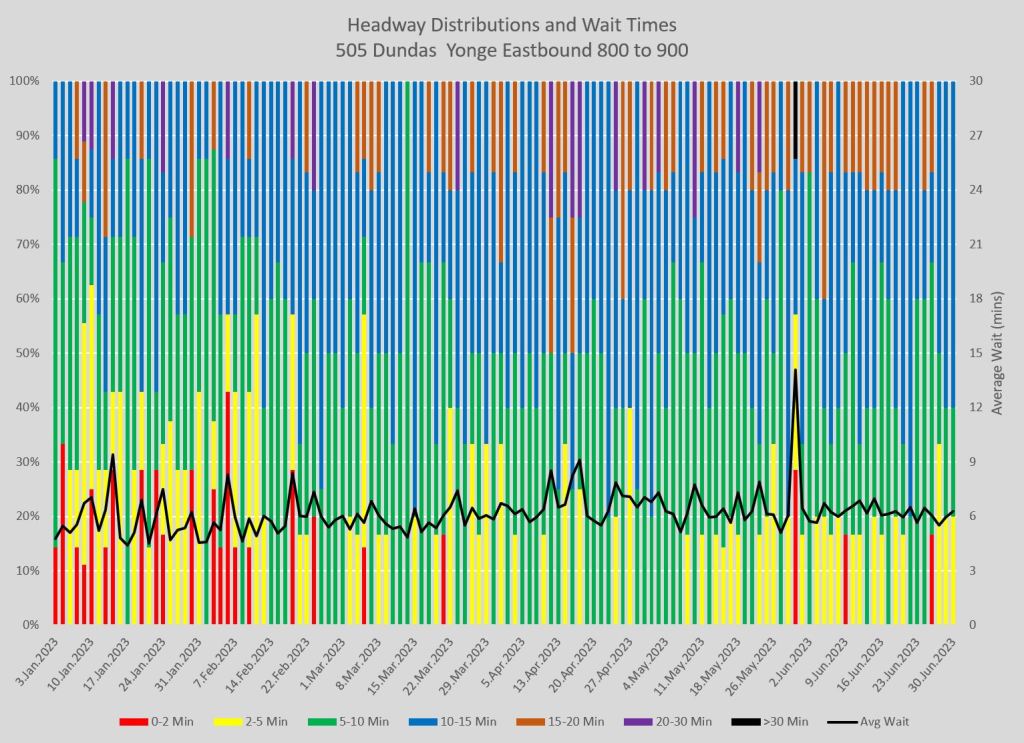
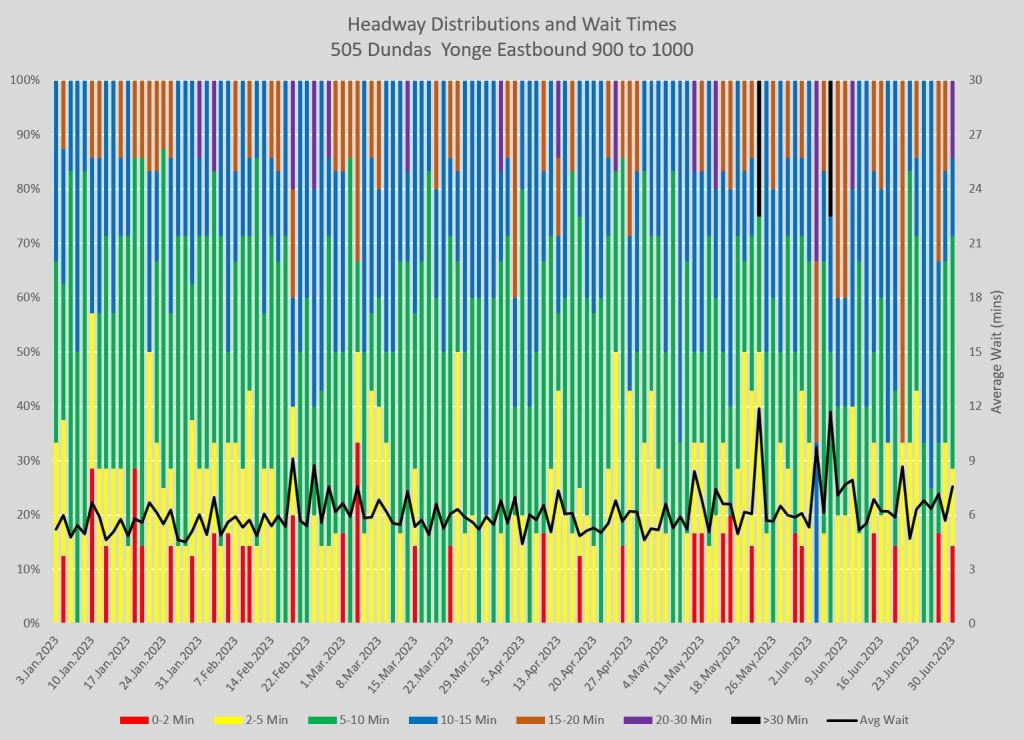
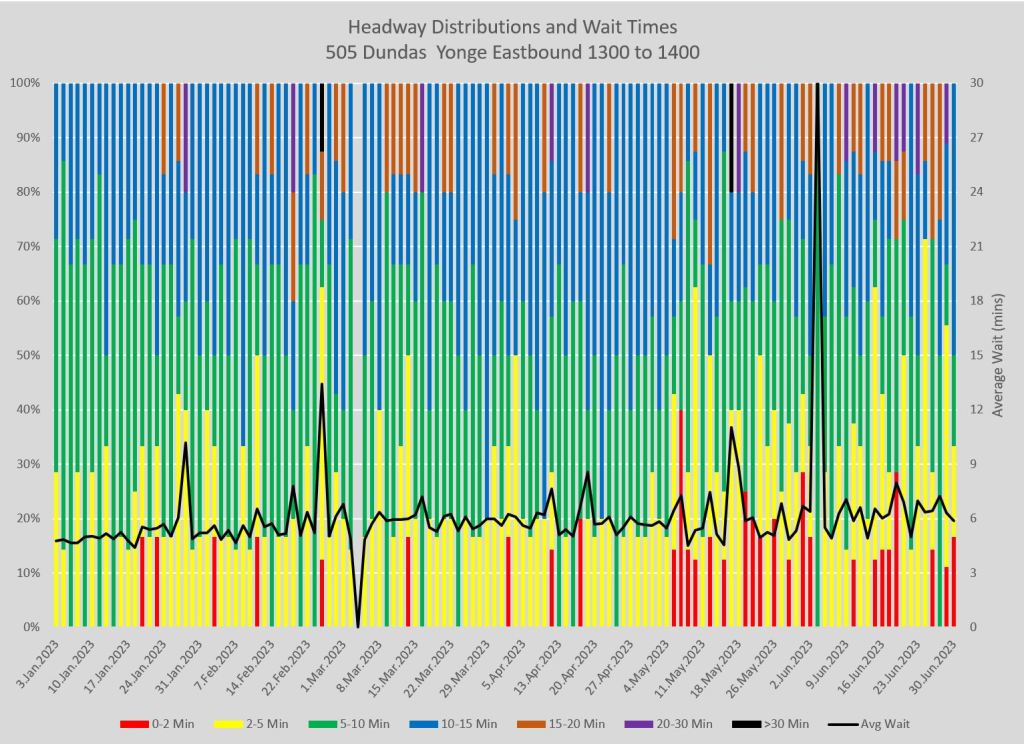
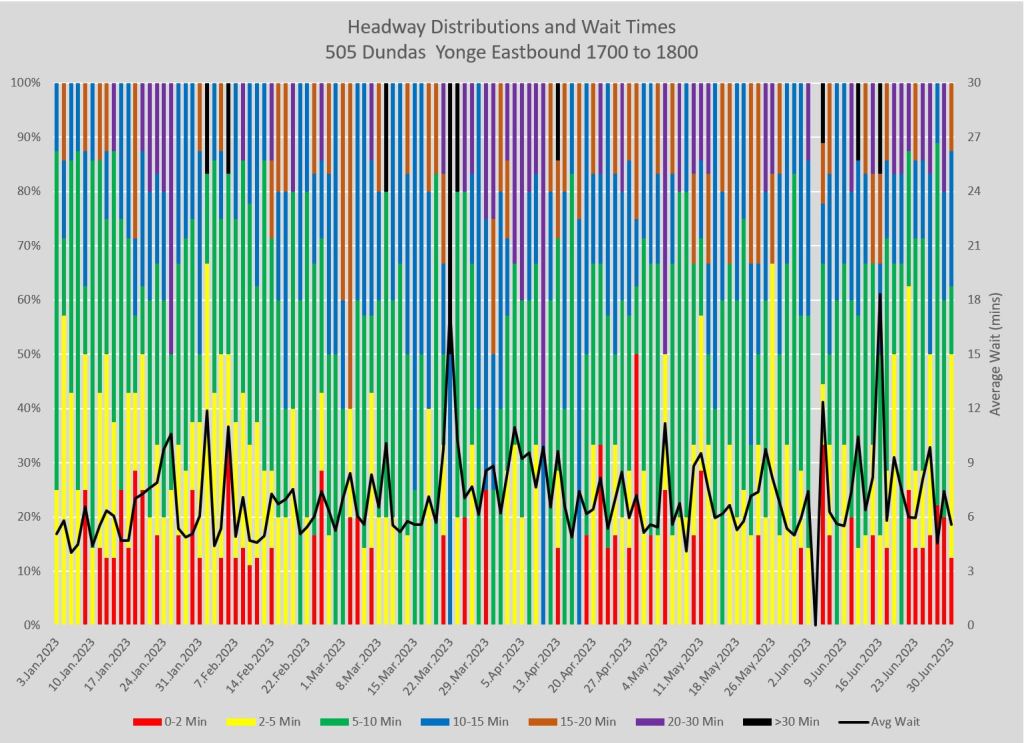
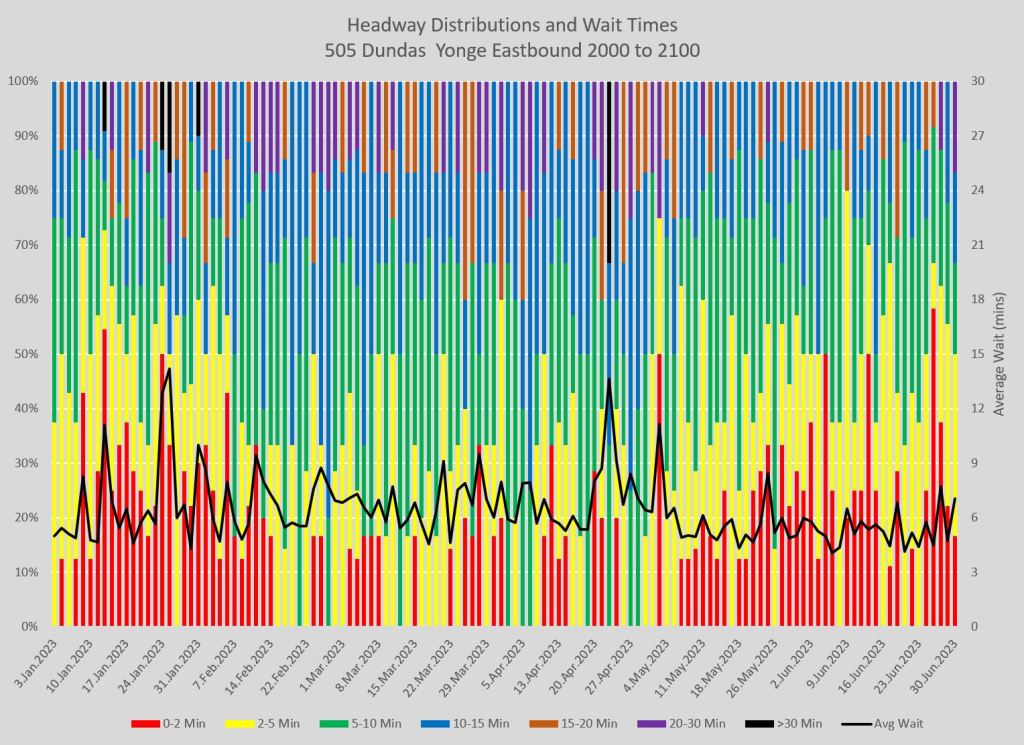
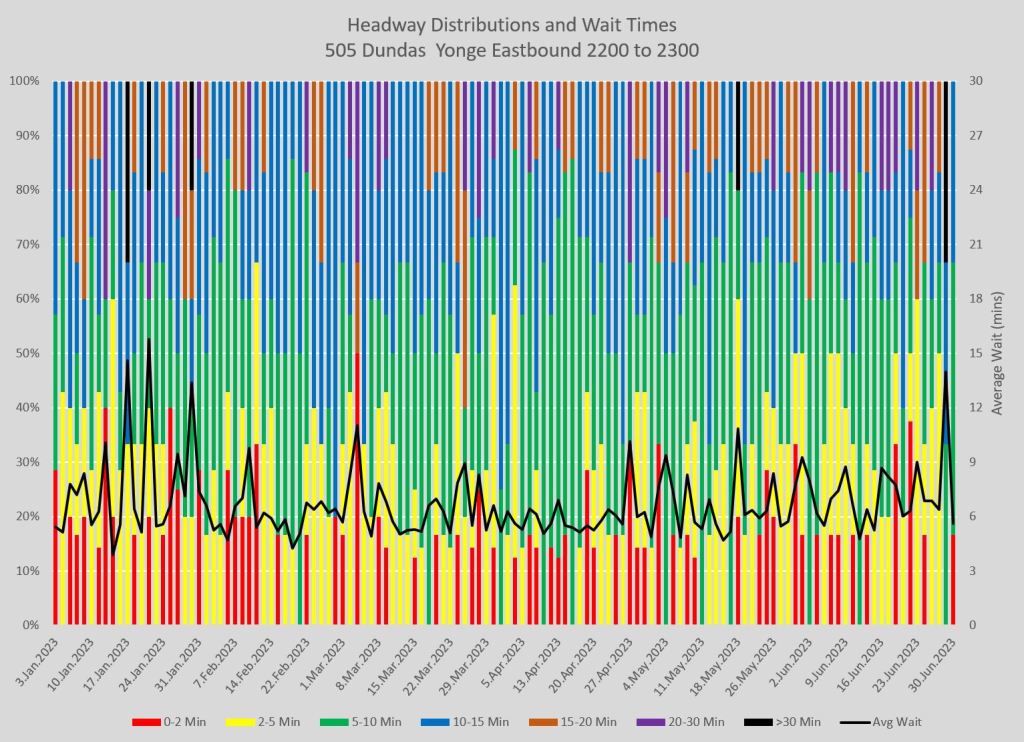
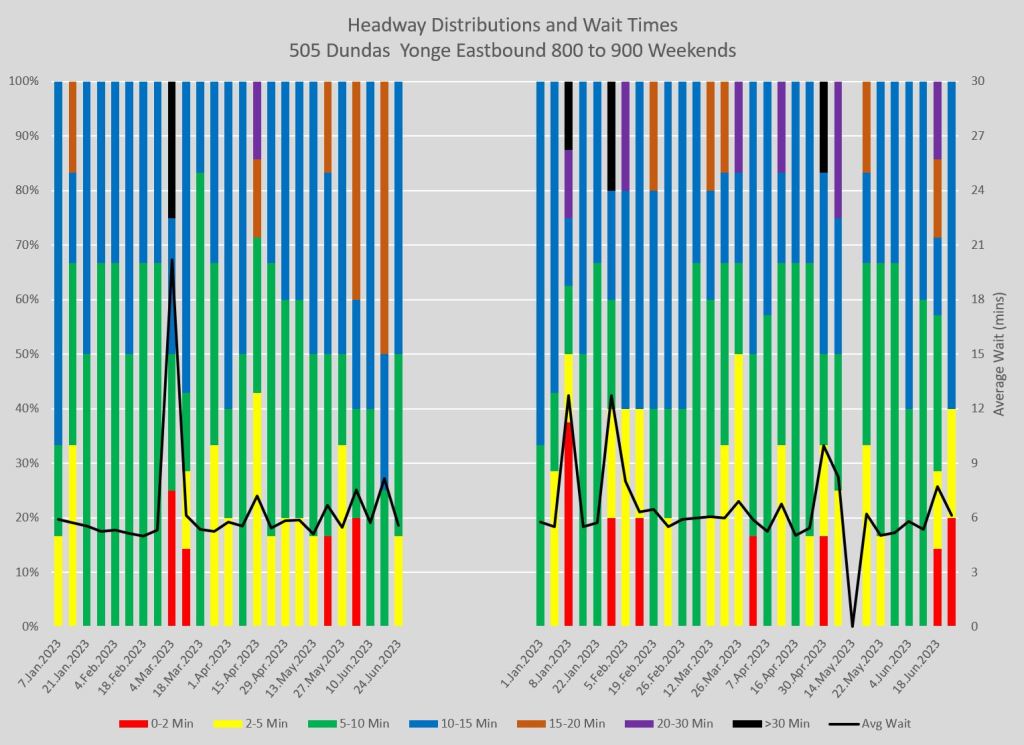
The following charts are in a format that I developed with the aid of readers (see Part 1 and Part 2 of that discussion) to illustrate the distribution of headway values, their variation day-by-day, hour-by-hour and the wait time an average rider experiences.
[In brief, the average wait time for one rider is one half of the actual, as opposed to scheduled, length of the gap between vehicles, aka “headway”. If service is operating exactly on time, the average wait for any rider will be one half of the scheduled headway, However, if there are gaps and bunches, more riders will wait for the longer gap and the average wait per rider goes up. Short headways (bunches) don’t serve many new riders because few accumulate in the interval.]
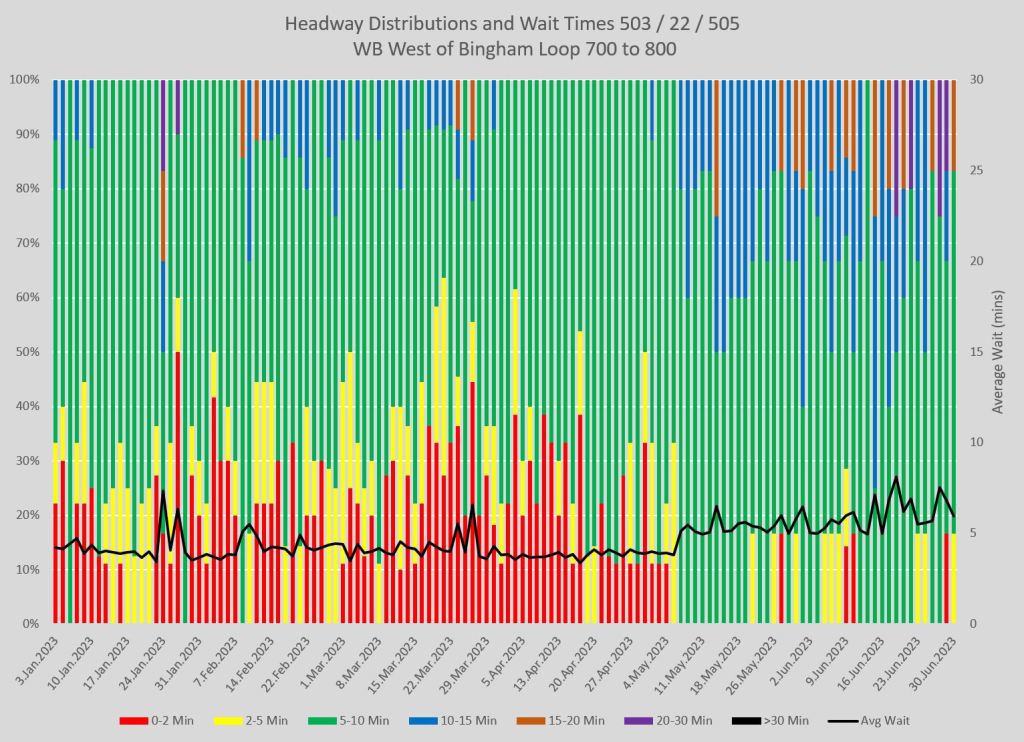
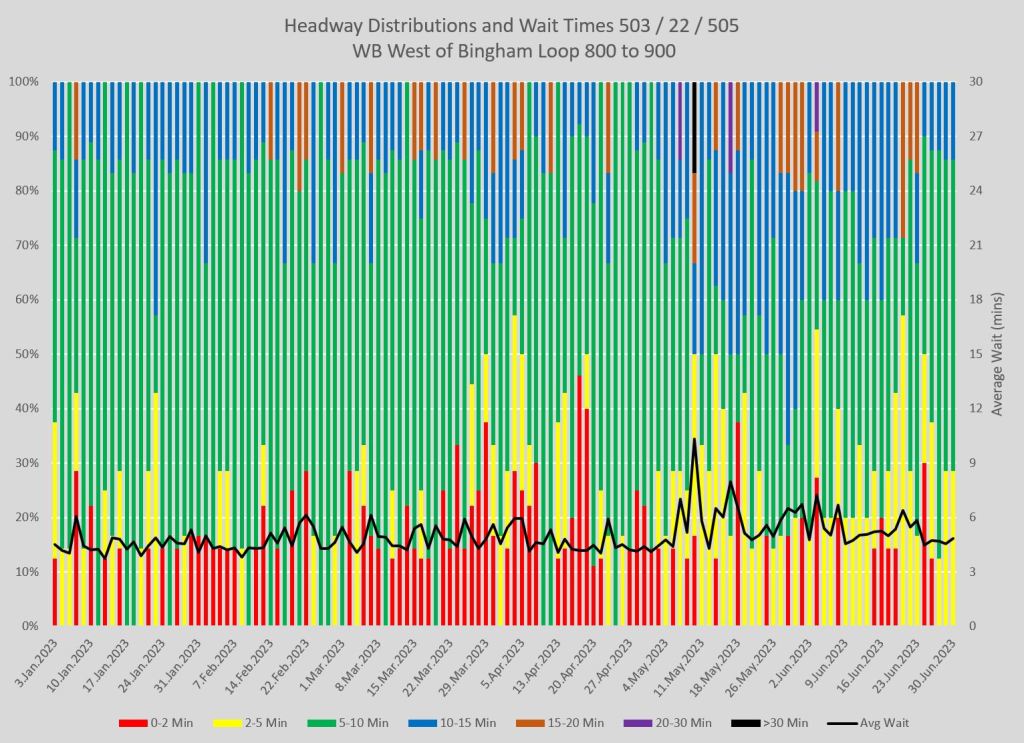
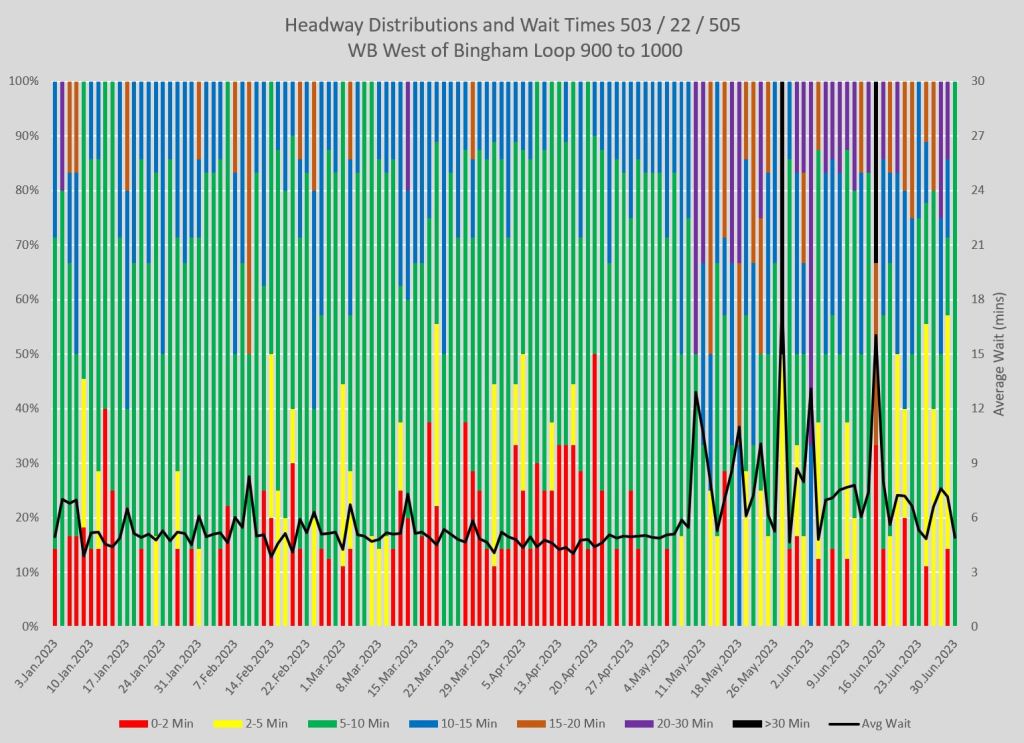
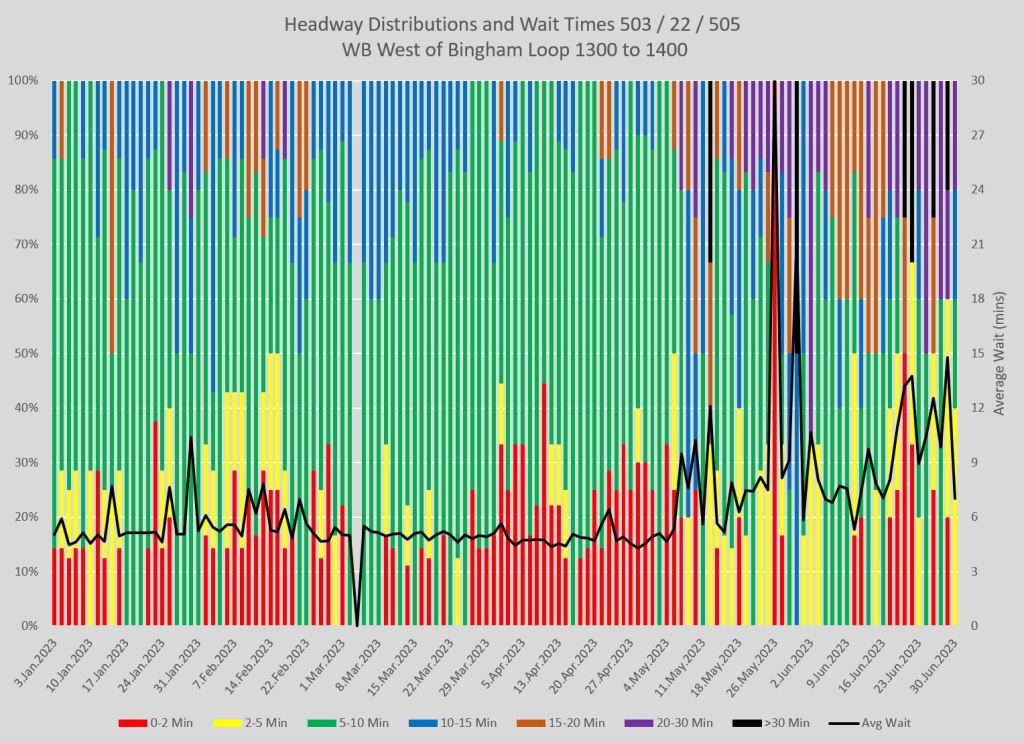
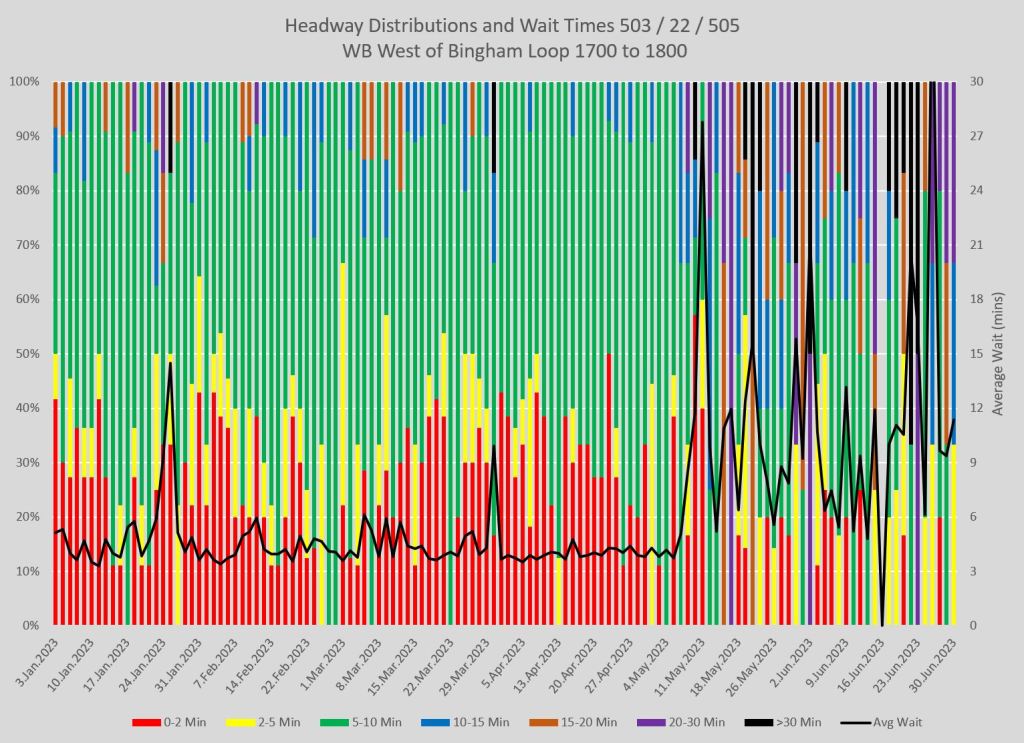
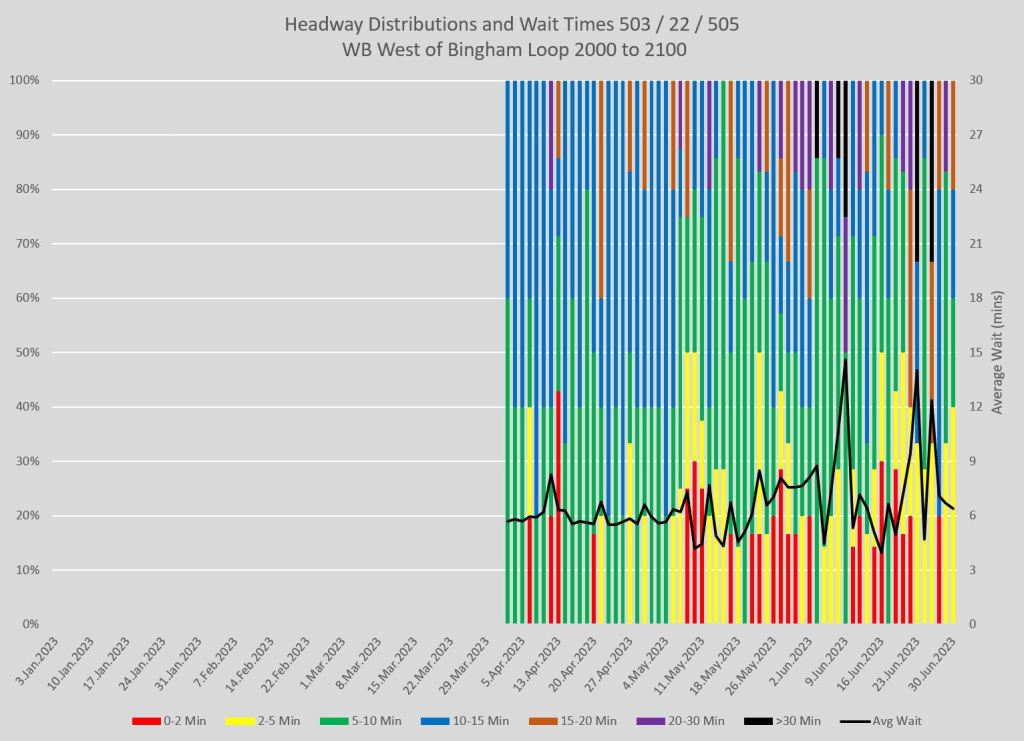
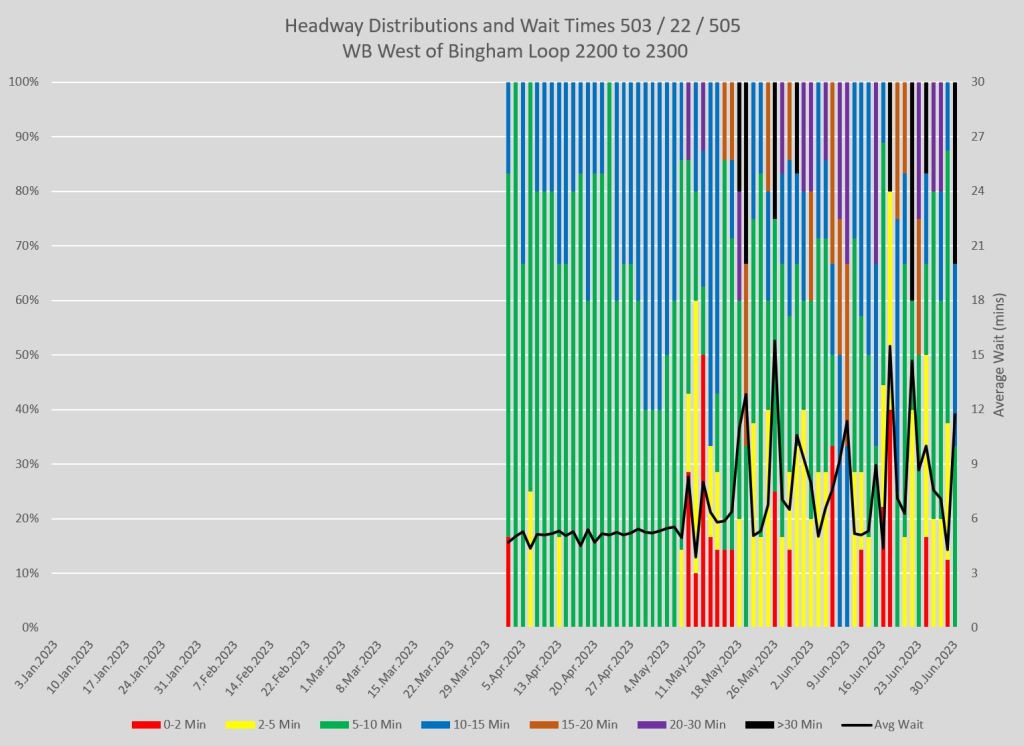
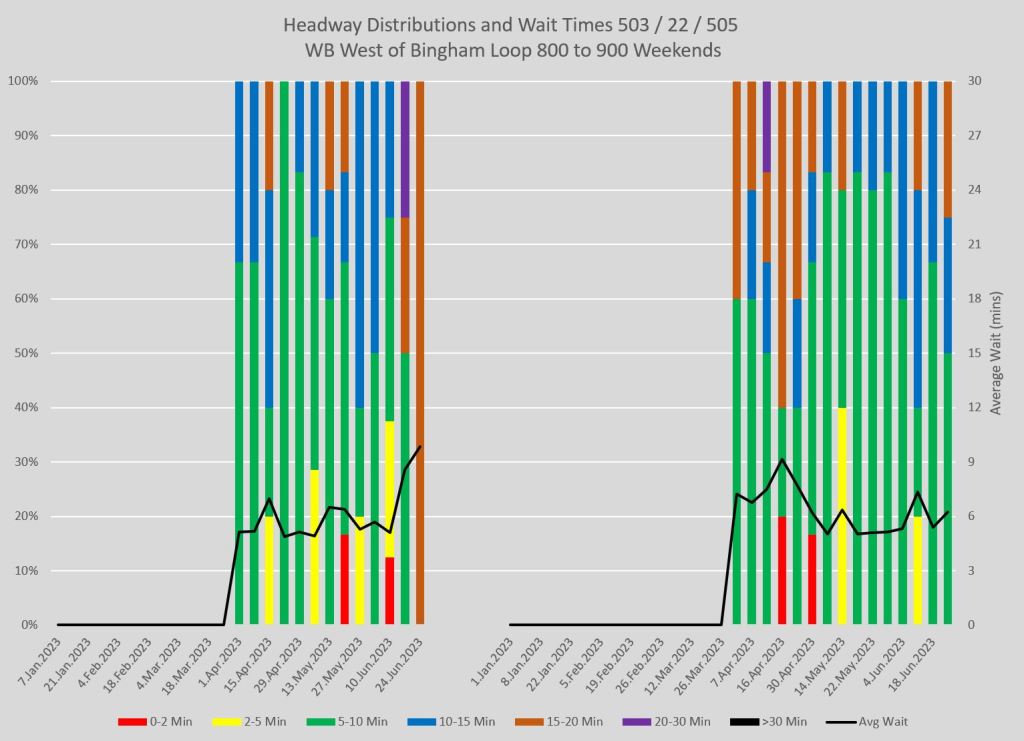
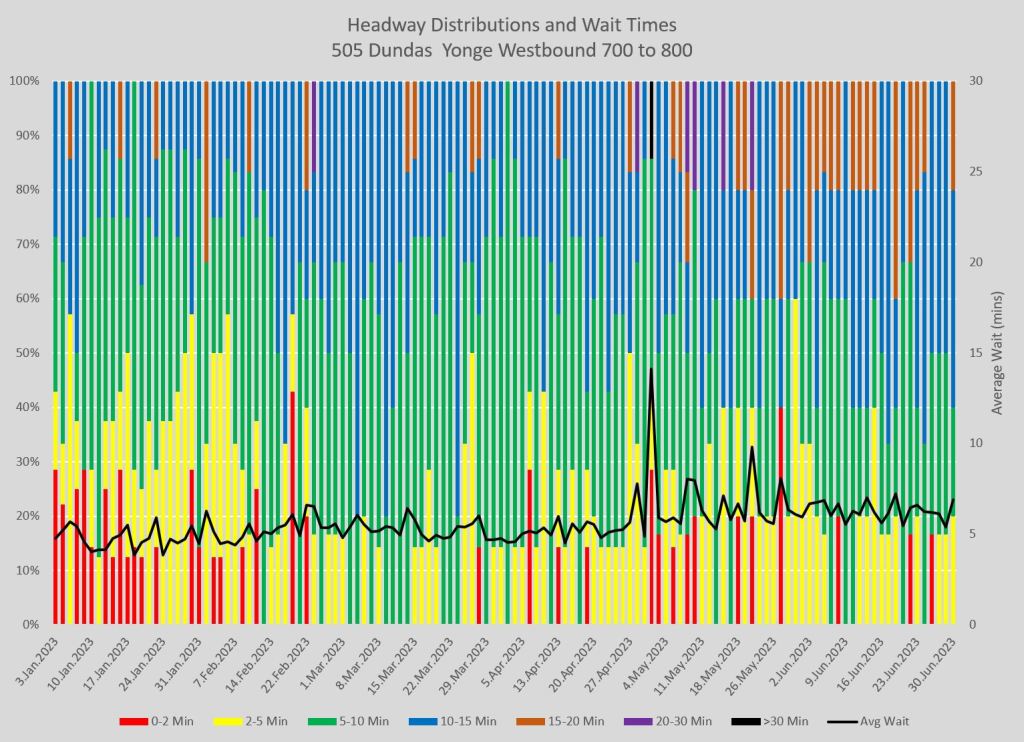
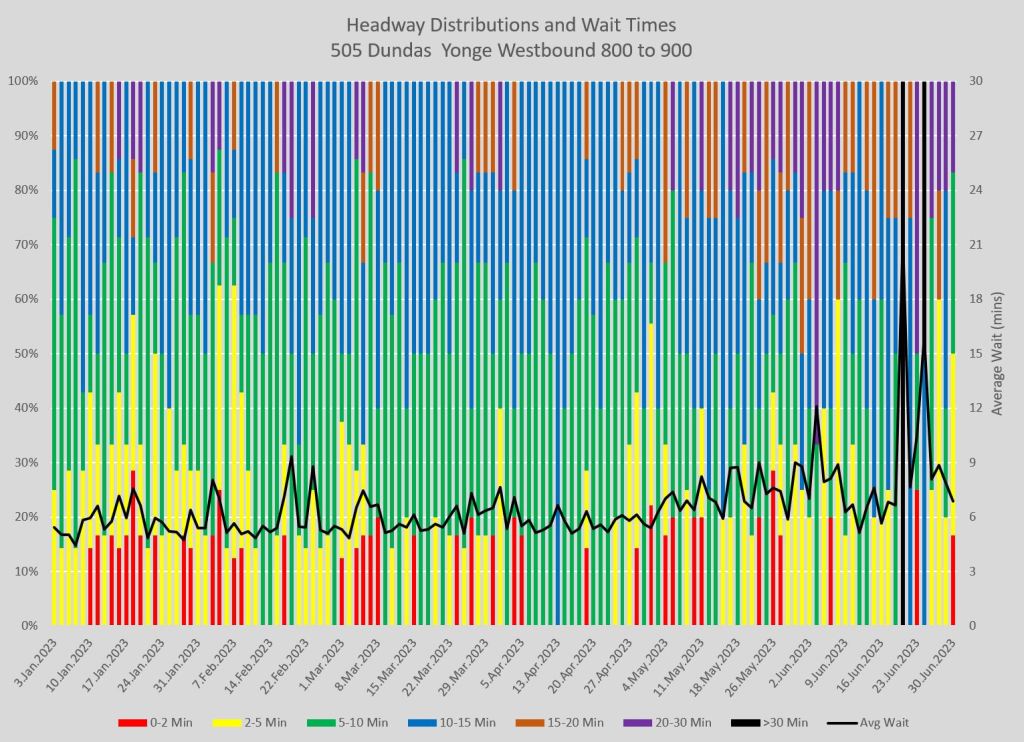
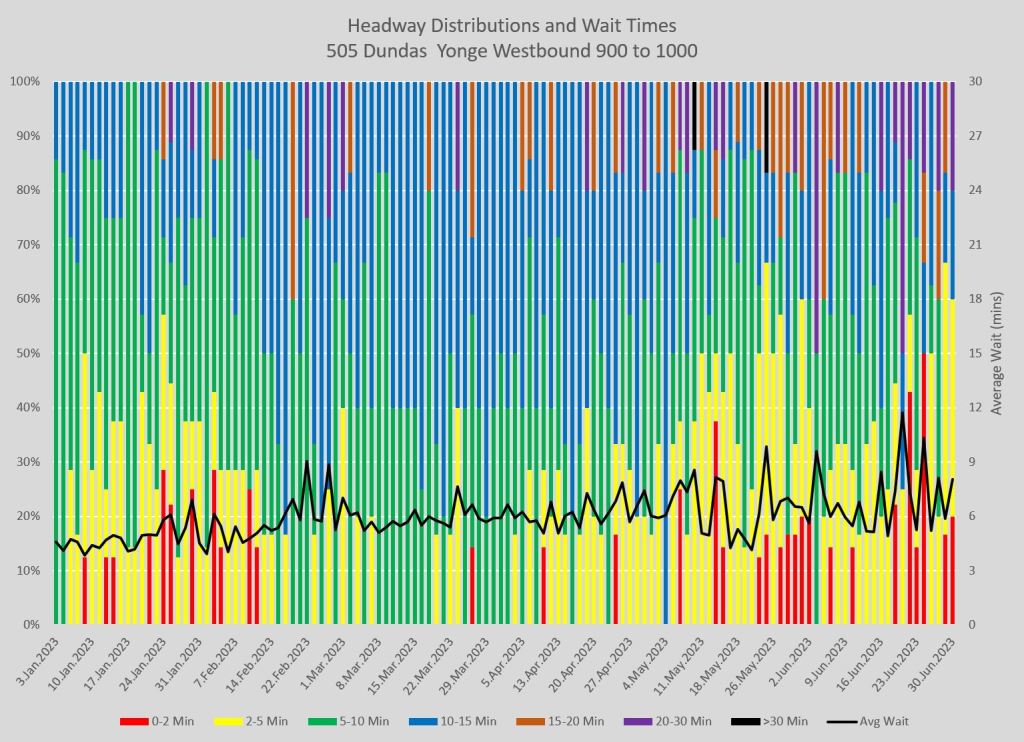
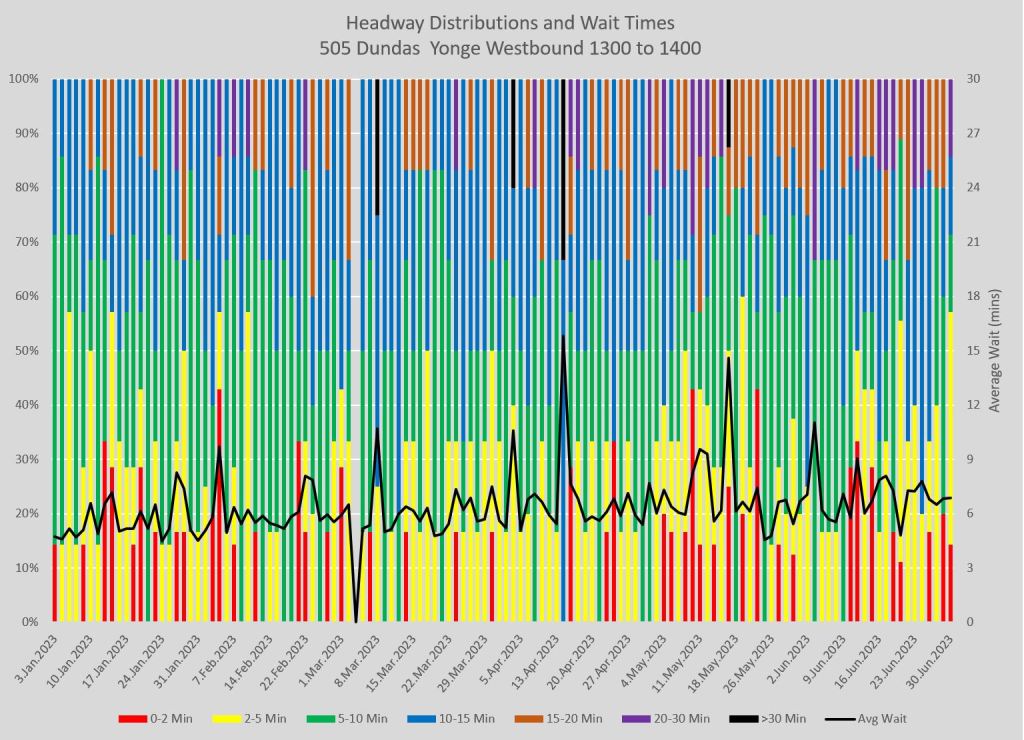
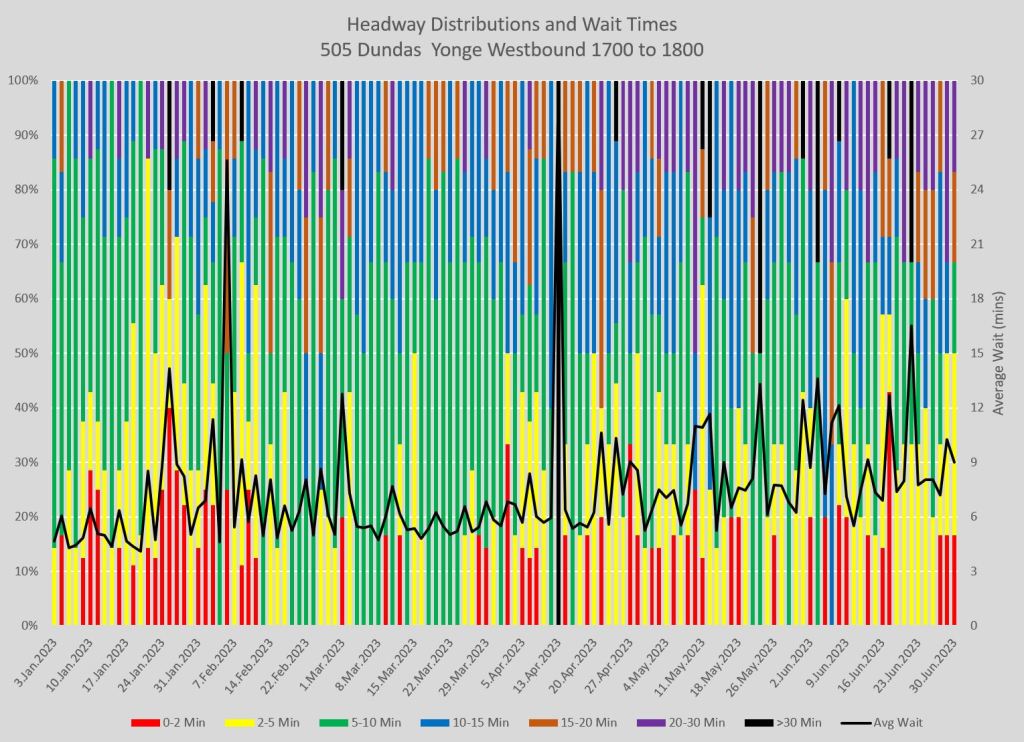
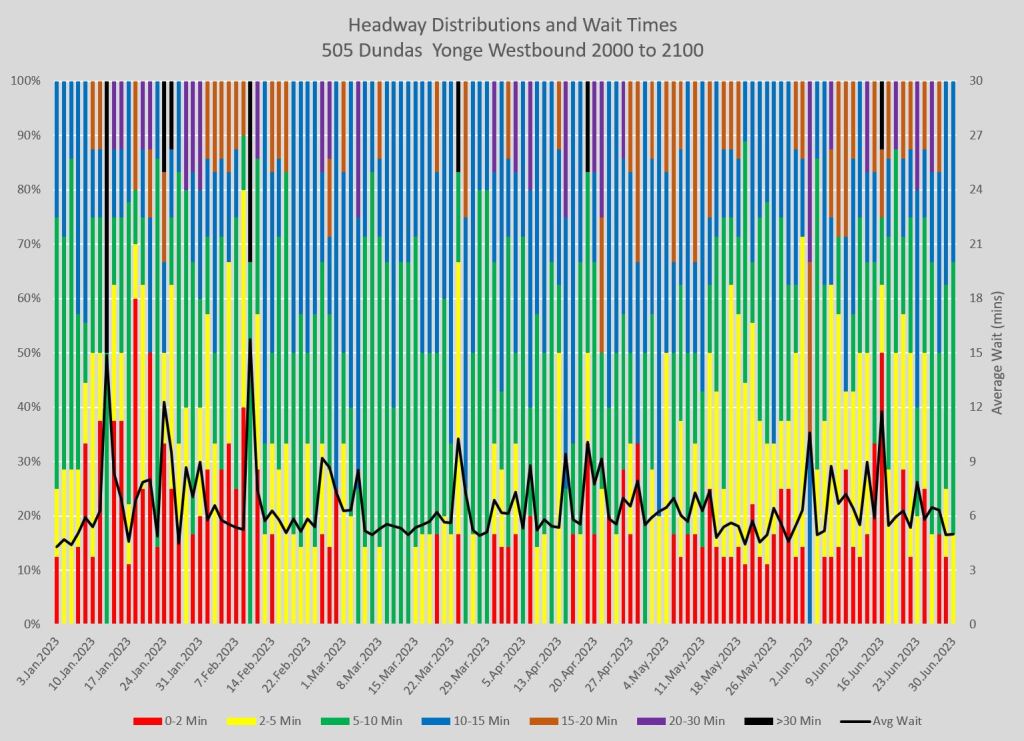
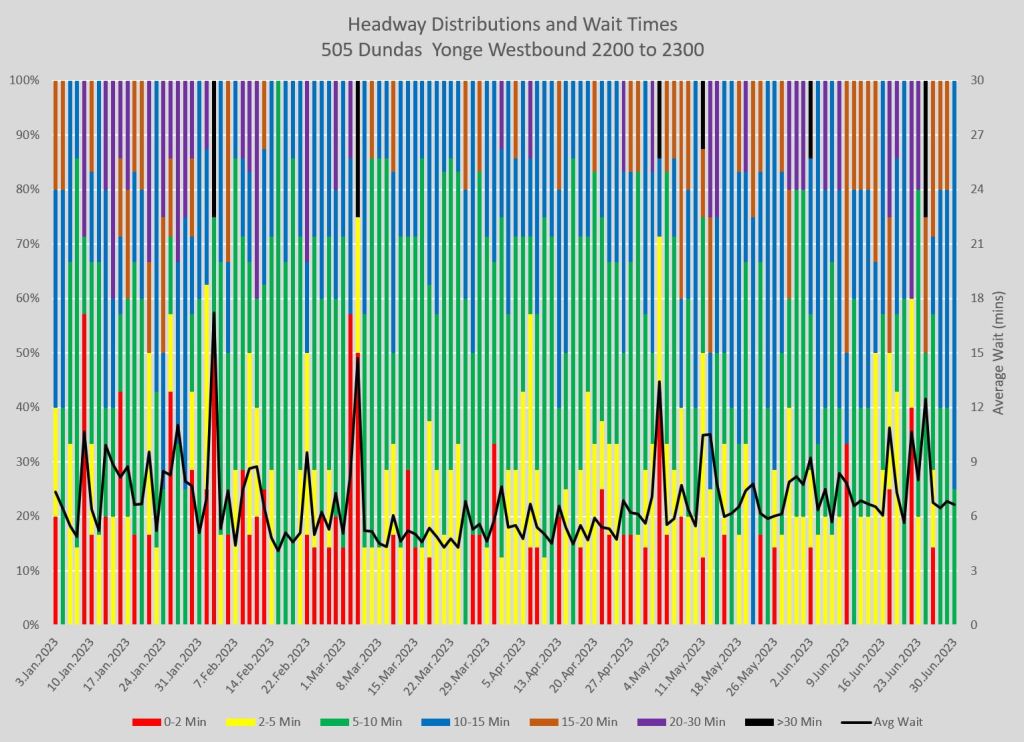
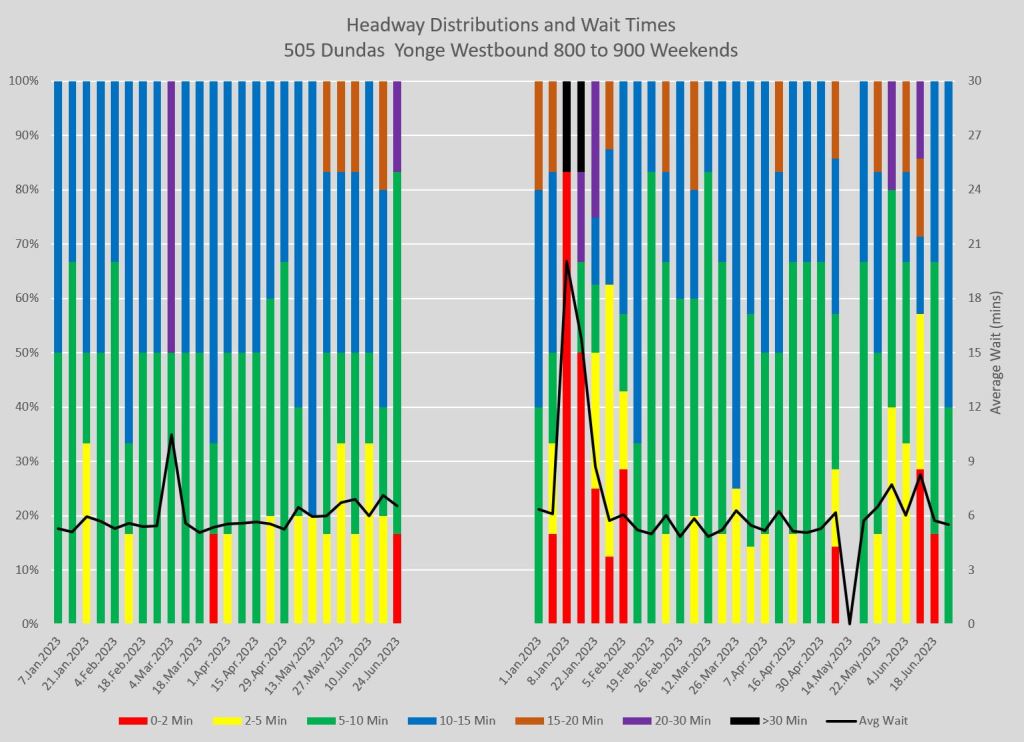
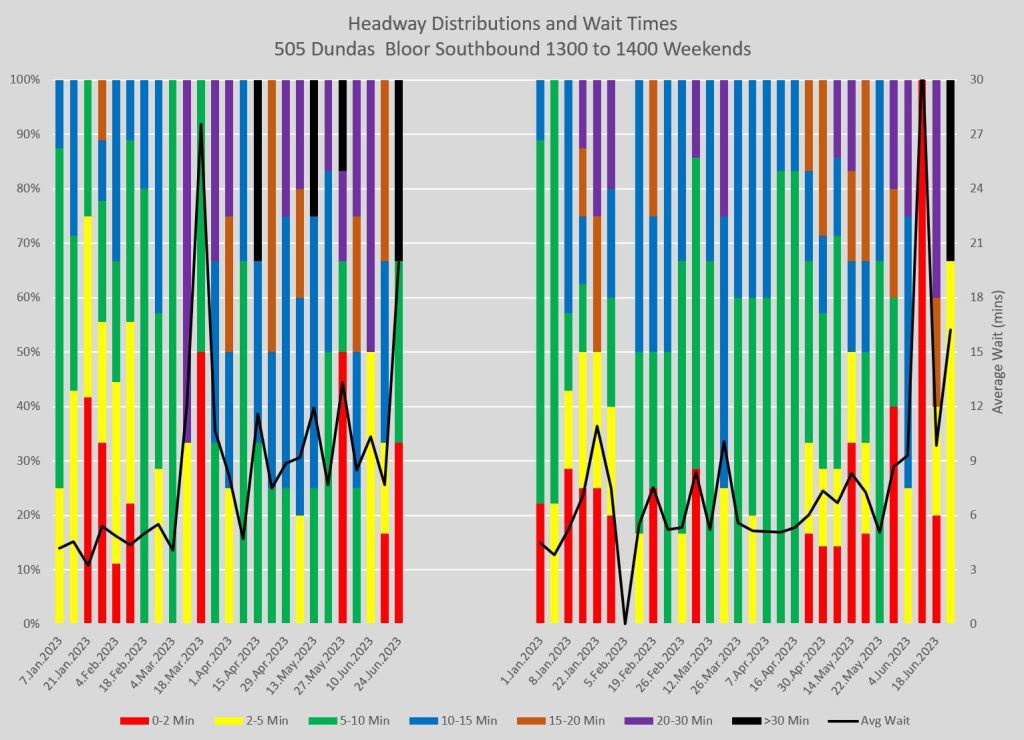
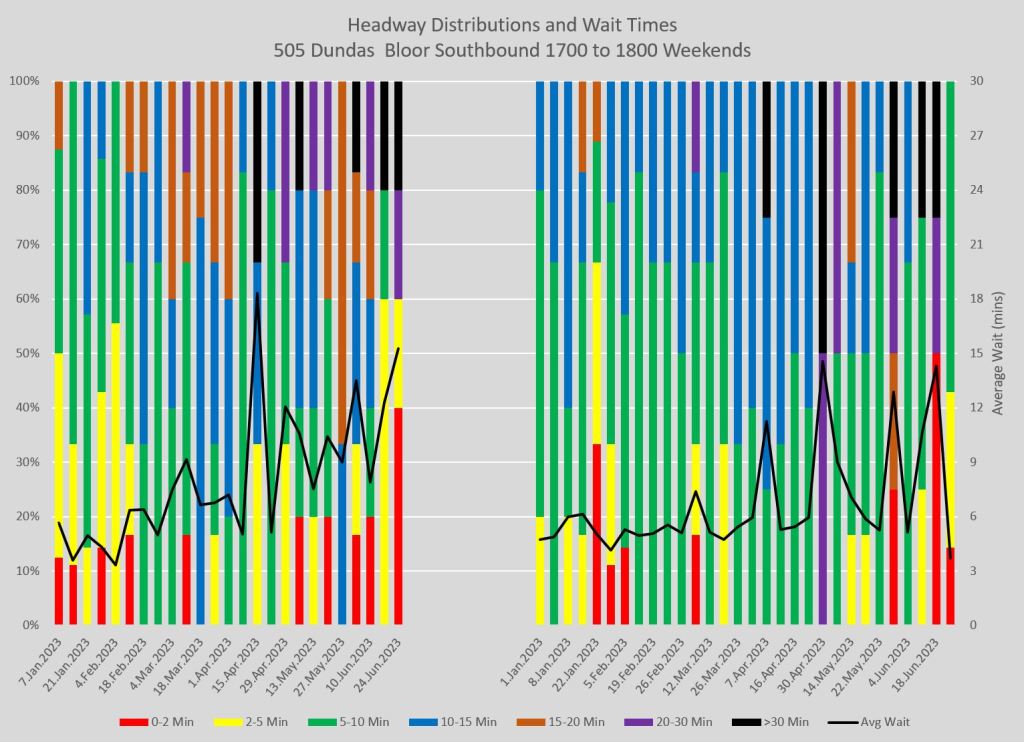
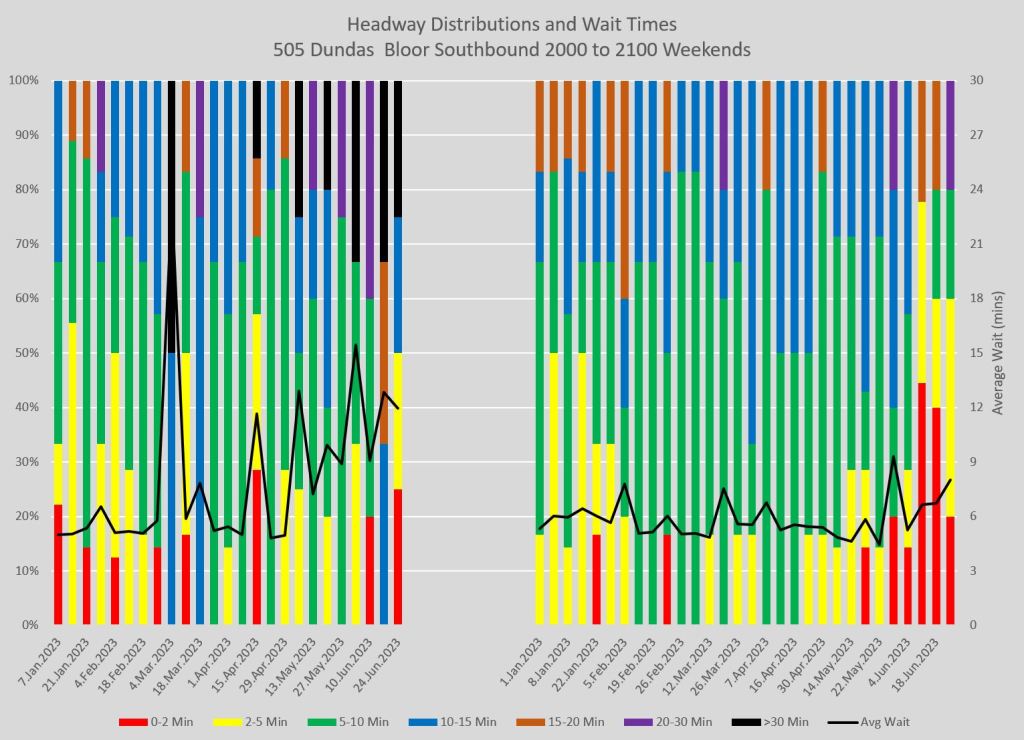
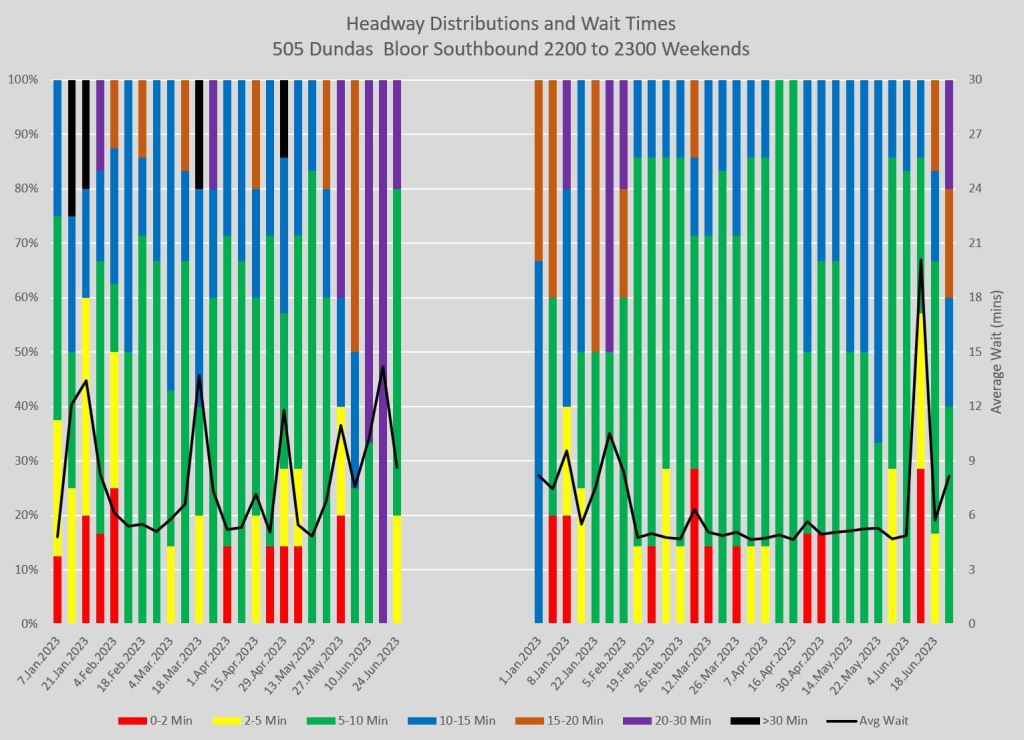
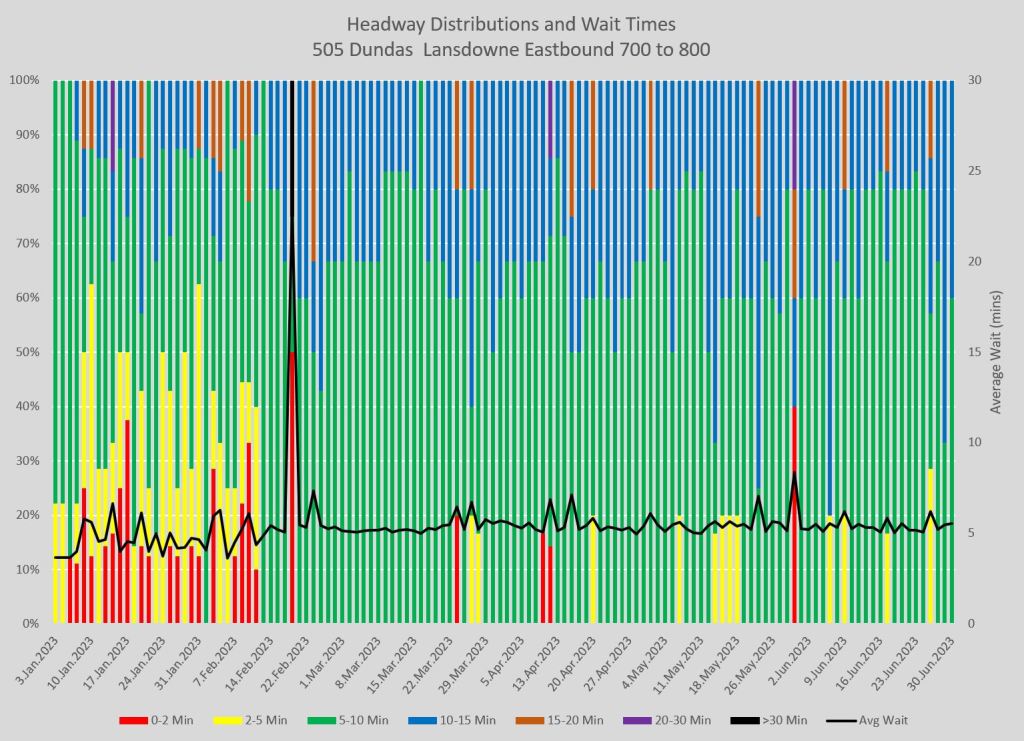
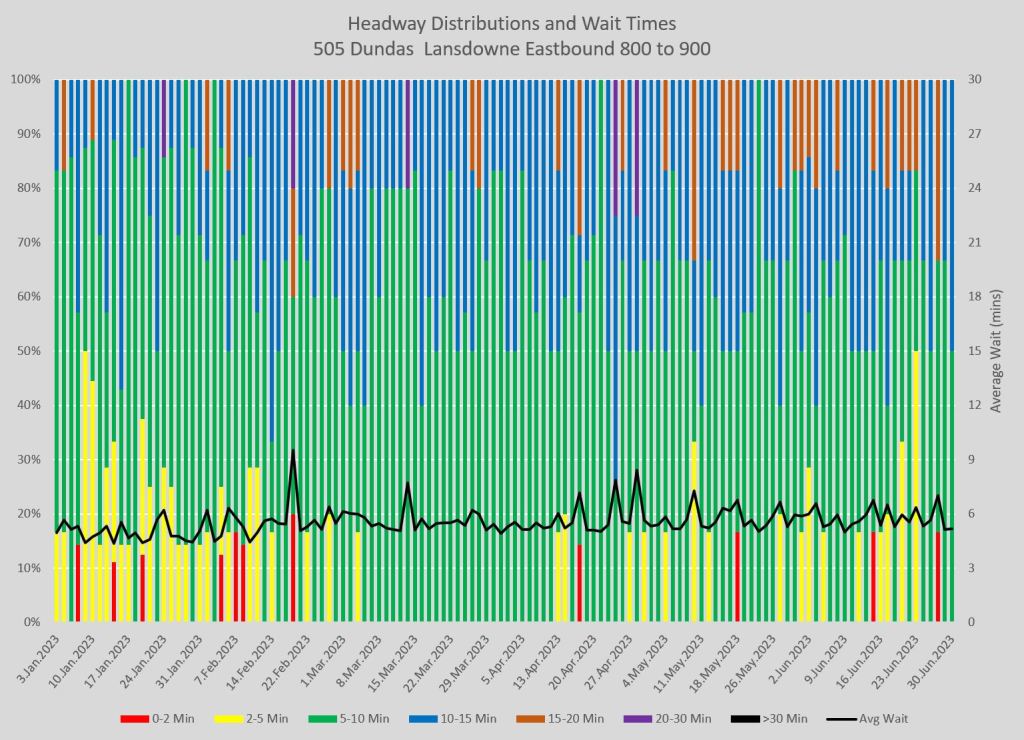
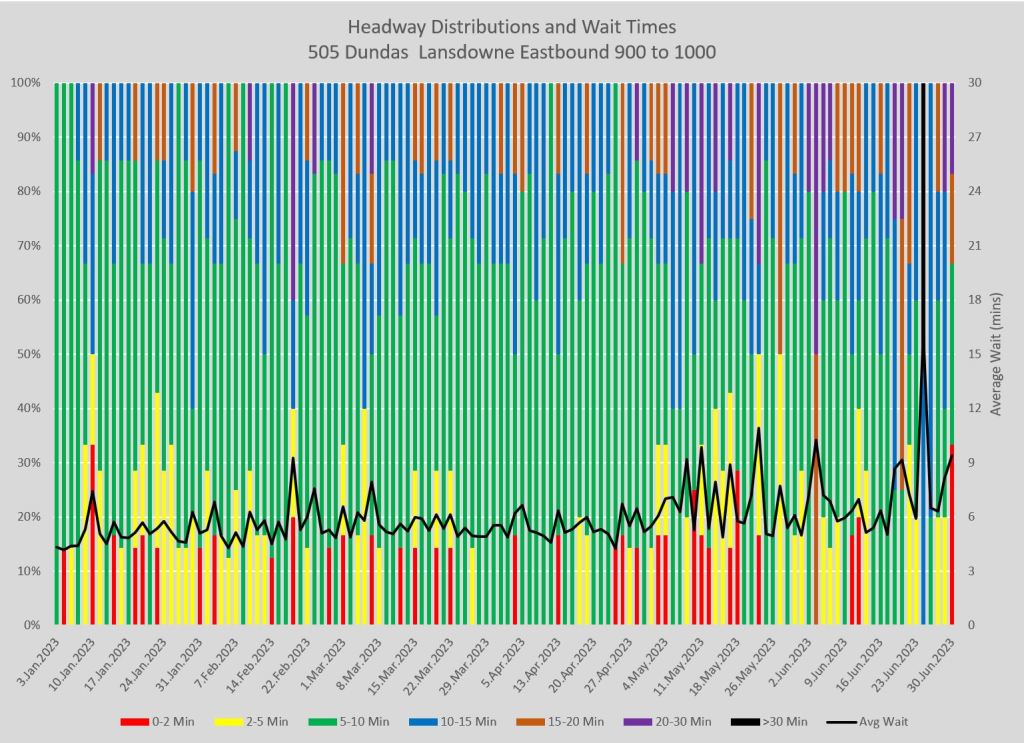
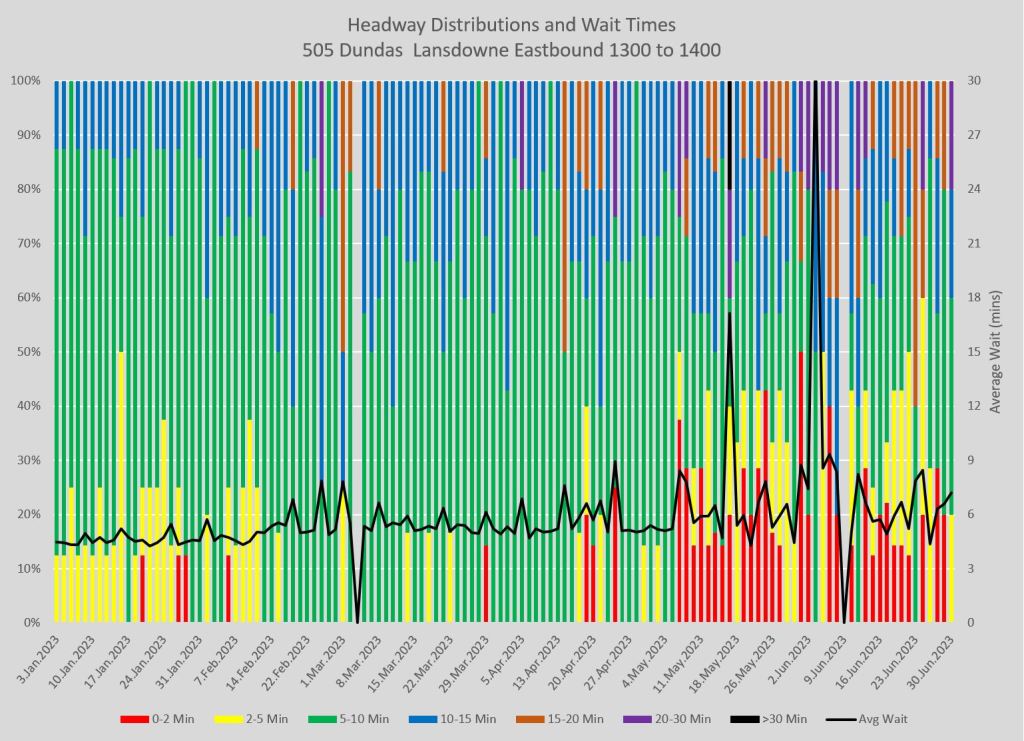
For a scheduled service every 10 minutes, one would like to see most vehicles arriving on that spacing give or take a few minutes. Very short and very long headways are not desirable. In the charts, each column represents one day’s data for the hour shown in the heading. Note how the amount of red (under 2 minutes) varies. Similarly, at the top of the chart, the darker colours represent larger values over 15 minutes. Where these colors press down into the body of the chart, wide gaps in service are common.
The black line squiggling across the charts is the average wait time which, as explained above, is not the same thing as the average headway.
The Bingham Loop charts combine data from 503 Kingston Road weekday peak and midday, and from 22A Coxwell at other times for days up to May 6. All other data come from the 505 Dundas car.
Service Leaving Bingham Loop
AM Peak
The three charts below show how service evolves from the early AM peak into the mid-morning service. Between 7 and 8am, the average wait time shows some variation but remains fairly consistent. There is a jump effective with the change to 505 streetcar service when the scheduled headway increased to 10′, but the values are fairly consistent.
In the 8 to 9am hour, there is a visible change in the streetcar values especially at the beginning of the new route design. This becomes even more pronounced after 9am.
Afternoon and evening
Service after May 7 in both the 1 to 2pm and 5 to 6pm hours is much worse than in January to April. In some cases, so much service short turned without ever reaching Kingston Road east of Woodbine Loop that averages over 20 minutes were seen on some days.
I did not begin to pull tracking data for 22 Coxwell until April, and so the left side of the two evening charts is blank. However, the service after May 7 is substantially worse than before.
Weekends
Weekend service until May 6 was provided by the Coxwell bus, and so the charts show “before” data only from April 1 onward. During most periods shown below there is a noticeable change from April to May-June.
In these charts note that Saturdays are the group of columns on the left, while Sundays and Holidays are on the right.
Service at Broadview Westbound
When the cars reach Broadview & Dundas, they are on the common portion of route with the only difference being the origin of their trips. Until May 6, cars ran from Broadview Station, but from May 7 their origin (at least officially) was Bingham Loop. The effect of the change in the terminus is evident in the the hourly snapshots beginning at 7, 8 and 9am.
From 7 to 8am, the headway distributions and average wait times vary little before and after the cutover date. However, in the 8 to 9am data has a more ragged average wait time line and an increase in headways over 15 minutes. By 9am, the average waits are even more variable and the proportion of trips with headways of 5 minutes or less is much larger than earlier in the day.
Visible in these and later charts is the effect of the mid-February schedule change which widened many headways but also provided more running time in selected periods.
Weekdays
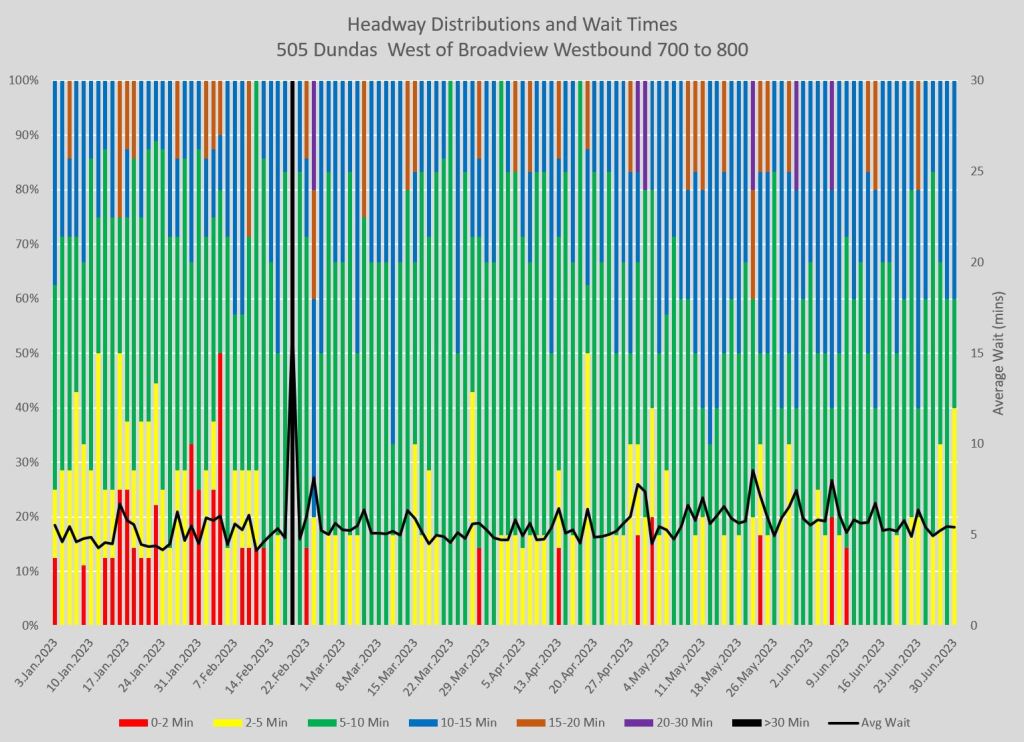
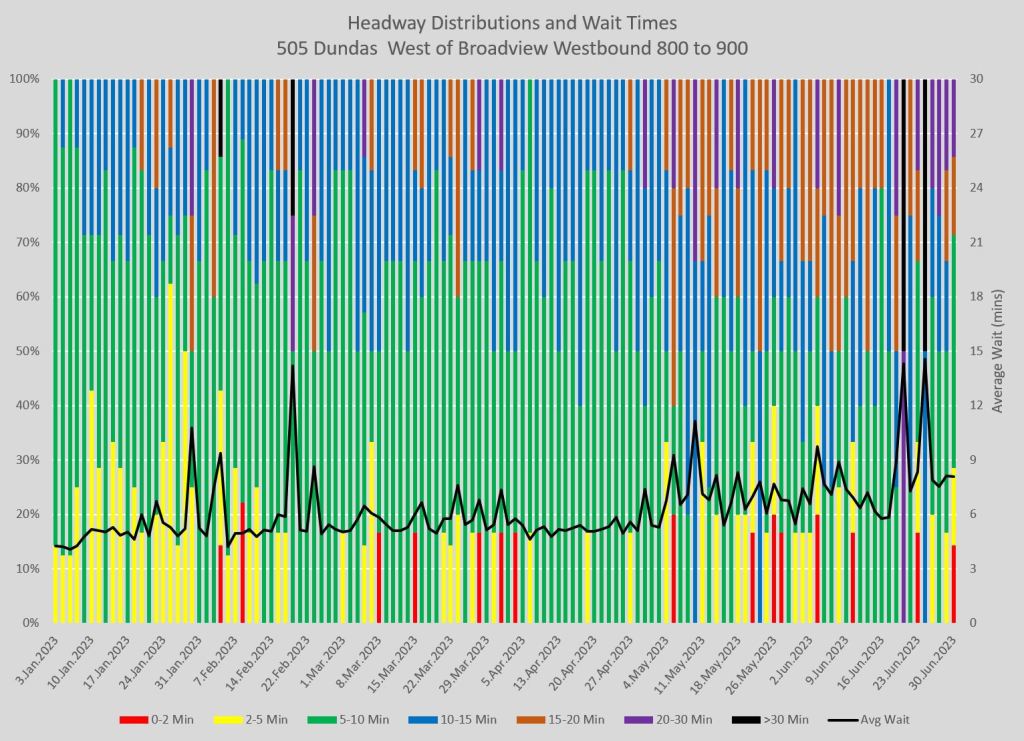
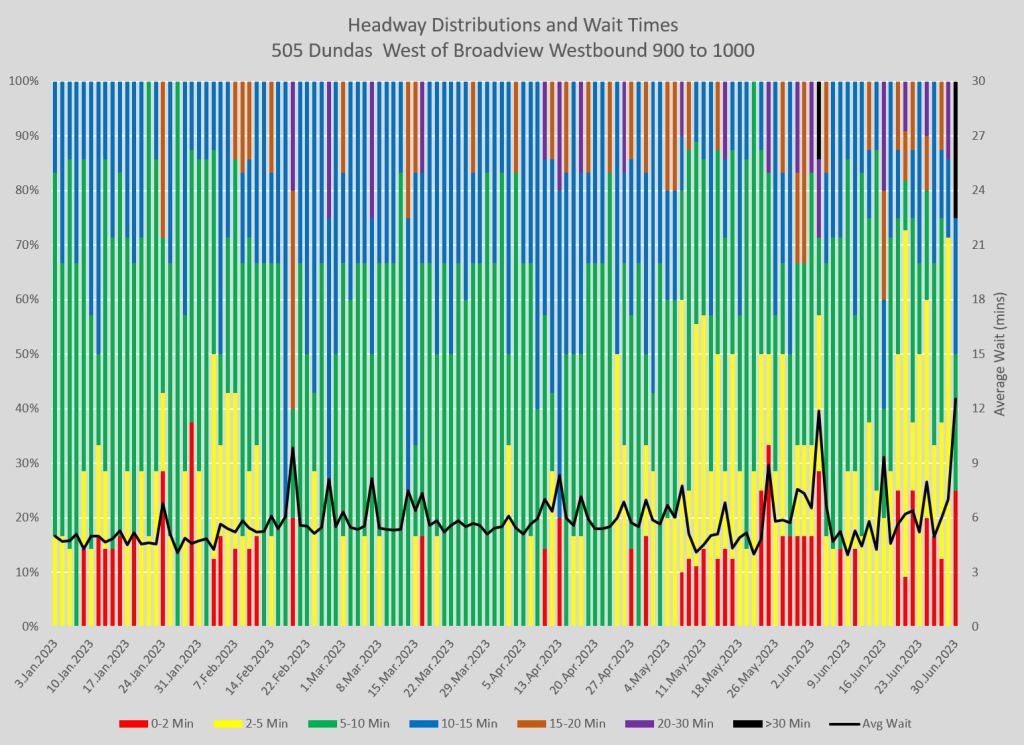
As the day wears on, the pattern is similar although the “before” data show less than reliable service especially in the winter months with some late evening gaps over half an hour. 505 Dundas had reliability problems before the Bingham extension.
Weekends
There are spikes in the average wait times on various dates in both the before and after periods, there is an increase in long headways and bunching during many periods in the “after” portion of some charts.
Service at Yonge Westbound
By the time the service reaches Yonge Street, the headway reliability is driven less by the Bingham extension than by the basic problem that service will become more bunched the further it is from a terminus. Average wait times are particularly bad in the 5 to 6pm weekday period.
Weekdays
Weekends
Service Leaving Dundas West Station Loop
Dundas West may be at the far end of route 505 from Bingham Loop, but the effect of the extension and the scheduling problems was felt in the west end because cars short turned without reaching the terminus. As on the east end of the route, reliability was already a problem at Dundas West Station, but it worsened after May 7.
Note that the screenline for these measurements is at Bloor Street after cars have left the station.
Weekdays
After 9am, average wait times at Dundas West become longer and considerably less reliable. Aside from the obvious link to the Bingham extension, this is a commonly-seen problem on routes that become disorganized through the AM peak and then provide irregular service, especially at terminals, in the hour following. By 1pm the service is slightly more reliable, but the average wait times are still above the “before” period.
Service in the afternoon peak was already unreliable, but ironically improved for a few weeks in May. Evening service settles down compared to the peak, but there is more bunching.
As on previous charts, the effect of the mid-February schedule change is easy to spot.
Weekends
Service at Lansdowne Eastbound
Compared to the service at Dundas West, service eastbound from Lansdowne is fairly well-behaved although the PM peak does have problems. The effect of the mid-February schedule change is quite evident with reduced bunching in most periods.
Service here is less irregular than at Dundas West because this is the most common short turn point for service in the west end.
Weekdays
Weekends
Service at Yonge Eastbound
As with the westbound service at Yonge (above), the eastbound service shows the cumulative effect on trips east from Dundas West. Average wait times are irregular from day to day particularly in the PM peak. The Bingham era of the service is similar to the pre-diversion period on weekdays, although some weekend time periods are worse in May-June.
Weekdays
Weekends


Looks like the 505 Bingham experiment is a bit of a flop. Why not just bring back the 503 streetcar to York (or Spadina) from Bingham? Seems the best way to solve some of the troubles.
Steve: The 503 has already returned as a bus, and will become a streetcar again in October.
LikeLike
Thank you for sharing, Steve. It is very interesting to me (but not surprising) that the longer the streetcar routes the more unreliable they are. Why not break the 501, 505 and 506 in Downtown Toronto and establish new lines to serve the other half of the line? It could also be an opportunity to use some of the operational track connection for regular streetcar service. There are so many possibilities in Downtown Toronto and with some more tracks, e.g. in front of Union Station, more direct connection would be possible. Do you have some statistics on ridership? Are actually a lot of people using the streetcar through downtown? How much of a burden would it be to break the routes into two?
Steve: I do not have ridership data because TTC, in spite of repeated requests, does not make it available.
Splitting routes is tricky because there is always an issue of how many riders originate one side of downtown bound for the other, and therefore would face a transfer where they now have a one seat ride. I can think of several instances of this. A particular example is on King where the overlapped 504A and 504B provide frequent service to the areas around the Distillery and especially to Liberty Village both of which are employment as well as residential centres. (I am using “Distillery” to embrace a fairly wide area here.)
501 Queen is easy to break, especially if the TTC ever builds a loop planned years ago for property they own at Queen and Broadview that now hosts a parking lot (east side, just north of Queen). That would provide a central overlap area from west of University (McCaul Loop) to Broadview. However, this route is going to be subject Ontario Line construction for some time, and this complicates things.
505 Dundas is harder to split particularly west of Yonge, and also has the problem that its eastern “half” is relatively short.
Union Station is not a location that is close to any of the routes you mentioned and frankly I do not see it as a destination for traffic from the east-west streetcar lines considering that the subway already provides that.
LikeLike
So since this diversion started, the bridge was only actually closed to streetcars for one week.
Just one week it was closed and otherwise it was open for turns and run-ins/run-outs but not used for service at all. This baffled me!
Steve: It is not unusual for the TTC to announce a diversion for work that occurs on a different or shorter schedule. On point about the job was that they placed new concrete around the expansion joint that was repaired at the east end of the bridge. Normally, they prefer to not operate any service over fresh concrete so that it will set properly. This would be of particular importance at a location where vibration would be common. That will explain some of the delay in re-opening.
What surprised me was that they did no work on the special work on the west side of the bridge. This track is due for rebuilding soon and has already had some spot repairs. This would have been an ideal time to fix both ends of the bridge during a single closure.
LikeLike
Hey Steve, Just a question, why don’t you maybe try starting a Youtube channel and make Youtube videos about these topics as that would allow to also turn these blogs into audiobooks as well since People today have the attention span of mud, giving people something to visualize is valuable.
Steve: While I realize that there is a strong love for visuals as opposed to text here on the net, the nature of a lot of what I write does not lend itself to that type of presentation. A brief overview maybe, but for details you need text and graphics that readers can pore over without me dictating the pace or focus.
The particular topic of this article on which you comment has a huge amount of data behind it as well as a raft of charts that illustrate my points. There is really little served by adding my smiling face or voice over.
LikeLike
I doubt that you, of all people, are surprised at the total lack of ‘connections’ in TTC planning! There are several sections of bad concrete around TTC tracks along King (often the concrete between track and asphalt.) It is very rare to see them trying to repair these when that section of track is not being used because of other (often larger) projects. They then, sometimes, days or weeks later, either stop all service for additional days or have flag-people and slow streetcars to a crawl. (Of course, in the latter case the concrete has no time to cure properly so it fails again soon!) The TTC needs to think, and think again!
LikeLike
The public should question the TTC Commissioners board, on how they’re allowing TTC planning department to plan like this.
TTC has always had enough operators and equipment to restore 100% of service pre pandemic levels.
Matching capacity to demand only has operator parked at subway stations waiting to be called by a supervisor to fill a gap.
There is no savings on the budget.
Steve: Yes, there is a great shell game going on here between service standards, the lack of accountability for RAD buses and the cost/capability of restoring service.
LikeLike
Was the whole reason for running 506 and 505 on a tour of Queen East to get them to a loop with driver facilities? That Broadview-Queen loop would have been really useful…
Steve: There is no washroom at Woodbine Loop, and so the original plan for the 506 would have required ops to pop out for a break at Russell Carhouse. It did, however, allow for an off-street terminus rather than parking on Parliament Street.
LikeLike
I’m curious as to why they didn’t have the 506 Carlton car go to Kingston road loop instead of the 505 as it would make sense given the proximity of it to Main Street.
Steve: In theory, both of them will go to Woodbine, although depending on running time issues, the 506 might not make it that far. They have not decided yet.
LikeLike