Bunching & Gapping: AI To The Rescue?

In a previous article, I examined the report on the Bunching & Gapping pilot now in progress at the TTC.

At the November 3 Board meeting, there was almost no discussion of that report, but in its place management provided a short presentation. Unfortunately, this portion of the meeting was not uploaded to YouTube, and so readers will not be able to view it for greater detail.

Information about hot spots on routes was presented in a different way from the original report. Both versions are shown below.
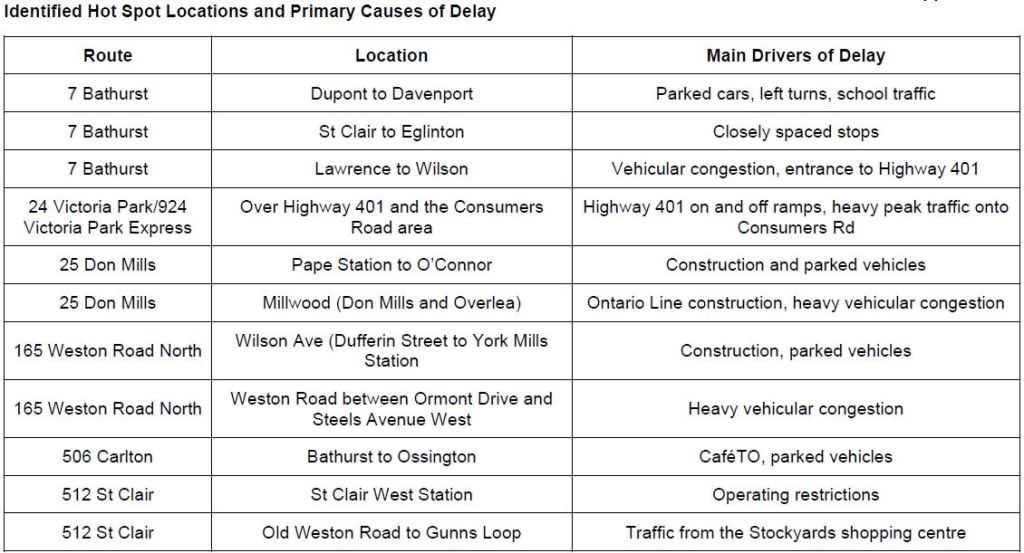
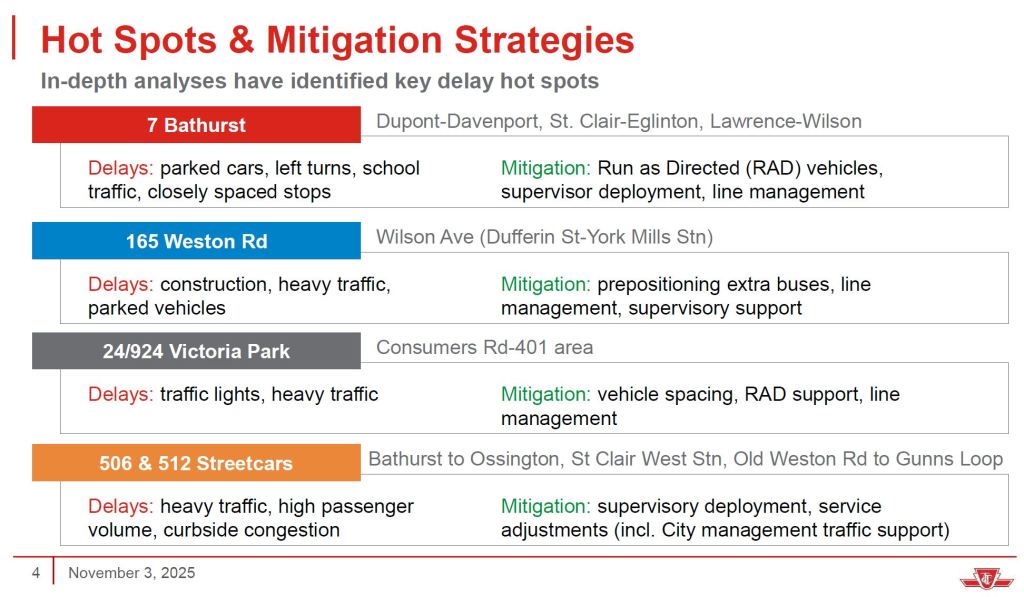
The original version has more granularity showing the issues specific to each route segment.

The presentation shown at the meeting included a hot spots map across the whole system, but this is not included in the published deck. I will ask TTC for a copy and add it here when available.

The important point about that map is that the hot spots are all over the city, while conventional wisdom presents this more as a downtown, streetcar-centric problem.

Results on the pilot routes have been mixed, and even this has required a high level of supervision that likely would not scale to the entire system and most hours of service. As an alternative, the TTC is considering an AI (Artificial Intelligence) tool developed at York University. Initially this would be used in an advisory manner to route supervisors who would decide whether its recommendations were valid. Later, it would directly instruct operators to hold enroute to even out headways.

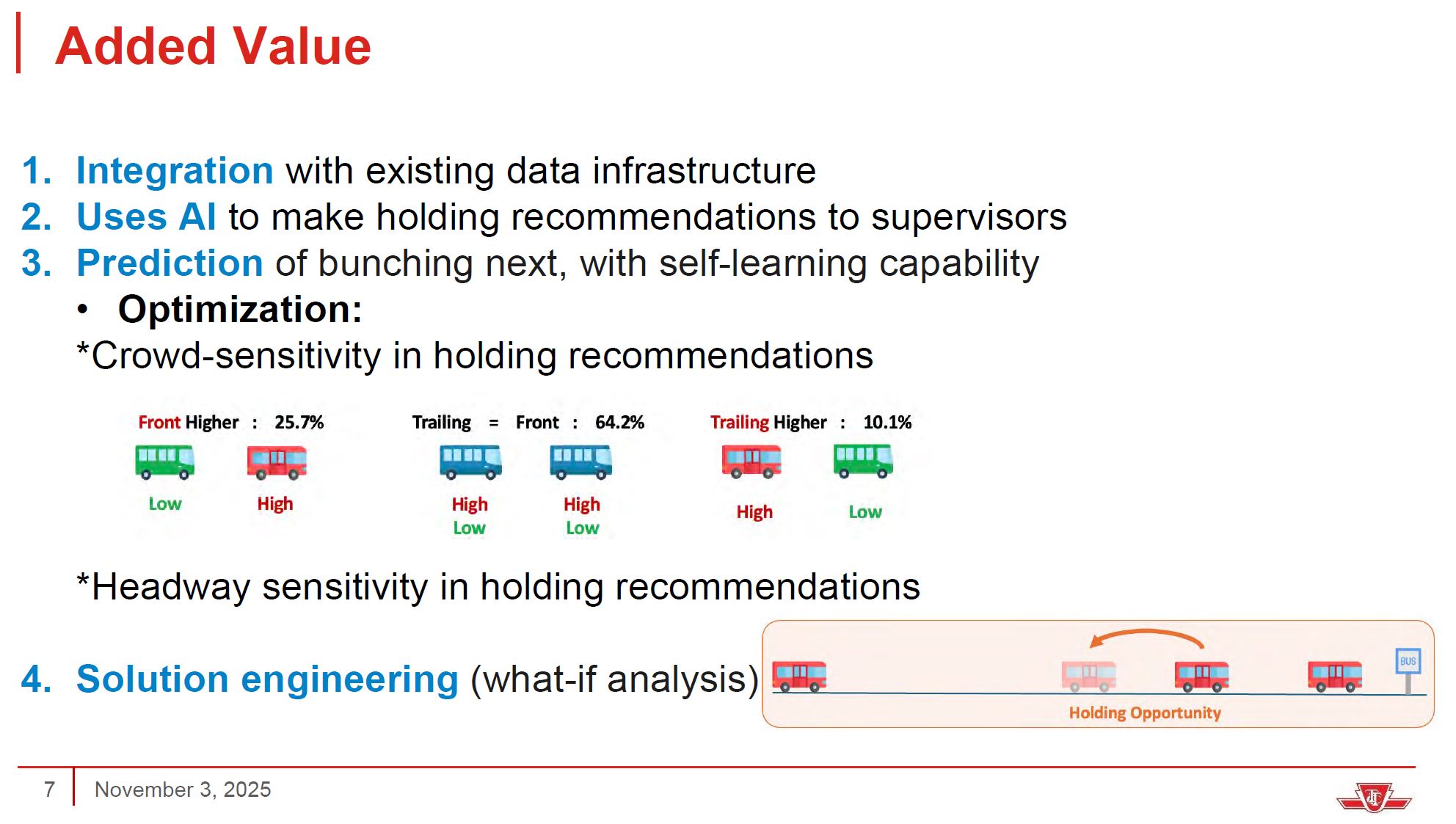
A decision to hold a vehicle would take into account the relative loads of the leading (gap) bus and the trailing (bunched) one. Ideally, a bunched bus will have the lighter load and holding it to space service will affect fewer riders. This is not always the case if pairs of buses leap-frog to share the work along a route, and the “trailing” bus might have the heavier load at some points.
A proof of concept dashboard gives an idea of what might be presented to a route supervisor. This shows recommended holds, as well as the distribution of historical and predicted bunching. Note that the scale on the chart is the number of bunched buses, not the gap size to be corrected.
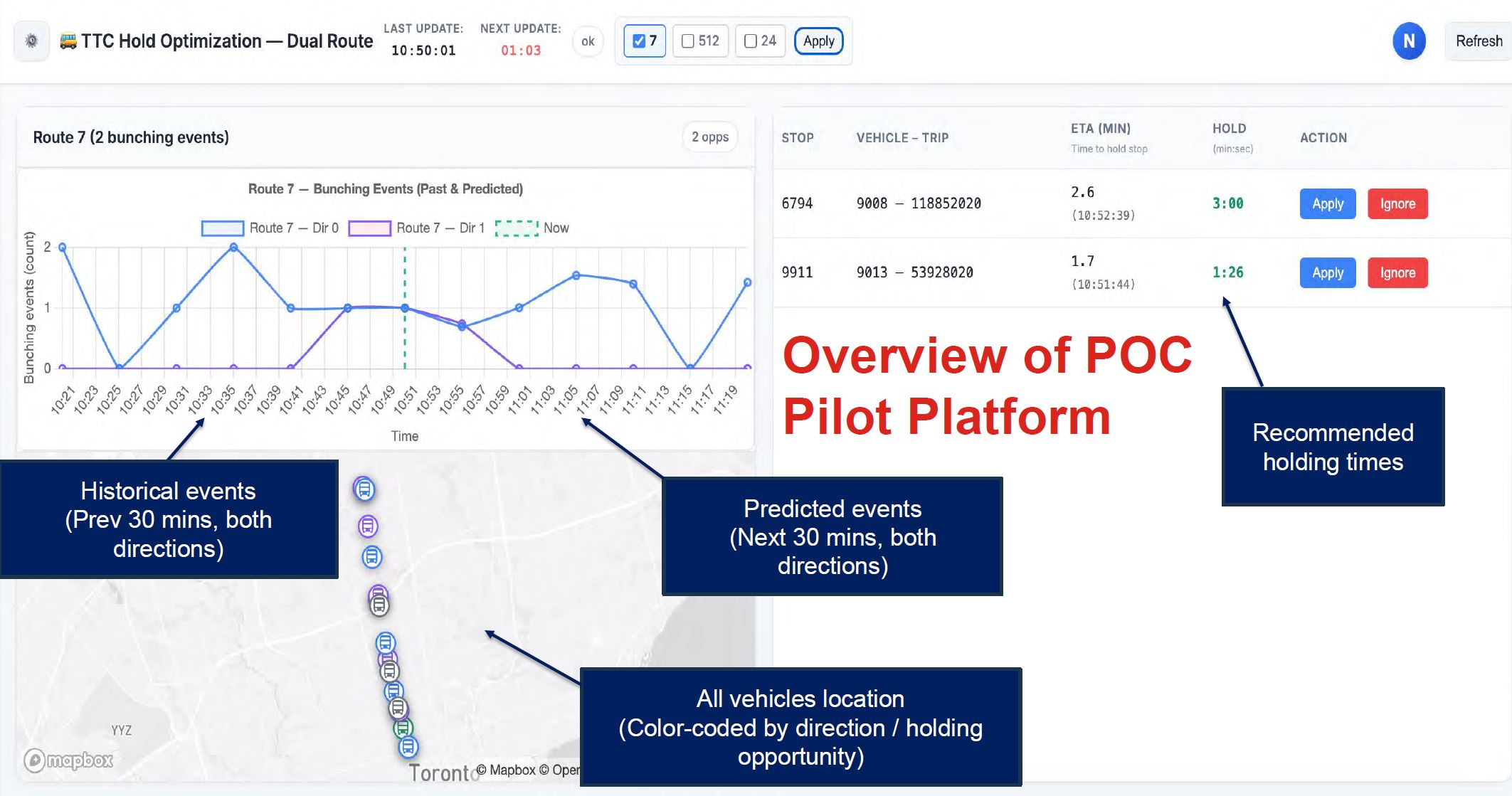
The challenge here will be for the AI model to predict future behaviour. Many things affect bus spacing, and some of them are not predictable. For example, irregular terminal departures can begin a process where a small gap gradually widens. That effect can be predicted and service adjusted, but the actual late or early departure is only known when it happens. Developing gaps are easy to spot along a route because the future service at a location can be predicted by what is in the few kilometres approaching it.

Congestion caused by accidents cannot be predicted, but the act of smoothing out service can deal with its results at least in part based on past experience with similar events. There is no mention of short turns or tracking of issues with buses running late due to insufficient schedule time, or the timidity of a junior operator.

Notable in the presentation is the implication of headway management, not on-time performance. The TTC needs to decide which of these it will adopt and incorporate that into terminal dispatching.

There is also the question of whether the Service Standards are too generous in defining the allowable variation in “on-time” and “headway” values. Departures are supposed to be no more than 5 minutes late, and never early. Headways on a 10-minute service like 7 Bathurst can vary from 5 to 15 minutes. If the AI tool uses these as its goal, it will perpetuate the uneven service allowed by the standards, particularly in headway management. There is also a danger that route speed will be determined by spacing service to accommodate the slowest drivers.

No computer system inherently “knows” what it is supposed to achieve, and depends on the parameters set down by its developers. If the TTC does not fully understand what “good service” should look like, an AI tool will only work toward expectations built into its design. An important component should be the ability to tighten or relax the targets for “good” service management.

TTC plans to shift the focus of its more intense supervision from the 7 Bathurst and 24/924 Victoria Park routes to 29/929 Dufferin and 25/925 Don Mills. I have collected tracking data on these routes for some time, and will publish analyses of changes in route behaviour after a few months have accumulated.

The Board approved the following motion:

Request TTC staff report back to the TTC’s Strategic Planning Committee as a part of consideration for 2026 budget priorities on the resource requirements, staffing, and operational needs to sustain a full-year Bunching and Gapping Pilot in 2026 as well as the feasibility of expanding the pilot to additional key routes across the City to improve service and reliability.

The next meeting of the Strategic Planning Committee is on November 25, 2025.
TTC Bunching and Gapping Pilot

The TTC has a pilot program underway on several routes with increased supervision in an attempt to improve service quality by addressing service gaps and bunching. These are complementary effects in that a gap is often followed by a bunch, although gaps can also occur due to missing vehicles and short turns. See:

The pilot evolved over the year as some of the challenges and resource needs to manage service became apparent.

March 2025Pilot launched on 7 Bathurst, 24 Victoria Park, 924 Victoria Park Express, 25 Don Mills, 925 Don Mills Express, 29 Dufferin, 929 Dufferin Express, 100 Flemington Park, 165 Weston Road North, 506 Carlton, 512 St Clair.
Dedicated staff to manage each route were not used initially and results were poor.
June 2025The pilot was scaled back to 7 Bathurst, 24 Victoria Park, 924 Victoria Park Express, 506 Carlton, and 512 St Clair.
One route supervisor was assigned to each route.
September 2025100 Flemingdon Park and 165 Weston Road North were added.
October 2025Pilot “refined” to focus on the weekday peak periods.

The TTC recognizes that delays leading to gaps can be caused by several effects: “including including Operator behaviour, customer incidents, traffic congestion, city events, construction, and operational factors, such as door/ramp operations.” [p. 2]

Later in the report, there is mention of the effect of passenger loads and long traffic signal wait times.

If vehicles are crowded either because service is inadequate for demand, or because a gap creates an extra load, they will take longer at stops. Filling vehicles to the brim can be counter-productive and inefficient. Space limitations onboard can delay passenger movement especially for those with large objects (e.g. strollers, luggage) and mobility devices. Although ramp operations are mentioned, there are many other types of passengers with extra space and boarding time needs.

Transit signal priority is also mentioned, but there is no indication of where or what priority measures were added on the pilot routes.

The remainder of this article reviews the metrics used by the TTC to track the success of the pilot project, as well as problems and actions that might be taken to resolve them.

Continue reading

Bathurst Street Proposal Update: September 2025

On September 18, 2025, Toronto & East York Community Council will consider a report recommending a revised proposal for speeding up bus service on Bathurst Street.

Back in July, the original proposal would have seen red transit-only curb lanes in both directions from just north of Bathurst Station to Eglinton Avenue. This proposal encountered substantial opposition, and the revised version is intended to improve transit and traffic operations when and where it is most needed in that segment of route 7 Bathurst Bus. There is no change proposed for the transit priority scheme for streetcars from Bathurst Station south to Lake Shore Boulevard.

The primary time and location of congestion affecting the south end of 7 Bathurst is in the afternoon, Mondays through Saturdays. To address this, the following changes are proposed:

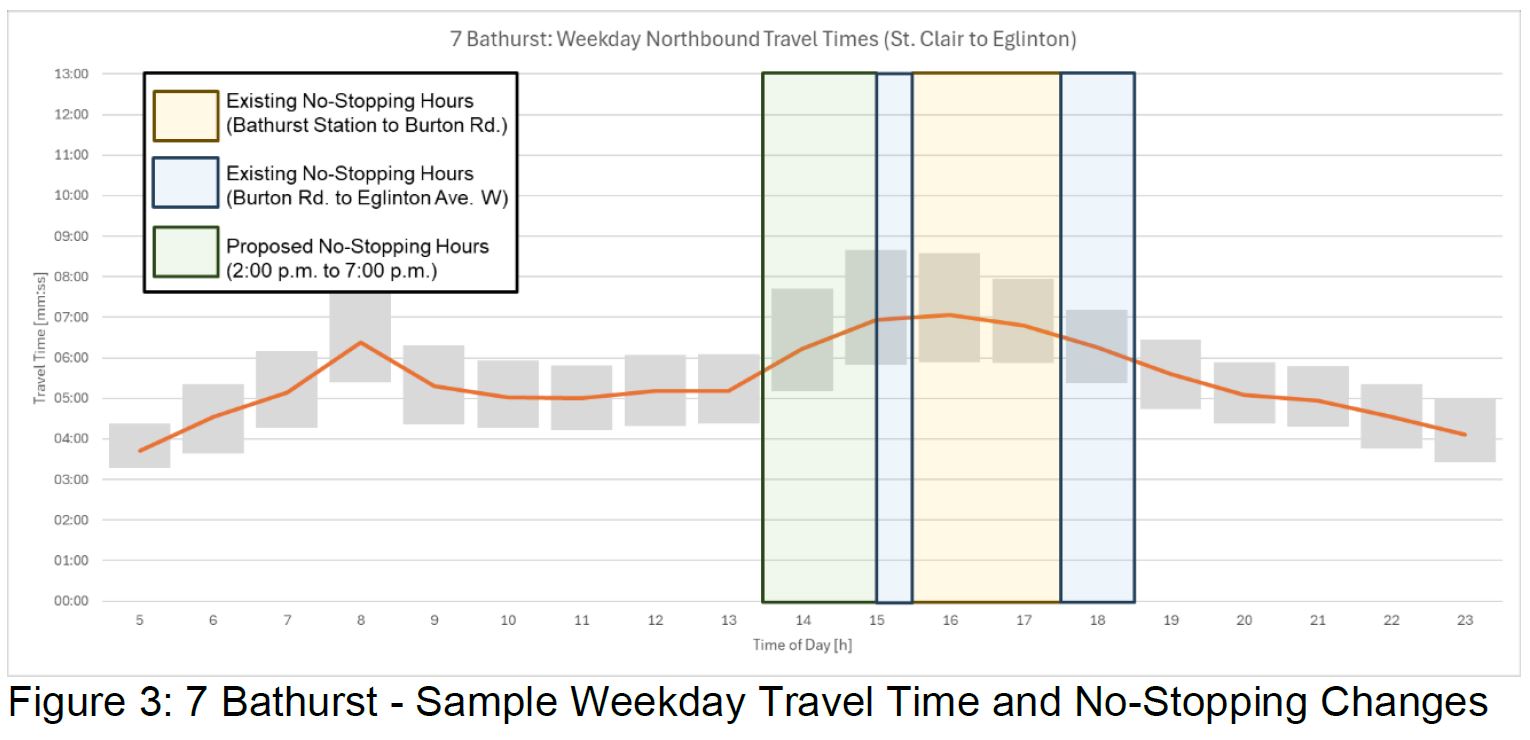
  • No stopping will be permitted on Bathurst Street northbound from the north exit of Bathurst Station to Eglinton Avenue from 2-7pm on weekdays, and 12-7pm on weekends.
  • North-to-west left turns at Bathurst & Davenport will be banned from 7am-7pm Monday to Saturday, except holidays.
  • South-to-east left turns at Bathurst & Dupont will be banned from 7am-7pm Monday to Saturday, except holidays.
  • The existing 7am-9am ban on north-to-west left turns at Bathurst & Dupont will be removed.

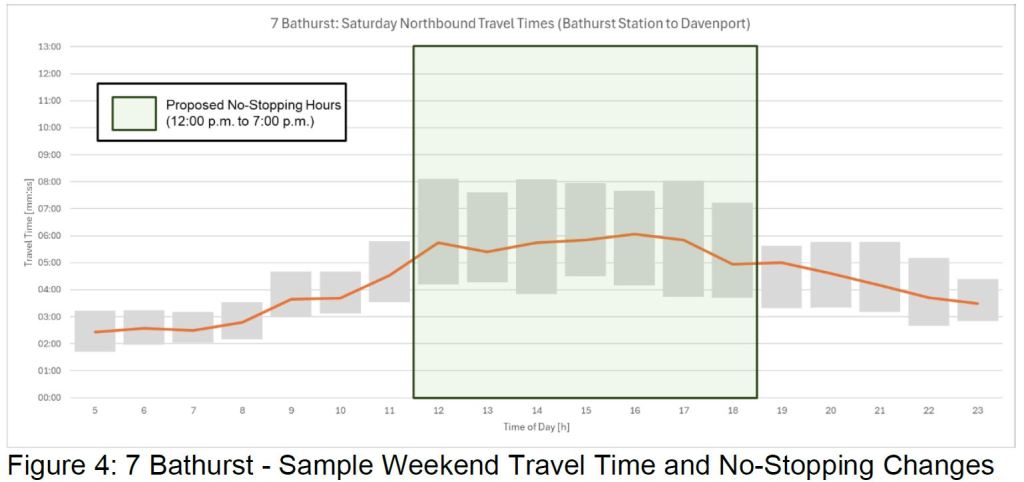
The chart below shows the weekday and weekend travel time profiles for Bathurst Street with the existing and planned hours of “no stopping” overlaid.

Continue reading

When Artics Aren’t Artics

Several routes in the TTC network are scheduled to operate partly or completely with 18m articulated buses in place of the standard 12m varieties seen on most of the system. A problem commonly found on some of these routes is that although the schedule assumes an 18m bus, what actually shows up is a 12m bus with less capacity.

On some routes, the proportion of shorter buses grows later in the day suggesting that for some reason the longer buses were replaced. The number of buses per hour is fairly consistent from day-to-day, and generally matches the scheduled level of service. This means that few extras (or “run as directed” buses) served these routes even though the capacity was reduced by substitution of smaller buses.

This post looks at how often this problem arises on several routes through the month of July 2025.

Continue reading

Travel Speed and Time on Bathurst/Dufferin Part I: 7 Bathurst

In recent discussions of the Bathurst and Dufferin transit priority schemes, a major issue is the degree to which various parts of the routes contribute to slower operation by time-of-day and direction. In this article and two to follow, I will review the actual behaviour of these routes to provide both a basis for discussion of expanding the priority schemes, and as a “before” reference for comparison after they are implemented.

Reviews by time-of-day are useful not just to spot peak period issues, but also as a reference for what might be achieved. At the beginning and end of service hours on most routes, there is no traffic congestion and lighter passenger demand reduces stop service time. Bettering travel times from those periods would be challenging.

Travel times are affected by many factors including:

  • Interference from other traffic on the road, and the degree of congestion for traffic generally.
  • Absence of signal priority and “priority” signals that do not adequately reflect actual operating conditions.
  • Stop service time including both the penalty for stopping, starting and rejoining the traffic flow; and passenger boarding times which depend on the volume of riders and crowding conditions.
  • The proportion of riders with large objects such as bicycles, baby carriages, shopping carts, luggage, scooters and wheelchairs. This affects not just boarding times, but also the ability of passengers to move within vehicles, particularly buses.
  • Slow driving speeds induced by a desire to avoid running early when scheduled times exceed what is actually needed.
  • Posted speed limits.
  • Weather conditions.

Express services have fewer stops and therefore lose less time on that account, but this is only one of many possible factors.

A further consideration is that for the transit vehicle, we generally talk about point-to-point times, but for a rider, “travel” includes access time to and from stops at their origin and destination. Removing stops might speed up buses, but at the cost of longer access time. This is a balancing act depending on local geography, the location of signalized intersections and major trip generators.

Travel Times and Ridership

The relationship between travel times and demand is not exact, and depends on various factors:

  • A substantial reduction in a long trip is more noticeable than a small reduction.
  • For short trips, an improvement in scheduled service and reliability will improve wait times possibly by more than the saving for in-vehicle time. This is compounded by riders experiencing wait time as longer than in vehicle travel time.
  • Comfort is important for longer trips where standing in a packed bus is no fun. For short trips the inability to board is a disincentive to ride. Speed is only one measure of attractiveness.
  • If service is changed, or stops are removed, in parallel with the reduction in travel time, it is not clear which factor influenced ridership the most.

The origin and quantity of any new riders can vary and will depend greatly on both the latent demand and the perceived improvement for travellers. Would-be riders who now drive require a substantial inducement to change modes especially if their trip would involve multiple routes of which only one was improved. Some riders may shift from nearby routes as happened with the King Street corridor, but this is very specific to local routes and riding patterns, and it does not represent net new transit users.

Any analysis is complicated by the events of 2020-25 and a major shift in overall travel including the stronger recovery of off-peak as compared to peak period demand. If transit priority only yields its greatest benefit in the peak, a large part of the travel market sees little change.

The TTC projects substantial ridership increases on Jane, Dufferin and Bathurst through the proposed transit priority schemes, and this implies both a major improvement in perceived service quality and a latent demand for better transit. However, they do not explain how they reach this conclusion nor the methodology behind their claims, nor the amount of extra service, if any, that will be fielded in anticipation of growth.

Looking at the Whole Route

The Council debate concerned only the section of 7 Bathurst and 29/929 Dufferin south of Eglinton, and of 511 Bathurst from Bloor to Fleet. An inordinate amount of time was spent on a short section of Bathurst south of Dupont. For both corridors, much work was done by local Councillors, their communities and Transportation Services to fine tune the design. This should have occurred earlier in the process.

The larger question, however, is not just the installation of transit priority over a portion of these corridors, but the routes overall and the service they provide. The TTC loves to point to external factors like traffic congestion as their rationale for irregular service, but they do not manage the service they already have as I have shown in numerous articles. Moreover, the standard on which they base reports of “reliability” is very generous for routes that only run every 10 minutes allowing a deviation between 5 and 15 minutes in vehicle spacing.

If one were to say “make it tighter”, I expect the first response would be “oh, we cannot possibly do that” even though the same standards set a tighter deviation for more frequent routes. If it is possible to manage to a six minute window on a 6 minute service, it should be possible to manage to this on a 10 minute service. TTC Service Standards excuse poor service rather than demanding excellence.

The main part of this article presents speed profiles showing details over 7 Bathurst by hour. Within these, one can see locations where transit vehicles have slow operation over extended distances, notably on approaches to intersections. These are key sites for any focus on speeding up transit service.

As a reference, the travel times over each segment, broken down by hour, are also included to show the variation over the day, and the degree of variation (standard deviation of values).

There are many charts, but only a sampling is included inline here. PDFs with full day sets are linked for those who are interested.

I will cover 29/929 Dufferin and 511 Bathurst Streetcar in Parts II and III.

Continue reading

Does TTC Mid-Point Route Management Work? (Part I)

In February-March 2025, the TTC added on-street supervisors on eleven routes in an attempt to reduce the incidence of gaps and bunching. This is described in the June 2025 CEO’s Report and the associated Metrics Report containing performance stats for the system.

Bunching and gapping of TTC service

Last March, the TTC expanded a pilot to improve service reliability on 11 key bus and streetcar routes. Working through the Transit Control Centre, uniformed Supervisors have been deployed mid-route to ensure our service frequency meets customer expectations and that we reduce the bunching and gapping of our buses and streetcars, which is a source of frustration for riders.

The pilot involves the following routes: 7 Bathurst, 24/924 Victoria Park, 25/925 Don Mills, 29/929 Dufferin, 100 Flemington Park, 165 Weston Rd North, 506 Carton, and 512 St Clair.

Starting in July, the CEO’s Report will include a Hot Topic that will provide news and updates on the progress – and challenges – related to this important issue. [CEO’s Report, p. 9]

Also:

TTC expanded a pilot to improve service reliability on key bus routes. Mid-route Field Supervisor presence on the nine priority bus routes was increased throughout the February and March Board Period, where the focus is on reducing bunching and gapping, in order to improve the reliability of service. Bunching and gapping is measured by “Headway Adherence”: the vehicle is considered on-time when the headway deviation is less than 50% of the scheduled headway. [Metrics Report, p. 15]

Mid-route Field Supervisor presence on the two priority streetcar routes continued throughout the February and March Board Period, to reduce bunching and gapping and improve the reliability of service. Bunching and gapping is measured by “Headway Adherence”: the vehicle is considered on-time when the headway deviation is less than 50% of the scheduled headway. [Metrics Report, p. 16]

Although there is a Service Standard for headway adherence, this is not measured and reported publicly, and results are never cited in ongoing service quality reports. For many years, the TTC clung to the concept that if routes were on time at terminals, the rest of the line would look after itself. However, the “on time” standard is sufficiently lax that badly bunched and gapped service can meet the target. That, combined with reporting only average results, hides the real character of service that riders experience day-to-day.

At the June 23 Board meeting, management gave the impression that they would not report on all routes in July and might have to farm some of the analytical work out.

This is a sad admission considering the years of articles I have written on service analysis showing what could be done with the hope that the TTC would develop internal tools to perform similar tasks. Sadly, however, I have been told by some at TTC they have what they need, and, in effect that I should run along and not bother them.

Partly to hold their feet to the fire, and to provide the type of information that should be routinely available to the Board, management and the public, this article will do the work the TTC claims they cannot. Here are headway reliability analyses for the routes involved over much or all of the period from January 1, 2024 to June 30, 2025.

In a very few cases, it is possible to see a change in service quality (measured as a smaller spread between minimum and maximum headways, or gaps between vehicles) around the beginning of March 2025. These are rare, and short-lived. February was a really bad time to try to implement any new practice as the city was digging out (or not depending on where you live) of a huge snowstorm. (The extended effect of the City’s poor snow clearing on transit routes is evident in the multi-day peaks in irregular service on some routes.)

I have presented 18 months of data to show that problems with headway reliability have existed for some time. There is more data going further back, but 18 months makes the point. Moreover, a consistent pattern is that headways might be well-behaved in the AM peak and Midday, but evening service does not fully “recover” from PM peak conditions, and erratic service is common.

Quite bluntly, service on all of these routes was poor, well beyond the TTC’s own Service Standards, for 2024 and early 2025, and showed little sign of improvement through to mid-year. It will be interesting to compare whatever stats TTC comes up with to the performance shown on charts here.

Part I of this series includes data for 7 Bathurst, 100 Flemingdon Park, 165 Weston Road North, 506 Carlton and 512 St. Clair. Part II will include 24/924 Victoria Park, 25/925 Don Mills and 29/929 Dufferin.

There are a lot of charts and this is a long read. I will put the “more” break here. Those readers interested in specific routes can soldier on. Thanks for reading!

Continue reading

Night Bus On Time Charts: Request For Comment

In a recent article, I detailed the headway reliability of night buses on several routes. In a comment, a reader asked if I could relate that data to “on time” performance.

There are a few problems with that concept, not least that the TTC’s own standard is so lax. The charts presented here are an attempt to show the degree to which departure times on two routes are scattered (307 Bathurst) or more closely bunched in a more-or-less reliable group (335 Jane).

Depending on reader feedback, I will include these charts, or possibly a modified version of them, in future articles about night services.

Updated June 20, 2025: The charts for 307 Bathurst Night Bus have been modified to show the advertised times of buses to show the degree to which service is “on time” or not.

A separate set of charts has been added to show the evolution of departure times northbound over the route from Front to Steeles.

Continue reading

A Review of Blue Night Services May 2025 (Part I)

This article begins a series to review the TTC’s overnight services, aka the Blue Night network. Most of these are bus routes, but a few of the older lines still operate with streetcars.

Included in this article are:

  • 307 Bathurst
  • 329 Dufferin
  • 332 Eglinton West
  • 335 Jane
  • 336 Finch West
  • 341 Keele
  • 352 Lawrence West

Other routes will follow in future installments.

It’s worth reviewing the TTC Service Standards regarding their Blue Night network.

Purpose of night service:

The overnight network is designed so 95% of the population and employment is within a 1,250 metre walk (15 minutes) of transit service. Consequently, overnight services may be provided on different routes than the base network in order to meet these requirements. Where possible, however, overnight routes will follow daytime routing and be identified in a manner consistent with the daytime route. The overnight network is an important part of the TTC’s commitment to maximizing the mobility of people in the City of Toronto and meeting all of their diverse travel needs.

  • Hours of service: 1:30am to 6:00am (8:00am Sunday)
  • % of population and employment served: 95%
  • Within walking distance: 1250 metres
  • Within walking time: 15 minutes
  • Minimum service frequency: 30 minutes
  • Headway performance: Service is considered to be on time if it is no more than 1 minute early and no more than 5 minutes late. TTC’s goal is to have 60% of all trips meet the on-time performance standard.

The one minute early standard was informally dropped in early 2025 and on time performance is now measured by TTC against a -0/+5 scale. That applies to on-time departure at terminals, but not to headways. The standard allows a swing of headways between 25-35 minutes for a half-hourly service as shown below. The service is “on time”, but unreliable, especially when the compounding effect of the swings is considered at transfer points.

Moreover, the “standard” need only be achieved 60% of the time, and then only at terminals. Almost half of the service is held to no standard at all.

TripScheduled Time / HeadwayActual Time / Headway
12:002:00
22:30 / 30m2:35 / 35m
33:00 / 30m3:00 / 25m
43:30 / 30m3:35 / 35m
54:00 / 30m4:00 / 25m

The TTC does not have any planned meets in its night network, and these would require scheduled, protected departure times enroute, not the current catch-as-catch-can arrangement. On a half-hourly base and with long routes, the gaps between buses can vary a lot, and riders cannot count on their arrival. This is a common annoyance on the daytime network, but on the night routes where a missed bus can make a large difference in trip time, this should be unacceptable.

Most night services operate every 30 minutes, although there are exceptions on both the bus and streetcar networks. That service level is provided generally from 2am onward to about 4am, later on some routes depending on when demand begins to build up for the morning. There is also some overlap of daytime and night time route number usage, although the TTC has been sorting out its schedules for consistency in past months.

Some routes do achieve a narrow band of headways around 30 minutes for terminal departures, although this band widens along the route just as it does with daytime service. However, some routes have erratic headways even near their terminals, but the standards are lax enough that these still can count as mostly “on time” in reports of service quality.

For all that the night services are supposed to be for shift workers and the night economy, reliability leaves much to be desired because, like so much TTC service, the time a vehicle will arrive is unpredictable. The situation varies from route to route as the sample in this article will show. Some routes are not too bad, but still leave riders vulnerable to missed trips and connections. Others are a real mess with 307 Bathurst taking the prize here. (There are likely competitors for that title, but I have not worked through every route yet. Be patient, gentle reader.)

May is an ideal month usually free of major storms, hot or cold, and conditions are about as good as one can expect. Service in February will not be as good as the examples shown here.

The TTC’s common bugbear/excuse for erratic service, traffic congestion, does not apply to these night services. Uneven headways are caused by lack of line management, the absence of a policy to maintain on time performance along routes, and in a minority of cases by schedules that are too tight to allow for terminal recovery time.

Through this series, I will review the quality of night service provided on the TTC system. This will take a while, and the articles will appear as time permits in between other topics.

Note: This is a long article with a lot of charts. I don’t expect most people to read every word or review every route. For some, this might validate their own experience. For others, it will show the variations across the network. Happy reading.

Continue reading

Bathurst-Dufferin Revisited

Thanks to a recent article about the proposed RapidTO lanes on Bathurst and Dufferin, A Contrarian’s View of Bathurst/Dufferin RapidTO, I was dumped on by several people notably on BlueSky in the type of exchange we are more used to seeing on X. The problem was compounded when several of my comments were incorporated in the now-discredited anti-bus-lane campaigns featuring AI-generated “spokespeople” for affected neighbourhoods.

The existence of those campaigns, however, does not invalidate my basic arguments questioning the purported benefits of the project.

While I was working on a series of articles reviewing the actual operating characteristics of 7 Bathurst and 29/929 Dufferin, the debate about red lanes started to heat up. I already knew from the analysis in progress that the issues on these corridors went well beyond parking, and in some cases were completely separate.

See:

Both routes suffer from appallingly irregular “dispatching”, if we can call it that, of vehicles from their northern and southern terminals. Before service even reaches the proposed transit priority areas, the headways are erratic with gaps and bunching. This worsens as buses travel along routes. This happens all of the time, every day of the week. This is not a case of chronically late buses leaving at random times, and tracking data show that much of the service enjoys a reasonable terminal layover time.

A related problem for riders is that the scheduled service on 7 Bathurst is not frequent, compared to other routes in the city with reserved lanes. This compounds with irregular headways to produce unreliable service.

Although Bathurst was part of the “top 20” identified as possible RapidTO candidates, it was not part of the original RapidTO studies reviewing Dufferin, Jane, Steeles West, Lawrence East and Finch East. Lawrence East is only on that short list thanks to efforts of the recently departed Councillor McKelvie who has gone on to a new career as an MP. Bathurst rose to prominence thanks to the anticipated need for transit priority during the six FIFA World Cup games in 2026.

Even the overnight 329 Dufferin Night Bus, operating half-hourly when there is no traffic congestion, does not maintain regular headways. Buses leave terminals at Exhibition Place and Steeles within a narrow band of headways, as one would hope when they are running “on time” relative to schedules. However, just as with daytime service, bus speeds vary, and as they move along the route, the headways spread out. Midway along the route between 3am and 4am, half of the service lies in a 15-minute wide band, well beyond TTC Service Standards, and the other half lies even further from the target.

This is not a problem of congestion but of the lack of headway and “on time” discipline for night services. In turn this makes wait times unpredictable, and transfers between routes can fail because a bus is badly off schedule. Night service is erratic across the city despite political talk of its important role serving shift workers.

TTC Service Standards give considerable leeway to what is reported as “on time performance” and allow management to report better results than a typical rider would find credible. I have covered this topic in other posts and will not belabour the problems here. The “Standards” badly need revision, and along with them, the quality of service management.

This is not to say that transit priority is unnecessary, but that it will not achieve its stated goals without addressing underlying problems affecting far more routes than the Bathurst and Dufferin buses.

As for the Bathurst Streetcar proposal, this originates in the FIFA games. The TTC hopes to run very frequent service between Bathurst Station and Exhibition Loop with transit priority from Bloor south to Lake Shore where the route joins the existing right-of-way on Fleet Street. The question here is whether the installation should be permanent, or only for the period of the games.

The 511 Bathurst car now operates every 8-10 minutes, although the TTC has plans to improve this to every 6 minutes later this year. The route suffers from many delays at crossings of other streetcar routes thanks to the TTC’s blanket slow order on junctions where streetcars crawl through the special trackwork. Those of us with long memories (or anyone who has visited street railways elsewhere) know that this is a Toronto-specific restriction that grew out of problems with electric switch controller reliability dating back to the 1990s.

If service on 511 Bathurst is to be very frequent for the games, the TTC will have to design a mechanism for crew relief that does not include parking vehicles for extended periods. Operators need breaks, but this should not cause transit traffic congestion at terminals.

On a four-lane road, no parking will be possible with a 7×24 reserved streetcar lane. As with the proposed bus lanes, the issue is whether all-day reservation is needed, and what locations would work with shorter hours. The problem of enforcement is trickier because motorists think of middle lanes as “theirs” while the curb lane might come and go. There will also be an issue with any mix of local and express services, and which of these is provided by the streetcars.

The TTC has not published any service design proposals to indicate what the transit demands on the road will be. Many operational issues need to be sorted out for an intensive FIFA service, and much more than red paint is needed.

Toronto talks a good line on transit support, but this is not reflected in system-wide issues including irregular and crowded bus service, and a sense that growth, if any, will be doled out by a parsimonious Council. This directly contradicts claims for the future importance of transit in moving people around the city and supporting increased density on major routes.

Continue reading

Service Analysis of 7 Bathurst Part III: Headways & Travel Times 2024-2025

This article is the final part of a review of route 7 Bathurst where the City of Toronto and TTC are currently studying the implementation of reserved bus lanes from Eglinton to Bathurst Station north of Bloor Street.

See also:

Data presented here are from all weekdays from January 2024 to April 2025 for three screenlines on Bathurst:

  • Barton Street just north of Bathurst Station
  • Just north of Eglinton Avenue
  • Just south of Steeles Avenue

These show headway behaviour at terminals and at the dividing line between the portion of Bathurst proposed for RapidTO bus lanes (south of Eglinton) and the portion that will not change. Travel time behaviour is shown for the entire route, as well as for the segments north and south of Eglinton.

In each chart, both the median value (50th percentile) and 85th percentile are shown. The latter value shows, generally, the degree to which the peaks lie above the median, while filtering out the worse case values in the top 15 percentiles.

Median headways over the 16 months are fairly consistent and lie near 10 minutes, the scheduled level of service. There value drops only in the period from November 2024 to March 2025 when additional unscheduled service operated during the morning.

The 85th percentile of headways stays close to the median during most off peak-periods and at terminals, but it drifts higher at Eglinton both ways showing how small variations leaving the terminals can grow enroute. In peak periods and directions, the 85th percentile is often well above the median value showing erratic departures from terminals.

Travel times along the route vary substantially from about 35 minutes in late evenings to over an hour in the peak periods. Although the length of the trip varies a lot by time of day, the 85th and 50th percentiles stay close to each other indicating that the travel times are consistent within each period. There is a day-of-week effect visible in repeating peaks in the values on midweek days. This is seen on several routes across the system, and shows how a formal schedule does not face the same conditions every day.

Not included here are the weekend data which, as shown in Parts I and II, are not as “well behaved” because of schedule shortcomings, very wide variation in the spacing of departures from both terminals, and a high level of short turning in an attempt to keep buses on time.

Although Toronto proposes reserved lanes on part of this route, this will not improve behaviour outside of the target area. Travel time savings would occur in the peak period primarily south of St. Clair.

Continue reading