A Rainbow of Rapid Transit

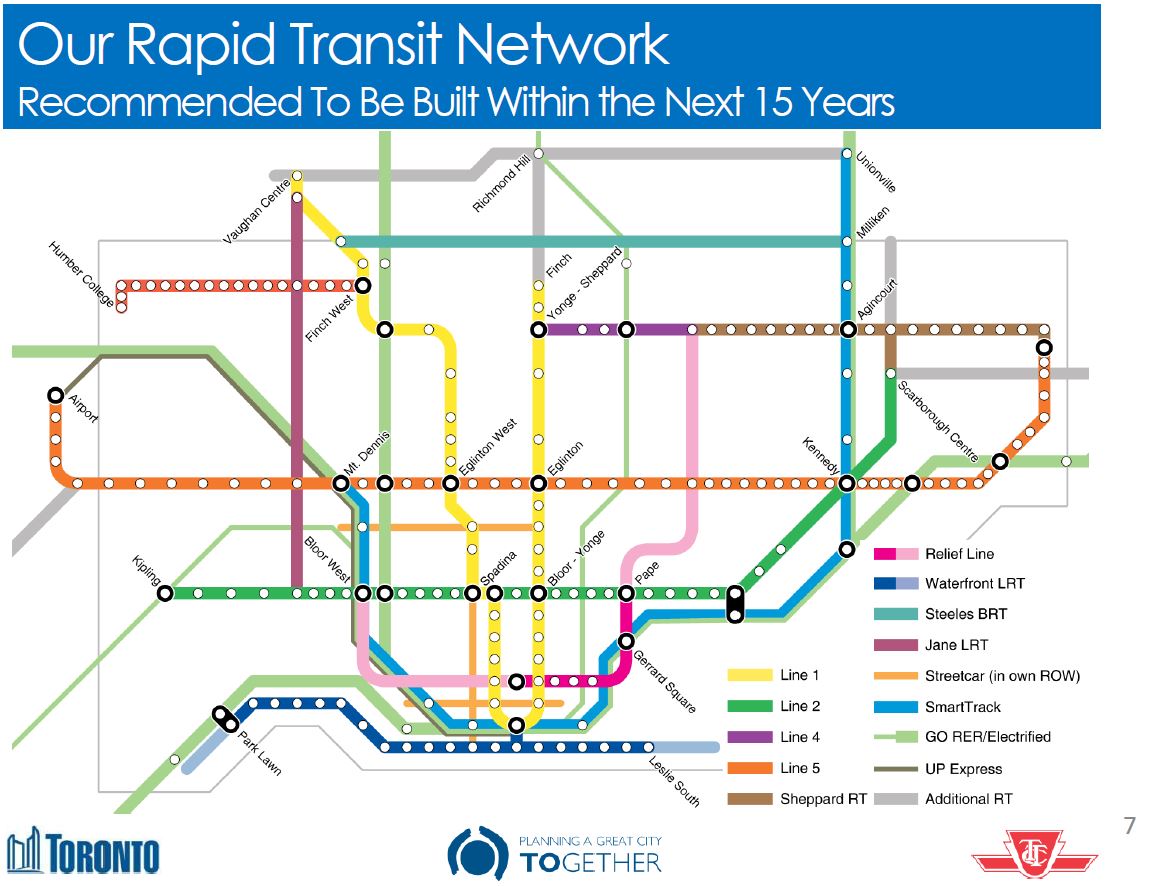
In Toronto’s never-ending fascination with new transit maps, the City Planning department has released a vision for our rapid transit network as it will be in 15 years.

201602_15YrPlan

Despite much talk of “evidence-based” planning, this is a very political map, and I cannot help remembering then-Premier David Peterson’s announcement of 1990 (not long before he lost an election and Bob Rae wound up as his much-surprised replacement) that amounted to a chicken-in-every-pot map.

There is nothing wrong with network-based planning, and indeed I have been beating a well-worn drum on that subject for years. But let us also remember that the Scarborough Subway exists because of the political clout of Brad Duguid, a former City Councillor, now Ontario’s Minister of Economic Development. Mayor John Tory, in Toronto Life, cites Duguid as saying that “if anyone tries to cancel the [Scarborough] subway, they’ll do it over his dead body”. “Evidence” apparently includes having a large cudgel to keep wandering pols in line.

The map also includes the Mayor’s pet project, SmartTrack, and it’s no wonder that he steers clear of the Minister’s position given the need for a provincial agency, Metrolinx, to accommodate SmartTrack on their network.

All of this is part of the “Motherlode” of public consultation sessions now running in various places around the City, and through Metrolinx in the wider GTHA. Background information and links to related material are available at Toronto’s TransitTO web site.

Continue reading

Relief Line, SmartTrack, GO/RER, Scarborough Subway Consultations

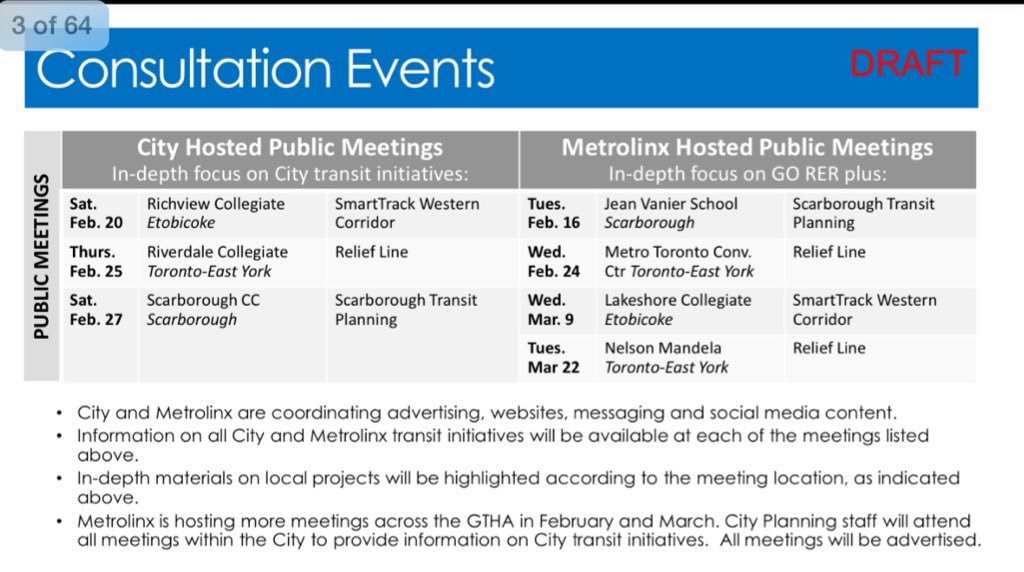
Toronto City Planning has released a draft list of upcoming public consultations on various transit plans including:

  • The Relief Line
  • The Scarborough Transit Plan (Subway, SmartTrack, Crosstown East LRT)
  • The Western SmartTrack Plan (SmartTrack, Crosstown West LRT)

2016_ConsultationCalendar

Additional meetings and information about Metrolinx plans (GO Regional Express Rail) will be organized by that agency.

Even more information will be available in March 2016 when the City releases a compendium report on all transit initiatives currently under study. These will include items listed above as well as the “Waterfront Reset” study, TTC Fare Integration proposals and a review of how (or if) Tax Increment Financing can contribute to the many transit projects under review. The intent is that this report will form the basis for public consultation and debate leading to recommendations at Council in June 2016. This is a very aggressive schedule, and there is no indication how consensus will actually be achieved in so short a time, especially with the usually-secretive Metrolinx as an essential player. At least the discussion will be at a network level, not ward-by-ward with a “relief” line for every member of Council, and there will be some filtering of various schemes based on engineering and operational realities.

What is sadly missing from all of this is a discussion of day-to-day transit operations and the backlog in the state-of-good-repair budget. We can blithely discuss billions worth of subway building to Scarborough and a Relief line, but Council won’t fund the basics of running a transit system.

SmartTrack: Now You See It, Now You Don’t!

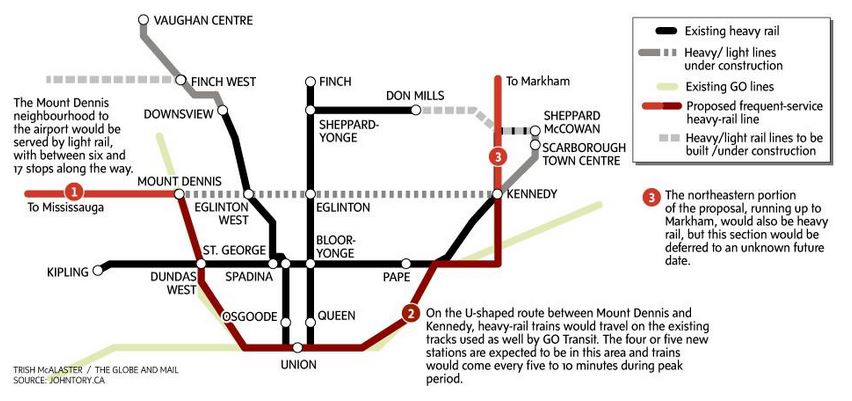
Oliver Moore in the Globe and Mail reports that there have been major changes to the SmartTrack plan, to wit:

  • The western branch of the service to the Airport district will be provided by the western extension of the Eglinton-Crosstown LRT as originally proposed.
  • “SmartTrack” per se will operate as a heavy rail service overlaid on GO Transit with the initial phase running from Mount Dennis to Kennedy Stations.
  • The northern extension of “SmartTrack” to Markham will be a separate phase of the project.

The map from the Globe & Mail is reproduced below.

GlobeSTLRTMap_20160114

According to Moore, the cost of adding SmartTrack to GO under this configuration would be much, much less than the originally quoted figure for the entire line. In turn, this would free up substantial capital spending headroom in City plans for other projects.

SmartTrack service at 15 minutes (the level proposed in Tory’s campaign) is far too infrequent to attract much riding, and especially to make a dent in demand on the existing subway interchange at Bloor-Yonge. We saw this in the June 2015 Metrolinx demand projections that were far more favourable to a Relief Line operating north to Sheppard and Don Mills. However, getting SmartTrack service down to as close a headway as every 5 minutes will be challenging for Metrolinx and for the corridors through which this would operate. There are no details yet on how this would be achieved.

The Eglinton West LRT has always been the superior way of serving this corridor compared to the heavy rail SmartTrack scheme. ST foundered on major problems with constructibility and neighbourhood effects, issues that were dismissed in a stunning display of cavalier “expert” knowledge during the campaign. Planning by Google Maps from an office in the UK has its limitations, but Tory’s campaign relied on this “expertise”. One shameless professor even rated ST with an “A+” in the CBC Metro Morning interview.

Keeping the first phase of ST confined south of Eglinton on both branches limits the operating costs the City must bear if this to be truly a “Toronto” project with “Toronto” fares, and it avoids the complexities of building into the 905.

Indeed, SmartTrack began as a real estate development scheme to make commercial property near the Airport and in Markham more accessible from downtown in a series of studies that actually claimed the market for downtown office space was static and falling. Yet another expert should be eating crow pie from his perch on the Metrolinx board. It was never clear why Toronto should shell out billions to improve property values in the 905, and this task now falls clearly to Metrolinx where it belongs.

The eastern leg of SmartTrack, north from Kennedy, obviously competes with the Scarborough Subway Extension, and there is no need for two routes serving the same demand, especially when GO already plans substantially improved service in the rail corridor. The long-standing issue of SSE demand may be clarified by the absence of SmartTrack as a competing service.

It is no secret that my own position would be to revert to the LRT plan in Scarborough, but that train has probably left the station, especially if the City can “save” a small fortune by scaling back on SmartTrack.

These changes could also foreshadow a revised schedule for the LRT projects at a time when “shovel ready” projects are in demand to soak up new federal spending. Eglinton West’s LRT extension is relatively easy to build, and it could be started soon enough to complete concurrently with the main Crosstown route. There is also the matter of the Sheppard East LRT including its proposed service linking to UofT Scarborough campus.

Coming weeks may bring many sputtering denials, or possibly, much improved clarity and acceptance of an – at last – realistic plan.


Eglinton Crosstown Station Names Settled At Last

After an extended discussion at its December 2015 Board Meeting, Metrolinx has decided on names for three stations on The Crosstown that were in dispute.

  • The station at Dufferin will be called “Fairbank”, as originally proposed, after the name of the original community.
  • The station at Bathurst will be called “Forest Hill”, as originally proposed. Although outside of the traditional centre of this community, the Bathurst/Eglinton intersection does lie on the edge of the borders of the original village.
  • The station at Lebovic/Hakimi will be called “Hakimi Lebovic” to recognize that the street changes name as it crosses Eglinton. Originally this was to be “Lebovic” station after the older and longer street of the two, and then the TTC Board, egged on by member Glenn De Baeremaeker, changed the name to “Hakimi” (the location isn’t even in his ward). Metrolinx adopted a “Solomon-like” decision to use a double name.

The Board held a teleconference meeting to discuss one item, the staff report on proposed names. The report proposed staying with the single name “Hakimi”, but this idea did not survive long in the rather short debate. Director Janet Ecker proposed “Hakimi-Lebovic” saying that this preserved some of “the integrity of the process”, but Director Bonnie Patterson wondered why this had not  been the original proposal.

The problem turns on the matter of a hyphen, and such punctuation offends the Metrolinx naming standards. The question of great import: to hyphenate or not to hyphenate? One director pointed out that the hyphen could indicate a link between the two families (as in a compound name), and this tipped the decision against the hyphen.

On a related note, all stations whose names are not already those of intersecting streets will get a subtitle, much as the stations on University Avenue have today, to identify the intersection they serve. Chair Rob Prichard suggested that people unfamiliar with their location could look at the signs on station walls to get the supplementary name, but subway riders will quickly tell you that this is not always possible depending on where a train stops and whether one can even see out of the window. There is also the basic question of access for those who cannot see easily or at all.

The entire exercise has the feel of massive face-saving for Metrolinx staff and the station naming protocols developed with much fanfare. The double name was described by Chief Planning Officer Leslie Woo as being in a grey zone, on the edge of the protocols. This is just plain silly. Many stations will have names that do not match the intersection they serve, and locations with different street names on opposite sides of a line are common (there are at least four on the Finch West LRT alone).

The protocols should be amended so that:

  • Double street names are allowed as station names where appropriate and where another option, such as a major nearby landmark or neighbourhood name, is not available.
  • Station “subtitles” should always be used to clarify a station’s location at a major cross street.

These “protocols” were not engraved in stone and they do not warrant worship as if they are immutable. Two basic issues were missed in creating them, and Metrolinx should be honest and humble enough to address this. “Nevermore” is not the correct answer in this circumstance.

Meanwhile, on a related topic, the actual name of the Eglinton-Crosstown name is still in debate given that the TTC has moved to line numbering. Will it become “Line 5”, or will someone complain that Toronto has scoffed all of the “premium” numbers for its rapid transit routes on a regional basis? At least GO Transit uses letters rather than numbers, and we can avoid a prolonged debate about who gets to use “Line 1”.

Such are the weighty matters that burden transit planners and politicians.

Eglinton Crosstown Station Names Update (Update 2)

Updated Nov. 17, 2015:

Although Metrolinx has yet to publish a report on the result of their consultation, it is clear that they have already decided on some changes to station names. This is revealed by a report for the TTC’s Board Meeting on November 23.

A proposed 2021 map (click map to expand) shows changes from the consultation information provided by Metrolinx (see original post below).

20151115_SystemMap

  • The station at Keele, originally proposed to be named “Silverthorne”, has become “Keelesdale”.
  • The existing Eglinton West station is to be renamed either “Allen” or “Cedarvale” (the TTC will pick one at its meeting).
  • The station at Avenue Road, originally proposed to be named “Oriole Park”, has become “Avenue”.
  • The station at Ferrand Drive, originally proposed to be named “Aga Khan & Eglinton”, has become “Aga Khan Park & Museum”.
  • The station at Bermondsey has become “Sloane”.
  • The station at Victoria Park, originally proposed to be named “Wexford”, has become “O’Connor”.
  • It is unclear whether the “& Eglinton” suffix has disappeared from all of the surface stop names because it was not included on the Metrolinx map either.

I will leave it to the trivia collectors to spot the stations shown as not accessible on this map where elevators are now under construction or well into the design stage.

Continue reading

Metrolinx Proposes Revised Names For Crosstown Stations

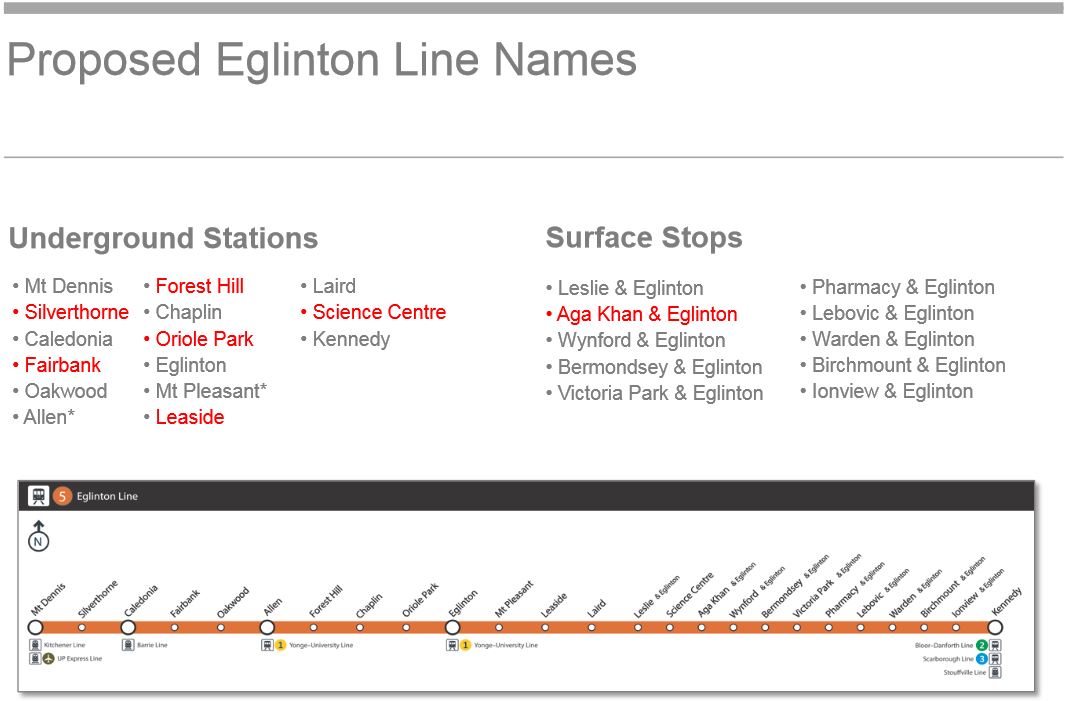
Metrolinx has proposed new names for several stations in the Eglinton corridor:

  • “Keele” to “Silverthorne”
  • “Dufferin” to “Fairbank”
  • “Bathurst” to “Forest Hill”
  • “Avenue” to “Oriole”
  • “Bayview” to “Leaside”
  • “Don Mills” to “Science Centre”
  • “Ferrand” to “Aga Khan & Eglinton”

Comments will be accepted by Metrolinx until October 7, 2015.

Updated October 2, 2015 at 9:30 am

201509_NewStationNames_ECLRT

Although the consultation affects only the stations listed in red in the list above, other changes are proposed including renaming “Eglinton West” to “Allen”.

The asterisk beside “Mt. Pleasant” is actually an error, and should be beside “Eglinton” because the proposal recommends a “change” from “Eglinton-Yonge”. Of course, the station isn’t called that yet.

Updated October 2, 2015 at 12:50 am:

The comments that have already been left on Metrolinx’ site suggest that many of their proposals are not exactly popular. I cannot help think that whoever is responsible for this report has a poor sense of Toronto (maybe another consultant who does all their work on Google Maps?), nor a sense of which neighbourhood names are actually used.

I cannot help think of the mystery surrounding stations at “St. Andrew” and “St. Patrick” that memorialized old ward/parish names that almost nobody knew fifty years ago, but which are now an inherent part of the city’s mental map of itself. Taking old names for an area may provide an historic link, but confuse people who have no idea of where these places are.

Of course we already have a precedent with Steeles West Station that has been renamed “Black Creek Pioneer Village” in reference to an attraction that is quite a distance from the station, and we almost got “University City” for Finch West.

Has anyone noticed, by the way, that this is called “Keele & Finch” in the “future” map in the report, “Leslie & Eglinton” is labelled “Sunnybrook Park” on the same map, and SmartTrack is nowhere to be found.

Finch West LRT Soon, Sheppard East Not So (Updated)

Updated April 28, 2015 at 8:20 am:

The decision to push construction of the Sheppard LRT out to the 2020s was taken quite recently as shown by two separate reports.

In today’s Globe & Mail, Oliver Moore reports:

According to Mr. Del Duca, the delay on Sheppard was because of the difficulty of trying to do too many big projects at once. “The plan right now is to have the procurement begin for the Sheppard East LRT after we complete the Finch West LRT,” he said.

There was no firm timeline available for the Sheppard line. If it starts on its new schedule and takes about as long as Finch to build, it should be ready some time after 2025.

This timeline is sharply at odds with the information given to a reporter in the provincial budget lock-up on Thursday. The government’s position then – given on background and not for attribution, under the rules of the lock-up – was that the Sheppard line would open about a year after Finch. Mr. Del Duca’s spokesman did not return a message Monday seeking clarification of what had changed.

On April 27, over an hour after the LRT announcement, one of my readers, seeking clarification from Metrolinx received the following email:

From: Metrolinx Customer Relations <customerrelations@metrolinx.com>
Date: April 27, 2015 at 10:43:26 AM EDT

Dear [x]

Thank you for contacting us about the status of the Sheppard East LRT.

The Sheppard East LRT is fully funded and approved. The Sheppard East LRT underpass construction at Agincourt GO Station has been completed.

Preliminary design and engineering work will be happening over the next few years. Construction is expected to begin in 2017 and be completed by 2021.

I appreciate you taking the time to contact us.

Sincerely,

[x] Customer Service Representative
GO Transit, A Division of Metrolinx

One wonders just what triggered a change so last-minute that it was not communicated to Metrolinx’ own “communications” team. The Minister claims that the delay is because there is only so much construction work that can be undertaken concurrently, but this seems to have more to do with avoiding a politically difficult decision.

A much more honest position would be to say simply that “we’re waiting for the results of various studies now underway on transit for Scarborough”, but leadership, or even a bit of common sense on anything transit-related in that part of town seems to escape the Liberals at Queen’s Park.

Original article from April 27 at 12:11 pm:

Continue reading

Planning for SmartTrack

At its meeting of January 22, 2015, Toronto’s Executive Committee will consider a report (SmartTrack Work Plan 2015-2016) recommending a work plan for the study of Mayor Tory’s SmartTrack proposal together with other related transit projects. This is intended to dovetail with Metrolinx’ work on their Regional Express Rail (RER) network, and will have spillover effects on studies of both the Downtown Relief Line (DRL) and the Scarborough Subway Extension.

The most important aspect of this report is that, at long last, a study is reviewing transit options for Toronto on a network basis rather than one line at a time. Factors such as alternative land use schemes, fare structures and service levels will be considered to determine which future scenarios best support investment in transit. Rather than starting with a “solution”, the studies are intended to evaluate alternatives.

If this outlook actually survives, and the studies are not gerrymandered before they can properly evaluate all strategies, then the process will be worthwhile and set the stage for decisions on what might actually be built. The challenge will be to avoid a scenario where every pet project on the map is untouchable rather than making the best of the network as a whole. The term “best” will be open to much debate.

Continue reading