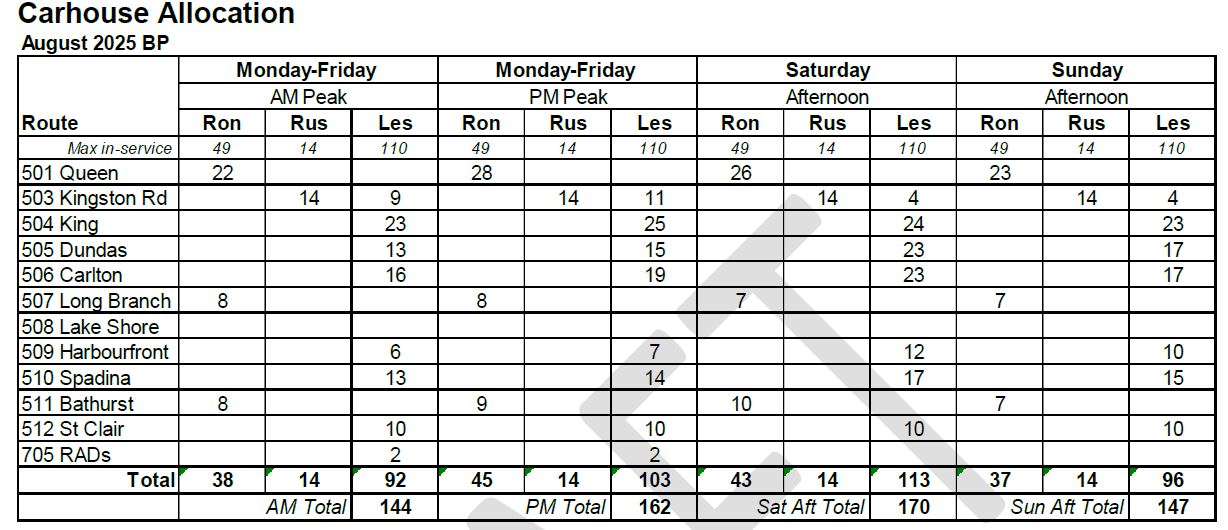
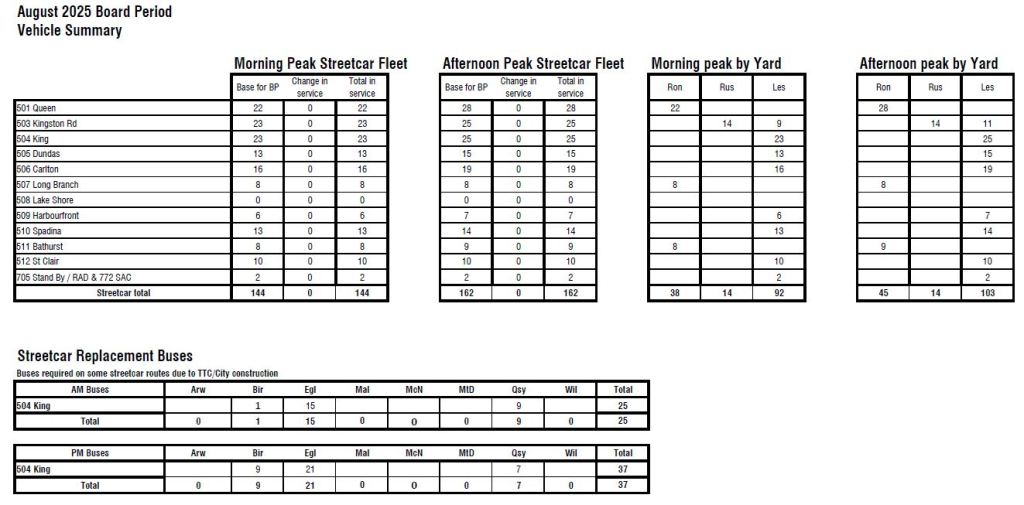
King-Church Construction and Traffic Effects

Updated May 5, 2025 at 12:50pm:

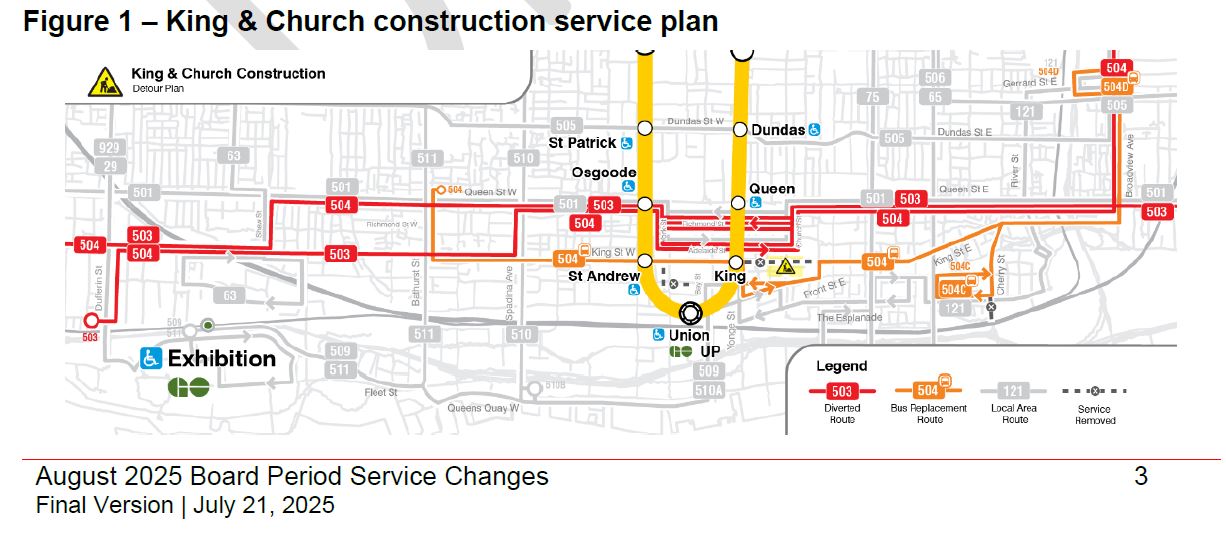
The TTC now has a web page with details of the changes for the first phase of the construction and diversions. This includes a map showing the diversions to west of Bathurst rather than just downtown. I have added this in the body of the article.

May 5, 2025 at 1:40pm:

Information about the 304 King and 303 Kingston Road night services has been added.

May 5, 2025 at 1:55pm:

The TTC has confirmed that overhead upgrades on King Street East and on Sumach/River will be completed before the King/Church track work end, and streetcar service will resume in September.

May 5, 2025 at 4:30pm:

I asked the City if it thought the intersections used by diverting streetcars and buses could handle the volume of traffic. They replied, but didn’t add much. See the end of the article for the exchange.

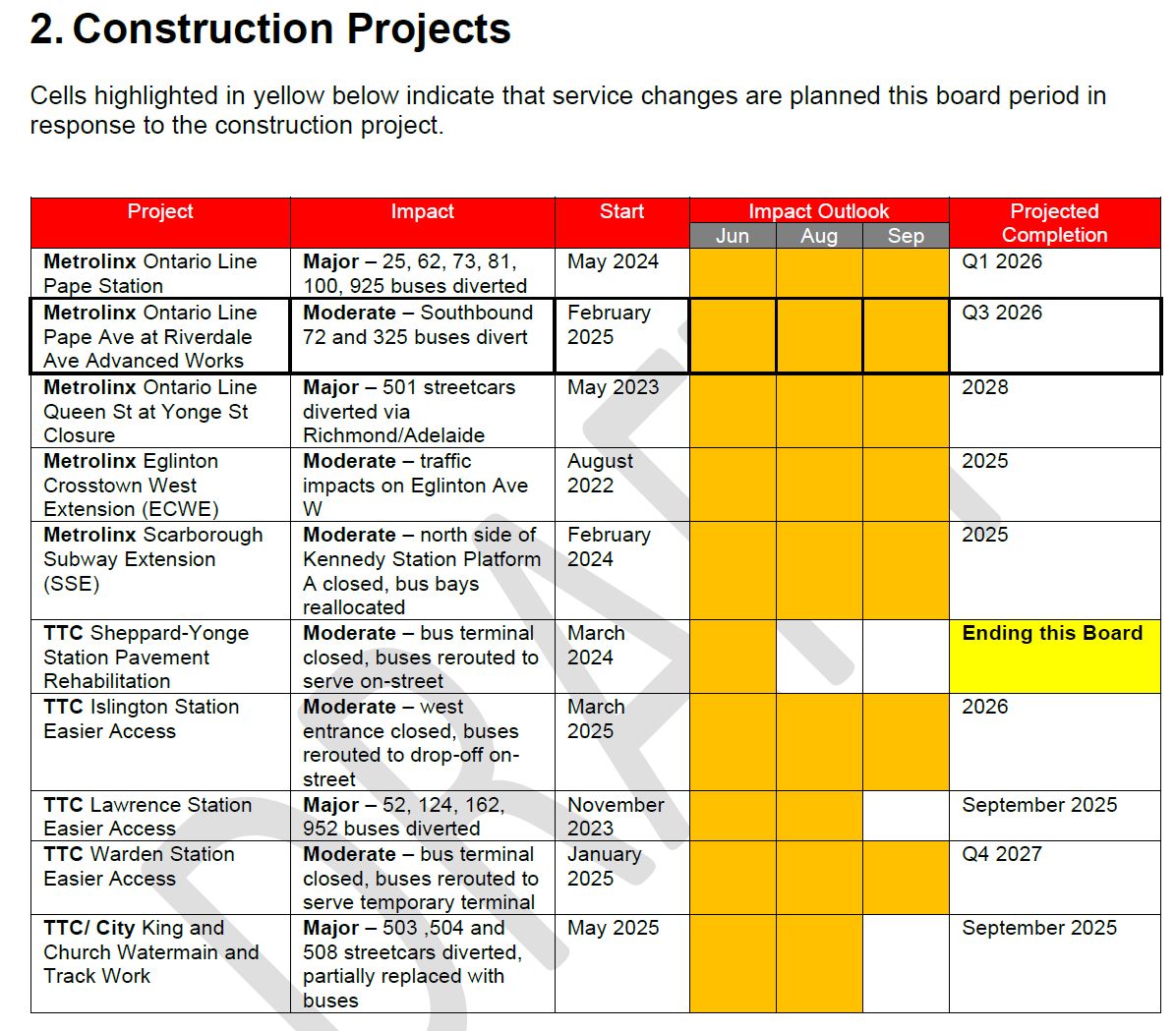
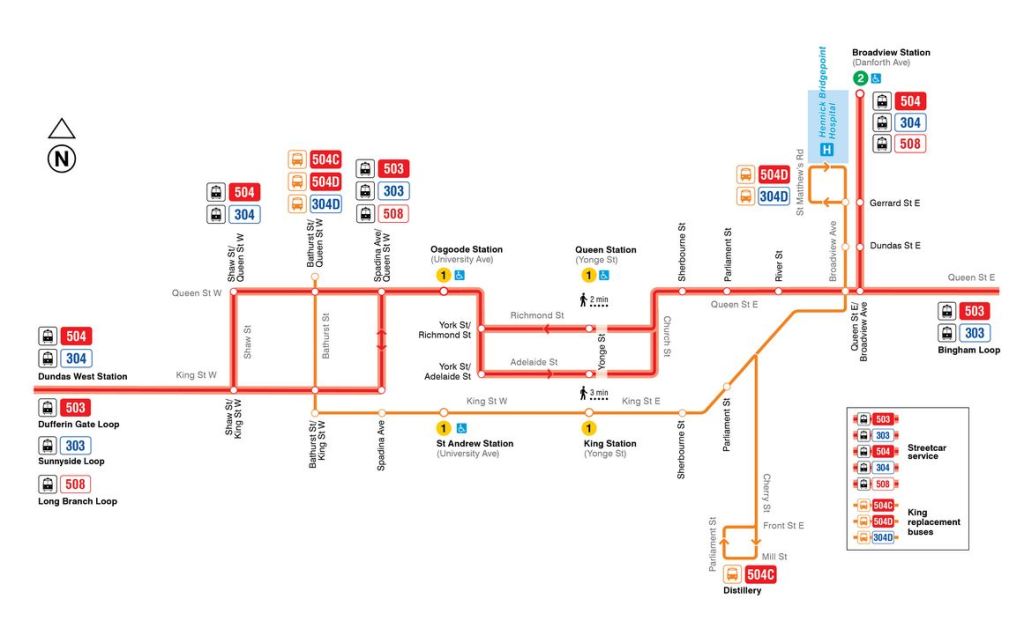
Major changes are coming to downtown streetcar routes on May 11 with the next schedule change. This will accommodate a combination of water main replacement, track reconstruction and streetcar overhead upgrades mainly at King and Church. Work is expected to require diversions until the October schedule change on Thanksgiving weekend. Streetcar service is expected to return with the September schedule change on Labour Day weekend.

The effects of work an King and Church have been known for some time through the Annual Service Plan and through a City report on the project. (The original report and recommendations were amended at the recent Council meeting to lessen the effect of various proposed lane closures.) Service levels have been published via the electronic version of schedules used by trip planning apps. The information about vehicles/hour at various locations is taken from those schedules.

(As an aside, the TTC website has still not been updated to include the 2025 Service Plan even though it was approved by the Board in January.)

With the concentration of transit service through various intersections, and the added complexity that most vehicles will make turns at these locations, there simply will not be enough capacity even under ideal conditions. It is no secret that “ideal” is a word rarely appropriate for transit operations downtown thanks to the lack of robust traffic management and real transit priority.

In past years, the diversion of services from King Street around the TIFF street fair created problems for transit travel times and reliability, but this lasted for a brief period. The planned diversions for King/Church will last through the summer.

Many of the water mains in the “old” city have been in service for over a century. Other parts of King Street have seen renewal, occasionally on an emergency basis following a break and sink hole.

The special trackwork at the King/Church intersection has been in bad shape for some time, and was overdue for replacement. Previous reconstructions were in 1983 and 2003. Other competing construction projects got in the way, and the track conditions have worsened year by year. There are many patches, and a well-deserved slow order unlike the standing practice even at freshly rebuilt junctions.

This intersection is also old enough that it predates the era of panel track construction where pre-welded sections are trucked in and assembled on site. This replaced the older style of tracks assembled piece-by-piece and often not welded robustly if at all. TTC has not yet been through its entire inventory of “old” track given the 20-30 year cycle depending on the level of service, wear, and disintegration at intersections.

Other work planned for this period of suspended streetcar service is the reconstruction of overhead on King and on the Distillery branch for pantograph-only operation.

Closing King & Church for an extended period concurrently with the Ontario Line construction at Queen & Yonge will add to the traffic snarls downtown. The City talks about using Traffic Agents to manage key intersections, but whether they provide enough people at enough places at enough times remains to be seen.

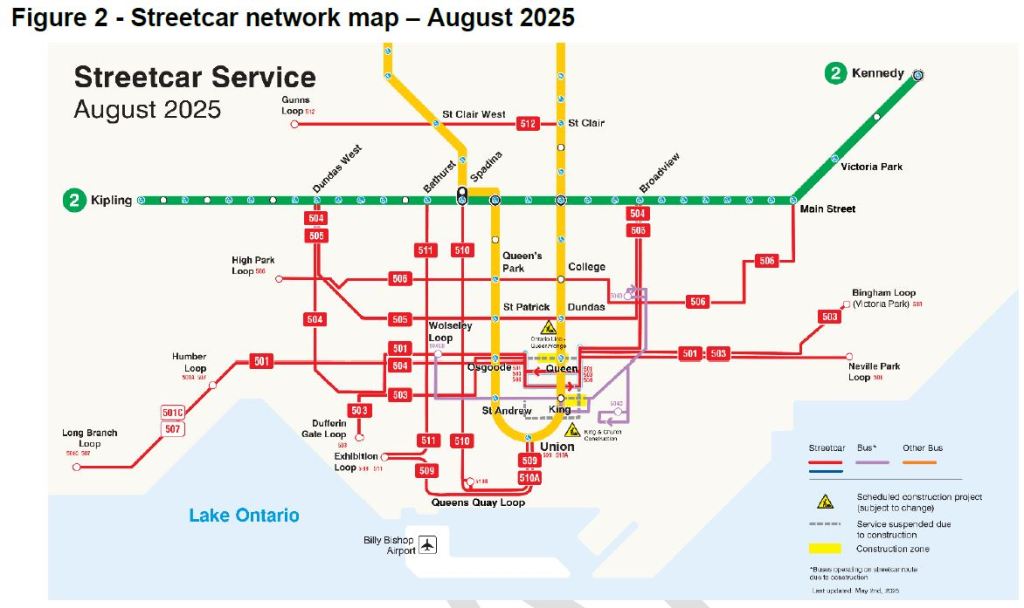
Routes Diverting off of King Street

Three routes are affected: 504 King, 503 Kingston Road and 508 Lake Shore.

The 504 King service will be broken into three sections:

  • A 504 streetcar service between Broadview to Dundas West Stations operating via the same route as 501 Queen between the Don Bridge and Spadina.
  • A 504C bus shuttle from Wolseley Loop south on Bathurst and east on King terminating at Broadview & Gerrard.
  • A 504D bus shuttle from Wolseley Loop south on Bathurst, east on King and south on Sumach to Front & Cherry. Buses will loop via [to be announced] and will not serve Distillery Loop.

The 503 Kingston Road service will be changed so that its western terminus shifts from York Street to Dufferin Loop. Cars will follow the same route as the 504 King via Queen from the Don Bridge to Spadina, then shift south onto King to follow the pre-diversion 504B route to Dufferin.

508 Lake Shore cars will follow the same route as 504 King.

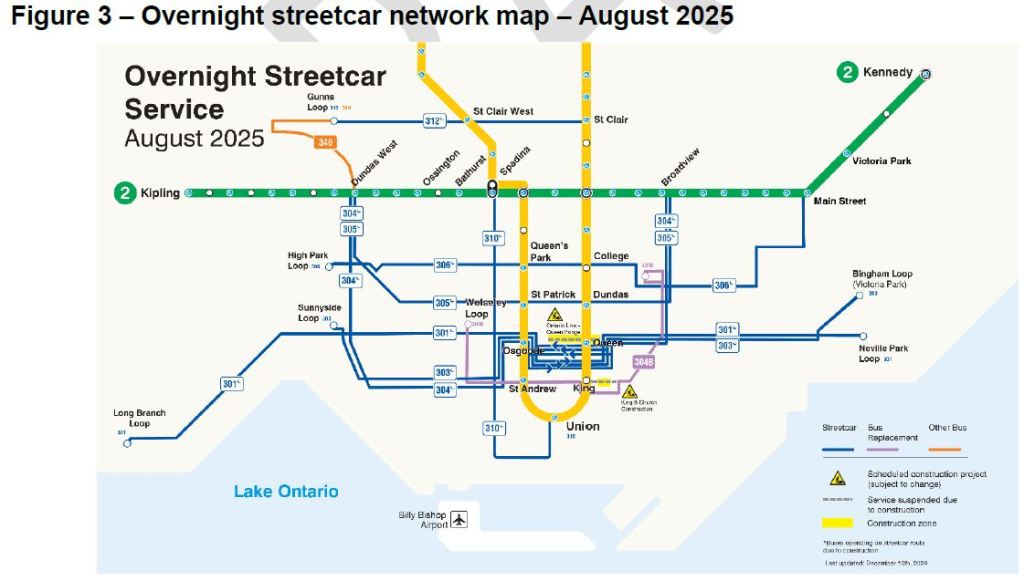
Night Service Changes

  • The 304 King night car will operate every 20 minutes over the same route as the daytime 504 service diverting via Queen and Spadina.
  • A 304D night bus will run every half-hour over the same route as the 504D bus from Wolseley Loop to Broadview & Gerrard.
  • The 303 Kingston Road night car will operate every 20 minutes over the same diversion route as the 304 King night car, and will operate as it does now to Sunnyside.

The maps below are from the City Report about this project originally published in February. An updated map for the first phase has been added later in the article.

Source: City Report at p. 5

For part of the construction period, King/Church will be impassible even to the replacement bus service and it will divert south to Wellington and Front.

Source: City Report at p. 5

These maps do not tell the whole story because another set of construction diversions will overlap the King/Church changes until the next schedule change in late June.

Although water main work at Bathurst/Fleet/Lakeshore is now complete, track work continues there and on Bathurst Street further north. 511 Bathurst streetcars will continue to divert east via King to Spadina looping via Adelaide and Charlotte. The 511B shuttle bus will be shortened from Wolseley Loop at Queen to an on-street loop via King, Portland and Richmond to Bathurst Street.

509 shuttle buses continue operating between Exhibition Loop and Queens Quay Loop at Spadina. 510 streetcars continue operating to Union Station.

The combined effect of the diversions will be greater than during the total meltdown of King service in 2024 when all cars diverted north via Church to Queen because volumes of other routes (510 Spadina, 511 Bathurst and 501 Queen) will be added to the King services, and more intersections will be affected over a wider area.

Updated May 5, 2025 at 12:50pm:

The TTC’s project webpage has a consolidated map of the diversions for the first phase of the work.

Continue reading

Extreme Precipitation and the TTC

The TTC Board met on April 16 with many items on its agenda including a report on Extreme Precipitation Planning.

Anyone living in Toronto will remember the heavy rains of July 2024 and the snows of February 2025. July 15-16 brought 115mm of rain within 24 hours, higher than the 100-year design for storms. From February 8-17, Toronto saw over 60cm of snow accumulation with no melts between storms. This was the highest snow pack in 25 years.

Both of these events revealed shortfalls in both TTC’s and City’s response to extreme weather. They also undermined the credibility of management claims of the transit system’s physical state, and the City’s false claims about snow clearing. The split jurisdiction between TTC and City forces did not help the situation either.

Among the issues raised in the report are:

  • The (in)adequacy of drainage on City streets to prevent ponding and flooding of underground structures.
  • The (in)adequacy of TTC drains for streetcar tracks, subway tunnels and stations.
  • The condition of drainage and pumping systems from inadequate maintenance and deferred replacement of aged equipment.
  • The integrity of TTC buildings, tunnels and other infrastructure to prevent or limit water penetration.
  • The actual condition of roads that were supposedly plowed versus reported conditions.
  • The absence of snow clearing at transit stops.
  • The creation of windrows both along curbs and between streetcar and adjacent lanes where the curb lane is not used by autos.
  • The failure to remove accumulated snow on transit routes causing repeated cases of parked cars blocking streetcars, and in some cases, buses.
  • The TTC’s ability to keep subway open cut areas operational when there is a large accumulation of snow on the tracks and power rails.
  • The adequacy and timeliness of public information provided to riders about transit operations during emergency conditions.

Many of these are interrelated. For example, if snow were actually cleared to the curb on four-lane roads with streetcars or buses, then autos would park normally rather than obstructing the only other lane available for transit vehicles. If maintenance of drainage and pumping systems (both day-to-day and life-cycle) kept them in working order, then less water would accumulate and potentially block service or render stations unsafe. If passengers could board and alight from transit vehicles with their usual ease, buses and streetcars would not be delayed attempting to serve snowed-in stops.

Among the TTC’s observations is the challenge of operating streetcars and articulated buses in bad weather, particularly snow. How much of this an inherent shortcoming of the vehicles, and how much is the effect of inadequate infrastructure maintenance and snow clearing?

Both from the delay logs and from personal experience, transit vehicles continued to be blocked by parked cars, and stops were blocked by snow, well after the snowfall ended. Some of the snowbanks did not dissipate until they melted. One particularly ironic location was at the southbound stop on Bay at Albert Street, the City Hall stop.

These are not just issues for the once-in-a-blue-moon weather events, but for the general condition and robustness of transit and related city infrastructure.

The report actually contemplates the purchase of spare buses, and possibly a new garage to hold them, to deal with periods when streetcars and articulated buses have operating difficulties. This would present a substantial premium in fleet size, garaging and staffing for these vehicles. One cannot help asking if the same money invested in better service generally would be more productive, combined with more aggressive storm responses when needed.The TTC is silent on the subway (for which bus replacements are completely inadequate even in good weather), and on the extra staff who would have to be available on the off chance of a bad storm.

This ludicrous approach avoids responsibility for making the streets and the transit system as robust as possible in their own right. Elsewhere I have written about the TTC’s bad habit of maintaining a spare ratio for their fleets well above industry targets, and “just buying more buses” would make the problem even worse. It is the kind of response I would expect from a system whose CEO considers crowded buses a mark of success, and months-long slow orders on deteriorated subway track as perfectly normal.

The TTC routinely trots out its list of unfunded capital projects. Critical maintenance such as replacement of pumps for subway tunnels is on that list. This is not a “nice to have”, but essential for safety. However, the problem is not just in capital funding, but under-resourcing of routine maintenance, an operating budget issue. We know the effects this brought to subway and SRT track. What other aspects of the system are waiting to fail?

The capital budget lines related to extreme weather effects total $1.4 billion of which only $360 million is funded in 2025-2034, mainly in the early years. (See TTC Major Projects Update and Funding Shortfalls for details.)

Continue reading

Fare Enforcement, Fare Freezes, Service and Budget Cuts

Fare evasion and enforcement are a common topic at TTC Board meetings, and for some time the sense has been that “there’s gold in them thar hills” among Commissioners. Debates can run for hours on what efforts should be launched, what policies for limited toleration there should be, and how much more can be spent on enforcement.

A fundamental flaw in these debates is that the presumed gross losses to fare evasion, based on field studies and estimates, is $140-million annually as reported by the City of Toronto’s Auditor General in March 2024. However, the TTC’s ability to recoup this missing revenue varies from place to place on the system because there are multiple ways to avoid paying.

  • The most obvious case is simply to avoid tapping on to surface vehicles when boarding.
  • Subway stations had “crash gates”, so-called because they were originally intended for cases where large volumes of riders needed to enter or exit quickly, notably for transfers to/from subway shuttles. To serve riders who did not have machine readable fares, these were left open for riders to enter on an honour system.
  • Where riders do pay by dropping money in a farebox (either on a bus or in a station), there is no guarantee they will pay the full amount owed.
  • Riders can walk into most subway stations unchallenged through bus and streetcar loops.

Much of the TTC’s focus has been on the first case, a rider who does not “tap on” to a vehicle, and until quite recently enforcement was directed at streetcars because of their multiple, unmonitored entrances.

TTC recently closed the crash gates so that riders wishing to pay cash must do so either at a fare vending machine. Ticket and token users (while these modes are still accepted) must use the station collector’s farebox, although whether anyone is present to monitor them varies by location and time of day. The estimated loss from open crash gates was $14.2-million per year, and from underpaid cash fares was $9.1-million. This leaves $116.7-million in other types of fare evasion.

In the 2025 Operating Budget, the TTC allocated $2.6-million for 69 additional fare enforcement staff. This is a part-year figure, obviously, as this only pays $37.7-thousand per employee. The anticipated new revenue is $12-million in 2025, and so the recovery ratio is about 4.6:1. That is a good return especially if it can be sustained.

There is no guarantee that hiring more inspectors will necessarily produce the same rate of return. A further problem is that with fares frozen, or increasing slower than wages, the cost of inspectors will go up faster than the recovered fare revenue.

New inspectors will be deployed to check riders getting off of buses in the paid areas of subway stations where inspection is easier than attempting on-board checks, especially on crowded vehicles. Absent fare inspection across the system, there are some types of evasion that will persist. The full estimated losses to evasion will never be recovered, and the implication that this amount would be available as new revenue is, to be kind, misguided.

Much information about evasion and enforcement is available in published reports, but this is not the only way the TTC spends money or foregoes revenue. Other areas do not get a comparable level of attention by the Board:

  • The foregone revenue due to fare freezes and below-inflation increases.
  • The cost of achieving standards to attract more riders to transit.
  • The effect on service quantity and reliability through constraints on maintenance budgets.

Even when these are discussed, the topics are considered in isolation.

In January 2025 as part of the budget approval, the TTC Board voted to establish a Strategic Planning Committee with details to come back for consideration in February. It is now April, and there is no sign of the committee. Previous attempts by members of the Board to increase their participation in planning and budgets have been sandbagged by inaction. Is this a repetition? Is the Board actually willing to perform its oversight role?

The City of Toronto claims to be pro-transit with a strong desire to attract more riders out of their cars. This is not echoed by the planned funding even at the “nice to have” level to see what budgetary effects might result.

The 2026 Budget work will begin in mid-year, and if the Board expects to have any input beyond the most superficial level, now is the time for those discussions and the review of alternatives to occur. So far, there is little sign that this will happen, and the budget will land with little opportunity for substantive change.

We will continue to hear about fare evasion, that shiny, spinning disco ball that diverts attention from most other issues. Some added revenue may be found over time, but a dedicated program to improve the transit system requires more than fare enforcement can provide.

The TTC and Toronto have many policy areas where decisions affect revenues and costs. Fare evasion and enforcement is only one of these. Some decisions, notably about the amount of budgeted service and maintenance levels, never come to the TTC Board for debate, let alone as a set of options ranging from “nice to have” to “absolutely must have”.

It is quite clear that funding for transit capital and operations will not come easily with the many economic pressures Toronto faces, and that was so even before the launch of a trade war and its potential effect on government revenues and priorities.

The TTC needs to discuss strategy for its future and understand what might be possible so that alternatives aspiring for better transit are on the table, not swept out of sight. That’s what a Strategic Planning Committee is for, and why the TTC’s failure to create one is so disheartening.

Continue reading

TTC Service Changes Effective March 30, 2025

The TTC will make several service changes on March 30, 2025. Most of the changes will increase the frequency of service, but in some cases there are reductions. There are also a few cases where the new schedules adjust travel times, but the frequency is unchanged.

Updated March 27, 2025 at 10:15am: The detailed spreadsheet showing changes in headways, travel times and vehicle assignments is now available.

Updated March 28, 2025 at 11:15pm: Erroneous entries in the first/last trip table that were copied from the TTC’s service change memo have been updated with information from the electronic version of the schedules (GTFS) on the City’s Open Data site.

Continue reading

TTC Board Meeting: February 24, 2025

The TTC Board met on February 24, 2025 with an agenda that seemed light going in, but the meeting itself ran well into the afternoon partly due to a long in camera discussion and partly to debates that expanded the scope of the items on the agenda.

Reports of interest:

    No Strategy for the TTC?

    Notable by its absence was a report on establishment of a Strategic Planning Committee, an item approved by the Board on January 10 with an implementation plan due at the February 24 meeting. (See minutes at p. 3) Such a committee is vital so that consultation and planning can occur before and while the 2026 budget is in preparation, a process that gets underway in roughly June-July each year. If there is to be some brave new vision of what transit can become, there is no point in asking that it be included in an already final budget in December.

    Continue reading

    Travel Times on 504 King: Update to January 2025

    Updated February 7, 2025 at 8:00pm: It occurred to me that although charts here are produced with maximum Y-values of an hour, or even 90 minutes, that this shows the peak times while compressing the visual range of the area where averages change over time. I have added a second set of charts for 2016-2025 with the maximum Y of 30 minutes to give the area where averages move between 15 and 25 minutes more “elbow room” and to make the evolution of values easier for readers to see. These have been added at the end of the “Implementing the Transit Mall” section.

    In previous articles, I have posted charts showing the changes in travel times on the central portion of the 504 King route between Jarvis to Bathurst. This is the area covered by the supposed transit mall, although the degree to which streetcars actually have priority has varied over time for various reasons.

    This article will review how travel times have evolved in recent years, as well as looking back to pre-pandemic and pre-transit mall eras. Full chart sets are available via links to PDFs for those who are interested.

    Beyond that central section lies the conventional “streetcar” portion of the route west through Bathurst/Niagara, Liberty Village and Parkdale. To the east is the northern reaches of the St. Lawrence and Distillery districts. Do these deserve the same level of priority treatment? What would be the benefit if any? I will turn to those areas later in the article.

    For those familiar with similar analyses on this site, I have retained the format of charting the 50th percentile (median) and 85th percentile values. These show both the general trend over time as well as the degree by which trips can vary from the median affecting reliability both in the priority area and on the broader route.

    Significant events include the implementation of transit priority in November 2016, the covid lockdown in March 2020, and the effect of enforcement (or lack of it) on the ability of streetcars to move briskly through the priority area. Also important to note is that the effects differ by time and direction, and that congestion interferes with transit not just during the classic peak periods.

    The important history lesson on King Street is that transit priority can improve travel times, but more importantly can improve reliability leading to more predictable trips and vehicle spacing over a route even beyond the bounds of the priority scheme’s area. Moreover, the benefits are easily lost through lack of enforcement and external events that significantly change demand on the road network.

    Continue reading

    TTC Service Changes Effective February 16, 2025

    There are relatively few service changes for the mid-February schedules, and most are on the bus network. There is no change in subway service.

    The major change for construction is the start of work at the Bathurst, Fleet, Lake Shore intersection for water main replacement and track renewal. This will be ongoing in stages until June 2025. 511 Bathurst and 509 Harbourfront cars will be replaced by buses at the south and west ends of each line respectively.

    With the completion of construction at Jane Station, the temporary route shifts to Old Mill and Runnymede Stations are reversed and service returns to Jane Station. This change is actually already in place 26 Dupont, 35/935/335 Jane, and 55 Warren Park. The schedules are now catching up. The 71/77 Runnymede/Swansea interline will be broken and the individual routes will loop in Runnymede Station.

    Bus bay allocations at Warden and Victoria Park Stations will change to better suit the routes operating there.

    Destination signs on many routes will be modified to standardize references to stations such as Scarborough Town Centre, Coxwell, Greenwood and Wilson Stations.

    Service on the 300 Bloor-Danforth and 320 Yonge night buses will be improved to deal with scheduling and crowding problems. I have an article in preparation on this situation using December 2024 and January 2025 tracking data as a “before” view of service quality which is extremely poor.

    Continue reading

    Delving Into TTC “On Time” Performance

    The TTC produces a monthly summary of On Time Performance for its bus and streetcar networks. To call it superficial would be generous, but there are pretty charts.

    First and most obvious among the problems is that the TTC never hits their target which is 90% across the system. Streetcars fare worse than buses because proportionately more of that network is affected by construction and diversions.

    “On time” is defined as leaving a terminal within a six minute window from 1 minute early to 5 minutes late. In practice, for routes with frequent service, this means that vehicles can run in pairs but be counted as “on time”. A related problem affects branching routes where there is no management nor measurement of the regularity of services merging together on an even spacing.

    There is no standard nor measurement of schedule adherence anywhere else on the route. Most riders do not board at terminals, and so service quality is not measured where most riders see it.

    The second problem is that the reported numbers aggregate an entire month’s data for every route. There is no indication of problem routes or time periods, or of how this relates to periods when many riders are trying to use the service.

    In an attempt to learn the details beyond the summary numbers, TTCRiders recently made a Freedom of Information Request for route and time period “on time” data from September 1 to November 16, 2024.

    The charts in this article review the TTC data at increasing levels of detail to show how different that view is from the simplistic summary values published as “key performance indicators” in the CEO’s Report.

    First, here is a breakdown by mode. The roughly echoes the values reported by the TTC with bus service achieving just over 80% “on time” trips and streetcars about 70%. Broken out here are the Express Bus routes (900 series) and the Blue Night routes (300 series). Note that night services which should have no problems with traffic congestion do not fare well.

    When the status for each mode is subdivided by time of day, things are not quite as rosy. In the charts below, there are four sets of columns corresponding to weekdays, Saturdays, Sundays and Holidays. Within these are six time periods.

    • Weekdays: AM Peak, Midday, PM Peak, Early Evening, Late Evening, Overnight
    • Others: Early Morning, Late Morning, Afternoon, Early Evening, Late Evening, Overnight

    Note that “on time” performance for streetcars (green) falls in the evenings and especially on weekends. Nowhere in the official KPIs does the TTC admit to only hitting 50% “on time” on part of its network.

    The upper right chart shows the proportion of late trips (more than 5 minutes after a scheduled departure). The percentages are high in the PM peak and evenings, with Saturday being particularly bad.

    The lower left chart shows the proportion of early trips (more than 59 seconds before a scheduled departure). Streetcars run early at terminals much more than buses. This might be related to the idea of getting a “head start” on a trip where delays are anticipated on busy downtown routes.

    The lower right chart shows missed trips. These are defined as trips that are over 20 minutes late or just do not show up at the terminal. This can occur due to short turns, operator or vehicle shortages, or severe schedule disruption. Note that on Saturday evenings about 1/6 of the streetcar service never reaches its terminus.

    The yellow bars (night service) only appear on the rightmost of the six columns because that is when 300-series routes are in service. About 20% of the service is late or early, and on Saturdays [actually Sunday morning] about 10% of service is missing at terminals. Reliability is quite poor on a service riders depend on for safe travel to and from shift work.

    In the following section, charts provide a route-by-route view of performance. They illustrate the wide variation by route and time period that is completely lost in overall averages. Many routes achieve 90% “on time” status much of the time and these pull up the system averages. However, some routes perform quite poorly. This problem did not just develop in the past few months. Consolidated reporting masks the problem routes and times, and hence the need for management to address service reliability.

    Continue reading

    TTC 2025 Subway and Streetcar Infrastructure Projects

    The agenda for the January 27 TTC Board meeting contains two reports containing information about infrastructure work planned on the rail networks in 2025.

    The Service Plan details proposed route changes for 2025 and evaluations of some options that were not recommended. I will address this part of the report in a separate article.

    The State of Good Repair report addresses the current situation with needed infrastructure maintenance, and contains a detailed calendar of planned work including major projects requiring streetcar diversions. The Service Plan includes some of the proposed route configurations.

    Subway Plans

    The subway plans are extensive and will see more partial or total service suspensions than in past years. This comes in part from the fact the subway is aging, but also from a recognition that past years have not seen the level of maintenance required to keep the system in good shape. One key item arising from recent major disruptions is the state of the work car fleet. Many specialized vehicles are used for aspects of subway maintenance, and their reliability and availability have not been at the level the TTC needs.

    Work planned during subway closures are reliant on work cars to aide in the performance of the scheduled activities. As such, the TTC’s 2025 Operating Budget includes $0.8M to bolster work car maintenance and the 2025-2034 Capital Budget and Plan includes $35.6 million of approved funding for work car overhauls as well as $62.9 million toward work car procurements. These investments, as approved by the TTC Board on January 10, 2025, and before City Council for consideration on February 11, 2025, are required to increase reliability and respond to increased demand for work cars due to higher capital activity. [p. 2 SOGR report]

    In a section reflecting on the growing amount of maintenance work, the report observes:

    […] significant investment into these programs is required along with the procurement of suitable work cars through a phased fleet replacement approach and rolling stock transition plan. To ensure the TTC is able to continue delivering on its state-of-good-repair program, while accommodating future growth and expansion projects, the availability of work cars for trackside activities and the time required to maintain the work cars in a state of good repair is inversely proportional, and as such, it is critical that the capacity to provide safe, reliable and available work cars is built into future plans. [p 12 SOGR report]

    Many problems with the work car fleet originated with deferral of a renewal and expansion plan proposed in Andy Byford’s era as CEO, but sidelined under Rick Leary.

    Closures are expensive because of many factors. These costs are recovered through the capital project budgets and from external parties, notably Metrolinx. They are not part of the regular operating budget.

    Subway closure costs are variable and dependent upon the duration and distance of the closure territory, along with the complexity of the work. The cost for each closure is attributed to the incremental costs for buses, advertising, and staffing. This includes Operators, contracted customer service support staff, TTC staff to supervise the closure, paid duty police officers, and parking enforcement officers. The average subway early closure cost is approximately $35,000 per evening and the average full, two-day weekend closure cost is $500,000 per weekend ($250,000 per day). [p. 1 SOGR report]

    The detailed list of proposed 2025 closures is organized by date and this shows how some work has been scheduled so that two or three projects can take advantage of one shutdown at a time [pp 17-30 SOGR report]. However, this makes major projects that spread over many weeks more difficult to see along with the dates when specific parts of the network will be closed. The main part of this article includes charts showing the dates and locations of closures.

    An important issue raised by the report is the TTC’s ability to perform all required maintenance work in the time available.

    On the subway side, a significant increase in production time is required to continue to maintain its assets in a state of good repair. Given the current rate of track asset deterioration, it is expected that the average production time of approximately 92 minutes will need to approximately double to more than 180 minutes to continue to ensure all assets remain in a safe and reliable state. [p 11 SOGR report]

    That “92 minutes” refers to the productive work interval between shutdown and startup of subway service, and has been cited recently by management when discussing the Reduced Speed Zones list. That connection is misleading in that major track rehabilitation is done during longer “possessions” of subway lines either through early closing, or weekend shutdowns. Indeed, TTC management have often touted how one weekend’s work is equivalent to many short weekday sessions.

    The TTC contemplates options for extending the time to perform maintenance:

    1. Organizing full weekend closures with significantly larger closures boundaries (i.e. Kennedy to Broadview closure).
    2. Weekly early access closures commencing at 10 p.m. with larger boundaries.
    3. Nightly suspension of subway service at midnight across some or all subway lines, rather than 2 a.m.
    4. Various multi-day or multi-week closures of various points of the subway system. [p 12 SOGR report]

    An important question here is how much of the SOGR list’s size is due to growth and aging of the network, and how much from deferred maintenance? Is the TTC in danger of becoming unmaintainable because the backlog is too long? Are more extensive shutdowns a “new normal”, or can we hope for a time when the project list is shorter?

    Closing the subway earlier will have major effects on riders. Toronto is not a city where transit riding evaporates at 7pm. The transit network is vital both for entertainment activities and for the many workers who do not have 9-to-5 commutes. Indeed, the TTC routinely cites the importance of evening and night service for both economic and safety reasons.

    Streetcar Plans

    The report acknowledges that streetcar infrastructure is falling out of good repair:

    Given the City’s challenges, certain TTC work has been deferred over the past several years. As the assets continue to age and are subjected to the daily service demands, a long-term execution strategy, post-2026, is required. This situation is further compounded by the ongoing Gardiner Expressway construction work and the Ontario Line expansion that limits TTC’s ability to replace its deteriorating assets on parallel routes (i.e. King, Queen, and Dundas). In the coming years, the prognosis is that TTC will need to expand its current state-of-good-repair work to meet the growing service demands at the forecasted asset deterioration rate. [p 12 SOGR report]

    Again, the question is whether the system can sustain an increased level of SOGR work without having many major routes out of service simultaneously. The main part of this article looks at the proposed work and the related diversions, where they are known.

    One project that will end, eventually, is the reconstruction of the overhead power distribution system for full pantograph compatibility. Some of this work is co-ordinated with shutdowns for track, road and utility repairs, but some projects are scheduled on their own. Work is not necessarily undertaken when scheduled, and riders have suffered from service replacements and diversions while nothing appears to be happening.

    Across both the subway and streetcar systems, Toronto now sees the effect of reduced maintenance and past year budgets that claimed to be adequate but concealed a slow decline. This has happened in other cities, but the TTC always fancied itself immune to such problems.

    The report warns of changes needed in 2026 and beyond, but does not explore the details. The TTC Board and the riding public deserve a full airing of this situation together with a recovery plan.

    Continue reading