TTC Service Changes: Sunday, March 29, 2020 (Corrected)

The TTC has several changes planned for the schedules going into effect on March 29.

Updated March 5, 2020 at 10:20 pm: Incorrect information was in the original description of the 163 Oakwood route. It will operate from Ossington Station to Lawrence West Station, not from St. Clair as the southern terminus as I had originally described it. Thanks to reader Joseph (who got there first) and others for spotting this. I am not quite sure where that idea came from, but both the article and the detailed list of changes below have been updated.

Updated March 6, 2020 at 10:55 pm: Incorrect naming of the 109 Ranee branches corrected. Thanks to reader Steven for spotting that.

2020.03.29_Service_Changes_V3

Streetcar/Bus Mode Changes

The most significant change is the restoration of streetcar service on 505 Dundas after a long absence due to watermain construction and the shortage of streetcars. The new service plan represents an increase in capacity primarily in the off peak periods. The change in headways will be most noticed during the peak periods where there will be 6.9 new streetcars/hour in the AM, and 7.7 cars/hour in the PM as compared to 16 buses/hour AM and 15 in the PM. Of course the buses tend to travel in packs of two or three, and so the waits for service could be more comparable than the raw schedules suggest especially if the TTC manages to maintain proper vehicle spacing on these much wider headways.

Changes during off-peak periods are not as substantial, and the net effect will be an increase in capacity on this route

A related problem is that the TTC has extended the travel times for streetcars substantially over the bus times in some cases (and the bus schedules were themselves adjusted in Mid-February 2020). This could leave many streetcars with a lot of excess time at terminals where it is now common to see several buses laying over because they are early. I will publish an analysis of actual travel times for both bus and streetcar operations as data become available.

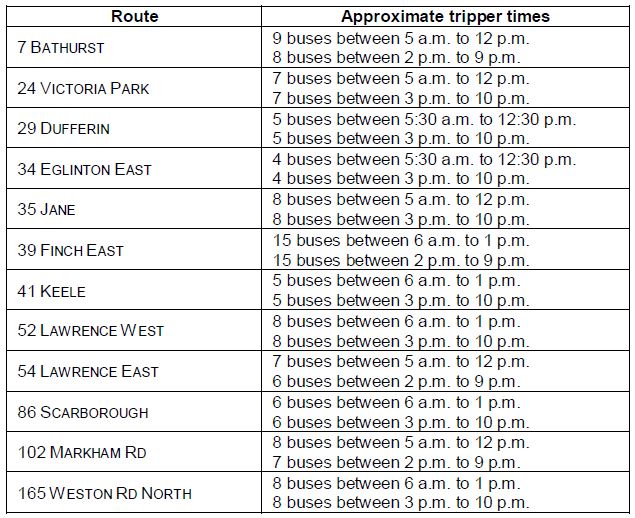
Service on Dundas will be supplemented by four bus trippers in each direction during the period from 8 to 8:30 am.

With 505 Dundas switching back to streetcars, the 511 Bathurst route changes to bus operation for various construction projects including work on the bridge over the rail corridor at Front, utility and track work from Front northward, and track work from Dundas to just north of Wolseley Loop (north of Queen). According to the TTC service change memo this will persist through all of 2020 implying that the streetcar service to the CNE will be provided only on the Harbourfront line this year. I have asked the TTC for service details, but they have not responded.

Keele Station Construction

The bus loop roadway at Keele Station will be under construction until mid-October 2020. During this period all services that normally terminate here will be redirected.

  • The 41 and 941 Keele services will be extended south to Howard Park looping via Bloor, Parkside, Howard Park, Roncesvalles and Bloor back to Keele.
  • The 89 and 989 Weston services will be extended west to High Park Station Loop.
  • The 30 High Park and 80 Queensway services will be interlined.

Eglinton West Station Construction

The bus loop at Eglinton West Station (to be renamed “Cedarvale”) will close for work on the Crosstown project. This will trigger several changes:

  • The 32D Eglinton West to Emmett service will be extended east to Eglinton Station.
  • The 63 Ossington and 109 Ranee routes will be reorganized into three segments.
    • 63B Ossington buses will run between Liberty Village and St. Clair (Oakwood Loop).
    • 163 Oakwood buses will run between Ossington Station and Lawrence West Station.
    • 109 Ranee buses will run between Lawrence West Station and Neptune (the street, not the planet).
  • The 51 Leslie and 56 Leaside buses at Eglinton Station will be shifted south to make room for a bay for the 32D service.

Passengers on the 32 Eglinton West bus will make connections to and from the subway from on street stops in what is already an area poorly set up for pedestrians. How this will operate with all of the additional foot traffic after March 29 remains to be seen.

Reliability Improvements

The TTC continues to “improve” routes by adding to running time and widening headways. Their claim is that they are just matching actual conditions, but what happens is that they aim for almost worst case situations (95th percentile) causing most vehicles to run early and bunch at terminals. From a rider’s point of view, service is less frequent most of the time.

Changes planned for March 29th affect:

  • 23 Dawes: Buses will run less frequently in all weekday periods except the AM peak. Off peak service is not affected.
  • 37 Islington and 937 Islington Express: Buses will run less frequently during the peak periods and midday weekdays. Evening service is not affected.
  • 111 East Mall: Buses will run less frequently during all weekday periods.
  • 161 Rogers Road: Buses will run less frequently during all weekday periods.

In one case, on 7 Bathurst, the TTC is clawing back excessive running time. During peak and weekday midday periods, there will be one bus less on the route, but scheduled headways stay the same. During the evening the number of buses and headways are unchanged, but some scheduled driving time is converted to make “recovery” time even longer than it is now.

Streetcar Carhouse Allocations

Due to trackwork at Roncesvalles Carhouse, there will be no access to the “North Gate” exit onto Roncesvalles for at least the remainder of 2020. Some services will be shifted among carhouse to allow for the reduced capacity at Roncesvalles.

  • All 501 Queen Humber-Neville service will operate from Russell Carhouse.
  • All 505 Dundas service will operate from Leslie Barns.
  • Some 506 Carlton service now operating from Leslie Barns will shift to Russell Carhouse.
  • Two of the five 508 Lake Shore trippers will operate from Russell Carhouse.

Crowding Standards

The TTC continues its practice of scheduling services at crowding levels above the board-approved standards. This occurs in some cases due to vehicle shortages, but more commonly because of budget pressures that do not allow provision of service at the level the standards would require.

New periods of scheduled crowding added on March 29 are:

  • 37 Islington weekday early evenings
  • 111 East Mall AM peak

TTC management are supposed to be reporting regularly to the Board on routes that exceed crowding standards, but this report has not yet appeared.

TTC Board Meeting: February 25, 2020

The TTC Board meets on February 25 to discuss several reports and proposals. Among items on the agenda are:

I will add to this article following the Board meeting with additional information from the discussions.

Notable by its absence from the CEO’s Report is any information on route crowding or improved metrics for service quality.

Trials of electric buses are in early days, and Toronto is a long way from seeing an entirely zero-emission fleet. My column this week in NOW Toronto present some of the history of evolving bus technology.

Commissioner Brad Bradford has a Notice of Motion which seeks to link spending on improved transit service to potential funding for new vehicles. While the recently improved City Building Fund provides more money for transit vehicles, this covers only one third of their cost and none of any future increase in operations. Bradford’s motion requests:

The TTC Board request that the TTC Chief Executive Officer, when engaging in negotiations with the provincial and federal governments for funding for the TTC’s vehicle procurement priorities, tie funding requests to the implementation of the TTC’s 5-Year Service Plan and service levels as prescribed by the strategy.

There are two problems with this stance.

First, if the TTC and Council choose not to actually fund the added service, this would imply that the capital funding should not come from other governments. I doubt that is Bradford’s intent, but the real issue is that there is no Council commitment to fund better TTC service. Other factors such as the jump in operating budgets to fund new lines such as Eglinton Crosstown and increased fare subsidies could crowd out spending on service.

Second, the scale of service increases proposed in the Service Plan is quite modest, and it really should be revisited. Sadly, the TTC chose not to include more aggressive options for expansion in the Plan even if only on an aspirational basis. Back in 2003, the strength of David Miller’s Ridership Growth Strategy was that it addressed what Toronto could do for modest increases in spending, but this approach has never been repeated.

Bradford also has a Notice of Motion that seeks to consolidate updates on two reports so that both sides of the revenue protection and enforcement issue can be seen by the Board together.

  • Auditor General’s Report – Review of Toronto Transit Commission’s Revenue Operations
  • Ombudsman Toronto Enquiry Report Review of the TTC’s Investigation of a February 18, 2018 Incident Involving Transit Fare Inspectors

Further discussion of fare issues and Presto are likely at the meeting.

TTC Service Changes: Sunday, February 16, 2020

The TTC will implement a number of service changes on February 16, 2020, but this is a comparatively minor set including the end of construction and resumption of normal routes for three projects:

  • Davisville Station paving, Lawrence Station paving, and Runnymede Station easier access construction (79 Scarlett Road only).

There will be changes to some services on Don Mills on weekends as the provision for effects of Metrolinx construction is reduced. No other routes are affected, nor is any weekday service.

So-called reliability improvements continue to work their way through the system. The predominant effect is to stretch available buses over longer running times with corresponding reduction in scheduled service levels. Routes affected in this round are:

  • 21 Brimley, 53/953 Steeles East local and express, 54 Lawrence East, 116 Morningside, 129 McCowan North, 505 Dundas, 945 Kipling Express

The peak bus fleet in regular service goes down by 5 in the AM peak and up by 5 in the PM peak, and so this month is a wash in terms of vehicles used. However, the reliability changes mean that buses on the affected routes are scheduled for slower driving speeds and/or longer times for recovery at terminals.

505 Dundas is a particularly odd case because the route is already notorious for having multiple buses taking extended layovers at terminals. The “new” schedule reverts back to October 2018 when running times were even more generous than they are today. Streetcars will return at the next schedule change on March 29, and if they have as generous travel times as the buses, congestion at Broadview and Dundas West Stations will become even worse than it is today.

2020.02.16_Service_Changes

When Better Service Isn’t – Part V: Streetcar Routes

This article continue the series reviewing routes where the TTC alleges that service has improved during 2019. Please refer to the first two parts for introductory information.

This concluding installment in the series reviews the streetcar routes. The comparisons here are different because the roll out of the new Flexity fleet combined with service resiliency changes and the substitution of buses for streetcars on some routes makes a year-over-year comparison only a snapshot of one point in the transition. Instead, this article compares service in January 2015 when the new fleet was fairly small and the network was operated, for the most part with streetcars, to the service in January 2020.

There is now a pervasive problem on streetcar routes with the amount of time allocated to travel plus recovery, to the point that there can be congestion of multiple cars (or buses as in the case of 505 Dundas) at terminals. This represents a waste of equipment by over-allocation of time so that even the worst case trips will not be late. Most are early, and operators get generous breaks as a result.

When contemplating service levels on the streetcar network, remember that all surplus cars were used up in 1997 when the 510 Spadina line opened, and the fleet did not get net new capacity until the Flexitys began to arrive. There is quite a backlog of demand for better service and more capacity as King Street showed.

Continue reading

When Better Service Isn’t – Part IV: Central Toronto

This article continue the series reviewing routes where the TTC alleges that service has improved during 2019. Please refer to the first two parts for introductory information.

In Part IV, I will turn to bus routes in the “old” City of Toronto, the central portion of the network. As for the streetcar routes, they are a special case because of the effects of the changeover to the new Flexity fleet in recent years. Those will be the subject of Part V.

For reference, here is the map showing routes with supposedly better service.

As on routes throughout what were once “the suburbs” of Toronto, “improvement” is a euphemism where stretching vehicles over longer running times and headways for “resiliency” provides, in theory “better” service, but in fact a reduction in route capacity and longer scheduled waits.

Continue reading

When Better Service Isn’t – Part III: Etobicoke

This article continue the series reviewing routes where the TTC alleges that service has improved during 2019. Please refer to the first two parts for introductory information.

For reference, here is the map showing routes with supposedly better service.

Continue reading

When Better Service Isn’t – Part II: The Three Yorks

Updated January 26, 2020: 89/989 Weston were omitted in error from this article and have been added at the end.

This article is the second part of a series on the misrepresentation of service “improvements” in the TTC’s 2020 budget. Please refer to Part I for the introduction to the series.

In this installment, I will review routes broadly speaking in North York, East York and York. Overlaps with other parts of the city are inevitable. For comments on the east-west routes crossing Victoria Park into Scarborough, please see Part I.

As a refresher, here is the TTC’s map showing all of the routes where there were alleged service improvements in 2019.

The issue here is that the vast majority of the “improved” routes actually have longer scheduled headways (the gap between vehicles) in the new schedules than in the old. This provides extra running and recovery time for the worst trips, but more generally simply means that scheduled frequency and capacity go down. The TTC has not reported crowding information to indicate what effect this has on riders. Some of the affected routes are relatively small and may not be at capacity in their “before” schedules, but this tactic is applied across the system including on major routes.

Continue reading

When Better Service Isn’t – Part I: Scarborough

As part of its 2020 Operating Budget, the TTC published a map showing the many routes that received service improvements. This gives the impression that there is widespread benefit to riders with better service on most routes across the city. But complaints about crowding and irregular service persist. How can we reconcile this?

What is an “improvement”?

  • More service, more buses
  • Limited improvement, few time periods
  • Route “resiliency” often with the same buses, but less frequent service

Two or even all three of these can be combined in one change. In addition, there can be a schedule change that simply involves an operational adjustment, but does not actually change service from a rider’s point of view.

Route resiliency refers to adjusting schedules to better match actual travel times which have grown due to traffic congestion. There is also a desire for operators to have enough time for a reasonable break at terminals particularly on long routes. In most cases, the TTC does not add vehicles to a route, but merely widens the scheduled interval between them to increase the round trip time. In theory, this improves on time performance, but at the expense of less frequent scheduled service.

The problem with this is that TTC now schedules for almost the worst case situation on a route, the 95th percentile of travel times. This means that most buses have too much running time and, as a result, wind up with generous layovers at terminals. Meanwhile scheduled service for riders gets worse so that problem trips will stay on time and avoid short turns. The TTC has never publicly analyzed the tradeoff between the two effects, but considers resiliency changes as an improvement. Many of the lines highlighted on the map actually have less frequent service, but they are “improved” according to this scheme.

Another problem here is that when a route appears highlighted on the map above, it could be for anything from a major rework of schedules to a slight improvement in service during one operating period. Moreover, routes can have improvements during some periods, and cuts in others. The extent of improvements can appear greater than it really was.

From a political point of view, the danger of presenting so many “improvements” is that the TTC gives the impression that, despite constrained resources, it continues to run better service across the network. This is misleading, plays to the idea that management “efficiency” can address needs, and undermines calls for more resources.

In this article, I will review routes from Victoria Park eastward. Future installments will look at the north central part of Toronto, Etobicoke, and downtown.

Continue reading

TTC Waffles On Reduced Crowding

Following my recent article in NOW, the TTC replied to my request for clarification of their position on crowding and how it would be addressed in their 2020 budget.

The TTC’s Stuart Green emailed on Tuesday, January 21, 2020:

The increase of 89,211 hours is comprised of the initiatives outlined in [the] table on page 18 which are described below the table on page 18.

The comments on page 17 are referencing the fact that some of these hours have been provided to preserve service standards. The crowding standard in this case is an example. No statement was made that there would be a reduction in crowding. The hours for reliability initiatives are being added to address operating needs and thereby preserve existing standards as noted in the Improvements to Surface Transit Schedules report (June 2019). The report indicated that it “is not possible to bring all schedules that actually operate outside of the tolerances of service standards in line with them within existing funding.” The 2019 funding for service reliability was used to maintain a balance between providing a reliable and comfortable service.

Page 17/18 reflect the base budget additions only. Page 22, identifies a further $3.7M investment (classified under new & enhanced). These approximately 39,000 hours are additional to the hours presented in the table on page 18 and are aligned to the 5 year service plan.  The “priority action” from the deck is linked to this specific initiative. These hours will be added in stages throughout the year, primarily in May and September.

With all of these references to other reports, a guide is required to understand what is stated here. It all begins with those 89,211 service hours, part of the increase for 2020 over the 2019 total of 9.45 million hours. Service is budgeted in hours because that is the primary driver of costs, but hours are not affected by inflation allowing service to be planned and measured on a constant basis.

They first show up on pages 17-18 of the TTC’s 2020 Operating Budget Report:

A further $4.8 million and 88 TTC operators are required to deliver an increase in service hours, which is required to adhere to the TTC’s service standards so that no more than 51 passengers are accommodated per bus in peak periods and 36 in off peak periods. To adhere to these standards, an additional 89,211 scheduled operating service hours are proposed for 2020 and is described in greater detail in the Service Budget section below.

The following section includes a table setting out the build-up of the 89,211 hours:

None of the components listed here address bringing service into line with crowding standards. Over half of the added hours simply carries forward 2019 changes into 2020 on a full-year basis, and the next highest component is the provision for the Leap Year. “Operational Flexibility” refers to additional buses that are on standby to deal with gaps and emergencies. There is an offsetting saving due to the full implementation of the new streetcar fleet.

The TTC has previously reported that some routes are operating above its crowding standards, and the TTC acknowledged in 2019 that they could not operate within these standards using existing funding. The text quoted from the budget states that the 89,211 new hours are needed to adhere to the standards. This implies that improvements would correct past problems and limit the effects of ridership growth to stay within the standards. The table shows that in fact the hours would go to other purposes.

The point was reiterated in the presentation deck used at the Board meeting which included the bullet “Delivery of expected service standards” [p 13].

In previous conversations with Stuart Green, he has described this as a problem with editing, but his email is quite explicit that “No statement was made that there would be a reduction in crowding”.

A further 39,000 hours will be added in 2020 at a cost of $3.7 million. The purpose of this is described in the TTC’s Budget Report [p 22]:

Service Reliability

5 Year Service Plan: Improvements to Surface Transit Schedules

To improve on-time performance, which is crucial to customer satisfaction, surface transit schedules will be revised to reflect operating conditions and improve reliability for customers. This is consistent with the plan outlined in the 5 Year Service Plan and 10 Year Outlook, which was presented to the Board on December 12, 2019. In all, 1,000 weekly service hours will be added over the course of 2020 at an estimated cost of $3.7 million and is essential to fulfill our commitment to customers that we will improve service reliability on our bus network.

This is our “truth in advertising” promise – that the TTC’s bus will depart on time according to published schedule. To start, service will be added on 5 of the busiest and most operationally challenging corridors in the City including 29/929 Dufferin, 35/935 Jane, 39/939 Finch East, 37/937 Islington and the 86/986 Scarborough Routes. These improvements will benefit service for 175,000 customers per weekday.

On time performance is not the same thing as route capacity, especially when the TTC only measures this at terminals and does not achieve it even there. The schedule changes often brings wider headways, less frequent service, to routes as the allocated vehicles are stretched over longer scheduled round trips. Combined with gapping and bunching of buses and streetcars, this can make for worse service, not better, but it avoids running more buses and streetcars.

It is not clear whether the TTC expects that 2020 will continue the problem that available resources will not fund service across the network to meet the service standards. CEO Rick Leary has stated that a quarterly crowding report will be coming to the TTC Board this year, but if past experience is any indication, the TTC will report vehicle loads on an average hourly basis without also showing the effects of service gaps. Crowding could be improved with more-reliably spaced service, but there is nothing to indicate that this is part of the overall plan.

What is clear is that the TTC Budget Report claimed that new resources were going to address service standards as their sole purpose, not “some” or “as an example” as the TTC claims. However, only one page later, the same resources were allocated to other changes.

What we do not see is a dedicated, explicit plan to address crowding, nor any estimate of what will be needed to achieve this. New capital funding for a variety of state of good repair projects, not to mention vehicle purchases, brought much rejoicing to the TTC. However, without clear plans and funding to operate more service, riders will not see any improvement in their daily travels.

We’re Not Getting Our Ten Cents’ Worth

My latest for NOW on the subject of the pending fare increase and budget.

TTC’s 10-cent fare hike doesn’t buy much transit

On the subject of just how much new service we will see in 2020, when and where, I repeatedly asked the TTC for this information, and am still waiting as of 8:30 am January 20.

There is a related issue with the TTC’s claims of widespread service improvements in 2019. I will explore this in a future article here.