A Twenty Minute Network?

At the September 4 meeting of the TTC’s Strategic Planning Committee, the desire to make some system improvements at no net cost led to some Board Members musing on discontinuing unprofitable services or shifting resources from “downtown” so that Scarborough, allegedly underserved, could get more frequent buses. This came from TTC Chair Jamaal Myers who forgets at times he is in charge of the Toronto Transit Commission.

It is one thing to argue for better transit service — more frequent, more reliable, less crowded — but this should be based on facts.

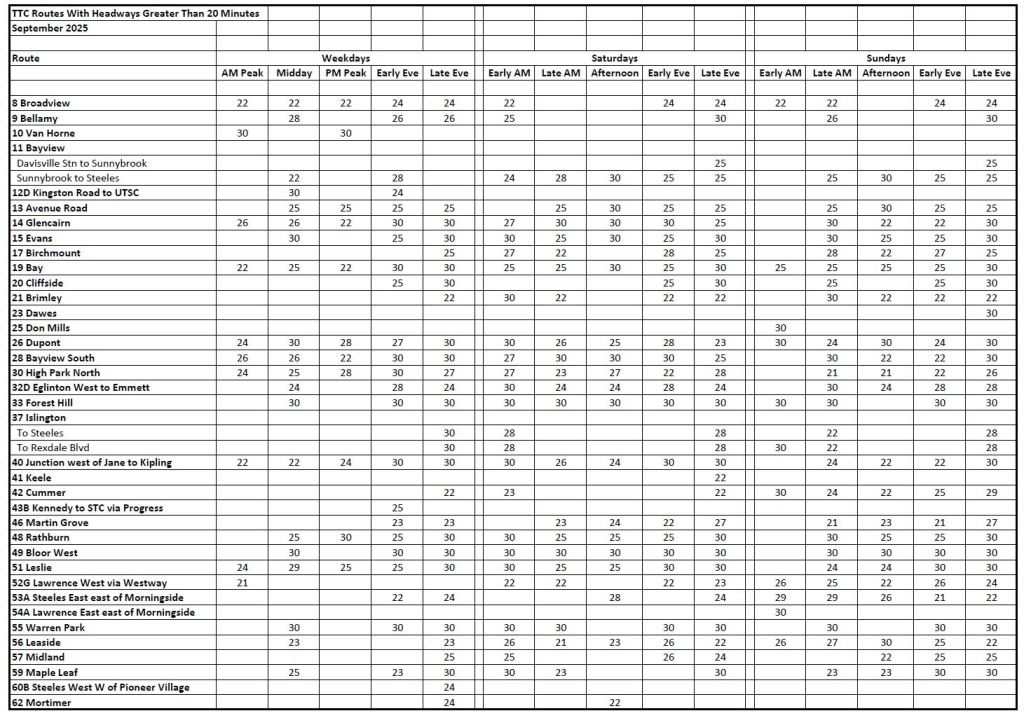
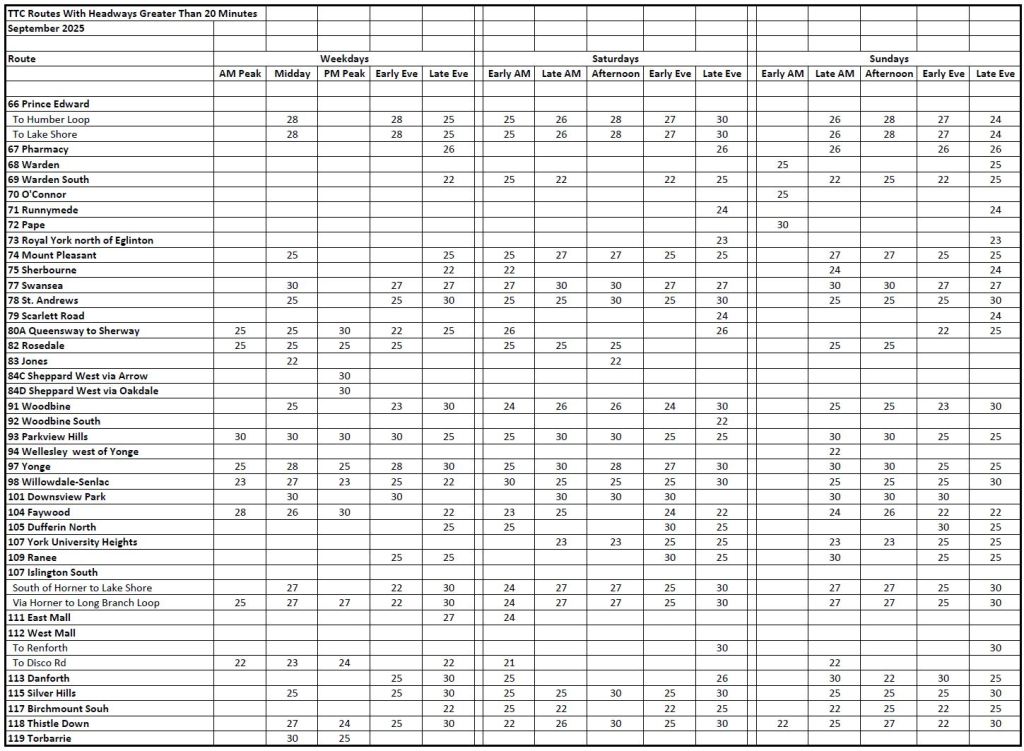
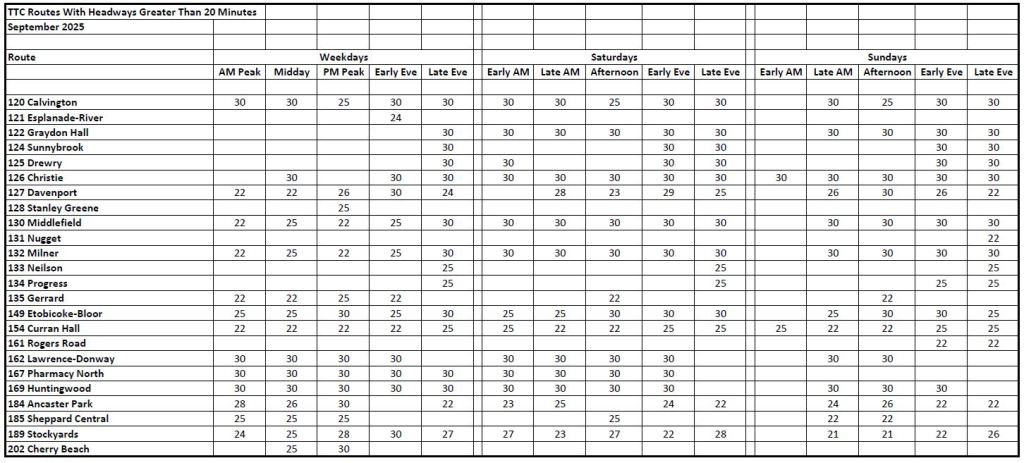
A proposal that surfaces from time to time in discussion of service standards is to improve the maximum headway on TTC routes from 30 to 20 minutes. An underlying assumption is that this will primarily affect the suburbs, but this is not the case. Many routes across the city, including the old “downtown”, have periods of infrequent service that such a change would affect.

The table below shows all routes, or route segments, operating less frequently than every 20 minutes where a policy change would demand better frequent service.

If the desire is to run more frequent service across the network, such a proposal should be balanced against the effects of any offset. For example, elimination of the 10-minute network would affect not just routes downtown but many routes in the suburbs. Is this a good policy choice, or is the real target the supposedly excess service “downtown” gets?

Pitting one part of the city against another is no way to lead an organization like the TTC, especially when the scheme is not well thought-out. There is no question that as Toronto’s network grew, the suburbs did not get their fair share of improvements. In part this was due to later development compared to the old city, and part to density, road patterns and a car-oriented philosophy. Transit has still not caught up, and needs more than a few subway lines to support stronger transit demand.

That said, the way to correct the inbalance is not to pillage the already-dense parts of the network for resources or to assume that every route in “downtown” has frequent service that can be trimmed.

TTC Ridership Growth and Fare Options Update

The TTC’s Strategic Planning Committee will meet on September 4 at 10:00am in the Board Room at 1900 Yonge Street, TTC headquarters. Among the items on the agenda is a report titled 2026-2028 Ridership Growth Strategy: 2026 Budget Considerations.

This report proposes implementation of six initiatives through the 2026 Budget which is now in preparation:

  • Fare capping (limiting the accumulated charge for trips within a month) as a replacement for monthly passes.
  • Year 1 of the TTC’s Wayfinding Strategy
  • Support growth from changing work-from-home practices
  • Improve service reliability
  • Implement outstanding proposals from the 2024 and 2025 Annual Plans
  • Bring service to the standards for crowding, express network routes, and the 10-minute network

There are many other possible tactics for building ridership. These are not included in the report, but the intent is to report back to the Board following budget approval in early 2026 with an updated RGS.

Updated September 1 at 10:40pm: The list of additional RGS options has been added to the end of this article.

A related issue is the question of a fare increase, the revenue it might generate and the likely reaction to such a proposal. A variety of increases from 5 to 35 cents on various fare classes are presented for discussion, but there is no recommendation.

Full disclosure: I participated in a meeting of the TTC’s Planning Advisory Group to discuss the proposed RGS along with other interested parties. There is a summary of our comments in the report [pp 6-7].

Updated September 4 at 9:00 pm: The Presentation Deck for this item is now available. I will add commentary to the article in coming days.

Continue reading

TTC Service Changes: August 31, 2025

The Labour Day weekend sees the TTC return to fall schedules on several routes, the end of some construction diversions, and the beginning of another.

Subway Service

There is no change in subway service

Streetcar Services

A plan to improve streetcar service to a six minute standard daytime headway begins with 512 St. Clair, and is expected to continue with 511 Bathurst and 505 Dundas at dates yet to be announced.

The construction work at King & Church finished recently. With the new schedules, streetcar service returns to King through downtown, but the west end of the line will divert around reconstruction of King & Dufferin until Thanksgiving weekend.

The 503 Kingston Road car will become a bus with the route shortened to Joe Shuster Way east of Dufferin. The 303 night service will be suspended. On Kingston Road the 322 Coxwell night bus will remain.

The eastern terminus of 508 Lake Shore will be shortened from Broadview Station to Distillery Loop.

Bus Services

Lawrence Station will reopen to bus service allowing restoration of regular bus services. The 52/952 Lawrence service will no longer operate via Avenue Road to Eglinton Station. Routes 124 Sunnybrook and 162 Lawrence-Donway will terminate at Lawrence Station rather than running west to Roe Loop on Avenue Road.

The south end of 325 Don Mills night bus will be extended east from Carlaw via Commissioners to Lake Shore Garage. The east end of 385 Sheppard East night bus will extended from Meadowvale Road to Rouge Hill GO Station.

Some of the seasonal services will end on Labour Day including:

  • The weekend service to Biidaasige Park on 72D Pape will end, and buses will return to the 72C terminus at Commissioners and Saulter Streets.
  • Weekday service on 200 Toronto Zoo and 201 Bluffer’s Park will end. Weekend service continues.
  • Service on 203 High Park will end.

Many routes see restoration of services reduced for the summer lull in riding, although there are a few cuts scattered around the system. A large number of school trippers are also back, but these are not listed here.

The remainder of this article details various aspects of the changes and includes a link to a spreadsheet with the operating plans for all modified routes.

Continue reading

TTC Surface Route Stats 2019-2024

The list of surface route operating statistics for 2024 recently appeared on the TTC’s Planning webpage. This article consolidates data for the years 2019 (the last pre-pandemic year) to 2024.

Values included in the TTC files are:

  • Weekday passenger count
  • Weekday vehicle hours
  • Weekday vehicle klometres
  • AM peak vehicles
  • PM peak vehicles

Derived values included in this article:

  • Passengers (boardings) per vehicle hour
  • Vehicle kilometres per hour
  • Recovery rates relative to 2019

Pages for each set of stats are included in the detailed part of the article, and a PDF containing all tables is linked at the end.

In a future article, I will refresh a previously published table comparing service levels on routes in September 2025, when this information is available, with prepandemic conditions.

A basic message of both articles is that the TTC trumpets a return to former service levels, but the metric they use, vehicle hours, misrepresents the level of service provided. Buses and streetcars travel more slowly now than they did in 2019, and they have more generous recovery times at terminals. These combine to make a vehicle hour less productive in the amount of service it provides than in past years, and so 100% of former hours does not produce the same service. That is separate from other factors such as a decline in reliability, bunching and gaps which compound the less frequent scheduled service.

The problem is particularly bad on streetcar routes where a combination of factors including understaffing, budget constraints, and operating practices that slow service, lead to considerably less “recovery” to former service levels. In turn, this hurts service quality and blunts ridership recovery.

Crowding conditions are not addressed by these stats, and this is difficult to extract from TTC tracking data due to the coarse-grained nature of reported loads. TTC does not publish numeric vehicle loads, only broad light-medium-heavy loading indications. Although they report all-day ridership on each route, this is not broken down by time of day, location and direction, at least not for external consumption. TTC has crowding standards, but we do not know how well they meet them.

The number of peak vehicles is lower in 2024 than in 2019. This partly reflects limits on service growth, and partly the shift of demand into off-peak periods.

In the attempt to woo riders back onto the TTC, let alone to boost transit’s mode share for travel in line with City goals, the question of service level and quality is key. In theory, if demand actually sits below the historic level, then less service is needed to handle it. However, those who remember the condition of transit before 2020 will know that crowding was a pervasive problem and calls for better service were common. Only the March 2020 drop in demand saved the TTC from a capacity crisis.

Toronto must understand and commit the resources needed to achieve its transit goals. Just getting back to 2019 is no goal to aim at.

Continue reading

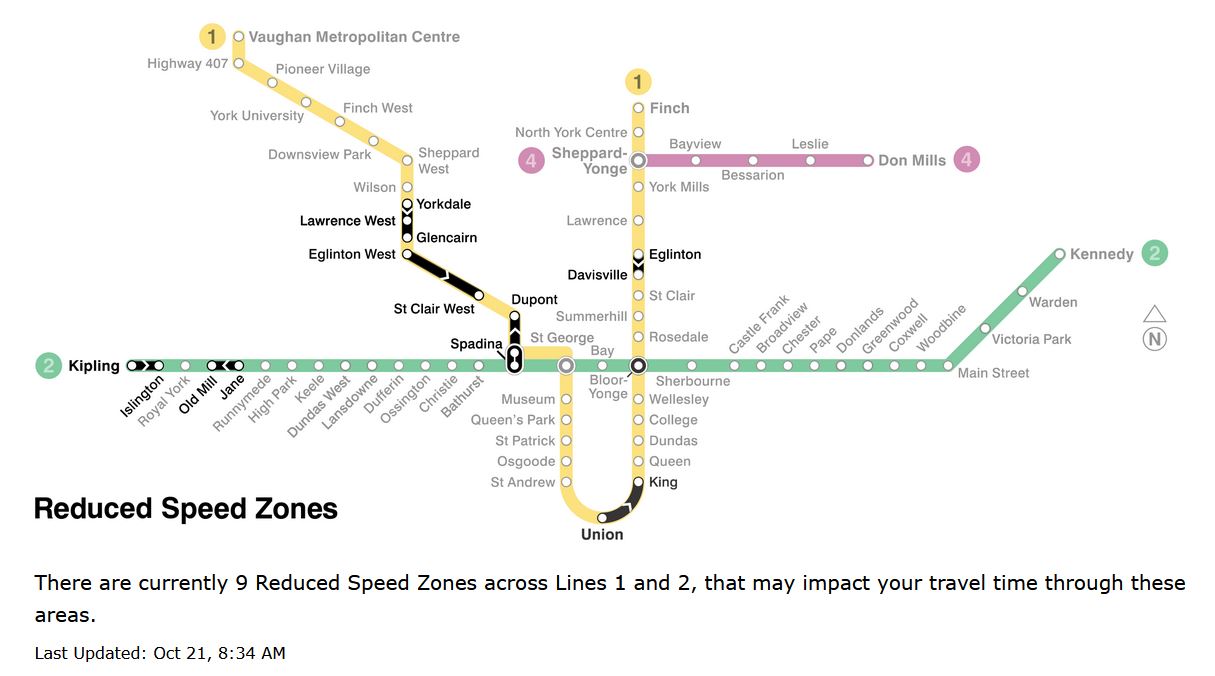
TTC Updates Reduced Speed Zone Info

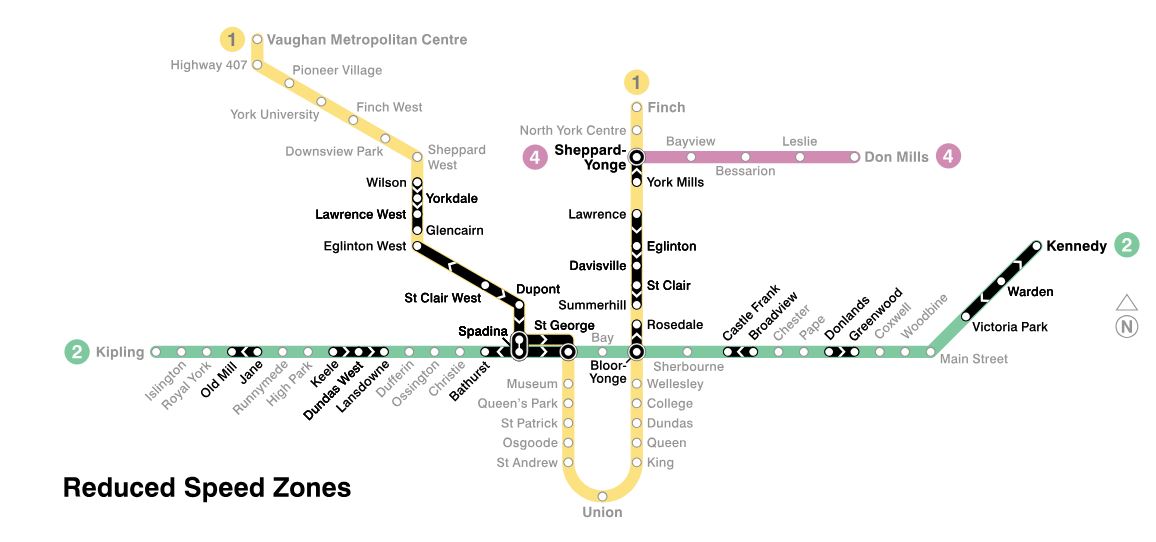
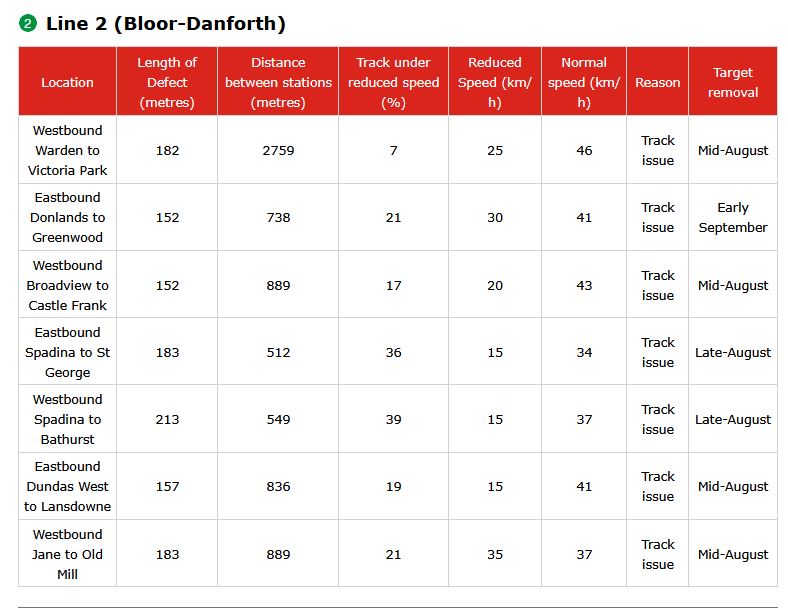
The TTC maintains a list of reduced speed zones on its website, and this constantly changing list is tracked in a previous article here showing how long some restrictions have been in place.

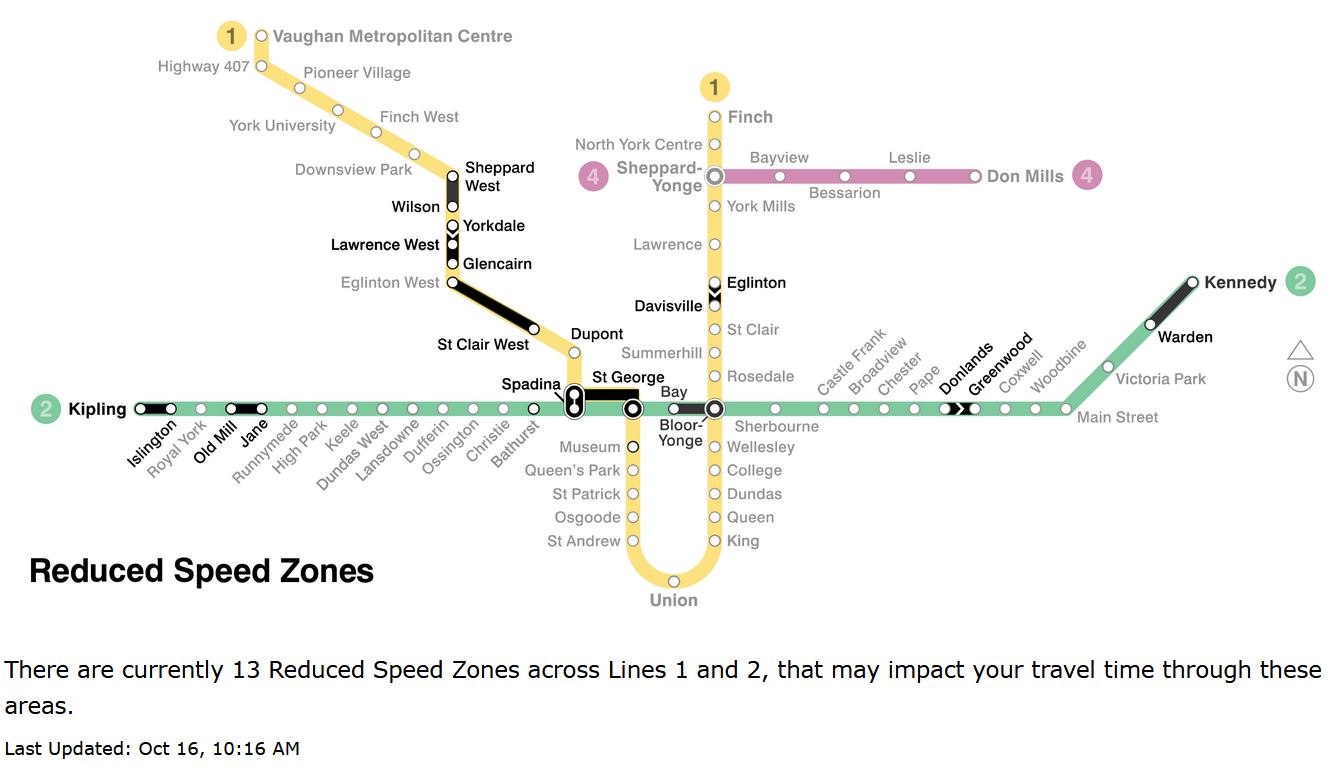
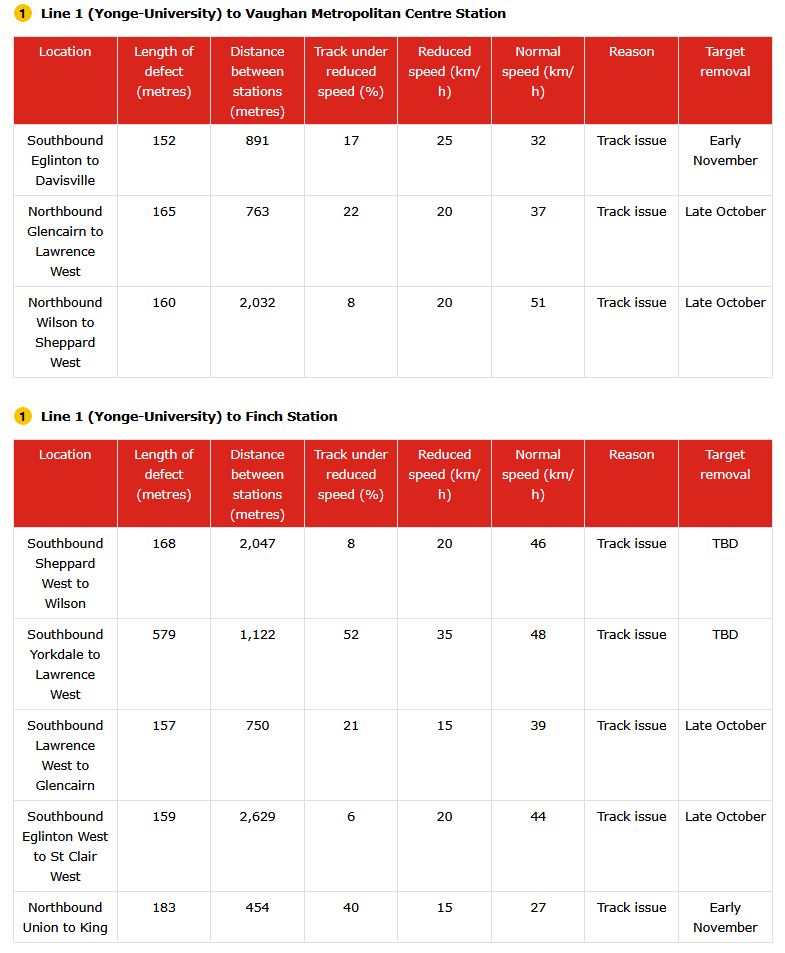
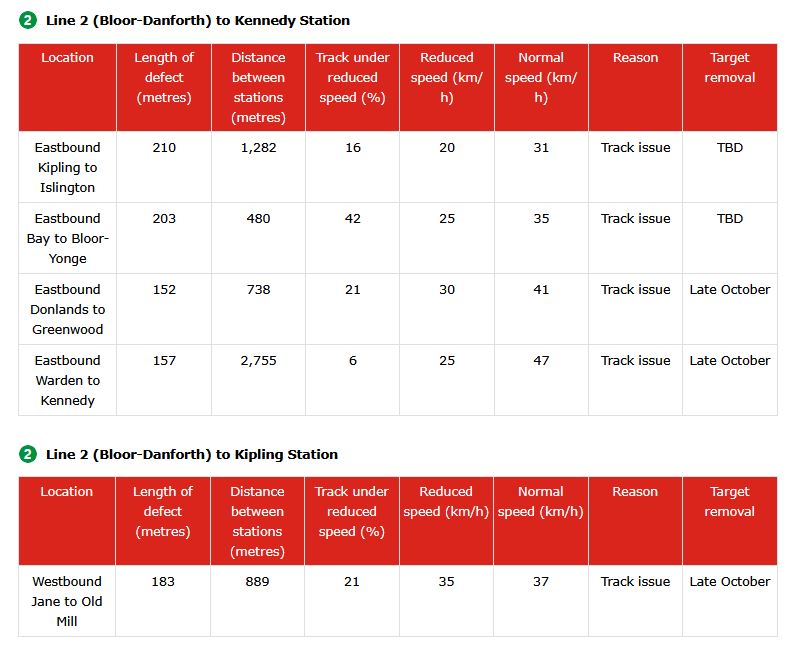
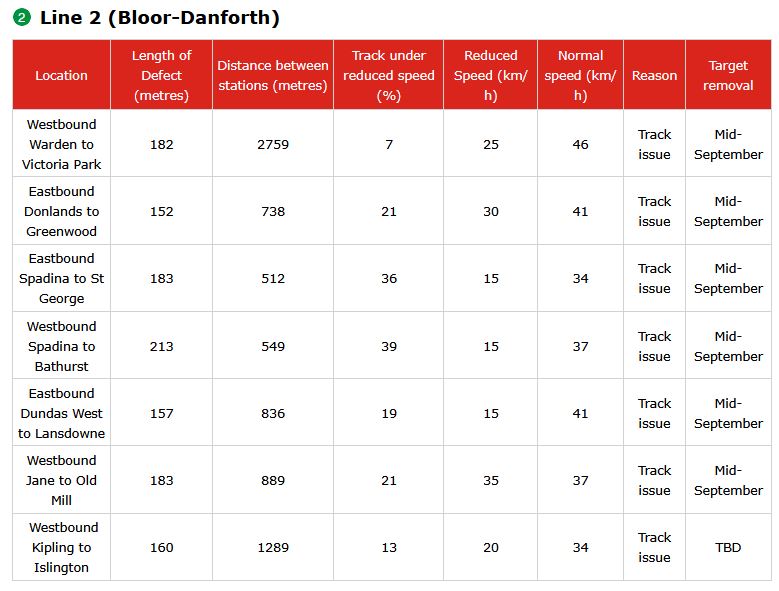
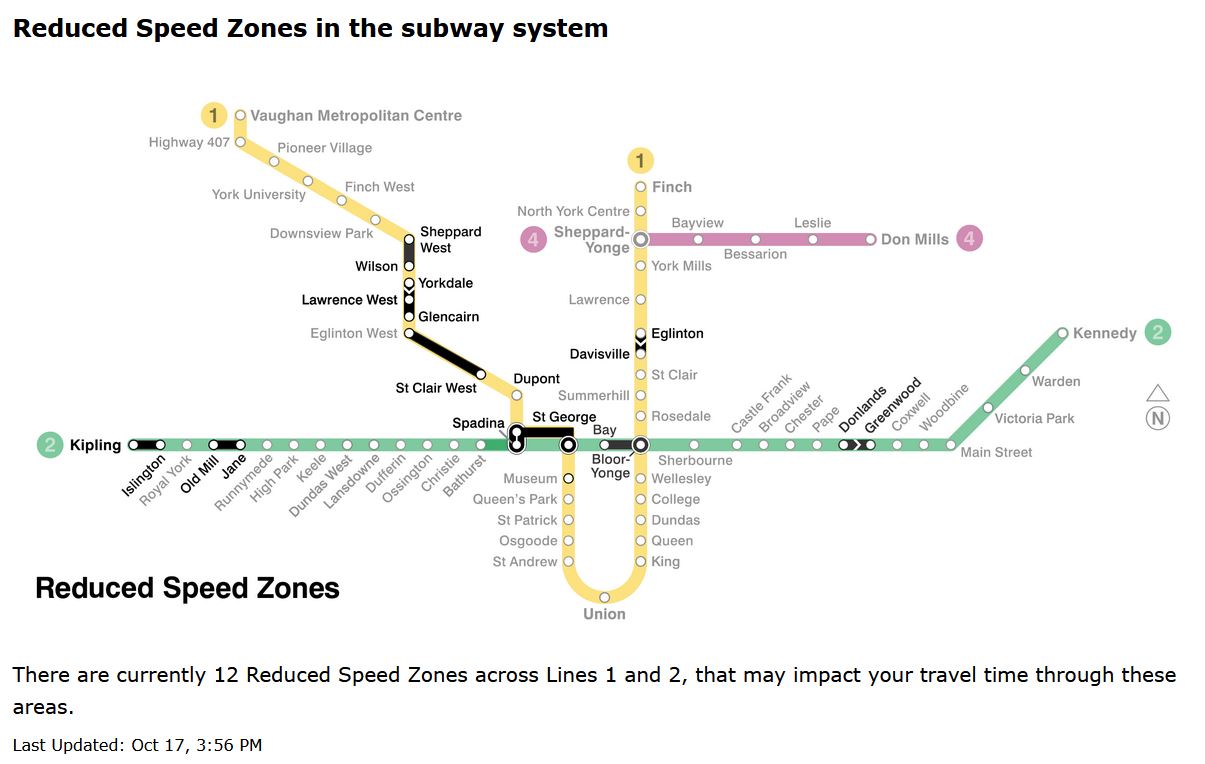
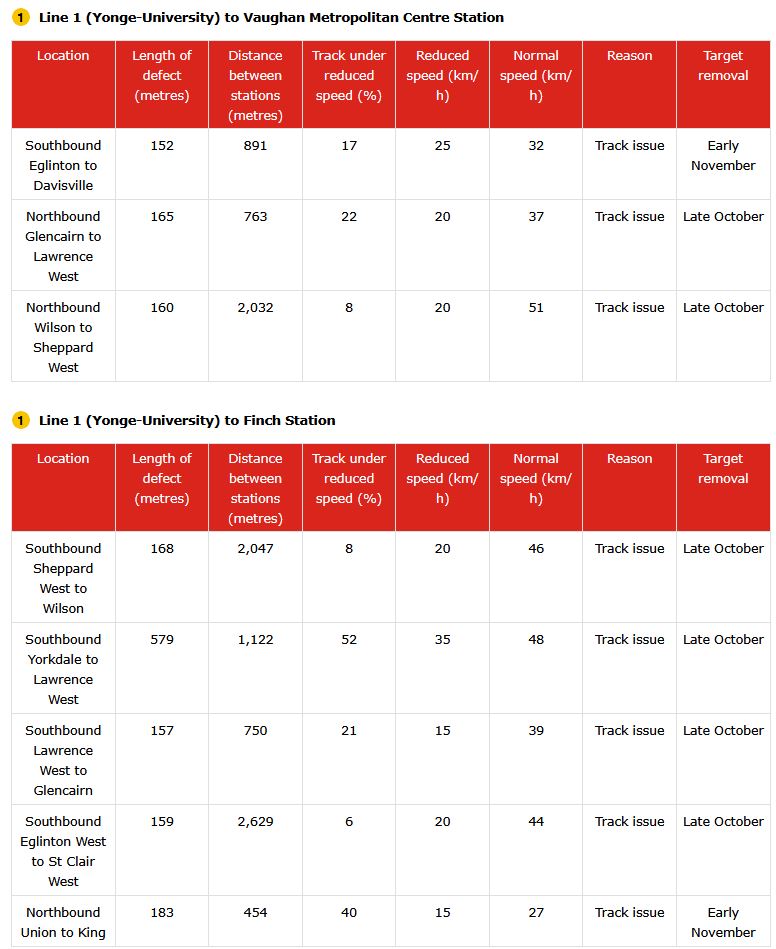
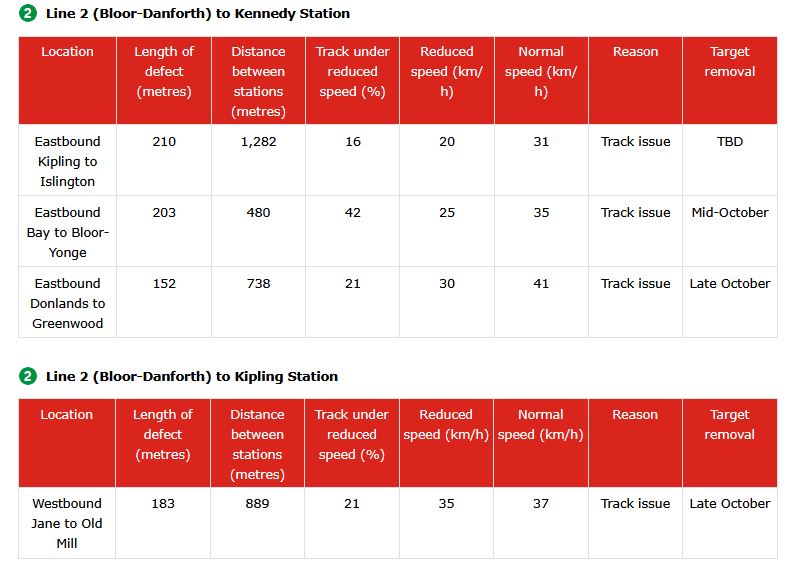
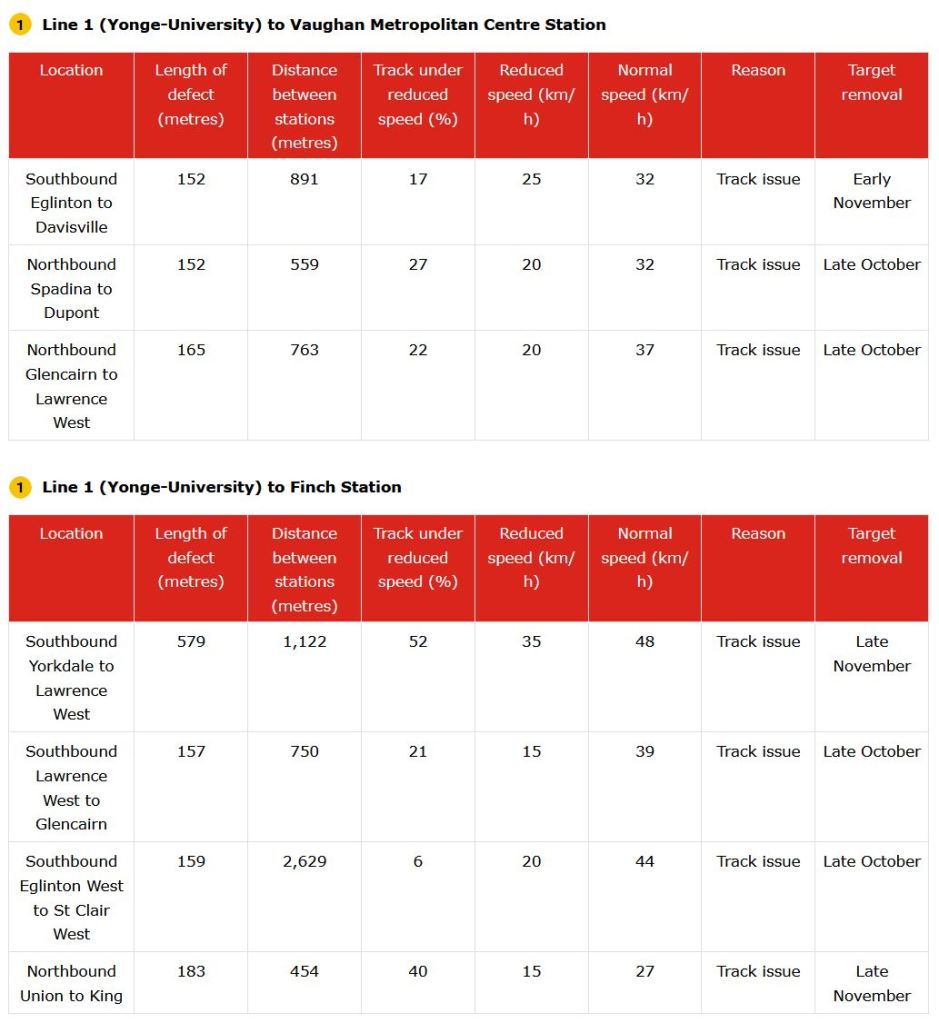
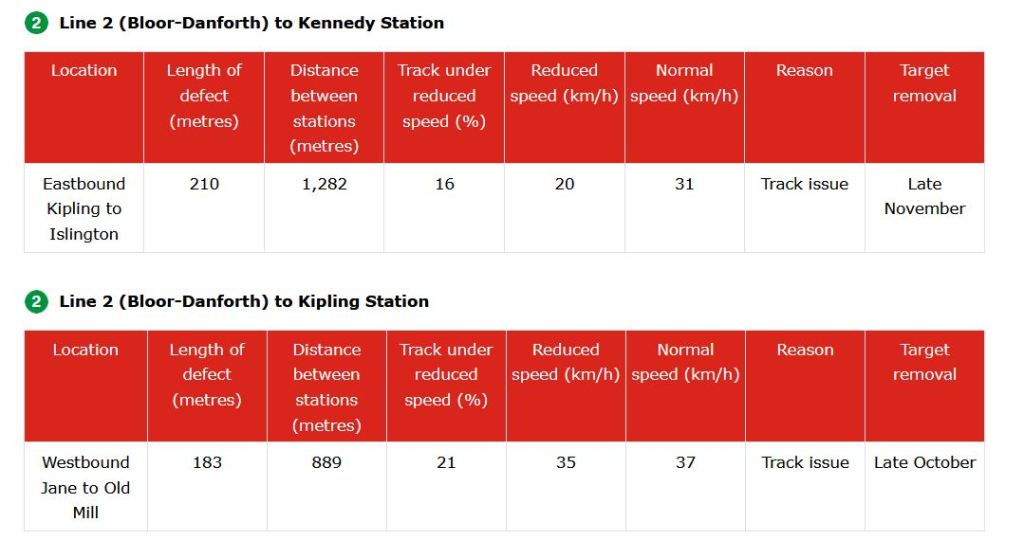
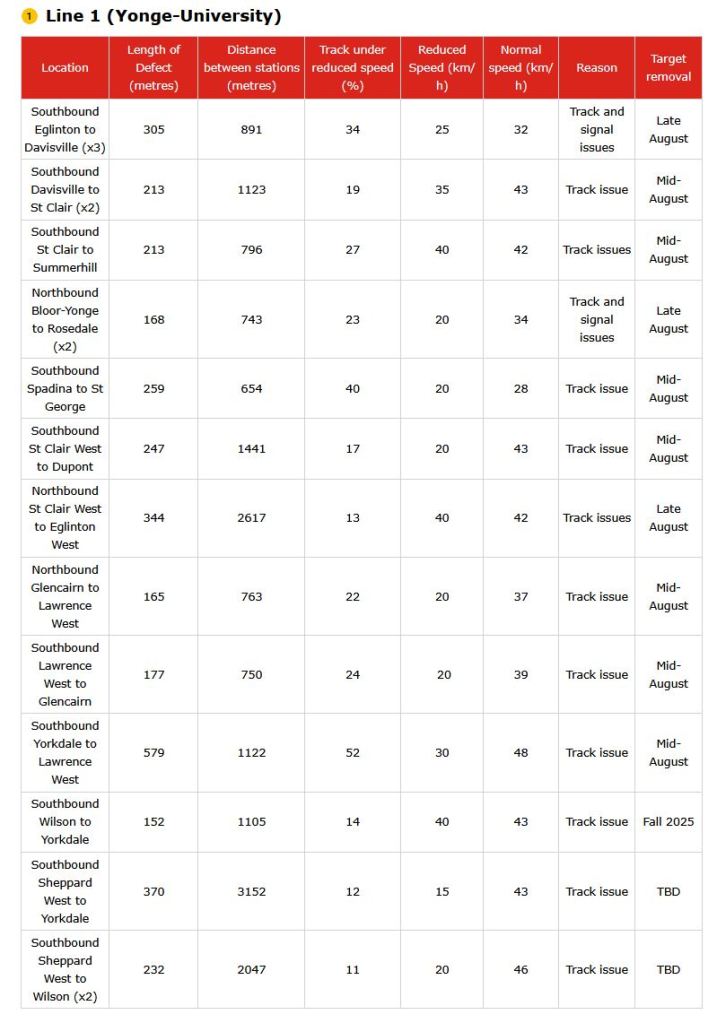
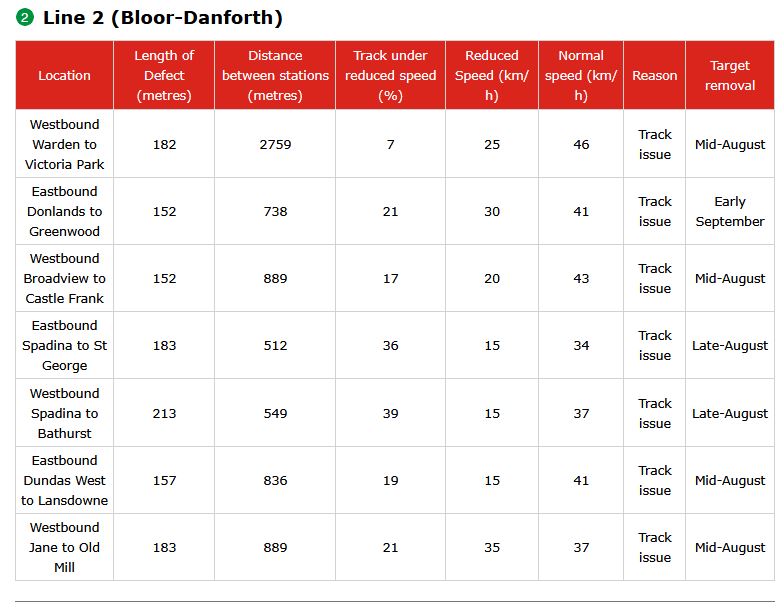
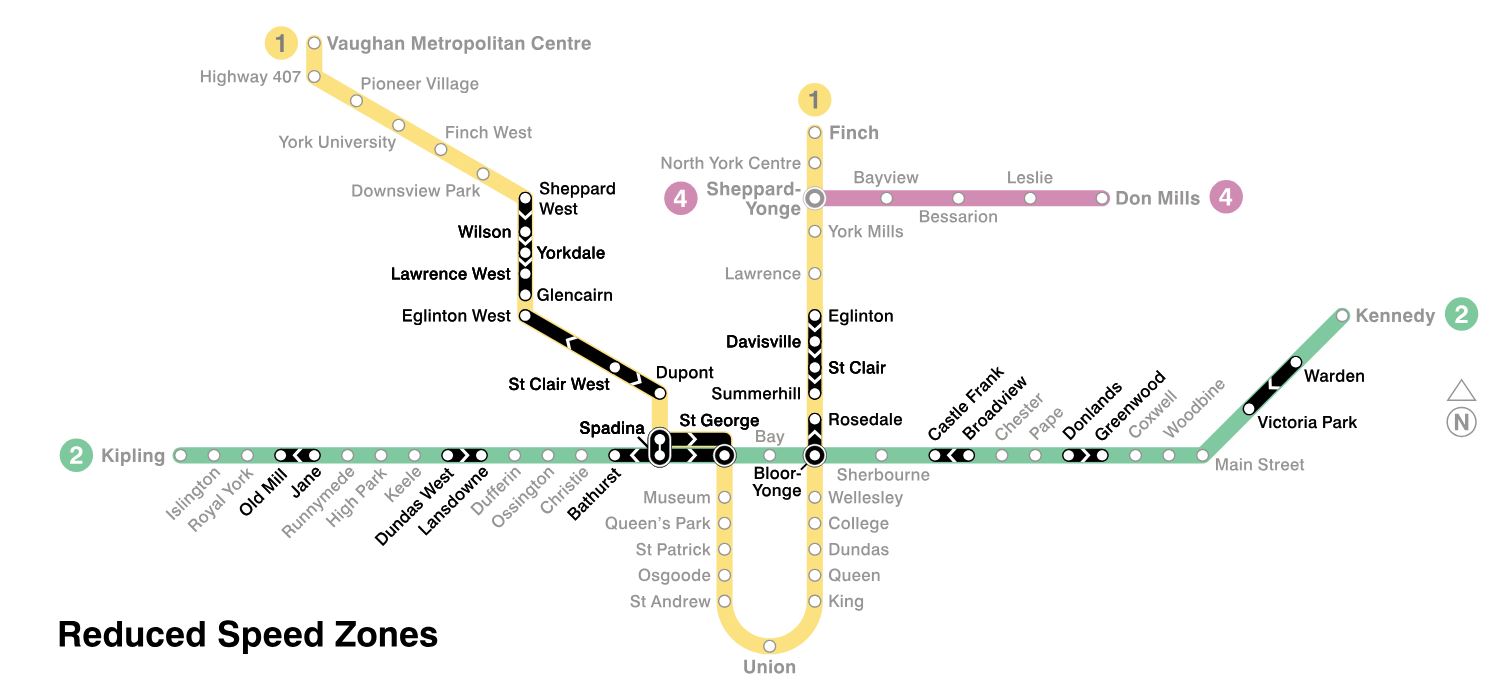
The format of the TTC page has been changed to include not just a map showing where the zones are, but why they were created and, in most cases, a target date for remediation.

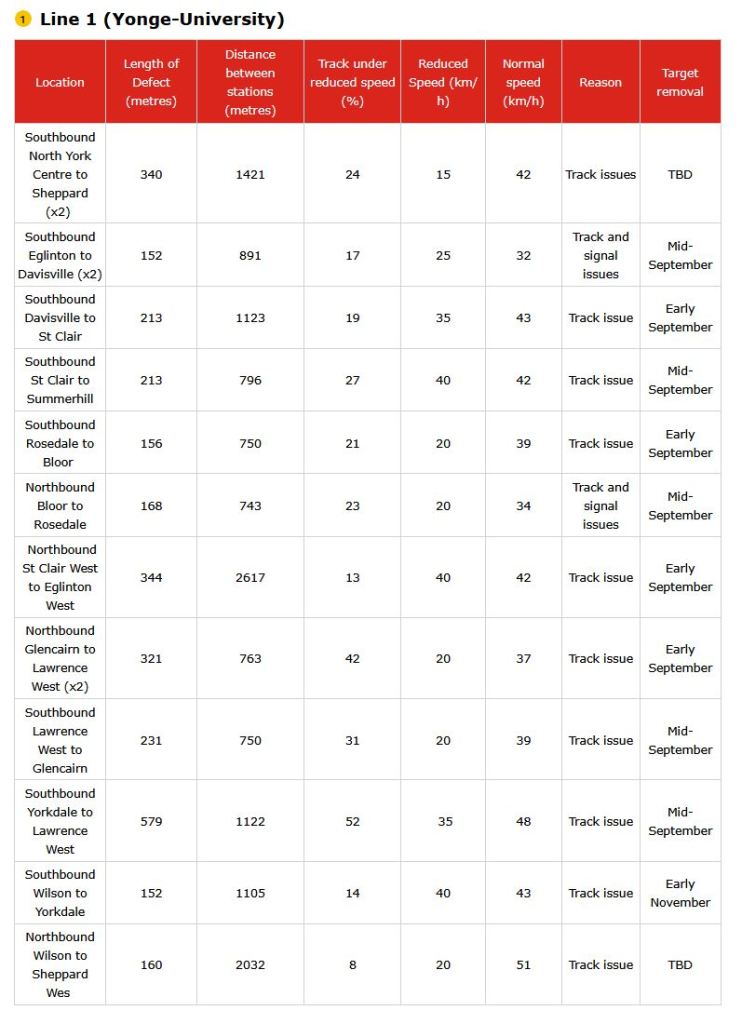
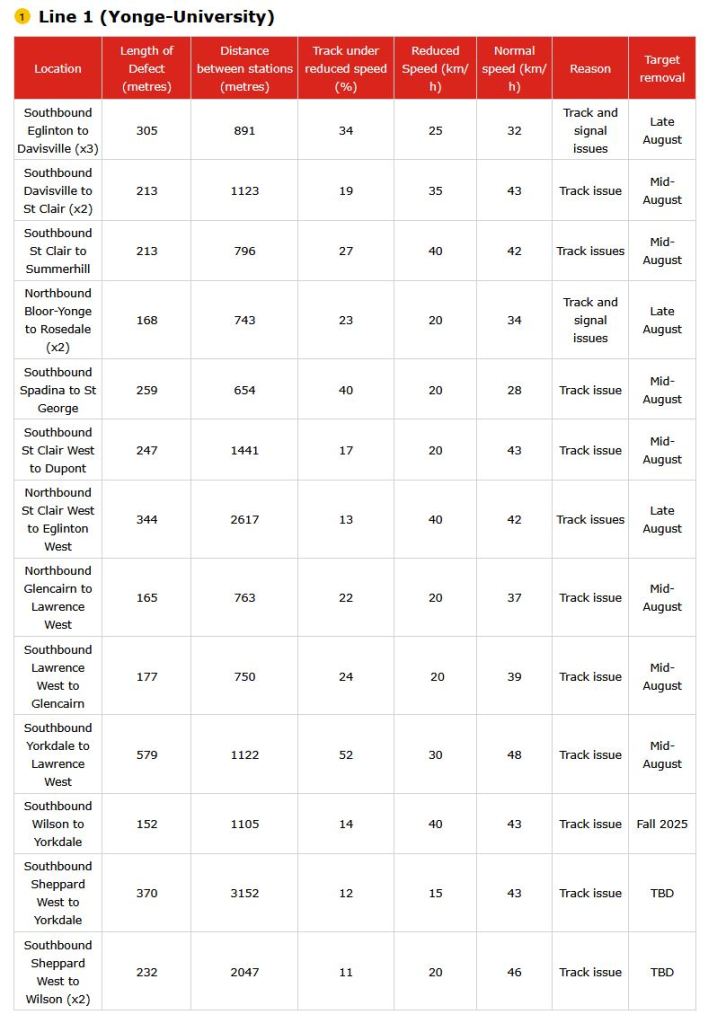
The current map and table of repair targets, as of July 31, 2025, are shown below. Note that some of the items on the map are not included in the detail (e.g. Warden to Kennedy eastbound), and the table includes entries that are not reflected on the map (e.g. Sheppard West to Wilson). This does not speak well of the TTC’s ability to communicate consistent, accurate information.

Updated August 1, 2025 at 9:10am: The TTC has updated their page so that the map and tables are now in sync with each other.

Most of the zones listed here are scheduled for removal by early September with only a few continuing into the Fall or beyond (“TBD”). This list will bear watching for additions, and for removals of cleared sections within the expected time frame.

Original July 31 versions:

Revised versions:

TTC Service Changes Effective July 27, 2025

The TTC will make a few service changes effective July 27, 2025 as well as a number of route name and signage modifications.

The changes including before and after service designs are in the spreadsheet linked below.

(The spreadsheet has been corrected to refer to Sheppard Yonge rather than Sheppard West Station for bus looping changes.)

Construction Projects

The only change in the construction project list is that paving work at Sheppard Station bus loop is complete, and buses will move back into the loop. There is no change in service on affected routes.

The bay allocation at Sheppard Station is shown below.

Temporary Service Improvements

With a surplus of operators, service will be improved to address crowding and service resiliency on many routes. These are not formal schedule changes.

504 King
20 Cliffside
32 Eglinton West
37 Islington
44 Kipling South
45 Kipling
54 Lawrence East
63 Ossington
66 Prince Edward

67 Pharmacy
68 Warden
80 Queensway
86 Scarborough
89 Weston
90 Vaughan
110 Islington South
111 East Mall
118 Thistle Down

119 Torbarrie
123 Sherway
124 Sunnybrook
125 Drewry
126 Christie
161 Rogers Rd
929 Dufferin Express
960 Steeles West Express
996 Wilson Express

Destination Sign Changes

Signs on many routes will change for standardization including:

  • 13 Avenue Rd
  • 30 High Park North (Branch letters removed)
  • 75 Sherbourne
  • 116 Morningside
  • 203 High Park
  • 302 Kingston Rd-McCowan Night
  • 332 Eglinton West Night
  • 924 Victoria Park Express
  • 929S Dufferin (new Dufferin Station short turn for CNE service)
  • 960 Steeles West

Routes renamed:

  • 74 Mount Pleasant
  • 103 Mount Pleasant North
  • 171 Mount Dennis

Streetcar Service Changes

301 Queen Night

Two early morning trips extended west from Roncesvalles to Humber Loop to improve the transition to 501 daytime service.

504 King

Official route standardized to operate via Queen and Shaw. This has been in place since May 2025, but the schedule change will also allow trip prediction apps to “see” cars on the route they are actually using.

Bus Service Changes

22 Coxwell / 92 Woodbine South

The holiday interline at the south end of the routes will be discontinued.

72 Pape

The 72C Commissioners service will be extended on weekends except late evenings to serve Biidaasage Park. The service will operate westbound via west on Commissioners Street to north on Ookwemin Street (formerly Old Cherry Street). Eastbound service will run from Ookwemin Street east on Villiers Street, u-turn to west on Villiers Street, south on Ookwemin Street, east on Commissioners Street

100 Flemingdon Park

Weekend service revised for reliability.

102 Markham Road

Added trips on weekdays SB from Warden Station to Steeles at 4:47 and 5:13 am to reduce crowding.

Streetcar Vehicle Allocations

Streetcar Route Maps

Bus Vehicle Allocations

eBus Compatible Runs By Garage

Budget and Scheduled Service Hours

TTC Board Meeting: July 17, 2025

The TTC Board met on July 17, 2025. Among the items on the agenda were:

Continue reading

TTC Strategic Planning Committee: July 10, 2025

Introduction

On January 10, 2025 as part of the budget process, the TTC Board approved:

  1. Establish a Strategic Planning Committee to assist the TTC Board in managing strategic planning and priorities, including through a Ridership Growth Strategy and other existing strategic documents, and direct the Director, Commission Services to report back to the February 24, 2025 TTC Board meeting on a proposed structure and meeting schedule after canvassing Commissioners’ interest in committee membership;
  2. Amend the 2025 Schedule of Meetings to add a Special Meeting of the Board in September 2025 to consider recommendations from the Strategic Planning Committee, receive an update on the 2026 Budget, and discuss budget priorities informing the development of the 2026 TTC Operating Budget; 2026-2035 Capital Budget and Plan and 15-Year Capital Investment Plan and Real Estate Investment Plan Update;
  3. Direct the Director, Commission Services to include a Special Meeting to consider recommendations from the Strategic Planning Committee, receive an update on the next year’s budget, and discuss budget priorities informing the development of the next year’s budgets in future year’s recommended annual schedule of Board and Committee meetings for the Board’s approval, in
    accordance with Section 20 of the By-law to Govern Board Proceedings;
  4. TTC Staff conduct public consultations and develop a Ridership Growth Strategy 2.0, building upon the Ridership Growth Strategy 2018-2022 and report back to the Board in July 2025;
  5. TTC staff develop a hiring strategy on the basis of the approved Ridership Growth Strategy 2.0 and report back to the Board by October 2025; and TTC staff use the approved Ridership Growth Strategy 2.0 and associated hiring strategy to inform the 2026 TTC Budget process.

I began writing this article before the meeting took place as background based on the then-posted materials. After attending the meeting, I found that it was more productive than I had expected thanks in part to two presentations that were not in the original published agenda.

TTC Chair Jamaal Myers praised Councillor/Commissioner Alejandra Bravo who chairs the Strategic Planning Committee for the work she did in producing a focused agenda that made for a useful meeting. Past attempts by the Board to engage in general policy debates have been rare.

There was much more meat on the presentations than we have seen in a long while at the TTC. Heavy going in places, and some hard truths about the options available. This type of briefing is long overdue, and will provide the foundation for informed discussions at the TTC Board and eventually at Council.

The actual establishment of a committee contemplated in point 11 did not actually occur until the Board meeting of April 16, 2025, and the first meeting only now happened, six months after the original motion. It is not clear how much influence the committee will have on the 2026 budget process considering the length of delay.

Although the next meeting date is currently shown as October 25, 2025, Chair Bravo indicated that she does plan to schedule one in time to feed into the budget.

As for consultations on a Ridership Growth Strategy, these have not yet begun, and the TTC is now only in the first round of its Annual Plan consultations. By extension, any service improvements flowing from a new RGS including hiring required to staff buses and streetcars do not yet exist. How much would be done in the 2026 budget remains to be seen.

The delay in the committee’s initiation places the Board in a familiar position. Actual discussion of policy options is pushed off, if it occurs at all, so late in the year that the next budget is “more of the same” because there was no time to consider alternatives. Options for significant growth are never presented to Council because the TTC Board never discusses what might be done.

“Value for Money”

Almost at the end of the meeting, Chair Bravo made a comment about advising the budget process. She posed two questions about funding:

  • Is it the best value for money?
  • Does it create the most value for transit users?

This slipped by quickly, but a vital issue here is that these are not the same question, but two separate issues depending on what one assumes as the role of transit. Best value for money for whom? For taxpayers asked to subsidize transit? For riders awaiting a bus that never comes?

That distinction lies at the heart of every transit funding debate I have heard, but the actual question is never asked, and “value for whom” rarely starts with riders. This can be an important change in budget planning and in advocacy for financial support from the City and Province.

On The Agenda

There are three items on the July 10 agenda:

Continue reading

TTC’s 2026 Network Plan: Round One

The TTC “Annual Service Plan” has been rebranded as the “Network Plan” in the interest of clarity, but based on the 2026 edition’s meagre content so far, this is an infinitesimal network. In particular, it really does not deal with the transit network as a whole, but only small tweaks at the edges. Big decisions such as long range, city-wide plans, budgets, service levels and the future of transit as part of Toronto are all made elsewhere.

Issues such as strategies for improving ridership and budget reviews which bear directly on the amount of service riders see are not in this plan. Nor is any discussion of basic service quality and management, nor of the fractured nature of TTC information for and communications with its riders.

Round One of the Network Plan consultation addresses only a handful of proposed route changes. More substantial work including an Express Bus Network review and discussion of construction-related service changes won’t appear until Round Two in August.

The Network Plan presentation lists several parallel studies under development parallel to but not included in the Annual Network Plan consultations. Only those keen transit watchers know about all or most of these, and it is a hard slog keeping up. The table below is from the Round One presentation deck.

  • 2026 Annual Service Budget
    • Sets service levels for each board period in 2026
    • Includes number of vehicles, service hours and distance
  • 2026-2028 Ridership Growth Strategy (RGS)
    • Cost-benefit analysis of service, fare, infrastructure and customer experience initiatives
    • Could achieve ridership growth over the next 3 years (if funded)
  • RapidTO Transit Priority Lanes
    • Completed: Queens Quay East
    • Next: Dufferin St and Bathurst St corridors (pending July 2025 Council approval). Target: ready for 2026 FIFA World Cup
    • Feasibility and design studies are on-going for the Jane Street, Finch Avenue East, and Lawrence Avenue East roadways
  • FIFA World Cup Transit Service Plan
    • Increased service on key downtown routes
    • Additional service on match days and during Fan Festival
  • Reducing bunching and gapping
    • Efforts to reduce bunching and gapping on 10 of the most problematic routes with enhanced on-street presence as well as scheduling related changes

There are also:

This may suit the TTC’s fragmented internal structure, but it drives people outside of the TTC mad. One does not have to be a seasoned transit advocate, merely a daily rider, to rail at the frustration of “consultation” on a handful of minor route changes. Basic service issues across the system must wait for the budget (no public consultation there at all), the Ridership Growth Strategy (budget limits again) and a Board that, until recently, actually believed (or chose not to challenge) management claims about quality.

Two burning issues are service quality (with associated crowding and unpredictable waits), and the effect of construction projects on routes (not to mention abjectly poor and inaccurate communications to riders). We will have to wait until Round Two in August to address at least some of these problems.

Consultation

An online survey opens July 7-16. There are separate consultations with the Advisory Committee on Accessible Transit (ACAT) and the TTC’s Planning Advisory Group which after many years now has a formal name. (Full disclosure: I am a regular contributor to that group.)

Pop-Ups will be held from 4-6pm at the following dates and locations:

  • July 9th: University of Toronto Scarborough Campus
  • July 10th: St. George Station
  • July 15th: Sherbourne & Rosedale Stations
  • July 16th: Lawrence West Station & Sunnybrook Hospital
Continue reading

TTC Board Meeting: June 23, 2025

The TTC Board met on June 23. Among the items on the agenda were:

A major item on the agenda was the subway platform edge doors study. This is covered in a separate article.

There were overlapping threads in discussion of current results, the financial update, and the non-fare strategy all stemming from the 2025 shortfall between budgeted and actual fare revenue and ridership. Although some shortfall was expected thanks to the severe winter, ridership has not climbed to the budgeted level. An unanswered question is whether the TTC aimed too high in its expectations for 2025, or if there is an inherent limit in system growth that will occur over the year.

Midweek rides (Tuesday to Thursday) in Period 4 (roughly the month of April) were about 2% over the corresponding period in 2024, but overall ridership is about 5.1% below the budgeted level.

Fare revenue follows a similar pattern, although it is down by only 4.6% to budget because the average fare/ride is slightly higher than expected.

The use of various payment methods continues to evolve toward Presto with either a Presto card, app (“virtual card” below), or bank card (“open payment”). This chart only goes to week 17 of the year, and legacy media were still accepted for another month although they have dropped to 0.2% of all fare payments. In Period 4 about 46,000 tokens and 12,000 tickets were collected (about 2,000 fares/day).

Boardings continue to be below pre-pandemic levels across the system.

Note that a “boarding” is one link of a trip on a single route, with the exception that transfers are not counted as new boardings on the subway. A “ride” is one or more boardings paid for with one fare or card tap.

The lower recovery level on the rail modes is attributed mainly to the work-from-home pattern which is still felt by the transit system with the average day on Tuesday to Thursday being 6% higher than Monday and Friday.

Weekend demand is important and stands at about 60% of the weekday level (1.53 million/day vs 2.54 million/day). By extension weekend service is also important, although the demand is less concentrated in peak hours, and the high point falls in the afternoon rather than the classic AM and PM “rush hours”.

The main CEO’s Report contains more current data than the Metrics Report and states:

For the week ending May 30, the overall weekday boardings stood at 2.5 million per day and increased by one per cent from the same week last year. Weekday boardings by mode continue to be highest on the bus network at 1.2 million, followed by subway at 1.1 million, and streetcar at 245,000. Compared to a year ago, subway and streetcar demand, respectively, increased by six and four per cent, mainly due to an increase in downtown office commutes, while bus demand declined by three per cent.

There is no analysis of the degree to which ridership growth is constrained by the quality and quantity of service. Those of us who remember back before the pandemic will recall that the TTC was in a period of constrained growth. All surplus capacity had been consumed by new riders, but budgets, fleet size and subway capacity limited the amount of service and its attractiveness for new and increased riding.

Rider complaints continue to rank timeliness of service, missed stops, and vehicle operation as the top three concerns, and these outrank safety by a wide margin. This is not to downplay safety issues, but the TTC has severe problems with the dependability of its service which are probably depressing ridership recovery.

An updated Ridership Growth Strategy is expected later in 2025, and the mix of complaints indicates where they should concentrate efforts to woo back riders.

Continue reading