Overcrowding on TTC Bus Routes

An ongoing issue with TTC service levels is that TTC claims about crowding do not always appear to align with rider experiences.

The TTC Board’s February 22 agenda includes a report about proposed free transit for Middle and Secondary School students, particularly for group field trips.

See: A Step Towards Free Transit for Middle and High School Students

Among the issues raised by the report is the ability of the transit system to handle the additional loads, and the need to co-ordinate planned outings with the TTC for provision of extra service. There is a map showing existing “hot spots” where mid-day routes are over capacity.

Many bus routes have this problem, but none of the streetcar routes.

A related issue is the degree to which crowding varies by day-of-week and the danger that Monday-Friday averages could mask problems with midweek demand levels.

Of particular note here is that the off-peak capacity shown is 35 per bus, not the higher value introduced with the 2023 budget that is close to a standing load. The heat map shows us where current operations exceed the 2023 standard, i.e. those over 100% occupancy vs a bus capacity of 35. Note that these are six-hour averages and individual bus loads will vary.

This also shows the scale of service changes required to reinstate the pre-2023 standard.

Here are the official Service Standard crowding levels and those implemented in the 2023 Operating Budget. The TTC Board has never formally change the Service Standards, and management plans to work back to the existing standards from the 2023 levels as part of future service and budget planning.

Service Standards Peak2023 PeakService Standards Off-Peak2023 Off-Peak
Bus50503545
Streetcar1301307090

The TTC produces a lot of charts in their monthly CEO’s report, but crowding maps like this one showing actual conditions only appear to support analyses of specific issues. They should be a standard part of the CEO’s Report so that there is an up-to-date indication of service capacity versus demand for all time periods.

Honest Budgeting Needed At TTC

This article began as a Twitter/X thread responding to a post from Mayor Olivia Chow.

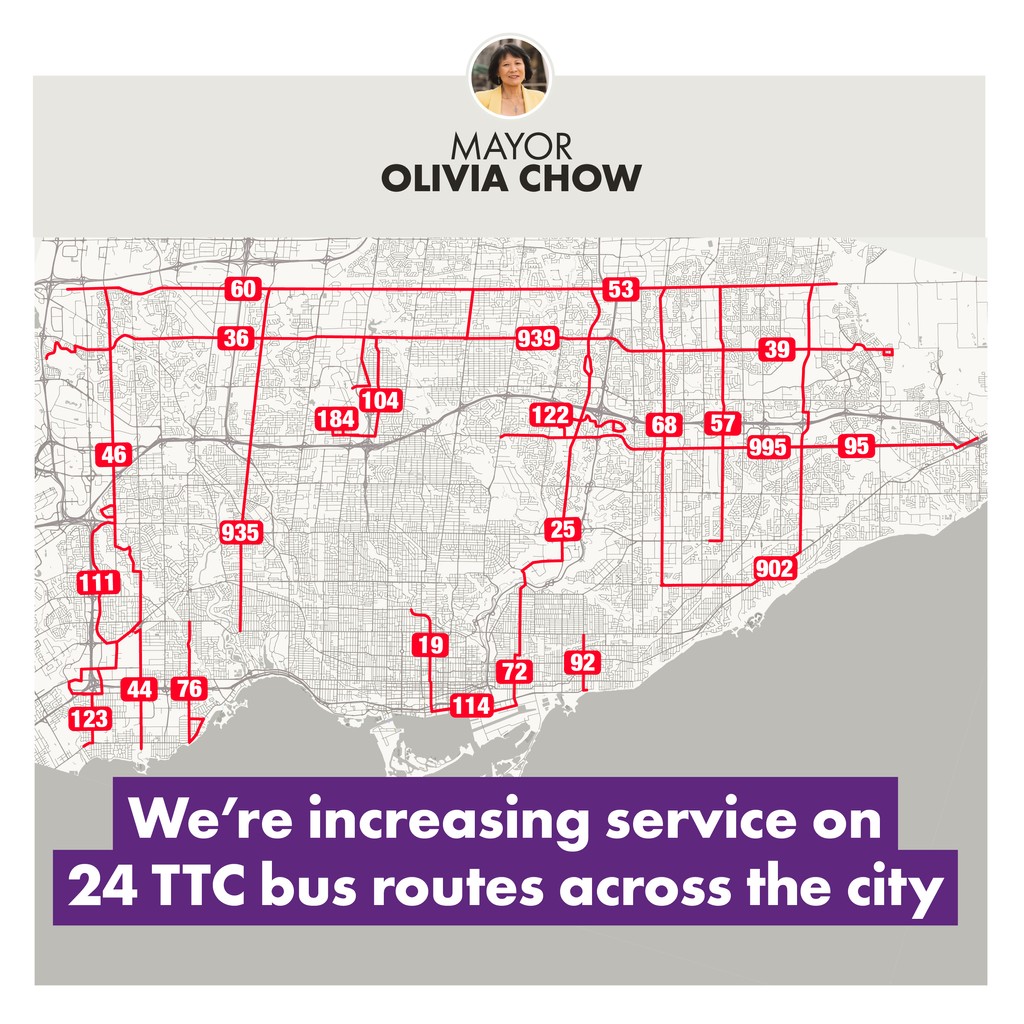
From the better way to the *best* way. This budget will restore 97% of pandemic-era TTC service cuts and get the city back on track.

There is a big problem with this claim, and I fear riders will be disappointed by what they actually see. Here is my consolidated thread.

It pains me to write this, but this post by Mayor Chow is simply not true. Either her spin doctors cannot read a budget, or she has been bamboozled by TTC’s misleading use of “restoring” service.

This chart is right out of the TTC budget and shows the planned service restoration by mode. Note that only the bus network gets back to 100%.

Because the values are based on vehicle and train hours, and buses (with relatively small capacity per vehicle) account for most of the hours, the total gets to 97% while leaving streetcars and the subway far behind.

But 97% is not really 97% as seen by riders. Many routes run more slowly than they did in 2019, and so it takes more hours to provide the same frequency and capacity of service.

For added clarity, “100%” of service hours will *not* reverse all pandemic era cuts because some hours go to routes running over 100% while others stay below that level. But spin doctors don’t do pesky details like that.

On top of that, crowding standards brought in by management without advance approval in 2023 mean that off peak service can be more crowded before triggering service improvements. These might be reversed in 2025 but only if there is budget headroom.

Talk about prepandemic service levels forgets that there were major problems with overcrowding and inadequate service back in 2019. Actual planned service in 2020 was higher than 2019, but was cut due to covid.

The shift in commute patterns means that total ridership is less than 2019 levels, but it is concentrated on a shorter work week. Off peak riding is already at or above former levels.

The TTC does not break out service frequency and capacity as metrics, but using vehicle hours hides deeper cuts in these areas.

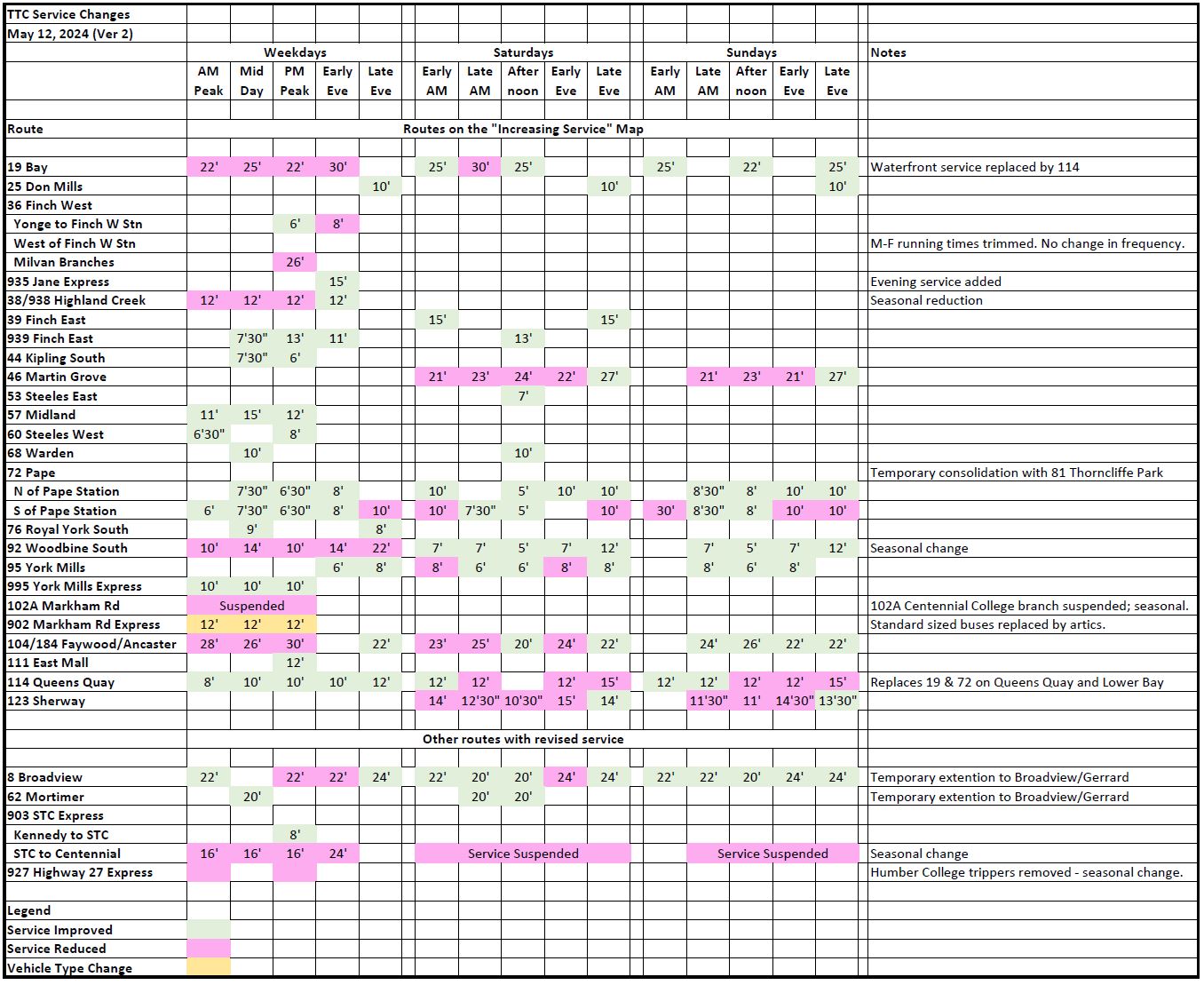
The February 18 schedule changes include cuts on many routes which are described as “adjustments” on the TTC’s website. A few of these are erroneously called “improvements”.

One reason for the February cuts is that service in January was actually *over* budget and the cuts back that out.

The TTC has no public measurement of crowding conditions and service quality including gaps and bunching. That 97% number will be broadcast far and wide, but will hide many problems.

Service Budgets

For comparison, here are the 2019, 2020 (pre-covid) and 2024 service budgets. The important column is the third from the left, “Regular Service Total”.

For a comparison of January 2024 service levels to January 2020, see this article:

There is work to be done, and a vital first step is to understand just what is needed and what is possible. The TTC Board plans a strategy session in March, and their Budget Committee will probably start meeting in June-July.

Soon I will publish an article about a Ridership Growth Strategy for 2024 that will set the stage for the kind of debate that should be on the agenda.

Can we hope that these meetings will not be consumed by self-serving management dog-and-pony shows, but rather will be an open discussion of the state of and options for our transit system.

TTC Service Changes Effective February 18, 2024

The TTC will modify service on many routes effective Sunday, February 18, 2024. Several of these changes involve “reallocation” of service between routes and time periods, and overall there will be a small decline in scheduled vehicle hours.

One concern about this process is that the TTC has stated that it would only impose the new, more crowded, off-peak loading standards when changing schedules, but would not retroactively cut service based on the 2023 management-imposed values. With many routes seeing service trimmed, we do not know what the new target crowding level will be because the TTC has not published this information for several years.

There will also be some adjustments for service reliability. These generally involve giving vehicles longer travel times with resulting wider headways on affected routes. In some cases, service does improve because extra time that had been allocated for construction effects is removed.

The table of construction projects affecting transit service is shown below. This does not include ongoing works on the subway system and slow orders for which there is no scheduled provision.

The major project beginning with this schedule period is the reconstruction of water mains and track on King Street West. This is the subject of a separate article:

The new service designs for 504 King, 501 Queen and 63 Ossington are included in the spreadsheet listing all changes below.

The configuration of the streetcar network is shown below.

Scheduled vehicle hours will decline slightly with these changes in part to correct for an overage relative to budget in January. A small increase is planned for the schedule change in late March, and a large one in September. The drop shown for December is the usual effect of the holiday break and the removal/reduction of school services.

Continue reading

Fun With Figures: The Value of Transit Investment

A common, but troubling practice in talking about transit is the attempt to build a “business case” as if city’s transit network can be examined through a rather simplistic management school lens. Everything is reduced to a monetary value, be that direct spending, spinoffs, or the notional value of benefits.

Aside from basic errors in methodology, this approach assumes that the supposed value of transit spending can be gleaned from a one-dimensional view of its so-called worth in dollars and cents. Bad enough that this practice is entrenched in Metrolinx, an agency that sets priorities based on political, not financial, evaluations thereby undermining the credibility of financial analyses. The scheme has trickled down to the municipal level with a TTC/UofT study intended to show that money for transit has financial benefits and should be encouraged for the good of city and country.

You might ask why a transit advocate has misgivings about this exercise, but the answer lies in my long-standing conservatism (with a very small “c”) about public spending generally. Megaprojects bring press coverage, especially with the opportunity to announce over and over the latest step, no matter how trivial, as work inches along. This tactic works as long as there is success to report, and we just don’t talk about abject failures like Line 5 Crosstown any more often than needed.

A huge problem with the TTC’s gaping hole in Capital funding, and to a lesser extent on its Operating side, is that the cry “please, Sir, I want some more” for transit support wears thin with would-be partners. Moreover, everything on Toronto’s wish list does not necessarily align with political priorities elsewhere, and it must compete with demands from other cities and provinces. Thus the desire to show that transit spending has a great “payback”, but that number hides fundamental questions.

The problem with spending for its own sake is that one rarely hears the question “what else might we do with these billions” or “is this project really worth its cost compared to other demands on public funds”. How much is not built or operated because some other project took priority, or the growing cost of works already underway crowded other new schemes off of the table?

Into our political environment, one rife with patronage, cronyism and outright corruption, comes an attempt to justify spending on transit as an inherently good thing.

In 2022, the TTC launched a joint study with the University of Toronto Mobility Network which surfaced as part of the 2023 and 2024 Budgets. The goals of the study were “to identify and quantify the economic and other key benefits resulting from investment in transit and the TTC”:

  • Economic benefits realized from investments in transit services and capital works that enhance TTC’s existing transit network
  • Economic impact of the TTC on the local, regional, provincial and national economy
  • Qualitative and quantitative social, equity, health and environmental benefits and the economic spin off benefits derived from these other benefits
  • Impacts should the necessary service and capital investments not be made in the TTC
Continue reading

TTC Board Meeting: December 20, 2023 – Part II

This article continues the series about the December 20, 2023 TTC Board meeting with details of the budget discussion.

Items discussed here:

This article deals mainly with the Q&A session at the Board meeting as I have already written about the 2024 budgets in detail elsewhere.

The 2024 Operating and Capital Budgets

A major problem with TTC budget “debates” is that they are quite perfunctory compared with the size and importance of the reports, and the spending involved. There has been no TTC Budget Subcommittee for years, and even when it existed, it rarely met. The idea of at least part of the Board doing a deep dive into budgets seems to be utterly beyond their idea of “good governance”, at least until the recent change in the Mayor’s and Chair’s offices.

Commissioner Ainslie asked that the Chair work on creation of Budget Committee with a report in 2Q24. He observed that agencies with much smaller budgets than the TTC have budget committees, and the TTC should too. The Board asked staff to report in Q2 2024 on the establishment of a Budget Committee.

It should not be for staff to report on creation of such a committee, but for the Board to say “we need this” and immediately canvass members for their interest. An informed committee will be essential for review of the 2025 budget priorities before the budget is struck. The budget should not come to the Board as a fait accompli based on discussions at the staff level. Moreover, the Mayor’s Office should have visible input to the process. If the level of so-called review by the Board amounts to a once-a-year dog-and-pony show by staff, there is no opportunity for Board input and queries about the underlying policies, assumptions and options available.

Some TTC Board members are strong in their belief that the role of the Board is to provide policy and oversight, and of management to manage. That is a great model provided that the Board actually engages in its role, but for many years there was no sense that the TTC Board actively developed policy, let alone held management accountable.

By the end of the budget debate, Board members were very concerned about the financial status of the TTC, even though quite complimentary about the detail of work presented by staff. Some of these members sat through the years when Mayor Tory ran the show, and the primary message was “everything’s just fine”. They bear some responsibility for problems that have festered for years.

After the staff presentation on the two budgets, there were many questions from the Board. The items below have been consolidated by topic. Illustrations are taken from the presentation deck.

Continue reading

Broadview Station Reopens to Bus Service

The TTC has announced that bus operations will return to Broadview Station in coming days now that reconstruction of the track and paving is complete.

Thursday, January 4:

The 504/505 King/Dundas replacement bus service has operated from Castle Frank Station stopping on street at Broadview & Danforth. It will resume use of Broadview Station. The 304 King Night bus will also return to the station.

The 8 Broadview and 62 Mortimer buses have terminated at Broadview & Danforth using on street stops, and then deadheading to Gerrard to loop near Bridgepoint Hospital. They will return to their normal looping at Broadview Station.

Sunday, January 7:

The 87 Cosburn, 100 Flemingdon Park and 322 Coxwell Night buses have operated to Pape Station. They will resume their normal routes to Broadview Station.

Streetcar Service

Streetcar service is expected to return to Broadview Station on 504B King and 505 Dundas in the mid-February schedule changes.

When 95% Really Isn’t 95%

Many shouts of “hurrah” have been heard around transit circles with the news that the TTC will be operating service at 95% of pre-pandemic levels on the bus network in early 2024 building up to 97% by the Fall.

The key question here is “95% of what?”

To make this a tad simpler, consider a rider who is told that service is back to 100%. To someone waiting on a street corner, this means that the bus will arrive (or at least be scheduled) at the same frequency as it was four years ago before the covid cuts tore through many routes’ service levels.

At the risk of disappointing readers, they should not rush out on January 7, 2024 when the next schedules come into effect waiting for the miracle of restored transit service to roll down their street.

Politicians and management who trumpet the return to “full service” should qualify their excitement with the fact that service on many routes is less frequent than it was in 2020.

“Service” also includes crowding standards. It is hardly valid to claim full service restoration if crowding standards pack more riders per vehicle before service is improved, and even that depends on available vehicle hours in the budget. It has been many years since the TTC published current loading stats and a list of routes that are operating beyond standards.

Truly restoring full service will require more resources than the TTC has been given or will see in the 2024 budget, and a political will to talk about “service” in a way that reflects rider experience.

Continue reading

TTC Service Changes Effective January 7, 2024

The TTC will adjust service on many routes with the January 2024 schedules.

A summary of all changes is in the spreadsheet linked here showing a before and after view of the affected routes. Note that the “before” data are from the November 2023 schedules which do not include the holiday period’s service cuts. All of those cuts are restored in the 2024 schedule, and they are not listed here.

TTC Service Changes 2024.01.07

Updated December 30, 2023:

  • Maps of route changes have been added from the corresponding TTC Service Changes pages.
  • The revised 501B Queen looping at Broadview & Gerrard has been added.
Continue reading

TTC 2024 Budget Preview: Part I – Operating

The TTC Board’s meeting agenda for December 20, 2023 deals primarily with the 2024 Operating Budget, the Capital Plans looking forward 10-15 years, the growing backlog of State of Good Repair (SOGR) spending, and a preliminary look at the Five Year Corporate Plan. A few items are carried over from the December 7 agenda that the Board could not complete due to time limitations, of which the most significant is the quarterly financial review.

In this article I will preview the Operating Budget, but will turn to the Capital Budget in a second piece. I will also follow-up the Board meeting discussion and additional presentations from staff.

Major Issues

The overwhelming issue is, of course, funding: who will pay to continue TTC operations at their current level let alone to improve them?

No fare increase is proposed for 2024 “in recognition of the impact current economic conditions have on customers”. This has a cost in increased subsidy, or more subtly in works not undertaken for lack of revenue, if the gap is not filled. In 2024, this gap will use a reserve draw, but that approach is not sustainable due to declining reserves and the escalating cost from year to year of a continued freeze.

A political challenge in seeking profincial and federal subsidies for covid shortfalls is that a fare freeze appears to come on the back of covid payments that might not otherwise be claimed.

More generally, the idea of “covid costs” is going to run out of steam soon as support programs close down at the provincial and federal level. The TTC and City must figure out what TTC plans look like based on current revenue and ridership, plus whatever added subsidy might be available.

Future years include major challenges with a continuing reduction of core area work trips compared to pre-pandemic conditions. While total weekly trips might be lower than historical levels, daily volumes show considerable variation both on transit and traffic conditions. Service planned on the basis of average demand could be overloaded on the peak days.

Although the budget speaks of a return to 97% of the Service Budget level by Fall 2024, this is qualified by a note that this is to address traffic congestion. In terms of actual service level (i.e. buses per hour), riders may not see as much improvement as the 97% figure implies. There is almost no provision for additional streetcar and subway service. Peak subway service continues to operate at a much lower level than pre-pandemic schedules in spite of an overall return to 83% of the former service.

The budget contains little provision for additional service related to demand growth, nor is there any discussion of the implications of a growth rate higher than the assumed value. Ironically, added costs are included for maintenance of the growing streetcar fleet, but not for actual operation of these vehicles. Capital plans for buses see only a modest growth in fleet size and, by implication, in service levels.

There is no discussion of reversing changes to Service Standards implemented by management in 2023 that brought allowable off-peak crowding to almost peak levels. This keeps the cost of service down, but affects its attractiveness.

The net effect of demand changes in the core is that the TTC’s share of the travel market is falling even though ridership is strong for non-core trips with a higher recovery rate.

There is a major disconnect between capital plans for substantial growth in core area capacity on the rapid transit and GO networks, and the very modest plans for service growth to the same area.

This is very much the kind of budget presentation we have seen through many years of the Tory regime with small-scale changes. Given the funding limitations, this is no surprise, but there must also be a reconciliation between political aims for greater transit and what the money sitting on the table will actually pay for.

Other City initiatives, notably a greener fleet and proposals for massive service expansion, affect the Capital Budget and, eventually the Operating Budget, but these must be understood in the context of a basic question: what do we spend our money on? Basic operations and service quality will be compromised by bad choices or by simply hoping that a transit equivalent of the Tooth Fairy will appear.

Continue reading

TTC Service Changes Effective December 24, 2023

The TTC will institute a number of service changes for the holiday period between Sunday, December 24, 2023 and Saturday, January 6, 2024.

All of these involve service cuts usually made over this two week period with the removal of school trips on many routes. These will be restored in the January schedules.

On all routes but one, the change is implemented either by switching back to the summer 2023 schedule or by amending the existing schedule to remove the extra trips.

38 Highland Creek has an extended route this year compared to 2022, and so it has a new “summer” schedule for the coming holiday. This will be used in 2024. Other routes extended as part of the SRT replacement do not have school trips, and so they are not affected by the holidays.

Service Changes Effective 2023.12.24

The file linked here contains lists of the routes that will lose school trips and/or will have summer service for the two week period. The last page of this file details the TTC’s plans for service on a day-by-day basis including New Year’s Eve. The arrangements are identical to those for 2022 except that there are no “last train times” for the now-discontinued Line 3.

No new diversions have been announced for the holiday period although it would not surprise me if a whole pack of Grinches is working on a last minute “gift” for transit riders.