SmartTrack: Now You See It, Now You Don’t!

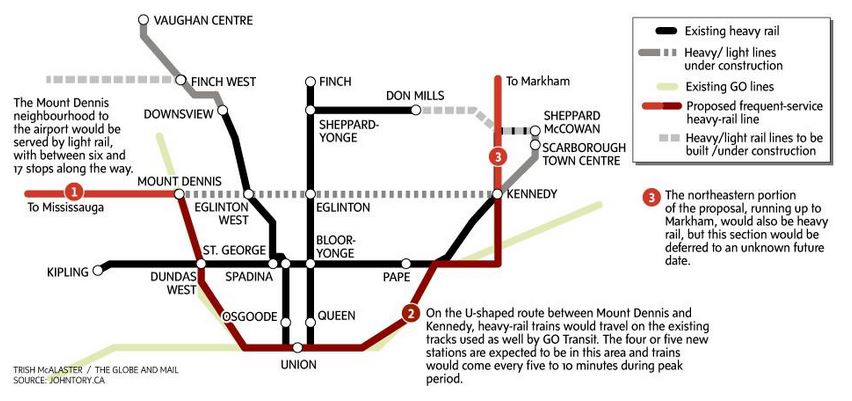
Oliver Moore in the Globe and Mail reports that there have been major changes to the SmartTrack plan, to wit:

  • The western branch of the service to the Airport district will be provided by the western extension of the Eglinton-Crosstown LRT as originally proposed.
  • “SmartTrack” per se will operate as a heavy rail service overlaid on GO Transit with the initial phase running from Mount Dennis to Kennedy Stations.
  • The northern extension of “SmartTrack” to Markham will be a separate phase of the project.

The map from the Globe & Mail is reproduced below.

GlobeSTLRTMap_20160114

According to Moore, the cost of adding SmartTrack to GO under this configuration would be much, much less than the originally quoted figure for the entire line. In turn, this would free up substantial capital spending headroom in City plans for other projects.

SmartTrack service at 15 minutes (the level proposed in Tory’s campaign) is far too infrequent to attract much riding, and especially to make a dent in demand on the existing subway interchange at Bloor-Yonge. We saw this in the June 2015 Metrolinx demand projections that were far more favourable to a Relief Line operating north to Sheppard and Don Mills. However, getting SmartTrack service down to as close a headway as every 5 minutes will be challenging for Metrolinx and for the corridors through which this would operate. There are no details yet on how this would be achieved.

The Eglinton West LRT has always been the superior way of serving this corridor compared to the heavy rail SmartTrack scheme. ST foundered on major problems with constructibility and neighbourhood effects, issues that were dismissed in a stunning display of cavalier “expert” knowledge during the campaign. Planning by Google Maps from an office in the UK has its limitations, but Tory’s campaign relied on this “expertise”. One shameless professor even rated ST with an “A+” in the CBC Metro Morning interview.

Keeping the first phase of ST confined south of Eglinton on both branches limits the operating costs the City must bear if this to be truly a “Toronto” project with “Toronto” fares, and it avoids the complexities of building into the 905.

Indeed, SmartTrack began as a real estate development scheme to make commercial property near the Airport and in Markham more accessible from downtown in a series of studies that actually claimed the market for downtown office space was static and falling. Yet another expert should be eating crow pie from his perch on the Metrolinx board. It was never clear why Toronto should shell out billions to improve property values in the 905, and this task now falls clearly to Metrolinx where it belongs.

The eastern leg of SmartTrack, north from Kennedy, obviously competes with the Scarborough Subway Extension, and there is no need for two routes serving the same demand, especially when GO already plans substantially improved service in the rail corridor. The long-standing issue of SSE demand may be clarified by the absence of SmartTrack as a competing service.

It is no secret that my own position would be to revert to the LRT plan in Scarborough, but that train has probably left the station, especially if the City can “save” a small fortune by scaling back on SmartTrack.

These changes could also foreshadow a revised schedule for the LRT projects at a time when “shovel ready” projects are in demand to soak up new federal spending. Eglinton West’s LRT extension is relatively easy to build, and it could be started soon enough to complete concurrently with the main Crosstown route. There is also the matter of the Sheppard East LRT including its proposed service linking to UofT Scarborough campus.

Coming weeks may bring many sputtering denials, or possibly, much improved clarity and acceptance of an – at last – realistic plan.


Does More Running Time Improve Service?

[This is a long article, and I won’t hold it against anyone for failing to read all the way to the end, or not looking at every page of every chart. The issue here is a system-wide one of how service is scheduled and managed using routes where the TTC is attempting to improve operations as a reference.]

At the TTC Board Meeting of December 2015, Chief Service Officer Richard Leary gave a presentation “Performance Based Service” outlining the work done to date to improve the reliability of surface routes. [A YouTube video of the presentation is also available.]

The focus of changes made to several schedules has been that end-to-end running times should reflect actual on-street conditions rather than presenting drivers with an unattainable goal that cannot be met during typical conditions, let alone anything unusual such as poor weather or unusually bad traffic congestion.

The changes to date are summarized in the table below.

201512_Leary_AddedRTT

In some cases, the extra running time is provided simply by widening the headway. For example, if a route takes one hour, and it has a bus every 10 minutes, that’s six buses. Extending the headway to 11 minutes would change the round trip to 66 minutes with no added cost. In theory, if this allows vehicles to stay on time, better service might actually be provided because all buses would show up as planned. That, however, depends on them being properly spaced so that their capacity is evenly used.

In other cases, where the problem is not just scheduled time but also capacity, more vehicles can be added. In the example above, a seventh bus would allow the headway to stay at 10 minutes while the trip time went up to 70. With the long-standing problems of a constrained fleet, this is only possible in off-peak periods, or by raiding other routes for vehicles.

Continue reading

NextBus Next to Useless After Major Schedule Changes

Updated January 5, 2016: New schedules have been installed at NextBus and the service on affected routes should now appear correctly.

On January 3, 2016, the TTC implemented major changes in the schedules on 501 Queen and 510 Spadina, as well as minor changes to 509 Harbourfront and 511 Bathurst. Since then, NextBus information has been wildly erratic for these routes.

There are a few underlying problems of which I am aware from past experience like this, and there are likely more, but it’s worth consolidating this information in an article.

First, it is important to understand the basics of how NextBus works:

  • TTC vehicle location information is collected by their monitoring system which polls each bus and streetcar every 20 seconds to obtain GPS readings. These are consolidated into an updated feed that is available to NextBus, but not to the general public.
  • There are two extracts of schedule data that provide the “in theory” version of service for external agencies/applications:
    • A GTFS (General Transit Feed Specification) data feed available through the City of Toronto’s Open Data site
    • A NextBus-specific feed that is not public
  • NextBus uses the real-time data plus the schedule to produce maps showing all vehicles on a route, plus predictions of arrivals at stops. The predictions are based on historical tracking of vehicles and their likely running times, not on scheduled values, except at termini where a vehicle is expected to leave on its scheduled time.
  • Downstream stops from terminals show predicted arrivals based on the schedule until a vehicle leaves the terminal. This can cause errors in predictions because the schedule and real world might differ. Conversely, predictions based on actual travel times will correct for cases where the schedule is unrealistic provided that a vehicle is actually enroute to the stop. This is a “Catch 22” situation.
  • Predictions and displays (e.g. on video displays at stations) can run “late” to the real world for a variety of reasons related to latency in updating the data at each step along the way. If the “real-time” location feed is slow getting from TTC to NextBus, then vehicle positions will not reflect the world “now”, but some time ago. If the station/stop displays do not refresh their information frequently, they will show stale predictions.
  • NextBus only displays vehicles whose “run number” (the reference number assigned by the TTC to each vehicle) is actually in the schedule. When schedules change, an entirely new set of run numbers might be in use, or there could be some overlap with the old schedule. This can cause only partial service to be tracked/predicted because some vehicles are not linked to a run number that is in the schedule NextBus is using. Problems arise either if the new schedule is not imported to NextBus, or if the data exported from the TTC is in error.

All of the apps that run on various platforms use the NextBus feed. They may present this information in different ways, but all are limited to whatever NextBus puts out because that is the only feed available.

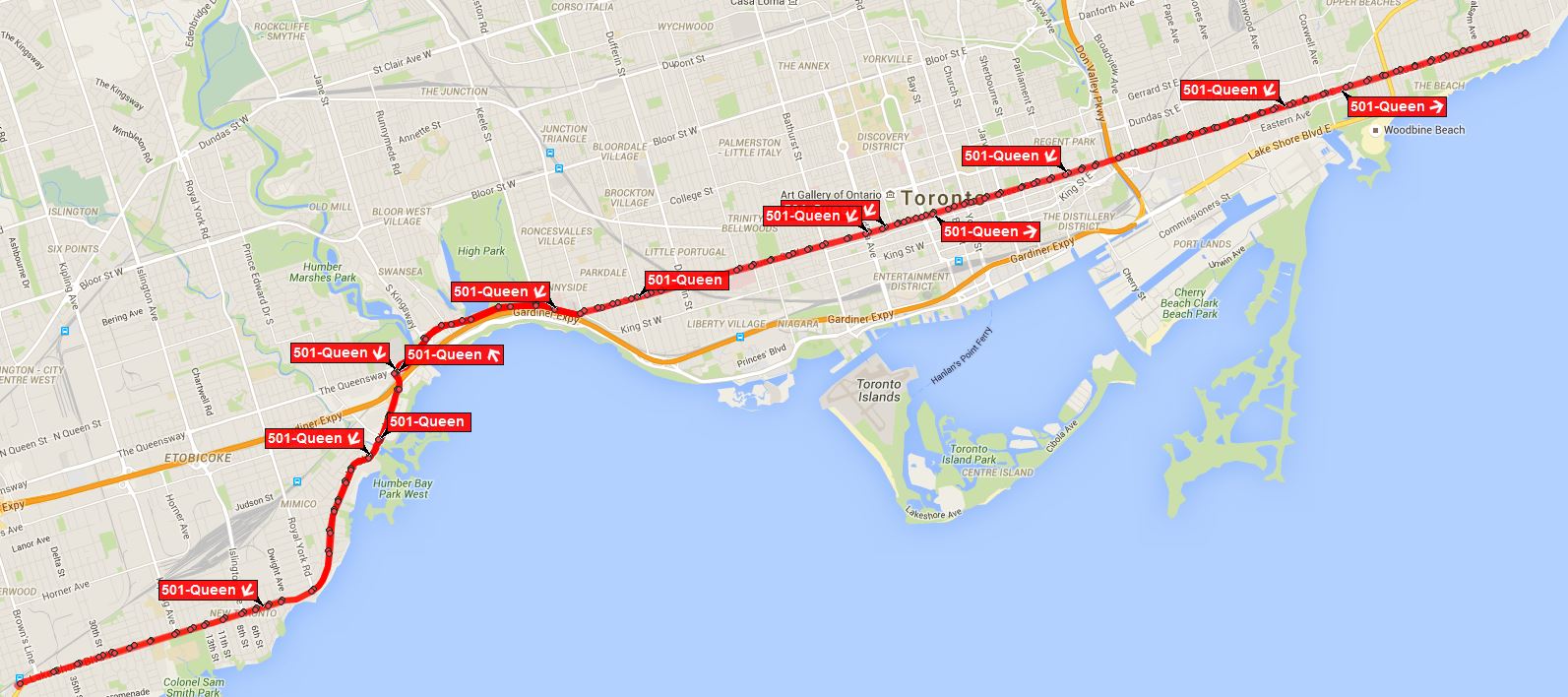
As I write this, there is an additional problem with the NextBus display for Queen which is hinted at by the snapshot below.

20160104_Rte501_0515

Note that all of the cars show with the arrow pointing west. If you watch the animated version, some of these cars are actually moving east. Predictions are wildly inaccurate because NextBus does not seem to “know” that eastbound cars actually are eastbound. (This snapshot was taken at 5:15 am.)

The problem changed somewhat later (5:56 am) when a few “eastbound” cars did show up in the display, and in downstream predictions. However, the predictions are still wrong because they only include cars NextBus is tracking, not all service on the route.

20160104_Rte501_0556

For example, NextBus claims there will be two cars eastbound at Bathurst in 18 minutes (they are both at Humber Loop eastbound), and the next one 53 minutes hence.

It is a bit early in the day for examples, but there will likely be cars missing from displays and predictions for 510 Spadina (which has a completely revised schedule for Flexity operation), on 509 Harbourfront and 511 Bathurst (which have been revised to terminate at Fleet Loop due to construction).

Updated: The problem with vehicle direction tracking also appears to have affected 505 Dundas.

The schedule data [this link returns a large XML file] NextBus is using for 501 Queen is from December 2015 when all service operated from Long Branch to Neville rather than with a route split at Humber. (For those who are interested, search on the string “scheduleClass” to locate the start of each block of schedules available.) The situation is the same for other routes.

This type of foul-up between TTC and NextBus has occurred before and at times has taken weeks to resolve making the “service” NextBus provides of poor quality, to be as generous as possible. The problems may lie at TTC or they may be at NextBus or some combination of the two, but they are problems that should be fixed. At the very least, some basic testing should occur at the TTC’s end when there is a change to ensure that the updated schedules have been installed. If I can do this with a simple XML call to the NextBus site, then so can anyone at the TTC.

Problems have arisen in the past where the TTC’s schedule extract for NextBus does not contain complete or correct data. This will only show up with actual use, but some sort of internal quality control on the content of the extract should be possible, especially for a major change such as the restructuring of a route.

This has been an ongoing problem, and it says a lot about the TTC’s alleged commitment to “Customer Service” that it has not been fixed.

TTC Transfers: 1954/55

Transfers as a physical fare medium are set to disappear from the TTC in 2017 with the completion of the migration to Presto fare cards.

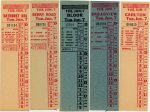
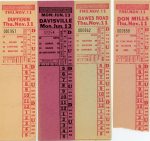
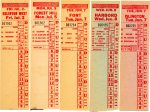
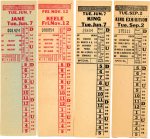
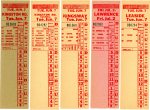
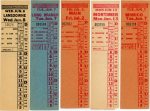
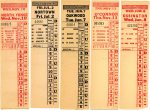
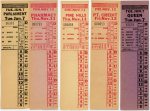
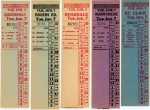
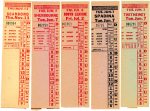
Here are the transfers as they existed in 1954 and 1955, the first year of the “Toronto Transit Commission” by that name. These include many suburban bus routes that were amalgamated into the TTC’s network with the formation of Metropolitan Toronto in 1954.

A few items worth noting:

  • Many of the suburban routes used red ink on white paper as a distinct colour scheme to identify cases where a check for a “zone 1” fare on a city route would be necessary. When coloured paper was abandoned for the older routes, Carlton was already using the “suburban” colour scheme and was missed in the conversion. For many years, it was the only “downtown” route with a red transfer.
  • There are two Yonge transfers. One is for the “Yonge T.C.”, the trolley coach operation from Eglinton to Glen Echo. The other, simply “Yonge” might suggest that the streetcars were still operating in 1955 over a year after the subway opened. This is for the night service.
  • Many route names are recognizable, but the outer ends of the suburban routes are a lot closer to the old city than they are today.
  • The text on the back of the transfer exhorting riders to only make their connections in the proper TTC way has not changed in years (it can be found on transfers from 1921). The use of the word “Conductor” is amusing considering that by 1955 two-man operation had ended. The term even appears on bus transfers.
  • “Up” and “Down” refer to directions of travel and correspond to the “U” and “D” cutoffs along the edge of the transfer. Generally, “Up” is westbound or northbound, but there are exceptions sometimes caused by route changes and amalgamations with segments in the “wrong” direction.

For a look at pre-TTC transfers, please refer to this article.

TTC Budgets for 2016: City Analyst Preliminary Notes

As the budget cycle begins, analysts from the City’s Finance Division publish reviews of the budgets submitted by every department and agency. These will eventually show up on the City’s general “budget” website, but most of them are now part of the agenda for the Budget Committee’s meeting of January 5, 2016. This article reviews the notes for the TTC’s Operating and Capital budgets.

All illustrations within this article are clickable for a larger version.

Operating Budget

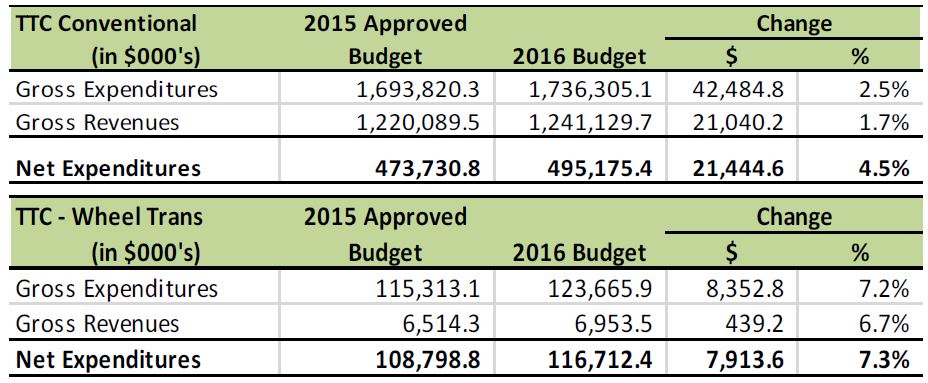
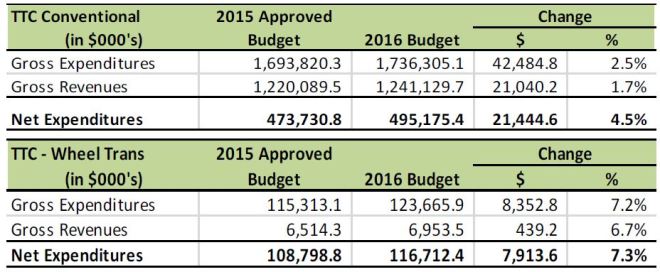
The notes begin with an overview of the “conventional” and “Wheel-Trans” budgets:
PrelimANotes_OpsSummary

This chart shows how the total budget, fares and subsidies interact. Although the gross expenditure for the conventional system goes up 2.5%, the subsidy goes up by 4.5% because revenues do not keep pace. There is always a tug of war between providing more service to handle both growth and political promises, while keeping fares down, again for political reasons. Council can hardly complain that the subsidy grows well above the inflation rate under these circumstances.

For Wheel-Trans, the growth of the subsidy is dictated almost entirely by the growth in costs because so little farebox revenue comes from that service. Ridership is growing thanks to eligibility changes and increased service, while fares grow by only a small amount.

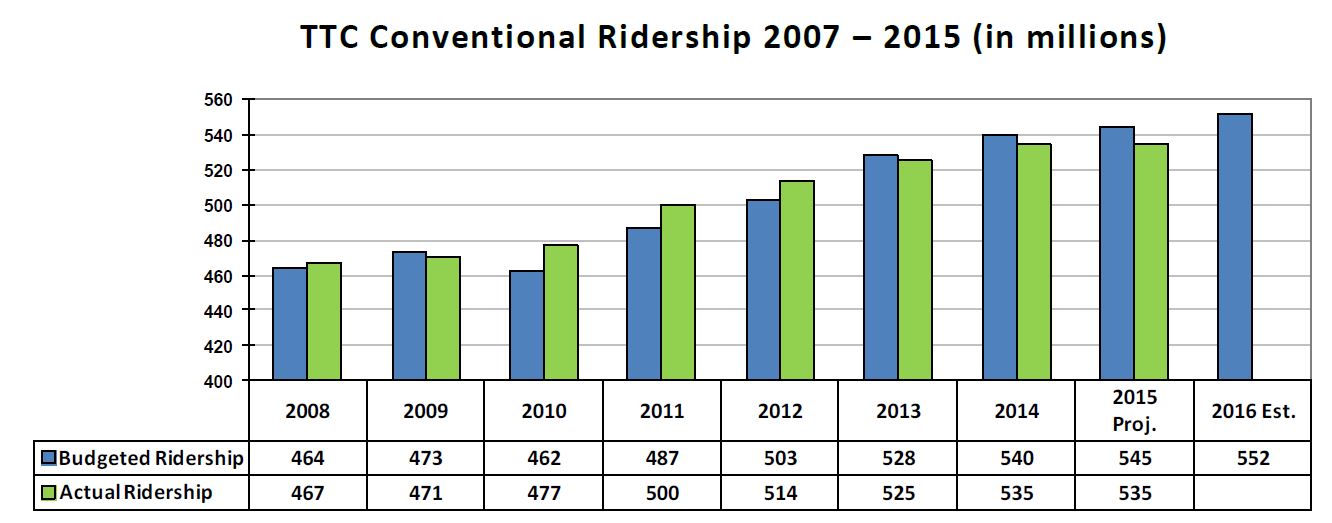
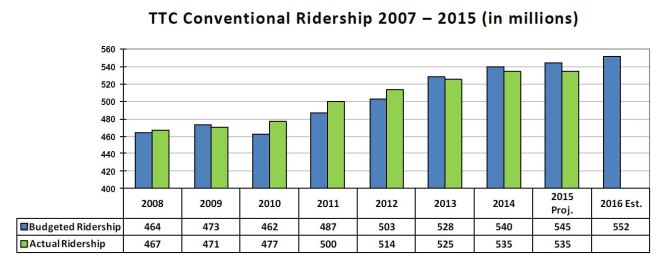
On the conventional system, ridership has not been growing at the expected rate not just in 2015 but for a few years previous. The routine claim from TTC is that this is due to bad weather in early 2015, but this does not explain the ongoing shortfall in previous years, nor the fact that ridership continues to run below budget into the fall of 2015 when the weather, if anything, has been quite balmy.
PrelimANotes_OpsRidership

Since 2013, actual ridership has been below budget, and the 552-million figure for 2016 shown here will be a challenging target to meet.

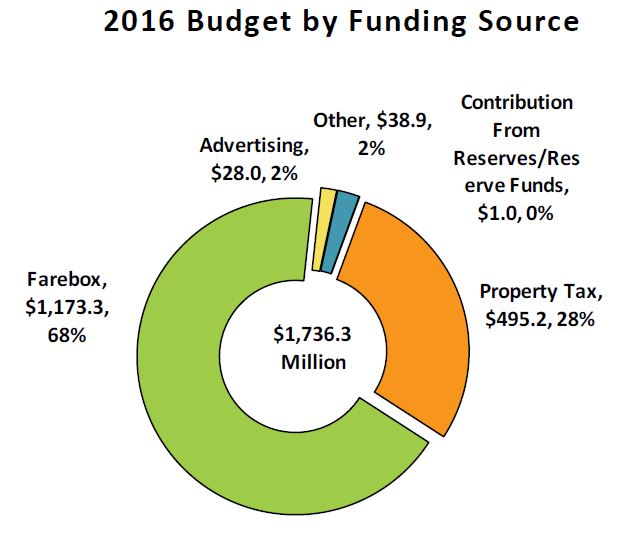
The TTC is funded primarily by fares, with much of the remainder coming from subsidies.
PrelimANotes_OpsSourceOfFunds

This chart is actually in error in that Property Tax does not supply all of the $495.2-million shown here. The City also receives Provincial Gas Tax revenue of about $160m of which $90m is dedicated to the Operating Budget where it appears as part of the City subsidy. (No Provincial subsidy is directed to Wheel-Trans.)

An outstanding issue for the City is that the TTC does not have “Service Standards” for its departments. These should not be confused with the standards applied to service design (crowding, maximum headways, etc.). These values the City seeks relate to departmental performance, and it is difficult to say just how meaningful such standards would be and how closely they would relate to the actual “service” the organization provides to riders.

The Preliminary Budget included here is not the same as the TTC’s version because it omits $18.4-million in various TTC-approved improvements for 2016.

PrelimANotes_OpsServiceImprovements

Note that “Earlier Sunday Transit Service” applies to the surface network, primarily bus lines, where many routes do not now begin service until 9:00 am. Although earlier rapid transit service on all routes will begin at about 8:00 am effective January 3, 2016, the feeder surface routes will not see earlier service until later in 2016, and assuming that this budget line is approved at Council (or the TTC takes some other action to fund the service without affecting the subsidy level).

The POP Fare Inspection is a particularly amusing item because Proof of Payment and All Door Boarding were implemented with great fanfare by the TTC on its streetcar system quite recently. However, Council might well not approve funding of the Fare Inspectors the TTC requires.

Operations in 2017-18

Future years’ operations pose a challenge for the TTC and City beyond the usual pressures of inflation and ridership growth. These include:

  • Garage leasing: To accommodate a “hump” in total bus fleet requirements that will last until new rapid transit lines replace bus services in the early 2020s, the TTC will lease a “temporary” garage at an annual cost of $25-million starting with the 2017 budget. This is a net new operating cost to which must also be added the cost of staffing and maintaining the new garage.
  • Presto fare card: The cost in fare handling fees to the TTC from Presto is estimated to grow to over $50m in 2017. The TTC has not yet identified offsetting savings from the reduced scope of existing fare collection systems. The Analyst notes recommend that Council require the TTC to report to Executive Committee by June 2016 on the savings that will be used to offset Presto costs.
  • Wheel-Trans costs are projected to rise at well above inflation due to demographic changes and increased eligibility.
  • The additional cost of operating the subway system once the TYSSE opens to Vaughan (net of new revenue) is projected to be $11m in 2017 (startup and commissioning) and a further $20m in 2018 for an annual added cost of $31m.
  • Further “significant funding increases” will be required for operation of the LRT lines and the Scarborough Subway, and there is “currently no funding strategy in place” to address them.

Another way of looking at this is that before Toronto even manages to spend any new money it might find to support improve transit service, it must deal with a backlog of unavoidable demands on the operating budget.

Capital Budget

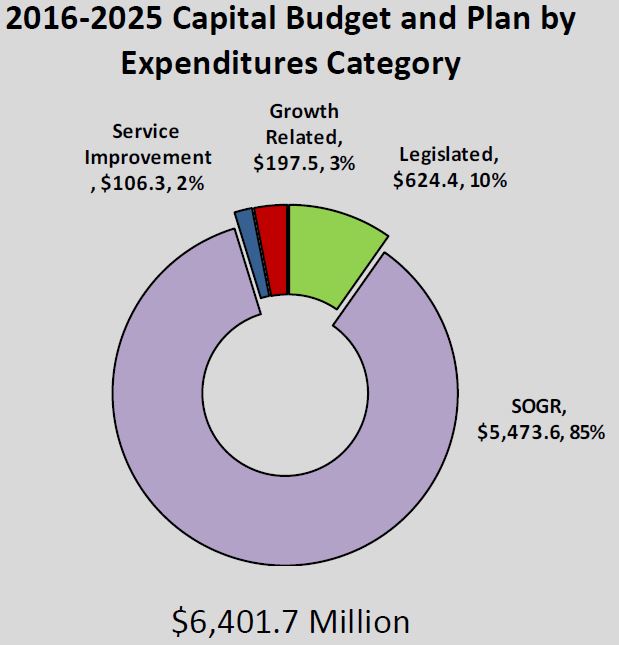
The Ten Year Capital Plan for 2016-25 includes just over $6-billion in proposed spending. As discussed in a previous article, this is nowhere near the total of the TTC’s capital needs, but stays within the City’s “affordability” target.

The budget is subdivided by type of work with “State of Good Repair” consuming the lion’s share. Assignment of some projects to these categories can be misleading because some projects address more than one area. For example, a project to increase subway car storage capacity for the TR trains is booked as “SOGR” although, in part, this is a cost related to system expansion. Similarly, part of new fleet costs are related to replacement of old vehicles, and some to system growth. By contrast, the cost of McNicoll Garage is divided equally between “SOGR” and growth [see p2 for details], while Presto costs related to new fare gates are booked against “growth” when they are really “SOGR” and “legislated” because they address accessibility at automated subway entrances.
PrelimANotes_CapSpendingBreakdown

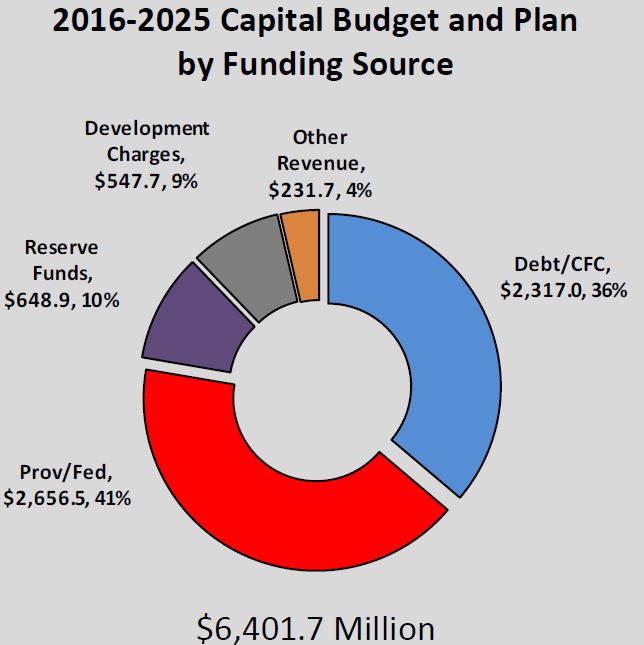
Over 75% of the funding for this plan comes from Provincial and Federal subsidies, and from City debt or capital-from-current spending. Of the subsidy moneys, only about $230m ($160m from Ottawa and $70m from Ontario) comes from Gas Tax and is not tied to any specific project. On a long-range basis, the subsidy will fall based on current commitments placing great pressure on the City’s own ability to raise capital.

Development Charges are mentioned from time to time as a funding source, but as they now provide less than 10% of the total (and that for an underfunded plan), the ability of DCs to offset much of the shortfall is limited.

“Other Revenue” is primarily money from Waterfront Toronto’s budget for projects that they are funding such as the Queens Quay rebuild and Union Station second platform.
PrelimANotes_CapSourceOfFunds

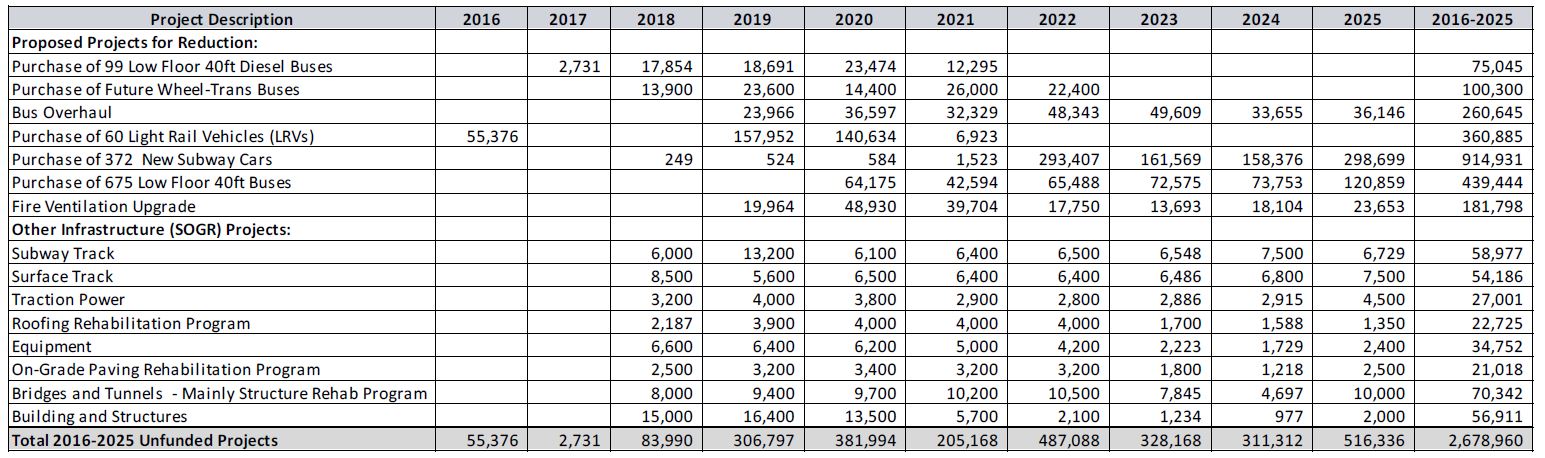
There remains almost $3-billion in projects that the TTC has approved in principle, but for which there is no funding, and another $5.5b worth of projects that have not even made it into the 10-year plan.

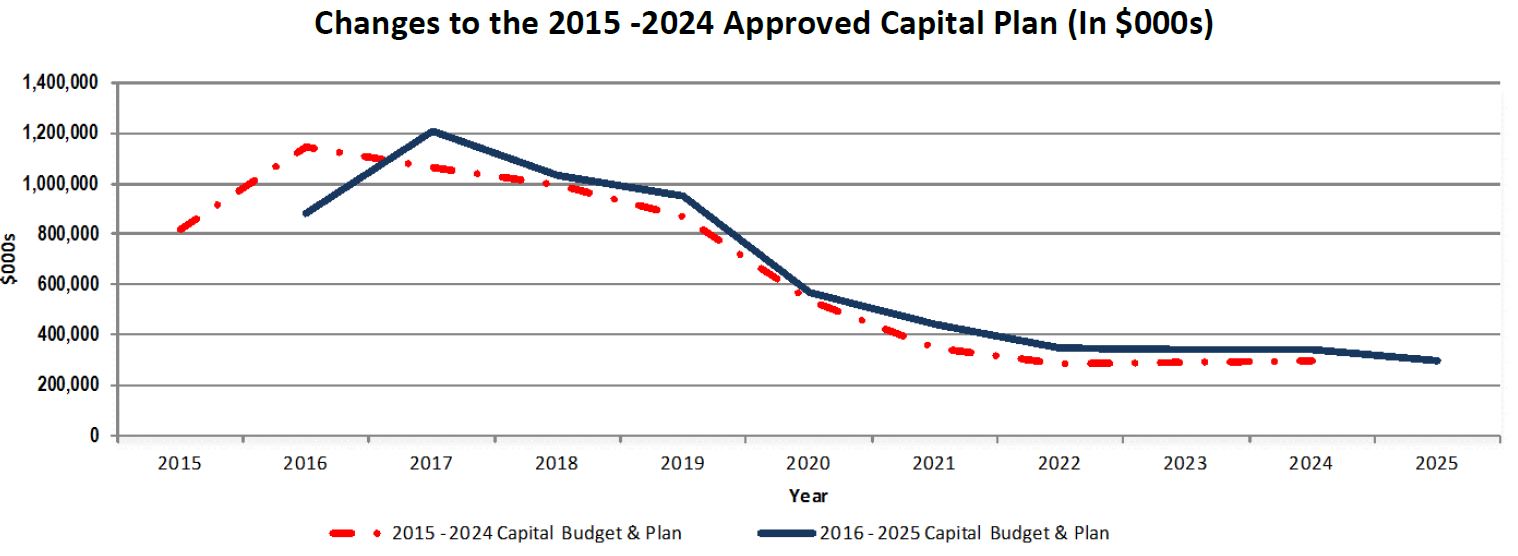
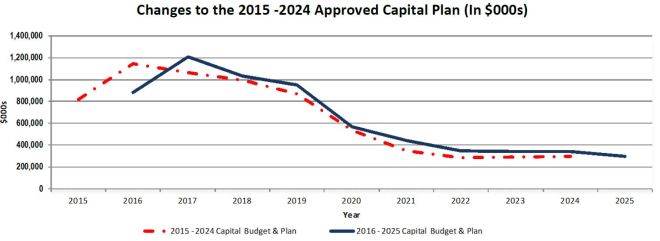
Some Capital spending planned for 2015 has moved into future years, and 2016 now has the peak spending rate.
PrelimANotes_CapChangeFrom2015

There is a steep decline after completion of the TYSSE (Spadina extension), the Yonge-University resignalling, and the new streetcar procurement projects. These have subsidy funding from one or both senior governments, and the spending rate beyond 2019 reflects the City’s own ability to fund ongoing capital needs. (Metrolinx projects such as the Crosstown LRT do not appear on the TTC’s books.)

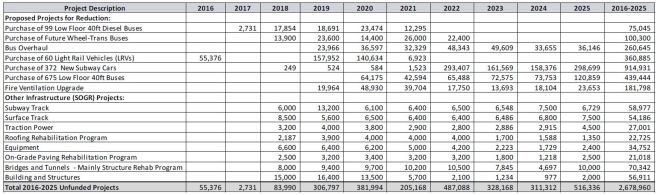
Among projects that have fallen “below the line” to unfunded status are:

  • Bus heavy rebuild program
  • Bus replacement program

Projects with increased funding include:

  • Easier Access Program: full accessibility to subway stations is now funded for completion by 2024. This project was formerly “below the line”.
  • Subway car overhaul
  • “Finishes” which includes roof rehabilitation and station modernization costs.

Spending of less than $400m/year cannot sustain a $9b 10-year plan.

The constrained rate of capital spending brings a growing backlog of unfunded “SOGR” work. Such a backlog cannot be allowed to accumulate forever, and one must wonder what sort of catastrophe will be required to wake up City Council and other potential funders analogous to the Russell Hill subway disaster in 1995. With all the claims that the TTC is focussed on an improved experience for its riders, taking pride in restoring the system to its former premier status, the underfunding is an uncomfortable reminder of what has happened before.
PrelimANotes_CapBelowTheLine

The replacement of the T1 subway car fleet (which operates on the BD line) first appears in 2018 with early contract payments. The Analyst notes that the T1s will be reaching the end of their life in 2025. This timing is also related to the resignalling of the BD line and conversion to Automatic Train Control which the T1s cannot use, and the existing signals cannot be decommissioned until the T1 fleet is retired.

A program to overhaul Hybrid Buses in 2019-25 has been moved below the line. The TTC has already planned to retire the oldest of its Hybrids rather than trying to keep them in operation, but treating maintenance of those remaining in service as unfunded begs the question of which buses will be available to provide service when these fail.

A plan to buy 99 additional buses to improve loading standards has been placed below the line.

Among the projects that are not part of the approved capital plan are:

  • Fire ventillation upgrades ($1.5b): This is not a legislatively mandated program except at sites where construction triggers a need to meet the current building code.
  • Yonge-Bloor capacity improvements ($1.1b): This project dates back to the era before the TTC accepted the need for and benefit of a “Relief Line”. If Metrolinx demand projections are to be believed, the future demand at this junction could be reduced substantially. This begs the question of exactly what “capacity improvements” are really needed, and whether savings in this project can be used to offset the Relief Line’s cost.
  • Waterfront ($1.1b): This project is described as being for the West Donlands LRT and four vehicles for the Bremner LRT. These lie beyond the timeframe of the East Bayfront LRT which is not included in the TTC’s list presumably because Waterfront Toronto is expected to pick up the tab.

Notable by its absence here is the Relief Line itself which, by virtue of its distant commencement date (if ever), is not within the plan’s 10-year scope.

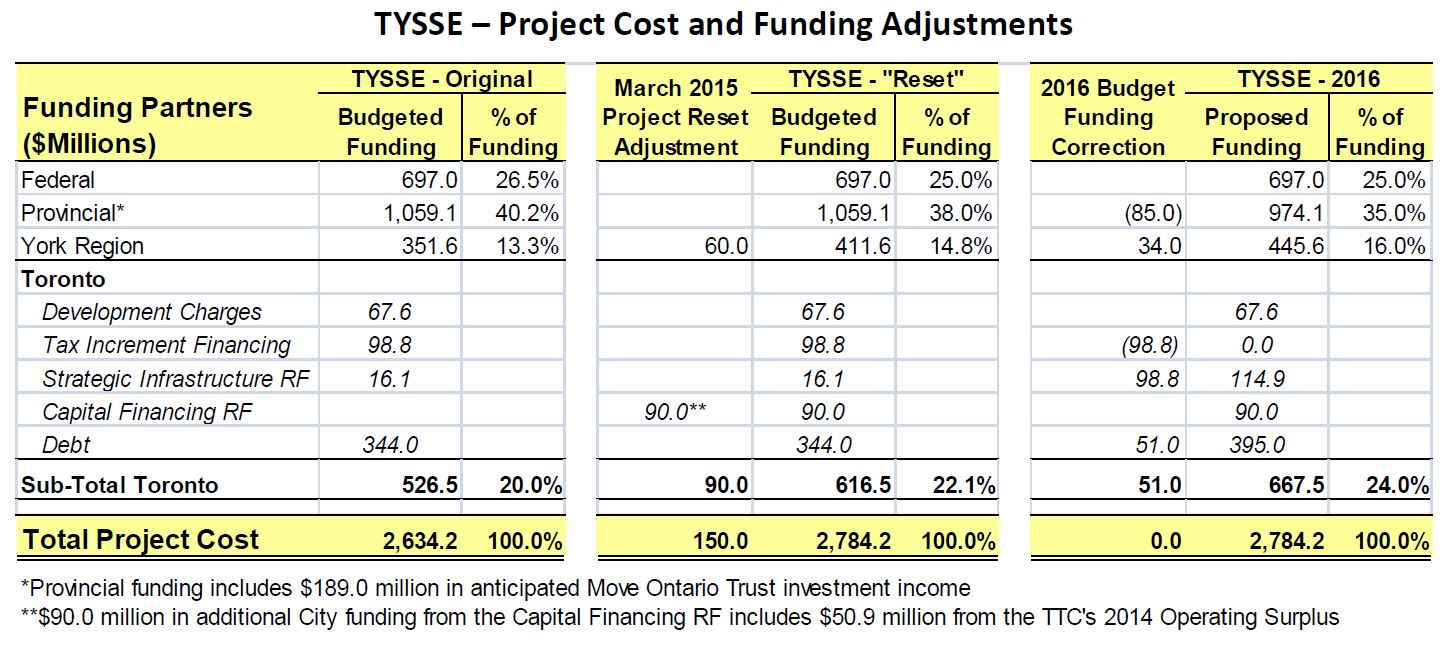
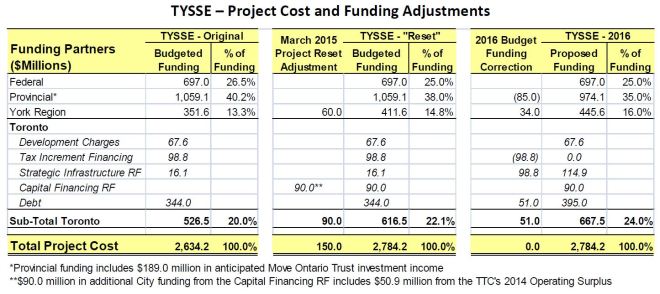
Financing of the TYSSE has been affected by various factors including:

  • A provision for $150m in additional costs to complete the project.
  • A loss of hoped-for investment income from the Move Ontario Trust (which held Provincial subsidy monies for the project) of $85m as the trust was unable to achieve a 4% rate of return. This has been partly offset by redirection of surplus funding from TTC’s 2015 operations.
  • A loss of hoped-for Tax Increment Financing because the Ontario government has not passed an enabling regulation. This has been offset by a draw on the City’s Strategic Infrastructure Reserve.
PrelimANotes_CapTYSSEBudgetAdj

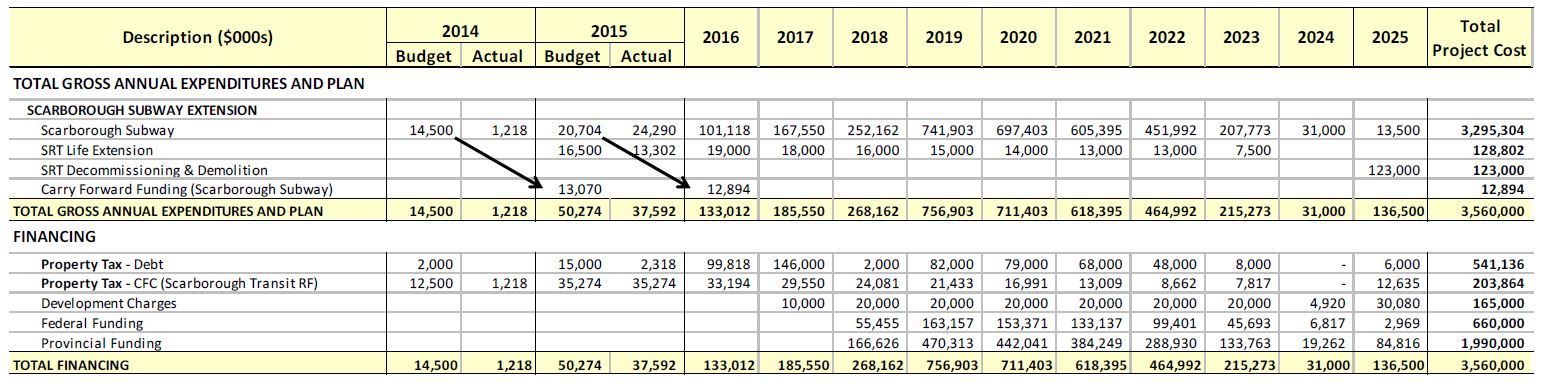
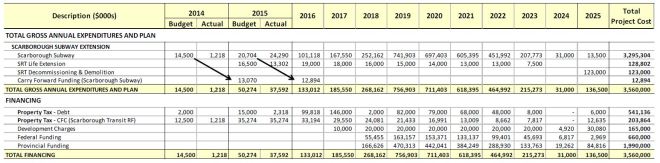
The Scarborough Subway Extension (SSE) will be funded from a number of sources including Federal and Provincial commitments. It is unclear whether these funds are “net new” or whether they represent a draw against programs such as the planned new Federal Infrastructure Program. If the latter, this will reduce the amount available to Toronto from this “pot” for other capital programs.

PrelimANotes_CapSSE


TTC Proposes New Fare Rules for Presto Roll Out

On December 16, 2015, the TTC Board will consider a report from management recommending several changes in the fare collection system. Some of these proposals are straightforward while others are likely to bring confusion and outright complaints from TTC riders.

On December 14, the TTC streetcar system goes to “Proof of Payment” (POP) on all routes and a few days later, Presto will be enabled across the streetcar system. In the short term, paying by Presto will be akin to dropping a token in the farebox on the “old” streetcar fleet. If you need a transfer, board at the front door and get one from the operator. Otherwise, rear door boarding is allowed. Transfers will be required if somewhere in your journey you will encounter a bus that is not Presto equipped. (The TTC is silent on how they will handle a route like 504 King that operates both types of vehicle if a Presto user discovers a non-Presto equipped vehicle is the first thing to show up.)

The roll out of Presto brings the opportunity to revise the fare system, for good or ill, as the TTC migrates away from its conventional model of tickets, tokens and transfers. (It is worth noting that a large number of riders have already made this migration by using Metropasses which are simple, if limited in the fare options they provide.)

The transitional period when both Presto and existing fare payment systems co-exist will be a difficult one. Indeed, there are strong incentives for riders not to shift to Presto until the system is fully functional unless their TTC usage is limited to that part of the network where Presto is active.

Continue reading

TTC Service Changes Effective January 3, 2016 (Updated)

Updated December 8, 2015 at 12:30 pm: I checked with the TTC about the termination of both the 509 Harbourfront and 511 Bathurst routes at Fleet Loop rather than simply running one route between Bathurst and Union Stations. Here is the reply from TTC Service Planning:

We considered running a 511 (Bathurst Stn-Union Stn) service but ruled it out for two main reasons. Firstly, stop usage on Fleet west of Bathurst has greatly increased in the last year, and serving these stops only with the shuttle bus would introduce a transfer or longer walk for too many people. Secondly, because of the road configuration and traffic patterns, it is not possible to have a northbound stop for through 511 cars on Bathurst at Lake Shore. The nearest stop would be the existing 509 stop on Bathurst farside of Queens Quay. This adds to the walking distance for customers heading to Fleet Street, and requires customers to cross an inhospitable intersection.

The original article follows below:

The new year brings changes to some routes, mainly on the streetcar system, to deal with the shortage of new Flexitys and a construction project while improving service on 501 Queen, 502 Downtowner and 503 Kingston Road to better reflect actual conditions.

2016.01.03 Service Changes

Continue reading

City of Toronto 2016 Budget Overview

On December 1, 2015, Toronto’s new City Manager, Peter Wallace, presented an overview of the state of the City’s finances to the Executive Committee. This was by way of an introduction to the 2016 budget which will launch on December 15. Wallace’s talk can be viewed on YouTube, and the slide deck from his presentation is on the City’s site.

Wallace’s approach to the budget is a breath of fresh air on two important accounts. First, he believes that the proper roles for Council and for the City Staff are policy and implementation, respectively. Second, he begins the budget cycle without the now-familiar annual exercise of wrestling the “budget gap” down to zero before Councillors even have a chance to review the numbers. These combine to place responsibility for choices and options where it belongs, at Council, rather than having a back-room hatchet job done by staff without the tradeoffs and options ever surfacing for public debate.

The City Manager is quite clear: decide what kind of City you want and then figure out how to pay for it.

Moreover, Wallace is very clear that the City has been living a charmed existence thanks to very strong revenues from the Land Transfer Tax, and because a large and growing backlog of unfunded capital projects has not been included in the City’s financial planning.

Politicians depended on staff telling only good news so that tax cuts and other giveaways could proceed without arousing questions of where the money will come from, or what might not be built without the lost revenue. That was certainly the case through the Ford era and the early part of John Tory’s mayoralty, but this extends even back into David Miller’s term. The concept of “below the line” budgeting was used to keep some capital requirements off of the books in hopes of major contributions from other governments, and to make the City’s long-term exposure look less dire to maintain a favourable bond rating.

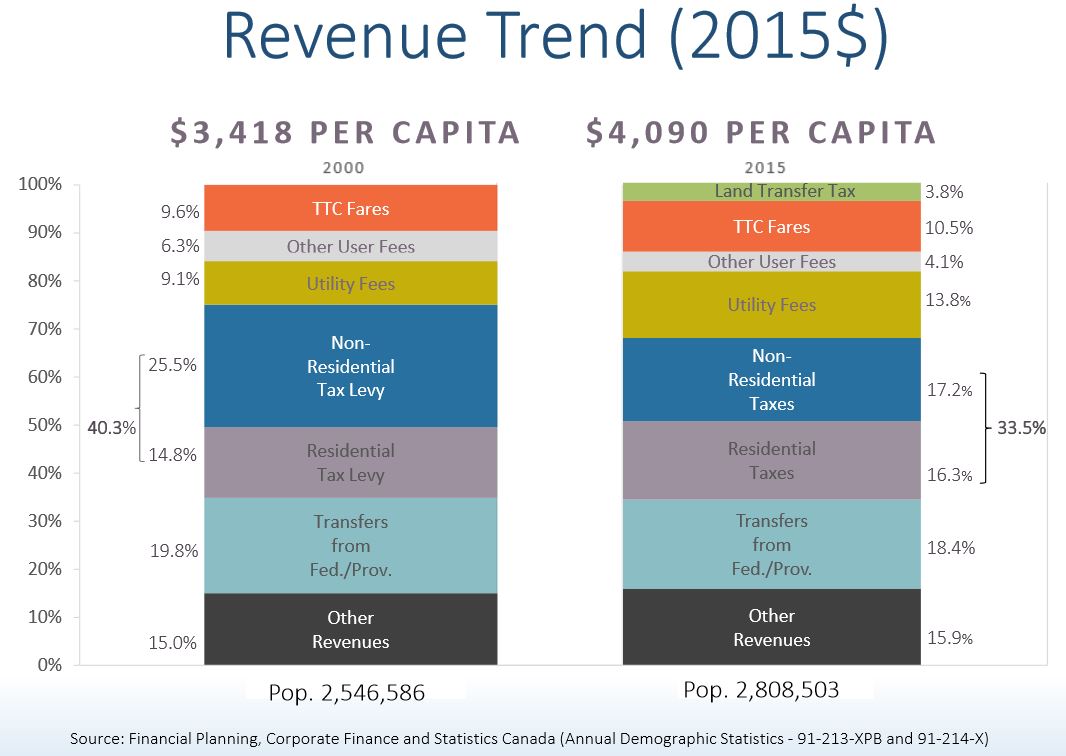
From 2000 to 2015, the total City revenue per capita has grown by 19.7%, and the City’s share of the region’s economic activity has stayed at the same level (in other words, the City has not become relatively a larger or smaller part of the regional economy). What has changed is the proportion of income received from various sources.

TTC fares as a proportion of the total have risen from 9.6% to 10.5%, Utility Fees have gone up by about 50%, and Other User Fees have fallen. The property tax which formerly accounted for about 40% of City revenue now is only 33.5%. Most of this reduction comes from lower non-residential taxes (about which more below).

Land Transfer Tax may only account for 3.8% of total revenue, but that is out of a very large total and it represents several hundred million dollars annually.

CityRevenueTrend_20002015

Continue reading

Development Charges and Politicized Transit Planning (Updated)

Updated November 26, 2015 at 11:00 pm: A follow up article by Jennifer Pagliaro includes reactions from Mayor Tory. My comments appear at the end of this article.

The Toronto Star’s Jennifer Pagliaro reports that the Building Industry and Land Development Association (BILD) will challenge Toronto’s planned increase in Development Charges for the Scarborough Subway Extension (SSE) at the Ontario Municipal Board (OMB).

[BILD is] challenging the planning foundation for the three-stop subway — which council controversially approved last term over a seven-stop LRT that was fully funded by the province. BILD is raising red flags about the city’s ridership projections.

Bryan Tuckey, BILD’s president and CEO, says homeowners across the city should not be on the hook for a “political decision.”

“The ridership numbers that we have demonstrate that what’s needed in that area is light rapid transit,” Tuckey, whose background is in city and provincial planning, told the Star.

“We want to have fair and accountable use of development charges.”

This action has implications well beyond the Development Charges (DCs) for the Scarborough Subway and touches on the whole question of transit financing and planning that for years has been more about political gamesmanship than about the actual needs of the City of Toronto.

We know that the development industry does not like paying one cent more than they have to, and preferably less, in taxes. In that sense they are no different than other taxpayers.

However, while homeowners can only express their opposition by voting for politicians with vague promises to fight waste at City Hall, and hope that their “champions” like Ford and Tory will “do right” by them, their only real recourse is at election time. Elections are fought on signature platforms like SmartTrack and “Subways Subways Subways”, and voters don’t get to cherry pick the platform lines they really want. Elected politicians claim they have “a mandate” when their victory may simply depend on “not being the other guy”.

Development Charges, on the other hand, have specific rules about how they are calculated and an appeal mechanism neither of which is available for general property taxes (or many other taxes Council can or could levy of which the Land Transfer Tax is one obvious example). As the Star notes, most of the City’s share of the SSE ($910m) will come from the subway property tax yielding $745m. This tax will rise to 1.6% in 2016 and then stay on tax bills for decades. The amount coming from DCs ($165m) is much smaller, but developers have an appeal option through the OMB.

Continue reading