TTC Service Changes Effective Sunday, January 5, 2020

The TTC will make several changes to its services in January 2020.

All seasonal changes implemented on December 22, 2019 have been reversed to the November 2019 schedules except where some other change affects a route.

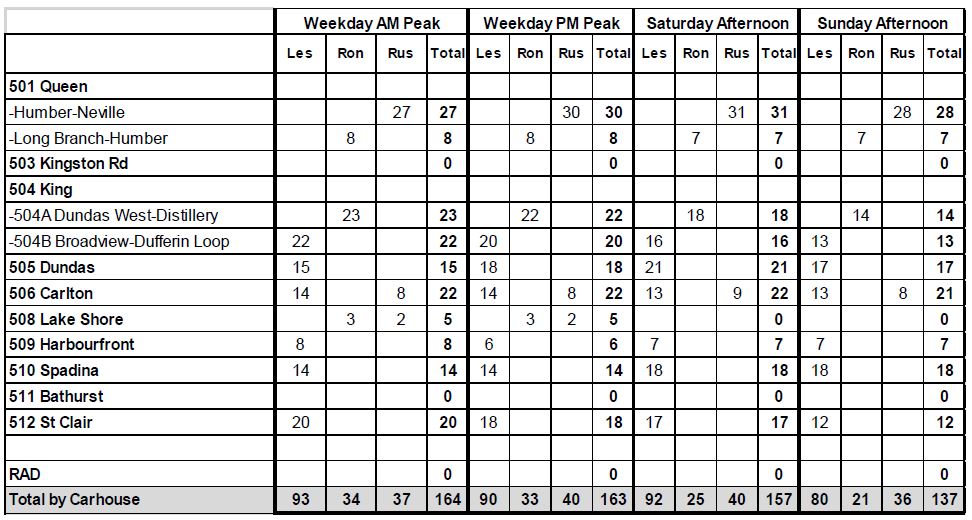
On the streetcar network, the retirement of the CLRV fleet will be complete and service will be 100% accessible on all surface routes. Route allocations to carhouses have been revised with a view, in part, to current and future pantograph operations

511 Bathurst schedules will be adjusted slightly to compensate for the larger vehicles, and streetcar operation will continue until April 2020 when buses will return to the route for construction projects.

505 Dundas will return to streetcar operation in April. The 502/503 Kingston Road service consolidation running with buses will continue for the foreseeable future.

Cars entering service from Leslie Barns via King Street are already running under pans for their journeys to and from 509 Harbourfront, 510 Spadina, 511 Bathurst and 512 St. Clair. 505 Dundas will operate under pans when streetcar service resumes in April, and 506 Carlton is expected to switch over in late 2020. No conversion dates have been announced yet for 501 Queen or 504 King.

Implementation of “service reliability improvements” continues on several bus routes with, in most cases, wider headways and no added vehicles. The premise is that if driving plus recovery time covers 95% of actual conditions on the route, short turns should be rare and service will more closely match the scheduled/advertised level. This does not take into account headway irregularity and bunching which can contribute at least as much to the perceived (in)frequency of service as the fact that some drivers could not make their trips in the previously allotted time. The change is particularly striking on 52 Lawrence West.

Another effect of these changes is that many buses make their trips in well under the scheduled time causing bunching at terminals, especially in cases where the recovery time equals or exceeds the scheduled headway.

The eight bus trippers in the AM peak on 506 Carlton will be changed to provide service on other routes (23 Dawes, 24 Victoria Park, 47 Lansdowne and 67 Pharmacy) on their trips to the Carlton route. [Updated December 2, 2019: The origin of these trippers on existing and planned schedules has been clarified in the pdf linked below.]

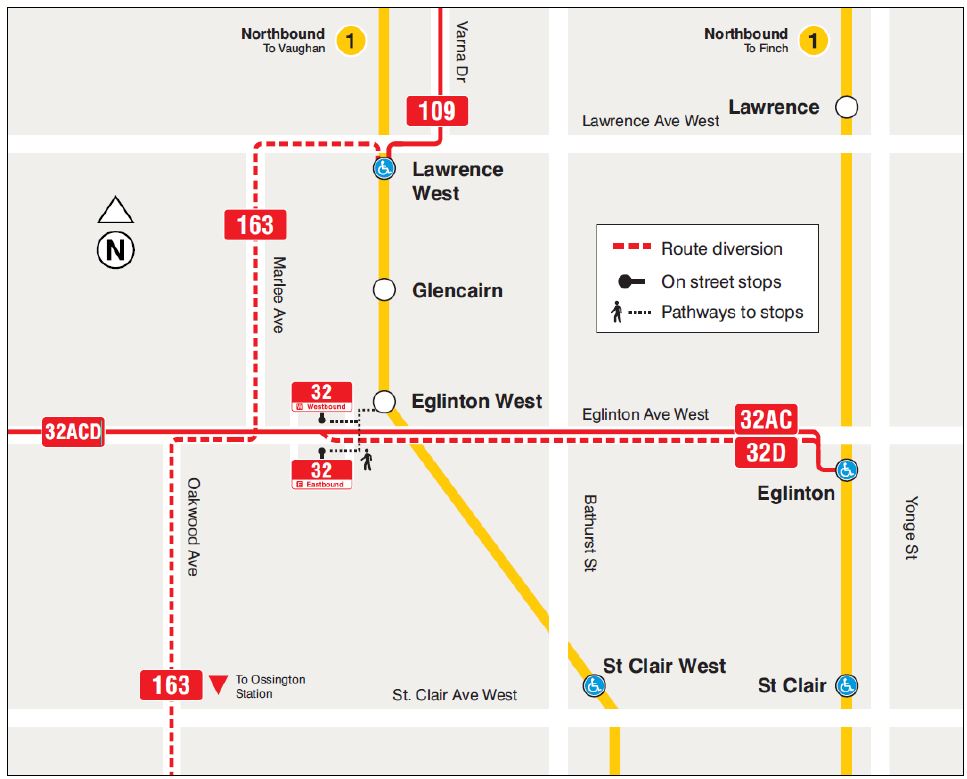
New trippers on 32 Eglinton West will serve the students from York Memorial Collegiate (Keele & Eglinton, damaged by fire) who have been relocated to Scarlett Heights Entrepreneurial Academy (Royal York & Trenholme).

Service will be improved on 300 Bloor-Danforth Night Bus Monday through Friday (Tuesday to Saturday mornings). Buses will be added to the Saturday and Sunday schedules, but the headways will not change. This is a “reliability” improvement that creates recovery times of half and hour and more. Service will also improve during the transition from night to daytime operations, but no details of this were included in the TTC’s service memo.

Planned overcrowding continues with three more routes (45 Kipling, 54 Lawrence East and 95 York Mills) slipping over the approved levels in some periods. These route will also lose their 10-Minute Network status during some periods.

Details of these changes are in the PDF linked below.

2020.01.05_Service_Changes_V2

TTC Service Changes Effective Sunday December 22, 2019

The last service changes for 2019 are all seasonal service adjustments for the Christmas and New Year holidays. These will be in place for two weeks with the next changes to occur on January 5, 2020. The details for January are not out yet.

Many routes will drop back to their summer service levels on weekdays between December 23 and January 3.

In anticipation of shopping traffic additional standby service will be provided on the Saturday and Sunday before Christmas, and on Boxing Day.

There are a few cases where the changes reduce running times, and this could affect service reliability. I have asked for comment from the TTC on this, but have not received a reply.

The routes in question are: 16 McCowan, 34 Eglinton East, 47 Lansdowne, 90 Vaughan and 125 Drewry.

2019.12.22_Service_Changes

Metrolinx Board Meeting: November 22, 2019

The Metrolinx Board met on November 22, 2019 with its usual mixed agenda of private session and public items. This article deals with the following public reports and mainly with the Kitchener and Niagara Falls business cases.

Continue reading

Analysis of Route 70 O’Connor for October 2019

When I publish route analyses, they are usually of the heavyweights like the King and Queen streetcars, or major bus routes like those on Finch, Dufferin, Keele, or Don Mills.

Back on Saturday afternoon, October 5, 2019, I was watching my Twitter feed, and a message went by from someone complaining “where is my bus?” about 70 O’Connor. I looked at Nextbus and to my amazement, all four of the buses were running in a pack headed eastbound on O’Connor, and there was no service anywhere else on the route. I camped on to the route to see what would happen and this is how they evolved.

  • 3:55 pm: Four buses headed outward on the common section of the route on O’Connor
  • 4:00 pm: Two buses are headed east to Warden Station and two northeast to Eglinton
  • 4:33 pm: All four buses are southbound on Coxwell
  • 4:37 pm: All four buses are at Coxwell Station

To put this in context, here is the section from the TTC’s Scheduled Service Summary which describes the service as it should be on 70 O’Connor. (Click on the table to expand it.)

Before we go any further, there are a few important points here:

  • 70 O’Connor is not the most important route in the TTC’s system, but it serves Toronto East General Hospital and one would hope that this connection to the subway would be reliable. This route carried 7,745 riders per weekday in December 2016, the date of the most recent route-level statistics published by the TTC on Toronto’s “Open Data” site. This puts it in the same league as 6 Bay and higher than the express service to University of Toronto Scarborough.
  • When buses run together for an extended period with no visible effort to space out the service properly, this shows that nobody is “minding the store”. From a rider’s point of view, the long gaps in service are precisely why “TTC” means “Take The Car” when they cannot depend on service to show up. This theme was part of my recent exploration of the 41 Keele bus.
  • Service that operates this erratically will not attract customers, and even worse, a lot of the space in that pack of four buses was probably empty. When the TTC looks at vehicle loads, they do this on an average basis, and will see low utilization, a possible incentive for a service cut.

Making routes like this work properly (not to mention the really big routes that carry tens of thousands daily) is important. This is central to making transit service attractive.

On Saturday afternoon, there are four buses providing, in theory, a combined service every 11 minutes on the common portion of the route, and every 22 minutes on the branches.

After seeing this, I thought, well, maybe it’s an oddity, something must be wrong, and surely the TTC will sort things out. But just for interest, I added route 70 to my request for vehicle tracking data to see how it behaved for the rest of the month, including the parts of October 5 I had not been watching online. The results were not at all pretty, and I let loose a blast on Twitter about the appalling state of service. It struck a nerve and sparked the most activity I have seen on a Tweet of mine for quite some time. Riders, and not just on O’Connor, see bad service every day.

There is a problem with NextBus (the source of all vehicle tracking seen outside of the TTC) in that it only tracks scheduled runs. Applications that use a route-based data feed from NextBus will not “see” any extra unscheduled buses because NextBus does not follow them. However, they should still exist in the TTC’s source data somewhere. The data I use comes from the TTC, not from NextBus, and should at least show all vehicles that are “signed on” to the route, not just the scheduled buses. If an extra is not signed on to route 70, it will not show up in the data I receive for that route.

The TTC’s position is that I do not have the portion of the tracking data showing unscheduled extras (also known as “RADs” or “Run As Directed” buses) that were used to fill gaps on the route due to construction. My response is that this is as much a face saving stance than an examination of the details. It is one thing to have an extra filling in for extra running time caused by construction, but quite another to have all of the scheduled buses in the same place at the same time with no evident attempt to sort out the service. If the TTC does have records of where the extra(s) operated on O’Connor, I would be happy to receive them and blend them into my analysis. After all, the TTC should be doing the same thing itself already.

Here is what I found, at least for the buses reported in the data provided by the TTC.

Updated 5:56 pm November 20, 2019

The CBC posted a story on their site about this today.

Continue reading

A Potpourri of TTC Items

Several items have languished unreported here for a while, and it’s time to push them all out of the door in preparation for the deluge of budget information and the new Service Plan that will come in December. My apologies for not keeping you as up to date as I might have.

The items covered here are:

  • Ridership and revenue
  • Vehicle reliability
  • Service quality (briefly)
  • Automatic train control
  • eBuses (electric buses)
  • Fare evasion

Continue reading

Presto’s Geographical Confusion

The CBC reports a problem from two Presto users who were billed wrongly for trips miles from their actual location on a different transit system. Specifically, riders who boarded the subway at Wilson Station, and then transferred to the 52 Lawrence West bus using Presto cards with TTC monthly passes were billed for a MiWay trip at Westwood Mall.

Source: CBC

Problems with Presto placing a rider or charging wrongly for trips have been known for quite some time. Some cases are due to GPS errors, and others due to limitations of a rule-based system for calculating fares.

Before the TTC moved to the two-hour fare in August 2018, riders could find they were billed for a new fare in cases where they made a legitimate transfer connection. This could occur for two reasons:

  • The connection occurred at a location that was not defined as a valid transfer point between routes within the Presto system. Typically this happened when vehicles were short-turned or diverted and the transfer happened at a location Presto was not programmed to recognize. Transfers between cars of the same route could trigger a new fare charge.
  • The vehicle did not accurately “know” where it was at the time a card was tapped because of a GPS error, and so Presto misinterpreted the transfer as a new trip.

Riders using passes on their Presto card were not affected by these problems because they paid a fixed charge, but pay-as-you-go riders would be charged a fare they should not have paid. Unless riders checked their transaction history, they would never notice the problem.

With the two-hour fare, the controlling factor is the time, not the location of the tap, and so the whole transfer point issue disappeared.

However, recently Presto extended its functionality so that TTC riders could use their card on neighbouring systems such as York Region Transit and MiWay, and this created a new way that Presto could fail. If a TTC bus reports its location in a “foreign” location, Presto could assume that they were on a different transit system, and charge for a trip there.

The specific case reported by the CBC is particularly interesting because Westwood Mall is a legitimate location on the 52 Lawrence West route. TTC buses run outside of the City of Toronto on some routes and riders can use their Presto cards to pay the outside-city fare on a TTC vehicle. However, it is clearly impossible that someone could get from Wilson Station to Westwood Mall in 6 minutes.

This brings us to the problem of how Presto deals with bad GPS data.

The plot below shows GPS data from the 52 Lawrence route taken from the TTC’s vehicle tracking system. There are 10,000 vehicle data points included here, and they clearly show the geography of the route, its branches, and the garage trips to and from Mount Dennis Garage. The blue dot at the northwest end of the route is at Westwood Mall.

However, the plot looks somewhat different if we zoom out to include all data. The cluster of dots in the lower central part of the plot is the main part of the route, but there are many dots far away from the route. When these are plotted on a map, locations range from Wasaga Beach to the middle of Lake Ontario. What does Presto do when it “sees” a tap at such a location? Does it try to map this to the nearest point that is legitimate for the route? Would a tap far northwest of Toronto be mapped to Westwood Mall, the nearest point on the 52 Lawrence West route?

There are two major issues for Metrolinx here, and this is not the trivial problem the agency presents.

First, GPS errors happen and Presto needs to deal with them. This is not a problem with the TTC, a favourite whipping boy for Metrolinx, but with GPS systems generally. This will become more important as riders whose “home” systems with local fare discounts such as monthly passes or two-hour fares regularly cross boundaries to other systems. Even with some sort of fare integration (a rat’s nest of policy and funding problems in its own right), there will be challenges if the tariff involves zones or some distance-based charge. There must be a reasonableness check built into the system to detect travel patterns that don’t make sense for a rider. Even so, things will go wrong.

The second problem is that Presto needs to acknowledge that these problems do occur and clean up its Customer Service practices. Only after this incident became a media issue did Presto actually do something, three months after it occurred. Indeed, their original advice to the riders was that they should contact MiWay to get a refund even though (a) they were on a TTC bus and (b) the fare system is Presto’s, not MiWay’s. Evading responsibility should not be the first response to a customer complaint.

Transit has a hard enough time fighting for riders. It should not be hobbled by systems and procedures that work against good service.

Downtown Premium Express Routes Move To King Street

With the schedule change coming on Sunday, November 24, 2019 (for which details will appear in a separate article), the routing of the Downtown Premium Express 14x series will be shifted off of Adelaide and Richmond Streets to the King Street Transit Corridor.

New stops will be created eastbound along King at Peter, Simcoe (west of University), Jordan (west of Yonge), George and Parliament. The one exception will be that the 142 Avenue Road service will stop for unloading only eastbound on King farside at University, the streetcar stop.

New westbound stops will be at George, Yonge, York, and Peter.

All of the stops for these routes will be separate from those used by streetcars to avoid confusion between local and express services.

Services from the east (141 Mt. Pleasant, 143 Beach, 144 Don Mills) will loop via Spadina, Adelaide and Charlotte with a stop southbound on Charlotte at King.

Services from the west (142 Avenue Road, 145 Humber Bay) will loop via Sherbourne, Front and Berkeley with a stop northbound on Berkeley at King.

The 141 Mount Pleasant bus will jog east via Adelaide to George before continuing south to King where there will be an inbound stop. Outbound service will stop on Jarvis north of King.

The 143 Beach and 144 Don Mills services which come through the Richmond/Adelaide interchange east of Parliament Street will turn south from Richmond via Parliament with a stop at King. Outbound services will turn north on Power from King Street to reach Adelaide. (As a matter of historical interest, the original name for the spaghetti junction east of Parliament was the “Duke and Duchess Interchange” after the names of these streets in the old town.)

The 145 Humber Bay service will enter downtown via Adelaide Street from Bathurst, but will turn south to King at Charlotte using the common stop with services from the east. Outbound buses will continue west on King to Bathurst, then turn south.

The 503 Kingston Road bus will continue to operate on King Street looping via York, Richmond and University.

With all of these bus routes and a new set of stops on King, cyclists will find the transitway somewhat more challenging and motorists will have to deal with buses blocking the curb lane at stops. Turning movements at Spadina could be challenging as there is no priority for streetcars when they turn off of King, let alone for buses. This will add to delays that are already a problem at this location.

It is also unclear what the effect of these routes will be on the ambience of the curb lane cafe spaces along King should the operation last into the good weather in 2020, nor how these arrangement would be affected by the TIFF diversions.

There is no end date announced yet for this trial, nor for the outcomes on which it will be measured. I will continue to track the speed of streetcar operations in the corridor to determine whether the additional buses have an effect on streetcar service.

Toronto’s Auditor General Exposes Many Presto Problems

At the TTC Board meeting of October 24, 2019, Toronto’s Auditor General, Beverly Romeo-Beehler presented a detailed report on the problems faced by the TTC with the Presto farecard system.

For clarity: In this article, where text is directly quoted with an indented block and a page citation, these are the words of the Auditor General’s report. Where there is emphasis within a quoted section, this is taken from the original report, not added by me. Otherwise, comments here are my own with, in some cases, paraphrases of the report. Page numbers cited are within the linked PDF of the report, not necessarily the page numbers shown in the document because numbering restarts within it.

This is a long article, but nowhere as long as the 123 page report on which it draws. It begins with an overview and then continues with detailed reviews of various aspects of Presto and of the relationship between Metrolinx and the TTC. The sequence is slightly different from the Auditor General’s report in order to group related sections and comments together.

After the Introduction, the Audit Findings section delves into the detail. There is a lot of detail because there is a lot wrong with Presto. The Auditor General’s report is an indictment of a failed project and bad management primarily from Metrolinx, but the TTC does not go unscathed.

If anything is missing, it is a historical review of how the system came to be in its present state. However, that is beyond the remit of an investigation into whether the TTC is getting what it pays for from Presto, and whether shortcomings affect the revenue the TTC should receive through that system.

TTC management has accepted all of the Auditor General’s findings, and their remarks can be found in Appendix 1 beginning on page 110 of the report pdf.

Summary: TTC accepts all of the Auditor General’s recommendations. Most of the recommendations are consistent with TTC management and actions to date and ongoing efforts to address and resolve the issues as identified in the recommendations.

Metrolinx’ response to the findings are generally positive and acknowledge many shortcomings including missing or broken processes that should be in place by both parties. How well this will be sorted out remains to be seen. Probably the most important part of the letter is the view forward to the next iteration of the Presto system, and the recognition that what we have now can be improved for everyone’s benefit.

As you know, PRESTO is embarking on modernization plans that are enabling us to focus even more on delivering exceptional services. This work will result in new offerings that will remove customer pain points and give them new ways to pay, while offering transit agencies valuable features to drive ridership and fare revenue. Consultations with the transit agencies on new payment forms and other improvements included in the roadmap have been underway throughout the summer, including with TTC, and we look forward to their participation in shaping the future of PRESTO.

We are also preparing to retender our current supplier agreement with a view to opening PRESTO’s ecosystem to more market participants, which we will leverage to improve our overall performance. Recommendations stemming from your audit of the TTC will inform our future approach as we go to market for these services.

As with all reports from the Auditor General, there will be a follow-up in a year’s time to report on the progress achieved on her 34 recommendations.

Introduction

This is “Phase Two” of a detailed study of TTC fare collection that began with a review of fare evasion. I reported on this in February 2019. See Fare Evasion on the TTC: The Auditor General’s Report. That review raised questions about the unreliability of Presto equipment as a source of revenue loss and frustration for riders who could not always pay their fare properly.

A central issue here is the length of time Presto has been in place and the number of unresolved or even unacknowledged issues surrounding the system.

In November 2012, TTC contracted with Metrolinx to integrate and operate the PRESTO fare card on its transit network for 15 years, plus options for renewal. As of the end of 2016, PRESTO could be accepted for fare payment across the entire TTC network.

The Master E-Fare Collection Outsourcing Agreement (Master Agreement) stipulates that Metrolinx manage all PRESTO equipment on TTC’s properties, on board TTC vehicles, and where necessary on the street. This includes the design of the hardware and software, and the installation and maintenance of the machines. In return, Metrolinx is compensated with 5.25 per cent, inclusive of HST, of the gross revenue collected through the PRESTO system on TTC. [pp 33-34]

The Auditor General’s office conducted a field study of Presto equipment, looking at real machines on real buses.

In reviewing the functionality of PRESTO fare equipment, we conducted a bus device audit for two days in June 2019. Over 100 TTC operators representing all seven bus garages drove 168 buses and noted any PRESTO issues during their shift. Of the 330 PRESTO issues noted, nearly 300 (91 per cent) of them were frozen PRESTO card readers.

A frozen PRESTO card reader is when a passenger taps their PRESTO card but the reader is stuck and does not always accept the tap. Not only does this result in revenue loss if the passenger doesn’t tap on another reader successfully, but the device may be captured as “in-service” rather than “out-of-service” in the availability calculation and the availability rate could be overstated for this issue. [p 24]

They also dove into the murky world of contracts between the TTC, Presto and vendors who provide services within the Presto system. The results were not pretty, certainly not with the rosy confidence we often hear from Metrolinx/Presto spokespeople making claims of a robust, near-perfect system. Moreover, there is a wide gap between the services actually provided by Presto and those for which the TTC has contracted and is paying through its service fees.

There is a very long list of findings from the audit, and it reveals a complex web of ownership and responsibilities for provision, operation, monitoring and maintenance of the Presto system. One cannot help feeling that these arrangements grew like an unweeded garden where functions were cobbled together on an ad hoc basis to provide new or extended features. If Metrolinx has any desire to consolidate all of this into a new iteration of Presto (we already have “Presto Next Generation”, and so a new name is really required here), this will not be a simple process. Moreover, as noted by the Auditor General, both Metrolinx and its client transit systems must have a clear set of requirements for any new system rather than taking whatever Metrolinx management thinks they will accept willingly or not.

The appalling status of the entire contract is summarized in one paragraph in which we learn:

PRESTO card readers need to be available greater than 99.99 per cent as per the service level identified in the Master Agreement between TTC and Metrolinx. Given SLAs [Service Level Agreements] have not been set up, what goes into the calculation of the service level has not yet been defined or agreed upon. Metrolinx staff have advised us that “they do not have an agreement with TTC on the device service level commitment calculations, nor the consequences for non-performance”. [p 25]

One might reasonably ask why an SLA is not in place after all these years including a penalty mechanism, but given that it is Metrolinx who benefits from this situation it is hard not to assume that they simply do not want to take the responsibility and potential, publicly identified cost that might go with it.

There is more than a little irony that a report exposing bad project management and a difficult relationship between the TTC and Metrolinx should appear just before City Council was asked to approve a much more complex arrangement for the funding, expansion and operation of the rapid transit system.

The greatest problem between the two parties is the political aversion at the City to “rocking the boat”. The Provincial attitude is that they can more or less act as they please because they have the upper hand on funding and political control. The Liberal government threatened to withdraw Gas Tax funding from the TTC if it did not implement Presto, and the Conservative government was on the verge of stripping responsibility for at least the subway network, if not the entire transit system, from the City. This does not make for a level playing field nor honest, transparent public debates.

Quite bluntly, if Metrolinx were not a government agency with the power to do as it pleases, but instead a private vendor, it would have lost this contract years ago and faced claims for non-performance.

The first recommendation is the need for “Foresight” by both the TTC and Metrolinx. The contract has many unfulfilled requirements, but what does the TTC really want its fare system to look like? What are Metrolinx’ goals for Presto as it evolves? Are the various suppliers of parts of the Presto system delivering what Metrolinx and its clients really need?

Overall, and in our view, there must be a strategic refocussing at the top by both TTC and Metrolinx to tackle what matters most – the shared outcomes of customer experience and maximizing revenue.

For this to work, both parties also need to:

  • Define clear, agreed upon, and formalized outcomes and Service Level Agreement (SLA) targets
  • Seek a win/win for both parties, but acknowledge individual and shared accountabilities and responsibilities in this arrangement – several examples of which are outlined in this report. [p 2]

The second recommendation is the need for “Insight”.

To solve problems you need insight into the root cause. To gain such insight, the right level of information must be analyzed using the right data. Without that, you are solving what you think might be wrong without the evidentiary support to confirm you are addressing the true cause(s) and actual issue(s). [p 2]

One might cynically observe that this statement applies to a lot of what passes for “analysis” and “planning” for transit in Toronto, but that is entirely another article.

The Auditor General noted “fundamental” information gaps:

  • Service level agreements are not in place setting expectations and responsibilities for each party seven years after the contract was signed.
  • Key information that the TTC needs is either encrypted or purged in a short time-frame contrary to the Master Agreement.
  • The current analysis was limited by
    • problems with Presto readers including root cause analysis for frozen machines, problems with the device monitoring tool;
    • accurate monitoring of vending machines on streetcars and regular collection of coins from them to prevent out of service conditions;
    • manual practices for identification of out of service fare gates. [adapted and condensed from pp 2-3]

The third recommendation is the need for “Oversight”. Astoundingly, although the agreement provides for a Joint Executive Committee and an Expert Panel, these either do not exist or have not met for an extended time. One cannot help feeling that the TTC, in the face of an intransigent service provider, has simply given up and treats Presto as “broken as designed”. However, this could also mask resentment of a system forced onto the TTC compounded by little municipal political support to hold a provincial agency publicly to account.

Moreover …

… there needs to be the following to improve oversight of the system as a whole:

  • TTC, PRESTO and all vendors working together as one, sharing information, and diagnosing and solving problems together (e.g. coin collection issue on new streetcar vending machines needs to be resolved together despite all vendors staying within defined responsibilities)
  • Focusing, measuring and monitoring the desired outcomes
  • Controls over PRESTO revenue and assurance provided by PRESTO needs strengthening, including retailer network controls [p 3]

There are 34 recommendations in the report, and I leave it to dedicated readers to peruse the full list.

Looking back to Phase 1 of the study and the ongoing dispute between the TTC and Metrolinx over revenue losses due to Presto, the Auditor General concludes:

We prepared calculations to estimate a range for the overstatement of the PRESTO card reader availability rate and annual revenue loss. Based on the work performed with the information we could obtain, it is our view that TTC’s estimate of $3.4 million in revenue loss for 2018 due to malfunctioning PRESTO fare equipment does not appear to be overstated. TTC’s availability estimates may even be understated given the issues we identified in this report with availability of PRESTO card readers. We are not including revenue loss calculations in this report. It is our view that the information and data gaps identified at this time make it difficult to provide these important numbers with the required level of audit assurance. [p 9]

The two agencies are now going to arbitration over this and other issues, and it will be intriguing to see what effect the Auditor General’s report has on that process. A major problem for quite some time has been that there has been little field work to document how the system is actually behaving or to explore reasons behind the perceived unreliability of equipment. That neither the TTC nor Metrolinx undertook a definitive review says a lot about both organizations, but at least we now have the Audtor General’s work to show the kind of information that is available if only one makes the effort to collect it.

The high level summary of the audit occupies one page [click to enlarge].

Continue reading

Service Quality on 41 Keele: Fall 2019 Update

At the TTC Board Meeting of September 24, 2019, a motion was introduced by Commissioners Shelley Carroll and Brad Bradford on behalf of Councillor James Pasternak in response to a citizens’ group, Action Keele, who have many requests regarding changes to the service on the 41/941 Keele bus routes. Two deputations from Action Keele, Matt Davis and Paul Grey, spoke to the request:

  • a. Include the #41 Keele bus route on the 10 Minute Network.
  • b. Increase the intervals for the green light facing west, at St. Clair Ave. and Old Weston Rd for easier turning maneuvers.
  • c. Move the Sir William Hearst bus stop further north to avoid extra congestion with vehicles accessing and exiting Highway 401.
  • d. Restrict the right-hand lanes, both northbound and southbound, at the Keele St. and Wilson Ave. intersection, to right turn only lanes, for better access of buses to the stops.
  • e. Add more vehicles to the local (not express) #41 Keele route to facilitate access to the network for individuals facing accessibility and mobility constraints.
  • f. Limit the main #41 Keele bus route to operate between Keele Station and Finch West Station and consider adding a #41B Keele bus route to operate less frequently from Keele Station to Pioneer Station.

Matt Davis noted that these proposals come from riders and staff, and that Action Keele had spent much of the year on surveys. He said that TTC data ranks Keele low on reliability, and riders complain about crowding and long waits.

Grey continued this theme stating that one of the main recommendations is the first, that Keele have 10 minute or better service all of the time. A consistent issue from riders at all stops was the frequency of service. One night of a survey during the coldest part of last winter, they canvassed at Keele and Lawrence where 10 people were huddled inside a shelter anticipating 20-30 minute waits for a bus.

That is not service that attracts riders, but rather drives away any who can afford to avoid it by moving or by getting a car.

Commissioner Carroll, although she presented the motion, was somewhat hostile to the deputants saying that their list of changes may or may not be implemented, and hoping that they understood there were financial impacts to this. Grey replied that there is a certain expertise gained in daily riding and operating on a route, and Action Keele thinks they have done their due diligence to produce helpful recommendations.

Vice Chair Alan Heisey asked staff if items b through d fell under the city’s Transportation Department. They do, and this part of the request would have to be dealt with there, although the TTC could provide an advocacy role as they claim to be interested in transit priority.

As for the service design, staff replied that they would review this route as part of their service plan, that there had been a service reliability improvement in September, and that they would report back. Furthermore, Keele and Lawrence has been identified as a “super stop” in the new plan now under development.

This sounds good, but it is a misleading response.

The service change in September consisted of stretching the running time allegedly so that buses could stay on schedule, but without adding vehicles so that headways actually became noticeably wider (see service history below). The reliability of service remains spotty as a review of vehicle monitoring data shows.

The TTC has a cultural inability to recognize that service does not operate on a reliable headway, and that bunching and gaps will not be fixed simply by padding running times. On routes like Keele where the scheduled service is infrequent, bunching can cause very wide gaps in service even though all of the scheduled trips are operated and few or no buses are short turned.

Commissioner Jennifer McKelvie asked when the five year service review coming back to the board. Staff replied that this will be in December 2019, and will be a “big picture” review to set up the plan for implementation. Changes will come in following years as the multi-year plan is updated. McKelvie was concerned that ad hoc requests from the community for service would be lost in this process.

Commissioner Carroll observed that requests from a local community to the TTC Board are not precedent setting giving the example of the Dufferin bus. Councillors who do not sit on the board historically bring forward concerns this way. Keele has been a problem every term of Council for a long time. Carroll mentioned demand at York University, although she missed the point that there is much demand on the Keele route that is completely separate from the university which now has two subway stations. Carroll emphasized that the Board wants engagement at this level saying “I don’t want to crap over that level of engagement”.

The request was referred to staff for consideration as part of the Service Plan on December 19.

Prologue

This is a long article with a lot of detail intended for those advocating for better service on Keele Street, and to balance TTC claims that it has “improved” service with new schedules in September 2019. Some readers don’t want all this detail, and you can bail out when it gets tedious. I won’t mind.

Several issues common to Keele and other routes are evident here:

  • Service does not leave terminals within the TTC’s 6-minute target, and irregular headways are common even where buses are supposed to be “on time”.
  • Service gets even worse as vehicles move along the route and closely spaced buses catch up to each other leaving wide gaps behind them.
  • TTC only measures service quality at terminals and, therefore, reports only on the best case situation along a route.
  • Service quality varies enormously by time of day and day of the week, but TTC reports only average values thereby burying the poor performance of the worst periods.
  • Express service runs on erratic headways which counter the supposed benefit of a faster trip.
  • Padding schedules with extra running and recovery time does not guarantee reliable service.

Some of 41 Keele’s problems are worsened by the use of articulated buses on wide headways. These vehicles were purchased for frequent routes like Finch West and they are out of place on Keele where they contribute to the very wide headways and the fact that this major route is not part of the Ten Minute Network. Unofficially, I have learned that there are plans to move the artics back to 7 Bathurst and change the 41 Keele local service to use standard sized buses with a concurrent reduction in headways. However, without an attention to service reliability, riders on Keele will still suffer.

To this I must add that TTC’s portrayal of service “improvements” work counter to the goal of both better service and a higher regard for the TTC. Schedule changes that make service worse for riders, not to mention “new” express services that are nothing more than a rebranding exercise, might play well with TTC Board members who do not look at the details. However, real improvements require better management of service on the street, an end to laissez-faire attitudes about bunching and the band-aid “fix” of extended running times, and a recognition that Toronto needs more service, not just tinkering for the sake of appearances.

Continue reading

A Big Announcement, or a Transit Three Card Monte?

On October 16, the governments at Queen’s Park and Toronto City Hall announced a deal to sort out competing transit plans for the city. The current provincial priority projects are the Ontario Line (Don Mills/Eglinton to Exhibition), Scarborough Subway extension from Kennedy Station to Sheppard, Yonge Subway extension from Finch to Richmond Hill, and the Eglinton West LRT extension from Mount Dennis to Renforth.

The main City of Toronto report will be discussed at Executive Committee on October 23, and then at Council on October 29-30.

This article reviews that report with reference to a few parts of its many attachments. I will turn to the technical attachments in a second article. To focus material on each subject for readers, I have grouped related items together or re-sequenced things for emphasis. There are extensive quotations of key material so that readers hear not just my “voice” but that of the report’s authors.

Despite the importance politicians at both levels place on the proposals, the fundamental problem remains that many of the details are cloudy, to be kind. Specifically:

  • The City of Toronto retains ownership of the existing transit system avoiding a complex realignment of responsibilities and governance, but with this comes total responsibility for funding the ongoing state of good repair.
  • A large gap remains between the amount of funding needed to maintain and expand Toronto’s transit system relative to the amounts actually available and committed in budgets at various levels of government.
  • Ontario will build four key projects substantially with its own money, but continued support for transit beyond this is uncertain.
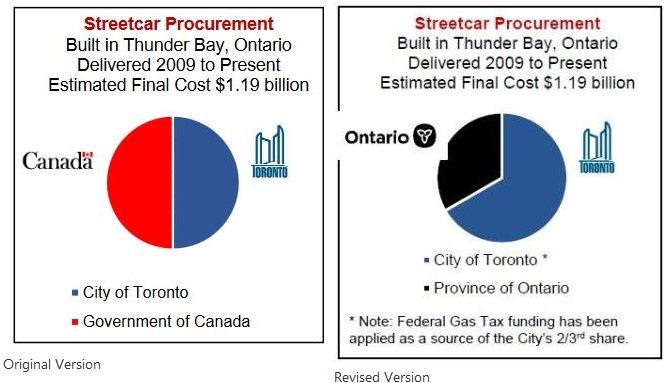
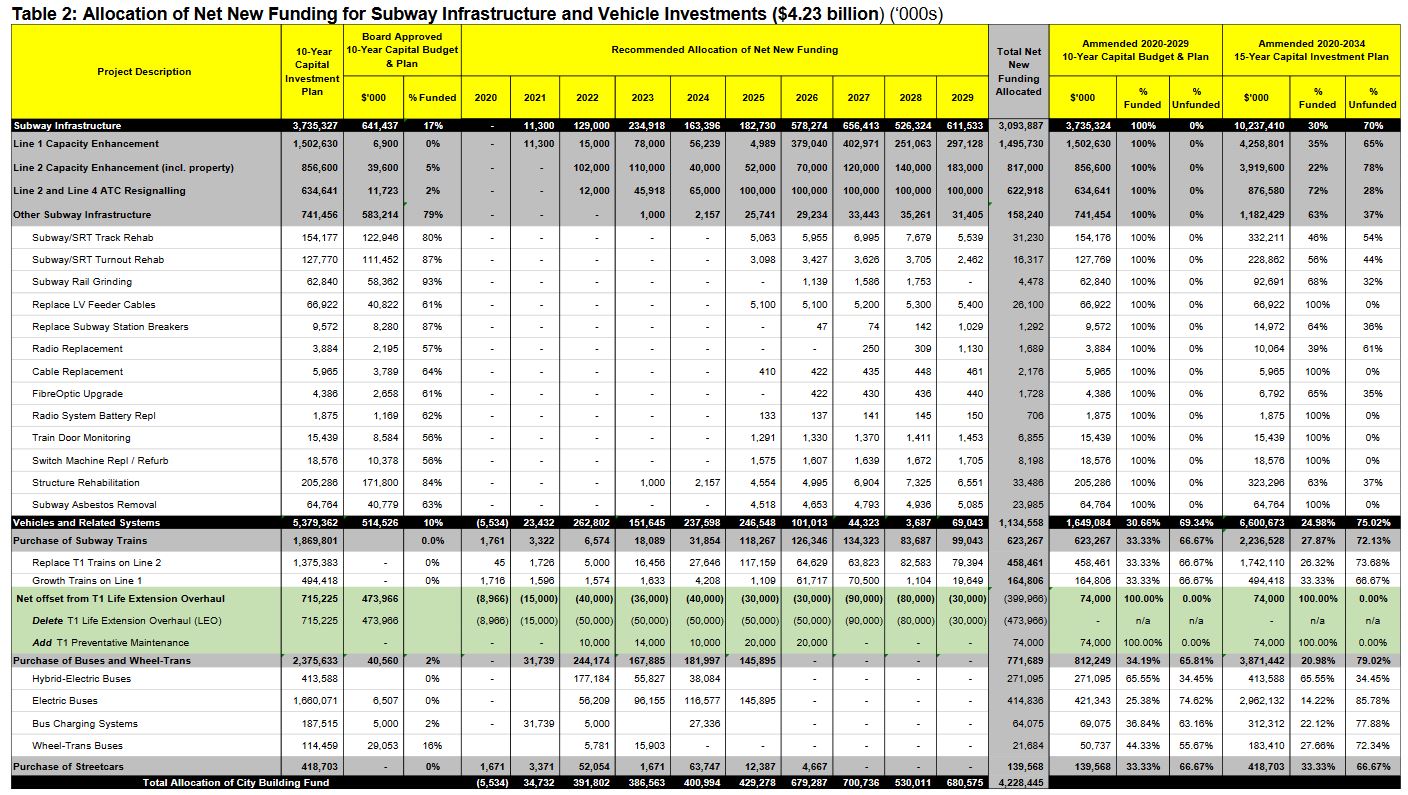
  • Toronto will redirect funding originally earmarked for its share of the key projects to other priorities, notably the TTC’s repair backlog. However, much of that “funding” does not exist as allocations in existing budgets and new money is required from Toronto to pay its share.
  • Cost estimates for the key projects are based on preliminary estimates that could change substantially as the design process unfolds. These estimates are in 2019 dollars and make no provision for inflation. The reports are silent on how the proportion of total spending by each contributor might change over the decade or more of construction.
  • A substantial total of project costs will be born by private sector partners through a “P3” financing mechanism. These arrangement will require future payments for what will be, in effect, a capital lease, but the mechanism for funding this from three levels of government is unclear. The reports are silent on the split between short term borrowing to pay for construction as opposed to long term payments to the P3 financier.
  • Project details as they are known today will change in response to design work and the need to keep costs within the projected level. This will affect alignments and stations, and what we think we are buying could be quite different from what we actually get.

The challenge in all of this is, as always, the question of money. We can watch the hands of politicians and managers at all levels as they shuffle cards on the table. We hope to “find the Queen”, to win in the subway sweeps rather than being taken for suckers who will cheer any plan, but lose every game. It is far from clear whether the proposal is a “good deal” for Toronto, and there are huge future transit costs that are barely addressed.

The whole exercise is a political deal to bring peace, comparatively speaking, to the transit file which was needlessly fouled by Doug Ford’s insistence that he knows more about transit in Toronto than anyone else. Does Toronto take this as its last best chance to preserve some semblance of control over its transit future, or do we keep fighting for a better deal?

There are a lot of holes in this plan and severe implications both for the City’s finances and the future of Toronto’s transit system. Many questions need to be asked and answered, even if the result will be a whole new plan after provincial and municipal elections in 2022.

Continue reading