TTC Board Meeting July 12, 2023

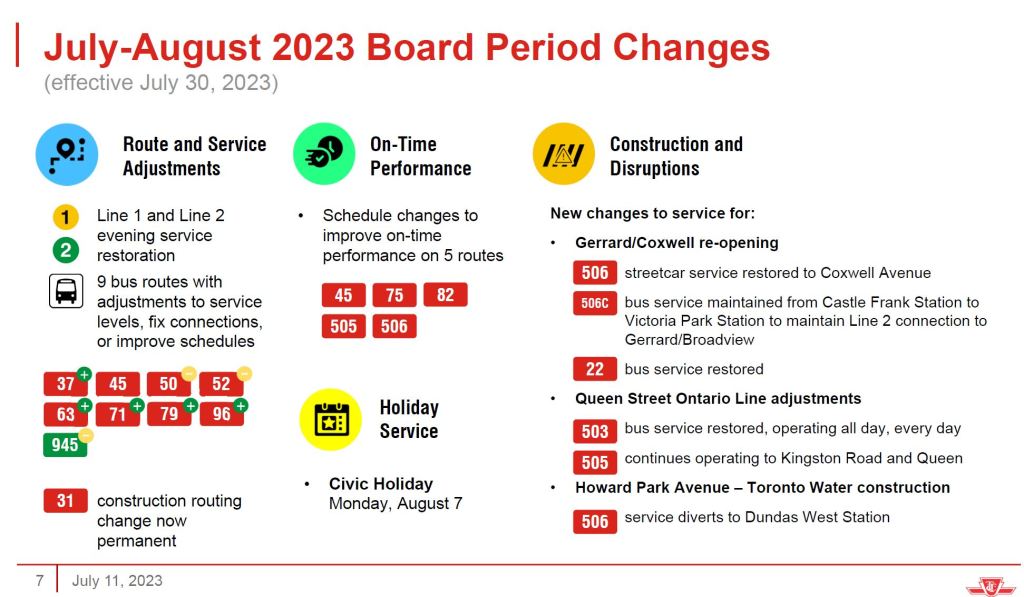
The TTC Board met on July 12 with a variety of items on their agenda. I have already addressed the presentation of pending service changes as well as a discussion of short turns in previous articles.

Topics discussed here include:

  • The CEO’s Report for July 2023
  • Elevator and Escalator Overhauls
  • Wheel-Trans Transformation 2023 Program Update
Continue reading

Preliminary List of Service Changes July-September 2023

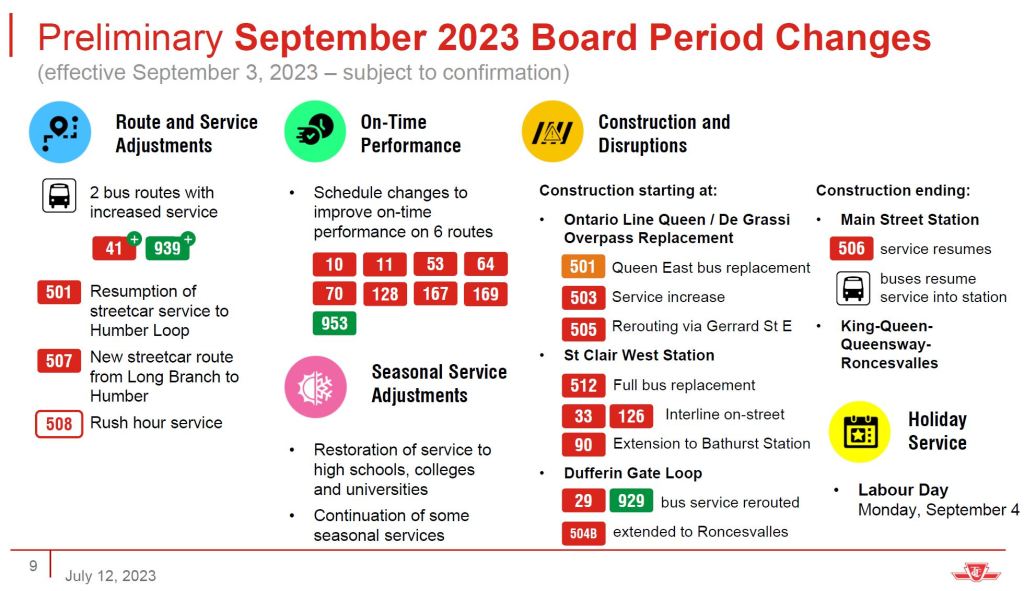
At the TTC Board Meeting, management presented plans for coming service changes to the Board.

When I receive the detailed plans for coming schedule periods, I will post the usual omnibus articles.

Updated July 13, 2023: The eastern terminus of the 506C bus has been corrected to Victoria Park Station.

Updated July 14, 2023: The 506 Carlton street service will resume on Gerrard East to Coxwell on Monday, July 17.

Updated July 15, 2023: The map of the revised 506 Carlton routing has been posted by the TTC.

Week of July 17 (Updated)

With the completion of water main and track work at Coxwell & Lower Gerrard, the 506 Carlton cars will be extended east from Broadview via Coxwell to Woodbine Loop on July 17. Service to Victoria Park Station will continue to be provided by the 506C Carlton bus.

Through bus service on Coxwell from Danforth to Queen will be restored on July 30 when 22 Coxwell return.

July 30

Several changes will occur on Sunday, July 30 including adjustments in response to demand levels, scheduling improvements and construction work.

The 31 Greenwood bus route which has been operating temporarily via an expanded south end loop will be permanently extended to Queen & Eastern Avenue.

The 506 Carlton route will be shifted to Dundas West Station as its western terminus to permit water main construction on Howard Park Avenue.

September 3

Streetcar service will return to Long Branch with 501 Queen cars running to Humber Loop, and 507 Long Branch cars from Humber to Long Branch. The peak period 508 Lake Shore (via King) will also return.

Streetcar service will return to Upper Gerrard and Main Street Station with completion of construction work there.

Streetcars will be replaced on Queen East and on St. Clair for construction.

On 501 Queen, the Ontario Line work at Degrassi (east of Broadview) will require bus service in place of streetcars. As previously announced, the temporary 505 Dundas service to Woodbine Loop will be routed via Gerrard and Coxwell due to the Metrolinx work on Queen.

On St. Clair, reconstruction of St. Clair West Station Loop will require buses over the entire 512 route. This will also affect 33 Forest Hill and 126 Christie (which will interline rather than looping at St. Clair West), and 90 Vaughan which will be extended south to Bathurst Station.

Reconstruction of Dufferin Loop will alter the south end loop arrangements for the 29/929 Dufferin services, and the 504B King to Dufferin service will be extended to Roncesvalles.

The duration of these new construction projects has not been announced.

Service Analysis of the 505 Dundas/Bingham Diversion (Part I)

On May 7, 2023, the eastern terminus of 505 Dundas shifted from Broadview Station to Bingham Loop due to sewer work, track construction and road paving on Broadview north of Gerrard. This will continue into at least the late Fall 2023.

This operation was not a success by any measure with extremely erratic service on Kingston Road where the 505 replaced the 22 Coxwell bus and the 503 Kingston Road streetcar. Service on the main part of 505 Dundas from Broadview to Dundas West Station has also become less reliable.

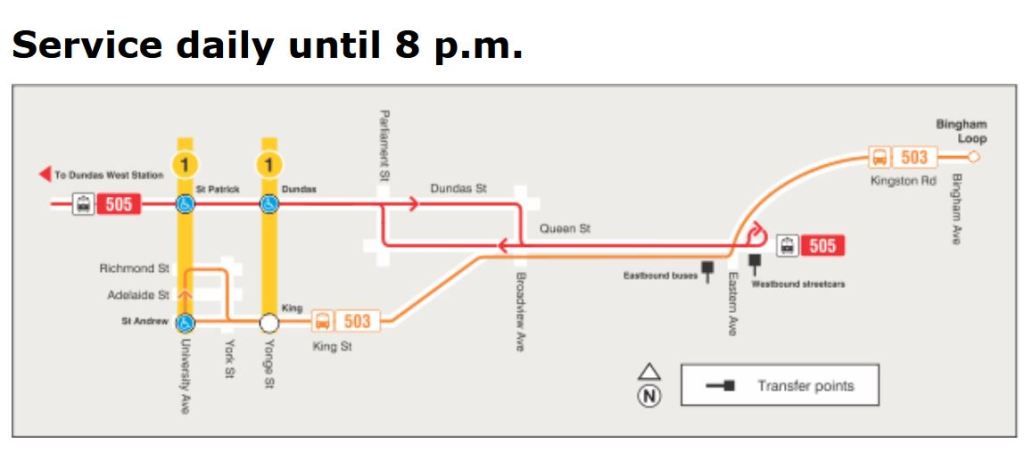
July 4, 2023, service changes (505 Dundas was cut back to Woodbine Loop and 503 Kingston Road buses (running as unscheduled extras) provided service to Bingham until 8pm to correct this problem, but riders endured almost two months of bad service. This affected not just Kingston Road but the entire 505 Dundas route.

This article reviews service during the May-June 2023 period when 505 Dundas cars ran to Bingham with comparisons to the “before” conditions on routes 505, 503 and 22. It is a long article with many charts for those who are interested in the details of how this service has behaved over the past six months. In Part II I will turn to reviews of operations on a sample of days in May-June.

In brief, the May schedules unwound improvements made in February that adjusted travel times to better match conditions. Moreover, Februrary saw major service cuts to the 505 Dundas route which compounded with less reliable service to make for much wider gaps between cars. In many ways, this was an “own goal” by the TTC.

Continue reading

Where Is My Diversion Notice (July 2/23 Edition) (Update 2)

Oh the irony! The TTC’s Annual Service Plan consultations are all about how to handle a few (but not all) of the construction projects coming in 2024, but the elephant in the room remains bad communications and changes on the fly.

The new routes implemented in May and June 2023 were in cases impractical thanks to a combination of unduly optimistic running times in schedules, less than adequate transit priority and line management whose priority was not the provision of well-spaced, reliable service. Several changes will take effect on July 4 and 5 to correct some of these problems, but the information is scattered through the TTC’s website, if you can find it at all.

First, a summary of the changes:

  • The 501/504 shuttle bus (an ad hoc service implemented to cover for the absence of the 503 Kingston Road car to King Street downtown) will be rebranded as “503” and will serve Kingston Road to Bingham Loop until 8pm every day. This will become a scheduled bus service at the end of July, and will revert to 503 streetcars likely in October.
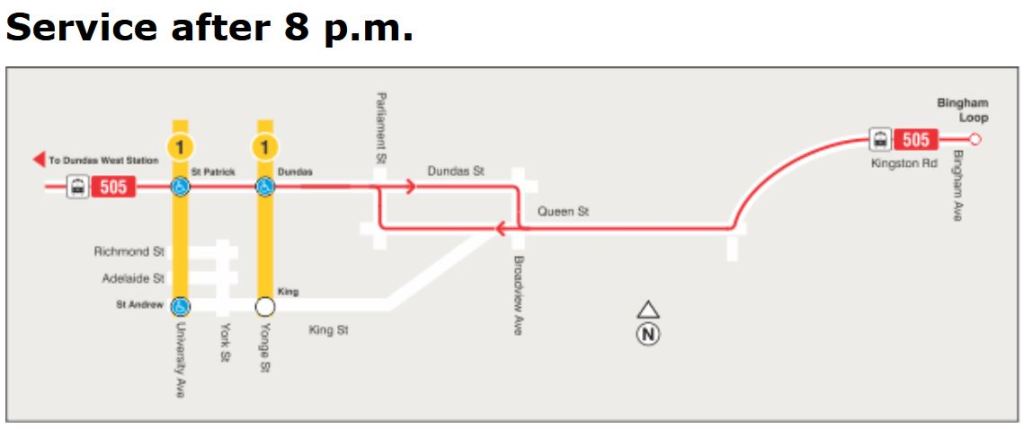
  • The 505 Dundas car will only operate east on Queen from Broadview to Woodbine Loop, except after 8pm when service to Bingham will be provided by streetcars.
  • The 506 Carlton car will only operate to Queen and Broadview and will return west to route via Queen and Parliament Streets without running east to Woodbine Loop.
  • The 512 St. Clair car will be restored, temporarily, west of Lansdowne to Gunns Loop. While it lasts, this will correct for the erratic service now provided there by the 47 Lansdowne extension.

The challenge is to find out that this is happening to your route. The TTC website is very poorly organized with information in many places that is inconsistently placed and linked (or not) to the main route pages affected. Some items are out of date, but remain in place to confuse riders. Some items describe major changes but are hard to find if you don’t know the site in detail.

These are the hallmarks of a site maintained by many groups each with its own (probably jealously guarded) responsibility for providing information. Nobody appears to care about overall site consistency and ease of navigation, or if they do, are in any position to change what is a clearly broken process. Some information is just plain wrong indicating that whoever created or updated the page was either sloppy, or does no know what is actually happening.

Updated July 4, 2023 at 7:10am: Changes to the TTC website since this article was posted are noted in various places below.

Updated July 5, 2023 at 4:30pm: Changes to the TTC website since the July 4 update are noted throughout the article.

Continue reading

Changes to Kingston Road, Dundas, Carlton and St. Clair Ave. W. Services (Revised)

The TTC will implement two route changes in July to address, in part, problems with service reliability on construction diversions.

Updated June 30, 2023: The location of Salsa on St. Clair has been corrected.

Updated July 1, 2023: The 506 Carlton cutback to Queen and Broadview has been added.

503 Kingston Road / 505 Dundas

Effective Tuesday, July 4, 2023 (July 3 is a holiday), service on Kingston Road to Bingham Loop (Victoria Park) will be revised on weekdays and Saturdays from 6am to 8pm, Sundays from 8am to 8pm:

  • 505 Dundas cars will turn back at Woodbine Loop in stead of running through to Bingham.
  • 503 Kingston Road buses will operate between Bingham Loop and York Street via King. Because these are “extras”, not scheduled buses, they will not appear on trip prediction apps.

After 8pm on all days, the 505 Dundas car will run through to Bingham Loop as it does now.

This change should relieve problems with tight running times that caused many short turns on 505 Dundas and wide gaps both on Kingston Road and on Dundas west of Lansdowne. (I will publish an analysis of 505 Dundas headways and reliability in early July.)

Effective Sunday, July 30, 2023, the 503 Kingston Road bus will operate between 6am and 1am (starting at 8am on Sundays) over its Bingham to York route.

Streetcars are expected to return in the fall, likely on Thanksgiving weekend. It is not yet clear whether the 503 streetcar will permanently replace the evening and weekend service formerly provided by the 22A Coxwell bus.

506 Carlton (Added July 1, 2023)

The 506 Carlton streetcar service will be cut back in the east end to Broadview rather than running east to Woodbine Loop. This will correct a problem with inadequate running time that caused many streetcars to short turn without getting to Woodbine Loop anyhow.

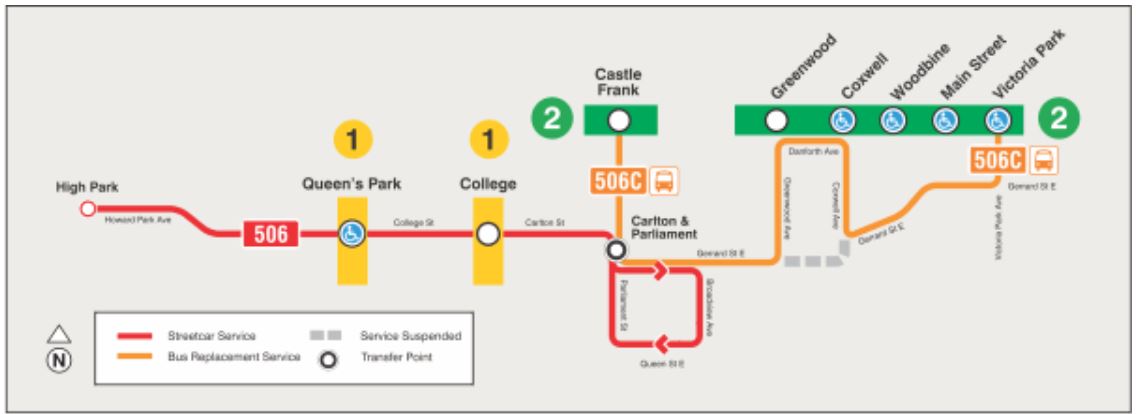
The map below shows the 506C bus diversion via Greenwood and Danforth around track construction at Coxwell and Lower Gerrard. This configuration will be in effect until mid-July when buses can again operate via Gerrard and Coxwell without diverting.

512 St. Clair

Effective Wednesday, July 5, 2023, the 512 St. Clair car will resume operation west to Gunns Loop. Construction at the GO Barrie corridor bridge west of Caledonia has been delayed allowing through service until August. The date when turnbacks at Lansdowne (Earlscourt Loop) will resume is not specified in the TTC announcement.

On the weekend of July 8-9, 2023, streetcar service will be suspended on at least part of the route (TBA) for the Salsa on St. Clair festival between Oakwood and St. Clair West Station.

Service on the temporarily extended 47 Lansdowne bus on St. Clair has been quite erratic. (Stay tuned for an analysis of this operation in coming days.)

TTC 2024 Service Plan Consultation Round Two

The TTC is part way through production of its 2024 Service Plan as well as a 5-Year Service Plan and Customer Experience Action Plan. In Round Two, consultation will focus on plans for service changes triggered by major construction projects. Five pop-up sessions are planned at Flemingdon Park, Union Station, Liberty Village, Finch Terminal, and Pape Station between June 29 and July 12, 2023. Details are available here.

Also available on that page is a link to a survey seeking feedback on various proposals. Please note that my site is not an official TTC conduit for feedback, although it is no secret that many at the TTC do read articles and comments here. Any specific feedback for the TTC should be submitted through their own survey.

Round Three in August-September will present draft concepts for the 5-Year Plan and Customer Experience Action Plan, and these will be refined into final drafts for Round Four in October-November.

The remainder of this article presents an overview of the survey and proposals for construction-related service changes.

There are no proposals for new routes nor of overall service levels in this round. The election of Olivia Chow as Mayor will no doubt bring a review of existing services, but that is not in the scope of this round.

An important issue left over from the 2023 Budget process and the recent service cuts is the question of Service Standards. These are described as “Board Approved”, but in fact the 2023 changes were implemented by management as part of the budget with only retroactive consent from the Board. Moreover, the actual effect of the changes was withheld from the Board and Council until well after the budget was approved.

Transparency in budgets and service planning will be an important change looking ahead to 2024. With a new Mayor I hope to see a much improved process.

Continue reading

TTC Cancels RFP For New Subway Trains (Updated)

A Request for Proposals for new subway trains has been cancelled due to lack of funding. The following notice was sent to all vendors on Friday, June 23:

The Toronto Transit Commission issued a Request for Proposals (RFP) on October 13, 2022 for the procurement of New Subway Trains.

The RFP indicated that the TTC was in the process of actively pursuing additional funding from other orders of government (Provincial and Federal), and that contract award was subject to receiving full funding commitments by early 2023. As detailed in item 1.2.2 – Funding Status of Part 1 – Invitation and Submission Instructions of the RFP document: “Timelines associated with this RFP have been communicated to potential funding partners, and a request for confirmation of funding by early 2023 has been requested. In order to receive the NST deliveries in time for the legacy fleet replacement and to meet growth needs, the TTC has elected to commence the procurement at this time, however, contract award is subject to receiving full funding commitments.”

Unfortunately, the additional funding required has not been secured and as such, TTC is cancelling the RFP effective immediately, and the Bonfire Portal will be closed.

The TTC will continue to have discussions with the Provincial and Federal governments on funding requirements for New Subway Trains and evaluate the requirements for issuance of a future Request for Pre-Qualification and Request for Proposals in the future.

Where this leaves future projects for enhancement of Line 2 Bloor-Danforth, conversion to Automatic Train Control and provision of full service on the Scarborough Subway Extension is anyone’s guess.

This is a project which was initially delayed by CEO Rick Leary in favour of a fleet rebuild, then reactivated as his attitude to the worth of ATC warmed with the success of the Line 1 conversion, a project very much the work of his predecessor Andy Byford and his team. The focus on spending for new lines has left major state of good repair such as fleet renewal high and dry, and this RFP cancellation show where that shortsighted policy has brought us.

I have reached out to TTC Media Relations for comment. This post will be updated as more information becomes available.

Updated June 26, 2023 at 3:45 pm

The TTC replied to my query for comment with the following:

As the posting says (or should), the purchase of the cars is contingent on funding being secured.

That has not yet happened, although discussions are ongoing.

This was about being transparent with bidders and letting them know that once funding is secure, we would re-post.

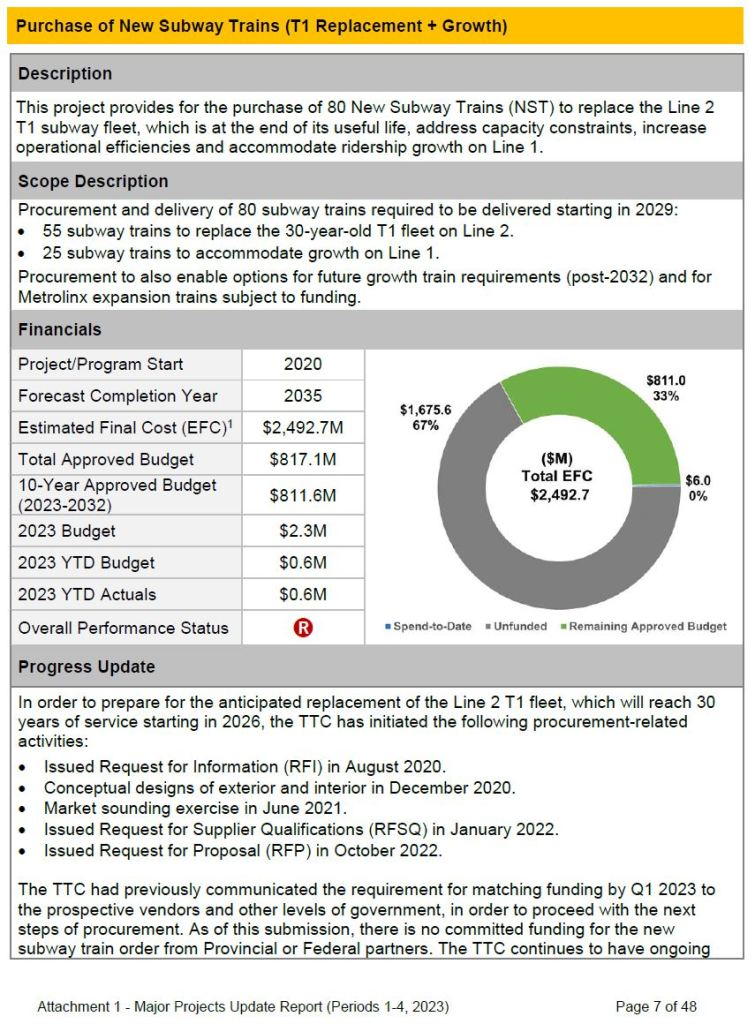
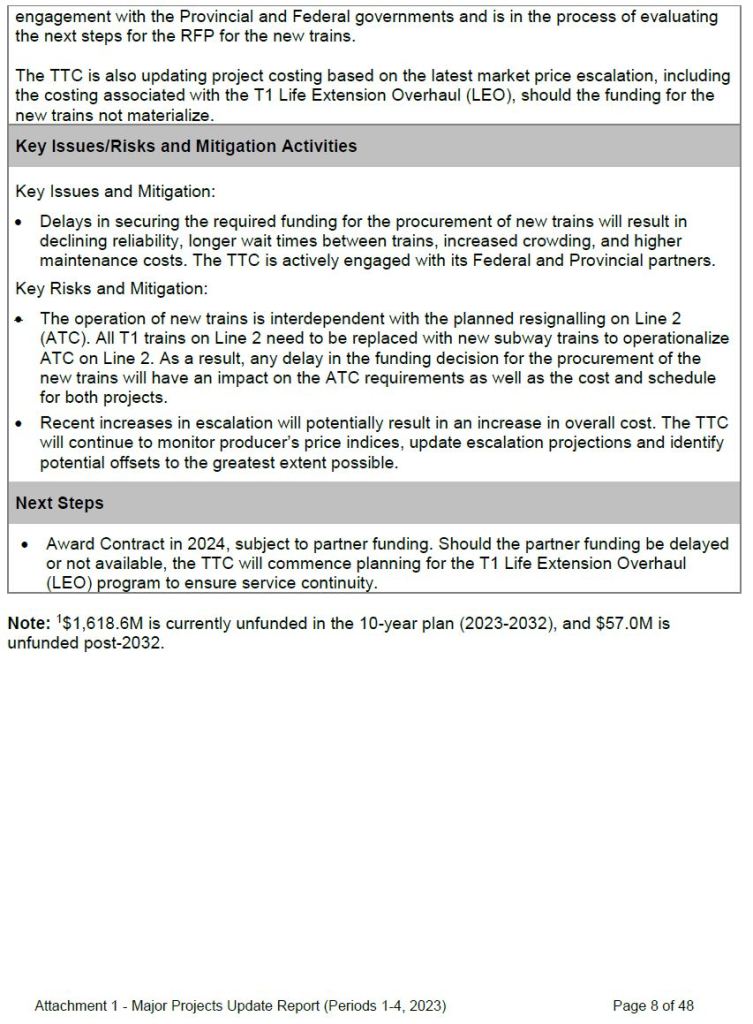
It is worth noting that as recently as the TTC Board meeting of June 12, 2023, there was no mention in the public session that this action was imminent. Here are the relevant pages from the Major Projects Update.

Updated June 26, 2023 at 5:00 pm

How many trains will the Scarborough Subway Extension require?

The TTC owns 370 cars in the T1 fleet which operates Line 2. That is equivalent to 61 6-car trains plus four spare cars.

The scheduled AM peak round trip time on the existing Line 2 is 105 minutes. For the maximum service possible with the existing signal and train control system, one train every 140 seconds, requires 45 trains. That was the AM Peak scheduled service in January 2020 before the pandemic-related service cuts. One additional train was on standby as a “gap” train for a total of 46. Allowing for spares at 20%, this requires a fleet of about 55 trains leaving only 6 spare for expansion.

The Scarborough extension is only marginally longer than the Line 1 extension from Eglinton to Finch with similar station spacing. A one-way trip on that part of Line 1 takes about 12 minutes, or 24 for the round trip. By analogy, that would make the round trip on the extended Line 2 about 129 minutes, and would required 55 trains with nothing left over for extras. Including spares at 20% would require a fleet larger than the TTC now owns.

Alternately, if every second train short turns at Kennedy Station leaving a 280 second service (4’40”) to Sheppard East, the line could probably operate with 50 trains which just fits within what is available.

One might argue that with a new fleet and the benefits of Automatic Train Control, overall speed could be improved and with that the fleet needed for full service to Sheppard could be reduced. But that is moot if TTC maintains the existing fleet.

When the SSE was planned, it had a pocket track east of Kennedy Station, but this was cut to save money, then it was restored. I wonder if someone is counting trains, or just hedging their bets on service levels beyond the existing terminus?

In any event, a failure to buy new trains has the double effect that it will condemn Line 2 to manual operation with an aging signal system for the foreseeable future, and will prevent the operation of full service beyond Kennedy in peak periods unless the Bloor-Danforth line never returns to the pre-pandemic peak service level.

Tunnels And Track But No Trains

At the TTC Board meeting on June 12, 2023, key reports presented the current and future challenges our transit system faces:

This article reviews the Major Projects Update and more generally the TTC’s Capital Program and funding shortfall. In future articles, I will turn to the Operating Budget, subsidies and the changing environment for transit in 2024 and beyond.

A related report from a past meeting presents the entire Capital Plan, not just the “major projects”, and I have consolidated information from it to provide a complete view.

TTC Capital Plans are presented with three separate timelines:

  • The current year,
  • A ten year window, and
  • Fifteen years and beyond.

The fifteen year view is comparatively recent, but it was a vital addition to the transit outlook. Until this version was introduced, a growing list of needed projects simply did not exist in the published TTC plans nor, more importantly, in the minds of Councillors and financial planners at all three levels of government. Magically, the ten year view always managed to fit within money the City had available from its own revenues or provincial and federal commitments.

That fifteen year view was a huge shock to the City, but it was no secret to anyone who looked through the budget and found gaping holes. This situation was a financial convenience to make future City capital needs appear smaller than they actually were. Funding problems were “fixed” year after year by failing to acknowledge key projects, or by pushing them beyond the City’s ten year capital planning window.

Doug Ford arrived on the scene with his subway plans and billions in provincial spending, but much of this was for projects that were not already part of the City’s plans, or at least not at the scale the City contemplated. The province gave the impression of taking a load off of Toronto, but much of the planned provincial spending was never in Toronto’s plans to start with.

Then came the pandemic and severe doubts about the sustainability of the City’s spending.

For his part, former Mayor Tory’s SmartTrack brand was still on the books, even if it was a shadow of its original plan. Despite going over budget, it lives on as five new GO stations thanks to an infusion of $226 million by the provincial government.

At the TTC, CEO Rick Leary was initially distrustful of Automatic Train Control and the new Line 2 fleet it would require. For a time, the projects to resignal the Bloor-Danforth line, buy a new fleet and build a carhouse at Kipling were put on hold. The TTC would make do through another decade with “life extended” trains which would be at least 40 years old by their retirement. Leary has since changed his tune, but this brought the cost of ATC, new trains and, possibly, the carhouse back onto the table.

The situation is complicated by the Scarborough Subway Extension which would require more trains to provide full peak service to Sheppard than the existing fleet. Half of the peak service would short turn at Kennedy to fit the service within the existing Line 2 fleet.

The already-expensive extension does not include ATC signalling because Metrolinx does not know whether the TTC will have an ATC-capable fleet by the opening date. Only the construction delays due to Ford’s intervention in the project give the TTC enough time, and then only barely, to bring Line 2 up to modern standards.

Another related issue is the emerging demand for Platform Edge Doors (PEDs) for which ATC is a pre-requisite. Without new trains and signals, there will be no PEDs on Line 2.

Toronto is in the unhappy position that we are building miles of tunnels, but may not have trains to run in them when they are finished. The self-contained Ontario Line has a fleet, and the Crosstown has its LRVs, but the subway extensions and planned service improvements are another matter. Moreover, if the Line 2 fleet’s life is pushed out to 40 years, there is no guarantee it will provide reliable service.

Award of the contract for new subway cars has already been delayed into 2024 and costs rise thanks to inflation while we await a funding decision. The Major Projects Report notes that:

  • Delays in securing the required funding for the procurement of new trains will result in declining reliability, longer wait times between trains, increased crowding, and higher maintenance costs. The TTC is actively engaged with its Federal and Provincial partners.
  • The operation of new trains is interdependent with the planned resignalling on Line 2 (ATC). All T1 trains on Line 2 need to be replaced with new subway trains to operationalize ATC on Line 2. As a result, any delay in the funding decision for the procurement of the new trains will have an impact on the ATC requirements as well as the cost and schedule for both projects.
  • Recent increases in escalation will potentially result in an increase in overall cost. The TTC will continue to monitor producer’s price indices, update escalation projections and identify potential offsets to the greatest extent possible.
  • Award Contract in 2024, subject to partner funding. Should the partner funding be delayed or not available, the TTC will commence planning for the T1 Life Extension Overhaul (LEO) program to ensure service continuity.

Meanwhile, on Line 1 Yonge-University, the fleet is in its youth, but more trains are needed to increase service and to provide for the Richmond Hill extension. A new maintenance facility will be required to hold the larger fleet, and it will most likely be built north of the new extension. There has been no word on whether York Region will contribute to any of the cost their subway extension will add to the TTC’s budget woes.

The Major Projects Report notes:

This program includes the accommodation of train storage and maintenance requirements, and other infrastructure enhancements, to expand capacity and improve circulation on Line 1, reduce overcrowding, increase the frequency of trains and reduce travel times, which will result in improved customer service.

[…]

Train Maintenance and Storage Facility (TMSF), which includes:

  • Storage for 34 trains, including a test track, and access track to the site;
  • Carhouse with five Bays for Preventative and Corrective Maintenance to support daily service;
  • Operations and Infrastructure (O&I) facility to support maintenance activities (small shop building, outdoor and indoor storage tracks for work cars, material storage, and staging area);
  • Ancillary facilities (Traction Power Substation (TPSS), Hostler platform).

More service adds to the electrical draw and in turn that will trigger upgrades to the subway’s power distribution system.

Without going into the many details, this illustrates how subway planning is not simply a question of drawing lines on a map and cutting ribbons when the tunnel boring machines arrive.

Continue reading

TTC Service Changes Effective June 18, 2023

Several changes will affect TTC routes on June 18. Notable among these is the formal restoration of more frequent weekend subway service, the Broadview construction project, various adjustments to improve route operations, and seasonal changes.

A consolidated table showing current and new service designs is in the spreadsheet linked below.

2023.06.18 Service Changes V2.2

Updated June 15, 2023 at 1:00pm:

  • Route numbers for 104 Faywood, 121 Esplanade-River and 165 Weston Road North corrected.
  • Route of Broadview/Gerrard loop for 121 added.
  • Route of 100 Flemingdon Park on Pape clarified.
  • Route of 203 High Park South clarified.

Updated June 15, 2023 at 10:30pm:

  • Change to partly articulated bus operation on 36A Finch West corrected to refer to the portion of the route between Yonge and Finch W Stn.

Updated June 16, 2023 at 2:00pm:

  • Route maps for streetcar service changes added.
Continue reading

Promises, Promises: 2023 Edition

The Toronto Mayoral By-Election is just under a month away, and candidates pump out announcements daily, often with a transit spin. In this article I will look at the transit-related issues they are trying to address (or in some cases avoid).

All of this takes place in a strange world where the availability of money to pay for anything is suspect. Is a promise is even credible let alone affordable? Many of the platforms overlap, and so I will take related issues in groups rather than enumerating and critiquing each candidate’s platform.

A month ago, I wrote about what a transit platform should look like:

That sets out my philosophy of what I seek in a candidate, and the short version appears below. If you want the long version, click on the link above.

  • Service is key. Run as much as possible, everywhere, and run it well.
  • Build budgets based on what you want to see, not on what you think you can afford. Just getting by is not a recipe for recovery and growth. If the money doesn’t come, then look to “Plan B” but aim for “Plan A”.
  • Fares are a central part of our transit system, but the question is who should pay and how much. Strive for simplicity. Give discounts where they are truly needed. Make the transit system worth riding so that small, regular increases are acceptable.
  • Focus on ease of use among transit systems in the GTA, but do not equate “integration” with amalgamated governance.
  • Transit property: parking or housing?
  • Foster a culture of advocacy in management and on the TTC Board.
  • Beware of lines on maps. A “my map vs your map” debate focuses all effort on a handful of corridors while the rest of the network rots.
  • Plan for achievements in your current term and make sure they actually happen. Longer term is important, but the transit ship is sinking. You are running for office in 2023. Vague promises for the 2030s are cold comfort to voters who have heard it all before.

Full disclosure: I have always maintained an “open door” to anyone who wants to talk transit, and in this round I have been approached by both the Matlow and Chow campaigns for information and advice, as well as some media outlets. This I provided pro bono and without any “leakage” of who asked me what. No other candidates asked. How much of my input shows up in platforms is quite another matter. We shall see as the campaign unfolds.

Continue reading