
The TTC has announced the details of its service changes for October 2023.
Continue readingFinance
TTC Board Meeting Preview: September 26, 2023
The TTC Board will meet at Scarborough Council Chambers at 10:00 am on September 26, 2023. This will be the first meeting of the reconstituted Board under Mayor Chow’s administration. Among the reports on the agenda are:
- CEO’s Report for September 2023
- Line 3 Bus Replacement Update
- Easier Access Phase III – Project Status Update September 2023
- Financial and Major Projects Update
- Notice of Motion – A Step Towards Free Transit for Middle and High School Students
- Appointments to TTC Committees
- The Sustainable City of Toronto Fleets Plan
The agenda also includes a report Update on TTC’s Partnership Approach to Community Safety, Security and Well-Being on Public Transit. I will address this in a separate article.
Continue readingNew Metrics for a New TTC
With the changing of the guard in the Mayor’s Office and a shift in the political balance of the TTC Board, it is time to blow the dust off of the metrics in the TTC CEO’s Report and elsewhere. I have written about aspects of this before, and will not belabour earlier arguments. However, in an era of recovery, we need to show what this is actually happening, and that we are getting good use out of the transit infrastructure, notably a large vehicle fleet, that we already own.
The areas of particular interest are:
- Ridership, demand and crowding on routes
- Service quantity and reliability
- Fleet availability, usage and reliability
The CEO’s Report is replete with “Key Performance Indicators” (KPIs), a favourite tool of lazy managers to give the impression a complex organization and process can be reduced to a handful of simple numbers. Either “up” or “down” is considered “good”, and as long as the lines move in the correct direction, gold stars are handed out like confetti. Rarely, if ever, is the underlying process, the product, or the real meaning of the KPIs discussed.
A subtle, pervasive issue for TTC KPIs is the focus on top line numbers for ridership and revenue. This is akin to a restaurateur who counts the receipts and the number of meals sold without asking what brings diners to the door, or even worse, whether they will come back. The goal is to sell more meals, preferably at a low cost. Advertising, not word of mouth, generates new, if not lasting, trade.
Ridership is a rough measure of system use and a point of comparison for post-pandemic recovery, but it does not tell the whole story. Already we know that the bus network which is mainly based in the suburbs has recovered much of its pre-pandemic demand, although this is not distributed the same way with shifts in peak periods and in travel patterns. Off peak recovery is stronger than peak, in part because “work from home” affects less than half of the total demand, and non-work trips still occur.
Even “growth” can be misleading. In pre-pandemic times, the TTC routinely celebrated year-over-year riding growth even while the rate of growth slowed and eventually stalled. A problem flagged at the time was that growth occurred disproportionately in the off-peak where there was surplus capacity. That capacity filled up, but thanks to budget constraints service did not expand to match.
This shows the danger of looking at a single, simple number without understanding the detailed system behaviour, or even worse, of using the simple metric to hide a growing problem. Trimming capacity to demand can be a vicious cycle that prevents growth.
The phrase “subject to budget availability” is a standard caveat on any goals, and it has haunted TTC planning for years, well before the pandemic. That might be a basic part of corporate management, but over many years it has become the foundation of TTC reality. Aim low because aiming higher will cost too much.
This speaks to the split nature of TTC goals. It is supposed to provide transportation, and the motto “Service, Courtesy, Safety” is emblazoned on the TTC’s coat of arms. However, the TTC Board sees its primary role as serving its political masters at Council and especially the Mayor.
I wrote about TTC culture and that motto back in 2010. For context, this was before Andy Byford became CEO, let alone Rick Leary.
- Service, Courtesy, Safety (Part I)
- Service, Courtesy, Safety (Part II)
- Service, Courtesy, Safety (Part III)
The common problem with many KPIs the TTC publishes is that they are one dimensional and report only average values of major variables. They do not necessarily reflect what riders see nor give a sense of the shortfall between what the system achieves and what could be possible.
I have said this before: riders do not experience “average” trips any more than diners in a restaurant experience an “average” meal. A four-star restaurant might outdo itself with a plateful of magic from the kitchen, but an off day could bring overcooked, lukewarm food and indifferent treatment by the wait staff. Getting it right most of the time doesn’t warrant four stars. Getting it right only some of the time doesn’t warrant any. The diners are paying for all four.
On occasion, I am asked how I would change the TTC’s KPIs to better show what is happening. My first response is that many aspects of a transit system cannot be reduced to one-dimensional metrics that compress all of the vital details into simplistic averages.
TTC needs to focus its performance metrics on service-related factors, direct measures of what riders experience. Average values will not do, and the Board needs to understand what these numbers mean. Providing tolerable service on most routes a good deal of the time is not an advertisement for “the better way”. Provide attractive, reliable service and riders will follow.
Continue readingTTC Service Changes for September 3, 2023
The TTC did not release the detailed list of September 2023 service changes until the afternoon of September 1.
To get this information out promptly, this article is published without the usual spreadsheet comparing old and new schedules. I will add the spreadsheet here in a few days when I have built it. Check back later in the weekend.
Updated September 3 at 8:40 pm: The spreadsheet detailing all of the service changes with before:after comparisons is now available.
Updated September 5 at 2:20 pm: The description of the modified 403 Don Mills South Community Bus has been corrected.
Continue readingYet Another Change to East End Streetcar Services
Further to my recent post about planned service changes effective September 3, the TTC has issued a revised set of route arrangements thanks to a change in the schedule for Metrolinx work at Queen & Degrassi.
There will be four stages to the service modifications:
- Sunday, September 3 to Friday, September 22 at 10 pm
- Friday, September 22 at 10 pm to Friday, September 29 at 10 pm
- Friday, September 29 at 10pm to Monday, October 2 at 4 am
- Monday, October 2 at 4am to Sunday, October 8
October 8 falls on Thanksgiving weekend which is the October TTC schedule change date. Service arrangements beyond that point have not been announced.
The information here is adapted, with corrections, from the TTC’s website Streetcar Service Changes page. As I write this (4:50 pm, August 29), there are several inconsistencies or errors on the TTC’s site. This article is an attempt to consolidate the available information.
Continue readingTTC Announces Fall 2023 Service Increases
On August 28, 2023, Mayor Olivia Chow and TTC Chair Jamaal Myers held a press conference at Scarborough Centre Station, hosted by TTC CEO Rick Leary, to announce planned service improvements for coming months. The map below shows routes affected by plans for October and November 2023.
The routes in blue, the former SRT colour, are part of the restructuring for the Line 3 replacement service. Note that they are shown as running west from STC via Progress, Brimley and Ellesmere. This is the final routing, although the 903 express bus is now using Progress all the way to Kennedy. The reason for this is that a queue jump lane is planned for Brimey and Ellesmere, but it is not yet ready. When it is completed, the buses will shift to the originally announced route via Ellesmere.
Other routes will see improvements to service and/or to reliability. No details were announced.

Service hours are planned to increase through the fall:
- In September to 93% of prepandemic levels
- By November to 95% of prepandemic levels with bus service rising to 99%.
Note that this does not mean that late 2023 service will be identical to early 2020, but that similar numbers of service hours will be provided. The bus network is especially important because it has the strongest ridership recovery rate.
The improvements planned include restoration of school trippers (a normal fall event), increasing service based on demand, reducing wait times by improving the Ten Minute Network, and adding unscheduled, Run-As-Directed service to supplement capacity.
Funding for the improvements comes from the unspent budget headroom created by the delay in opening the two Provincial LRT projects on Eglinton/Crosstown and on Finch.
I expect to receive the details of September service changes soon and will publish them when they are available.
TTC Service Changes Effective Sunday, September 3, 2023 (Preliminary)
This is a preliminary version based on GTFS data (the standard format for transit schedules used by online services) and some Service Advisories on the TTC site. I expect to receive the full list of September service changes early in the week of August 28 and will update this article accordingly including the usual detailed comparison of service levels.
Updated August 26 at 9:15 pm: 512 St. Clair updated to reflect complete bus replacement for work at various locations on the line.
Updated August 27 at 4:30 pm: At 10:30 am on August 28, the Mayor, TTC Chair and CEO will hold a press conference at STC Station to “outline how the TTC will increase service beginning September and into the fall.”
Updated August 29 at 5:30 pm: Due to changes in the Metrolinx schedule for work on the Lake Shore East Queen Street bridge, there has been a further revision of planned service. Please see this post for details.
Continue readingTTC 2024-2028 Service Plan Consultation Round Three
The TTC continues its consultation on a five-year plan for service combined with a “customer experience action plan” with a series of pop-ups in mid-August, meetings with various stakeholder groups, and an online survey available until August 27.
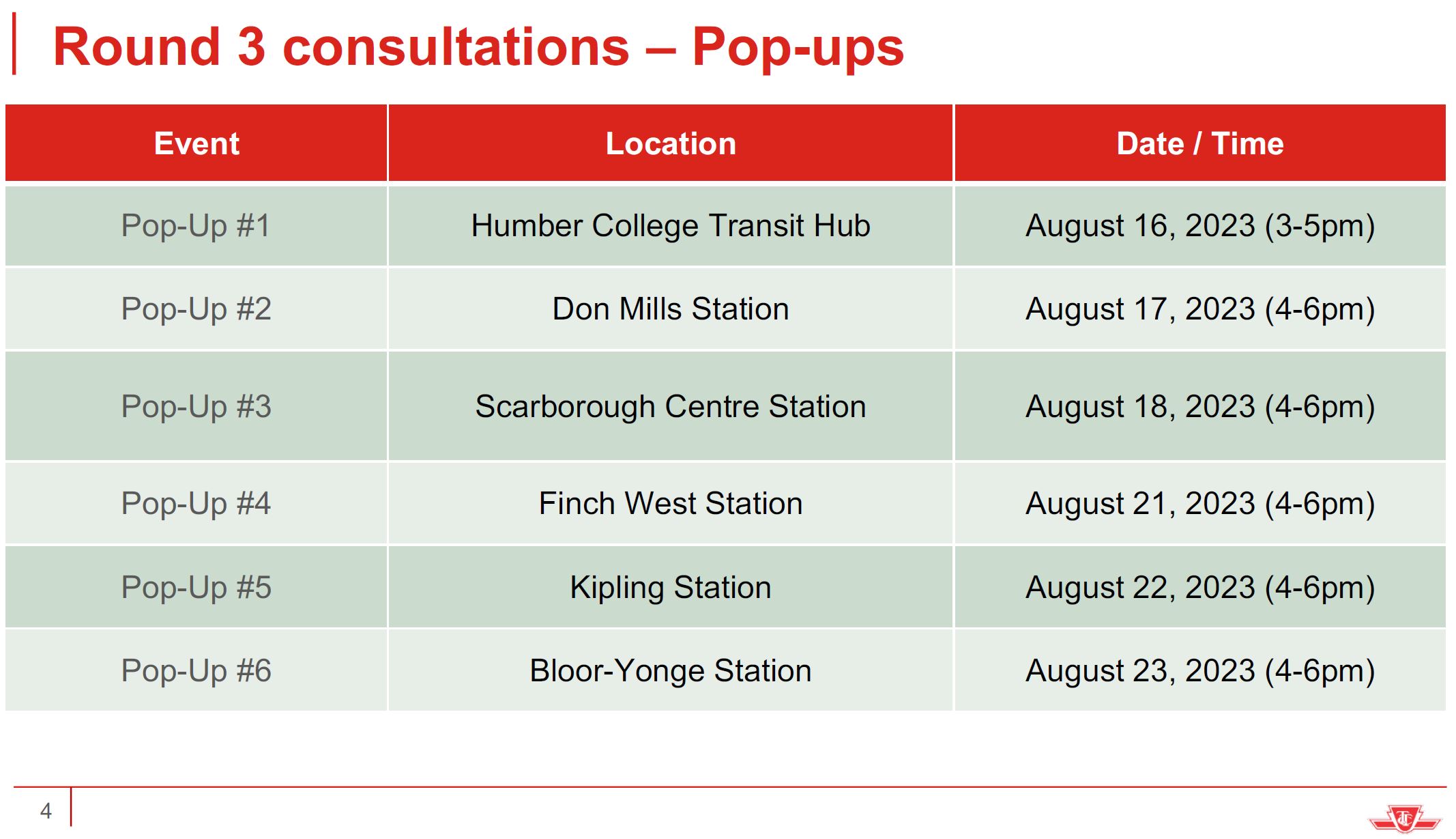
With the election of a new Mayor and a shifted political balance of the TTC Board, the context for these plans has changed quite substantially. After years where “less is more” might have been a fitting logo, the TTC now faces key questions about its future. What should transit be? How deep are it shortfalls? How high should we aim for improvement?
For information about previous rounds, see:
Current plans are to take the Annual Service Plan for 2024 to the TTC Board in Fall 2023. There will be a final, fourth round on the Five-Year Plans in November 2023 and they will go to the Board in early 2024. It is not clear how the Five-Year Plan will interact with the 2024 budget process which will already be substantially complete. This timing is a remnant of the Tory era at City Hall when the budget was a “done deal” at the Mayor’s bidding and debate on future options simply was not tolerated.
An important part of the Five-Year Plan is the TTC’s claimed “vision” for its future:
Focus on improvements that enhance TTC’s core-competency: mass transit – moving large volumes of customers safely, reliably, and swiftly across Toronto
In all of the talk about transit and various improvement schemes, staying focused on moving people must be a top priority. The attractiveness of transit for that function – getting from “A” to “B” and back again – must not be lost in flirtations with marginal technologies, ancillary services or “improvements” that will not touch most riders’ daily experience.
Continue readingA Revived, Activist TTC Board?
Following Olivia Chow’s election as Mayor of Toronto, the process is now underway to repopulate committee and board appointments that will reflect the Mayor’s and Council’s priorities .
The Striking Committee – Councillors Malik (Chair), Bravo (Vice-Chair), Carroll, McKelvie and Perks – is very different from the crew who managed this process under Mayor Tory. Only Deputy Mayor McKelvie was carried over from previous era.
The City Clerk polled Councillors to determine each member’s interest in a wide variety of positions, and their requests will be considered by the Committee at its meeting on August 10, 2023. Their recommendations will be forwarded to Council for approval at a special meeting on the afternoon the same day.
Up for grabs are six positions on the TTC Board including the Chair and five other seats. The Councillor members’ terms will run to the end of 2024 when the process of juggling appointments will be repeated (standard practice at Council’s mid-term), although the sitting TTC Board members are likely to be reappointed for a further two years.
The remaining four members of the board, non-Council “public” members, will not be up for reappointment until early 2025 or 2027 unless Council rescinds them sooner. Any selections will be affected by the revised membership in the Civic Appointments Committee.
Today there are only five Councillors on the Board and there is one vacancy.
Councillors who have asked to be considered for the TTC Board are: Ainslie, Burnside, Holyday, Mantas, Matlow, Moise and Myers. Of these, all but Matlow and Myers are already on the Board, and Burnside is Chair. (The Vice-Chair is chosen from among the citizen members.)
The Striking Committee and Council should aim to create a TTC Board that actively pursues policies to improve transit. This includes public debates about just what we, as a city, expect of the system. Wringing their hands and saying “we can’t afford anything, so we won’t bother trying” should not be an option.
There are huge challenges financial (the City’s budget deficit), political (the Ford government at Queen’s Park) and organizational (the less-than-steller performance of and reputed poisonous environment under CEO Rick Leary). Any would-be Commissioner who views their job as simply showing up for meetings now and then to hear good news stories should seek work elsewhere.
The TTC has just embarked on consultation for its 5-Year Service Plan and a Customer Experience Action Plan. This might have been a business-as-usual plan under Mayor Tory entrenching a “Board approved” set of targets driven by a conservative agenda.
Toronto needs much more, an aspiration not just for “better” transit, but for a greater relevance of transit to riders across the city. Even if our goal is out of reach in the short term, we should aim high.
Continue readingTTC Service Changes Effective July 30, 2023
The TTC will make several changes to its services on July 30, although this round is more of a “fixer upper” to correct problems with some existing schedules rather than major changes.
Weekday evening subway service will be formally restored to every 6 minutes or better on Lines 1 & 2. Streetcar service in the east end will be reorganized to correct schedule problems and reflect progress on construction work (much of these changes are already in effect). Several bus route schedules will be updated to improve reliability including use of common headways on overlapped sections.
Continue reading Steve Munro