TTC Service Changes Effective January 7, 2024

The TTC will adjust service on many routes with the January 2024 schedules.

A summary of all changes is in the spreadsheet linked here showing a before and after view of the affected routes. Note that the “before” data are from the November 2023 schedules which do not include the holiday period’s service cuts. All of those cuts are restored in the 2024 schedule, and they are not listed here.

TTC Service Changes 2024.01.07

Updated December 30, 2023:

  • Maps of route changes have been added from the corresponding TTC Service Changes pages.
  • The revised 501B Queen looping at Broadview & Gerrard has been added.
Continue reading

TTC 2024 Budget Preview: Part I – Operating

The TTC Board’s meeting agenda for December 20, 2023 deals primarily with the 2024 Operating Budget, the Capital Plans looking forward 10-15 years, the growing backlog of State of Good Repair (SOGR) spending, and a preliminary look at the Five Year Corporate Plan. A few items are carried over from the December 7 agenda that the Board could not complete due to time limitations, of which the most significant is the quarterly financial review.

In this article I will preview the Operating Budget, but will turn to the Capital Budget in a second piece. I will also follow-up the Board meeting discussion and additional presentations from staff.

Major Issues

The overwhelming issue is, of course, funding: who will pay to continue TTC operations at their current level let alone to improve them?

No fare increase is proposed for 2024 “in recognition of the impact current economic conditions have on customers”. This has a cost in increased subsidy, or more subtly in works not undertaken for lack of revenue, if the gap is not filled. In 2024, this gap will use a reserve draw, but that approach is not sustainable due to declining reserves and the escalating cost from year to year of a continued freeze.

A political challenge in seeking profincial and federal subsidies for covid shortfalls is that a fare freeze appears to come on the back of covid payments that might not otherwise be claimed.

More generally, the idea of “covid costs” is going to run out of steam soon as support programs close down at the provincial and federal level. The TTC and City must figure out what TTC plans look like based on current revenue and ridership, plus whatever added subsidy might be available.

Future years include major challenges with a continuing reduction of core area work trips compared to pre-pandemic conditions. While total weekly trips might be lower than historical levels, daily volumes show considerable variation both on transit and traffic conditions. Service planned on the basis of average demand could be overloaded on the peak days.

Although the budget speaks of a return to 97% of the Service Budget level by Fall 2024, this is qualified by a note that this is to address traffic congestion. In terms of actual service level (i.e. buses per hour), riders may not see as much improvement as the 97% figure implies. There is almost no provision for additional streetcar and subway service. Peak subway service continues to operate at a much lower level than pre-pandemic schedules in spite of an overall return to 83% of the former service.

The budget contains little provision for additional service related to demand growth, nor is there any discussion of the implications of a growth rate higher than the assumed value. Ironically, added costs are included for maintenance of the growing streetcar fleet, but not for actual operation of these vehicles. Capital plans for buses see only a modest growth in fleet size and, by implication, in service levels.

There is no discussion of reversing changes to Service Standards implemented by management in 2023 that brought allowable off-peak crowding to almost peak levels. This keeps the cost of service down, but affects its attractiveness.

The net effect of demand changes in the core is that the TTC’s share of the travel market is falling even though ridership is strong for non-core trips with a higher recovery rate.

There is a major disconnect between capital plans for substantial growth in core area capacity on the rapid transit and GO networks, and the very modest plans for service growth to the same area.

This is very much the kind of budget presentation we have seen through many years of the Tory regime with small-scale changes. Given the funding limitations, this is no surprise, but there must also be a reconciliation between political aims for greater transit and what the money sitting on the table will actually pay for.

Other City initiatives, notably a greener fleet and proposals for massive service expansion, affect the Capital Budget and, eventually the Operating Budget, but these must be understood in the context of a basic question: what do we spend our money on? Basic operations and service quality will be compromised by bad choices or by simply hoping that a transit equivalent of the Tooth Fairy will appear.

Continue reading

TTC Service Changes Effective December 24, 2023

The TTC will institute a number of service changes for the holiday period between Sunday, December 24, 2023 and Saturday, January 6, 2024.

All of these involve service cuts usually made over this two week period with the removal of school trips on many routes. These will be restored in the January schedules.

On all routes but one, the change is implemented either by switching back to the summer 2023 schedule or by amending the existing schedule to remove the extra trips.

38 Highland Creek has an extended route this year compared to 2022, and so it has a new “summer” schedule for the coming holiday. This will be used in 2024. Other routes extended as part of the SRT replacement do not have school trips, and so they are not affected by the holidays.

Service Changes Effective 2023.12.24

The file linked here contains lists of the routes that will lose school trips and/or will have summer service for the two week period. The last page of this file details the TTC’s plans for service on a day-by-day basis including New Year’s Eve. The arrangements are identical to those for 2022 except that there are no “last train times” for the now-discontinued Line 3.

No new diversions have been announced for the holiday period although it would not surprise me if a whole pack of Grinches is working on a last minute “gift” for transit riders.

The Politics of Outsourced TTC Vehicle Cleaning and Servicing

Updated December 20, 2023: As of today, Board member Ron Lalonde, whose term was to run until February 2025, resigned creating a vacancy that could be filled with a non-Tory aligned citizen member.

At its December 7, 2023 meeting the TTC Board considered a management report recommending the continued outsourcing of surface vehicle cleaning and servicing. This proved to be a very contentious issue triggering a long in camera session after which the recommendation was adopted in part, but with one amendment, and on a split vote.

Background

Outsourcing of bus cleaning began under CEO Andy Byford as an outgrowth of Toronto’s core services review. It began as a pilot at Mount Dennis and Malvern garages, and from November 2013 was expanded to the (then) full seven garages. When that contract expired at the end of 2017, a new contract was signed covering the period to the end of 2023.

In 2020, as part of the Covid response, the work of disinfecting all vehicles, including streetcars and subway trains, was added to the contract.

Cleaning and servicing of streetcars was added to the contract in September 2021 with a December 2023 end date, and an option for two additional one-year terms. Starting in January 2023, midday in-service streetcar cleaning was added as part of “TTC’s action plan with respect to community safety, security and well-being”.

The contractor, TBM Service Group Inc., uses employees under Local 2 of the Service Employees International Union, and pays wages higher than the statutory minimum, but not as high as comparable work that would be done by Amalgamated Transit Union 113. ATU claims that this work is rightfully theirs, and that the TTC is in breach of contract by outsourcing it. This is a long-standing dispute.

TTC argues that TBM’s employees are 40% female and 85% visible minority, but this does not speak to what the breakdown might have been had the work stayed with ATU. For their part, ATU argues that the cleaning and servicing positions were entry level jobs to the TTC which are no longer available.

TTC also argues that having ATU staff perform these functions created problems at garages because of staff shortages. When other maintenance workers filled in, this left repair work unfinished. The TTC argues on the basis of efficient staff usage without addressing why they were short cleaners in the first place.

TTC also claims that vehicle reliability has gone up over the outsourcing period, but does not address other possible factors such as:

  • the average fleet age which has been falling as the shift to a 12-year replacement cycle builds into the system,
  • the under-utilization of the fleet thanks to pandemic-era service cuts allowing the worst performing buses to be sidelined,
  • the opening of McNicoll Garage relieved bus crowding at other locations that interfered with efficient maintenance.

The TTC acknowledges that the work model implemented by TBM is an improvement over past TTC practices, and they would adopt it although costs would rise because of higher ATU wage rates.

TBM has since refined the business model to adopt a production line approach utilizing dedicated workforce to perform each activity. If the TTC were to perform servicing and cleaning in-house, the TTC would be inclined to adopt a similar business model as TBM to ensure continued success of KPIs. Using TBM’s business model, the TTC would need to increase its workforce compared to the 2012 business model. The expected cost avoidance of second sourcing with the updated workforce model is approximately $101.83 million over the contract term (2024-2028) or an average annual cost avoidance of $20.37 million.

Appendix A – Bus and Streetcar Servicing & Cleaning – Benefits & Performance p. 5

Leaving aside the question of cost, this begs the question of whether the TTC was attempting to make do with fewer staff than needed when the work was in house.

Continue reading

Analysis of 903 STC Express: September-November 2023

This article is a preliminary look at the service offered by the 903 express bus which replaced Line 3 SRT.

Until Saturday, November 18, the 903 buses provided very frequent service between Scarborough Town Centre and Kennedy Station. On Sunday, November 19, eight other routes were extended from STC to Kennedy Station, the 903 was extended to Centennial College replacing the 134/913 Progress bus, and much existing service on route 903 was reallocated to the extended routes.

I will review the other routes serving this corridor in early 2024 when they have accumulated a few months’ experience.

Travel Times

The charts here show how travel times between STC and Kennedy Station have changed over the past three months. The screenlines for these measurements are located:

  • Leaving STC Loop
  • Just north of Eglinton on Midland and on Kennedy

Note that this excludes time spent navigating roads and construction near Kennedy Station, and any time spent in STC Loop. I will review terminal operations when more data for all of the routes in this corridor have accumulated.

The charts below show monthly data, by week and hour, with North/Eastbound service on the left and South/Westbound service on the right. Note that there are no data for September, Week 1 because the service was provided with untracked extras until the schedule change on Labour Day weekend.

The solid lines show the average headways, and the dotted lines show the standard deviation, a measure of the scatter in the values. The closer the SD values are to zero, the more reliable the service is.

In the early weeks of operation, the transit priority measures were not in place, and service was more affected by traffic sharing the road. This settles down by November, although some peak period effects are still visible.

The TTC had anticipated that a trip between Kennedy Station and STC would take 15 to 18 minutes depending on conditions. Considering that the times shown below do not include access time to and from terminals, the service is close to the TTC’s target.

Service from November 19 Onward

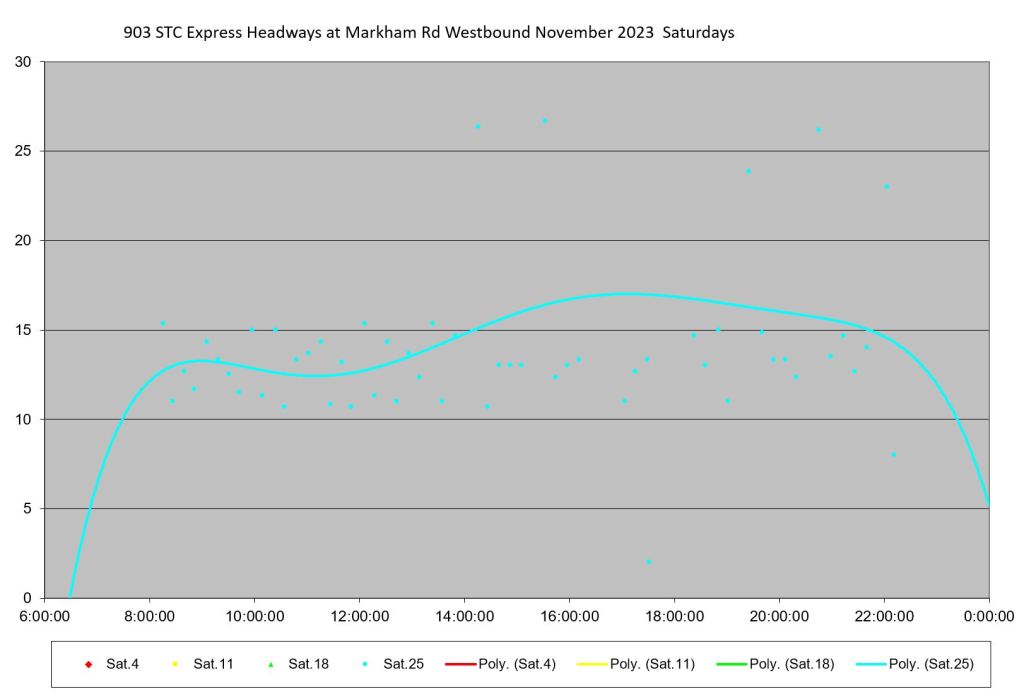
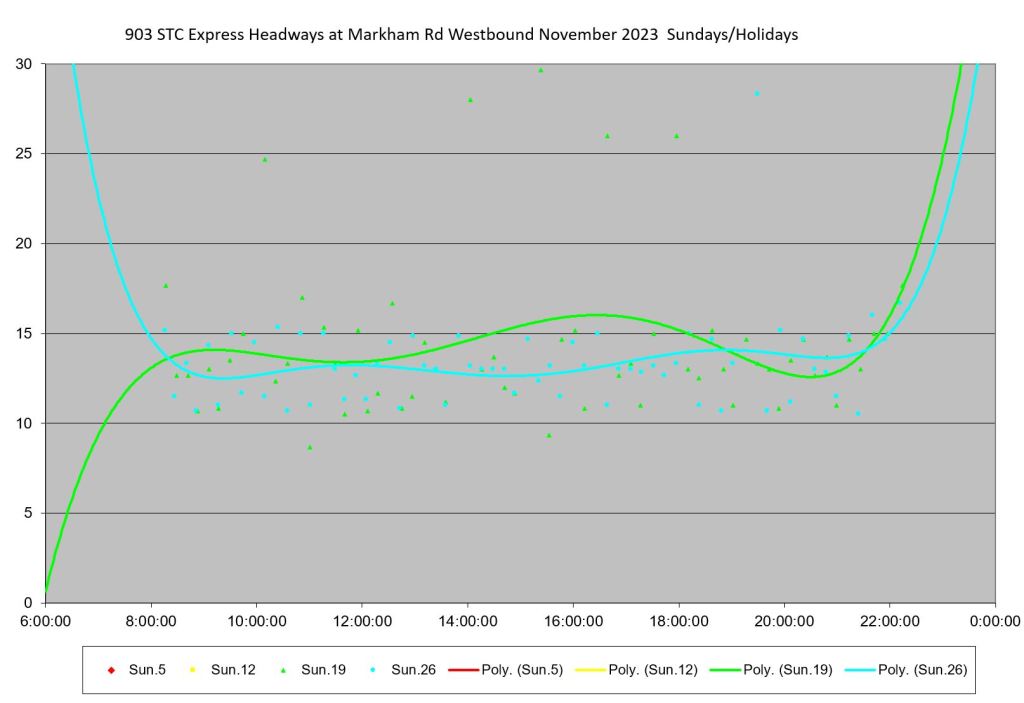
After November 19, the 903 STC Express became more typical of other routes with less frequent service. Variations show up that are similar to other parts of the system. The charts below show headways westbound at Progress and Markham Road, and northbound from Eglinton and Kennedy for the last two weeks of November. The scatter of data points shows the type of service that someone waiting for a 903 bus would experience.

  • Some data are missing on the morning of Friday, November 24.
  • Some of the wider headways (dots higher on the charts) have no correponding short headway (dot near the horizonal axis). This indicates that a bus was missing, as opposed to two buses running close together after a long gap.
  • The weekend charts at the south end of the line include data for the early part of the month when 903 service was much more frequent.
  • Although much of the weekend service stays close to the target headway, there are data points showing wide gaps where a bus was missing from the service. This is a concern for service east of STC to Centennial College.

East End Route Diversion Update

This post consolidates information about the diversions affecting east end bus and streetcar services as a convenience for readers.

Construction projects affecting these routes include:

  • Water main repairs on King between George and Sherbourne. This is a permanent repair for the problem that diverted all service in late October due to a sinkhole.
  • Reconstruction of Broadview Station Loop.
  • Adelaide Street reconstruction for the Ontario Line streetcar diversion.
  • Ontario Line construction at Queen and Yonge.

Routes as of Tuesday, December 5

501D Queen East streetcars run between Neville Loop and Distillery Loop via King west of the Don River. The easiest way to connect with these cars is to take any route headed east out of downtown that goes far enough to make a transfer connection with the 501D. Note that this is tricky at King and Sumach because stops are not well-located for a transfer connection eastbound there.

503 Kingston Road streetcars run between Bingham Loop and (officially) King and Spadina diverting via Queen between the Don River and Church Street. In practice, much of this service turns back via the traditional 503 downtown loop via Church, Wellington and York to King. If you want a 503 eastbound from anywhere west of York, it is best to get on any eastbound service and transfer to the 503 at Bay or Yonge. If you transfer at York, the 503 stops on the SE corner. Note that at Church and King Streets, eastbound 503 streetcars stop on Church just north of King. [Corrected 6:05 pm, Dec 5]

501B Queen buses that run between Bathurst (Wolseley Loop) and Broadview and Gerrard have swapped their route east of Church with the 503 cars. The 501Bs run on King Street, and the 503s run on Queen.

504 King streetcars are all turning back at Church Street looping via Church, Richmond, Victoria and Adelaide because they cannot run east on King.

504/505 King/Dundas shuttles operate from King and Parliament to Broadview and Danforth making on street stops on the NW and SW corners of that intersection. Subway connections are via a walking transfer. These buses continue west across the Viaduct to Castle Frank Station.

Both the 501B and 504/505 buses do not stop eastbound on Queen at Broadview, but instead stop northbound on Broadview beside the parking lot. Westbound buses stop at the usual southbound stop on Broadview at Queen.

504 King shuttles to the Distillery run from a downtown loop of Church, Wellington and York Streets, and they serve the eastbound stops on King at Bay and Yonge Streets, among others. At the Distillery, they are supposed to loop west from Cherry via Mill, Parliament and Front to Cherry. They do not serve Distillery Loop.

508 Lake Shore streetcars normally operate east on King looping via Parliament, Dundas and Broadview. They are diverting via Queen and Church. This is a peak only service.

There is no change to the 505 Dundas streetcars which continue to operate to Woodbine Loop via Gerrard and Coxwell east of Broadview.

Beware of TTC notices posted at stops as they are almost certainly out of date, incomplete or inaccurate thanks to the frequent route changes. There is a particular problem with outdated notices remaining at stops sometimes without a current replacement, or the “new” sign might be found in a different location (pole, transit shelter) than the “old” ones.

King Street water main work is supposed to be completed by the coming weekend, Sunday, December 10, and routes should go back to a somewhat less chaotic arrangement.

Effective Wednesday, December 6

Although Broadview Station Loop is still closed for construction, Broadview Avenue itself is open. Effective December 6, the 62 Mortimer and 8 Broadview bus routes will resume operation on Broadview stopping at Danforth at the NW (southbound) and SE (northbound) corners for subway connections.

These buses will continue south on Broadview to Gerrard, but will run out of service and loop via Gerrard, St. Matthews and Jack Layton Way. Riders making a transfer between these routes and the 504/505 King/Dundas shuttle should note that this does not stop at the same stops as the 8 and 62 buses. Southbound 8/62 riders would get off on the NW corner at Danforth and cross to the SW corner to catch a 504/505. Northbound 504/505 riders would get off on the NW corner (farside) at Danforth and walk back to the SE corner to catch a northbound 8 or 62 bus.

Effective Monday, December 11

For one week, the intersection of Bay and Adelaide will be completely closed to traffic. The TTC has not yet announced diversions for 19 Bay and 501B Queen (eastbound) buses.

Traffic congestion on King will no doubt be even worse during this period.

King Street Travel Times: May-November 2023

This post reviews the evolution of travel times for 504 King streetcars across downtown between Bathurst and Jarvis Streets, the scope of the so-called transit priority zone. There are many problems with how this zone actually operates, but matters reached the meltdown stage in recent months with the combined effect of the Queen Street closure at Yonge for the Ontario Line, the Adelaide Street reconstruction for utilities and an eventual streetcar bypass track for Queen cars, and emergency utility work on King east of Jarvis.

There were other contributors, but there are two important issues. First, everyone assumes that their project won’t bring chaos, often because they only look at local effects for their site (e.g. a new condo construction project with a curb lane occupancy), not for the network as a whole. Second, not only is enforcement of the transit priority rules missing in action, but the added management needed for extra volumes of turning transit vehicles meandering on their temporary routes is also absent.

I recently received the detailed TTC vehicle tracking data for 504 King for November, and have crunched this into a chart that long-time readers will remember from the days when the “King Street Pilot” was in its infancy.

The main set of charts here show travel times for eastbound and westbound streetcars in May through November 2023. Later in the article, there are a few charts to show the historic context for the effects of various changes on King Street over the years.

As in all of these articles about service quality and operations, the data come from the TTC, with much thanks for a long-standing arrangement. The programs to condense the data into manageable charts are all my own, as is the analysis of what they might mean.

Continue reading

Yet Another King Diversion (Updated)

Not long ago, traffic and transit service on King Street were tied in knots thanks to a sinkhole that undermined the track east of Jarvis Street.

Starting Monday, December 4 and running to Sunday, December 10, the diversions are back, albeit in a slightly modified form for water main repairs.

Updated December 4, 2023 at 12:05 pm: The TTC (@TTCNotices on X) advises that there is a hydro cable installation today that runs until 5pm. After that time, the 501D Queen East service will run to Distillery Loop.

Updated December 4, 2023 at 11:20 am: The notice in the “Updates” section of the TTC’s site has been changed to show a December 10 end date. Meanwhile, as of this morning, the 501D Queen East cars are still running to York & Wellington, not to the Distillery Loop as shown on the map below. I suspect this will change as the day wears on and congestion builds up on King Street.

Updated December 3, 2023 at 8:15 pm: In the best TTC tradition there are conflicting notices on their website. Under “Service Changes” this diversion is to end on December 10, but under “Updates” it will only run to December 7. I will attempt to find out which of these is correct, and post an update here.

Apologies for the soft images. This is the condition in which they were published by the TTC on its Service Changes page. Also note that as of December 3, this information is not included on the omnibus Streetcar Service Changes page. Click on any image to open the gallery.

The changes are:

  • 501D Queen East streetcars will only come as far west as Distillery Loop via King.
  • 501B Queen buses which normally run east from downtown via King, Church and Queen to Broadview will instead remain on King Street
  • 503 Kingston Road streetcars will divert from King via Queen between the Don River and Church Street.
  • 504 King streetcars will loop via Church, Richmond, Victoria and Adelaide.
  • 504 King buses will operate from York Street to the Distillery district looping downtown via Church, Wellington and York, and at the Distillery District via Mill, Parliament and Front.
  • 508 Lake Shore streetcars which normally operate on King will divert via Church and Queen to their normal loop at Parliament, Dundas and Broadview.

In other news, Broadview Avenue has opened between Danforth and Pretoria following completion of track and paving work, but transit service has not yet returned to Broadview Station as work on Erindale and in the station is not yet completed. This is expected to change soon, but the TTC has not announced any details.

The intersection of Bay and Adelaide will completely close to traffic between 7am Monday, December 11 and 7am Saturday, December 16 for track installation. Service diversions have not been announced.

There is no word on whether any special effort will be made to unsnarl the intersection of King and Church with the many additional turning transit vehicles. King is already a total mess thanks to the lack of traffic management at University, among other intersections, and the added turns at Church will only compound this. In the following week, with Adelaide completely closed at Bay, traffic on King is likely to be even worse.

TTC Streetcar Overhead Maintenance Audit

At its November 22, 2023 Meeting, the TTC Board received a report and presentation from the Auditor General of the City of Toronto reviewing the Streetcar Overhead Maintenance department. This report was also considered a few days earlier at the TTC’s Audit and Risk Management Committee.

The audit was not complimentary. The Auditor General reviewed activities in 2022, and found that:

  • There were major gaps in the tracking of overhead assets, inspections and repairs.
  • Many processes were manual, paper-based or with limited use of technology such as an Excel spreadsheet to maintain a list of inspection cycles.
  • Inspections that should have occurred on a regular basis (e.g. annually), took place at varying intervals if at all.
  • Formal procedures to specify what constituted an inspection were missing, and the actual work done could vary from one inspection to another.
  • A high proportion of identified defects had no matching completed work orders.
  • The average time-to-repair for those that could be tracked was five weeks – two weeks to generate the corrective maintenance order and three to perform the work.
  • The quality of maintenance varied with multiple corrective maintenance orders for the same asset.
  • There was a lack of root cause analysis to identify and correct common failure types and locations.

Electric track switches repairs (for which the Streetcar Overhead section is responsible) were similarly not reliably tracked. The unreliability of streetcar track switches and resulting operational constraints (slow orders, stop-and-proceed rules) has been an issue for more than a decade. I will return to this later in the article.

The management response went into some detail about the work now in progress to improve the section’s procedures, record keeping and asset management. However, there is an inherent contradiction between the implication that this has been underway for some time, and the fact that the Auditor General’s review cites 2022 data, the most recent complete year, with poor results.

In a telling exchange between the Board and Management, Commissioner Diane Saxe asked if there were other groups within the TTC’s infrastructure maintenance suffering from similar problems. Fort Monaco, Chief of Operations & Infrastructure, replied there about 20 groups of which Streetcar Overhead would be the worst, but it is not the only one with problems. He said that these groups are better now, but there is still work to be done.

Arising from this exchange, Saxe moved that the Board:

Direct staff to report to the Audit & Risk Management Committee by the end of Q2 2024 on the state of preventative maintenance for the overhead system, and that the report include a remediation plan, if required.

Chair Jamaal Myers asked if there were similar issues on Line 3 SRT regarding preventative maintenance and work orders. Monaco replied that one would find a lot of the same thing, and the Subway Track team had just changed from an older Maintenance of Way Information System (MOWIS) to the Maximo system now used by TTC to track assets and maintenance work. Myers asked if staff are confident that SRT derailment was not caused by this, and Monaco replied that it was not caused by the changeover.

(The detailed report on the SRT derailment has still not been released.)

Vice-Chair Joanne De Laurentiis observed that maintenance tracking is a risk issue and would it be useful to have the TTC Audit group look at this in more detail, and then report back to Board. However, no motion to that effect was made and it is unclear what reviews will be conducted on the Board’s behalf.

Management has accepted all of the Auditor General’s findings. Their response can be found beginning on p. 89 of the report linked above (p. 72 within the Auditor General’s report proper).

An important note here is that this audit dealt with ongoing maintenance, not with capital projects. Followers of the streetcar system will know that the conversion from trolley pole to pantograph operation has taken much longer than originally forecast, and this has left the infrastructure in a mixed state for many years. Completion of this work appears to be decades in the future, a figure that is hard to believe unless the true aim is to limit the rate of spending within the overall budget.

Continue reading

Ontario and Toronto Make A Deal

After several weeks of behind-the-scenes discussions between the Ontario and Toronto governments, amid various side-shows such as the Greenbelt scandal, the bribes for planning overrides, the potential destruction of both Ontario Place and the Science Centre, there is a deal, sort of.

In the immediate publicity after the announcement on November 27, the level of information varied depending on which document one read all the way from simple, enthusiastic political statements up to terms sheets and draft legislation.

Toronto comes out of this with a better fiscal situation, including some benefits for transit, but some battles are now over, conceded as part of the deal.

The Rebuilding Ontario Place Act has considerable detail on the redevelopment of Ontario Place, and it is clear that this was not pulled together at the last moment. Although the announcement speaks of design changes and makes passing reference to the Science Centre, neither of these is mentioned in the Act which confers substantial power on the Province to do anything it wants, and compels Toronto to stay out of the way.

The Recovery Through Growth Act, by contrast, is threadbare with only the most cursory provisions recognizing the discussions between Toronto and Ontario, and leaving the bulk of any details to Regulations that might be enacted by the Lieutenant Governor in Council (the Provincial Cabinet).

The new financial arrangements for Toronto extend only three years, roughly until after the next provincial and municipal elections, when the context of any renewal might be different. Meanwhile, the Province and City will “undertake a longer-term targeted review of the City’s finances to be completed by 2026”. [Detailed Term Sheet Cover Letter, p. 2]

Both parties expect added support from the federal government, although the dollar amounts and target projects vary between the City and Province.

The “core commitments” in the Detailed Terms begin with a recognition that housing and transportation are intertwined issues:

Toronto needs to expeditiously streamline and optimize planning approvals and accelerate the delivery of affordable, attainable, and rental housing across the continuum. As density is added, Toronto’s transit and city-enabling infrastructure needs to keep up. The upload of the Gardiner Expressway and the Don Valley Parkway will create significant additional capacity for the City to support building more homes faster in Toronto and across the GTHA.

The City commits to using immediate financial benefits as well as all future financial benefits of the upload (pending Provincial due diligence) to support historic investments in housing and the infrastructure that supports and enables growth such as transit, water and wastewater infrastructure, and local road improvements.

What is needed now from the City is an updated pro forma 2024 budget showing the effects of this agreement. This would inform consultation and debate now in progress leading into the budget cycle at Council.

On the transit front, the entire debate about service restoration and quality must be updated with a sense of the monies that will be available in coming years, and the possible targets Toronto can aim at depending on how much additional support is provided to the TTC.

The following sections are arranged by major topic area and are reordered from the Detailed Terms.

Continue reading