Service Changes for October 18, 2009 (Updated)

Updated August 31, 2009 at 4:10 pm:

In response to questions in the comment thread, I checked with the TTC about two items:

  1. The elimination of premium fares on some express routes has been moved back to June 2010.
  2. Construction of Park Lawn Streetcar Loop is on hold indefinitely due to funding constraints.

Original post:

The following service changes will be implemented, except as noted, for the schedule period beginning Sunday, October 18, 2009. 

Of note here are new express bus services, the split of the 501 Queen car into two separate routes (covered in detail in a separate post), and the restoration of service cuts implemented in February 2009. Continue reading

Queen Car Route Split Effective October 19, 2009

Starting on October 19, 2009, the TTC will experiment with splitting the 501 Queen route into two segments on weekdays only.  The intention is to decouple the outer ends of the line from events that occur on the opposite side of the city, and to provide sufficient flexibility that short turns should not interfere with riders’ ability to use the service.

This will be a trial operation lasting only for the October schedule period (roughly six weeks).  Seven cars will be added to the route during peak periods, with between five and eight additional at other times.  Weekend service is not affected, nor is the operation of the 502/503 routes on Kingston Road.

Two separate services will operate:

  • Neville Loop to Dufferin, looping in the west via Shaw, King and Dufferin.
  • Long Branch Loop and Humber Loop to Broadview, looping in the east via Parliament, Dundas and Broadview.

The eastern route will operate from Russell Division, and the western one from Roncesvalles.  This will eliminate crewing complexities with cars and operators switching between divisions.

Overnight service on the 301 Queen car will be split in the same manner, but cars will be scheduled to connect.  This arrangement will result in scheduled pairs of cars on the common section, a rather odd configuration.

The Neville-Dufferin branch will operate with the following headways:

  • AM Peak: 7’15”
  • Midday: 7’30”
  • PM Peak:  7’15”
  • Early Evening: 8’00”
  • Late Evening:  9’30”

The Humber-Broadview branch will operate with the following headways (service to Long Branch in parentheses):

  • AM Peak: 5’30” (11′)
  • Midday:  6’15” (12’30”)
  • PM Peak:  6’30” (13′)
  • Early Evening: 7’30” (15′)
  • Late Evening: 9’30” (19′)

By comparison, scheduled service for September 2009 is:

  • AM Peak: 5’10” (10’20”)
  • Midday: 5’53” (11’45”)
  • PM Peak: 5’40” (11’20”)
  • Early Evening: 6’45” (13’30”)
  • Late Evening: 10′ (20′)

If the new service is closer to schedule than the old one, then service should be improved even though scheduled headways on the outer ends of the route are slightly wider.  

Headways on the two halves of the route are, except for the overnight operation, different and there is no attempt to produce a blended operation in the central part of the route.  It will be interesting to see how many cars run in pairs by coming out of Dufferin or Broadview immediately behind a through car.  This is a challenge for TTC line management, and could defeat the benefit of the overlapped service between Broadview and Dufferin.

The considerable overlap of the two routes provides continuity even if either of them needs to be short turned.  Westbound cars from Neville could short turn at Bathurst or at McCaul while still serving downtown and connecting with the through service to the west end.  Eastbound cars from Humber could short turn at Church.  A shorter overlap would have almost guaranteed that many cars would never serve the major downtown stops or connect with their counterparts for through service.

Although all cars will pass through the congested section between University and Bathurst, short turns will be possible without eliminating connections, and the need for short turns at the outer ends of the line should be reduced.  This will bear watching.

Transit City Bus Plan: Surface Routes Matter (Update 2)

Updated August 28, 2008 at 8:15 pm:

At its meeting on August 26, the TTC adopted the Transit City Bus Plan with a few amendments:

  • There will be a 6-month communication and consultation period  regarding the proposed plan.
  • Staff will report back on criteria for inclusion of routes in the plan so that these can become part of the formal Service Standards policy.
  • Staff will report back on headway-based rather than schedule-based management of routes with frequent service including those in the Plan.

As I was out of town for this meeting, my comments were submitted as a written deputation.

Updated August 23, 2008 at 8:45 am:

I have added information at the end of this article about streetcar and bus route headways illustrating some of the issues raised here.

Original article:

Today, the TTC published its Transit City Bus Plan, the next step in an ongoing attempt to focus attention on the transit system overall, not just the subway projects.

I would like to report wild enthusiasm about this plan, but we will have to drop the “wild” part, and think of enthusiasm tempered by disappointment.  The TTC is headed in the right direction, but with compromises.  In a constrained economy, compromises are necessary, but so are the bolder strokes giving politicians and the public at least the option of moving faster should they wish to.  That was the whole concept of the Ridership Growth Strategy (RGS) to which the bus plan is a successor.

The report linked above contains both an Executive Summary and a detailed set of proposals.  I will skip over the summary and comment on the main report. Continue reading

Why Streetcars?

Tom Jurenka sent in the following note, and it raises questions that deserve a debate.

Hello Steve

As a non-native Torontonian (grew up in Winnipeg, but have lived in Toronto for 24 years now) I have always been puzzled — and often infuriated — by streetcars (and the absolutely terrible traffic light timing in Toronto, but that is another story).

My question is an honest one — WHY? All I can see is the negatives of streetcars:

  • they tear up streets (I’ve lived through Queen Street E, Gerrard, now St. Clair, being torn up utterly to undo the damage of streetcars pounding the rails)
  • they are slow as molasses (as a bicyclist, I routinely pass 5 or 6 streetcars on Queen Street heading from AC Harris to downtown)
  • because of their slowness and immobility they delay traffic all the time, causing snarls and the attendant idling pollution
  • they are super expensive (witness the recent funding mess)

So I’m really curious why streetcars are a better alternative to trolley buses or just plain old buses, which move fast, are mobile, and are less expensive per unit to buy. Would you be able to point me at some links/articles/studies/whatever to help me understand this issue?

Thank you for your time.

Best regards,

Tom Jurenka

This is a far more complex question than just the list above, but I will use this as a jumping off point. Continue reading

Service Changes Effective August 2, 2009

For mid summer, there are only a few schedule changes on the TTC network, and they take effect at the start of August running through to Labour Day weekend.

Changes for September are much more extensive, and I will deal with these in a separate post.

Bingham Loop Reconstruction

Due to the reconstruction of Bingham Loop, routes 502 Downtowner and 503 Kingston Road Tripper will be replaced by buses.  Combined streetcar service of 7’30” will be replaced by bus service of 6’00”.  The off-peak 20’00” headway is unchanged.

Diversions at Bingham Loop will change from time to time as construction progresses.  This also affects the 22A Coxwell, 12 Kingston Road, 322 Coxwell and 324 Victoria Park Night Buses.

Roncesvalles Reconstruction

Running times on the Roncesvalles shuttle bus will be increased at some times to compensate for actual start of construction and the diversion of southbound service via Dundas, Lansdowne and Queen.

501 Queen

The test of a modified step-back crewing operation will end, and normal crewing will resume on this route.

77 Swansea & 71 Runnymede

Running times on these interlined routes will be increased.  In the AM peak and midday, this will be done by reducing recovery times scheduled at terminals.  In the PM peak and evening, headways will be increased.  PM peak headways on the common section of the route will go from 10′ to 11′ with a change from 20′ to 22′ on the Runnymede branches.  A similar change will occur in the early evening, but at that time only half of the service runs south of Bloor.

Caribana

Additional service will operate for the parade on Saturday, August 1 on 511 Bathurst, 509 Harbourfront and 29 Dufferin, as well as express buses from Keele, Dundas West and Lansdowne Stations.  The 329/316 night routes will divert around the CNE grounds as described in the next section.

Additional service on 509 Harbourfront, 510 Spadina and 6 Bay is also planned for the Sunday, August 2 events on Toronto Island.  Whether these will actually occur given that the civic strike has shut down the ferries remains to be seen.  All of the added service is operated “at the divisional level”, meaning that the work is easily cancelled or reassigned if the party ends up at a new location.

Canadian National Exhibition

Additional service will operate on all of the usual routes including 511 Bathurst, 509 Harbourfront, 193 Exhibition Rocket and 29 Dufferin.  Overnight service on interlined routes 329 Dufferin and 316 Ossington will not operate through the CNE grounds, but will connect via Fraser and Liberty.

Queen’s Park Reveals Metrolinx’ Role

My thanks to Peter Miasek who sent me the link to this item on York Region’s website.

Recently, Ontario’s Deputy Minister of Transportation, Bruce McQuaig, wrote to York Region advising on the financial and operational framework for “designated projects” as defined in the recently enacted Metrolinx legislation.  This letter can be found among several pieces of correspondence bundled into one PDF starting on pages 12-16.

I understand that a similar letter went to the City of Toronto, but it has not yet appeared in any public debates, partly because there are so few of them currently.  It is alluded to in a TTC report on Transit City funding.

The scheme begins with a desire by Queen’s Park to bring its books into line with current accepted accounting principles.  What this means, in practice, is that instead of shipping money off to York Region and Toronto, never to be seen again except as part of the Provincial Debt, Ontario will now own the assets purchased with those funds.  Nothing in the letter explains how those portions of projects funded by others such as Ottawa would be treated, nor what would happen with extensions of existing lines owned municipally like the Yonge-University Subway.

The assets would be depreciated over their expected lifetimes and would show up as an offset on the provincial books to the debt raised to fund them.  This is a neat bit of accounting that ignores the fact that an asset only has a real value if you could sell it and recapture your investment, but it keeps the bean counters happy and makes the books look better for the politicians.  To quote the letter:

Through retaining the risks and rewards of asset ownership over regional transportation assets, the Province can best achieve its accounting and financial management objectives.

This, of course, has nothing to do with transit and could equally refer to a hospital, a school or a highway.

There are some fine words about partnerships with the municipal governments coupled with concern about “value-for-money to taxpayers and transit customers”.  Then we get into the details.

Ontario, through Metrolinx, will own and control the Sheppard LRT, Eglinton LRT, Finch LRT, Scarborough RT and VIVA Next Bus Rapid Transit.  Ownership, from an accounting point of view, requires control and this means that Queen’s Park can’t just build the lines, they have to actually appear to manage them rather than effectively ceding them to municipalities via a long-term lease.  This does not prevent Metrolinx from contracting with local agencies for construction, operation and maintenance, but on paper, the lines remain Queen’s Park’s property, and they could be assigned to some other entity if they chose to do so.

Terms of any operating agreement would be set at 75% or less than the expected lifespan of the asset so that, in a worst case scenario, Metrolinx would regain control of a line before it was run into the ground.  A great deal of legal verbiage must be created to define the criteria to which local agencies (or any private entity) will be held by Metrolinx.  This strikes me as an opportunity for a huge bureaucratic waste of time especially if all parties involved are in the public sector.

Metrolinx will define project scope, budgets and schedules, and any changes will require their approval.  Given the total absence of political input from the municipal level to Metrolinx, these discussions will likely happen in private.  Of note is the exclusion for Metrolinx funding of ancilliary upgrades to utilities, streetscaping, etc. that are thought to be add-ons of convenience for a municipality rather than an integral part of a transit project.  It will be interesting to see what standards Metrolinx defines as the “basic” level it will fund, and how much will fall on municipal budgets.

Queen’s Park wants transit riders to “experience the benefits of a regionally integrated and inter-operable system”, and the Presto fare card will be a requirement for all of the designated lines.  In a telling comment, the Deputy Minister states:

 … the Province and Metrolinx will … monitor the evolution of technologies, and will consider how to plan for enhancements and improvements as part of an overall strategy to sustain the Presto electronic fare collection system.

“Evolution” will no doubt include a recognition that this is not a situation where Ontario should develop or adapt a proprietary technology, but should work with internationally recognized electronic payment standards and systems.  The time is long past when Ontario could get away with building “roll your own” systems, and they need to look at the extensive experience in other jurisdictions.

While Metrolinx is working on the benefits of a regional service, they will also need to address the integration of GO Transit fares and service into the wider regional system.  GO, as a separate entity, has remained aloof from regional integration except as it suits them with cost sharing arranements in 905 municipalities.  These arrangements are to GO’s advantage because the joint fares with local operators are much cheaper than the cost and development effects of building more parking at stations.

Finally, Infrastructure Ontario will act on Metrolinx’ behalf for projects that are to use Alternative Financing and Procurement (AFP).  This is a variation on a PPP in which the asset may actually be built and held by a private company and leased to Metrolinx.  The accounting fig leaves are thick on the ground here.  One way or another, Ontario borrows money, Metrolinx builds something (or has it built for them), and, likely, the local operating agency contracts to run it.

Lurking under all of this is a clear indication that it is Queen’s Park, not the Metrolinx Board of Directors, who runs the show.  To be fair, it is their money (or more accurately our money), but the opportunities for interference and sheer bureaucratic incompetence are legion.  There’s a reason transit has been in local hands for decades — the Ministry of Transportation hasn’t the first idea how to operate large systems, nor any feeling for the local issues involved.

Metrolinx itself becomes little more than a construction planning and, later, a holding company on the Province’s behalf.  This should not overly tax the skills of the new, non-political Board, for whom all of the important decisions will be made elsewhere.

How Many Streetcars Do We Need?

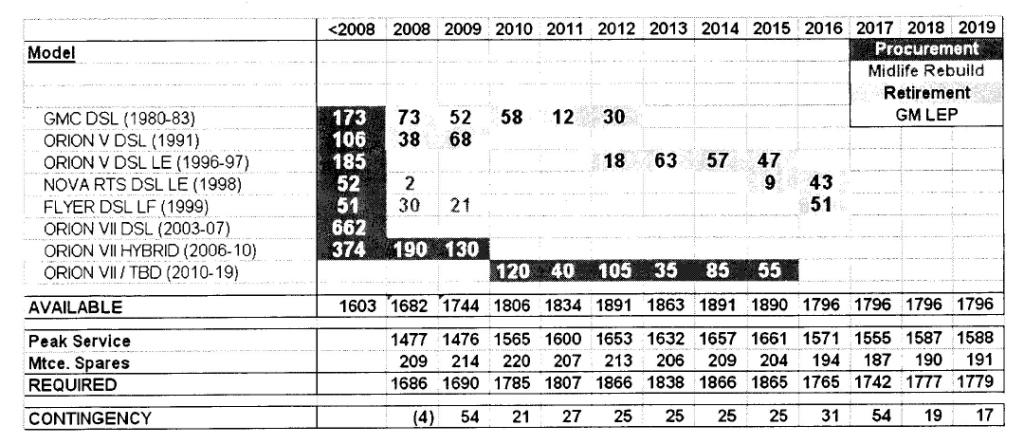
Recent comments by Adam Giambrone, Chair of the TTC, suggest that 30 to 40 percent of the streetcar fleet is out of service in the shops, and that bus substitution will be required on some routes come the fall.

Those of us who follow the TTC have been waiting for a definitive fleet plan for some time, and hope to see one, finally, in the July Commission Meeting Agenda.  Meanwhile, I thought that I would set the stage by reviewing the current scheduled service to see how it may evolve over coming months.

The fleet contains 195 CLRVs (one of the original 196 has been scrapped) and 52 ALRVs.  The scheduled service beginning June 21 is 123 CLRVs and 38 ALRVs.  This is 63% of the CLRV fleet and 73% of the ALRV fleet.

Peak AM requirements by route are:  Bathurst (9), Carlton (32), Dundas (14), Queen (31 ALRV), Lake Shore (3), Downtowner and Kingston Road (11), King (27 CLRV + 7 ALRV), Spadina (15), Harbourfront (6), St. Clair (6).

What we don’t know is the number of cars that are permanently out of service with problems that cannot be or are too expensive to fix.  In effect, we don’t know what the true size of the available fleet might be.  A CLRV overhaul program is in progress (the affected cars are those with the new entrance layout and revised rear seating), but this is not as extensive as the original plans to replace major subsystems such as the electronics package.  This program takes some number of cars out of the pool, but should gradually replenish the fleet.  We don’t know how quickly this is happening, nor how reliable the “new” cars are.

In August, peak requirements will drop by another 11 cars when the 502/503 routes are converted to bus operation, although this will be offset in the fall when the 505/506 routes revert to their standard arrangement in the west end.  The May schedules for these routes required 53 cars in the AM peak compared to 46 today.  A further 9 cars will be needed to restore the 504 King line to its May schedule.

Late in 2009, the 512 St. Clair line’s service will be restored at least to Oakwood, later to Lansdowne.  However, this route is now using a captive pool of cars trapped north of the underpass work at Dupont and Bathurst, and there are, I believe, enough cars in that pool to handle this extension (combined with appropriate schedules where cars spend more time in motion than laying over at terminals).

The TTC needs to explain how it plans to manage streetcar service over the next three years, not to mention service improvements for capacity and the commencement of service in the eastern waterfront.  How long will new streetcars simply make up for failing CLRVs and ALRVs rather than contributing net new capacity to the network?

Service Changes Effective June 21, 2009 (Updated)

Updated:  The Service Summary is now available online.

The June/July schedule board period will bring many seasonal cuts to transit service on the TTC.  I will not list all of them, but the real issue will be to see whether they are reversed in the fall.  A few cuts in this round are identified as a response to budget concerns (see my previous article about Metropass use and its effect on revenues).  If this is just reasonable belt-tightening, that’s just good management.  If this is a return to the bad days of stealth service cuts even while riding grows, the TTC is in for problems. Continue reading

TTC Ridership, Budgets and Those Pesky Metropass Users

This week, the TTC announced that it has record ridership for the past twelve months of 470.8-million.  This continues an upward trend from last year, and indicates that TTC demand may be insulated from the effects of the economic downturn.  Possibly a shift from auto to transit riding is offsetting any reduction in employment or recreational traffic.

The Chief General Manager’s Report for the first quarter of 2009 notes that although ridership continues to grow, revenue is below budget.  Why?  More Metropasses were sold than expected in January-March, and this trend is continuing into the second quarter.  The TTC had budgeted on a higher average fare-per-ride, and the more who travel with passes, the lower this average falls.

Rumours of budget related service cuts started to surface a few weeks ago, and one change effective June 21 is explicitly listed as being due to budget.  (I will report on that in a separate post on June service changes.)  This is an odd state of affairs considering that there is a buffer for service growth on the TTC”s budget, and there has been no report to the Commission of pending service cuts (or of deferred service improvements).

Moreover, in a separate report, the TTC plans to launch an ad campaign seeking organizations to be part of a Metropass Affinity Program where pass holders would receive discounts to products or events.  The intention is, wait for it, to sell more Metropasses by making them even more attractive.

The TTC has a long-standing love-hate relationship with the Metropass going right back to its origins 29 years ago.  Each pass is seen, by some, as a loss of revenue, a loss of individual fares that might otherwise be collected.  Of course, a pass is also an incentive for users to ride the system and get all those “free” extra trips, exactly the sort of mindset an auto driver operates in every day.

Those 260,000 monthly pass holders are now responsible for over half of the adult trips on the TTC.  Budgets and fare policies must recognize that there is a demand for flat rate purchase of transit services, and that this market will grow both through pricing incentives and improved service.  Cutbacks because too many people buy passes are a laughable, but unfortunately predictable response to what should be a transit success story.

Who Pays for Transit?

Every so often, the question of subsidies shows up in comment threads here.  My usual explanation is “well, it depends, and it’s complicated”.

For those of you who want to see just how complicated, you can look at the TTC’s draft financial statements for 2008.  Scroll down to Notes 12 and 13 which detail where the operating subsidies come from and go to, and in much more excruciating detail, how the capital subsidies work.

This is a testimonial to the madness of project-based, partisan announcements.  Every government has to come up with its own program.  Even if an old one worked, we need a new one clothed in new party colours.  All of this takes a lot of accounting just to keep track that monies received are spent on only those projects for which they were announced.  Perish the thought that a Tory Blue dollar might accidently wind up paying for a Liberal Red bus, or that money intended for “Green” programs simply pays for keeping the transit system going.

We hear a lot from governments about getting out of the way of private business, of simplifying regulations and reporting because this is a huge burden on the private sector.  Canada’s competitiveness depends on the simplest and shortest rules possible.  The concept has not yet reached public sector regulation where the intent seems to be to strangle any ability to use funding productively and quickly.