The Mysterious GTA Pass [Updated]

[This piece has been updated to correct information about the tax deductibility of weekly passes.  Some comments in this thread will reflect the original version of the post that didn’t include take this into account in price comparisons.] 

Cynthia Cheng wrote to me recently:

I know plenty of people who don’t even realize that GTA passes exist and are paying two or more fares to get to and from work, school, etc. I am sure that if enough people know about it, then perhaps we’ll have monthly passes rather than weekly and perhaps more outlets would sell them. Do you know why this is?

A while ago, I had written about the demise of the GO/TTC Twin Pass thanks to GO-Transit’s refusal to pay its share of the $10-subsidy built into the pass.

There is, however, a GTA Pass that costs $43/week.  The only place it seems to be advertised in Toronto is on a pulldown on the TTC website for the various types of fares and passes.  It is not on the TTC fare card, nor is it on the VIVA farecard.

I had lots of time to contemplate this today while I languished in Don Mills Station waiting 22 minutes for the nominally 15-minute headway on the 190 Rocket to STC.  In vain did I search for any mention of the GTA pass on TTC or VIVA displays.

According to the web page, I can even buy one of these mystery passes at Don Mills Station.  The only problem is, I cannot do this in the bus loop, but at the collector’s booth which is somewhere else, I am sure, but not on the path I take from the Sheppard Subway train to the buses.  [In one of the comments below, directions to this booth were provided.]  I could also do this at STC station where the bus/RT interchange actually passes through the same space as the collector’s booth.

But would I want to buy this pass?  What does it offer me?  If I am a 10-trip-a-week person, my TTC fares at ticket rate would cost $21, compared with $30 for a TTC weekly pass.  That pass is tax deductible only if I buy 4 a month, and there is no bulk buy discount because, obviously, if I wanted that I would be in the Metropass Discount Program.

Meanwhile, over in Mississauga, I could pay $22 for 10 tickets or $23 for a weekly pass.  This means that a GTA pass equals the combined cost of 10 trips at ticket rate on the TTC and Mississauga Transit, and I can get a combined pass for the TTC and other GTA systems for only $13 more than a TTC-only weekly pass.

If we were pricing things the same way for monthly passes, the equivalent cost would be $143 assuming no discount for bulk purchase, but eligible for a tax refund of roughly $21 for a net cost of $122.

As things stand, I can pay $172 for four weeks’ worth of GTA passes, or buy a monthly pass for both systems.  The after-tax cost of the weekly passes is $146.20.  This is cheaper than buying monthly passes for the TTC and Mississauga Transit separately, about $166 net of the tax rebate, or $159 if I buy TTC passes on the discount program.

The situation is comparable for other GTA systems combined with the TTC.

This is a good example of how fare structures can be bastardized depending on what one is trying to achieve, not to mention the marketing issue that this is an almost unknown type of fare.  Given the discount, I’m not surprised they hide it!

Integrating fare systems where there are existing deep discounts for certain types of usage will be a real challenge.  Once we eliminate the artificial barrier between the 416 and 905, what should the fare be?  What should passes cost?

Passes, Smart Cards, Fare Zones and the GTTA

I received the following note from Miroslav Glavic:

I am reading Metropass Triumphs! and I have a question or two, and a few more…

I personally think there should be ONE transit agency for the GTAH (up to Barrie, then east to Oshawa and west to Hamilton).

Smart cards are nice, I love my metropass, when I want to go to SQ1 (I live in Scarborough), I have to get out my metropass (which I love and have been getting for years now), then get out the change and pay.  One card would be nice, I go to Seneca College, Seneca@York campus, I can use my ONE CARD (ID card) in all of their campuses, take out book in all the campuses libraries and so forth.  Something like that for the GTAH would be nice.

Now to the non-universal fares…

Let’s say we go to the Toronto Zoo and after a day of visiting the animals (my favourite is the Gorillas, what’s yours?), I go to Fairview Mall, you go to the airport, we both put [in] $2.75.  Do you think it’s fair that it is the same fare?

In London, I went from Heathrow station to Charing Cross (via Picadilly Circus station), I went through most of their fare areas).

What if you went from Don Mills Station to Victoria Park Avenue/Sheppard?  Do you think it is fair to pay $2.75 to go 5 stops? (or 1 direct stop with the 190).  You can go from Don Mills Station to anywhere in the city for $2.75.

What if the TTC had fare zones? (yes it would get people a while to get adjusted), by the way London has a monthly pass as well.

Let’s go back to the example about the Zoo, what if to Fairview Mall it was $3.00 then to the airport was $6.00?.

The way it works in London is that you put the ticket/card (like a smaller metropass, made out of paper/cardboard material), and out it comes from the other side, imagine like the reader for metropasses, then when you get out from your end station you do the same, I guess it will deny you exit or something like that.  I am sure there is a way to implement this to use on buses and streetcars.

The TTC would have get a lot more money which it needs.

I am using cash fares for my examples, but there would still be one price for metropasses.

Steve:  I don’t go to the Zoo, but have dropped in on the Royal Winter Fair where my favourites are the swine.

The use of cash fares skews the argument badly.  One huge advantage of the Metropass is that people don’t pay individually for each trip they take.  Saying that it’s unfair that a ride two stops on the subway costs the same as a ride to the airport misses the point that with a pass, the fare is not charged for either trip, but for transit usage in general.  One big reason I posted Metropass Triumphs! is that we now have more than half of TTC rides taken by people who don’t have to think about reaching into their pocket for change or resenting the cost of individual trips.

Turning to Zone Fares, Toronto had them until 1972 when they were eliminated by the suburban members of Metro Council.  Their argument was that suburban taxes paid to support the TTC, and suburban riders should pay the same amount as their city counterparts.  Any attempt to re-introduce zones, at least within the 416, would meet with strong opposition and would, I feel, be counterproductive.  With a flat fare Metropass, we make the system appealing wherever one is travelling, and it is simple to administer.  Zones just complicate things and undo some of the benefits of the flat fare. 

The claim that the TTC would get much more revenue means that, one way or another, someone pays more for their trip.  On a zone basis, long trips are penalized, and yet it is these very trips that are the most difficult to attract to transit.  How would the good folks of Vaughan or the students at York U feel if we told them that their brand new subway was going to be in Zone 2 or 3, and that it would cost extra to come downtown?  “We spend billions to build this thing and now you want us to pay an extra fare?”

I am already on record as opposing zone fares even if we extend the fare structure to the entire GTA.  Yes, that will cost money, but it will save us a fortune on expensive fare collection technology and on endless squabbling about where the fare boundaries should be.  The option of a premium fare for GO Transit still remains because it is a fundamentally different class of service, but at least the same pass would be valid on local systems at both ends of the trip.

The current estimate of implementation costs for the TTC is in the range of $140-million, with an ongoing maintenance and support cost of $10-million or more for a the GTA Smart Card system.  Do we really need to spend this much money to replace a system that works today?

What, exactly, is the supposed benefit of a Smart Card?  If the purpose is to allow us to divvy up fare revenue among GTA agencies, isn’t that a bureaucratic exercise, a matter of turf protection, rather than of providing good transit service?  I am not advocating elimination of local transit operators, but must ask if there were already one big transit system, would concerns about revenue sharing and division even exist as a justification for Smart Cards?

Metropass Triumphs!

An important statistic came out quietly at the TTC meeting this week:

This year, for the first time, more than half of all adult rides will be taken using the Metropass.  Tickets, tokens and cash share the remainder.

Metropass usage is up almost 25% over 2006 thanks to its new transferability and tax deductibility.  The pass now has broad appeal to regular transit users rather than only for the heavy users who make numerous personal trips in additional to regular work trips via TTC.

Advocates for a new unified “smart” farecard should take note:  the Metropass is hugely popular as an “all you can eat” way of purchasing transit services.  Any new fare structure that eliminates this option, or attempts to rebalance the pass pricing upward, will meet stiff opposition. 

Moreover, elaborate fare schemes requiring detailed tracking of passengers and some form of fare-by-distance calculation are doomed on at least two counts.  First, they will incur substantial additional cost to track rides and reconcile fares.  Second, if the resultant charges don’t lie in the realm of current pass pricing, they will destroy the very incentive to transit use the Metropass represents — no marginal cost for any trip and no need to plan trips to minimize transfer or stopover charges.

The one downside to Metropass growth is that the average fare per trip is falling.  This is not surprising, but the rate of shift to passes means that total revenue is at best level if not slightly down despite continued growth in demand.  This will lead eventually to an important debate about how we “sell” transit service.

The historic model of one fare for each trip is meaningless, now, for a majority of rides.  Transit will be a bulk service purchased the same way people pay for many utilities, paying for its availability, not for the amount consumed.  Service and budget planning will also be affected, and we should return to the era when decisions about service quantity were based on demand, not on running as little as possible to get by.

Ridership Growth Strategy for the Island Ferries

The April 10th meeting of Toronto’s Parks and Environment Committee will consider a proposal to give two-for-one fares for adults travelling on the ferries between 5 and 9 pm (except for special event days on holidays and weekends) from the Victoria Day to the Labour Day weekend.

Most people leave the island in the late afternoon after a hard day at the beach.  The Parks Department reckons that there is a growing population who live downtown near the ferry docks for whom the island could be a welcome evening spot.  The ferries are running with available capacity, and the cheaper fares are not expected to cost the city anything.

Fortunately, the GTTA has yet to demand that total fare integration be provided so that a rider can board a GO Train in Barrie and travel seamlessly to Hanlan’s Point.

Budget Proposes Changes to Transit Tax Credits

The following text is taken from the budget announcement.  You will have to scroll down to find this heading because the page is not indexed.

Public Transit Tax Credit

Budget 2006 proposed a non-refundable public transit tax credit for the cost of monthly public transit passes starting July 1, 2006. Budget 2007 proposes to strengthen this measure on two fronts.

Electronic Payment Cards

Since the introduction of this credit, several transit authorities have developed proposals for the introduction of cost-per-trip electronic payment cards. The requirements for the existing credit do not accommodate these proposed cards.

Budget 2007 proposes to extend the eligibility for the public transit tax credit to accommodate these electronic payment cards. Under this proposal, the cost of an electronic payment card will be eligible for the credit if:

  • the cost relates to the use of public transit for at least 32 one-way trips during an uninterrupted period not exceeding 31 days, and
  • that transit usage, and cost of those trips, are recorded and receipted to the purchaser by the relevant transit authority, in sufficient detail as to allow the Canada Revenue Agency to verify eligibility for the credit.

A one-way trip will consist of an uninterrupted trip between the place of origin of the trip and the destination.

This measure will apply to electronic payment cards issued after 2006.

Weekly Passes

There may be instances where low-income individuals are unable to afford the financial outlay associated with purchasing a monthly pass. Even though they are regular transit riders, they may purchase a series of weekly passes.

Budget 2007 proposes to extend eligibility for the public transit tax credit to accommodate weekly passes where an individual purchases at least four consecutive weekly passes. For the purposes of this measure, weekly passes will include passes that provide a passholder the right to unlimited public transit use within a period of between 5 and 7 days.

Individuals making claims will be required to retain their receipts or passes for verification purposes.

This measure will apply to weekly passes valid for use after 2006.

I am not quite sure how the first measure will actually be implemented because the most likely way a Smart Card will work will be to operate as a limited-time pass.  In effect, you get to ride for some period of time within some bounded area.  This is necessary because the computing and monitoring required to figure out when one “trip” ends and another “begins” is quite daunting in a free-transfer system like the TTC.  Such a capability would significantly increase costs and raise concerns about trip monitoring as an invasion of privacy.

Making Weekly Passes part of this scheme is a welcome and overdue addition.  Now, can we look forward to multiple-trip fare media such as GO’s 10-trip tickets?

Going, Going, Gone

I received the following note from a reader here, and this prompted me to dive into the archives. 

Hi Steve,

Do you know if the old TTC tokens have been redesigned since the 1950s?  I have a token that looks completely different from any of the tokens currently in use (with the TTC coat of arms etc; not the bimetallic ones).  It simply says “Toronto Transit Commission” around the edge and the word “Subway” across the middle.  Could this be a very old token or is it a fake?

Thanks,
Arthur

This is an older type of token.  The illustration below (click to open the larger version) contains three token holders of various vintages in the form that tokens were then sold.  There are both the 6/$1 and 5/$1 version dating from the late 1960s, as well as a single token holder that was a complimentary “first day cover” for the Bloor-Danforth subway.  Note that this last one is a brass token, the format used for single-token sales.

If you look at the regular tokens, you will see that they match the one you have.

Old Token Holders

Why stop at 1966, I thought.  Let’s go back a bit further.  The next pair of images are front and back scans of some pre-TTC fare media.

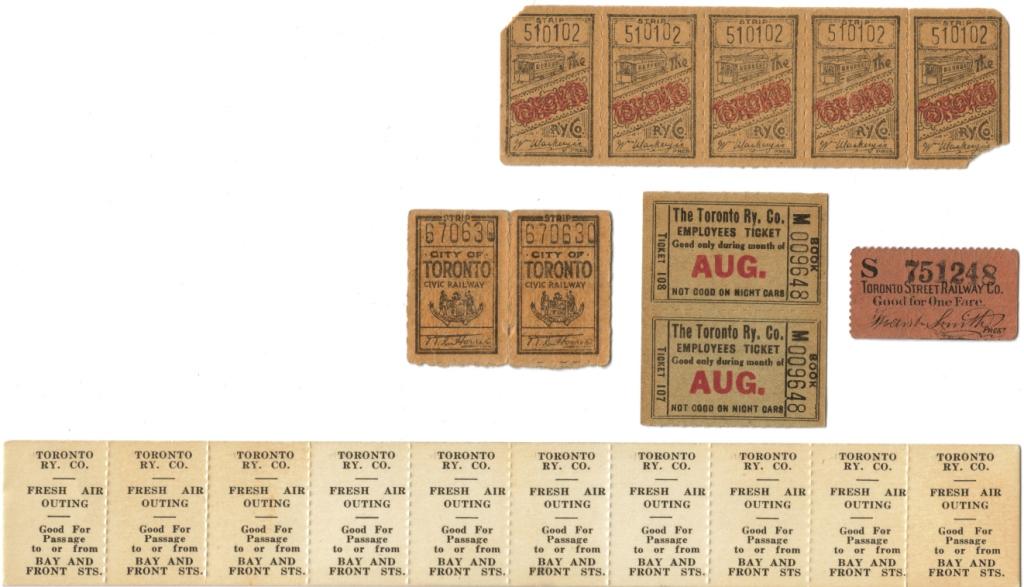
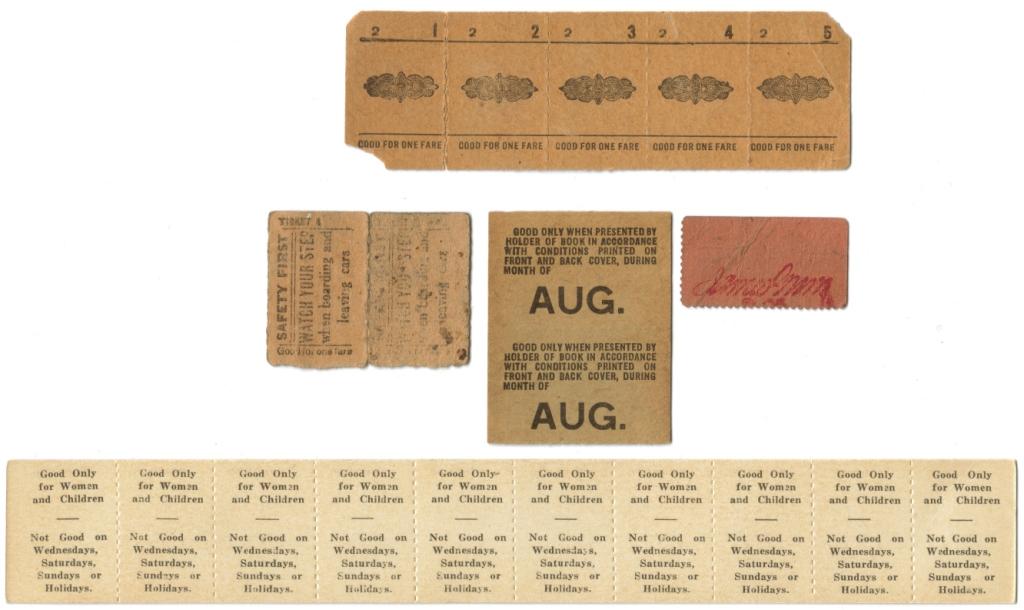
The red ticket is from the Toronto Street Railway.  The TSR was replaced by the Toronto Railway Company in 1891, and by 1911 when the TRC refused to extend its network, the city set up its own company, the Toronto Civic Railway.  These two, plus other bits and pieces, merged into the TTC in 1921.

The TRC tickets are interesting for a number of reasons.  First is the little picture of the electric trolley car.  The TRC was granted its franchise with the express purpose of electrifying the street railway, and so an electric car was central to their purpose.  Next, you will see that there were special tickets for employees that had restrictions on time of use.  Finally, there is the strip of Ferry Service tickets good only for women and children travelling to the docks (note that the service did not yet cross south of the railway corridor, and the destination is Bay and Front).

Old Tickets Front

Old Tickets Back

TTC Meeting Wrapup: December 13, 2006

The first full meeting of the new Moscoe-less TTC took place on Wednesday.  Nothing was particularly astonishing.  Like all first meetings, we watched as the newcomers found their way around the agenda and the complexity of what’s going on.  One can only hope that new Commissioners will learn to address issues rather than making speeches.

To his credit, the new Chair Adam Giambrone stayed on top of the agenda and moved business along as briskly as possible without visibly throttling debate.  A few delicate interventions framing the sense of the meeting in a motion rescued us all from interminable rambling.

Meanwhile on the agenda: Continue reading

Fare Boundary Woes

I received the following comment from a student at Ryerson, and thought it would be a good jumping off point for a new thread.

Hello,
This is more of a question rather than a comment.

I am an Engineering student at Ryerson University working on a report for my Technical Communications class.  I chose to write my report on: the inconvenience it is for students commuting from Brampton/Mississauga area, cost wise.

It is financially hard for students to pay for:

  • The local transit to get to the GO station.
  • The monthly GO pass and
  • The TTC fare from Union Station to Dundas.

And not to mention the time that is consumed commuting.  I was wondering if these issues have been discussed before with TTC and GO authorities.  Would anyone of you know the status of the situation?  Are there any documents or online resources that discuss this in detail?

If they have not been discussed before, what are your views on this topic?  Any help on your behalf is much appreciated.

Sincerely,
Mon.

There are a number of intertwined issues here. Continue reading

Proof of Payment and Service Quality

Proof of payment fare collection has been in place, officially, since 1990 on the Queen route.  All riders are expected to have a valid pass or transfer and in return they can board at all doors.  Riders who pay a fare when they board are given a transfer in case a POP inspector comes by. 

This setup allows all-door loading at major stops, shortens the time lost to boarding and gives a better distribution of passengers through the cars.  This is important on the ALRVs which ply Queen Street.

In practice, this does not happen very often.  Moreover, many operators don’t open all doors at most stops and the benefit of POP is lost.

A report on the TTC’s agenda discusses the history of POP, the benefits of the system and its future on the TTC streetcar system.  Continue reading