Toronto’s Network Plan 2031: Part III, Fare Integration

This article is the third installment of my examination of reports going to Toronto Executive Committee and to the Metrolinx Board on June 28, 2016. For a complete list, see Part I of this series.

This article deals with two separate reports from the City of Toronto and from Metrolinx about Fare Integration. These two reports have quite different outlooks. For Metrolinx, there is an acknowledgement that any new fare policy will be difficult, but a determination to stay the course with their work plan and fare models. For Toronto, the focus is on the inequity of short versus medium and long-distance GO fares (a problem not just for Toronto as a node), and on the changes needed for GO to become more than a 905-to-Union Station commuter railway.

Additional material comes from the Metrolinx Fare Integration Advocacy Groups & Academics’ Workshop held on June 24, 2016. Presentations from this workshop are not yet online.

Continue reading

Toronto’s Network Plan 2031: Part I, SmartTrack

For the past months, Toronto Planning, the TTC and Metrolinx have hosted a number of public consultation sessions leading up to two critical meetings on the same day: June 28, 2016.

One will be the Toronto Executive Committee’s consideration of a series of reports on various transit proposals.

The other will be the Metrolinx Board’s first meeting in four months with several related items on the agenda.

Reviewing all of this material will require several article that I hope to finish before the meetings where these issues will be discussed actually occur.

Here I will begin with SmartTrack because of all of the proposals, that has been the most threadbare one throughout the public consultation. It is complicated by being a joint project with Metrolinx who own the tracks over which the trains will operate, and who now quite clearly will also own and operate the trains regardless of what the service is called.

Continue reading

TTC Board Meeting: May 31, 2016

The TTC Board will hold its regular meeting at 1:00 pm on May 31, 2016 in Committee Room 1 at City Hall.

Items of note on the agenda include:

  • The monthly CEO’s Report
  • Purchase of 97 diesel buses
  • Metrolinx response to a request for additional parking in the Kipling Terminal project

The agenda also includes the draft financial statements which I covered in a separate article.

Continue reading

Ministerial Hot Air On Fare Integration

Today saw an exchange in the Ontario Legislature showing the true colours of the provincial government when it comes to an informed, intelligent discussion of fare integration in the GTHA. The full exchange is below lest anyone accuse me of quoting them out of context.

Ms. Andrea Horwath: My question is for the Acting Premier.

Throughout its history, TTC fares in Toronto have been based on the simple principle that every Torontonian deserves equal access to their transit system regardless of their income and regardless of where they live.

But now Metrolinx is quietly working on a fare integration plan that could force people living in Scarborough, Etobicoke and North York to pay a higher fare for a subway ride than people living downtown. Will the Liberal government guarantee that Metrolinx will not force people living in Scarborough to pay more to ride the subway?

Hon. Charles Sousa: Minister of Transportation.

Hon. Steven Del Duca: I want to thank the leader of the NDP for the question. Of course, as everyone should know by now, the folks at Metrolinx, who are doing an exceptional job, are working hard to liaise with all of our municipal transit systems around the greater Toronto and Hamilton area to make sure that, collectively, we can deliver on fare integration for this region.

I think anyone who moves around the greater Toronto and Hamilton area would recognize—and certainly I hear it loud and clear from my own constituents in York region—that we need to make sure, in order to support the unprecedented transit investments that this government is making, that we need a fare integration system across this entire region that works seamlessly, that makes transit more accessible, more affordable, more reliable and more dependable for the people of the entire region. That’s the work that Metrolinx is embarking upon in conjunction with all of our municipal transit systems. They will keep working hard, Speaker, to make sure that we can get it right.

The Speaker (Hon. Dave Levac): Supplementary?

Ms. Andrea Horwath: Speaker, in fact, what Metrolinx has been quietly doing is designing a fare integration plan that could force the TTC to become a zone-based system that divides Torontonians based on where they live. So years from now, people in Scarborough might get a new subway but then find out that they can only afford to ride the bus.

Will the Liberal government guarantee that there will be no fare zones within Toronto, and that Metrolinx will not force the TTC to charge higher fares for subway riders?

Hon. Steven Del Duca: I guess only the leader of Ontario’s NDP would think somehow that after months of open conversations, after months in which every single board meeting has a public portion, only the leader of Ontario’s NDP would think that this is somehow hidden. It’s a conversation that’s been ongoing.

It’s part of my mandate letter which, of course, she should know. For the first time in Ontario’s history our mandate letters were posted publicly at the time that we received them, Speaker.

I think what’s also, perhaps, the reason that the leader of the NDP is mistaken about how supposedly hidden this effort is, Speaker, is that because while we are investing in transit through budget after budget after budget, that leader and the NDP caucus continue to vote against them. They are obviously more focused on petty partisan politics in Scarborough instead of being focused on making sure that they support the transit investments needed to deliver the seamless integrated transit network the people of this region and the people of Scarborough deserve.

Let’s get the historical inaccuracy in Horwath’s question out of the way first. The pre-Metro Toronto Transportation Commission used a single fare within the old City of Toronto, and supplementary fares beyond in what were then separate municipalities where the TTC provided some services. Some suburban bus routes were operated by private companies which charged their own fares. After the creation of Metro in 1954, the Toronto Transit Commission had fare zones roughly based on the old city and everything else, but these were abandoned in 1973 as part of the political deal for suburban municipalities helping to finance transit expansion through their Metro taxes.

I am no fan of Andrea Horwath, but she asks a legitimate question.

The Minister’s response is pure political hot air talking about the wonderful work at Metrolinx, and the wonderful spending on transit construction now underway, but utterly avoiding the issue of separate fares either for zones or classes of service within Toronto. Instead, he turns the question into one of “petty partisan politics” and fails to address the matter of whether Scarborough riders will pay more to ride their new subway whenever it opens.

One might ask the same question about the Minister’s constituents in York Region who will be heavily subsidized by Toronto Taxpayers to ride the Spadina extension to Vaughan.

Fare Integration: A TTC/Metrolinx Non-Update

Updated April 29, 2016 at 9:00 am: Information added about the joint meeting.

The joint meeting of the Metrolinx and TTC boards was something of a love-in with much generous praise of each other’s organization and shows of “working together” with joint presentations on major issues. In his opening remarks, TTC Chair Josh Colle noted that although the two organizations had similar goals, there would be times when the TTC and Toronto Council would not agree with Metrolinx. It is too early to tell whether cracks began to form in the building foundations at Union Station where the normal state of Metrolinx meetings is sunny and the concept of disagreement is banished in the (usually) well-managed agendas.

A substantial chunk of the meeting was consumed with opening remarks and overviews of the two organizations by their respective CEOs. At an initial meeting, this might be expected, but it follows a distressing pattern where substantive discussion is pre-empted by management back-patting eating into the limited time available. The idea that Metrolinx and TTC Board members would need an overview of each other’s current activities says much about the degree to which each board is informed about transit in the GTHA in general. (One might make a similar observation about some board members with respect to their own agencies, but that’s another topic.)

The TTC made a point of citing their own ridership numbers and, by implication, the scale of their operation (not to mention its longevity) compared to Metrolinx. For its part, Metrolinx noted that it has just reached 10 years of age, but completely forgot that GO Transit has been around for almost 50 years.

Cross-border travel at 58 million rides per year might increase by as much as 8 million with some form of TTC/GO/905 fare integration and the removal of the boundary between TTC and other systems, but this would still only bring the cross-border total to about 12% of the TTC’s total ridership. The main benefit of fare integration would be to reduce fares for existing riders.

In his opening presentation, TTC CEO Andy Byford dwelt at length on five “megaprojects” within the TTC, and showed a list of other major improvements in the hopper (see p34 of the presentation). All of these have been implemented at least to some degree except for Time-Based Transfers, and the idea has been sidelined for the moment in part because it is perceived to be too expensive by some city politicians. The most recent word on the subject was in a December 2015 update on fare policy:

While introducing a 2 hour time-based transfer is still considered a worthwhile service improvement that would reduce complexity and make the TTC consistent with other transit agencies within the Greater Toronto and Hamilton Area, the ongoing Fare Integration work, led by Metrolinx, may propose changes to transfer rules. That being the case, it is recommended that further analysis or implementation should follow the completion of the Fare Integration work if required. [pp. 2-3]

This is something of a Catch-22 because transfer rules are obviously part of any overall fare strategy – they affect the attractiveness of transit for multiple “short hops” on a single fare without the need to own a Metropass (or some equivalent). Moreover, the ability to make many short trips on one fare speaks to the problem of “trip chaining” often cited in debates about bias in fare policy towards longer commute journeys and against the type of travel more common to the un- and under-employed.

Transfer rules across the GTHA should be part of any “fare integration”, and yet the topic has been completely ignored in Metrolinx work to date. Metrolinx sloughs off the topic claiming that these are local policies, not regional issues, forgetting that regional planning is impossible without considering local effects.

During the update presentation, TTC’s Deputy CEO Chris Upfold noted that the TTC network is an integrated design with free movement between routes and modes. Josh Colle gave as an example the St. Clair streetcar which runs directly into two subway stations and talked of how the system would have to be “de-integrated” to accommodate a separate fare for subway travel.

Metrolinx Chief Planning Officer Leslie Woo replied that the concepts in the study are only for analysis with a business case, economic and operating impact studies to follow. Considering how long the study has been underway (see main article), one might think that economic and operating impacts would have been an integral part of early analysis to determine whether options were viable. Instead, Metrolinx forged onward with its preferred view of fare structures strongly leaning to a distance and class-based tariff ignoring the issues for transit operations, not to mention the potential effect on riders. Again, the blinkered view of an agency with relatively small ridership and a uniform demographic precluded consideration of the effect on an operation ten times its size serving much more complex travel patterns.

TTC Commissioner Shelley Carroll asked about reports to come in fall 2016, and their implication for actual implementation of new fares. Woo replied that Metrolinx is very open to meeting with area Councils, agencies and transit management. That reply dodges the basic problem that Metrolinx has acted as the gorilla in the room in its dealings with local transit agencies, and the threat of losing provincial subsidy always hangs over municipalities who don’t sing from the Metrolinx songbook.

Chris Upfold stated that the TTC Board and Toronto Council need to take a position on fare integration. He suggested that this cannot happen until something is actually proposed, and nothing is going to happen to fares within 2016. That’s all very well, but Metrolinx history shows that once a proposal emerges from staff, it acquires the endorsement of a provincial agency and is cast, if not in stone, in very fast-setting concrete and is almost impossible to change. Toronto needs to understand what a new tariff would actually look like in order to take an informed position. Otherwise, the process is nothing but endless rounds of approving “principles” that could have far-reaching effects. “Equity” to one person might mean time-based transfers (in effect limited-time passes), while to another might mean fares charged by distance and class of service.

“We can leave the decision to later” is a recipe for Metrolinx cooking up a tariff and claiming that Toronto (or other cities) don’t object when the process precludes such objections until after the tariff is fixed. This is the same cart-before-horse process we see in transit project assessments (mini-Environmental Assessments) where early decisions discard options that are almost impossible to reinstate later even if the early work is shown to be flawed or outdated.

Metrolinx Board Member Iain Dobson asked why we couldn’t just “do something, somewhere” such as eliminating the Mississauga/Toronto fare boundary as a trial. Upfold replied that Presto would have to be in place for this (so that fares paid on one system would be valid on the connecting legs of a journey), and that there would be a need to fund such a reduction in fares for the affected riders. The fact that both agencies have had paper transfers for ages and could simply adopt a policy of accepting each other’s as a valid fare seems to escape him.

TTC Commissioner Joe Mihevc noted that “fare integration” is one of those areas where the mandates and outlooks of the regional and local agencies and councils will not align. Toronto residents may not be happy with using the TTC to support lower fares for the 905.

Metrolinx Chair Rob Prichard opined that a $40 million cost to provide an integrated fare is not much of a problem. He should talk to his good friend, John Tory, for whom this amount is more than a 1% tax increase, and who has torpedoed much less expensive transit initiatives through TTC budget cuts.

TTC Vice Chair Alan Heisey remarked that Toronto already subsidizes the 905 by about $50 million annually through the TTC operating subsidy, and Commissioner Rick Byers reiterated that the TTC already has the lion’s share of the region’s transit ridership.

Prichard ended the discussion saying that we don’t know what the right answers are now. One might ask “why” considering how long his staff have been working on the question.

In the media scrum following the meeting, Josh Colle was asked whether subway riders should worry that their fares are going up. He replied that, no, this should not be a concern and gave as strong an indication as any we have seen to date that the whole “subway fare zone” concept is dead in the water. It is amazing what a little political realism can bring to a debate.

As I have said in other forums, I would love to attend a public meeting where the Scarborough MPPs and Councillors (not to mention the well-meaning social activists on the Metrolinx Board) explain to their constituents how they will get a shiny new subway, but will have to pay more to ride it while commuters from Markham enjoy lower fares.

Original article (April 25, 2016):

The TTC and Metrolinx boards will meet in a joint session on the evening of April 27, 2016. Among the items to be discussed is an update on the Fare Integration study that has been underway for some time between these agencies and other GTHA operators.

Based on discussions at recent Toronto Council and TTC meetings regarding the “motherlode of reports” that will hit Council in June on a wide variety of transit issues, one might have expected something definitive about Fare Integration. Alas, this will not be so as the projected date is now in fall 2016. That poses a challenge for discussions of SmartTrack (ST) which depends strongly on integration with the TTC network and fare structure for its attractiveness. Of course, given that ST has dwindled to no more than a few stations added to what the GO Regional Express Rail (RER) would provide anyhow, the point may be moot. However, as long as we pretend that ST is a going concern, then its fare structure remains an issue for debate.

Chris Selley in the National Post wrote recently about the importance of Fare Integration and the political minefield it represents. Recently we have seen just how badly Metrolinx can screw up its planning with the botched implementation of the UPX service to Pearson Airport. The idea of Fare Integration has been around for some time, but discussions have always been quite general on matters of principle and general concepts with no explicit examples of how various schemes might affect riders or subsidy requirements.

It is worth reviewing the history of reports to the Metrolinx Board on this subject.

Continue reading

Where Is TTC Ridership Going? (Updated)

Updated March 25, 2016 at 1:45 pm: Charts and commentary have been added at the end of this article regarding monthly ridership statistics published by the TTC through the CEO’s Report.

In a previous article, I wrote about a TTC management report giving a “Ridership Update” for early 2016. This was triggered by concerns that overall ridership had stagnated, and the obvious question management might hear: “what are you doing about this”.

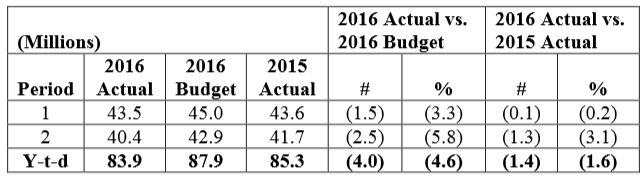
During the debate at the March 23, 2016 Board meeting, it became clear that to some extent, management was making up the story as they went along. The report includes data for the first two months of 2016, and February was particularly bad with a drop against both the budget target and against results in 2015.

20160323_JanFeb16Ridership

However, once the debate was well underway, management reported that March to date was almost on budget, and was up 2.5% over 2015. Why was this information not in the report, or at least in a supplementary paper published before the meeting got underway? The entire tone of the debate would have changed with the sense that, maybe, things were turning around and ridership was growing again.

The situation was further complicated by repeated claims from management and from TTC Chair Josh Colle that ridership was not on a decline, but that it simply did not achieve its budget target. This quite flatly is not true as anyone capable of reading TTC reports can see.

Continue reading

No Time For Panic on TTC Ridership Numbers

The TTC’s Ridership Update report will be discussed at the March 23, 2016 Board meeting. Its publication triggered an unwelcome round of hand-wringing about transit service and financing that could well undo momentum seemingly regained by the Tory regime at City Hall. How did we get so quickly from a pro-transit stance to one where just avoiding cuts will seem a victory?

Fun With Budgets at City Hall

During the Ford years, TTC ridership continued to climb despite the best efforts of Council to throttle the TTC budget, but a good deal of that growth came at the margins, filling up less crowded routes and time periods, and stuffing the busier ones to the extent any new riding was possible. John Tory ran on a platform that SmartTrack would fix absolutely everything, but once in office acknowledged that day-to-day service had taken a hit and needed fixing. Improvements to date have not addressed peak capacity for the simple reason that there were no spare vehicles, and that is only now being addressed.

Some of the new buses bought by the TTC will not directly address capacity shortfalls, but instead will be used to bolster the pool of spare buses so that maintenance standards can improve and fewer vehicles will fail in service. The streetcar system remains hobbled by a car shortage thanks to Bombardier’s missed deliveries, and this cascades down into the bus fleet. On the subway it is physically impossible to run more trains, a problem that will not be eliminated until 2019-20, and then only on Line 1 YUS. Riders might be forgiven for wondering if things will ever improve, especially for peak period travel.

Schedule adjustments have reduced the amount of short-turning on some routes, but gaps and bunching of vehicles remain a problem.

The TTC is far from out of the woods on service quantity and quality, and this situation cannot be fixed overnight.

Continue reading

A Few Questions About “Emerging Transit Plans”

At the February TTC Board meeting, Chief Planner Jennifer Keesmaat took the Board through the road show presentation she and her staff have been taking around Toronto with the proposed new Toronto transit plan. This issue was held over to the March Board meeting because, for procedural reasons, there were limited questions in February.

One major issue here is that the body actually charged with setting transit policy, the TTC Board, was being briefed on a plan they had not seen before, and to which they had given no input or direction. This is only partly explainable by the fact that any long-term transportation plan would form part of the city’s Official Plan, and the Planning Department “owns” that document. However, one would hope that members of the TTC Board would have at least a passing familiarity with what was in the works. This situation is complicated by the presence of “citizen” members who are not also Councillors and are not part of the information flow, such as it is, at City Hall.

The plan and supporting reports will go to City Council a week after the TTC meeting.

A major problem, of course, is that “planning” in Toronto consists of catering to the whims of the Mayor, influential Councillors, the Minister of Transportation (and his government), and senior members of the government caucus. To describe planning in this context as unbiased and purely “evidence based” is something of a stretch.

That said, the situation is better today than in recent years because, at least, all of the proposals are on the table at once, and it is more difficult to dress up a bad proposal when it must compete for attention and analysis with many others at the same time. This does not prevent Councillors from making the attempt at advancing their pet projects, but some degree of comparative evaluation might keep them in check.

Continue reading

What Is The TTC Policy on Fares? (Updated)

Updated March 11, 2016 at 11:00 am: A section has been added commenting on the TTC’s claim that a two-hour transfer would result in a revenue loss of $20m/year.

Recent discussions about a proposed Toronto transit plan have included, almost as a minor sideshow, the Metrolinx study of regional fare integration. A basic tenet of this study is that “rapid transit” would be a separate fare zone or structure from everything else, but the exact mechanism by which this would be done is as yet unclear. GO Transit fares might be lowered and subway fares increased for certain trips, but there is no worked example to show how various trip types inside and outside the City of Toronto will be affected.

Although City and TTC staff are working with Metrolinx on this study, neither the TTC Board nor Council has been presented with a definitive proposal, and there is limited direction from either of them on guiding factors staff should use.

The only context in which Council has decided anything was for SmartTrack, and their wishes included lots of stations, frequent service and the ability to ride SmartTrack for a TTC fare. We know now that many stations and a good deal of service are no longer part of the package. As for fares, there has been some equivocating about this by staff as to just what a “TTC fare” might be by the time SmartTrack (or more accurately GO Regional Express Rail) begins operating.

As for the TTC Board, there has been a series of reports and decisions evolving over the last year. None of these sets a definitive policy, although the motions passed could be misread to imply this has happened.

Continue reading

When Is a GO Train not a GO Train? When It’s UPX!

Among the mysteries of the internal organization at Metrolinx is the presence of separate “divisions” for GO Transit (the commuter rail service), Presto (the fare card service) and UP Express (the premium fare airport shuttle service).  Rather than using the GO brand for the airport service and integrating its operation and fares, Metrolinx treats UPX as a completely separate entity, no doubt so that it could isolate the operation as a profit centre on the books. We now know that “profit” is the furthest thing from a UPX future where just finding riders now takes precedence.

Soon, fares on UPX will be much lower and this might encourage some to incorporate the UPX into their journeys. However, there are two glaring holes in the new arrangement.

UPX, being a separate operation, does not have fares integrated with connecting GO services at Union. Riders transferring between these services will pay separate fares for each leg of their journey. Presuming that UPX fares stay low, this should be corrected, at the latest, in the next annual review of GO’s tariff.

But the really bone-headed decision (or lack of decision) lies with the TTC. Although GO fares discourage “local” travel within the 416, there is a legal transfer move a rider can use called TTC Times Two. A trip can start on the TTC, transfer to GO, and then back onto the TTC again using the original TTC transfer.

With UPX moving to lower fares and the likelihood that it will attract commuter trade within the city, the question becomes “is TTC Times Two valid for UPX”? I asked the TTC’s Brad Ross and Chris Upfold this question at the recent TTC Board meeting. Their answer? “No” because (a) UPX is not a GO train and (b) a TTC policy change would be required.

The irony, of course, is that GO operates in the same corridor as UPX, and it would be impossible to distinguish whether a traveller with a transfer from the Lawrence 52 bus arrived at Union Station via GO or via UPX, except of course that GO service only runs in the peak period.

During the March 1 subway shutdown thanks to a power vault fire, TTC riders travelled on GO and UPX for no extra charge. The reverse courtesy has been extended to GO riders on occasion. This did not require a formal meeting and policy decision, simply the recognition that there is one transit network regardless of the logo on the train.

How riders get from one connection point to another should not matter. Between now and March 9 when the new UPX fares take effect, can someone at the TTC show a small spark of initiative and decide that a traveller on either a GO or UPX train can use TTC Times Two? Or will we continue to have an artificial distinction between two services provided on the same track by the same agency?