Part 1 of this article reviewed recent approvals and designs for the Eglinton LRT. In part 2, I will turn to the remaining Transit City routes.
The main article follows the break below.

Part 1 of this article reviewed recent approvals and designs for the Eglinton LRT. In part 2, I will turn to the remaining Transit City routes.
The main article follows the break below.
Wednesday, December 9 was the first “snow day” for the TTC of the 2009-10 season. Although I’m now retired and should have stayed in bed listening with glee to the traffic reports, I bundled up and rode over to Bloor-Yonge Station to watch the morning rush hour with the new crowd control setup.
It was not pretty.
The crowd control actually achieved its purpose in spreading out the load on the southbound platform, but the service was a complete mess. The TTC had signal problems, service interruptions due to smoke at track level (more about this later) and a number of passenger assistance alarms (PAAs) brought on by people feeling unwell or fainting in crowded trains.
A log of my observations shows the wide gaps in service with headways rarely below 4 minutes. During the two-hour period from 0800 to 1000, the TTC managed to get only 26 trains through the station, slightly fewer than they would normally operate in the peak hour.
Traffic was heavier than usual with trains arriving southbound quite full of passengers. However given the gaps in service, it was impossible to know if this was due to heavier demand on a snow day or simply the backlog of riders. Passengers transferring from Bloor-Danforth made their way well down the platform, and the south end was often more crowded than the north end. Even when the crowd was backed up on the platform beyond the pillars (roughly half of the platform depth), transfer passengers from BD flowed fairly freely behind them.
TTC staff adjusted their tactics to suit the changing situation and on one occasion sent passengers transferring from the Yonge to the Bloor line the “wrong way” through the passageway to the north concourse to avoid the congestion on the main part of the platform they would normally use. This sort of flexibility and “on the spot” judgement about routing pedestrians is vital to the scheme, and will be part of the design considerations for any sort of “permanent” installation of barriers.
A sharp-eyed trainspotter can keep track of the approaching service using the “next train” time indications. When these change infrequently, the next train is spending a lot of time at stations or crawling between them. Given that signal problems slowed trains, and passenger congestion extended the dwell times, it’s hard to know which condition had the greater effect.
Dwell times at Bloor were appallingly long, and few trains achieved under one minute dwells. The TTC has cut back on platform assistants, and this really showed because several trains had problems getting doors closed on the first attempt. Moreover, some of the PAs held back from the crowd rather than being trapped between them and the platform edge.
A delay at Pape caused by a smoke observation shut down the entire BD line from about 0824 to 0841. This choked off transfer traffic, and the YUS caught up with a “gap train” (empty train arriving express from Davisville) clearing the platform at 0830. However, once the BD delay cleared, things on the YUS level became congested, and the platform was not cleared again until after 1000. If the BD line had run normally, the platform at Yonge would likely have been overwhelmed.
These smoke delays are becoming quite common, although you would never know it from the TTC’s eAlerts. Far more info is available on the TTC’s Facebook page. According to that page, there have been three smoke delays so far today (1020), three yesterday, three Wednesday. I am still waiting for the TTC to provide information on what is happening and why these delays are so frequent.
TTC’s eAlert system has been more or less missing in action. The only alert on Wednesday was for a derailed streetcar at College and Ossignton, and it has been completely silent otherwise.
Overall, my impression of Wednesday’s operation was that the crowd control system together with the 20-minute shutdown of the BD line kept the situation at Bloor Station from completely falling apart. This shows the importance of everything working as one system, and how badly things can go awry if any part of that system is unreliable.
A related issue is headroom, the spare capacity needed to absorb unexpected problems and surges in demand. We hear a lot about the demand the YUS might carry, but that only works if the line is much, much more reliable. All the signals and automatic train operation are worthless if there are regular delays caused by smoke or door problems or ill passengers from overcrowding.
We are trying to jam more and more people onto a system that was not designed for these loads, and whose maintenance philosophy appears to tolerate random service disruptions as a normal part of operations. The more important any one component in the network becomes, the more important that it work reliably regardless of the weather.
The coming TTC operating budget debates will no doubt include the usual calls for belt-tightening, but we can already see that the TTC is falling behind in system reliability. The debacle of the mid-90s must not be repeated, and the TTC must operate good, reliable service rather than falling back on “snow” as a catch-all excuse.
Updated November 27 at 10:00 am:
A section has been added at the end of this post with photographs of Bloor-Yonge station showing the crowd control measures.
During the AM peak, the TTC is experimenting with crowd control measures at Bloor Station, southbound with the intention of getting more trains down the line and increasing its peak capacity.
Media reports last week did not fully describe what is happening, and for the benefit of those who do not use the station in the morning rush, here is a short description.
For the first few days, it took time for passengers to get used to the new arrangements, and many are still seeing this setup for the first time. From talks with TTC staff at the station, I learned that the confusion is falling off, and I saw few problems myself.
Today’s Metrolinx Board Meeting was notable both for the update, in public session, of the project status for five major lines as well as for supplementary information that came out in a press scrum after the public session.
Five projects now have funding and are at various stages in their approval/construction process.
At its meeting on November 17, the TTC will consider a report on the yard needs for the Yonge-University-Spadina subway.
Updated November 15 at 6:10 pm:
A reference to the replacement dates for the BD signal system and the T1 fleet has been corrected. This triggers a discussion of whether the TTC will concoct an excuse to retire the T1’s early on the grounds that it is not worth installing ATO on them.
Updated November 15 at 4:30 pm:
The Subway Rail Yard Needs Study (aka SRYNS) proposes that future operations of the Yonge-University-Spadina line through 2030 be provided through a combination of various facilities:
However, looking beyond 2030, staff foresee a need for additional storage and are asking the Commission for perimission to protect for a new yard on the Yonge line with purchase of property, should it become available. This is a rather oddly worded request to which I will return.
The SRYNS was funded by York Region in recognition of the storage and servicing issues that a Richmond Hill subway extension would create for the YUS line. The study explicitly does not look at requirements for the Bloor-Danforth line, but the report recognizes that this too must be examined. The restructuring of the fleet and storage requirements for YUS trigger a move of all T1 subway cars to Greenwood, but that yard is not large enough to hold all of them. In the short term, the TTC owns more T1s than would be required to operate both the BD and Sheppard subways, but this fleet will reach 30 years in 2026 and replacement with newer cars will occur within the timeframe of any projected yard requirements. Continue reading
The full version of the Benefits Case Analysis for the Yonge Subway extension to Richmond Hill is now available online. I will comment on it at greater length when I have the time to do so.
Notable in this report is the acknowledgement of the effect of this extension on the existing subway system and especially Bloor-Yonge Station. There are conflicting remerks in the BCA regarding the degree to which improved service on GO Transit to Richmond Hill can divert riding from the subway line. A major issue here is that the implementation of very frequent all-day “Express Rail” GO service to Richmond Hill is not contemplated in the Metrolinx plan until 2031, long after a subway extension would open.
Detailed work on a number of related proposals will continue, and Metrolinx expects that a full evaluation will be available in late 2010.
The TTC Capital Budget contains many projects related to subway fleet, capacity and future operations. Collectively, these projects amount to billions of dollars and many of them are not yet funded.
There are two major problems faced by subway planners:
Large organizations and projects share issues familiar to many:
Both of these effects can be seen in the TTC’s subway fleet and service plans. Continue reading
Updated October 2 at 11:15 pm:
In the comments thread, a question has come up about the originally proposed alignment of the SLRT. This dates back to the Metropolitan Toronto Transportation Plan Review (MTTPR) and a study of alternatives to the Scarborough Expressway. One of these was an LRT line starting at roughly Queen & McCaul running east to the CNR Kingston Sub at Degrassi St., then northeast via the CN to Morningside Avenue. A branch would run north from Scarborough Junction following mainly existing and abandoned rail corridors to the Scarborough Town Centre.
That branch eventually became the SRT, but was moved to follow the Uxbridge Subdivision because the old right-of-way used in the first proposal was very narrow. As you will see from the maps, this is not the very wide Hydro corridor that crosses the SRT line, but a much tighter route.
To orient yourself, the Uxbridge Subdivision runs just below the top edge of these maps which have north to the right.
Updated September 30 at 4:50 pm:
Item SC 28.30, which requests the TTC and Metrolinx to report in November 2009 on an LRT implementation for the SRT, was passed today by Council.
Item SC28.20 was ruled out of order and withdrawn.
Updated September 30 at 12:45 pm:
This morning, in discussion of another Transit City matter on the Council Agenda, Councillor Thompson asked TTC Chief General Manager Gary Webster about the status of the Scarborough project. Among other things, Webster replied that:
The debate will continue this afternoon, but I suspect the items listed in my original post below will not be dealt with until tomorrow given their place on the agenda.
Original post:
Toronto Council’s agenda today, September 30, includes items of interest regarding the Scarborough RT (SRT) line.
The Cumberland Street entrance of Bay Station re-opened recently at long last. Construction had been delayed by unexpected conflicting structures when the old entrance was demolished.
It’s a nice entrance, as TTC buildings go, but something very odd shows up in the decor. At the bottom of the entrance stairway, we find not a beautiful mural, not an historic account of Yorkville, not even ad advertising frame, but a copy of TTC Bylaw No. 1 at very large scale. This is no cardboard throwaway, but a metal sign built to last the ages.
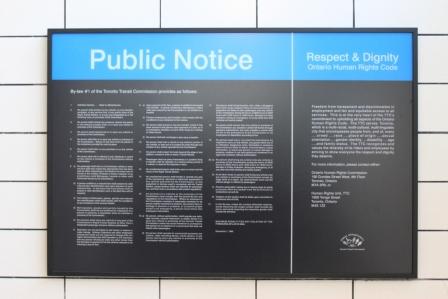
There’s only one tiny problem: the date.
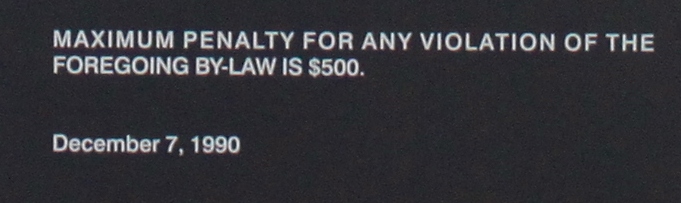
In fact, the TTC Bylaw was updated in 2009 as we can see by visiting the Bellair Street entrance.
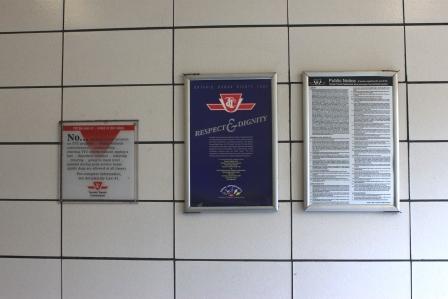
Here, we have the same info as on the Cumberland panel (the Human Rights statement and the Bylaw), plus a “here’s the bylaw stuff you really need” sign. However, this is the new bylaw from January 2009.
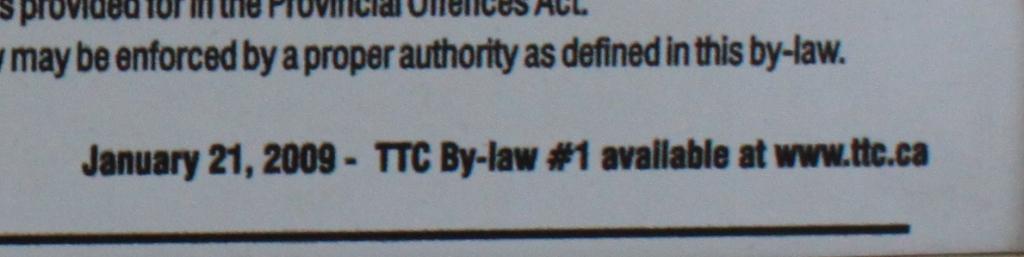
I have been advised that the Cumberland panel will be replaced. Why did this happen in the first place? What is so important about the bylaw that it deserves pride of place on a wall that could have held a decoration appropriate to the neighbourhood? Why was a sign installed with text that was replaced 8 months earlier by a new and substantially revised bylaw?
There is a move afoot to set up a website where people can report signage foul-ups. It may be hosted here, or maybe elsewhere. Once this is in place, I will publish the details.
Updated September 22 at 9:50 pm: According to this evening’s Global news, the TTC will pull the offending maps tonight from all stations. Now may be your last chance to photograph your favourite blunder. Mind you, considering how fast the TTC is at taking down out-of-date notices, I suspect the “bad” maps will be around for awhile.
It will also be intriguing to see if, when the new maps are installed, they actually do update all of them in every station. I found four of elderly vintage without looking very hard yesterday.
Meanwhile, the Star managed to publish an annotated version of the St. Andrew map which shows City Hall where Osgoode Hall actually is, and the CN Tower at the corner of John and Front, north of the rail corridor. I suppose a paper with its offices in the 905 can’t be expected to know much about downtown Toronto any more.
Finally, I strongly urge that the TTC circulate the new maps for comment to ward Councillors’ offices who might actually know where things are in their respective neighbourhoods. Even better, as some have suggested in the comments here, put them online so that the vastly better-informed transit amateurs can help out with the project.
 Steve Munro