There’s A New Subway On The Way (2)

As construction progressed on the Bloor-Danforth-University subway, the TTC issued progress reports from time to time.

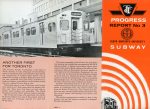
Progress Report 3 predates the opening of the University leg of the project. By this time, a funding contribution from Queen’s Park brought the then estimated completion date back from 1969 to 1967.

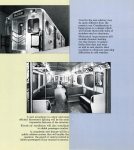
The first batch of aluminum 75-foot cars, a form that would become standard for Toronto, came from Montreal Locomotive Works. All subsequent orders went to the plant in Thunder Bay now owned by Bombardier.

There’s A New Subway On The Way

With all the hoopla about yet another new transit plan for Toronto, it’s time to remember that the 50th birthday of the Bloor-Danforth subway is coming up in a week’s time. Depending on which event you consider the “real” birthday, it will either be Thursday, February 25 (the anniversary of the ceremonial opening) or Friday, February 26 (the first day of revenue service).

Over the next week I will post some ephemera from that era when Toronto launched on a major subway building project.

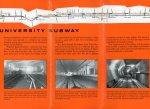
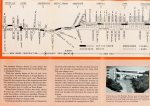
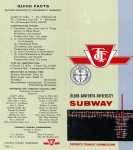
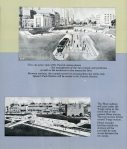
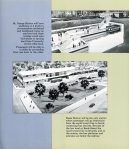
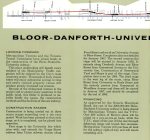
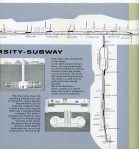
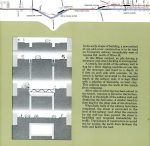
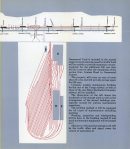
The handout below was a publicity piece for the Bloor-Danforth-University subway project. Among items of interest are:

  • The expected construction time was 9 years broken down as the University Line (3.5), Greenwood to University including Greenwood Yard (4), and the remaining pieces east from Greenwood to Woodbine, and West from St. George to Keele (2.5). Almost all of the line was built cut-and-cover , and the city expropriated a swath of houses along most of the route to the north of Bloor Street and Danforth Avenue. This strip is now home to parking lots, a few parks, subway entrances, and the occasional new building sitting right on top of the subway.
  • The original completion date to the terminals at Woodbine and Keele was planned to be 1969, but work was accelerated thanks to additional funding from the Metropolitan Toronto government and Queen’s Park.
  • The paintings showing what the new stations would look like date from 1956 and 1957, before the project had been approved by Metro Council.
  • The map of the route includes the original names for most of the stations including Vincent, Walmer and Yorkville. By the time this was printed, “Willowvale” Station had already changed to “Christie”, but the park to the west retained its original name.

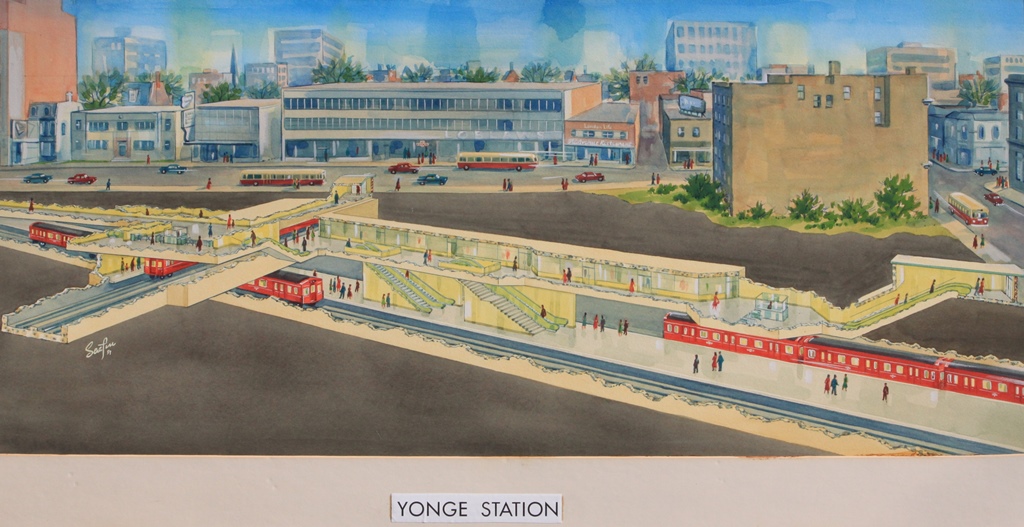
The station illustrations are by Sigmund Serafin whose work also shows up in samples of the original Yonge line station designs. Of the four stations shown here, none was built exactly as shown. You can see the full set on Transit Toronto. The eight water colours were rescued from a housecleaning binge at the TTC in the late 1960s when much material went into various private collections lest it simply disappear. These paintings are now back with the TTC who plan to issue them as posters later this year, and the originals will go to the City Archives.

Here is Bloor-Yonge Station in all its mid-50s glory, with Gloucester trains, no Hudson’s Bay building and a lot of Bloor-Yonge streetscape that has vanished over the years.

Yonge_Station_Serafin_1957w

For a detailed history of the Bloor subway, visit Transit Toronto.

TTC’s 2016 Customer Charter Reviewed

The TTC has released the 2016 version of its Customer Charter listing a number of areas in which they promise improvements through the year.

First Quarter:

  • Ensure that 510 Spadina is served by fully accessible streetcars: Mostly done already with a few of the high-floor ALRVs still in service but the majority of runs operated with low-floor Flexitys.
  • Apple Pay at collectors’ booths: In progress.
  • Reduce streetcar short-turns by a further 20% over Q1 2015: New schedules on 501 Queen effective January 3 make a big contribution to this coupled with the milder winter weather.
  • Start subway service at 8:00am on Sunday: Done effective January 3.
  • Add service to Line 1 (YUS) during off-peak: Not done yet, but the schedules going into effect at the end of March have not yet been announced. (Note 1)
  • Establish a Local Working Group for Donlands Station second exit project: Done.
  • Add five new express bus services: Planned for late March.

Second Quarter:

  • Wifi at 22 new stations (Note 2).
  • Roll-out of new fare gates with Main Station as a pilot: Work at Main in progress.
  • Improve bike parking at 5 stations.
  • Add 20 bike repair stops at subway stations: Subject to outcome of a pilot.
  • Install notice boards in 12 busy stations to inform passengers about planned/unplanned closures.

Third Quarter:

  • Ensure 509 Harbourfront and 511 Bathurst are served by low-floor streetcars: With delivery of new cars, Harbourfront is already planned to ramp up beyond two assigned Flexitys in mid-February. Delivery rates for new cars are supposed to be up to 1/week by the end of March and this should make conversion of 511 Bathurst an easy task provided Bombardier manages to stay on track.
  • Pilot high capacity bike parking at one station.
  • Replace T1 trains on Line 4 (Sheppard) with 4-car TR sets: The order for these cars is in progress at Bombardier with delivery expected later this year.
  • Improve 28 Bayview South and 101 Downsview Park routes to be part of all-day, every day service. This will bring services to two park-based areas. The Bayview South bus serves the Brick Works from the west (Davisville Station), but service from the east (Broadview Station) will still be operated by a free shuttle bus.
  • Add 3 trains to Line 1 (YUS) to improve AM peak service. It is unclear whether these will be “gap” trains used to supplement service when things go wrong, or an attempt to slightly shorten the average headway over the entire line. Gap trains generally make a bigger difference for situations where holes in service at peak times and direction need to be filled because the extra train is used specifically where it is most needed.
  • Add peak service to 25 busy bus routes.
  • New streetcar service on Cherry Street: (Note 1) This service could most easily be implemented by converting the 504 buses now scheduled from Dufferin to Parliament back to streetcars as a Dufferin to Cherry operation. Peak vehicle requirements would probably go down, but the off peak service on Cherry would be a net addition. This change is related to whatever modifications the TTC will make to the 72 Pape and 172 Cherry bus routes.
  • Begin revamping the east parking lot at Finch Station.

Fourth Quarter:

  • Widen 25 bus stop pads to improve accessibility: Locations TBA
  • Install external route announcement system on all vehicles: Work in progress.
  • Add two new elevators at Ossington Station: Work in progress.
  • Install customer info screens at Union Station mezzanine and platform levels: An overdue follow-up. This work should have been an integral part of the station renovation.
  • Install customer info screens at Dufferin, York Mills and Lawrence stations.
  • Install transit signal priority at 15 intersections: Locations TBA
  • Complete PRESTO roll out to the entire system: Bus fleet conversion in progress; new fare gates will finish PRESTO subway access as they are installed.
  • 10 additional WiFi stations: Locations TBA (Note 2)
  • Lengthen 10 bus pads for compatibility with articulated buses: Locations TBA
  • Start construction on a bus queue jump lane: Location TBA
  • Introduce a new Wheel-Trans qualification process: Details TBA
  • Install new, “more informative” stop markers at over 3,000 surface stops.
  • Review schedules on 32 bus and streetcar routes to improve reliability and travel times.
  • Reduce subway delays by 10% (counted as both incidents and minutes of delay). See What Causes Subway Delays?
  • Consult with riders and other stakeholders to revise service in three neighbourhoods around routes 40 Junction, 54 Lawrence East and 116 Morningside.

Note 1: Some items in the Charter are not yet funded in the City’s budget. Whether they will actually operate depends on the TTC’s ability and desire to squeeze money out of other parts of their operation.

Note 2: The WiFi rollout in the subway is limited to internet access only because the major telcos – Bell, Rogers, Telus – will not provide service over the incumbent provider’s network. Even the internet access has its problems due to login requirements recently introduced that require signon to a sponsoring site such as Twitter. This state of affairs can be traced to a bad system and contract design by the TTC who appear not to have contemplated the difficulties of the “big” players refusing to come onto, and thereby financially support, the network.

I cannot help feeling that a lot of this “Charter” is a shopping list of the low hanging fruit, things the TTC planned to do anyhow, but repackaged in a “look at us” format where green tick marks will gradually fill up the boxes. What is missing, and this is as much a political discussion as a managerial one, is a “what could we be” dimension and aspirational goals that might not be achieved, certainly not in a one-year timeframe.

Of course, when there are members of Council and the TTC Board who would rather count paperclips than address fundamental issues of just what  “good transit” really is, this situation is almost inevitable. Good news, but as cheaply as possible, and so we aim low.

What Causes Subway Delays?

The TTC’s Andy Byford recently committed to a major reduction in subway delays by 2019 thanks in large measure to the introduction of a new signal system on Line 1 Yonge-University-Spadina.

Can this level of reduction actually be achieved? To get a sense of this, we must look at the actual delay reports from the TTC to see the location and type of service interruption. If a problem only account for one quarter of all delays, then a three-quarter reduction in delays cannot possibly be achieved simply by eliminating this class of problem. Similarly, if half of the delays are on one line, and a new technology is implemented on another, then nothing has been done to address delays on the untouched part of the system.

The TTC reports overall reliability statistics in the CEO’s report, but these are (a) not subdivided by cause and (b) use a measure of service “reliability” that would give a perfect score even if a large proportion of the service were missing. As long as trains are close enough to each other, even if there is one gap leading the pack or all of the trains crawl along the line, they do not count against the metric the TTC used for years to report service quality.

The counts below were calculated by reviewing all of the TTC eAlerts for service interruptions on the four rapid transit lines for January 2016. Anyone who reads these alerts and rides the system regularly knows that some delays never make it to an alert, but this is the best we have for published information.

Type of Delay                    Line 1    Line 2    Line 3    Line 4

Passenger Alarm                   6  16%   14  23%    2  18%
Signals                          11  30%   11  18%              3  60%
Mechanical                        1   3%    4   7%    8  73%    1  20%
Track                                       3   5%
Switching                                   1   2%
Security                          5  14%    6  10%              1  20%
Police Investigation              3   8%    4   7%
Fire Investigation                3   8%    8  13%    1   9%
Medical                           3   8%    4   7%
Power Off                         4  11%    3   5%
Unauthorized at Track Level                 1   2%
Late Clearing Work Zone           1   3%    1   2%
Unspecified                       0         1   2%

Total                            37        61        11         5

The details of the incidents are in the following table.

201601_SubwayDelayStats

This is only a one month sample, and there are bound to be somewhat different numbers for other periods, but this gives the flavour of the situation.

Signal problems, annoying though they may be, account for only 30% of the delay incidents on the Yonge line, and 18% on the Bloor line for January 2016. That said, these tend to be the most long-lasting incidents and so their effect is greatly out of proportion to their number. Moreover, the incident count is higher on the Bloor-Danforth line by a wide margin. The new signals on Yonge-University will certainly improve conditions on that route, but delays overall will not be a thing of the past.

If the TTC is going to shoot for improvements, then they must start reporting their delay statistics at a more granular level so the a link will be visible between the type of “fix” undertaken and the location and type of delay whose stats go up or down. This would be a much more useful measure both of service quality and of the effects of management programs to improve the quality of transit service.

Relief Line, SmartTrack, GO/RER, Scarborough Subway Consultations

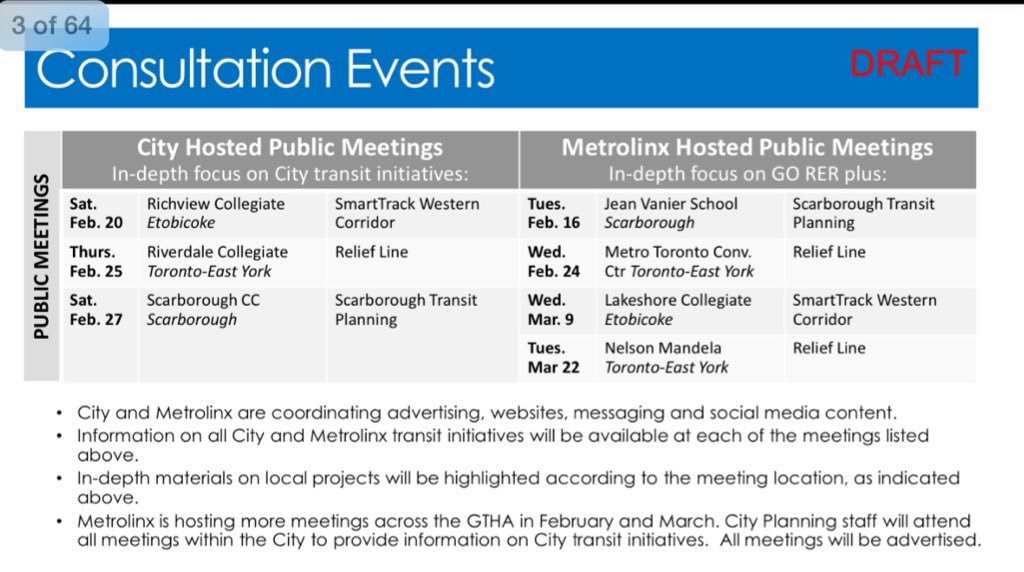
Toronto City Planning has released a draft list of upcoming public consultations on various transit plans including:

  • The Relief Line
  • The Scarborough Transit Plan (Subway, SmartTrack, Crosstown East LRT)
  • The Western SmartTrack Plan (SmartTrack, Crosstown West LRT)

2016_ConsultationCalendar

Additional meetings and information about Metrolinx plans (GO Regional Express Rail) will be organized by that agency.

Even more information will be available in March 2016 when the City releases a compendium report on all transit initiatives currently under study. These will include items listed above as well as the “Waterfront Reset” study, TTC Fare Integration proposals and a review of how (or if) Tax Increment Financing can contribute to the many transit projects under review. The intent is that this report will form the basis for public consultation and debate leading to recommendations at Council in June 2016. This is a very aggressive schedule, and there is no indication how consensus will actually be achieved in so short a time, especially with the usually-secretive Metrolinx as an essential player. At least the discussion will be at a network level, not ward-by-ward with a “relief” line for every member of Council, and there will be some filtering of various schemes based on engineering and operational realities.

What is sadly missing from all of this is a discussion of day-to-day transit operations and the backlog in the state-of-good-repair budget. We can blithely discuss billions worth of subway building to Scarborough and a Relief line, but Council won’t fund the basics of running a transit system.

Toronto Relief Line Alliance Launched

The recently-formed Toronto Relief Line Alliance has  just launched a campaign to showcase the benefits of a new subway line from downtown Toronto to Don Mills & Sheppard. Unlike the less-than-arms-length SmartTrack advocates, FAST, the Relief Line Alliance isn’t trying to make any politicians look good or prop up the remnants of an ill-considered election platform.

Of particular interest on their site is a map where readers can see travel time savings possible for various trips to downtown. All of the numbers they use are based on published reports notably Metrolinx’ own evaluation of such a route from June 2015.

Now that Toronto can finally discuss something other than John Tory’s signature project, the new Alliance can provide a voice and a forum for a much-needed part of our transit system.

City Hall and Queen’s Park must get their heads out of the sand and make the Relief Line an integral part of medium term, “see it in our lifetime” plans. The time for transit plans pandering to pet projects and political egos is over.

TTC Board Meeting January 21, 2016

The TTC Board will meet on January 21, 2016. Unlike most meetings, the public session will begin at 10:00 am, although they may go into camera to discuss details of item 3 on the agenda, the cost overrun on the Spadina subway extension.

Items of note include:

This article has been updated with details on these subjects.

Continue reading

SmartTrack: Now You See It, Now You Don’t!

Oliver Moore in the Globe and Mail reports that there have been major changes to the SmartTrack plan, to wit:

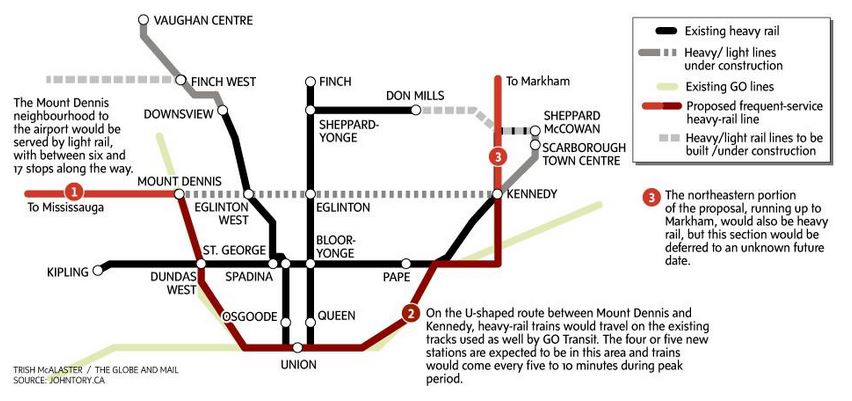
  • The western branch of the service to the Airport district will be provided by the western extension of the Eglinton-Crosstown LRT as originally proposed.
  • “SmartTrack” per se will operate as a heavy rail service overlaid on GO Transit with the initial phase running from Mount Dennis to Kennedy Stations.
  • The northern extension of “SmartTrack” to Markham will be a separate phase of the project.

The map from the Globe & Mail is reproduced below.
GlobeSTLRTMap_20160114

According to Moore, the cost of adding SmartTrack to GO under this configuration would be much, much less than the originally quoted figure for the entire line. In turn, this would free up substantial capital spending headroom in City plans for other projects.

SmartTrack service at 15 minutes (the level proposed in Tory’s campaign) is far too infrequent to attract much riding, and especially to make a dent in demand on the existing subway interchange at Bloor-Yonge. We saw this in the June 2015 Metrolinx demand projections that were far more favourable to a Relief Line operating north to Sheppard and Don Mills. However, getting SmartTrack service down to as close a headway as every 5 minutes will be challenging for Metrolinx and for the corridors through which this would operate. There are no details yet on how this would be achieved.

The Eglinton West LRT has always been the superior way of serving this corridor compared to the heavy rail SmartTrack scheme. ST foundered on major problems with constructibility and neighbourhood effects, issues that were dismissed in a stunning display of cavalier “expert” knowledge during the campaign. Planning by Google Maps from an office in the UK has its limitations, but Tory’s campaign relied on this “expertise”. One shameless professor even rated ST with an “A+” in the CBC Metro Morning interview.

Keeping the first phase of ST confined south of Eglinton on both branches limits the operating costs the City must bear if this to be truly a “Toronto” project with “Toronto” fares, and it avoids the complexities of building into the 905.

Indeed, SmartTrack began as a real estate development scheme to make commercial property near the Airport and in Markham more accessible from downtown in a series of studies that actually claimed the market for downtown office space was static and falling. Yet another expert should be eating crow pie from his perch on the Metrolinx board. It was never clear why Toronto should shell out billions to improve property values in the 905, and this task now falls clearly to Metrolinx where it belongs.

The eastern leg of SmartTrack, north from Kennedy, obviously competes with the Scarborough Subway Extension, and there is no need for two routes serving the same demand, especially when GO already plans substantially improved service in the rail corridor. The long-standing issue of SSE demand may be clarified by the absence of SmartTrack as a competing service.

It is no secret that my own position would be to revert to the LRT plan in Scarborough, but that train has probably left the station, especially if the City can “save” a small fortune by scaling back on SmartTrack.

These changes could also foreshadow a revised schedule for the LRT projects at a time when “shovel ready” projects are in demand to soak up new federal spending. Eglinton West’s LRT extension is relatively easy to build, and it could be started soon enough to complete concurrently with the main Crosstown route. There is also the matter of the Sheppard East LRT including its proposed service linking to UofT Scarborough campus.

Coming weeks may bring many sputtering denials, or possibly, much improved clarity and acceptance of an – at last – realistic plan.



TTC Service Changes Effective January 3, 2016 (Updated)

Updated December 8, 2015 at 12:30 pm: I checked with the TTC about the termination of both the 509 Harbourfront and 511 Bathurst routes at Fleet Loop rather than simply running one route between Bathurst and Union Stations. Here is the reply from TTC Service Planning:

We considered running a 511 (Bathurst Stn-Union Stn) service but ruled it out for two main reasons. Firstly, stop usage on Fleet west of Bathurst has greatly increased in the last year, and serving these stops only with the shuttle bus would introduce a transfer or longer walk for too many people. Secondly, because of the road configuration and traffic patterns, it is not possible to have a northbound stop for through 511 cars on Bathurst at Lake Shore. The nearest stop would be the existing 509 stop on Bathurst farside of Queens Quay. This adds to the walking distance for customers heading to Fleet Street, and requires customers to cross an inhospitable intersection.

The original article follows below:

The new year brings changes to some routes, mainly on the streetcar system, to deal with the shortage of new Flexitys and a construction project while improving service on 501 Queen, 502 Downtowner and 503 Kingston Road to better reflect actual conditions.

2016.01.03 Service Changes

Continue reading