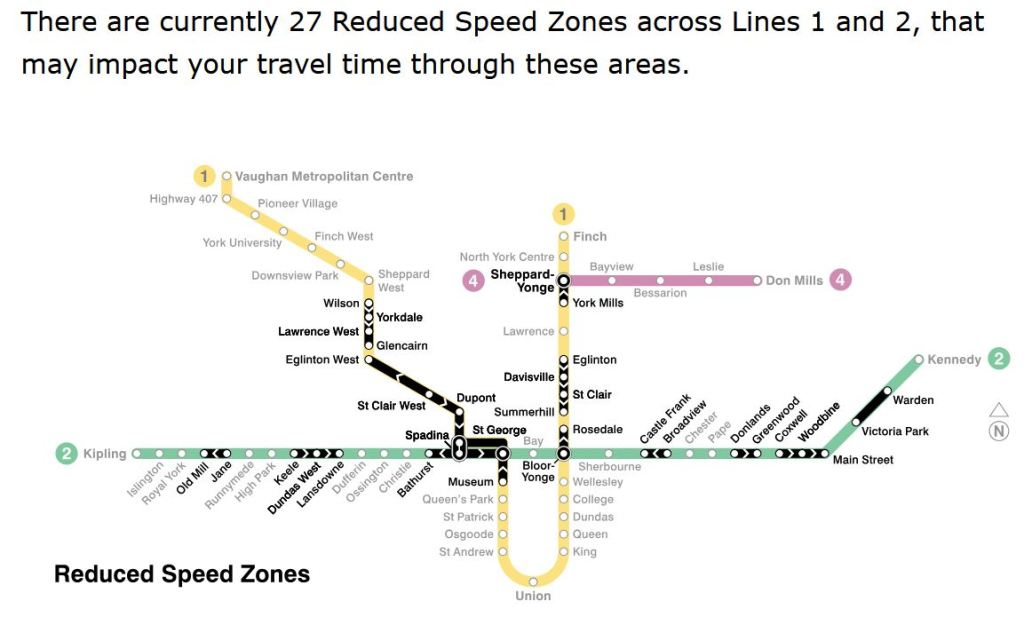
Since February 2024, I have tracked the TTC’s posted list of Reduced Speed Zones (RSZs) on subway lines 1 (YUS) and 2 (BD). A pattern has emerged that some RSZs are very long-lasting, others are brief, and some come-and-go.
Former Interim CEO Greg Percy claimed that we should expect about a dozen of these at any time, but the current total as of July 13, 2025, sits at 27.
If these zones came and went in short order as problems were discovered, one might tolerate a period of travel delay. My own recent experiences with glacial trips from Vaughan to St. George makes me thankful that I don’t take this route every day, but regular riders there have my sympathy.
Current reporting makes actual tracking of track defects difficult, and there is no sense of the underlying problems or limitations on performing repairs. Transparency demands that more information is provided for the status of RSZs, specifically:
Location
Date first reported
Defect issue(s)
Planned repairs
Projected date to completion
Actual date slow order is lifted
Whether this will speed repairs depends on available resources (capital, work equipment, crews) and conflict with other works along the subway lines, but at a minimum riders deserve to know when they can expect relief from slow orders. The TTC Board and Council deserve to know how deep-seated the outstanding problems might be, where they originated, and what will be required to fix them.
Approve addition of PEDs requirements, including operational and technical system requirements to the TTC Design Manual and Master Specifications for implementation at future new stations.
Direct staff to include funding based on estimates for the implementation of a pilot installation at TMU Station (Dundas) as part of the 2026 budget submission.
Approve ongoing planning work, including prioritizing stations for implementation of appropriate technologies based on specific needs and drivers of each station.
At the meeting, there was an attempt to refer the report to staff for further study:
Motion to Refer Item moved by Fenton Jagdeo (Lost)
Refer the report back to staff for further analysis to compliment [sic] the platform edge door study that includes:
Other technology, infrastructure, or passenger management solutions at stations that could improve operational efficiency, customer experience, and safety.
Prioritization of stations that would most benefit from platform edge doors and those that could realize safety, operational, and customer experience improvements utilizing other solutions.
Capital budget costs of (non platform edge door) station enhancement investments that could be implemented in 2026 to improve safety, operations, and customer experience.
Expanded business cases that include metrics for potential operational cost savings, service reliability improvements, and customer delay time savings that could be realized with platform edge doors at the highest priority stations.
A jurisdictional review of alternate platform edge door funding models that leverage non-fare (advertising) revenues.
There was also a motion to refer the report to the Strategic Planning Committee for further discussion:
Motion to Amend Item (Additional) moved by Councillor Dianne Saxe (Carried)
The TTC Board requests that staff provide the Strategic Planning Committee with class 5 estimates of the costs and benefits to the TTC of technically feasible options to detect or discourage track-level intrusions at subway and LRT stations, including those being installed by Metrolinx on new stations in Toronto.
The Feasibility Report by AECOM is a long document, but the core of it lies in the first 90 pages covering many aspects of potential implementations and designs. One significant conflict between this report and the management recommendations lies in the choice of stations for a trial installation. Although management recommends Dundas/TMU, a busy downtown station, the Feasibility Report recommends lightly used stations where problems can be worked out without a major upset to service and riders.
It is further highly recommended that TTC implement a number of PED installation pilot projects at different stations representing the typical condition for each type of design solution. Representative stations are proposed based on low ridership numbers to minimize impact to the subway system and ridership inconvenience associated with performance of the work and the anticipated learning curve. Potential stations include North York Centre, Lawrence, Glencairn and Old Mill. This variety of stations will allow contractors to familiarize themselves with all station groups and structural solutions. [p. 19]
The project is estimated to take over 20 years to complete system-wide at a substantial cost:
The total capital cost for the implementation of the PEDs system for Lines 1, 2 and 4 is estimated at $4.1 billion, with average costs of $44 million to $55 million for two platforms of a station based on the preliminary (Class 5) cost estimate, which includes a cost escalation to the midpoint of construction projected in 2036. The estimated cost was also included in the 2025-2039 Capital Investment Plan and remains unfunded. Subject to the approval of the recommendations of this report and available funding room available, $44 million will be included in the 2026-2035 Capital Budget and Plan submission for the implementation of a pilot installation at TMU Station (Dundas) for Board consideration. The preliminary cost estimate does not include the ATC interface. This will be further reviewed and discussed with the Line 1 ATC supplier as the PEDs project progresses and an implementation strategy is developed. [Management Report, p. 2]
Note that the study lists many other aspects of the project for which costs are not included. I will turn to these in the detailed part of this article.
The PED project is not funded in the Capital Plan and would have a significant effect on annual spending, especially if there is political pressure for a compressed timeline.
The study reviewed four different implementations:
Full-height doors with a roughly 300mm ventillation space at the top.
Partial height doors.
Intrusion detection systems (IDS)
“Rope” barriers.
Based on a scoring system full-height doors were favoured because they are the only proven system that completely prevents track level access. However, this is only one component of the evaluation and the differences overall are small, except for “rope” systems due to a “less-proven” ranking.
The costs for full- and half-height doors are substantial thanks to the station modifications needed for their installation many of which are common to both schemes.
Adapted from Board Report, Table 1, pp. 6-7
An important issue in such a review is to determine just what reason lies behind the desire to install PEDs. The commonly cited issue is suicides, and yet the TTC has a greater problem with people walking at track level. Other problems include fires caused by debris blown onto track level, and the potential contact between passengers on the platform and trains. Various implementations address each of these to a greater or lesser extent.
If the intent is to make track level access difficult and deter the majority of intrusions, then walls of some height are required. Sensors can detect unwanted intrusion, but they will not prevent it, and could be prone to false positives.
The operative word in “IDS” is “detection”. Such a system can detect entry into the guideway, but not prevent it. This will be used on the underground portions of the soon-to-open Lines 5 and 6 in Toronto, and we will see how well it works, especially in distinguishing between real intrusions and false positives that would halt service.
Installing PEDs is not simply a matter of erecting a wall along the platform. There are issues of structural integrity of platforms, relocation of services in the under-platform area, station and tunnel ventilation, power supply and control systems, and emergency operation of the doors. Most of these are common to half and full-height implementations, although the effect on ventilation is less for half-height doors.
The implementation of PEDs at existing stations will require extensive planning, with the majority of the work taking place at track level during non-operating hours and will need to be implemented alongside ongoing State of Good Repair (SOGR) work in subway tunnels and stations. Implementation of the PED system as part of major works, such as Bloor-Yonge Capacity Improvements (BYCI) will minimize operational and customer disruptions while addressing cost and schedule efficiency.
Extensive subway station closures and station bypasses will be necessary to effectively complete track-related work for the PED system and to minimize the challenges. Partial and full closures of subway lines and stations were used in Paris, Hong Kong, Singapore, Copenhagen, and Seoul’s Metros to successfully retrofit the PED system in existing stations. [Management report pp 1-2]
The TTC has never undertaken an “extensive” closure of a station, let alone a line, beyond weekend maintenance shutdowns. This has substantial implications at busy stations near major destinations or with extensive surface feeder services.
The Business Case (also by AECOM) presents the advantages and disadvantages of PEDs.
The Business Case is a troubling document because it purports to show the monetary value of the project, albeit over an extended period. I am not convinced that this is an appropriate way to address the issue. The majority of the savings comes from fatality incidents which contribute to many of the factors below, notably to the imputed value of lost lives. Some of these savings are not direct dollar spending (such as emergency response costs), and cannot be recouped as an offset to the capital cost.
Arguing the preservation of life as a “business case” begs the question of whether fiscal hawks would agree to the project if there were not a good “return on investment”. Conversely, a 20-year implementation plan has little sense of urgency. The question, then, is how quickly the project could actually unroll, at what cost, and a what disruption both to ongoing subway operations and the overall capital plans for the TTC.
The footnote above refers to anticipated longer dwell times at stations as the control systems for both the platform doors and trains agree with each other about opening and closing while trains are stopped.
There is some irony to the proposal of Dundas/TMU Station as a trial installation. At the previous TTC Board meeting, the University made a proposal to set up a research effort with the TTC based on their business startup model. The idea was that there were potential developments that could be marketed to the world. One of the focus areas was to be intrusion detection, although such systems have existed for decades in various forms. In December 1985, SkyTrain in Vancouver opened with an Intrusion Detection System, although a replacement technology is now under consideration. IDS is not a new concept, and whether TMU can bring some enhancement that does not already exist in the market remains to be seen.
At this point, management asks the Board for approval to continue study of a potential PED rollout. This would include evaluation of appropriate technologies for different types of stations. and make budget provision for a trial implementation at Dundas/TMU. Any installation work is still a few years away, and a full rollout further still. An obvious question is whether an interim Intrusion Detection System is worthwhile, or even sufficient for the less heavily-used stations.
The challenge is to define the system’s goal and the level of protection needed to achieve this. Will problems simply migrate from stations with full segregation between platforms and trains to others with lesser or no detection or barrier? What proportion of the system must be converted to achieve a significant reduction in unwanted events? How long would it take to achieve this?
The remainder of this article delves into the technical review of PEDs and what their implementation on the TTC network would entail.
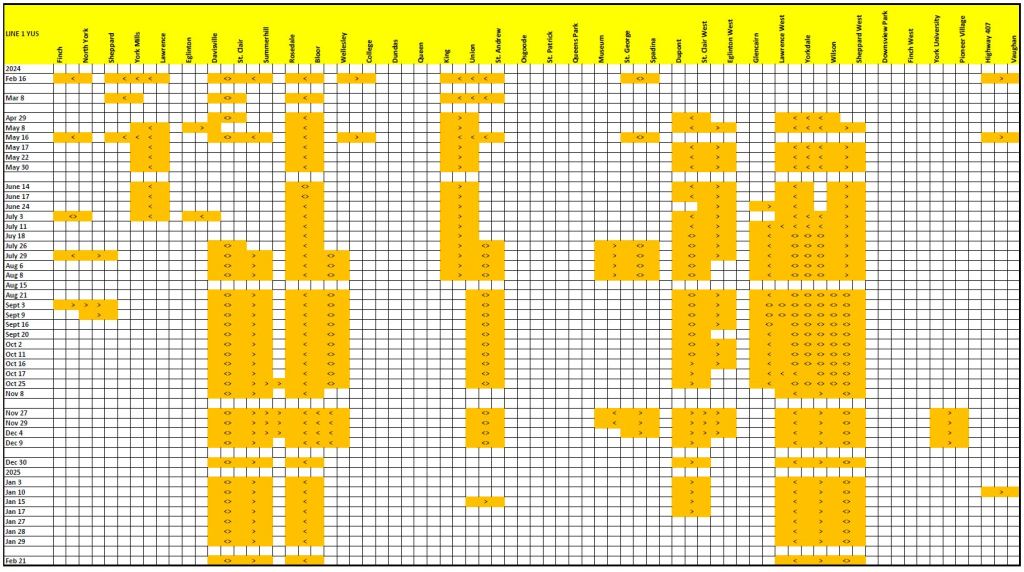
The TTC continues to issue notices of Restricted Speed Zones (RSZ) for the subway system. Some appear and disappear in short order, while others are extremely long-lived. I have been tracking the status of these since early 2024, and the charts below show where and when the zones were in place.
Some areas have had RSZs in place continuously for over a year. The TTC has not given any indication of when these will be repaired, although the list has thinned out over the past year.
The departing interim CEO has claimed that 12 RSZs will be a normal situation. This might be credible if problem areas appeared and disappeared quickly, but this is only the case for some of the zones listed here.
A related problem is that some of these areas have been in bad shape for an extended period thanks to deferred maintenance and the complexity of repairs. TTC management has mused about extended shutdowns to attack these problems, but without any specifics, and especially regarding replacement services.
Where the symbols “>” or “<” are used, the RSZ is only in one direction. Where “<>” is used, the zone applies both ways. The charts are broken by year with 2024 on the top, 2025 below. The dates correspond to my visits to the website.
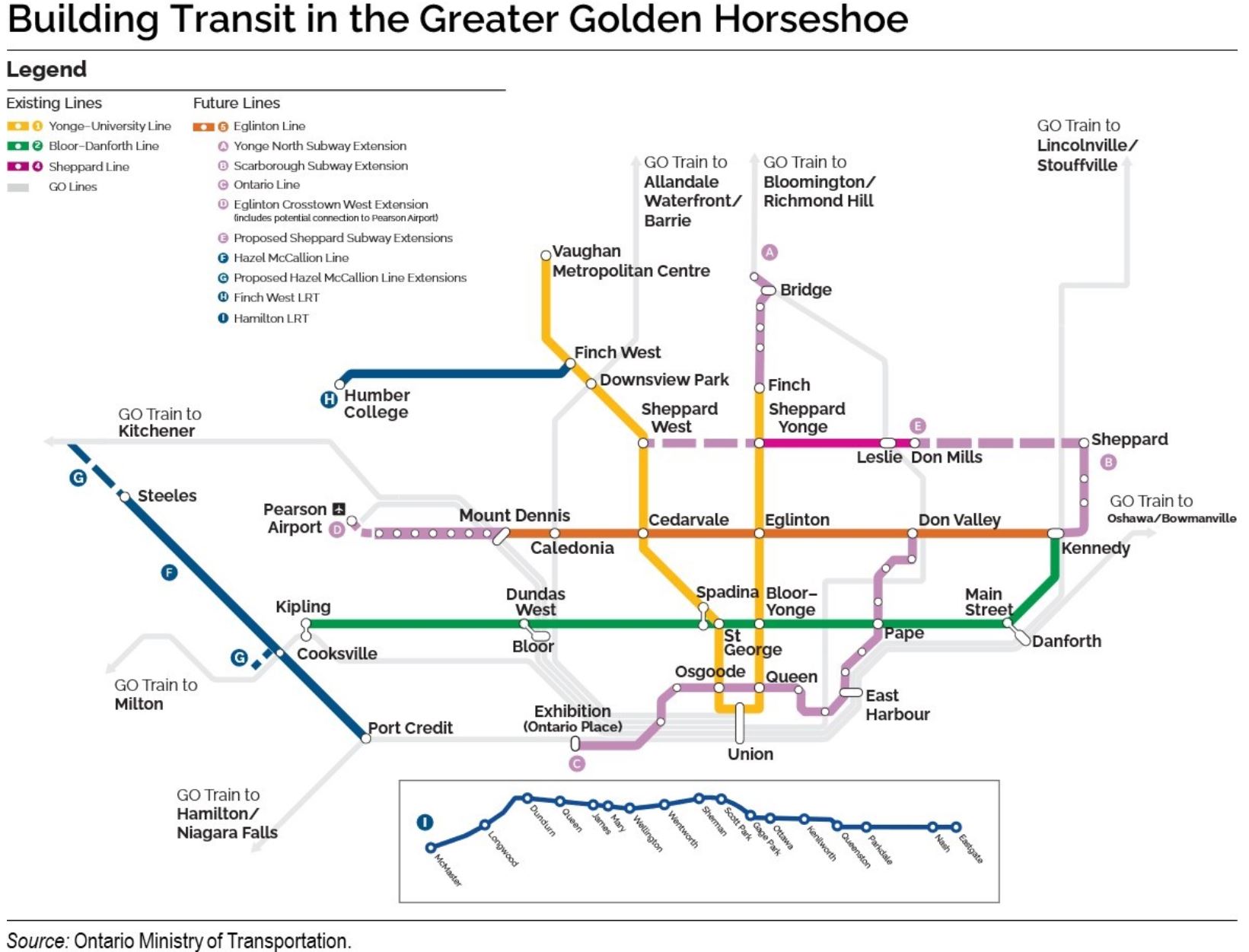
Ontario unveiled its 2025 budget on May 15. Although it speaks of “Approximately $61 billion over 10 years for public transit”, by far the lion’s share of this spending is for projects already underway in the construction and design stages.
All of this is for capital expansion and renewal, and nothing has been announced for day-to-day improvement of transit service.
GO Transit
The budget cites:
The Hamilton-Niagara through service connection at West Harbour Station which is already in service.
The proposed Bowmanville extension which has been announced before, but is only barely underway at the “early works” stage. This extension has physical alignment issues.
GO 2.0 includes “delivering all-day, two-way service to Kitchener and Milton, building new GO stations across the region and advancing planning to unlock potential new rail corridors through midtown Toronto, Etobicoke, York Region and Bolton.” There are no dates attached, and some of these have been on maps for a very long time. Notable by its absence is any mention of electrification.
A total of $850 million to refurbish GO Transit rail coaches at the Thunder Bay Alstom the North Bay ONR facility. This work is already announced. The cars may receive convenience upgrades such as “charging plug ports, cup holders and improved Wi-Fi”, but the long-term retention of these cars indicates that the operating model for GO electrification, if and when it occurs, will have a large component of locomotive-hauled trains rather than electric multiple units.
Subways
Subway projects in the budget are:
Ontario Line (under construction).
Eglinton-Crosstown Western Extension (under construction).
Yonge North to Richmond Hill (procurement underway).
Sheppard Subway Extension (planning, consultation and business case preparation underway). Notable in the map below is the absence of a line east of McCowan where there is a conflict with the City’s Eglinton East LRT project and with maintenance yard property requirements.
New subway cars for Line 2. Provincial funding for these trains has been in place for some time. What is not yet funded are trains for service expansion beyond pre-covid 2019 levels. Trains for the Yonge North and Scarborough extensions are included in those projects. The TTC is in the Request for Proposals process for new trains, but this has been skewed by provincial statements that the work should go to Alstom’s Thunder Bay plant.
Yes, they seem to have forgotten the Scarborough Subway Extension (now under construction) in the text although it is included in the map below..
East Harbour Transit Hub
The hub at East Harbour Station, near the point where the Lakeshore East GO line crosses the Don River, will eventually serve GO Transit, the Ontario Line, and the local streetcar/LRT system via the Broadview Avenue Extension and a link west via Commissioners Street.
A substantial portion of this project is funded by the City of Toronto as a remnant of John Tory’s “SmartTrack” plan.
Light Rail Projects
Hamilton LRT: This is in early states with procurement underway for Civil Works and Utilities.
Hazel McCallion (Mississauga) LRT: Construction is well underway for the initial phase of this project, and the Province is studying whether the extension into downtown Brampton should be tunneled.
Ottawa LRT: The Province is studying a potential upload of the Ottawa LRT “to help reduce costs for Ottawa taxpayers”. What implications this might have for future network operation and expansion is not clear.
Eglinton Crosstown and Finch West LRTs: “Major construction for both projects is now complete. Metrolinx continues to focus on safety and operational readiness testing, as the projects advance toward revenue service.” There is still no commitment to opening dates, and we are getting close to the three-month lead-time required for a go/no-go decision for an early fall 2025 start of service. Meanwhile, TTC has begun the process to update subway train announcements and maps to reflect the new lines.’
There is no mention of the Eglinton East or Waterfront East projects. In a recent letter, Mayor Chow asked the Federal government to contribute 1/3 to these schemes, but there is no indication of support in the Provincial budget.
Updated April 24, 2025 at 11:30 pm: TTC responses to my questions have been added at the end of the article. One questions remains outstanding.
Back in 2018, the City of Toronto bought the lands southwest of Kipling Station formerly known as the CP’s Obico Yard. This land was to be used for a new Maintenance and Storage Facility for Line 2 trains in anticipation of:
Space at Greenwood being reallocated to serve the Downtown Relief Line,
Greenwood’s layout being inappropriate for permanently coupled six-car trains,
The planned increase in the Line 2 fleet to accommodate both extension and increased service.
The existing Line 2 fleet comprised 372 T-1 subway cars dating from 1995-2001, and they will reach the end of their 30-year design life starting this year. The cars are in married pairs that can be easily uncoupled from their trains. Greenwood’s layout is based on short maintenance bays, not on six-car trains. (When Greenwood was designed, operation of four-car trains was common.) Back in 2018, the expected new trains for Line 2 would be similar to the TRs on Line 1 running in permanent six-car sets.
The original plan was to buy 62 New Subway Trains (NSTs) to replace the T-1 fleet. This would give enough trains to operate Line 2 through to Scarborough, albeit likely with a short turn during peak periods at Kennedy Station. The NST order has been scaled back to 55 trains (the number required for the existing Kennedy-Kipling line) with extras to be purchased as part of the Scarborough and Yonge North subway projects.
The NST design has changed to retain the style of the 6-car TRs with open gangways, but the cars will come in married pairs. Each end of the train will have a pair with one cab plus hostler controls on the “blind” end of the pair. The middle pair will have hostler controls at both ends. This will allow the 6-car sets to be broken up for movement of individual pairs in yards and shops. (See: TTC Requests Proposals for New Line 2 Trains and Signalling)
The Ontario Line replaced the Relief Line, and will have its own fleet and MSF at Thorncliffe Park eliminating Greenwood as its home base.
These factors led to a rethink of Greenwood Shops and the need for a new yard west of Kipling Station.
In 2022, the City bought property east of the Western Yard lands at 780 Kipling as a site for their next bus garage, although current plans will not require it immediately. The two properties are adjacent, but are separated by the link between the Metrolinx Lakeshore West corridor to the CPKC Milton line at Kipling Station.
TTC proposes to use this site not just for a garage, but to consolidate other operations that are now in leased space around the city.
The map below shows the two sites. The Milton corridor is at the upper left, and Kipling Station is out of frame at the upper right.
Source: Figure 1 from “MASTER PLAN – STUDY OF KIPLING INDUSTRIAL LANDS” TTC RFP March 2025
There are two RFPs (Requests for Proposals) on the street for consulting services:
The Master Plan for the Kipling Industrial Lands
Consultant services for design of the proposed Western Yard
The Master Plan work entails looking at the various possible uses for the site and how they would be accommodated.
The Western Yard RFP includes two documents from the Line 2 Capacity Enhancement Program as reference information. Both were prepared by HDR and Gannett Fleming.
Greenwood Yard Workflow and Processes Analysis, Final Report, June 13, 2023
Western Yard Concept of Operations & Maintenance Report, Draft, January 24, 2025
The Need For Another Yard
Although it may seem like the distant past, only six years ago the subway system was bulging with passengers, and planning focused on how to accommodate more riders. This led to proposals including new trains, automatic train control and a general increase in capacity of both Lines 1 and 2. The services now operating on Lines 1 and 2 are not yet back to pre-covid levels.
Line 1 Time Period
Trains (Headway) January 2020
Trains (Headway) April 2025
Capacity Difference
AM Peak
65 (2’21”)
56 (2’52”)
-22%
M-F Midday
42 (3’49”)
35 (4’34”)
-20%
PM Peak
65 (2’36”)
54 (2’59”)
-15%
M-F Early Eve
46 (3’30”)
38 (4’11”)
-20%
M-F Late Eve
32 (5′)
26 (6′)
-20%
Sat Afternoon
42 (3’41”)
34 (4’34”)
-24%
Sat Early Eve
30 (5′)
30 (5′)
Nil
Sun Afternoon
35 (4’20”)
34 (4’34”)
-5%
Sun Early Eve
30 (5′)
25 (6′)
-20%
Source: TTC Scheduled Service Summaries. Note that M-F services include trippers and gap trains.
Line 2 Time Period
Trains (Headway) January 2020
Trains (Headway) April 2025
Capacity Difference
AM Peak
46 (2’21”)
42 (2’38”)
-12%
M-F Midday
33 (3’20”)
30 (4’04”)
-22%
PM Peak
43 (2’31”)
34 (3’23”)
-34%
M-F Early Eve
29 (3’42”)
25 (4’52”)
-32%
M-F Late Eve
20 (4’52”)
19 (5’23”)
-11%
Sat Afternoon
26 (4’15”)
26 (4’15”)
Nil
Sat Early Eve
19 (5’30”)
19 (5’30”)
Nil
Sun Afternoon
22 (4’52”)
22 (4’52”)
Nil
Sun Early Eve
20 (4’52”)
19 (5’30”)
-13%
Source: TTC Scheduled Service Summaries. Note that M-F services include trippers and gap trains.
TTC expects to be back to the pre-covid peak service in 2030. Line 2 will require 46 trains plus 7 spares (at TTC’s minimum of 15%) for a total of 53, or 9 spares (at 20%) for a total of 55. Spares include both trains ready for deployment as replacements or extra service (ideally 4), as well as those in maintenance programs.
Service more frequent than 140 seconds will not be possible on Line 2 until it fully converts to automatic train control in the early 2030s. The Scarborough extension’s opening date is currently claimed to be 2030, although whether like so many other projects it will come in late is unknown. Extra trains for that extension, and for ATC conversion will be needed starting in 2030.
Thus far, this article has covered basics and readers might ask about the title’s question – will a western yard ever be built?
The Western Yard design RFP incorporates the Greenwood Yard study which speaks of construction of a new yard originally planned for 2034, but now pushed to 2038 or beyond by the TTC. No reason for this is given. No estimate of construction time, and hence availability of the new facility, is given either.
Can Greenwood handle the transitional state between its current role and various steps on the way to complete delivery of the new trains, not to mention a new yard?
Back in 2018, the transition looked relatively straightforward with a planned new yard to provide capacity. Now this is constrained by several factors even allowing for the DRL/OL fleet shift out of Greenwood. There is no provision in the TTC’s 10 Year Capital Plan for construction of a western yard, only for preliminary work such as design.
The issues go beyond space for train storage. They include capacity for ongoing servicing and maintenance, major overhauls, spare parts storage and workforce scheduling. For many years, the TTC had a surplus of space and maintenance capacity, but as the number of active trains grows concurrently with delivery of new trainsets, much more will be expected from staff and facilities.
This situation arose in part because TTC management opted to defer the new yard with no acknowledgement of its critical role as the system grows. Simultaneously, contracts for new trains and ATC conversion also were pushed out into the future. This delayed capital expense, helped to keep taxes down, and left headroom for other projects.
All of this bumps into assumed go-live dates for the Scarborough extension, automatic train control and headways below 140 seconds. The pandemic pushed many dates for transit’s growth into the future thanks to lost riding. However, if events drive demand up faster than the TTC’s projections, they will not be able to handle the pressure. Considering that the City of Toronto often cites transit growth as an essential part of fighting traffic congestion, the City and TTC plans could be out of whack.
The TTC Board met on February 24, 2025 with an agenda that seemed light going in, but the meeting itself ran well into the afternoon partly due to a long in camera discussion and partly to debates that expanded the scope of the items on the agenda.
Notable by its absence was a report on establishment of a Strategic Planning Committee, an item approved by the Board on January 10 with an implementation plan due at the February 24 meeting. (See minutes at p. 3) Such a committee is vital so that consultation and planning can occur before and while the 2026 budget is in preparation, a process that gets underway in roughly June-July each year. If there is to be some brave new vision of what transit can become, there is no point in asking that it be included in an already final budget in December.
Revised at 6:30 pm on February 23, 2025: Additional RSZ charts posted to the Urban Toronto site over the past year were passed on to me by a reader. I have incorporated info from them into the charts below to fill in several blanks in my own data.
For roughly one year, the TTC has published a list of reduced speed zones (RSZ) on the subway system. Many of these are long-lasting and span multiple stations.
In recent discussions of service quality, TTC management speaks of twelve zones as a reasonable number to exist at any time. Things will go out of whack, or otherwise need repair, to be sure, but the number and longevity of RSZs is extremely frustrating for riders.
As with some other performance indices, the one chosen by the TTC only tells part of the story, even if we agree (which I do not) that having 12 RSZs is perfectly acceptable. What this number does not tell is the extent of each slow order (mileage or proportion of the line affected) or duration (days, weeks, months). Indeed, TTC could get the number down to two simply by making all of Lines 1 and 2 an RSZ. That is obviously nonsense, but shows the problem inherent in just counting items in a list.
The charts below show the areas with RSZs for the two major subway lines over the past year. I was not assiduously collecting this information every week, and used the Internet Archive to fill in a few gaps. Where there is a break of more than a week in my snapshots, I have left a blank line in the chart, although the similarity of data before and after the break suggests that the RSZs persisted.
Most striking about these charts is the proportion of Line 1 that has been under an RSZ for the past year. Some problem areas appear and disappear implying that the problem was minor and fixed quickly, but others are permanent.
A common factor among many of the affected areas is that they are in open areas where track sits on ties and ballast. These are subject to shifting and deterioration far more so than track in tunnels that is bolted to the concrete floor, or sitting on concrete ties (except for switches and crossings). This makes repairs more complex compounded by the problems of working in winter. However, these areas have been on the chart since long before the snow, and a real problem for the TTC is whether repairs can even be achieved in weekend shutdowns.
There are many problems with how the TTC reports is own performance, notably that problems are understated or masked by the choice of metric and presentation. A further concern from these charts is whether the TTC will ever dig itself out of the backlog of work they represent.
Reading the charts:
The colour bands extend from the limits of a slow order as shown on TTC maps or text descriptions.
The symbols “>” and “<” indicate the affected direction of travel, and “<>” means “both ways”.
I will update these charts from time to time to show the TTC’s progress, or not, in resolution of chronic subway slow zone problems.
On December 9, 2024, the TTC issued Requests for Proposals for two major contracts affecting the future of Line 2 Bloor-Danforth: one for new trains, and the other for a new signalling system.
Although the documents for these RFPs total over 2,700 pages with detailed specifications for cars and signals, round one of the process is intended to establish the basic capabilities of would-be suppliers to actually handle the contract without getting into the nitty-gritty. Following rounds will get into the technical details and negotiations.
The RFP process for round one closes on January 28, 2025 (trains) and on January 27 (signals). Contract awards will occur in 2026.
Major points:
The two projects/contracts are linked because implementation of Automatic Train Control on Line 2 requires a new fleet. ATC installation can run concurrently with new train deliveries, but the benefits of ATC operation are not possible until the existing Line 2 fleet of T-1 trains is replaced.
As a separate project, the T-1s will be overhauled to keep them running into the 2030s, although they will be retired as new trains are delivered.
The new trains RFP includes provision for additional equipment including trains needed for extensions of Lines 1 and 2, and for improved service on Line 1. The timing of train deliveries for Line 2 could bump into requirements for Line 1 trains thereby delaying the Line 2 cutover to ATC. Additional trains for Line 1 also trigger the need for a new carhouse which is not yet a funded project.
Growth in capacity of Lines 1 and 2 beyond 2019 levels could be constrained by the availability of fleet and infrastructure. This has already shown up in the planned completion of the ATC cutover on Line 2 in 2035. This date conflicts with TTC projections of demand growth.
Although the RFP for new trains is theoretically open to all bidders, both the provincial and federal governments have made statements about how this will guarantee work for Thunder Bay. Bidders might well ask if any firm but Alstom actually should bother participating. Options within the RFP include future replacement of the Line 1 TR fleet which, based on a 30-year lifespan, would stretch from 2039 to 2047.
The Line 2 ATC RFP is also an open bid, and it explicitly states that if a different vendor from Line 1 (Alstom) is chosen there will be Line 1 and 2 trains with different vendors’ ATC gear. The trains will not be able to interoperate between the lines except in manual (“emergency”) mode at restricted speed.
Work cars need dual capability and the TTC intends to equip them with gear that can work with either the Line 1 or 2 system. What this might entail both for physical space on the cars, operating procedures and complexity is not discussed.
If train frequencies are improved beyond 2019 levels (less than 140 seconds), there will be capacity issues at terminals and turnbacks. The ATC RFP includes a performance requirement for faster turnarounds (as low as a 100 second headway) but it is not clear whether this is possible with existing track geometry.
The Scarborough Subway will be built with conventional block signals, and will be retrofitted with ATC in a later, as yet unfunded, project. It is not yet clear whether full service will operate during peak periods on the SSE during peak periods, and the ATC RFP provides for turnback operations in a tail track east of Kennedy Station.
Funding for future stages beyond 70 cars (55 for Line 2, plus 15 for the Scarborough and Yonge North extensions) is not guaranteed.
Back in 2017, there was a proposed renewal program for Line 2 that covered many aspects including fleet planning, extensions, future demand growth, signalling and maintenance yard requirements.
Most regular transit followers in Toronto will scratch their heads and ask “what renewal program”. The problem was that it was too rich for political blood at the time and most of it was ditched after CEO Andy Byford was replaced by Rick Leary.
A fundamental premise of the plan was that all of its components would be handled through one master schedule and common overall project management. The TTC had learned from experience on Line 1 that a piecemeal approach was fraught with conflicting timetables and specifications, not to mention the danger that each piece had to be funded separately with little appreciation for the big picture.
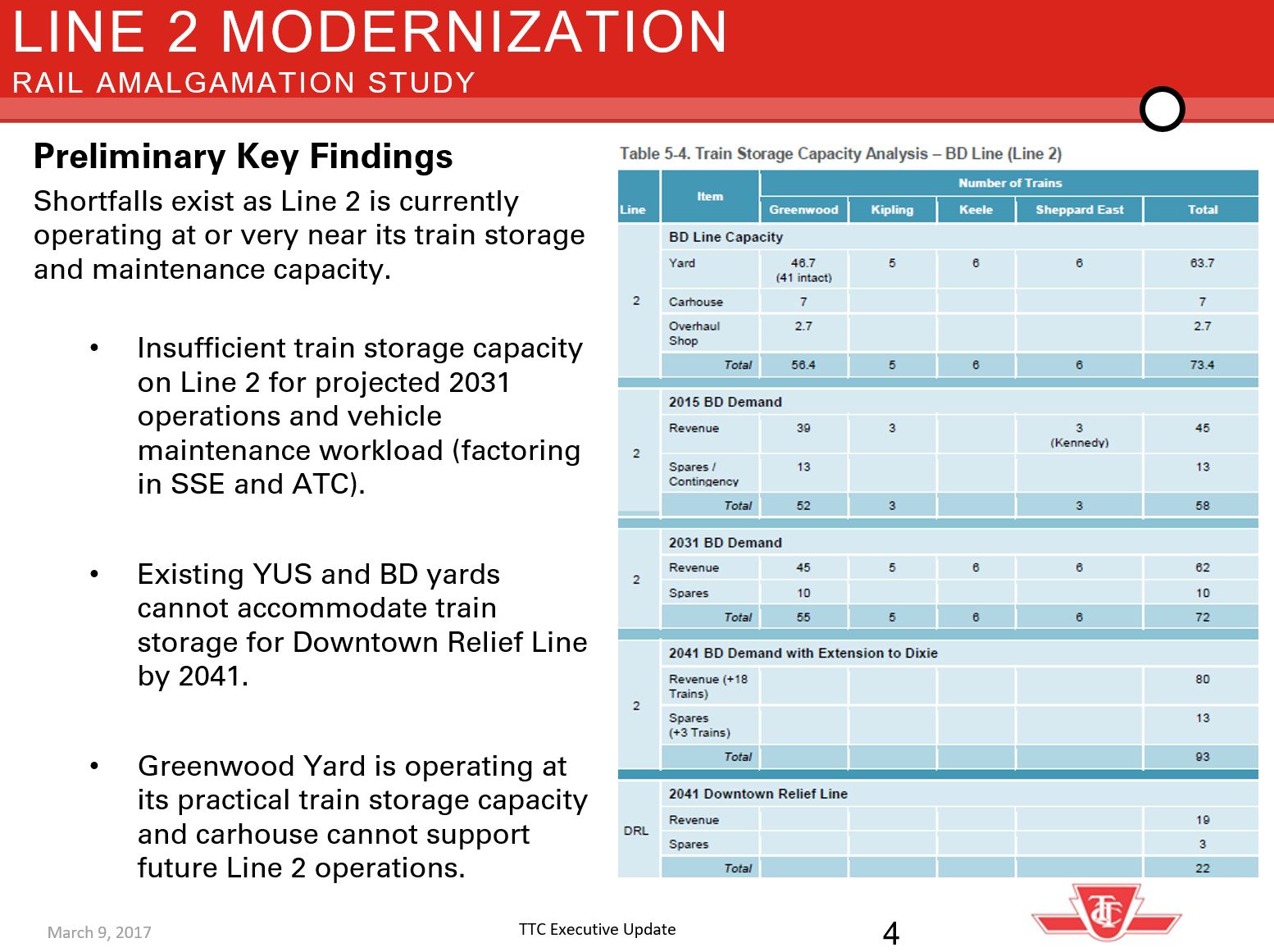
A Rail Amalgamation Study was conducted for the TTC by HDR and Gannett Fleming starting in 2015, and it was expected to finish in 2017. The intent was to review the line’s needs based on various future scenarios. For maintenance and storage facilities, it would consider:
The use of 2-car sets rather than the 6-car TR train configuration.
Possible line extensions
Expansion of the work car fleet to support expanding infrastructure
Implementation of ATC (Automatic Train Control) signalling
A preliminary report from the study showed that capacity would be a major problem. Note that in the context of this study, the Ontario Line did not yet exist, and the intent was that Greenwood Yard would host the Downtown Relief Line trains. Even without the DRL, Greenwood would not be able to handle expected growth in demand on Line 2.
The remainder of this article shows the details of the resulting plan, notably proposals for a new Line 2 fleet and expansion of the work car fleet that might have been set in motion had this scheme not been sidelined.
The TTC had a consolidated plan for Line 2 (and for the DRL), but this fell victim to budget cuts, the idea that we could “make do” rebuilding old trains and signal systems, and then the Provincial intervention with Metrolinx showing how they “knew better” how to plan and build rapid transit lines. We all know how that worked out.





 Steve Munro