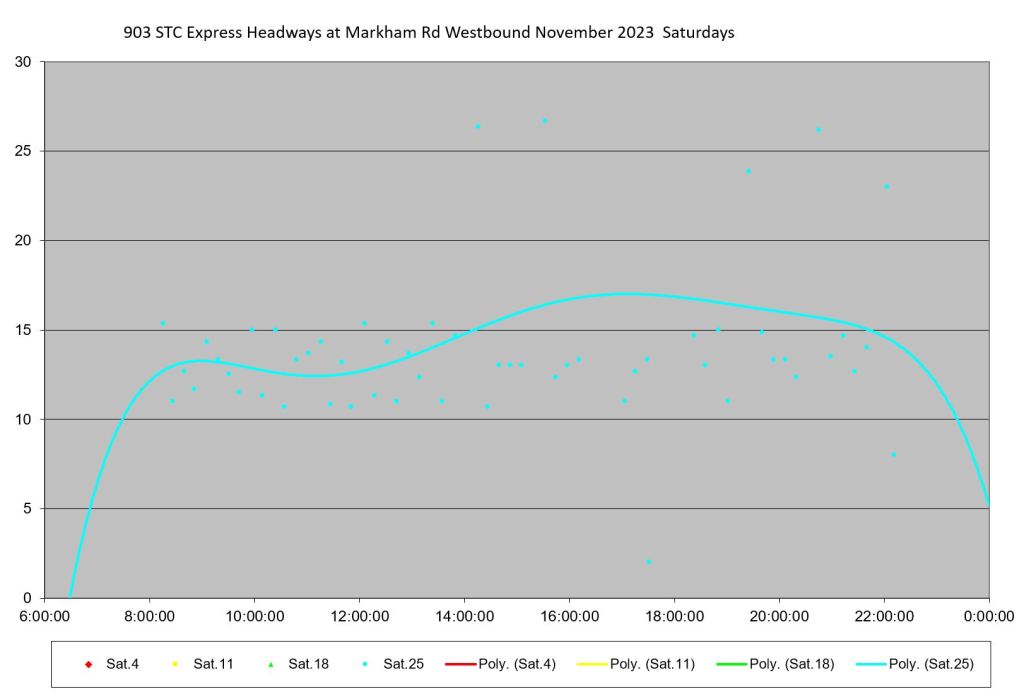
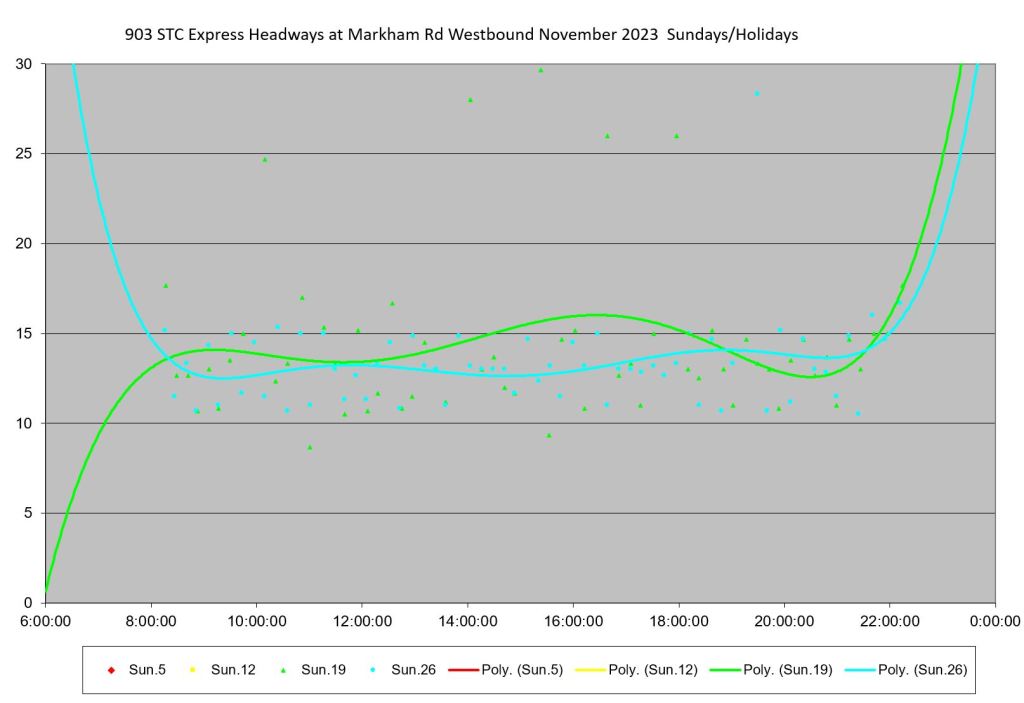
Line 3 SRT Replacement Service and Derailment Investigation

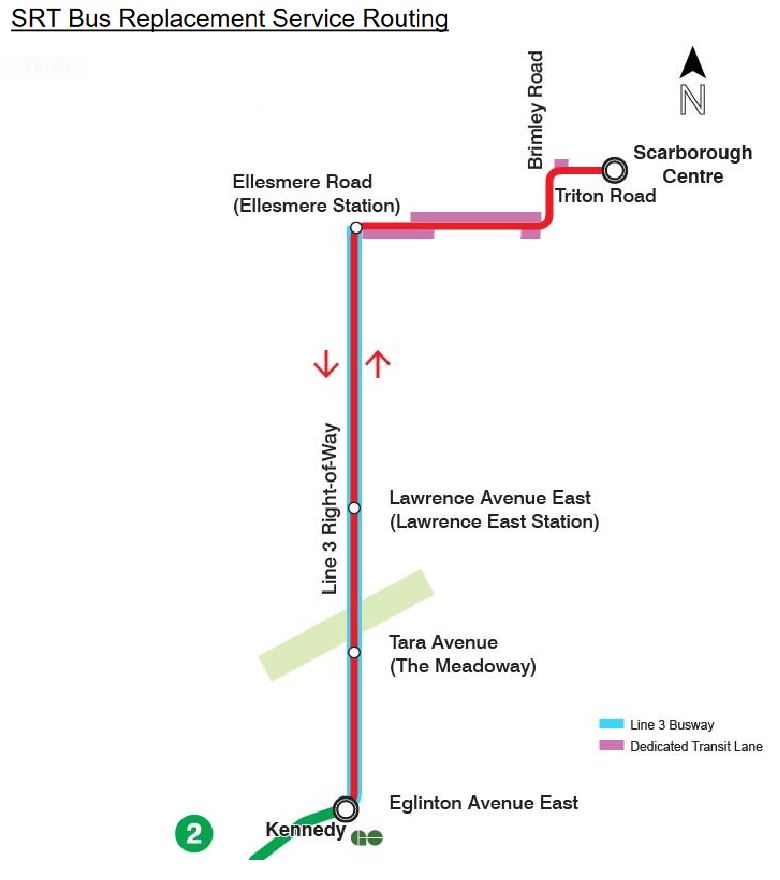
The TTC Board received a presentation at its September 26, 2023, meeting updating the information in the report published with the agenda. The first part deals with plans for the Line 3 bus replacement service and gives additional details beyond those previously announced.

The shift to using all of the Red Lanes on Ellesmere, Midland and Kennedy is planned for November 19.

The travel time today is considerably higher than when the RT was operating (second bar in the chart on the right below). This will be reduced with the elimination of transfers at STC between feeder routes and the 903 shuttle service together with the full transit priority implementation in mid-November. Further saving is expected when buses shift to a busway in the SRT corridor.

On November 19, eight routes will be extended to Kennedy Station to eliminate the need to transfer to the 903 shuttle.

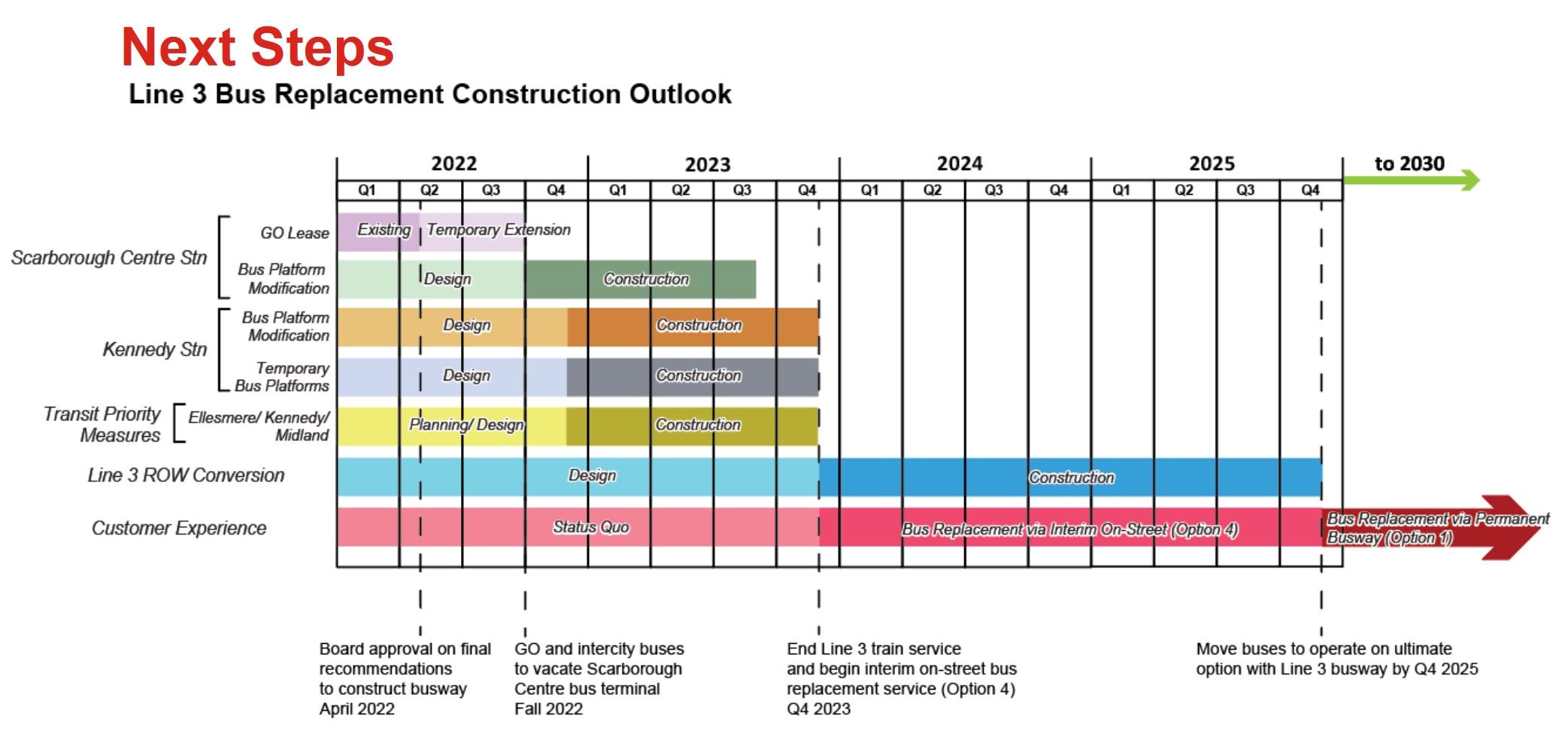
The most disappointing part of the presentation is the timeline overview which shows the opening date for the busway in the SRT corridor as 2026. Design work is underway to be completed in 2024 with construction in 2025 aiming at a mid-2026 opening date.

Continue reading

New Metrics for a New TTC

With the changing of the guard in the Mayor’s Office and a shift in the political balance of the TTC Board, it is time to blow the dust off of the metrics in the TTC CEO’s Report and elsewhere. I have written about aspects of this before, and will not belabour earlier arguments. However, in an era of recovery, we need to show what this is actually happening, and that we are getting good use out of the transit infrastructure, notably a large vehicle fleet, that we already own.

The areas of particular interest are:

  • Ridership, demand and crowding on routes
  • Service quantity and reliability
  • Fleet availability, usage and reliability

The CEO’s Report is replete with “Key Performance Indicators” (KPIs), a favourite tool of lazy managers to give the impression a complex organization and process can be reduced to a handful of simple numbers. Either “up” or “down” is considered “good”, and as long as the lines move in the correct direction, gold stars are handed out like confetti. Rarely, if ever, is the underlying process, the product, or the real meaning of the KPIs discussed.

A subtle, pervasive issue for TTC KPIs is the focus on top line numbers for ridership and revenue. This is akin to a restaurateur who counts the receipts and the number of meals sold without asking what brings diners to the door, or even worse, whether they will come back. The goal is to sell more meals, preferably at a low cost. Advertising, not word of mouth, generates new, if not lasting, trade.

Ridership is a rough measure of system use and a point of comparison for post-pandemic recovery, but it does not tell the whole story. Already we know that the bus network which is mainly based in the suburbs has recovered much of its pre-pandemic demand, although this is not distributed the same way with shifts in peak periods and in travel patterns. Off peak recovery is stronger than peak, in part because “work from home” affects less than half of the total demand, and non-work trips still occur.

Even “growth” can be misleading. In pre-pandemic times, the TTC routinely celebrated year-over-year riding growth even while the rate of growth slowed and eventually stalled. A problem flagged at the time was that growth occurred disproportionately in the off-peak where there was surplus capacity. That capacity filled up, but thanks to budget constraints service did not expand to match.

This shows the danger of looking at a single, simple number without understanding the detailed system behaviour, or even worse, of using the simple metric to hide a growing problem. Trimming capacity to demand can be a vicious cycle that prevents growth.

The phrase “subject to budget availability” is a standard caveat on any goals, and it has haunted TTC planning for years, well before the pandemic. That might be a basic part of corporate management, but over many years it has become the foundation of TTC reality. Aim low because aiming higher will cost too much.

This speaks to the split nature of TTC goals. It is supposed to provide transportation, and the motto “Service, Courtesy, Safety” is emblazoned on the TTC’s coat of arms. However, the TTC Board sees its primary role as serving its political masters at Council and especially the Mayor.

I wrote about TTC culture and that motto back in 2010. For context, this was before Andy Byford became CEO, let alone Rick Leary.

The common problem with many KPIs the TTC publishes is that they are one dimensional and report only average values of major variables. They do not necessarily reflect what riders see nor give a sense of the shortfall between what the system achieves and what could be possible.

I have said this before: riders do not experience “average” trips any more than diners in a restaurant experience an “average” meal. A four-star restaurant might outdo itself with a plateful of magic from the kitchen, but an off day could bring overcooked, lukewarm food and indifferent treatment by the wait staff. Getting it right most of the time doesn’t warrant four stars. Getting it right only some of the time doesn’t warrant any. The diners are paying for all four.

On occasion, I am asked how I would change the TTC’s KPIs to better show what is happening. My first response is that many aspects of a transit system cannot be reduced to one-dimensional metrics that compress all of the vital details into simplistic averages.

TTC needs to focus its performance metrics on service-related factors, direct measures of what riders experience. Average values will not do, and the Board needs to understand what these numbers mean. Providing tolerable service on most routes a good deal of the time is not an advertisement for “the better way”. Provide attractive, reliable service and riders will follow.

Continue reading

TTC Service Changes Effective Sunday, September 3, 2023 (Preliminary)

This is a preliminary version based on GTFS data (the standard format for transit schedules used by online services) and some Service Advisories on the TTC site. I expect to receive the full list of September service changes early in the week of August 28 and will update this article accordingly including the usual detailed comparison of service levels.

Updated August 26 at 9:15 pm: 512 St. Clair updated to reflect complete bus replacement for work at various locations on the line.

Updated August 27 at 4:30 pm: At 10:30 am on August 28, the Mayor, TTC Chair and CEO will hold a press conference at STC Station to “outline how the TTC will increase service beginning September and into the fall.”

Updated August 29 at 5:30 pm: Due to changes in the Metrolinx schedule for work on the Lake Shore East Queen Street bridge, there has been a further revision of planned service. Please see this post for details.

Continue reading

TTC Confirms SRT Will Not Reopen, Plans Bus Improvements

The TTC has announced that the SRT will not reopen and that the focus will now be on the replacement bus service.

The review of the July 24 derailment is still underway and is unlikely to complete with much time left for remediating the condition of the SRT and restarting service for a short period before the planned November 18 shutdown.

The initial operation with reserved bus lanes is under construction with painted lane markings southbound on Midland and northbound on Kennedy between Eglinton and Ellesmere. Other work including red painted lanes, queue jump lanes and signal priority will be implemented in the next three months.

One problem caused by the unexpected early SRT shutdown is that the temporary bus terminal facilities at Kennedy Station are not yet completed. A interim terminal north of Kennedy Station will be used. Once the station reconfiguration is done, eight routes that now terminate at STC will be extended through to Kennedy Station to eliminate transfers.

This was part of the original plan for the SRT replacement service. The list of candidate routes for transfer elimination is 38 Highland Creek, 129 McCowan North, 131 Nugget, 133 Neilson, 134C Progress, 939 A/B Finch East Express, 954 Lawrence East Express, 985A Sheppard East Express [source: FAQ within Future of TTC’s Line 3 Scarborough].

According to the press release, the TTC is working to remove the existing SRT infrastructure and build the replacement bus roadway sooner than the original plan that stretched out two years. An updated target date has not been announced, buy the TTC’s recognition that this roadway is urgently required is a welcome change.

A larger issue critical to review of TTC’s maintenance plans is whether the derailment is a “one of” event, or if there has been a general decline in TTC maintenance across the system. This is directly tied to capital and operating budget planning for 2024 and beyond.

A Revived, Activist TTC Board?

Following Olivia Chow’s election as Mayor of Toronto, the process is now underway to repopulate committee and board appointments that will reflect the Mayor’s and Council’s priorities .

The Striking Committee – Councillors Malik (Chair), Bravo (Vice-Chair), Carroll, McKelvie and Perks – is very different from the crew who managed this process under Mayor Tory. Only Deputy Mayor McKelvie was carried over from previous era.

The City Clerk polled Councillors to determine each member’s interest in a wide variety of positions, and their requests will be considered by the Committee at its meeting on August 10, 2023. Their recommendations will be forwarded to Council for approval at a special meeting on the afternoon the same day.

Up for grabs are six positions on the TTC Board including the Chair and five other seats. The Councillor members’ terms will run to the end of 2024 when the process of juggling appointments will be repeated (standard practice at Council’s mid-term), although the sitting TTC Board members are likely to be reappointed for a further two years.

The remaining four members of the board, non-Council “public” members, will not be up for reappointment until early 2025 or 2027 unless Council rescinds them sooner. Any selections will be affected by the revised membership in the Civic Appointments Committee.

Today there are only five Councillors on the Board and there is one vacancy.

Councillors who have asked to be considered for the TTC Board are: Ainslie, Burnside, Holyday, Mantas, Matlow, Moise and Myers. Of these, all but Matlow and Myers are already on the Board, and Burnside is Chair. (The Vice-Chair is chosen from among the citizen members.)

The Striking Committee and Council should aim to create a TTC Board that actively pursues policies to improve transit. This includes public debates about just what we, as a city, expect of the system. Wringing their hands and saying “we can’t afford anything, so we won’t bother trying” should not be an option.

There are huge challenges financial (the City’s budget deficit), political (the Ford government at Queen’s Park) and organizational (the less-than-steller performance of and reputed poisonous environment under CEO Rick Leary). Any would-be Commissioner who views their job as simply showing up for meetings now and then to hear good news stories should seek work elsewhere.

The TTC has just embarked on consultation for its 5-Year Service Plan and a Customer Experience Action Plan. This might have been a business-as-usual plan under Mayor Tory entrenching a “Board approved” set of targets driven by a conservative agenda.

Toronto needs much more, an aspiration not just for “better” transit, but for a greater relevance of transit to riders across the city. Even if our goal is out of reach in the short term, we should aim high.

Continue reading

The Scarborough RT Derailment

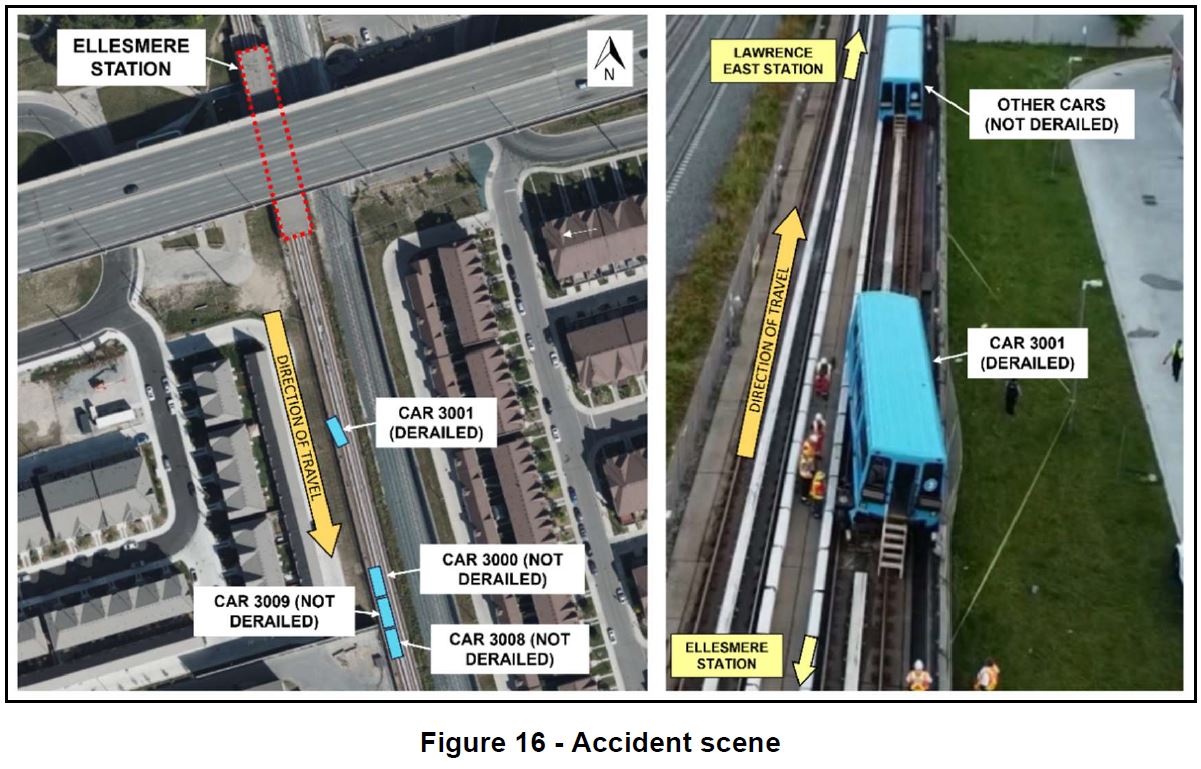
On Monday, July 24 at 6:45, a southbound SRT train was leaving Ellesmere Station when its rear car derailed. This was not simply a case of slipping off of the tracks, but a more complex incident in which:

  • The rear car of the train broke away from the other three cars.
  • The truck (or bogie, the undercarriage holding the wheels and motor) at the rear of this car was detached from the car.
  • A section of the reaction rail which is part of the propulsion system broke away from the guideway.

The car came to rest with one end leaning against the guideway’s fence and a low sidewall. Fortunately, this is a location where a derailed car could not fall any distance.

Five passengers were taken to hospital with minor injuries.

The line remains closed with shuttle buses ferrying riders, and the TTC has announced that the line will remain closed for at least three weeks pending an investigation of the cause of this accident. That will take us until at least mid-August.

It is not certain if the line, which was planned to shut down permanently in mid-November, will ever re-open depending on the cause of the derailment, the amount and cost of work to remediate it, and the limited time during which this expense would have any benefit.

Updated July 27 at 10:20pm: The proposed schedule for the SRT right-of-way conversion to a busway has been added to the article to clarify that “Winter 2025” really means the end, not the beginning, of 2025.

For the convenience of readers, especially those out of town who might not have followed this event in detail, here are links to many articles which include a wealth of photos.

City TV

CP24

Global News

Toronto Star

Spacing

  • Technical Difficulties: The Scarborough RT accident was absolutely predictable as policy-makers and riders have been aware of it’s deterioration for almost 20 years

CBC

Continue reading

Grading Toronto Region’s Transit Systems (Updated)

The Toronto Region Board of Trade recently published a review of municipal transit systems against an overall set of targets. Intriguingly, this document goes by two names:

  • Needs Improvement: Toronto Region Transit Report Cards is the title cited on the main announcement page for this report.
  • Needs Improvement: Getting to World-Class Transit is the actual title on page 1 of the report itself.

To little surprise, the most mature among the municipal systems received the highest grades: Toronto, Mississauga, Hamilton and Waterloo Region. The challenge with any grading system, assuming that it is uniformly applied, is the structure and goals used in any evaluation.

Updated July 12 at 11:10pm: Comments by Darwin O’Connor of TransSee.ca regarding reliability metrics are now reflected in the text of this article.

Updated July 10, 2023 at 3:00 pm: The City of Guelph had their grade upped from a D+ in the original rankings to a C+ based on service reliability which is quite high on that system. This raises a few key questions:

  • Was the “reliability” metric cited by Guelph the same as the one used by the Board of Trade for other systems? Just what does Guelph’s claimed reliability score of 88% mean?
    • (Updated) Darwin O’Connor, who calculated the reliability metrics for the Board of Trade Report, advises that he also provided the Guelph score and used the same methodology as for other cities where tracking data were available.
  • Reliability counts for 35% of the total mark. Was Guelph scored zero on this simply because the Board of Trade didn’t have service tracking data for them?
  • Reliability data are also listed as “Not Available” for Oakville and Milton. Considering that neither of them has a 15 minute service area, awarding them substantial marks for being “on time” with what they do run would be boost that might not be fairly earned.
    • (Updated) O’Connor replies: “TransSee is unable to provide reliability data for Oakville because their API doesn’t have a method to get all vehicle locations at once. I also didn’t have tracking data for Milton because my data source is unofficial. I expect if it was included they would get a better mark like Guelph did.”

If anything, this gaffe reveals sloppiness in the Board’s methodology and the typical problem of looking only at the high level summary without poking “under the covers” to verify the results. The Board of Trade should try harder for accuracy and completeness on their next transit outing.

See also Global News coverage of this change.

The Board regards the ability to move workers, students and residents as an important economic goal, and the absence of good transit as a drag on the region’s economy.

“Improving transit is critical to addressing our reputation as North America’s third-most congested city – a key barrier to the economic competitiveness of our region,” said Jan De Silva, President & CEO of the Toronto Region Board of Trade. “These report cards highlight where we’re falling short and, as a result, what we can look to as we seek to provide a world class transit network that will better-connect workers to jobs, students to school, and residents to their lives.”

TRBOT Media Release, July 5, 2023

There is a fundamental difference between a mere evaluation of our transit systems versus each other, and one that would qualify systems as “world class”. That term sets a much higher threshold, and there is no sense that the Board of Trade took this into account when constructing its grading system.

Updated July 10, 2023 at 3pm: The chart below is the revised version showing Guelph with a C+ grade.

“Getting to an A” is the premise behind the review, but much less clear is whether that “A” will actually bring the type of transit network and service to be truly competitive, to be “world class”.

The Board acknowledges the limitations of its review and notes that some conditions “are the result of a historical lack of investment and operational resources”. That is a delicate way of saying that transit has not been a priority at the political and social level. As population and travel growth shift the emphasis toward transit, “… suburban cities now find themselves pressured to stand up an urban-quality transit system that helps residents move within and throughout the region …”.

Key findings include:

  • The combination of network coverage (where there are routes close to people and destinations) and service is poor in most of the region.
  • Service reliability is particularly bad in Toronto with only 58% of trips meeting an “on time” standard.

Another important factor is that a line on a map does not guarantee good service, or service at the time and to the destination a rider might require. GO Transit, a system notably absent from the Board’s analysis, looks good on a map, but not quite so good on the timetable.

For an organization like the Board of Trade, this is a rare recognition that transit is more than a handful of high profile construction projects. A dominant car-oriented culture led directly to the congestion that bedevils the region. Cars enable travel throughout the region, but a corresponding web of transit service never developed. Our collective focus on big ticket projects to support commuting traffic primarily to Toronto’s core left other travel to lower-quality bus service, if that.

In all the hoopla about billions in “transit investment” we forget that over a decade ago the Metrolinx regional plan clearly showed that their proposed network would at best keep congestion from worsening, but would not relieve the underlying problem.

In this article, I will review the scoring system and the goals it seeks to achieve, what the Board considers worthy of an “A” grade. Are we aiming high, or is our definition of “world class” merely good enough to remove some of the more embarrassing gaps in our region’s transit network?

For those wanting the answer up front, no, I believe that the Board, and by extension the political voices they represent, are aiming low. Either they would give everyone an “A” grade for middling improvements, or they would be forced to admit that “world class” is out of reach.

The target for “frequent” transit service is not exactly high. If we were evaluating a road network on a similar basis, we would be happy with two lane roads on a roughly 1.6km grid. That would be a square from roughly Bloor to Dundas, and from Yonge to a bit west of Spadina. The roads would only require capacity for 200 people/hour each way equivalent to four full buses on a 15 minute headway. Some roads would close every evening and all weekend.

That is hardly a “World Class” transit service. The target coverage and service level befit a rural area with cows and sheep grazing by the roadside, not an urban transit system. This target understates the true shortfall in transit as a viable travel alternative.

Continue reading

Metro Morning June 27/23

On June 27, I was one of several guests on CBC’s Metro Morning doing “where do we go from here” pieces about newly elected Olivia Chow’s challenges as Mayor of Toronto.

The item was not posted on the show’s website, and so here for those who missed it is my own recording.

TTC 2024 Service Plan Consultation Round Two

The TTC is part way through production of its 2024 Service Plan as well as a 5-Year Service Plan and Customer Experience Action Plan. In Round Two, consultation will focus on plans for service changes triggered by major construction projects. Five pop-up sessions are planned at Flemingdon Park, Union Station, Liberty Village, Finch Terminal, and Pape Station between June 29 and July 12, 2023. Details are available here.

Also available on that page is a link to a survey seeking feedback on various proposals. Please note that my site is not an official TTC conduit for feedback, although it is no secret that many at the TTC do read articles and comments here. Any specific feedback for the TTC should be submitted through their own survey.

Round Three in August-September will present draft concepts for the 5-Year Plan and Customer Experience Action Plan, and these will be refined into final drafts for Round Four in October-November.

The remainder of this article presents an overview of the survey and proposals for construction-related service changes.

There are no proposals for new routes nor of overall service levels in this round. The election of Olivia Chow as Mayor will no doubt bring a review of existing services, but that is not in the scope of this round.

An important issue left over from the 2023 Budget process and the recent service cuts is the question of Service Standards. These are described as “Board Approved”, but in fact the 2023 changes were implemented by management as part of the budget with only retroactive consent from the Board. Moreover, the actual effect of the changes was withheld from the Board and Council until well after the budget was approved.

Transparency in budgets and service planning will be an important change looking ahead to 2024. With a new Mayor I hope to see a much improved process.

Continue reading

TTC Cancels RFP For New Subway Trains (Updated)

A Request for Proposals for new subway trains has been cancelled due to lack of funding. The following notice was sent to all vendors on Friday, June 23:

The Toronto Transit Commission issued a Request for Proposals (RFP) on October 13, 2022 for the procurement of New Subway Trains.

The RFP indicated that the TTC was in the process of actively pursuing additional funding from other orders of government (Provincial and Federal), and that contract award was subject to receiving full funding commitments by early 2023. As detailed in item 1.2.2 – Funding Status of Part 1 – Invitation and Submission Instructions of the RFP document: “Timelines associated with this RFP have been communicated to potential funding partners, and a request for confirmation of funding by early 2023 has been requested. In order to receive the NST deliveries in time for the legacy fleet replacement and to meet growth needs, the TTC has elected to commence the procurement at this time, however, contract award is subject to receiving full funding commitments.”

Unfortunately, the additional funding required has not been secured and as such, TTC is cancelling the RFP effective immediately, and the Bonfire Portal will be closed.

The TTC will continue to have discussions with the Provincial and Federal governments on funding requirements for New Subway Trains and evaluate the requirements for issuance of a future Request for Pre-Qualification and Request for Proposals in the future.

Where this leaves future projects for enhancement of Line 2 Bloor-Danforth, conversion to Automatic Train Control and provision of full service on the Scarborough Subway Extension is anyone’s guess.

This is a project which was initially delayed by CEO Rick Leary in favour of a fleet rebuild, then reactivated as his attitude to the worth of ATC warmed with the success of the Line 1 conversion, a project very much the work of his predecessor Andy Byford and his team. The focus on spending for new lines has left major state of good repair such as fleet renewal high and dry, and this RFP cancellation show where that shortsighted policy has brought us.

I have reached out to TTC Media Relations for comment. This post will be updated as more information becomes available.

Updated June 26, 2023 at 3:45 pm

The TTC replied to my query for comment with the following:

As the posting says (or should), the purchase of the cars is contingent on funding being secured.

That has not yet happened, although discussions are ongoing.

This was about being transparent with bidders and letting them know that once funding is secure, we would re-post.

It is worth noting that as recently as the TTC Board meeting of June 12, 2023, there was no mention in the public session that this action was imminent. Here are the relevant pages from the Major Projects Update.

Updated June 26, 2023 at 5:00 pm

How many trains will the Scarborough Subway Extension require?

The TTC owns 370 cars in the T1 fleet which operates Line 2. That is equivalent to 61 6-car trains plus four spare cars.

The scheduled AM peak round trip time on the existing Line 2 is 105 minutes. For the maximum service possible with the existing signal and train control system, one train every 140 seconds, requires 45 trains. That was the AM Peak scheduled service in January 2020 before the pandemic-related service cuts. One additional train was on standby as a “gap” train for a total of 46. Allowing for spares at 20%, this requires a fleet of about 55 trains leaving only 6 spare for expansion.

The Scarborough extension is only marginally longer than the Line 1 extension from Eglinton to Finch with similar station spacing. A one-way trip on that part of Line 1 takes about 12 minutes, or 24 for the round trip. By analogy, that would make the round trip on the extended Line 2 about 129 minutes, and would required 55 trains with nothing left over for extras. Including spares at 20% would require a fleet larger than the TTC now owns.

Alternately, if every second train short turns at Kennedy Station leaving a 280 second service (4’40”) to Sheppard East, the line could probably operate with 50 trains which just fits within what is available.

One might argue that with a new fleet and the benefits of Automatic Train Control, overall speed could be improved and with that the fleet needed for full service to Sheppard could be reduced. But that is moot if TTC maintains the existing fleet.

When the SSE was planned, it had a pocket track east of Kennedy Station, but this was cut to save money, then it was restored. I wonder if someone is counting trains, or just hedging their bets on service levels beyond the existing terminus?

In any event, a failure to buy new trains has the double effect that it will condemn Line 2 to manual operation with an aging signal system for the foreseeable future, and will prevent the operation of full service beyond Kennedy in peak periods unless the Bloor-Danforth line never returns to the pre-pandemic peak service level.