On November 16, 2023, the TTC posted an RFP (number P58PW23631) on the Bonfire bidding website for “Track Maintenance Consultant Services”.
The short description, on the title page, is:
The Scope of Work of this Contract includes, but is not limited to the provision of Consulting Services specializing in rail transit to provide track and structure engineering support.
This caught my eye because of the SRT derailment that shut down that line prematurely earlier this year. Although TTC management stated that the full report on this incident would come out “in a few weeks”, it is now mid-December and the report has not been released.
In the September report to the TTC Board, the cause was cited as loose bolts holding the reaction rail which allowed it to be pulled upward by magnetic forces and collide with the train. What was not explained was how the condition of the track reached a point where this could happen.
Recently, the City’s Auditor General reviewed the practices of Streetcar Overhead maintenance, and found them badly wanting. On questioning at the Board meeting, the TTC’s head of infrastructure acknowledged that Streetcar Overhead was likely the worst department on that count, but it was not the only one. This begs an obvious question: what other TTC departments are not producing top quality work and what is the effect on service and safety. A second equally important question is how did TTC practices decline.
We hear a great deal about system safety with homeless people living in the subway, and panhandlers (or worse) harassing passengers, but the context for discussion is that these problems originate outside of the TTC. Is there a generic problem with maintenance, and hence with safety and reliability, within the system itself?
The first of a series of goals here is “Increase passenger and overall system safety”. Another goal to “Increase competence and capability of Track Maintenance and Engineering staff” is equally troubling.
Through the entire Scope of Work is a sense that much needs to be improved within the TTC’s subway track maintenance activities.
This article is a preliminary look at the service offered by the 903 express bus which replaced Line 3 SRT.
Until Saturday, November 18, the 903 buses provided very frequent service between Scarborough Town Centre and Kennedy Station. On Sunday, November 19, eight other routes were extended from STC to Kennedy Station, the 903 was extended to Centennial College replacing the 134/913 Progress bus, and much existing service on route 903 was reallocated to the extended routes.
I will review the other routes serving this corridor in early 2024 when they have accumulated a few months’ experience.
Travel Times
The charts here show how travel times between STC and Kennedy Station have changed over the past three months. The screenlines for these measurements are located:
Leaving STC Loop
Just north of Eglinton on Midland and on Kennedy
Note that this excludes time spent navigating roads and construction near Kennedy Station, and any time spent in STC Loop. I will review terminal operations when more data for all of the routes in this corridor have accumulated.
The charts below show monthly data, by week and hour, with North/Eastbound service on the left and South/Westbound service on the right. Note that there are no data for September, Week 1 because the service was provided with untracked extras until the schedule change on Labour Day weekend.
The solid lines show the average headways, and the dotted lines show the standard deviation, a measure of the scatter in the values. The closer the SD values are to zero, the more reliable the service is.
In the early weeks of operation, the transit priority measures were not in place, and service was more affected by traffic sharing the road. This settles down by November, although some peak period effects are still visible.
The TTC had anticipated that a trip between Kennedy Station and STC would take 15 to 18 minutes depending on conditions. Considering that the times shown below do not include access time to and from terminals, the service is close to the TTC’s target.
Service from November 19 Onward
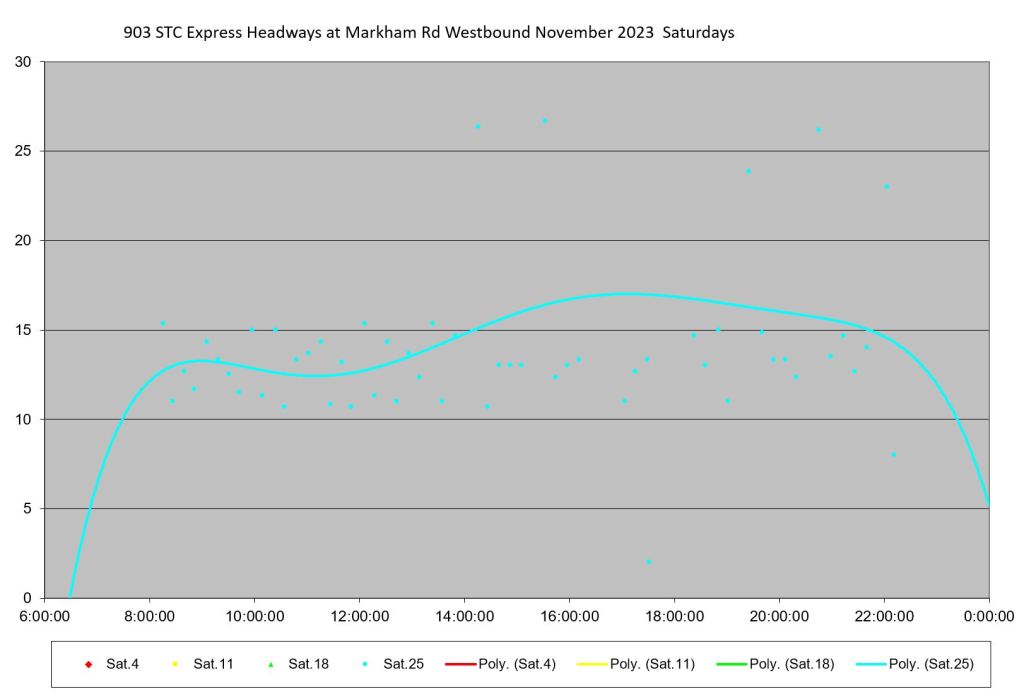
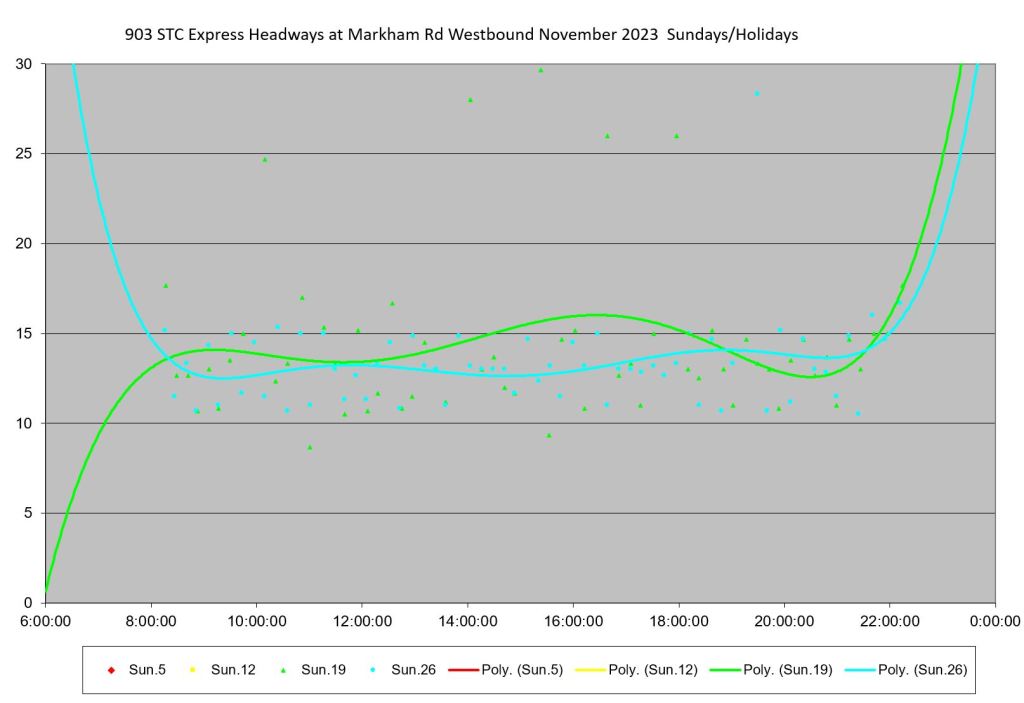
After November 19, the 903 STC Express became more typical of other routes with less frequent service. Variations show up that are similar to other parts of the system. The charts below show headways westbound at Progress and Markham Road, and northbound from Eglinton and Kennedy for the last two weeks of November. The scatter of data points shows the type of service that someone waiting for a 903 bus would experience.
Some data are missing on the morning of Friday, November 24.
Some of the wider headways (dots higher on the charts) have no correponding short headway (dot near the horizonal axis). This indicates that a bus was missing, as opposed to two buses running close together after a long gap.
The weekend charts at the south end of the line include data for the early part of the month when 903 service was much more frequent.
Although much of the weekend service stays close to the target headway, there are data points showing wide gaps where a bus was missing from the service. This is a concern for service east of STC to Centennial College.
After several weeks of behind-the-scenes discussions between the Ontario and Toronto governments, amid various side-shows such as the Greenbelt scandal, the bribes for planning overrides, the potential destruction of both Ontario Place and the Science Centre, there is a deal, sort of.
In the immediate publicity after the announcement on November 27, the level of information varied depending on which document one read all the way from simple, enthusiastic political statements up to terms sheets and draft legislation.
Toronto comes out of this with a better fiscal situation, including some benefits for transit, but some battles are now over, conceded as part of the deal.
Recovery Through Growth Act (City of Toronto), 2023
Rebuilding Ontario Place Act, 2023
The Rebuilding Ontario Place Act has considerable detail on the redevelopment of Ontario Place, and it is clear that this was not pulled together at the last moment. Although the announcement speaks of design changes and makes passing reference to the Science Centre, neither of these is mentioned in the Act which confers substantial power on the Province to do anything it wants, and compels Toronto to stay out of the way.
The Recovery Through Growth Act, by contrast, is threadbare with only the most cursory provisions recognizing the discussions between Toronto and Ontario, and leaving the bulk of any details to Regulations that might be enacted by the Lieutenant Governor in Council (the Provincial Cabinet).
The new financial arrangements for Toronto extend only three years, roughly until after the next provincial and municipal elections, when the context of any renewal might be different. Meanwhile, the Province and City will “undertake a longer-term targeted review of the City’s finances to be completed by 2026”. [Detailed Term Sheet Cover Letter, p. 2]
Both parties expect added support from the federal government, although the dollar amounts and target projects vary between the City and Province.
The “core commitments” in the Detailed Terms begin with a recognition that housing and transportation are intertwined issues:
Toronto needs to expeditiously streamline and optimize planning approvals and accelerate the delivery of affordable, attainable, and rental housing across the continuum. As density is added, Toronto’s transit and city-enabling infrastructure needs to keep up. The upload of the Gardiner Expressway and the Don Valley Parkway will create significant additional capacity for the City to support building more homes faster in Toronto and across the GTHA.
The City commits to using immediate financial benefits as well as all future financial benefits of the upload (pending Provincial due diligence) to support historic investments in housing and the infrastructure that supports and enables growth such as transit, water and wastewater infrastructure, and local road improvements.
What is needed now from the City is an updated pro forma 2024 budget showing the effects of this agreement. This would inform consultation and debate now in progress leading into the budget cycle at Council.
On the transit front, the entire debate about service restoration and quality must be updated with a sense of the monies that will be available in coming years, and the possible targets Toronto can aim at depending on how much additional support is provided to the TTC.
The following sections are arranged by major topic area and are reordered from the Detailed Terms.
The TTC is conducting its final round of consultation about its five year service plan covering the period from 2024 to 2028. This is a longer view of what the TTC might focus on over multiple years, a related but separate process from the Annual Service Plan for 2024 that will come to the TTC Board’s November 22 meeting. Although the range begins in 2024, in practice, 2025 will be the first budget year informed by the five year plan.
There is an online survey covering many topics, and I will review that it more detail later in this article.
Of particular interest as background to this process is the result of the third consultation round conducted in late summer. The TTC’s overview of the action plan and consultation includes detailed notes of feedback from various groups: online survey respondents, stakeholders (community groups and advocates), employees, riders, and youth ambassadors. There is a common thread through all of them about problems with information and communications, service quality and management. What remains to be seen will be whether the TTC has any appetite for addressing these issues rather than making superficial changes that sound good but achieve little.
I recommend reading those consultation summaries both to transit riders who might think they are lonely voices crying into the wind for better service, and to politicians who have only a tenuous grasp of what riders really want and need. Open the overview page for the service plan, and scroll down to Consultation Documents, Round Three.
Of course any major change depends on funding if more service is involved, but it also requires an organizational recognition that every transit problem cannot be blamed on uncontrollable, external forces. The issue of communications is entangled with the TTC’s organizational structure and the fractured responsibility for various aspects of getting the message out to riders.
The service plan itself echoes these limitations in that it talks about what might be done in general, but it is silent on basic matters such as how much service the TTC can physically provide (fleet size and availability, staffing limitations), and the magnitude of costs involved in changing service levels. Some issues, such as better management of service frequency and reliability require recognition that simplistic definitions for “on time” have little meaning in the real world faced by riders and operators.
The time is long overdue to stop the kudos for achieving “key performance indicators” that misrepresent the actual quality of operations. Lest this seem a rather broad indictment without background, I refer readers to the many articles I have written both on the content of the CEO’s Report and detailed reviews of day-to-day operations.
A review of the fourth round online survey follows below together with notes on information from this round of stakeholder meetings.
The TTC is in a very difficult position for capital planning because for many years it understated the size of the capital backlog and also tended to treat related projects, or even components of the same project, as separate items. This led to low-balled estimates of total costs and, in some cases, piecemeal execution of projects. Now that we see “all in” costs, the problems facing the system are perceived more seriously, but just at a point when new money to invest in existing subways is hard to find.
Although the TTC called for proposals for a replacement of the Line 2 fleet of T1 trains, with add-on provisions for system expansion, this was cancelled in June 2023 due to lack of funding commitments from either the Provincial or Federal governments.
The report proposes three scenarios depending on when new trains and facilities would be delivered and built at total costs ranging from $8.5 to $10 billion including inflation. Very little of this has committed funding.
This is not just a question of buying new trains, but of building, or renewing, many facilities:
Greenwood Carhouse dates back to the opening of the BD subway and needs to be modernized and rebuilt to handle a new fleet.
The signal system on Line 2 dates to the 1960s and must be replaced both to maintain reliability, improve operations and provide for service growth.
Additional trains for both Lines 1 and 2 will require more storage including a major new maintenance facility for Line 1.
The funding sought by this report does not include companion upgrades that have been flagged in the overall capital plan:
Running more frequent service requires more traction power on top of state of good repair work needed for both subway lines’ power systems.
More service means more passengers, and some key stations cannot handle additional demand between the platform and street without additional circulation capacity.
Moreover, there are major projects beyond subway fleet renewal that are either partly or totally unfunded even at the City level, never mind its partners:
Ongoing replacement of the bus fleet including electrification
Any provision for service growth to improve transit coverage and encourage a shift to transit riding especially in areas where it is not competitive with auto
LRT lines in the waterfront or Eglinton East
Platform screen doors to prevent access to track level
Even if the fleet and signal renewal for Line 2 finds much-needed financial support, this is only the beginning of the TTC’s search for capital, and I have not even mentioned the need for ongoing state of good repair.
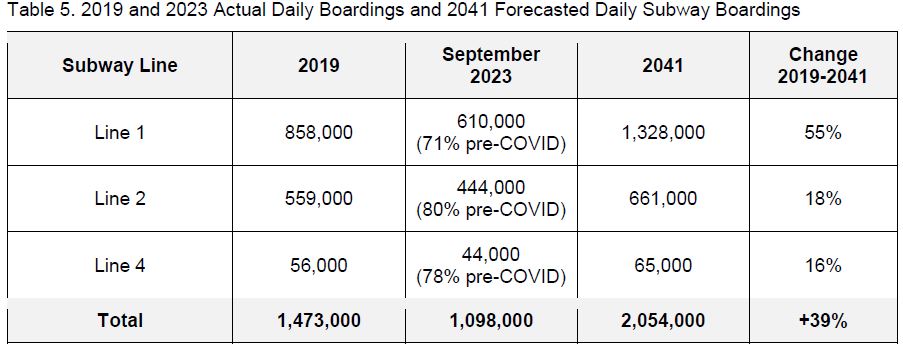
In the short term, the TTC has been “saved” from a capacity crisis by the covid pandemic and the loss of subway riding. Only a few years ago, the concern was not empty trains, but platforms full of riders who could not move. Although the subway is not back at full demand, recovery is well underway. Here are historical figures and projections for the future from the report.
2041 might sound a long way off, but in the scheme of subway fleet planning, it is fairly near given both the lead time to buy new trains and their 30-year design life. What we plan for today will affect the system for decades to come.
This forecast will be updated with results from the current Transportation Tomorrow Survey and other planning work to provide an outlook to 2051.
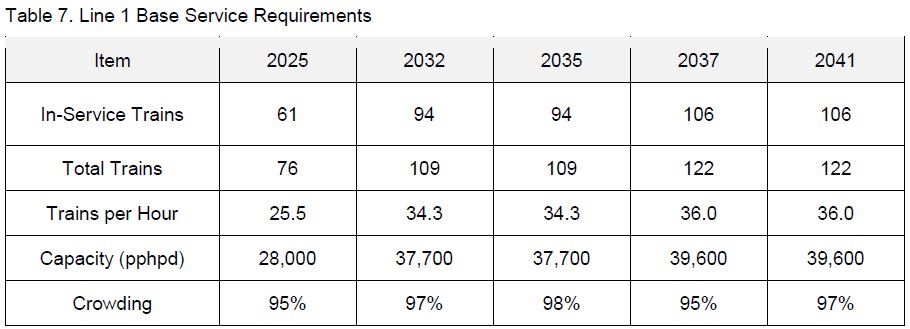
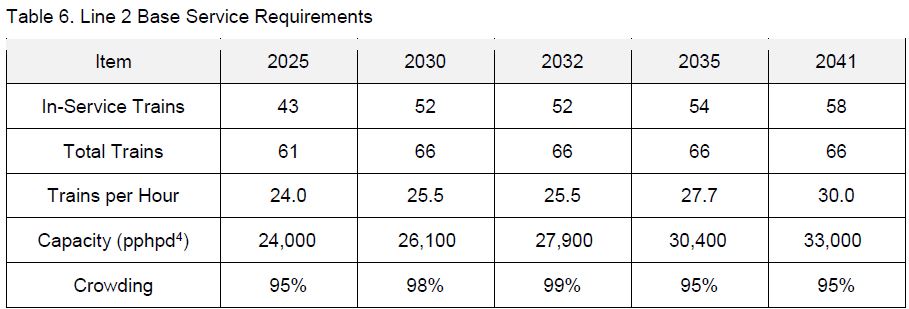
These projections translate to service requirements on the two lines. Note that this is likely based on the historical ratio of peak to all day demand. Although work-from-home may shift some riding away from peaks especially on Mondays and Fridays, this would still leave the midweek days facing crowding. It would be dangerous to make plans for lesser demand as a short-term cost saving measure.
Line 1 has already been converted to Automatic Train Control (ATC) with moving block signalling that can handle more trains/hour. Note that the projected Line 1 service is at 36 trains/hour, or every 100 seconds. This will be challenging to sustain especially at busy stations and terminals.
The current signal system on Line 2 cannot support headways below about 140 seconds, the pre-pandemic peak service level on that route. This is equivalent to 25.7 trains/hour which gets us only to the 2032 projected requirement.
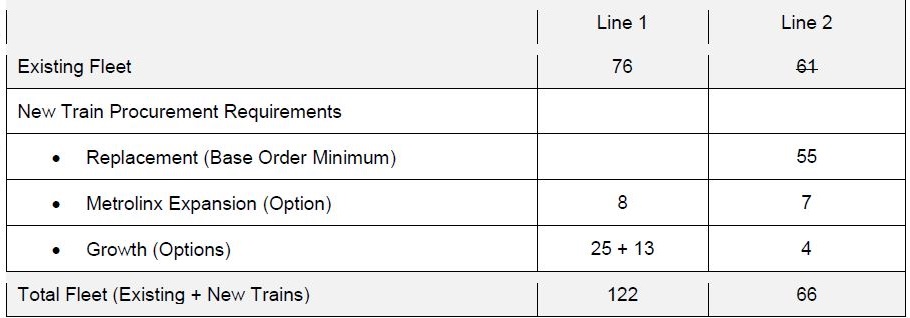
This translates into the following requirements for a larger fleet.
The 55-train replacement for Line 2 where there are now 61 trains is based on the capacity with new trains (similar to those now on Line 1) with about 10% more room than the old ones. This finally addresses the excess of T1 trains in the fleet ever since the TTC decided to run Lines 1 and 4 entirely with new “TR” trains and ATC, and relegated the T1 fleet to Line 2.
The Metrolinx options are for the Richmond Hill and Scarborough extensions. Growth trains are to permit the operation of more frequent service than the existing fleet can support.
Note that Line 4 Sheppard is not included here as it has a dedicated set of six 4-car trains that can handle projected growth on that line. Depending on the extension of Line 4, a future procurement of trains and storage facilities could be required.
In the remainder of this article, I will describe the scenarios and implications of choices the TTC, Council and its funding partners will make in the near future.
Recommendations
The report recommends that:
The TTC prioritize funding in the capital budget for:
New subway cars and related projects with a cost of $3.2 billion as the City’s share.
A 30-year state of good repair overhaul of the T1 fleet.
Risk mitigation activities for Line 2 related to fleet and signal system life extension.
Subject to confirmation of funding, the CEO issue an RFP for new trains needed on the existing Line 2 with options for extensions and demand growth on the system.
This will have effects not just for subway planning but for other TTC capital project funding and timing.
The TTC Board received a presentation at its September 26, 2023, meeting updating the information in the report published with the agenda. The first part deals with plans for the Line 3 bus replacement service and gives additional details beyond those previously announced.
The shift to using all of the Red Lanes on Ellesmere, Midland and Kennedy is planned for November 19.
The travel time today is considerably higher than when the RT was operating (second bar in the chart on the right below). This will be reduced with the elimination of transfers at STC between feeder routes and the 903 shuttle service together with the full transit priority implementation in mid-November. Further saving is expected when buses shift to a busway in the SRT corridor.
On November 19, eight routes will be extended to Kennedy Station to eliminate the need to transfer to the 903 shuttle.
The most disappointing part of the presentation is the timeline overview which shows the opening date for the busway in the SRT corridor as 2026. Design work is underway to be completed in 2024 with construction in 2025 aiming at a mid-2026 opening date.
With the changing of the guard in the Mayor’s Office and a shift in the political balance of the TTC Board, it is time to blow the dust off of the metrics in the TTC CEO’s Report and elsewhere. I have written about aspects of this before, and will not belabour earlier arguments. However, in an era of recovery, we need to show what this is actually happening, and that we are getting good use out of the transit infrastructure, notably a large vehicle fleet, that we already own.
The areas of particular interest are:
Ridership, demand and crowding on routes
Service quantity and reliability
Fleet availability, usage and reliability
The CEO’s Report is replete with “Key Performance Indicators” (KPIs), a favourite tool of lazy managers to give the impression a complex organization and process can be reduced to a handful of simple numbers. Either “up” or “down” is considered “good”, and as long as the lines move in the correct direction, gold stars are handed out like confetti. Rarely, if ever, is the underlying process, the product, or the real meaning of the KPIs discussed.
A subtle, pervasive issue for TTC KPIs is the focus on top line numbers for ridership and revenue. This is akin to a restaurateur who counts the receipts and the number of meals sold without asking what brings diners to the door, or even worse, whether they will come back. The goal is to sell more meals, preferably at a low cost. Advertising, not word of mouth, generates new, if not lasting, trade.
Ridership is a rough measure of system use and a point of comparison for post-pandemic recovery, but it does not tell the whole story. Already we know that the bus network which is mainly based in the suburbs has recovered much of its pre-pandemic demand, although this is not distributed the same way with shifts in peak periods and in travel patterns. Off peak recovery is stronger than peak, in part because “work from home” affects less than half of the total demand, and non-work trips still occur.
Even “growth” can be misleading. In pre-pandemic times, the TTC routinely celebrated year-over-year riding growth even while the rate of growth slowed and eventually stalled. A problem flagged at the time was that growth occurred disproportionately in the off-peak where there was surplus capacity. That capacity filled up, but thanks to budget constraints service did not expand to match.
This shows the danger of looking at a single, simple number without understanding the detailed system behaviour, or even worse, of using the simple metric to hide a growing problem. Trimming capacity to demand can be a vicious cycle that prevents growth.
The phrase “subject to budget availability” is a standard caveat on any goals, and it has haunted TTC planning for years, well before the pandemic. That might be a basic part of corporate management, but over many years it has become the foundation of TTC reality. Aim low because aiming higher will cost too much.
This speaks to the split nature of TTC goals. It is supposed to provide transportation, and the motto “Service, Courtesy, Safety” is emblazoned on the TTC’s coat of arms. However, the TTC Board sees its primary role as serving its political masters at Council and especially the Mayor.
I wrote about TTC culture and that motto back in 2010. For context, this was before Andy Byford became CEO, let alone Rick Leary.
The common problem with many KPIs the TTC publishes is that they are one dimensional and report only average values of major variables. They do not necessarily reflect what riders see nor give a sense of the shortfall between what the system achieves and what could be possible.
I have said this before: riders do not experience “average” trips any more than diners in a restaurant experience an “average” meal. A four-star restaurant might outdo itself with a plateful of magic from the kitchen, but an off day could bring overcooked, lukewarm food and indifferent treatment by the wait staff. Getting it right most of the time doesn’t warrant four stars. Getting it right only some of the time doesn’t warrant any. The diners are paying for all four.
On occasion, I am asked how I would change the TTC’s KPIs to better show what is happening. My first response is that many aspects of a transit system cannot be reduced to one-dimensional metrics that compress all of the vital details into simplistic averages.
TTC needs to focus its performance metrics on service-related factors, direct measures of what riders experience. Average values will not do, and the Board needs to understand what these numbers mean. Providing tolerable service on most routes a good deal of the time is not an advertisement for “the better way”. Provide attractive, reliable service and riders will follow.
This is a preliminary version based on GTFS data (the standard format for transit schedules used by online services) and some Service Advisories on the TTC site. I expect to receive the full list of September service changes early in the week of August 28 and will update this article accordingly including the usual detailed comparison of service levels.
Updated August 26 at 9:15 pm: 512 St. Clair updated to reflect complete bus replacement for work at various locations on the line.
Updated August 27 at 4:30 pm: At 10:30 am on August 28, the Mayor, TTC Chair and CEO will hold a press conference at STC Station to “outline how the TTC will increase service beginning September and into the fall.”
Updated August 29 at 5:30 pm: Due to changes in the Metrolinx schedule for work on the Lake Shore East Queen Street bridge, there has been a further revision of planned service. Please see this post for details.
The TTC has announced that the SRT will not reopen and that the focus will now be on the replacement bus service.
The review of the July 24 derailment is still underway and is unlikely to complete with much time left for remediating the condition of the SRT and restarting service for a short period before the planned November 18 shutdown.
The initial operation with reserved bus lanes is under construction with painted lane markings southbound on Midland and northbound on Kennedy between Eglinton and Ellesmere. Other work including red painted lanes, queue jump lanes and signal priority will be implemented in the next three months.
One problem caused by the unexpected early SRT shutdown is that the temporary bus terminal facilities at Kennedy Station are not yet completed. A interim terminal north of Kennedy Station will be used. Once the station reconfiguration is done, eight routes that now terminate at STC will be extended through to Kennedy Station to eliminate transfers.
This was part of the original plan for the SRT replacement service. The list of candidate routes for transfer elimination is 38 Highland Creek, 129 McCowan North, 131 Nugget, 133 Neilson, 134C Progress, 939 A/B Finch East Express, 954 Lawrence East Express, 985A Sheppard East Express [source: FAQ within Future of TTC’s Line 3 Scarborough].
According to the press release, the TTC is working to remove the existing SRT infrastructure and build the replacement bus roadway sooner than the original plan that stretched out two years. An updated target date has not been announced, buy the TTC’s recognition that this roadway is urgently required is a welcome change.
A larger issue critical to review of TTC’s maintenance plans is whether the derailment is a “one of” event, or if there has been a general decline in TTC maintenance across the system. This is directly tied to capital and operating budget planning for 2024 and beyond.
Following Olivia Chow’s election as Mayor of Toronto, the process is now underway to repopulate committee and board appointments that will reflect the Mayor’s and Council’s priorities .
The Striking Committee – Councillors Malik (Chair), Bravo (Vice-Chair), Carroll, McKelvie and Perks – is very different from the crew who managed this process under Mayor Tory. Only Deputy Mayor McKelvie was carried over from previous era.
The City Clerk polled Councillors to determine each member’s interest in a wide variety of positions, and their requests will be considered by the Committee at its meeting on August 10, 2023. Their recommendations will be forwarded to Council for approval at a special meeting on the afternoon the same day.
Up for grabs are six positions on the TTC Board including the Chair and five other seats. The Councillor members’ terms will run to the end of 2024 when the process of juggling appointments will be repeated (standard practice at Council’s mid-term), although the sitting TTC Board members are likely to be reappointed for a further two years.
The remaining four members of the board, non-Council “public” members, will not be up for reappointment until early 2025 or 2027 unless Council rescinds them sooner. Any selections will be affected by the revised membership in the Civic Appointments Committee.
Today there are only five Councillors on the Board and there is one vacancy.
Councillors who have asked to be considered for the TTC Board are: Ainslie, Burnside, Holyday, Mantas, Matlow, Moise and Myers. Of these, all but Matlow and Myers are already on the Board, and Burnside is Chair. (The Vice-Chair is chosen from among the citizen members.)
The Striking Committee and Council should aim to create a TTC Board that actively pursues policies to improve transit. This includes public debates about just what we, as a city, expect of the system. Wringing their hands and saying “we can’t afford anything, so we won’t bother trying” should not be an option.
There are huge challenges financial (the City’s budget deficit), political (the Ford government at Queen’s Park) and organizational (the less-than-steller performance of and reputed poisonous environment under CEO Rick Leary). Any would-be Commissioner who views their job as simply showing up for meetings now and then to hear good news stories should seek work elsewhere.
The TTC has just embarked on consultation for its 5-Year Service Plan and a Customer Experience Action Plan. This might have been a business-as-usual plan under Mayor Tory entrenching a “Board approved” set of targets driven by a conservative agenda.
Toronto needs much more, an aspiration not just for “better” transit, but for a greater relevance of transit to riders across the city. Even if our goal is out of reach in the short term, we should aim high.







 Steve Munro