TTC Madness: A Subway for Everyone

Today’s meeting of the transit commission was expected to be a modest affair with approval of the Downtown Relief Line study’s recommendations, and a few other housekeeping items.  What happened was a complete upending of the transit expansion policies we thought were put in place by the Karen Stintz coup d’état that bounced Rob Ford’s crew off of the TTC board back in the spring.  Stintz herself didn’t even have the nerve to stand up to the runaway proposals from her fellow members preferring to keep peace, for now at least.

To make sense of this debacle, I have to recount some of the earlier events.

The main act was a presentation by TTC staff of the DRL Study, and it contained few surprises relative to coverage we have already seen in the press and on this blog.  One comment caused attentive ears to prick up, namely that spending $1-billion expanding Bloor-Yonge station might be less cost-effective than providing additional capacity with a new line.  Would that the TTC would look at all components of its subway plans that way (a topic for another article), but it’s a refreshing point of view.

The study and presentation make explicit reference to potential shortfalls in GO Transit capacity as part of the problem.  Although these will no doubt annoy Metrolinx (is there a TTC meeting that doesn’t anger Metrolinx?), that agency’s basic problem is that long-term secrecy about what it might actually build forces assumptions to be made.  That said, nothing prevented the TTC from modelling improved service on the GO northern corridors just to see what this would do to demand flows on a “what if” basis.  After all, the whole DRL study is a “what if” exercise.

Councillor Parker asked about Main Station as an alternative DRL/Danforth subway connection.  Staff’s position is that there are advantages to a north-south connection further west that would potentially serve Thorncliffe and Flemingdon Parks, and line up with the Don Mills corridor.  (I will address DRL options in a separate article.)  There were humourous remarks about how staff were trying to buy Parker off with a subway to his ward.

Parker moved that the Danforth to Eglinton section of the DRL be included in the next phase of the study, but the motion fell short of actually committing to this segment as a top priority.

Councillor Milczyn asked about eliminating parking on King or Queen Streets.  Staff replied that this would be important for improved surface transit, and the idea would be part of a separate Downtown Traffic Operations Study now underway by the City, but that this would not avoid the need for a DRL.

Milczyn also asked about a Lakeshore West LRT and seemed to be mixing the proposal that was one option in the DRL study (an LRT or subway line in the rail corridor) with the Waterfront West LRT (that would run on Lakeshore Blvd.).

Councillor Colle asked about capacity on the Bloor-Danforth line east of Yonge, and staff replied that with the DRL, this would not be an issue.  However, that remark misses the fact that the Danforth subway regularly passes up riders today east of Pape, the point where capacity would be freed up.  More service will be needed on the BD line even with the DRL in place.

Colle went on to ask whether extending the BD line to Scarborough Town Centre would affect the DRL’s alignment by shifting the logical point for “relief” further east.  Staff replied that the demand model already has the extra ridership that the replaced and extended SRT will bring to Kennedy Station built into projected Danforth subway demand.

Councillor De Baeremaeker observed than an overall city plan needs to include subways, LRT and buses, that the DRL is a “good subway”, and that the problems of inadequate GO service and fare structure forcing riders onto the TTC need to be addressed.  We will hear more from De Baeremaeker later.

The staff recommendations with a few minor amendments were passed, and the meeting turned to other matters including a presentation on Transit Oriented Development.  This was something of a Trojan Horse brought in by Build Toronto.  An L.A. based consultant who has done a lot of work on redevelopments around station sites talked about the importance of putting good development (including attractive amenities) around transit stations.  This is the classic transit model which looks nice, but ignores the degree of neighbourhood upheaval that the level of development implies.  When you have a greenfield site, or your client is a totalitarian government, pesky problems with local activists and zoning are rarely encountered.

The moral was that if we are going to build many new stations, we should ensure that development occurs around them.  On the Spadina Extension, this is easier said than done at some sites, and development plans are already in place at others.  On the Eglinton line, many stations are in existing low density areas, and there would be a challenge on threecounts having them all upzoned for development at the scale shown in the presentation.  First, the locals would get a tad upset, and public meetings featuring a liberal assortment of pitchforks, torches and rotten tomatoes would be on order.  Second, developers have to believe that these sites are a market for development.  Third, the transit line’s role in the network must be strong enough relative to other nearby facilities (notably highways) that the new development would actually feed the transit stations.  See Sheppard Avenue for a counterexample.

The main discussion turned on the issue of taxation and the L.A. experience with Measure “R” passed in 2008, and Measure “J” expected to pass in the upcoming elections.  “R” levied a 30-year, 0.5% sales tax on Los Angeles County to generate dedicated funds for transit.  “J” extends this for a further 30 years.  This funding will be used to underwrite debt that will be undertaken during the early period (the next 10 years or so) to build out many new transit facilities.

Unlike Metrolinx, whose Investment Strategy seems to be discussed on a pay-as-you-play basis, L.A. appears ready to take on long term debt with matching long-term funding.  This is not unlike buying a house — you buy and live in the entire house at one go rather than adding a room at a time for 30 years.

By this time, the Commission clearly had a taste for spending money.  The DRL was not enough, and the suburban councillors needed to jump in with their projects.

The opportunity came unexpectedly by way of a public presentation by Alan Yule who often deputes at TTC meetings.  He proposed that the Scarborough RT/LRT conversion could be shortened as follows:

  • Since most of the traffic is between STC and Kennedy, all other stations would be closed, and SRT service would run express between the two points.
  • The intermediate stations would be boarded off (much like what is now happening at the Union Station 2nd platform project) while their reconstruction for LRT proceeded behind the walls.
  • Eventually, the work would have to turn to the right-of-way itself, and the line would close, but presumably for a shorter period.

I won’t go into details, but believe that the really time-consuming parts of the project would not be affected by this scheme, notably the underground work north of Ellesmere and the changes at Kennedy Station.  Alan does good, entertaining presentations.  The Commission thanked him for his work, and then the wheels came off the debate.

Councillor De Baeremaeker (he of the we need all modes in the network comment above) moved that staff report on the merits of a subway extension from Kennedy to Sheppard & McCowan.  De Baeremaeker’s position, following on from the One City Plan that briefly surfaced in June 2012, is that the difference in construction cost for a subway is only $500m greater than the cost of the LRT project, and this makes the subway option a great deal.  What he misses is that the comparator subway estimate is only for a line to STC, not to Sheppard.

That extra 3.6 km will cost roughly $1b and push the delta for the subway/LRT comparison much further apart.

Correction: The extra 1.7km will cost $700-million more than the LRT project according to a 2010 estimate. Moreover, the LRT runs further going east to Sheppard and Progress where extension to Malvern is possible.

(The question of comparative costs was discussed back in December 2010 in this article.)

De Baeremaeker should know this already, but it suits his role as the Superman of Scarborough transit to continue the charade that we can have a subway replacement for LRT at only a modest additional cost.  He also does not address the much higher operating cost of a subway line, especially given that it would be on a new, underground alignment, not at grade as the RT/LRT would be.

TTC CEO Andy Byford stayed clear of this debate, but recently in an interview on CBC he expressed guarded support for extending the Danforth subway.  This sends a mixed signal to the politicians and suggests that staff are not firm in their support of the LRT network.

Oddly enough, the staff position on the DRL continues to paint this as something for the medium to long term, at least 15 years away, with the option of adding capacity elsewhere in the interim.  This provides a window into which other subway construction projects might try to slip, an idea clearly on de Baeremaeker’s mind.

Not to be outdone, Councillor Milczyn asked that staff also report on looping this extended subway west from Sheppard & McCowan to Don Mills Station.  This is the Sheppard East subway, but reborn at least entirely on Sheppard itself rather than going through an industrial district to STC.  Such a line would obviously replace the Sheppard LRT.

Need I remind Commissioners of a phrase we heard a lot back during the subway/LRT debates:  Council’s will is supreme.  Council has voted, with not a little blood on the floor, for an LRT network which the province is supporting (to the degree that is possible in the current political climate).  Indeed, the Commission voted today to give CEO Andy Byford the authority to sign the operating agreement form the four-line LRT network.

Metrolinx’ hands are not completely clean in this on a few counts.  Most importantly, as recently as two days ago (Oct. 22), a representative presented an LRT project overview at a public meeting that includes a five-year shutdown for the SRT rebuilding.  However, Metrolinx own VP of Rapid Transit Implementation, Jack Collins, has said that during the contracting stage, Metrolinx hopes to get proposals from bidders that will be under 3 years, maybe only 2.5.  However, such a change has not been blessed by a Ministerial statement, and so we still hear “5” which scares the hell out of Scarborough transit users.  Toronto is ill-served by Metrolinx’ lack of accurate details in its public statements, of which this is only one example.

As if all this isn’t bad enough, the Commission has asked for these analyses to be available for its January 2013 meeting even though staff will be pre-occupied with major work on the 2013 budget for the next few months.  The date may slip, but what is clearly going on is that somebody wants information for use in a coming provincial election campaign.

What we see here is a Commission that claims to understand the limits of spending, that claims it should focus on subways where they are really needed, but which insists on revisiting LRT proposals over and over in the hope that they can be upgraded.  Saying “no” is very hard for a politician to do, especially when constituents have been convinced that LRT is a distant second class option.

The Star reports Councillor Parker’s reaction to the vote:

TTC commissioner John Parker, who was out of the room praising the decision on a downtown relief line, confronted his commission colleagues afterwards, telling them that voting in favour of subway studies was “a stupid, stupid, irresponsible thing.”

“Irresponsible” does not begin to describe my feeling about this vote, one which proved that the current Commission, given half a chance, will be just as irresponsible about the subway/LRT debate as the Ford-friendly crew they replaced.  It is not enough to say that we are getting more information for a better debate.  We have had this debate, and only people with a distaste for the hard truths about subway costs can pretend that this option is viable.
Spadina Extension Opening Pushed Back to Late 2016

A report before the TTC meeting this week advises that the opening date for the Spadina Subway Extension is now fall 2016.

The report includes a long history of the Spadina project as well as a comparison of the bureaucratic environments of Toronto and Madrid, a city that manages to build subways much faster than most other cities in the world.

For some time, the TTC has been evasive about the actual opening date citing mid-2015 (for the Pan Am Games), then late 2015, and now 2016.  The fact that parts of the project were behind schedule has been reported in the monthly CEO’s report for some time.  Now, formally, the TTC is resigning itself that the lost time cannot be made up.

This will, no doubt, raise questions about why a staged opening to, say, York University then later to Vaughan, was not planned from the outset.  It is doubtful this would be possible because some of the systems contracts such as signalling have been set up on the basis of doing the whole line at one go.  All of the station construction contracts are scheduled to complete in 2015 with York U being the last.

If a staged opening had been desired, the decision to proceed that way would have been made some years ago, and design and construction would have focussed on the south end of the line.  This would have delayed photo ops north of Steeles and chances for various politicians to show what they were doing for York Region.  It might even have left the northern part of the line vulnerable to changing government priorities.

“The other shoe” that has not dropped yet is the question of the project’s budget.  So far, the claim as been “on time, on budget”, but half of that boast just went up in smoke.  Will the project come in on budget given the many delays and design changes it has seen?

One point of note is that when the TTC put together the project plan for this extension, they had not yet committed to ATC (Automatic Train Cperation) on the Yonge-University line, and didn’t include money for ATC signalling in the Spadina project.  That’s an add-on that is not funded as part of the four-partner package for the extension itself.

Another future add-on would be platform doors, although I doubt we will ever see this applied to stations so far away from downtown, if anywhere.  Indeed, one station’s design underwent major changes because the platform door wall had been designed as part of the support structure of the station.  No doors, no wall, no support.

The project budget does include provision for more subway trains, but only at the currently planned level of service.  Every other peak period train heading north on Spadina will go to Vaughan with a scheduled short turn at the station now called Downsview, but to be renamed Sheppard West.  Any trains for improved service are an extra unbudgeted order, and of course they would require storage space somewhere.

TTC Rediscovers the Downtown Relief Line (Update 4)

Update 4 October 21, 2012 at 8:30 pm:

It’s intriguing to look back at coverage of the DRL the last time this was a major issue.  Mike Filey passed along a clipping from the Star from December 2, 1982 that makes interesting reading.  My comments are at the end in Postscript 2.

Update 3 October 20, 2012 at 3:20 pm:

A postscript has been added discussing the various demand simulations as a group rather than individually.  Charts of total demand southbound from Bloor Station as well as pedestrian activity at Bloor-Yonge are provided to consolidate information from several exhibits in the background paper.

Update 2 October 19, 2012 at 11:00 am:

This article has been reformatted to merge additional information from the background study as well as illustrations into the text.

At its meeting on October 24, 2012, the TTC will consider a report on the Downtown Rapid Transit Expansion Study.  The full background paper is also available on the TTC’s website.

A study by the City of Toronto and TTC, including consultations with Metrolinx, concludes that transit demand to the core by 2031 will grow at a rate that exceeds the capacity of all of the current and planned transit facilities.  Ridership will be 51% higher than today.  The residential population south of College from Bathurst to Parliament will grow by 83%, and employment by 28%.

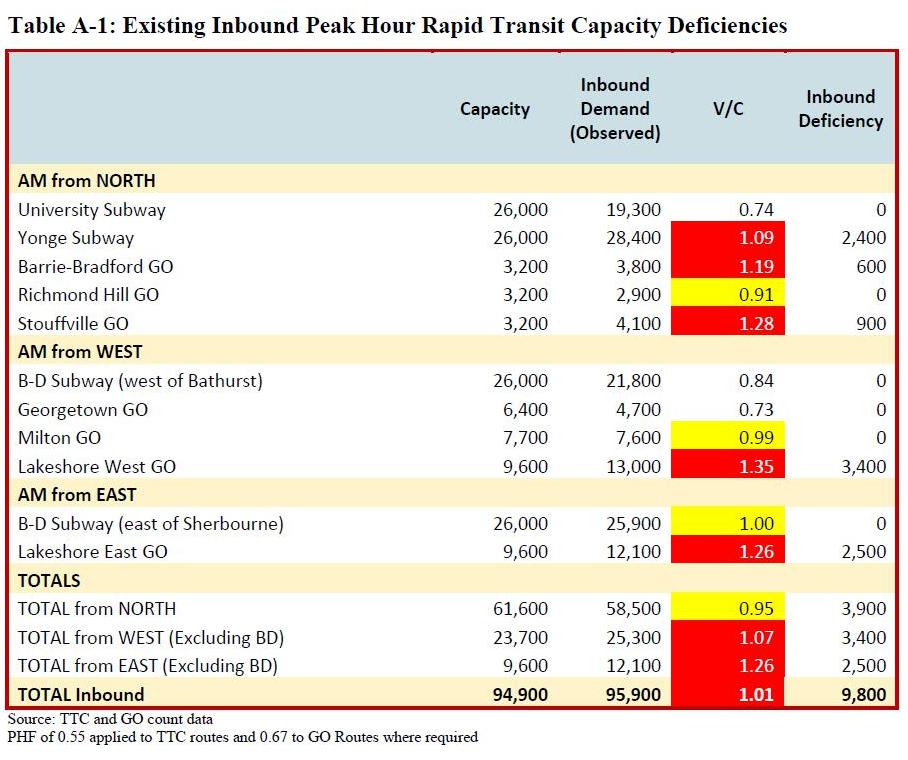
Capacity is an issue today as Table A-1 in the background paper shows.  Several corridors into downtown are already operating over their design capacity.  This is particularly the case on GO where the target is to have few standees, and there is more room for additional passengers in the design capacity than on the TTC subway services.

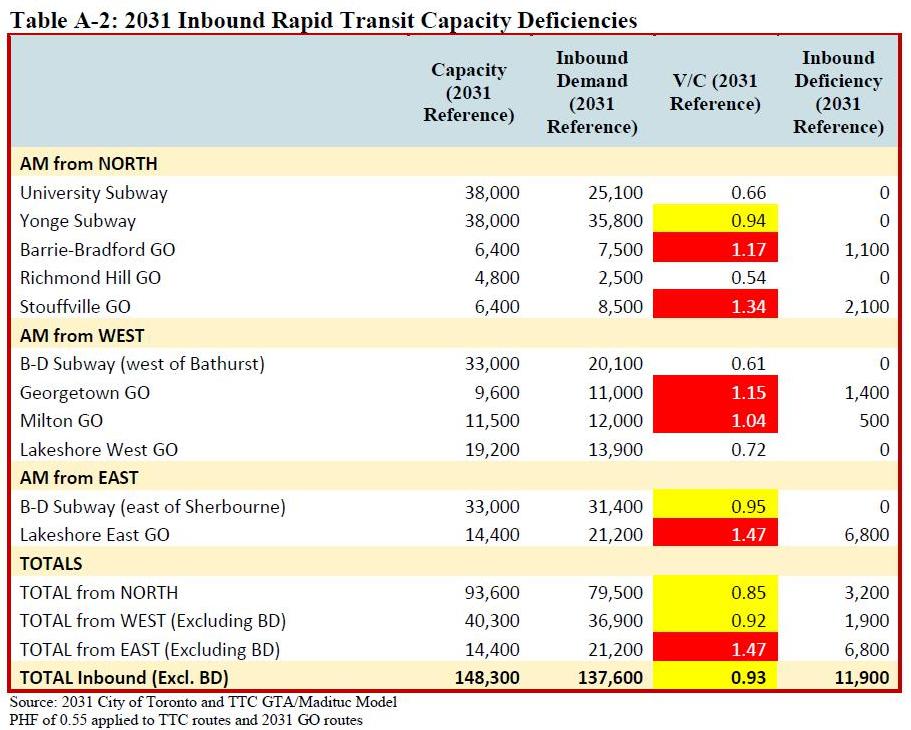
Table A-2 shows the projections for 2031.  All of the shortfalls are on GO, but the TTC lines are close to saturation.  This presumes a considerable increase in the capacity of various lines.  For example, the YUS goes from a design capacity of 26,000 to 38,000 passengers per hour (pphpd), an increase of 46% which may not actually be achievable.  Similarly, the BD line goes to 33,000 pphpd, an increase of 27%.

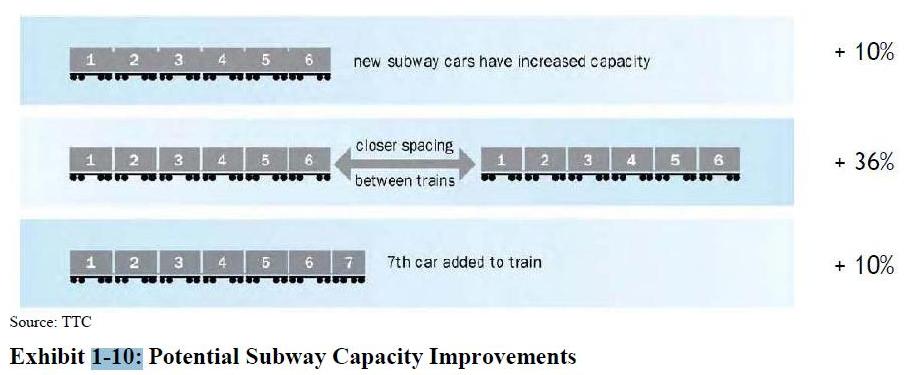
Exhibit 1-10 shows the components of projected capacity increase including 36% from running trains closer together.  As discussed at some length on this site previously, the constraints on headways arise at terminal stations.  A 36% increase in trains/hour implies a headway of about 100 seconds as compared with 140 today.  This cannot be achieved with existing terminal track geometry, not to mention the leisurely crew practices at terminals.

On the GO lines, the projected capacity on Lakeshore West doubles, and smaller increases are seen on other routes.  It is worth noting that the projected capacity of the north-south corridors to Stouffville, Richmond Hill and Barrie are nowhere near the level of service implied by The Big Move, probably because these lines are not targets for early electrification.  This contributes to the capacity shortfall in the northern sector.  Recommendation 1 of the study includes encouragement that Metrolinx review the possibility of increased capacity in those three corridors.

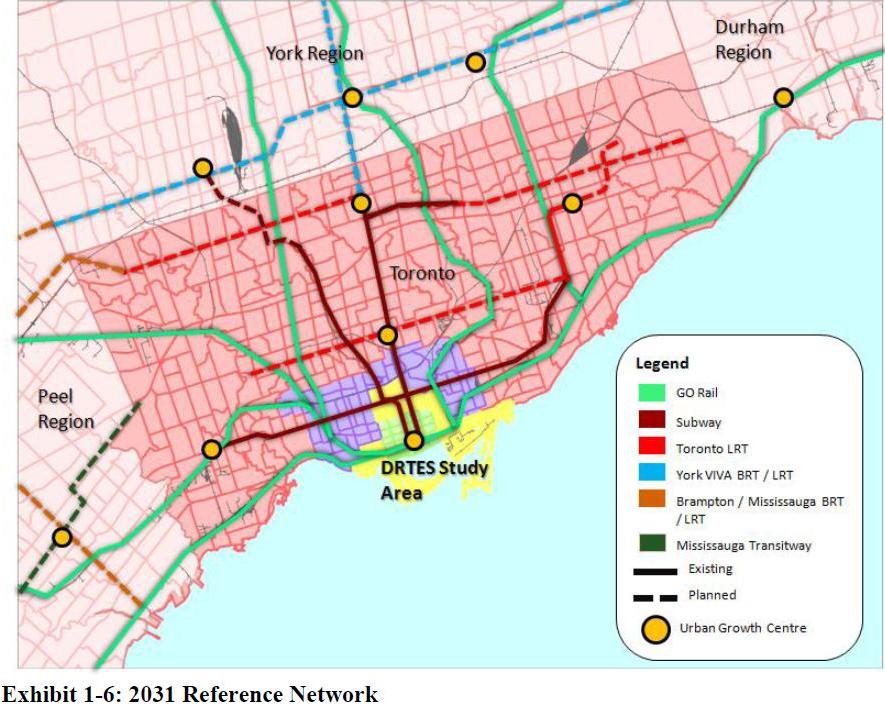
The full list of lines included in the modelled network can be found in the background study at section 1.2.1.

Continue reading

Tim Hudak Has A Plan (Updated)

Updated October 16, 2012 at 8:30 pm:

The Toronto Star reports that Tim Hudak has pledged to redirect all of the money earmarked for a Toronto LRT network to subway construction if he is elected Premier.  This is a truly bizarre stance for someone who claims to be trying to save Ontario money when we consider that almost none of the pledged $8-billion plus has actually been spent or committed, and this is all net new money, new borrowing Ontario will have to undertake.

Hudak was playing to his audience of Ford-friendly councillors who do not have control of Council on the transit file, but who seem to be attempting an end run around Council by having Queen’s Park support his position unilaterally.  Anyone who thinks they will get a full-blown Eglinton subway, and a Sheppard line (STC to Downsview) and a BD extension to the Scarborough Town Centre for these funds is dreaming.  Sadly, however, Toronto has a bad habit of wanting more than it can afford especially when someone else will foot the bill.

If I try to put myself in a conservative mindset (and that’s with a small “c”), I would be asking how much of that $8b actually needs to be spent at all, or spent on transit rather than some other portfolio.  That would be a common sense thing to do, the kind of approach we might expect from Mike Harris.  Alas, “common sense” also includes buying off local politicians by keeping their pet subway projects alive.

But no, Tim Hudak wants to spend $8b he doesn’t have on overbuilding a partial subway network apparently because he thinks this will play well to Ford’s base.  He might want to think about the uproar over paltry hundreds of millions wasted on shifting power plants out of Liberal ridings and consider whether the lure of the megaprojects has clouded his vision.

Of course, all this depends on “affordability” which is tied to the end of the provincial deficit, and so Hudak will likely never have to borrow that $8b whatever he might spend it on.  All he will achieve is even more delay in building any transit for Toronto.

Thanks to the Liberals’ tinkering with project schedules and love for P3 implementation, little work will actually be tendered by the time the government falls sometime in 2013.  Cancelling the Finch and Sheppard LRT lines will be child’s play, and the SRT upgrade will probably morph into an unbuilt subway while the SRT lies at death’s door.

Toronto Council needs to wake up and remind Mr. Hudak that the Mayor does not speak for the City.  Does Hudak even care, or is he just giving his pal a chance to say “screw you” to his opponents?

Continue reading

Raining on Civic Action’s 32 Minute Parade

This morning, the Greater Toronto CivicAction Alliance, or CivicAction for short, launched its “What Would You Do With 32?” campaign.  They have a video with all sorts of folks musing on how they would spend all the extra time they would have if the full Big Move plan were implemented.  Very nice, very charming, very misleading, very wrong.

Getting. Around. Town. Can. Take. An. Eternity.

But it doesn’t have to. It can be so much better.

There’s a plan in place to dramatically improve transportation in the Greater Toronto and Hamilton Area – one that could actually save you an average of 32 minutes on your daily commute. [From your32 website]

At the press conference, that number troubled me because I didn’t remember seeing such a calculation anywhere in the background papers to Metrolinx’ The Big Move.  It turns out that this number is not a saving relative to today’s trips, but a comparison of our future, 25 years out, in Big Move or “do nothing” scenarios.

What’s so important about the number 32?

32 represents the number of minutes per day, on average, that you’ll save on your commute if The Big Move is funded and realized – that’s eight days a year or about two years over the course of your life. It is the difference between the average commute time if The Big Move is built (77 minutes; Source: Metrolinx), and the commute time if no comprehensive system is in place (109 minutes; Source: Metrolinx). [From your32 website]

Anyone who thinks there commute will be 32 minutes shorter than it is today is dreaming.  For comparatively short commutes, a 32 minute saving is physically impossible unless Metrolinx has an unannounced program to teleport us around the city.  (Given Queen’s Park’s track record on transit technology, I wouldn’t be too keen on trying it out, although I can think of some guinea pigs who surely won’t be missed.  The concept of a short-turn does not bear consideration.)  Even for long commutes (over 90 minutes), a 32 minute saving is a substantial chunk of a trip, and it won’t be made over every segment.

The biggest problem for transit riders is not the “rapid” part of their trip today (subway or GO train) but it getting to and from the rapid line at both ends.  These parts of the trip don’t lend themselves to big reductions in travel time.  We might extend a subway to Vaughan, but unless you live in a condo on top of the station, you still have to get to it.  Many transit trips are all surface because even with The Big Move, they will not lie along rapid transit corridors and going out of the way (as an expressway driver would) to use them would be counterproductive.  The Big Move (and associated funding schemes) don’t address this problem and leave local municipalities to find the funds, if they are willing, to boost what are seen as feeder services to the subway, not as vital lines in their own right.

Yesterday’s discussion at Toronto’s Executive Committee included the important observation that people need to feel they are getting something concrete in return for a new tax they might pay.  Civic Action’s campaign has two phases — one to talk about what might be, and one to talk about how we might pay for it.  The fundamental problem, however, is that they are selling those “32 minutes” that don’t really exist.  Most commute times will not get 32 minutes shorter.

Don’t forget that’s an average, and so even greater savings are obviously forecast for some travellers while others will get little.  I am not sure of the arithmetic validity of these claims.   It’s noteworthy that the Metrolinx models were not capacity constrained and they forecast ridership on some routes like the main TTC subway lines well in excess of their actual capacity.  That translates into full trains and pass-ups, something riders know today, never mind 25 years in the future.  A missed train is extra wait time, but I suspect the Metrolinx model does not allow for this problem.  As for the TTC, there are limits on how many trains and riders can be stuffed into the existing system, and few of the updates needed to handle more riders (even if we assume they are practical) are part of The Big Move.

The basic problem with the “Your 32” campaign is that it tries to find something to sell — those 32 minutes — because it cannot talk about specifics of what network and services we might actually see.  Metrolinx’ plans are years old now, and there are already components that must be added to make the whole package work.  Among these are the proposed Union Station West (for additional capacity and operational flexibility), GO electrification (a prerequisite for very frequent service) and the Downtown Relief Line (with expanded reach and an earlier implementation date to make both Union West and the Richmond Hill subway practical).

Metrolinx has been hinting at an updated Big Move for some time.  One was expected this fall, but they now expect to release a “technical update” in Spring 2013, and there is no sense of how much this update will address.  We must hope that, at least, the 2013 plan contains all of the projects that the new Investment Strategy will fund, and that we won’t have an “oops” where a major component such as electrification is missing from the list.

Also still missing is a worked example of putting the many components of The Big Move through a prioritization scheme.  That process will inevitably set off a noisy political debate as people discover that their pet projects are now at the back of the queue (if they are still in the mix at all), and that major spending on new transportation capacity is decades away in some areas.  How badly will the transit map be gerrymandered to convince taxpayers and politicians throughout the GTA that they should buy into a region-wide funding scheme?

If we could raise $3-billion in new annual revenue, some of this would have to go to operations and to municipal transit systems, and it will be a quarter-century or more before the whole plan is completed.  One might ask the boffins at Queen’s Park whether the construction industry can even burn through capital at that rate given their concerns about the constructability of Transit City on a compressed timeframe.

John Tory, the chair of CivicAction’s board, spoke not just of traffic congestion but of leadership congestion.  This begs the obvious question of Mayor Rob Ford and his supporters.  At some point, “transit leadership” must include some blunt words about Ford’s views on transit and on funding.  Partnerships with the private sector might work, although there are no guarantees and transit riders (not to mention taxpayers) will be left holding the bag if these deals fall apart.  To his credit, Tory did not treat these partnerships as a source of free money, and talked of the need to pay back investments made by the private sector one way or another.

CivicAction recruited a council of over 40 “regional champions” for their cause.  What, exactly, they will do is still a bit vague, although one might hope they would organize outreach at the local level.  You too can become a “local champion” and take the message to your community.  This all has a rather amateurish feel to it, but I may be pleasantly surprised.  Much will depend on the resources available to these champions including clear answers from government agencies about the transportation schemes and revenue tools they are promoting.

A recent poll showed that 90% of GTA residents don’t even know about The Big Move, and if they don’t know about the plan in general, they certainly don’t know what it might (or might not) do for them.  Getting new revenue such as a regional sales tax will be an uphill battle if people see this as just another tax grab.  When and if CivicAction gets down to the task of explaining The Big Move, they will discover just how hard finding those phantom 32 minutes will be, and this could further undermine its credibility.

The potential revenue from new taxes and fees are well-documented, most recently in the City’s report, and the City consultations will focus on the money side of things.

“Your 32” might have been a nice idea in a different context, but I fear CivicAction fails on two counts.  First, the underlying premise is wrong, and there is no way to sugar-coat that statement.  It’s not a question of interpretation, but of misrepresentation.  Second, the real debate will focus on raising money for major expansion of transit, and this demands concrete answers about what we would actually build and what the benefits of various network components will be.  CivicAction depends on Metrolinx for this sort of information, and that agency remains silent on the details.

Advocacy by local municipalities and by CivicAction is hamstrung because there is no way to know what the provincial priorities might be.  Will The Big Move will be treated as little more than a bag of election goodies to dribble out as Queen’s Park sees fit?

Toronto Contemplates Transit Funding / Reviews Transit Plans (Updated)

Updated October 9, 2012 at 5:30 pm

Toronto’s Executive Committee considered a report on transit funding mechanisms today.  In the following report, I have included only the most interesting or important of comments to give the flavour of the debate.

The proceedings were rather odd in that a presentation, cued up for City Staff, was never heard, but a “private citizen” managed to give a half-hour long deputation thanks to many friendly questions from Committee members.  That “citizen” was Dr. Gordon Chong, former head of Toronto Transit Infrastructure Limited, an all-but-bankrupt subsidiary of the TTC used to conduct a study of the Sheppard East subway extension for Mayor Ford.

Chong liberally drew on his transit experience including years as head of the Greater Toronto Services Board, a provincial agency predating Metrolinx.  Throughout his deputation, the highly misleading map of four cities’ subway system was projected to emphasize how little Toronto has done.  (That map purports to show how little Toronto has in comparison with London, New York and Madrid while ignoring the fact that these were much larger cities, much sooner.)

A “glaring omission” from the collection of transit plans in the staff report, Chong said, was his own Sheppard report and the information produced by KPMG about tax increment financing (TIF).  Chong clearly implied that the report was biased, but missed the fact that the Council motion directed the inclusion of “approved” plans for review, something Chong’s most emphatically was not.  As for TIF, it is mentioned, but rejected as a funding mechanism as staff argue that such revenue is needed for general support of city services and should not be earmarked just for transit capital projects.

Councillor Michael Thompson pursued the scheme of a Scarborough subway with a BD extension that would loop back along Sheppard to close the loop at Don Mills Station.  Chong replied that if Toronto could deal with the “money issue”, then there is no reason we can’t have the best in transit.  Thompson observed that a casino might bring in $75-100m annually and could fund transit projects.  The oddity here is that both treat any new money as a bonanza to be used for the best possible transit (where they want it) when fiscal conservatives might be expected to argue for careful husbanding of whatever loot might come their way.  There is also the small problem that the municipal share of projected revenue for a Toronto casino is probably an order of magnitude lower than the Councillor’s claim.

Various Councillors mused about a regional agency to dispense transit dollars and decide which projects should be built.  An underlying assumption was that, of course, the network of suburban Toronto subways would rank high on the list, and nobody seemed to contemplate that a 905-dominated agency might have other more pressing needs or think that the investment in all those subways was of dubious value.

Chong had only veiled contempt for the “expert panel” who reviewed his report and recommended, instead, for the LRT option on Sheppard.  He strongly supports subway construction presuming the money is available, supported by the best possible feeder bus network.  Councillor Norm Kelly asked whether the LRT plan was “an aberration”, and Chong replied that all previous TTC Chief General Managers had supported subways.  Although he invoked the name of David Gunn, he neglected to mention that Gunn boycotted the opening ceremonies of the Sheppard line.

Next the Committee turned to questions of staff. Continue reading

Metrolinx Dumps TTC as LRT Partner (Maybe)

Updated October 4, 2012 at 9:20 am:

Mr reaction to the announcement yesterday that TTC would remain as “operator” of the LRT lines is on the Torontoist website.

Although the TTC sees this as a “good news” story, I am less impressed because Toronto is still very much the junior partner.  We get to drive the trains, and that’s about all.  With all maintenance remaining in the hands of Metrolinx private partner, whoever that will eventually be, this is a big step in outsourcing transit operations.

Updated October 1, 2012 at 10:00 pm:

The Toronto Star reports that discussions continue between Metrolinx, the City of Toronto and the TTC regarding the possible operation of the planned LRT lines by the TTC rather than a private contractor.

Exactly how much “operation” would entail is not mentioned, although the TTC is known to be concerned about responsibility for safety-sensitive systems such as vehicle, signal and track maintenance.

A related issue is the amount of detail that must be worked out before a master contract is let by Infrastructure Ontario.  If the private work ends when operation begins (with possible exceptions such as building and station maintenance), then this is a much simpler contract to draft than one that would require all of the details of future operations to be bundled with a design and construction contract.

Whether Queen’s Park and Metrolinx are aware of or care about the delay inherent in needing to specify so much detail so far in advance for a single contract remains to be seen.

September 21, 2012

My thoughts on recent announcements that Metrolinx would completely take over the LRT projects formerly part of Transit City are in an article on the Torontoist website.


CLRVs Visit Boston

Back in 1980, the Urban Transportation Development Corporation (UTDC) had suffered the demise of their planned magnetic levitation train system in Toronto, and the “Intermediate Capacity Transit System” (ICTS) we know as the Scarborough RT had not yet been foisted on Toronto.

During a brief period when the only viable UTDC product was its new light rail vehicle, the CLRV, they shopped the design around to various systems.  The only taker they ever got was San Jose, California, for a small order.  Three CLRVs found their way to Boston for a demonstration, and I was lucky enough to catch them out on the Riverside line in May 1980.

A train of 4027 and 4029 prepares to leave Riverside Yard (the outer terminal of the line which includes a large parking lot and the carhouse/shops for the route.  A train led by Boeing car 3400 sits beside the CLRVs.  The overhead in Boston at this point was set up for operation by cars with either trolley poles (the remaining PCC fleet) or pantographs (the Boeing cars).

The CLRV train pulls out of the yard.

… and onto the main line.

The Riverside Line was build on an abandoned railway corridor, the Highland Branch, and opened in 1959.  A new connection into the existing central subway (a streetcar subway dating from 1897) was built to bring cars through downtown.

Here the CLRVs pass outbound through Reservoir Yard.  The larger part of this yard and an old carhouse are out of shot to the left, and they serve the Cleveland Circle line which terminates there.  Work cars in the yard include a PCC converted for use as a line car, and several “Type 3” passenger cars adapted as snow plows, essential equipment for a network with so much private right-of-way.

Outbound at Newton Centre station.

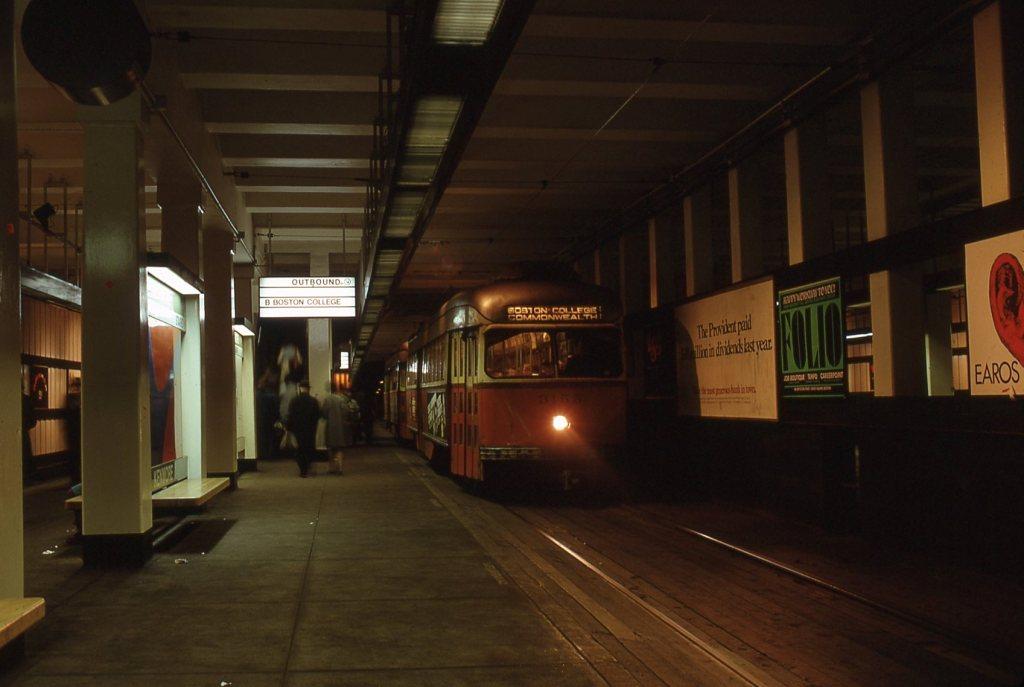
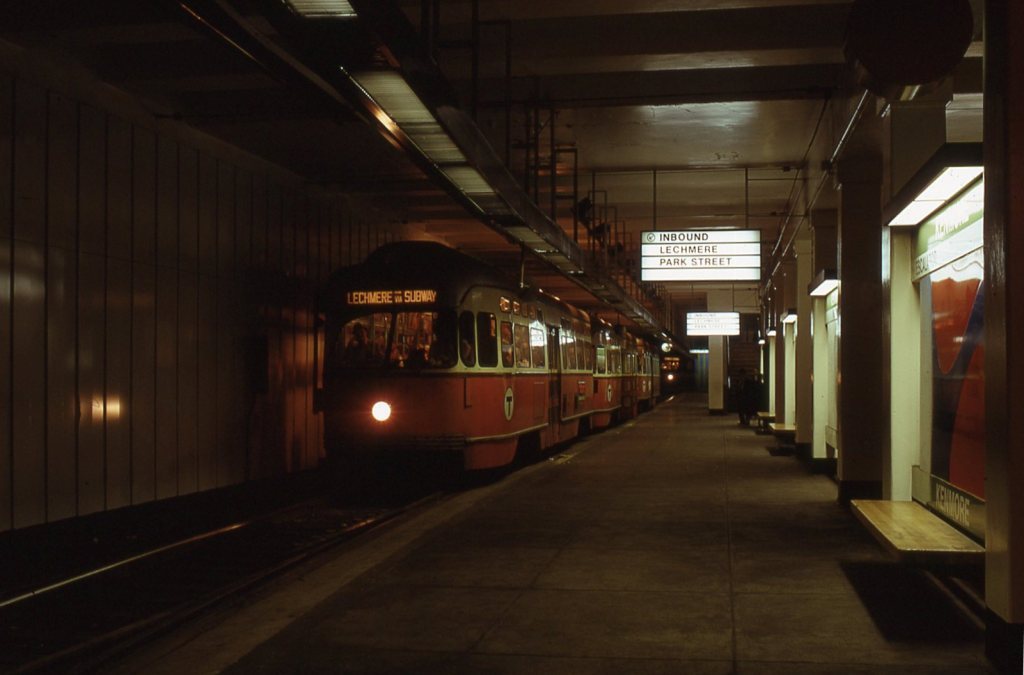
The shot below is from May 1972 at Kenmore Station which opened in 1932.  Readers with eagle eyes and long memories will recognize this shot which I loaned to the UTDC for inclusion in a brochure advocating the wonders of LRT which, at the time, the Ontario Government was actually pushing as a product, if not as a “solution” for Toronto.  It didn’t last long, and they went back to their old lies about how there was nothing to fill the gap, the missing link, between buses and subways — hence the need for an “intermediate” capacity system.

Kenmore Station is a busy place and has separate platforms for routes which diverge here.  Boston cars have doors on both sides so that they can serve island platforms like this.  Needless to say, the CLRVs served only stations with right-side platforms.  (The sign in the front window says “All stops except Kenmore” because the Riverside trains used the outside tracks at this station.)  Yes, that’s a three-car train of PCCs sitting at the platform.

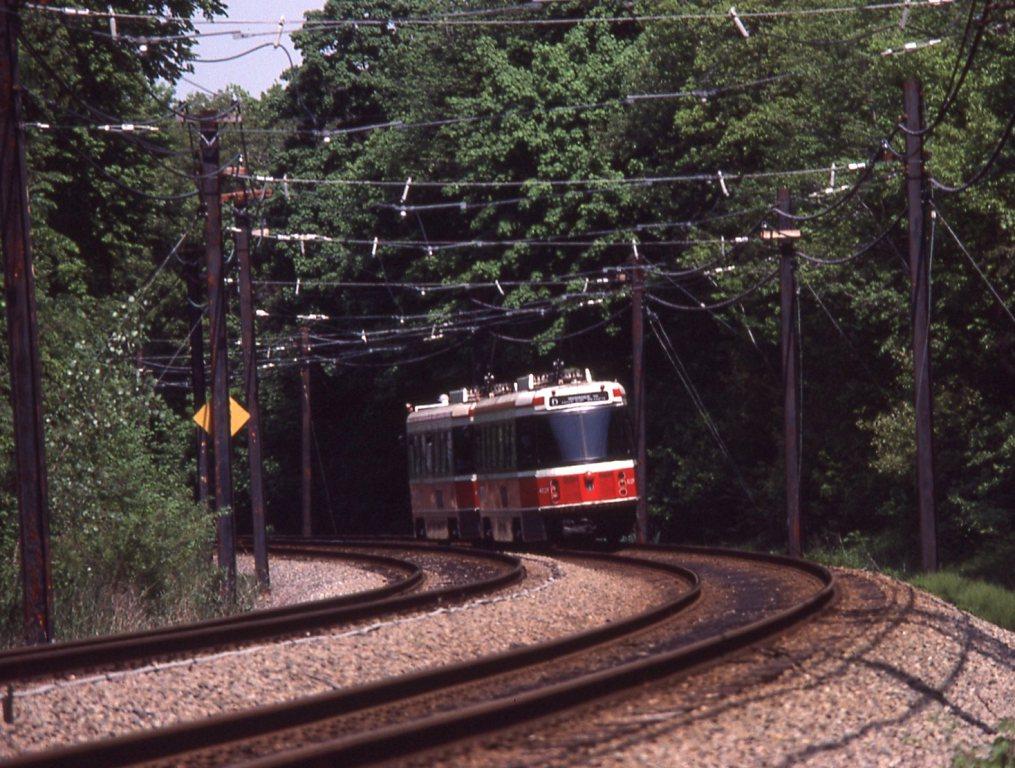
Finally, a look outward towards Riverside terminal (off to the left behind the trees in the distance)  in October 1968.  The small building on the right is an abandoned railway station.  This line could have been a model for the Scarborough RT, an implementation of “LRT” at the high end of what this technology can accomplish with almost complete grade separation, rapid transit station spacing, and speedy operation.  (Although the CLRVs are capable of 70mph operation — itself a design excess by the UTDC — they were limited to 50mph operation on the Highland Branch.)

By the time the SRT and its expensive ICTS opened at a cost more than double the original estimate for LRT, the Riverside line had been operating for 25 years.

How Long Will Rebuilding The SRT Take?

When OneCity was announced with much, if short-lived, fanfare back in June, the centrepiece of the scheme was a proposal for a Scarborough Subway.  Toronto could have a full-blown subway to the heart of Scarborough at a small price, and without the disruption associated with a long shutdown of the RT.

  • A subway would be built from Kennedy Station east along Eglinton and then north on Danforth Road and McCowan to Sheppard with stations at Lawrence, Scarborough Centre (shown as McCowan and Ellesmere on the OneCity map) and Sheppard/McCowan. (OneCity presentation at page 15)
  • Once the subway opened, the RT would cease operating.  Users of existing stations would have to access the subway at its new location.
  • The cost of this option compared to the expected cost of the RT conversion to LRT was $484-million.

According to OneCity (at Page 16) an SRT shutdown would take over four years during which service would be provided by a fleet of 43 shuttle buses.

When I wrote about OneCity, I received an email from Jack Collins, Vice-President of Rapid Transit Implementation at Metrolinx in which he said:

Your recent blog posting implies that Metrolinx or the Province has increased the duration of the SRT shutdown period from 3 years to 3 to 4 years.

This is not the case. The first time we heard 3 to 4 years was during the City Council debate on Wednesday concerning the One City Plan.

This duration did not come from a Metrolinx representative and in all our discussions with the TTC staff the shutdown has been three years, and hopefully less if we put our minds to it.

I wanted to assure you and your readers that even with an AFP type contract, the current Metrolinx plan is:

  • SRT will stay in service until after the 2015 Pan Am/ Para Pan games
  • The AFP contract will have a condition that will limit the shutdown period to no more than 3 years
  • As part of the AFP contractor selection process, contractors will be encouraged to come up with plans to reduce the shutdown period to less than 3 years

One might be forgiven for a bit of confusion here.  When Queen’s Park confirmed funding recently for the Toronto projects, the announcement included:

The Scarborough RT replacement and extension to Sheppard Avenue: work will begin in 2014 and be completed by 2020.

[This announcement originally said “2015”, but this was corrected subsequently to “2014” to align with Metrolinx plans.  However, the end date stayed at “2020”.]

When the proposed staging for the rapid transit projects was before the Metrolinx Board on April 25, the report proposed:

… the Scarborough RT replacement and extension to Sheppard Avenue, with a construction start of 2014 and an in-service date of 2019, …

and further:

The previous plan included a construction schedule for the Scarborough RT of 2015-2020. The schedule allows for the SRT to be in service during the Pan Am/Parapan Games in the summer of 2015, after which the service would be shut down for construction. Planning, design and engineering work will be completed prior to construction in order to minimize down time.

The revised plan will move up SRT completion by one year from 2020 to 2019. This would be accomplished by starting work on the extension of the line between McCowan and Sheppard as a first phase, allowing the existing service to continue until after the Pan Am/Parapan Games are completed.

The presentation slides included:

SRT replacement is a priority

The SRT has high, established ridership, it is near the end of its economic life and in need of replacement. Project acceleration has benefits and staging can be done to avoid any disruptions during the Pan Am/Parapan Games period.

It is quite clear from these statements that a four-year shutdown from 2015-2019 was contemplated, and this no doubt led OneCity proponents to quote such a term in their plan.

Metrolinx now claims that the shutdown will be for, at most, three years.  This means either that:

  • The line will close immediately after the Games in 2015 and re-open in 2018, or
  • The line will close sometime after 2015, possibly as late as 2017, in order to reopen “by 2020” as per the Queen’s Park announcement.

Either way, Metrolinx owes the City a clear statement of its intentions given the frequency with which construction schedules for the “Transit City” lines have been adjusted.  The current situation, according to Collins, is:

We are planning one AFP contract for both Eglinton and SRT to optimize procurement time and contractor selection.

As indicated earlier, the contractor will be required to not exceed a 3 year shutdown period for the SRT and hopefully the contractor will be able to improve on the shutdown period.

The overall schedule of work will be determined once we have a contractor on board at financial close. It is premature to set a specific date for the shutdown of the existing RT, the construction of the new LRT and its opening for revenue service until we have a schedule agreed with the contractor.

It is quite clear from this that the start date for construction is not yet settled, but that it is intended to be at most three years whenever it happens.  If this drifts out beyond 2015, this raises a question of the cost of maintenance and reliability of the SRT which is already a delicate flower.

Any discussion of the future of Scarborough’s rapid transit network must proceed on an informed basis.  Queen’s Park is somewhat misleading in saying that work will begin in 2014 and complete by 2020 if the construction schedule has not already been decided.  Even the 2014 date for prebuilding the extension from McCowan Station north to Sheppard is really subject to whatever the prime contractor for the project proposes.  The words “by 2020” do not inspire confidence.

Meanwhile, the OneCity advocates will have to refine their cost proposal for the subway extension.  They claim a subway cost of $2.3b even though an estimate done for Mayor Ford’s transition team by the TTC pegged the cost at $3.3b including vehicles but not including a new or expanded yard facility.  Given that the TTC has more T-1 cars than it needs to serve the existing Bloor-Danforth subway, it may be possible to extend the line without buying more cars (that surplus is a long story in its own right) or building a new yard.

TTC owns 370 T-1 cars.  The BD line requires 43 trains for peak service (258 cars) and Sheppard requires 4 (16 cars) for a total of 274 cars.  Add in spares at 15% and this brings the fleet requirement to 316 at 2011/12 winter service levels.  If all BD trains ran through to Sheppard, this would require roughly 13 more trains plus spares, half that with a turnback at Kennedy.  15 trains would cost at least $240m.

The TTC’s cost estimate for a subway to Scarborough Town Centre is $2.6b including vehicles.  Adjusting for the T-1 surplus would bring this down to $2.3-2.4b, the number claimed by OneCity for a subway extension all the way to Sheppard.

The whole debate between OneCity and Metrolinx, between a Scarborough Subway and the RT/LRT replacement, needs to proceed on a much more informed basis than it has to date.  With luck, staffs of the various organizations will bring credible information to Council in fall 2012 and will not “cook” the comparison of various options to suit political aims at City Hall or Queen’s Park.

The Fate of OneCity (Updated)

Several postmortems have appeared on blogs about the supposed death of OneCity and what might follow:

Updated July 19, 2012 at 7:00 am:

Updated July 16, 2012 at 11:15am:

My own take on OneCity’s fate together with the original article detailing proposals for dealing with transit planning follow the break.

Continue reading