Metrolinx Board Meeting of June 27, 2013

The Metrolinx Board met on June 27 with a full agenda.

There is a great deal of duplication between various reports, and I have consolidated information to keep like items together.  Some reports are omitted entirely from this article either because the important info is included elsewhere, or because they simply rehash status updates with no real news.  Metrolinx has a love for “good news” to the point that each manager stuffs their presentations with information that is already well known, or which parallels other presentations.

Among the more important items in these reports are the following:

  • Metrolinx is now conducting various studies all of which bear on the problem of north-south capacity into downtown Toronto.  This involves the (Downtown) Relief Line, the north-south GO corridors and the Richmond Hill subway expansion.  A related study involves fare and service integration across the GTHA.  It is refreshing to see Metrolinx taking a network approach to planning, rather than looking at projects in isolation, and recognizing that some of their own, existing routes can be part of an overall approach to solving this capacity problem.
  • The Metrolinx Five-Year Strategy includes dates for the beginning of service on various projects including the LRT replacement for the Scarborough RT.  Previous versions of these dates cited “by 2020”, and Metrolinx has indicated a desire for as short a construction/shutdown period of under three years.  However, the new strategy paper talks of an “in service date” of 2020.  Metrolinx is aiming for a three year shutdown at most, but the SRT might continue operating beyond the originally planned September 2015 date, possibly for one additional year.  This could lead to an earlier reopening than 2020.  (Correspondence from Metrolinx on this issue is included later in the article.)

Continue reading

The Scarborough Subway Vs LRT Debate, Again (Updated)

Updated July 3, 2013 at 11:20pm: 

TTC Chair Karen Stintz, as reported by the CBC’s Jamie Strashin on Twitter, claims that Minister of Transportation Glen Murray has put $1.4b of the planned $1.8b SRT conversion cost on the table as a contribution to a subway project.

Jamie Strashin ‏@StrashinCBC

TTC Chair Karen Stintz tells me she just met with Provincial Transportation Minister Glen Murray. 1/2

2/2 Stintz: Murray indicated that if city shows clarity around subway option, province would be “open” to freeing up $1.4 slated for LRT.

There has been no confirmation from Murray whether this is true, or if Stintz/Strashin have misreported a conversation.  Such a proposal would violate claims about provincial support for a subway extension that were made in the Metrolinx letter to the City of Toronto.  Given Murray’s past history of freelancing on government policy, we will have to wait for clarification of what is really on the table from the provincial point of view.  An informed debate at Council requires that this be stated publicly and unambiguously from the Premier’s Office.

Meanwhile, Stintz offers her own version of the situation on her blog, but with no reference to her conversation with Minister Murray.  She repeats the canard that a four-year shutdown will be required to replace the SRT with LRT in the same corridor.  Moreover, she adds a sweetener about using the existing SRT right-of-way to expand trackage for the GO Stouffville corridor, something which is not actually necessary.

Mayor Ford has announced that he has asked the City Manager to report to the July16 Council meeting on the Scarborough subway option.  How definitive this report will be remains to be seen, especially if the TTC and Metrolinx cannot come to an agreement on cost estimates and the penalties involved in ending the LRT project.

The original article follows below.

Continue reading

Development Charges and Transit Expansion

The City of Toronto Executive Committee will discuss the matter of a new Development Charges Bylaw at its meeting on July 3, 2013.  This is a statutory requirement as the current bylaw expires in April 2014, and it must be replaced in order for the city to continue collecting these charges.

Already press reports show a real estate industry apoplectic at the possibility that these charges will double.  With all the concern over a possible softening of the market for new units, the last thing they want is yet more cost added to the purchase price.  However, what we are seeing is a combined effect of the rising population and the exhaustion of surplus capacity in existing infrastructure, notably transit and water.  Much of the new development is concentrated in the central city in former industrial areas that do not possess the infrastructure needed to support their coming new populations.

(Chief Planner Jennifer Keesmaat observed at the “Feeling Congested” session earlier this week, about 70,000 people will call places like Liberty Village and the waterfront neighbourhoods their new home over the coming decade.)

There is bound to be lively debate, especially from the “no new taxes” brigade on Council, but the simple fact is that the city cannot have new development without some way to pay for the supporting infrastructure and services.  In this article, I will talk only about the transit component which is the single largest piece of the new DCs rising about 150% from the previous level for residential development.  (DCs overall will go up 86% because other categories have lower increases.)

Continue reading

Feeling Congested Part 2: Setting Priorities

The City of Toronto’s Planning Department is consulting with the public for the development of an updated Official Plan.  The plan’s transportation component falls under the rubric of “Feeling Congested” with a website devoted mainly to transit issues.  In the first round of meetings, the focus was on “what is important”, what goals should the new plan try to achieve.  In the second round, the topic is the prioritization of goals and how these might drive out different choices in a future network.

This parallels work that Metrolinx is doing on their Big Move plan, but it includes additional options for study that are city initiatives such as transit to serve the waterfront.

A survey now in progress (until June 30) seeks feedback on the evaluation criteria for transit projects, and also for the goals of the cycling plans.  Some of this makes more sense if one first reads the toolkit, but even then the presentation will leave skeptics unhappy because there is no link to the detailed study explaining how the proposed criteria have been measured for each of proposals.  (A summary chart on page 14 does not include the subcategories within each of the eight criteria that generated the total scores .)

Even with this background, an exercise asking whether the methodology is sound seems to be an odd way to survey public attitudes without a stronger discussion of the implications for a preferred network.  This is rather like discussing the colour of a magician’s hat rather than the effect this might have on the rabbit he pulls out of it (or if there’s even a rabbit at all).

Continue reading

TTC Meeting Wrapup for June 24, 2013

Aside from the King Street transit lanes and the new streetcar rollout plans (covered elsewhere), there wasn’t much else on the agenda for the TTC Board (as it now styles itself).

One procedural change was that there are no longer any printed agendas for the meeting — reports are available only online.  If you’re not carrying a device that can display them easily, you’re flying blind making sense of the meeting.

CEO’s Report

Ridership for reporting period 4 (mainly the month of April) was 1.1% below budget, but 2.2% above the corresponding period in 2012.  Poor April weather (an unusually cold early spring) was blamed for the shortfall.  For the last twelve months (May 2012 to April 2013), ridership is up 2.4%.

For the year 2013, ridership is expected to be at the budgeted level of 528-million.  However, the average fare is lower than projected because of higher pass usage, and the revenue projections are down by $2.0m.  This is offset net savings in expense lines.  On the entire budget, this is a variation of less than 1.5%.

Yonge subway reliability has fallen due to ongoing issues with TR train reliability, “workforce availability”, passenger-related delays and fires at track level.

There has been no update on problems with the TRs beyond “we’re working on it”, and the time is overdue to ask whether the goals for reliability have been set too high.  Without a detailed report on the situation, there is no way to know whether the trains have chronic, difficult-to-solve problems, or if we can expect some resolution.  (According to minutes of an Advisory Committee on Accessible Transit meeting (ACAT), TTC staff have no prognosis for correction of the TR platform leveling problem that makes trains inaccessible.)

36 of the 70 TR trainsets on order have been accepted for service.  This leaves 34 trains still in the pipeline to hit early 2014, although the last 10 of the trains are intended for the Spadina extension that will not open until 2016.

“Workforce availability” is an odd term to use considering that overall attendance rates at the TTC are supposed to be improving.  Punctuality is affected by a number of factors including the effect of many small delays, but also by extended times required for some crew changeovers.  The TTC needs to sort out which effects are strictly due to staff and which to other factors.

The reliability index for Bloor-Danforth is also dropping, but still runs at a higher level than the Yonge-University-Spadina line.  The TTC does not break out the various sources of delay by line to report which problems exist system wide and which are more prevalent in certain locations.

SRT performance has been quite good since October 2012 when schedules were changed to reflect the actual capabilities of the aging technology.

Surface route performance for both modes is above the rather generous target levels, but we know from the Quarterly Report published earlier in 2013 that overall headway adherence is quite bad on some routes.  This is no surprise to anyone who looks at vehicle monitoring data.

Elevator and escalator availability continues to get a high rating, although, as I understand things, this is based on a once-a-day report of status.  There is no report of the prevalence of outages or their duration.  This is rather like looking out the window, seeing one bus, and deciding that all is well with the transit system.

A few new Sunday shutdowns of the subway have been announced in this report:

  • June 29 from Wilson to Downsview for track installation.
  • July 7, 14 and 28 for beam installation on the Prince Edward Viaduct.  This work is normally done during the night-time shutdown, but a provision for opening the subway later than normal gives more time to complete planned work.

Details will be announced for each planned shutdown.

Change Orders for Design Costs on the Spadina Extension

Four reports requested substantial changes in the contracts for design work at Steeles West, Vaughan Corporate Centre, Highway 407 and York University stations.  The magnitude of the changes attracted questions from the Board.

According to staff, TTC practice is to award design contracts based on interim amounts with change orders issued along the way as required.  A contingency budget line provides funding for these changes.  Some of the costs will be recovered from third parties such as York Region and GO Transit/Metrolinx who asked for design changes in the originally completed plans.  Other costs were incurred to reduce construction expenses and keep stations within the project’s budget.  The degree to which this may have compromised the original designs is unknown.

Oddly, some of the extra costs cited by staff were for activities at Finch West and the new Downsview/Sheppard West stations (changes to suit GO and the Finch West LRT project).  Neither of these was the subject of the four reports on the agenda.

CEO Andy Byford wants to improve the reporting of large project budgets and costs, but does not expect to have a proposed scheme for doing so until fall 2013.

Steeles East Night Bus

The Board approved the proposed extension of the 353 Steeles East route from Middlefield Road to Markham Road effective August 4, 2013.  This extension uses up excess running time in the current schedule and requires no extra buses.

Ossington Bus / Hellenic Home for the Aged

The TTC has been requested to divert the 63 Ossington bus to a home for the aged which is north of Davenport up a steep hill on which seniors have difficulty walking to service on the main street (see map in report).  A decision on the matter has been put off to July 24 to allow for meetings between staff and those requesting the change.

The staff report recommends against this diversion which was requested through Councillors Mihevc and Fragedakis.  Mihevc should know better as a former member of the TTC Board.  Off-route diversions are the bane of transit operations and compromise the benefit of straight routes for passengers.

It is worth mention that this home was built off of the Ossington route some decades ago, but long after the route was established.  The policy decision is whether transit routes should be tweaked to serve such sites, and whether the Board has the political backbone to say “no” when the greater good of the route and the precedent for future requests are at stake.

Bicknell Loop

The property at which the Rogers Road car, originally part of York Township Railways, ended has been declared surplus to TTC requirements.  Buses on this route use the nearby Avon Loop on Weston Road.

More Metrolinx New Math (Updated)

Updated June 8, 2013 at 12:05pm:

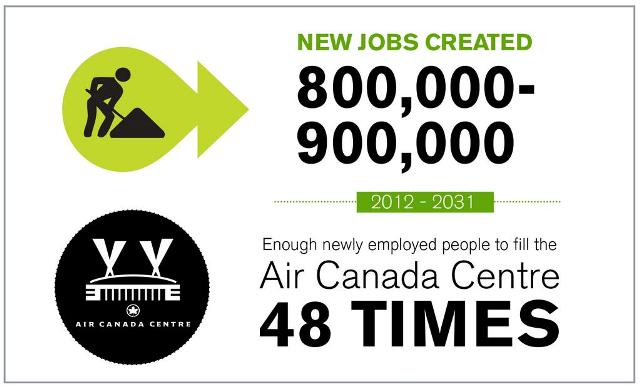
Metrolinx has issued a correction via Twitter (where this discussion started) clarifying that, yes, it is person-years of employment, not jobs, that they are creating, and acknowledging that the graphics and tweets using them were “shortened”.

Anne Marie Aikins ‏@femwriter

… Report explains “person yrs of construction & LT employment” pg 30. Graphs/tweets shortened. Good reminder. Thx

[Anne Marie Aikins is a Media Relations Manager at Metrolinx]

That’s putting it mildly.  Someone did a calculation to figure out how many ACCs would be needed to hold all those people, and so clearly did not understand how the numbers should be used.  Someone put that chart in the Metrolinx report.  The report survived Board scrutiny without anyone, including their members from the banking sector, spotting the problem.

Ooops.

The original post from June 7 follows below.

Metrolinx recently published a graphic purporting to show the employment effect of the Next Wave’s spending over twenty years.

MetrolinxNextWaveJobsWeb

These numbers are a complete fabrication and show how an organization more concerned with puffery than with accuracy can screw up basic arithmetic.

The statement here is that “enough newly employed people” would fill the ACC 48 times.  The official capacity of the ACC is 19,800, and so we’re talking about 950,400 newly employed people.  That’s roughly 1/3 of the entire population of Toronto.

The problem here is the confusion between employees and employee-years.  Metrolinx plans to raise $2b annually for twenty years.  Let’s assume that it will all be spent on job creation, not on getting more work from an existing pool of labour, nor on purchasing offshore technology such as rolling stock, control systems and managerial expertise.  We’re talking about design, engineering and construction, not the cheapest of professions and trades, and a reasonable average fully-burdened (including benefits) cost per job would be at least $80k.  (Governments have paid vastly more per new job on things like auto plants.)

The math is straightforward:  $2b/year divided by $80k gives 25,000.  If the entire amount goes to net new hires, then that’s 25k.  Do this every year for 20 years, and you produce 500k person-years of employment, but not 500k new hires.

There will be some multiplier effects in that an employed person has money to spend and that will find its way into the local economy.  How many new jobs will result is another matter.

We can look at this from the reverse angle: if there is $40b on the table, and it has to be shared among 800k new hires, then each of them will receive $50k.

In this, I have assumed that even the 25% of revenue dedicated to municipal projects creates jobs on the same basis as for the 75% allocated to the Next Wave.

Metrolinx has similar math challenges on commuting times when they routinely confuse avoided future congestion with actual savings.  Moreover, the claimed “saving” only occurs if the entire Big Move is built, something that appears vanishingly likely.  Because Metrolinx only ever discusses their fully-built scheme, we have no idea of how much “saving” will accrue for intermediate stages of the network, nor of the variation in benefits across the region.  This most basic of business analyses is totally missing, at least in any published Metrolinx papers.

Metrolinx really needs some remedial work on economic analysis and basic arithmetic.  Think about it: does it really take 1/3 of Toronto’s population to build a transit network? I have to repeat: the Metrolinx claim is not for job-years, but for newly employed people, nearly one million of them. That’s a basic reasonableness check anyone should be able to spot. How did such a claim even get out the door?

Howling errors like these job creation numbers undermine credibility not just of an incompetent agency but of the government who looks foolish for making claims they cannot possibly deliver.


What Does Subway Construction Cost?

An interesting article on the site Pedestrian Observations was recently linked on Twitter by Taras Grescoe (@grescoe), the author of Straphanger.  In Comparative Subway Construction Costs, Alon Levy attempts to bring together projects worldwide, adjust for currencies, inflation and other factors to derive comparable US$ values for subway construction.  The numbers are interesting in light of complaints about overpriced construction in Toronto.

The underlying problem, of course, is that no two projects are the same.  Varying proportions of underground construction, different soil/rock/water conditions, variations in station numbers/size/depth, not to mention rolling stock procurement and yard/maintenance facilities all affect the total cost and hence the cost/km.  Stir in political differences and the ease or difficulty with which projects are approved, and the number of variables is quite high.

All that said, Toronto’s costs are not wildly out of line.  This is not to say that they may not be excessive, but the cause could be our extended design and approval process and a preference for deep bore tunneling that drives up construction costs compared to shallower cut-and-cover.

The argument for LRT has always turned on the availability of a surface option where it is practical.  Whether we choose to exercise this in every possible case is another matter.

There are cases where underground construction is the only practical way to build a line, but that should not condemn Toronto to building only subways without looking at alternatives.

TTC’s Five Year Plan Reviewed

TTC CEO Andy Byford was hired by former chief Gary Webster to modernize management practices and provide focus to an organization that had lost its way.  Thanks to Webster’s ousting at the hands of the subway-loving, LRT-hating Mayor Ford, Byford unexpectedly found himself top dog.  After a year in Toronto, Byford released his five year corporate plan on May 29, 2013.

Those of use who follow the TTC closely have heard a lot about this plan as a centrepiece for the future of our transit system.  Byford’s talks at meetings around the city, most recently a Town Hall presented by Councillor Josh Matlow on the eve of the plan’s release, raised expectations for a major document, a fundamental shift in how the TTC would operate.  If this were a summer movie release, Byford’s appearances would be the equivalent of ever more tantalizing trailers and “sneak peeks” at what would come.

The plan’s release was something of an anti-climax — a press release via web and email, no additional information, no political feedback to indicate support.  The TTC board discussed the plan in its private session at their May 24 meeting, but made no public comment.  Internally, the plan was launched at staff meetings that will continue over coming weeks to reach throughout the 12,000-strong company.

Media attention is, to be generous, muted with the story completely submerged under the Ford follies at City Hall and the Metrolinx Investment Strategy.

Continue reading

Five Years, Seven Goals: Where Will The TTC Be In 2018

TTC CEO Andy Byford addressed the Empire Club on May 13, 2013 setting out a strong argument for political and financial support for the transit system (full text at the Torontoist site).  After last week’s debacle at Council where almost nobody took any sense of responsibility for the future of transit beyond their own doorsteps, arguing for the TTC is a hard battle.

On one hand, we have an intensely local debate at the ward, if not the neighbourhood level, with the worst of petulant “I-want-a-subway-too” politics.

On the other, the region and the province are preoccupied with funding a large-scale plan that happens to have a spin-off for local transit, but one that will only give Toronto a fraction of what it costs to run and maintain the TTC today, let alone make substantive improvements.

In some ways, the TTC has been its own worst enemy managing on one hand to alienate potential supporters with poor community relations, unreliable budgeting and declining service quality, but on the other managing to attract riders and be more financially “efficient” in spite of itself.  When political support for better funding and service is needed, the “success story” is that the TTC has managed to cram more riders into fewer buses and streetcars.

This is not a sustainable approach to transit.  Growth – which has come disproportionately in off-peak periods when there is still some capacity in parts of the system – cannot continue on this basis.

Byford will formally launch a Five Year Plan for the TTC in the week of May 27, 2013, but his speech gives a broad outline of his goals.  Are they enough, or is there too much concentration on the decor while the house rots around us?

Continue reading