UPX Ridership Update (Updated)

Note: The figures showing revenues and costs for UPX have been corrected as of 12:35 pm, June 30.

A section on future ridership requirements vs operating costs has been added.

Updated 5:30 pm June 30, 2016: Due to conflicting information in the Metrolinx Annual Report, it is possible that the level of subsidy per rider has been overstated in the original article. Pending clarification from Metrolinx, I have added a separate version of the calculation taking into account both sets of figures.

Also, the three days in February 2016 cited originally as “missing” were actually free days and these were not included in Metrolinx counts to avoid skewing the averages. Similarly, reporting “zero” for these days would skew the averages. Therefore, the approach taken below of using the previous week’s data, during a period of little change in ridership, allows the moving average and overall trend to more accurately reflect what would have happened in the absence of the promotional weekend.

Updated 5:45 pm June 30, 2016: Metrolinx has confirmed that there is an error in their Annual Report.

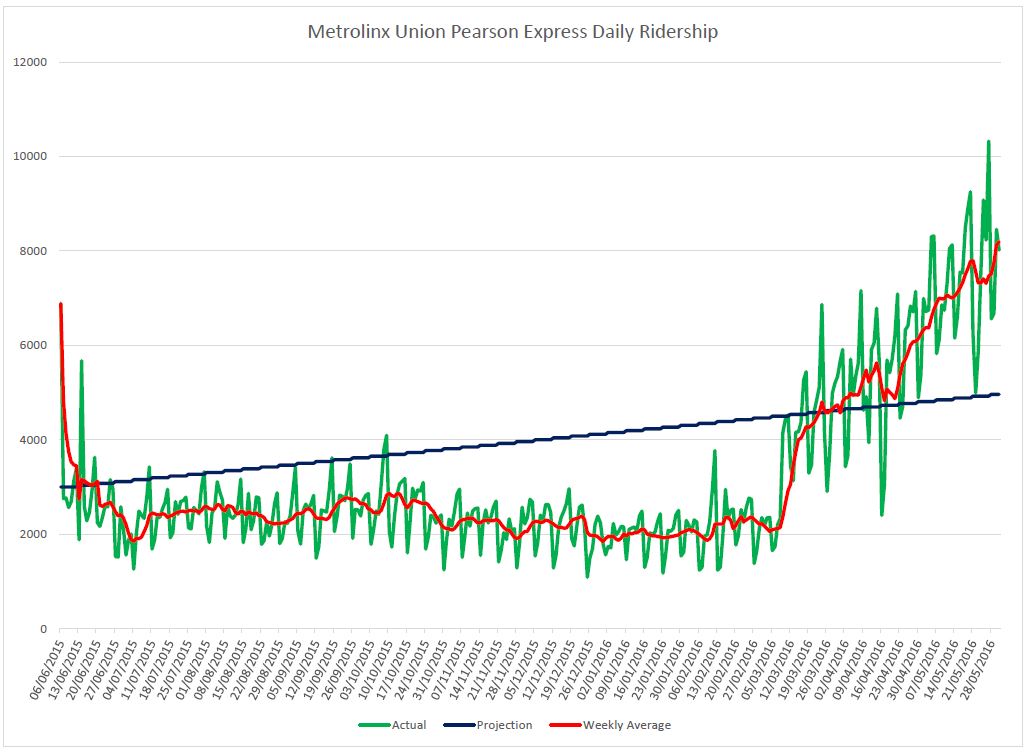
Metrolinx has published the ridership for the Union Pearson Express up to the end of May, 2016. The daily counts rose dramatically once fares were reduced on March 9, 2016, and the values are running well above the original projections after a long period of poor performance.

Exact origin-destination counts are not available, but Metrolinx reports that about 80% of travel is to and from the airport while the remainder are trips between other stations on the line.
UPX_Ridership_20160531

Note: In the source data, values are zero for February 13-15, 2016 as this was a free weekend for promotional purposes. The values from February 6-8 have been substituted for continuity.

Total ridership to March 31, 2016 (the end of the fiscal year) was 751,500.

The revenue situation for operations up to March 31, 2016 is revealed in the annual report. Budgeted revenue for UPX was considerably higher than actual.

Source          Actual         Per Rider     Budget
 
Fares           $15,165,000    $20.18        $43,275,000
Other Revenue   $ 8,762,000    $11.66        $ 7,093,000
Total           $23,927,000    $31.84        $50,368,000

According to the report:

UP Express non-fare revenue of $8.8 million consists of sponsorship and partnership revenues earned in the year. [p 43]

Updated June 30, 2016 at 5:30 pm:

There are two separate sets of figures in the Annual Report related to the subsidy. One claims that the subsidy paid was $63.2m while other shows this value as the total operating cost of UPX. This leads to different calculations of  the per rider subsidy. For completeness, I have left both calculations below pending clarification from Metrolinx.

(As of 5:45 pm Metrolinx has confirmed that their original report was in error.)

Revised version:

Metrolinx has published both the total revenue and the total cost for UPX, and from this we can deduce the operating subsidy.

                               Per Rider
Total Cost     $63,200,000     $ 84.10
Revenue        $23,927,000     $ 31.84
Subsidy        $39,273,000     $ 52.26

With a total cost of $63.2m for 10 months’ operation, an annualized value would be about $76m. If the average fare falls to $10 (half the level with the original tariff), then 7.6m riders would be required to break even.

That is equivalent to about 20,800 riders per day, roughly 2.5 times the current level of demand. This would require an average load of about 144 per train on every trip, both ways, to and from the airport, close to a 2-car train’s capacity. (Calculation based on 4 trips/hour each way, 18 hours/day)

A break-even situation is not in the cards for UPX, and it will continue to drain subsidy dollars from other more widely-used parts of GO operations.

Original version (based on erroneous Metrolinx report):

Metrolinx received approximately $233.8 million in operating subsidies from the Province of Ontario, of which $71.2 million was allocated to the direct costs of PRESTO operations and $63.2 million to the direct costs of UP Express. [p 44]

Yes, just over 1/4 of the subsidy paid to Metrolinx went to support the UPX. This does not include any capital amortization which is provided for separately.

                               Per Rider
Subsidy        $63,200,000     $ 84.10
Revenue        $23,927,000     $ 31.84
Total Cost     $87,127,000     $115.94

With a total cost of $87m for 10 months’ operation, an annualized value would be about $104m. If the average fare falls to $10 (half the level with the original tariff), then 10.4m riders would be required to break even.

That is equivalent to about 28,500 riders per day, roughly 3.5 times the current level of demand. This would require an average load of about 200 per train on every trip, both ways, to and from the airport, greater than the train capacity. (Calculation based on 4 trips/hour each way, 18 hours/day)

A break-even situation is not in the cards for UPX, and it will continue to drain subsidy dollars from other more widely-used parts of GO operations.
Toronto’s Network Plan 2031: Part I, SmartTrack

For the past months, Toronto Planning, the TTC and Metrolinx have hosted a number of public consultation sessions leading up to two critical meetings on the same day: June 28, 2016.

One will be the Toronto Executive Committee’s consideration of a series of reports on various transit proposals.

The other will be the Metrolinx Board’s first meeting in four months with several related items on the agenda.

Reviewing all of this material will require several article that I hope to finish before the meetings where these issues will be discussed actually occur.

Here I will begin with SmartTrack because of all of the proposals, that has been the most threadbare one throughout the public consultation. It is complicated by being a joint project with Metrolinx who own the tracks over which the trains will operate, and who now quite clearly will also own and operate the trains regardless of what the service is called.

Continue reading

A Cat’s Cradle of Transit Plans (Updated)

Updated June 6, 2016 at 11:30 pm: The chart of the demand profile for the Eglinton East LRT has been updated by City Planning to correct an error in labelling where inbound and outblound values were reversed. The new chart has been placed into this post, and the link to the source pdf has been updated below.

Public consultation sessions are coming to an end on the “motherlode” of transit projects (as they were described earlier this year by Toronto’s Chief Planner, Jennifer Keesmaat). This process will soon bring a consolidated set of reports and recommendations for Council. So far, the presentations have been subdivided between various projects.

A major challenge for politicians, the media and the general public is to sort out all of these schemes and to understand how they all fit together. This is not just a question of how we will finance all of the projects, but of how each project and the choices made for it will affect everything else. Where typical studies in Toronto might have wrestled with whether a new line should go under street “A” or “B”, and where the stations might be located, today’s work requires understanding of how the network will evolve over time and how it will work as a whole in a few decades.

The process is complicated further by having municipal (City Planning & TTC) and provincial (Metrolinx) components, and the secretive nature of Metrolinx studies means that some vital information about its projects is not yet public. The Metrolinx reports are expected to appear on their Board’s agenda for June 28, and this implies public availability sometime in the preceding week.

The consolidated City reports should be available on June 21 when a briefing session is to occur at City Hall a week before the June 28 Executive Committee meeting.

Continue reading

Toronto Council Endorses Transit Plan, Seeks Background Details

At its meeting of March 31, 2016, Toronto Council passed several motions relating to the proposed rapid transit plan for the city.These evolved first as a set of staff recommendations, then amendments at the Executive Committee and finally amendments at Council. The changes along the way give a sense of how the attempt at a general approach taken in the new transit plan by staff can be warped into an emphasis on individual projects while losing sight of the overall purpose. This is not new in Toronto’s political theatre, but the city and region are at a crucial time when the “big picture” of the transportation network is essential. The challenge for those who would lead this process is to find a responsible balance between wider priorities and local concerns without making every decision only on political merits.

Many of these motions involve requests for additional reports, and at one point there was some concern about whether city staff could actually handle the workload. One might ask whether the city should be making such important decisions if staff are unable to produce sufficient background material and simply want approval trusting their recommendations. While studying issues to death is a well-known delay tactic, rushing decisions without all the details is a classic method of railroading through decisions the city might regret later. There is certainly nothing wrong with asking for a more thorough study of items that have been omitted, provided that the same requests do not surface over and over again.

If anything, Council has been woefully underinformed on transit options, priorities and tradeoffs, and such an environment “debate” often has little to do with the real world. Will every Councillor read every page of every study? No, but at least the material will be there to answer questions, support the good ideas and counter the dubious schemes. We hear a lot about “evidence based planning”, but this can be a double-edged sword where “evidence” might not support fondly-held proposals.

This article groups Council’s motions by topic so that readers do not have to sort through the relationship of recommendations and amendments.

Continue reading

GO/RER Details Emerge in Business Case Analysis

Metrolinx has published a set of documents containing the “Initial Business Case” for the GO Transit Regional Express Rail (GO/RER) network.

Updated Dec. 13, 2022: Due to a reorganization of Metrolinx’ site, the reports are no longer available there. However, I have archived copies of them. The Summary and Full Report links below are to my site. The Appendices are not yet available as I must break them into chunks small enough that WordPress will allow them to be uploaded.

  • Summary
  • Full Report
  • Appendices A-J
    • A: Corridor Specifications
    • B: Corridor and System Schematics
    • C: Model Assumptions and Results
    • D: Record of Assumptions – Direct Demand Model
    • E: Financial Performance of RER Systems
    • F: Sensitivity Analysis
    • G: Wider Economic Benefits
    • H: Line Speed Analysis
    • I: Environmental Assessment Program
    • J: Fare Structure Issues and Solutions
  • Appendix K:  Station Access Analysis

[Note that except for the Summary, the documents are large PDFs.]

This article begins a review of these documents and of the various RER proposals examined in the Metrolinx studies.

Overview

Work on this review of GO/RER began in April 2014 following the announcement by Queen’s Park of its commitment to the RER concept. Unlike previous reports, this study looks in depth at all of the GO corridors, and reviews the technical issues associated with both increased service and electrification. This is not a final review, and much engineering work remains to be done, but there is a great deal more information now publicly available as the basis for discussions.

These documents were completed sometime in 2015 as is clear from references to future events that will occur later in the year, notably reports from the City of Toronto on SmartTrack. That scheme gets only passing mention, some of it the usual political cover story, because the specifics had yet to be decided. Exactly what the incremental effect of ST will be beyond the proposed GO/RER configuration is not yet known. Preliminary information in City reports implies that ST will amount to considerably less than was foreseen by the Tory election campaign, possibly as little as a few more stations and some sort of TTC/GO fare integration.

Five scenarios were reviewed to compare the effects, benefits, costs and technical issues associated with various possible future networks.

  1. The “Do Minimum” scenario provides only marginal peak period improvements to the existing system in response to projected demand growth, but with no electrification. This is effectively a “business as usual” model for the base case.
  2. The “Two-Way All-Day” scenario expands off peak service, but with diesel operation and no electrification. This is a minimal level of service expansion.
  3. The “10-Year Plan” would provide frequent service on the inner parts of some corridors, but with limited electrification.
  4. The “Full Build” extends beyond the 10-Year Plan to provide frequent service on the inner parts of all corridors, and with full electrification.
  5. The “10-Year Plan Optimized” extends the scope of electrification beyond that contemplated in scenario 3.

This progression implies a certain sequence of events during the study where a full build is impractical and the original 10-year plan was not aggressive enough with electrification, a key component of the announced government direction.

The estimated capital costs rise from $5 billion for scenario 1, through $10b, $12b and $19b for scenarios 2 to 4. The price tag for the latter is well above what Queen’s Park has available, and scenario 5 was developed with a projected cost of $13.5b. All but scenario 4 are said to be achievable by 2024. Given that it is now 2016, and this is a 10 year plan, that date probably requires some adjustment.

Scenario 5 is the 10-Year Plan Optimized, it represents significant progress towards implementing the service levels of Scenario 4. It goes beyond the investments and service included in Scenario 3 (10-Year Plan), with electrification also to Bramalea, Barrie, Stouffville and to Pearson Airport. This scenario and the resulting recommended RER program has been defined to maximize return on investment while mitigating risks. Depending on resolving various challenges, it can be delivered over 10 years for approximately $13.5 billion. It does not preclude, but rather prepares for, services to Milton and Kitchener to be eventually electrified and frequent all-day services introduced when agreement is reached on co-existence of GO and freight on these privately-owned corridors. [p. iv, Full Report]

Annual ridership is expected to go up by a factor of 2.5 over the coming 15 years, but operation costs will not rise at the same rate. The study postulates that an operating profit would be possible, eventually, but that will depend a lot on future fare policies, and on the evolution of trip patterns (length, direction, average fare). The ridership model foresees that “hundreds of thousands” of auto trips would be replaced by GO ridership each weekday comparing scenario 5 to scenario 1. The proportion of trips and its relationship to expected growth is not specified in the Executive Summary. (Possibly in the demand modelling later.)

The rate of demand increase on GO overall is projected at 2.3% which is lower than recent levels, but allows for some leveling off in a more mature service.

One big issue is the problem of getting riders physically to and from the GO trains. Either this will be done with substantially improved local transit services (an option that brings many issues associated with fare integration and cross-system subsidies), or with parking. The cost estimates include $750m for 15,000 new parking spaces, or $50k per space. At that scale, simply paving empty lots is not an option. The study notes the possibility that some of this cost “may not be necessary if service integration and fare integration with local transit services can be improved”. [p. v]

Those 15,000 spaces represent nowhere near the ratio of new parking spaces to existing facilities that the projected ridership growth would entail if everyone arrived by car. Parking charges are listed as a way of raising additional capital for the RER project, and of encouraging a shift to ride sharing and public transit feeder services.

It is amusing to read about the benefits of proven technology, something for which Ontario has not been noted in past endeavours.

Virtually all of the works are within existing rail corridors, so environmental and community impacts are limited mostly to noise and vibration. RER will use proven technology that is working around the world. [p. v]

Descriptions of RER cite similar operations in more than 50 city regions worldwide [page 6], and list a number of factors that simplify implementation [p. 4]. I cannot help thinking of how badly past studies have downplayed the benefits of LRT which bears a family resemblance, but at a local rather than a regional level.

The first electric railway opened in 1883 (the Volks Tourist Railway on the Brighton seafront in the U.K.). Ever since that time, electric traction has increasingly become the default source of power for the world’s more intensively used rail systems. [p. 14]

Finding this statement in a Metrolinx report is quite amusing considering some of the remarks made during community meetings on electrification before Metrolinx and GO “got religion” on the subject. The report skirts that debate by observing that GO is now at the threshold where electrification makes sense:

Until recently, diesel traction has been the appropriate mode of traction for the GO rail operation. However, the service enhancements envisaged in the near future will take GO rail beyond the threshold of service intensity appropriate for electrification. Continued use of diesel traction will become a source of financial and economic inefficiency. [p. 14]

Metrolinx intends to pursue discussions with the railways regarding the upgrades needed on their trackage, and also intends to review “modern, proven technology” with Transport Canada and the railways.

This is an “initial” analysis, and changes are likely depending on the evolution of expectations, changes in provincial funding, and who knows what political meddling that could arise.

A decade is a long time in politics, and the likelihood that the current governing parties or councillors will still be in place at that distant time is minuscule. Moreover, changes could come at any level part way through the project, and only a very strong, unshakeable commitment (i.e. very popular and difficult to derail) is likely to survive. This is not simply a case of showing up for a photo op or two with a gigantic prop cheque, but of supporting the plan for the long haul, including building a constituency that can survive beyond current governments. The arrival of a Ford-equivalent who simply wanted to start over with his own plan would be disastrous.

Continue reading

A Few Questions About “Emerging Transit Plans”

At the February TTC Board meeting, Chief Planner Jennifer Keesmaat took the Board through the road show presentation she and her staff have been taking around Toronto with the proposed new Toronto transit plan. This issue was held over to the March Board meeting because, for procedural reasons, there were limited questions in February.

One major issue here is that the body actually charged with setting transit policy, the TTC Board, was being briefed on a plan they had not seen before, and to which they had given no input or direction. This is only partly explainable by the fact that any long-term transportation plan would form part of the city’s Official Plan, and the Planning Department “owns” that document. However, one would hope that members of the TTC Board would have at least a passing familiarity with what was in the works. This situation is complicated by the presence of “citizen” members who are not also Councillors and are not part of the information flow, such as it is, at City Hall.

The plan and supporting reports will go to City Council a week after the TTC meeting.

A major problem, of course, is that “planning” in Toronto consists of catering to the whims of the Mayor, influential Councillors, the Minister of Transportation (and his government), and senior members of the government caucus. To describe planning in this context as unbiased and purely “evidence based” is something of a stretch.

That said, the situation is better today than in recent years because, at least, all of the proposals are on the table at once, and it is more difficult to dress up a bad proposal when it must compete for attention and analysis with many others at the same time. This does not prevent Councillors from making the attempt at advancing their pet projects, but some degree of comparative evaluation might keep them in check.

Continue reading

Is Anything Left of SmartTrack?

In the City Planning report at Executive Committee on March 9, 2016, two options for the configuration of a “combined” SmartTrack and GO Transit/Regional Express Rail (RER) service remain on the table. These are referred to as Option C and Option D.

OptionC

OptionD

The number of trains/hour cited here has bothered me for some time, and a recent conversation with Jonathan Goldsbie of NOW Magazine got me digging a bit deeper. Here is the service plan for the Stouffville and Kitchener corridors as shown on the Metrolinx RER website, in the “How Will I Benefit” page.

GORER_StouffvilleService

Peak service on the Stouffville corridor totals 7 trains/hour or one every 8.6 minutes as shown in Options C and D.

GORER_KitchenerService

In the Kitchener corridor, there are 8 trains/hour, but two of these are service to Kitchener which would run express from Bramalea to Union leaving only 6 “local” trains in that segment.

The service levels and station plans have profound implications for the transit network now under study.

  • There is no distinct SmartTrack service, only GO trains and (maybe) a few new stations. There will be no “SmartTrack” branded fleet.
  • If TTC fares will be offered on SmartTrack, this will really consist of giving people cheaper rides on service GO is already operating.
  • If “Regional Fare Integration” means that TTC rapid transit (subway) fares rise and GO fares for short trips come down, then SmartTrack will be a cash grab from subway riders to cross-subsidize SmartTrack riders on GO trains.
  • Demand models for SmartTrack indicate that very frequent service at TTC fares is required to attract substantial ridership, with 12 trains/hour (one every 5′) performing best in the model runs. The proposed service is considerably less frequent. “TTC fares” implies full transfer rights at no premium to and from the TTC network.
  • The existence of frequent SmartTrack service and stations in Scarborough is an integral part of the plan to build the subway extension as a one-stop express route to the Town Centre.
  • Part of the justification for keeping the Relief Line alignment to the north along Queen Street rather than King is to avoid competition with SmartTrack. However, there won’t be any SmartTrack service for it to compete with, only GO trains.
  • Tax Increment Financing requires that SmartTrack contribute something to the uplift in property values that would not occur absent the new service. However, the “new” service will entirely be GO Transit’s, and it will occur whether anything called SmartTrack exists or not.

The obvious question here is “where is SmartTrack”? In fact, it has completely vanished from the map, and at best would be represented by a handful of new stations, none of which is in Scarborough in Option D.

Is this the master plan, the culmination of John Tory’s election campaign and all of the vitriol poured over his critics?

The emperor has no clothes.


Transit Network Analysis, SmartTrack and the Mysteries of Future Growth

Among the many reports (scroll down to the bottom of this document for links) coming to Toronto’s Executive Committee on March 9 is a short paper on Transit Network Analysis, three detailed demand projections and a paper about  Growth Assumptions. Although this has the neutral title Population and Employment Projections, it is in fact a review of the effect of SmartTrack on development in the Greater Toronto Area. The main report is titled Commercial & Multi-Residential Forecasts For The Review Of SmartTrack.

The paper is authored by the Strategic Regional Research Alliance, or SRRA, whose primary focus is real estate market tracking and projection. This organization (or its principals) were involved in the reports leading to the original SmartTrack plan in now-Mayor Tory’s campaign, specifically:

A fundamental premise running through all three papers, and perpetuated in the SmartTrack proposal, was that downtown Toronto was more or less fully built-out, and that future commercial growth would occur primarily in two major centres outside of the city, the large area around Pearson Airport and an equally large area around Markham. The potential for additional growth within Toronto itself was regarded as low, and therefore major expansion of the rapid transit network would focus on the two big suburban nodes.

At the Mayor’s direction, SRRA was retained as a consultant to the planning work now underway by the City of Toronto. This raised eyebrows both at Council for the crossover from a campaign support role to consultant, and also at Metrolinx where SRRA’s principal, Iain Dobson, had been appointed to the Board during the latter days of Glen Murray’s term as Ontario Minister of Transportation.

Although there is reason to take the new SRRA report with a grain of salt, the document makes interesting reading including a shift in some of SRRA’s outlook compared to their earlier work.

Which Land Use Model is Toronto Actually Using?

This report is supposed to be background to the overall planning study coming to Executive, but its focus is exclusively on the effects of SmartTrack. There is little mention of the development effects of other initiatives including the Scarborough Subway Extension (SSE), the Eglinton Crosstown LRT. Also, in part because ST and the GO/RER proposal cover the same territory and share stations, it is unclear how much change to development patterns occurs specifically due to SmartTrack and how much to the two services operating in one corridor.

Other background studies examine ridership effects of various combinations of SmartTrack, the SSE and the Relief Line, and these clearly must have an underlying land use, population and job location model. How this was developed or relates to the SRRA study is not clear.

That said, for the remainder of this article, I will concentrate on the SRRA text and its underlying assumptions.

Continue reading

GO Transit to Take Over UP Express

According to Oliver Moore in The Globe, the separate Metrolinx division responsible for the Union Pearson Express will be placed under GO Transit’s control. The fate of UPX President Kathy Haley is unclear.

UPX even managed to win awards from the Global AirRail Alliance for:

2015 Travelport Project of the Year – UP Express

2015 AccesRail Integrated Partnership of the Year – UP Express

2015 Personality of the Year – Kathy Haley, UP Express

2014 Air Rail Concept of the Year – UP Express: Strategic Partnerships, Toronto, Canada

2014 Travelport Project of the Year – UP Express: The Airport Connection

2013 Travelport Project of the Year – Union Pearson Express Project

One wonders who they were competing against, but the Alliance’s site does not list nominees, only winners. It is am impressive “project” that can rake in the hardware before ever carrying a passenger or proving its viability as a business. Such is the back-scratching nature of the industry, I must assume.

While it may be convenient to target Haley as the culprit here, the real question is how the structure and corporate attitude that led to UPX’ creation arose in the first place. From the beginning, this has been a project for which the word pretentious is almost inadequate. Despite the abandonment of this scheme by its original private sector proponent – for the simple reason that it was judged financially unsound – Ontario forged on with this as a signature project, part of the Bid Book for the Pan Am Games. We would show the world what Ontario could do.

Haley may take the fall for this fiasco, but she worked for a board who lapped up the praise, who bought into the flawed vision of what UPX would become. That board, and the government who set all of this in motion to begin with, owe us all an explanation.

When Is a GO Train not a GO Train? When It’s UPX!

Among the mysteries of the internal organization at Metrolinx is the presence of separate “divisions” for GO Transit (the commuter rail service), Presto (the fare card service) and UP Express (the premium fare airport shuttle service).  Rather than using the GO brand for the airport service and integrating its operation and fares, Metrolinx treats UPX as a completely separate entity, no doubt so that it could isolate the operation as a profit centre on the books. We now know that “profit” is the furthest thing from a UPX future where just finding riders now takes precedence.

Soon, fares on UPX will be much lower and this might encourage some to incorporate the UPX into their journeys. However, there are two glaring holes in the new arrangement.

UPX, being a separate operation, does not have fares integrated with connecting GO services at Union. Riders transferring between these services will pay separate fares for each leg of their journey. Presuming that UPX fares stay low, this should be corrected, at the latest, in the next annual review of GO’s tariff.

But the really bone-headed decision (or lack of decision) lies with the TTC. Although GO fares discourage “local” travel within the 416, there is a legal transfer move a rider can use called TTC Times Two. A trip can start on the TTC, transfer to GO, and then back onto the TTC again using the original TTC transfer.

With UPX moving to lower fares and the likelihood that it will attract commuter trade within the city, the question becomes “is TTC Times Two valid for UPX”? I asked the TTC’s Brad Ross and Chris Upfold this question at the recent TTC Board meeting. Their answer? “No” because (a) UPX is not a GO train and (b) a TTC policy change would be required.

The irony, of course, is that GO operates in the same corridor as UPX, and it would be impossible to distinguish whether a traveller with a transfer from the Lawrence 52 bus arrived at Union Station via GO or via UPX, except of course that GO service only runs in the peak period.

During the March 1 subway shutdown thanks to a power vault fire, TTC riders travelled on GO and UPX for no extra charge. The reverse courtesy has been extended to GO riders on occasion. This did not require a formal meeting and policy decision, simply the recognition that there is one transit network regardless of the logo on the train.

How riders get from one connection point to another should not matter. Between now and March 9 when the new UPX fares take effect, can someone at the TTC show a small spark of initiative and decide that a traveller on either a GO or UPX train can use TTC Times Two? Or will we continue to have an artificial distinction between two services provided on the same track by the same agency?