GO Transit Electrification Study Update

Where Did The Study Come From?

GO Transit’s Georgetown corridor, home to many existing and proposed services, has not been a happy place for the Environmental Assessment process, especially on the southern end of the line.  Officially, this project was the Georgetown South Service Expansion (GSSE), now shortened to the Georgetown South Project.  However, the project has a troubled history thanks to:

  • Extreme insensitivity to local concerns about noise and vibration from the West Toronto Diamond grade separation project eventually resulted in a successful appeal to the Canadian Transportation Agency forcing GO to change its construction methods.
  • Proposals to slice through Weston with a widened rail corridor, including closing streets that linked the commercial strip on Weston Road to the residential communities to the east, infuriated local residents.  This was compounded by their discovery that, initially at least, much of the additional traffic on the corridor would be for the premium fare airport shuttle from Union Station.

This established a confrontational relationship between GO and corridor residents.  When Metrolinx published The Big Move, it was obvious that vastly expanded service would be operated along this line including:

  • All-day service at least to Brampton on the Georgetown line
  • All-day service to Milton
  • Peak period service to Bolton (a line that now has no GO operations but shares the corridor to the north end of Weston)
  • All-day service to Barrie (a line that shares the corridor from Dundas Street south to the rail yards at Bathurst)
  • All-day service every 15 minutes on the Air Rail Link from Union to Pearson Airport operating via the Georgetown line and a spur to be built into the airport lands

GO was so preoccupied with opposition in Weston that it failed to take account of the quickly growing population around the rail corridor south of West Toronto Junction.  Aside from the question of daily train movements, GO further alienated residents with a proposal for the Strachan Avenue grade separation that would have created a major barrier within the new King West / Liberty Village community.  This matter was not resolved until intervention by Metrolinx and a compromise solution acceptable to the City of Toronto was adopted.

GO runs popular services, and as a provincial agency it is used to getting more or less what it wants.  Public participation and accommodation have not been GO’s strong suits.

When the Georgetown South project revealed that there would be over 400 train movements per day on the southern end of the corridor, residents were more than a little upset.  Their concerns about noise and pollution were not  helped by GO’s appeal to the greater good with claims that, overall, there would be less pollution thanks to auto trips diverted from highways.  Those highways are not in backyards in Weston, the Junction and Parkdale, and the benefits that might accrue on Highways 400, 401 and 427 were little comfort to those who would see their local rail corridor gain vastly more traffic than it has today.

From this swelling activism came a demand that GO electrify its system to reduce noise and pollution levels in the neighbourhoods through which it travelled.  Electrification had been considered before, but only in the context of the Lake Shore corridor, and only for lower service levels than The Big Move contemplates.  This has always been a “nice to do” that gets shunted aside thanks to budget constraints and a desire to concentrate on building service.  By late 2009, the demand for a detailed study reached a level where Queen’s Park and Metrolinx could not dodge the issue, and GO’s Electrification Study was born. Continue reading

Metrolinx Board Wrapup for May 2010

The Metrolinx Board met on Wednesday, May 19 for an unusually long public session.  Rather than post separate articles, herewith a compendium report.  The major topics are:

  • The Board Speaks!
  • The Managing Director Reports
  • We Have A Vision, We Just Don’t Know What It Is Yet
  • Achieving 5 in 10, or Transit City Rescheduled
  • GO Rail Service Expansion Benefits Cases
  • A Question of Advocacy

The Board Speaks!

Probably the most astounding thing about this meeting, the first anniversary of the “new” Metrolinx, is that the Board members finally found their voices.  I was beginning to wonder if they were ever going to show some indication of earning their keep and actually asking hard questions of staff in public.  We’re not quite there yet, but at least the discussion gave an indication that the Board is thinking about its role.

As regular readers will know, I believe that organizations such as Metrolinx should be publicly accountable through an electoral process and through direct access to one’s representatives.  Boards that answer to nobody but the government which appointed them, and entertain no criticism from the public, can leave much to be desired.

To be fair to Metrolinx, even when it had a political board, much of the “public participation” was managed to achieve concensus with, more or less, what Metrolinx planned to do anyhow.  That other well-known transit board, the TTC, is elected, but has succumbed to the disease of being cheerleaders for the organization right-or-wrong.

Metrolinx has not had to actually do much (as opposed to GO Transit which was simply merged into its new “parent”), and we have yet to see how the Board and the Government will react if Metrolinx badly fouls up any of its projects.

Continue reading

GO Transit Pile Driving Ruled Unreasonable (Update 3)

Updated April 12, 2010:  Metrolinx has dropped the appeal of the CTA’s order.  The Star quotes Transportation Minister Kathleen Wynne:

“This is about working with the community and repairing any damage that has been done and building a good relationship,” said Ontario Transportation Minister Kathleen Wynne.

“These transit projects are going to be going to go on for a number of years, as they should be. That means there will be disruption in the communities,” she said.

But the government is committed to working with residents to make the process as comfortable as possible, said Wynne.

Continue reading

Time For Metrolinx To Earn Its Keep

A few days ago, Queen’s Park dropped a bombshell on local and regional transit plans by announcing the deferral of $4-billion of previously announced support for transit construction.  Details were left for Metrolinx to work out.

Pity poor Metrolinx, and its Board who are about to embark on their annual retreat.  This will be no wine and canapés in the woods outing, but some very hard slogging for “Metrolinx II”.  This is a Board that did not work through the creation of The Big Move, and many members are short on local planning and political experience.  All the same, it’s their job to sort out what is to be done.

I’m not a Metrolinx Board member.  I wasn’t even on their Advisory Panel.  But if I were, here’s the advice I would give.

Metrolinx is stuck in a policy vacuum.  Queen’s Park claims it has not lost interest in transit, merely that it wants to hold off a while to get the financial house in better order and concentrate on portfolios more demanding of short-term spending.  We have to take them at their word, but this doesn’t really tell us what support for transit will look like whenever it will materialize.

Any program that assumes one specific level of support is doomed to irrelevance on two counts:

  • If spending priorities change for any reason, the program will be out-of-step with available funding and we will be back to the familiar position of waiting for yet another proposal while the clock ticks away.
  • A single program without alternatives includes many assumptions and tradeoffs that may be hidden in private discussions, and which preclude vital public debate on what role transit should have and how it will be financed.

Queen’s Park has announced that it will produce a 10-year fiscal plan in 2011.  That plan necessarily will include (or omit) whatever funding for transit, including Metrolinx projects, that will take us to the next decade.  Metrolinx’ job is not to produce one scenario, but a range of options that can inform the creation of that plan.

For obvious political reasons (the coming provincial election), debate on these options may happen in private, and that would be quite sad.  The future of the GTA’s transit network is far too complex and far-reaching to appear as a fait accompli by way of a pre-election announcement next year.  Moreover, if the Liberals were to lose power, a single program embedded in an election platform would almost certainly be discarded as a product of the ancien régime.  You need only look to the treatment accorded David Miller’s Transit City to see what the future might do to a Liberal transit plan.

Here, Board members, are your assignments. Continue reading

GO Transit / Clean Train Coalition Update

On March 22, the Toronto Public Health Department hosted a meeting at City Hall regarding the issue of clean trains in the Weston corridor.

I was not able to attend, but Robert Wightman sent the following report. 

I was at the meeting at city hall tonight and a few interesting things came up.

1 Prof. Christopher Kennedy, Civil Engineering U of T, said that far side stops on centre reservation LRT lines were a bad idea.

2 The number of 480 trains per day is only valid if GO gets every commuter to take the train downtown. They are only going to run an extra 10 to 15 GO trains per day. They were designing for the “worst” or “Best” case scenario. Gary McNeil from GO/Metrolinx said they did not have the capacity at Union for this many trains, no kidding.

3 Gary McNeil gave the impression that GO/Metrolinx really doesn’t know where it is going or what its real direction is. He did say that GO is inter regional as is not interested in providing service within the 416, but if the TTC wants to build a rapid transit line up the corridor they could tunnel under the rail right of way. GO is unwilling to consider anything that is not mainline railway compatible even if they own the entire corridor and have enough tracks to keep regular freight and passenger equipment off them.

4 SNC Lavalin is looking at a mainline version of the Ottawa Talent cars instead of recycled Budd Cars.

5 The Air Rail Link must be running for the Pan Am Games.

6 GO transit has NOT bought the Oakville Sub or any other tracks along the Lake Shore from CN but they are in negotiations for any and all lines that CN or CP will sell them. The guy beside me told me this. I think that his name was Bob Prichard.

7 McNeil said the electrification study should be done by December and that GO and MPI will have a tier 4 version of the MP40 Locomotive ready in about a year for testing.

The crowd was remarkably civil considering the fact that 99% thought that GO Metrolinx had been treating them like mushrooms, keeping them in the dark and feeding them manure.

If anyone else wishes to contribute observations, please do so in the comment thread.

GO Transit To Raise and Standardize Fares (Updated)

Updated February 22 at 4:00 pm

As expected, the Metrolinx Board approved the proposed increase in GO Transit fares at its recent meeting.  The contrast with the debates about TTC budgets and fares was quite striking.  The greatest potential for discord came with the presentation of an anti-increase petition.

The bottom line for this increase is “to ensure fiscal responsibility and meet the needs of a growing market of commuters” (presentation to the Board, page 2).  That’s shorthand for keeping the subsidy requirement under control, paying for the operations we have now and giving us some headroom to do more.

GO customers are, after all, from a very different market than the TTC.  Their median family income is $100k, they live well outside the core, and auto travel is already an established part of their lifestyle.  85% are fully employed, 9% are students and 1% are seniors.  They are travelling on GO overwhelmingly by choice and good service, in all aspects, matters.

40% of GO riders use monthly passes and another 40% use 10-trip tickets.  This is not unlike the TTC where the monthly pass accounts for over half of the adult trips, and a large majority of those remaining use token fares.

The purpose of the fare increase was to raise revenue by $14.6m in fiscal 2010.  Provincial subsidy will also jump for 2010 from $52.6m to $72.1m, but over half of this changes adjusts for one-time revenue in 2009/10 that allowed for a lower subsidy in that year.  GO’s total operating budget is $386.7m, and they expect to carry 56m rides.

By comparison, the TTC’s fare increase is project to raise somewhere between $36m and $50m depending on which figures you believe.  In 2010, the City will carry the entire $430m TTC subsidy while Queen’s Park spends its way through this budget cycle propping up Ontario’s economy.  The TTC’s proposed total operating budget is $1.37b, and they expect to carry 462m rides.

GO’s workforce, including contract staff, is 1,938.  The TTC’s proposed “conventional system” workforce for 2010 (as discussed in another thread), excluding contractors, is 10,491.  This number omits Wheel Trans, Capital Projects and Toronto Coach Terminal.

The TTC’s budget is only 3.5 times GO’s, but there are far more staff (5.4:1) and riders (8.2:1).  The subsidy per rider on GO is $1.29.  On the TTC it is about $0.93.

Earlier, I mentioned the potential for discord at the Metrolinx meeting.  The protocols for these meetings accept the public’s presence only grudgingly, unlike meetings for municipal agencies such as the TTC where in camera discussions are allowed on only a handful of grounds.  There are no deputations at Metrolinx, unlike the City of Toronto where a long history of public involvement would be impossible to silence.

The Directors, with few exceptions, ask no questions in the public session, and everything has clearly been worked out beforehand.  They’re just one big happy family.

Alas, thanks to an email slip-up, Metrolinx’ attitude slipped into view.  An internal email from Rob Prichard, Metrolinx CEO, was cc:ed to the petion’s originator in error.  From this, the clear intent was to give the petition as little exposure at the meeting as possible and assume that the Board would ignore it.  They did.

The original article from February 12 follows the break.

Continue reading

A Response to “Save Our Subways”

For some time, I have stayed away from the “Save Our Subways” dialogue over on UrbanToronto in part because Transit City and related issues are presented as being “Steve Munro’s” plan (there’s even a poll that just went up on that subject), and because there are many comments in the SOS thread that are personal insults, not fair comment, well-informed or otherwise.

Such are the joys of an unmoderated forum.

Some have proposed a public debate, possibly televised, which I flatly reject.  First off, the issues are more complex than can be properly handled in that forum, and it certainly should not turn into a mayoral candidates’ debate on transit.  I do not know any candidate who could debate the details of either commentary.

Second, the lynch mob mentality of some writers on UrbanToronto is utterly inappropriate to “debate”, and this poisons many of the discussions on that site.

Recently I was asked by the authors of the Move Toronto proposal to respond, and this article is an attempt to start that dialogue in a forum where civility occasionally breaks through the diatribes.

To begin with, there are areas where SOS and I agree strongly, notably on the need for the Downtown Relief Line (at least the eastern side of it).  I’ve been advocating this for years at the very least as a high-end LRT line, more recently as a full subway as that technology fits its location in the network better and is well suited to the likely demand.

Where we part company is the premise that we have to give up big chunks of Transit City to pay for the DRL.  This sets up a false dialogue where TC lines are portrayed as overpriced and underperforming, denigrated at least in part to justify redirecting funding to the DRL.  That is an extremely short-sighted tactic and harms the cause of overall transit improvements.  It takes us back to the days of debating which kilometre of subway we will build this year.

I don’t intend to repeat my three long posts about Transit City here, but anyone who has read them knows that I do not slavishly support everything in that plan.  If anything, the lack of movement on some valid criticisms people have raised regarding TC sets up a confrontational dynamic.  Instead, the City/TTC could have been seen as responding to concerns.

Now, with the mayoralty campaign, attacking TC has become a surrogate for attacking the Miller program and the candidacy of Adam Giambrone.  These need to be disentangled if we are to have any sort of sensible debate.

My greatest concern is that whoever is the new mayor, the issues will be so clouded by electoral excess, by positions taken as debating points, as sound bites to attack an opponent, that we won’t be able to sort fact from fiction afterwards.  If, for example, George Smitherman winds up as Mayor, he will need a reasoned program, likely a mixture of some old, some new, not a “throw it all out and start over” policy.  People will have different ideas about what that new program might be, and that’s a valid debate.

Whether Steve Munro is an arch villain (SFX: maniacal laughter) plotting the end of civilized transportation is quite another matter.  To some, I have a vast reach through the political machinery of the GTA, while to others I am irrelevant.  I am not the issue.  Transit is.

These comments are organized roughly in the sequence of the Move Toronto paper (6mb download).  Although variations and alternatives have appeared in other locations, notably threads on the UrbanToronto website, I have not attempted to address these as they are (a) a moving target and (b) not necessarily the formal position of the Save Our Subways group.

I believe that Move Toronto contains many flaws arising from an underlying desire to justify a subway network just as critics of Transit City argue against its focus on LRT.  Among my major concerns are:

  • Subway lines are consistently underpriced.
  • LRT is dismissed as an inferior quality of service with statements more akin to streetcar lines than a true LRT implementation.
  • Having used every penny to build the subway network, Move Toronto proposes a network of BRT lines for the leftover routes. However, this “network” is in fact little more than the addition of traffic signal priority and queue jump lanes (“BRT Light”) on almost all of the BRT “network”.
  • Parts of the BRT network suggest that the authors lack familiarity with the affected neighbourhoods and travel patterns.
  • There is no financial analysis of the life-cycle cost of building and operating routes with subway technology even though demand is unlikely to reach subway levels within the lifetime of some of the infrastructure.

That’s the introductory section.  The full commentary is available as a pdf.

Transit City Revisited (Part III, Updated)

(Updated at 3:00 pm, February 1.  I omitted a section on the proposed Sheppard subway extensions to Downsview and to Scarborough Town Centre.  This has been added.)

In this, the final installment of my review of Transit City, I will look at the unfunded (or underfunded) TTC transit projects.  Some of these spur passionate debates and the occasional pitched battle between advocates of various alternatives.  There are two vital points to remember through all of this:

  • Having alternatives on the table for discussion is better than having nothing at all.  It’s very easy to spend nothing and pass the day on comparatively cheap debates.  The current environment sees many competing visions, but most of them are transit visions.  The greatest barrier lies in funding.  Governments love endless debate because they don’t have to spend anything on actual construction or operations.  Meanwhile, auto users point to the lack of transit progress and demand more and wider roads.
  • Transit networks contain a range of options.  They are not all subways or all buses or all LRT.  Some are regional express routes while others address local trips.  Most riders will have to transfer somewhere, even if it is from their car in a parking lot to a GO train.  The challenge is not to eliminate transfers, but to make them as simple and speedy as possible.

I will start with the unfunded Transit City lines, and then turn to a range of other schemes and related capital projects. Continue reading

History of the Dundas West GO Connection

From time to time in the Georgetown South Corridor debate, the issue of a direct connection between Dundas West subway station and the GO platforms at Bloor station surfaces.  Oddly enough, although a connection at this point for the Airport link would be quite useful, the usual “design” mooted is for a walking transfer via Bloor Street.  This is bad enough for TTC-to-GO connections, but for Airport passengers with luggage, it’s a joke.

Since the late 1980’s, the TTC and GO have contemplated a direct link at this location, and provision for this was included in the property deal between the City of Toronto, the TTC and what became in time the Crossways Development.  Nothing ever came of this in part because service on the Weston corridor was peak-only, and the cost was considered excessive for the potential use it would see.  This situation is no longer true because there will be all-day service at least to Georgetown plus the Airport link, however it is implemented.

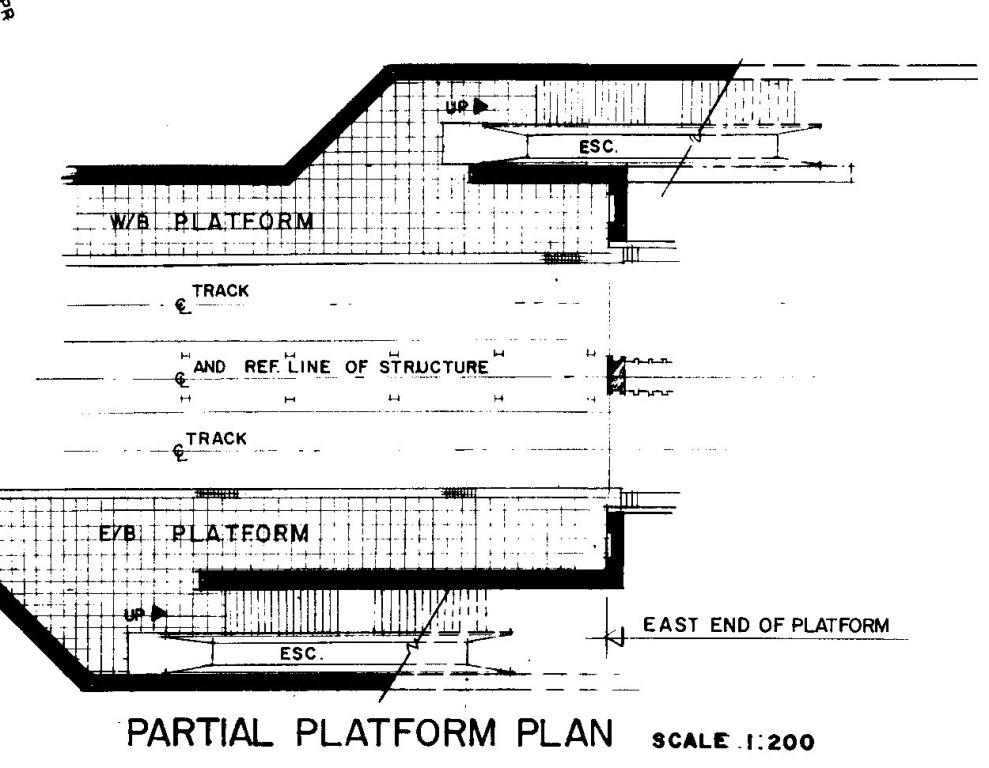
A preliminary design for the connection was done by TTC in April 1987.  This design would require some revision today both to provide full accessibility (elevators) and to fit with the planned new platform arrangements at Bloor station on the rail corridor.  In the interests of informed discussion, I have scanned the 1990 report on the history of this connection as well as the 1987 plan.

The report has been reformatted slightly, but the text is unchanged.  The drawing has been split apart from four separate images on one large page for ease of viewing online.

TTC GO Connection Report
Key Plan of Stations
Subway Platform East End
Control Area of Connection
Section View of New Connection