GO Transit To Raise and Standardize Fares (Updated)

Updated February 22 at 4:00 pm

As expected, the Metrolinx Board approved the proposed increase in GO Transit fares at its recent meeting.  The contrast with the debates about TTC budgets and fares was quite striking.  The greatest potential for discord came with the presentation of an anti-increase petition.

The bottom line for this increase is “to ensure fiscal responsibility and meet the needs of a growing market of commuters” (presentation to the Board, page 2).  That’s shorthand for keeping the subsidy requirement under control, paying for the operations we have now and giving us some headroom to do more.

GO customers are, after all, from a very different market than the TTC.  Their median family income is $100k, they live well outside the core, and auto travel is already an established part of their lifestyle.  85% are fully employed, 9% are students and 1% are seniors.  They are travelling on GO overwhelmingly by choice and good service, in all aspects, matters.

40% of GO riders use monthly passes and another 40% use 10-trip tickets.  This is not unlike the TTC where the monthly pass accounts for over half of the adult trips, and a large majority of those remaining use token fares.

The purpose of the fare increase was to raise revenue by $14.6m in fiscal 2010.  Provincial subsidy will also jump for 2010 from $52.6m to $72.1m, but over half of this changes adjusts for one-time revenue in 2009/10 that allowed for a lower subsidy in that year.  GO’s total operating budget is $386.7m, and they expect to carry 56m rides.

By comparison, the TTC’s fare increase is project to raise somewhere between $36m and $50m depending on which figures you believe.  In 2010, the City will carry the entire $430m TTC subsidy while Queen’s Park spends its way through this budget cycle propping up Ontario’s economy.  The TTC’s proposed total operating budget is $1.37b, and they expect to carry 462m rides.

GO’s workforce, including contract staff, is 1,938.  The TTC’s proposed “conventional system” workforce for 2010 (as discussed in another thread), excluding contractors, is 10,491.  This number omits Wheel Trans, Capital Projects and Toronto Coach Terminal.

The TTC’s budget is only 3.5 times GO’s, but there are far more staff (5.4:1) and riders (8.2:1).  The subsidy per rider on GO is $1.29.  On the TTC it is about $0.93.

Earlier, I mentioned the potential for discord at the Metrolinx meeting.  The protocols for these meetings accept the public’s presence only grudgingly, unlike meetings for municipal agencies such as the TTC where in camera discussions are allowed on only a handful of grounds.  There are no deputations at Metrolinx, unlike the City of Toronto where a long history of public involvement would be impossible to silence.

The Directors, with few exceptions, ask no questions in the public session, and everything has clearly been worked out beforehand.  They’re just one big happy family.

Alas, thanks to an email slip-up, Metrolinx’ attitude slipped into view.  An internal email from Rob Prichard, Metrolinx CEO, was cc:ed to the petion’s originator in error.  From this, the clear intent was to give the petition as little exposure at the meeting as possible and assume that the Board would ignore it.  They did.

The original article from February 12 follows the break.

Continue reading

A Response to “Save Our Subways”

For some time, I have stayed away from the “Save Our Subways” dialogue over on UrbanToronto in part because Transit City and related issues are presented as being “Steve Munro’s” plan (there’s even a poll that just went up on that subject), and because there are many comments in the SOS thread that are personal insults, not fair comment, well-informed or otherwise.

Such are the joys of an unmoderated forum.

Some have proposed a public debate, possibly televised, which I flatly reject.  First off, the issues are more complex than can be properly handled in that forum, and it certainly should not turn into a mayoral candidates’ debate on transit.  I do not know any candidate who could debate the details of either commentary.

Second, the lynch mob mentality of some writers on UrbanToronto is utterly inappropriate to “debate”, and this poisons many of the discussions on that site.

Recently I was asked by the authors of the Move Toronto proposal to respond, and this article is an attempt to start that dialogue in a forum where civility occasionally breaks through the diatribes.

To begin with, there are areas where SOS and I agree strongly, notably on the need for the Downtown Relief Line (at least the eastern side of it).  I’ve been advocating this for years at the very least as a high-end LRT line, more recently as a full subway as that technology fits its location in the network better and is well suited to the likely demand.

Where we part company is the premise that we have to give up big chunks of Transit City to pay for the DRL.  This sets up a false dialogue where TC lines are portrayed as overpriced and underperforming, denigrated at least in part to justify redirecting funding to the DRL.  That is an extremely short-sighted tactic and harms the cause of overall transit improvements.  It takes us back to the days of debating which kilometre of subway we will build this year.

I don’t intend to repeat my three long posts about Transit City here, but anyone who has read them knows that I do not slavishly support everything in that plan.  If anything, the lack of movement on some valid criticisms people have raised regarding TC sets up a confrontational dynamic.  Instead, the City/TTC could have been seen as responding to concerns.

Now, with the mayoralty campaign, attacking TC has become a surrogate for attacking the Miller program and the candidacy of Adam Giambrone.  These need to be disentangled if we are to have any sort of sensible debate.

My greatest concern is that whoever is the new mayor, the issues will be so clouded by electoral excess, by positions taken as debating points, as sound bites to attack an opponent, that we won’t be able to sort fact from fiction afterwards.  If, for example, George Smitherman winds up as Mayor, he will need a reasoned program, likely a mixture of some old, some new, not a “throw it all out and start over” policy.  People will have different ideas about what that new program might be, and that’s a valid debate.

Whether Steve Munro is an arch villain (SFX: maniacal laughter) plotting the end of civilized transportation is quite another matter.  To some, I have a vast reach through the political machinery of the GTA, while to others I am irrelevant.  I am not the issue.  Transit is.

These comments are organized roughly in the sequence of the Move Toronto paper (6mb download).  Although variations and alternatives have appeared in other locations, notably threads on the UrbanToronto website, I have not attempted to address these as they are (a) a moving target and (b) not necessarily the formal position of the Save Our Subways group.

I believe that Move Toronto contains many flaws arising from an underlying desire to justify a subway network just as critics of Transit City argue against its focus on LRT.  Among my major concerns are:

  • Subway lines are consistently underpriced.
  • LRT is dismissed as an inferior quality of service with statements more akin to streetcar lines than a true LRT implementation.
  • Having used every penny to build the subway network, Move Toronto proposes a network of BRT lines for the leftover routes. However, this “network” is in fact little more than the addition of traffic signal priority and queue jump lanes (“BRT Light”) on almost all of the BRT “network”.
  • Parts of the BRT network suggest that the authors lack familiarity with the affected neighbourhoods and travel patterns.
  • There is no financial analysis of the life-cycle cost of building and operating routes with subway technology even though demand is unlikely to reach subway levels within the lifetime of some of the infrastructure.

That’s the introductory section.  The full commentary is available as a pdf.

Transit City Revisited (Part III, Updated)

(Updated at 3:00 pm, February 1.  I omitted a section on the proposed Sheppard subway extensions to Downsview and to Scarborough Town Centre.  This has been added.)

In this, the final installment of my review of Transit City, I will look at the unfunded (or underfunded) TTC transit projects.  Some of these spur passionate debates and the occasional pitched battle between advocates of various alternatives.  There are two vital points to remember through all of this:

  • Having alternatives on the table for discussion is better than having nothing at all.  It’s very easy to spend nothing and pass the day on comparatively cheap debates.  The current environment sees many competing visions, but most of them are transit visions.  The greatest barrier lies in funding.  Governments love endless debate because they don’t have to spend anything on actual construction or operations.  Meanwhile, auto users point to the lack of transit progress and demand more and wider roads.
  • Transit networks contain a range of options.  They are not all subways or all buses or all LRT.  Some are regional express routes while others address local trips.  Most riders will have to transfer somewhere, even if it is from their car in a parking lot to a GO train.  The challenge is not to eliminate transfers, but to make them as simple and speedy as possible.

I will start with the unfunded Transit City lines, and then turn to a range of other schemes and related capital projects. Continue reading

History of the Dundas West GO Connection

From time to time in the Georgetown South Corridor debate, the issue of a direct connection between Dundas West subway station and the GO platforms at Bloor station surfaces.  Oddly enough, although a connection at this point for the Airport link would be quite useful, the usual “design” mooted is for a walking transfer via Bloor Street.  This is bad enough for TTC-to-GO connections, but for Airport passengers with luggage, it’s a joke.

Since the late 1980’s, the TTC and GO have contemplated a direct link at this location, and provision for this was included in the property deal between the City of Toronto, the TTC and what became in time the Crossways Development.  Nothing ever came of this in part because service on the Weston corridor was peak-only, and the cost was considered excessive for the potential use it would see.  This situation is no longer true because there will be all-day service at least to Georgetown plus the Airport link, however it is implemented.

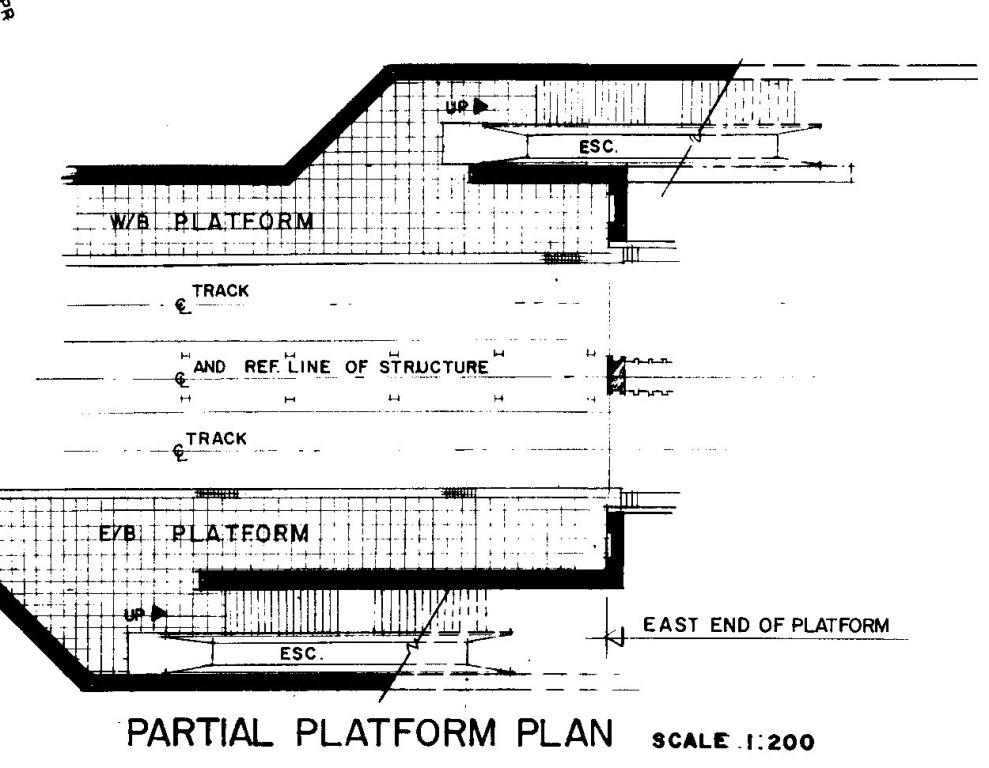
A preliminary design for the connection was done by TTC in April 1987.  This design would require some revision today both to provide full accessibility (elevators) and to fit with the planned new platform arrangements at Bloor station on the rail corridor.  In the interests of informed discussion, I have scanned the 1990 report on the history of this connection as well as the 1987 plan.

The report has been reformatted slightly, but the text is unchanged.  The drawing has been split apart from four separate images on one large page for ease of viewing online.

TTC GO Connection Report
Key Plan of Stations
Subway Platform East End
Control Area of Connection
Section View of New Connection

Metrolinx Publishes Full Richmond Hill Subway Study

The full version of the Benefits Case Analysis for the Yonge Subway extension to Richmond Hill is now available online.  I will comment on it at greater length when I have the time to do so.

Notable in this report is the acknowledgement of the effect of this extension on the existing subway system and especially Bloor-Yonge Station.  There are conflicting remerks in the BCA regarding the degree to which improved service on GO Transit to Richmond Hill can divert riding from the subway line.  A major issue here is that the implementation of very frequent all-day “Express Rail” GO service to Richmond Hill is not contemplated in the Metrolinx plan until 2031, long after a subway extension would open.

Detailed work on a number of related proposals will continue, and Metrolinx expects that a full evaluation will be available in late 2010.

The TTC Responds: TTC Times 2 / Riding Around Loops

Recent comments in the thread regarding the split operations on 501 Queen, as well as a reported incident where an operator was unaware that GO Transit could be used as a “bridge” between two TTC routes, led me to send questions for clarification to the TTC’s Director of Corporate Communications, Brad Ross. 

Here, with my comments, are the replies.  The questions have been slightly reformatted so that they can stand outside of the context in which they were written. Continue reading

GO Transit’s Service Plans: Small Changes Now, More Later

After a brief public session at last week’s Metrolinx Board meeting, there was a press scrum with GO Transit’s Gary McNeil.  Many questions focussed on GO’s plans to conform with the recent order from the Minister of the Environment that service in the Georgetown Corridor would have to meet Tier 4 diesel standards in 2015.  McNeil stated that GO’s goal was to have its entire locomotive fleet at Tier 4 by 2017 thanks to a planned overhaul.

To clarify what was said, I sent followup questions to GO/Metrolinx.

Continue reading

Metrolinx Electrification Study Terms of Reference

Metrolinx will seek a consultant to undertake a system-wide study of GO electrification with the intent of completing a report by December 2010.  A Request for Proposals (RFP) will be issued with the intention of award in November, and commencement of work in December 2009.  This is an aggressive timeframe for a project of this scope.

The proposed Terms of Reference (ToR) for this study are now available online.  They will be discussed at a meeting of the Metrolinx Board on Tuesday, October 20 at 11:45 am.  If approved, they will form the basis for the RFP.

My comments about the ToR were added here at about 6:30 pm on October 15.

Overall, the Terms of Reference are thorough and address many of the issues raised by the community.  Indeed, it is odd that Metrolinx was so defensive about its Georgetown South EA and associated claims regarding emissions considering the breadth of issues that will face the electrification study.

[Note that some remarks here duplicate replies in the comments thread which were posted before I updated the main article.]

The document linked here includes a covering report and the recommendations of the Community Advisory Committee created to advise Metrolinx on the ToR.  That Committee received input from, among other places, a “stakeholders meeting” in which I participated.  Some, but not all, of the issues raised by participants at that meeting have found their way into the ToR, or were already present.

I cannot help being amused (ROTFLMAO), but also dismayed by the following comment:

The GO System Electrification Study is a critical next step in the implementation of the Metrolinx regional transportation plan. It is a timely and important step in advancing the expansion of the GTHA regional transit network. In the continuing Metrolinx tradition that values community and stakeholder input, the Community Advisory Committee enhanced and enriched the quality of the work.  [Page 3]

There are a few community groups who would beg to differ with the claim that Metrolinx has a tradition of valuing community input.  This insults the many people who worked to raise important issues on the Georgetown South study, but for their pains were dismissed as NIMBYs while Metrolinx spun the issues to favour its own position.  Metrolinx is better known for secrecy and isolation than for community involvement.

The ToR are quite clear in requiring input from a broad range of interested and affected parties, and this will be a welcome change if there is no attempt to manage responses to fit a pre-determined conclusion.

A few broad issues are worth mentioning before I review specific sections of the proposal.

  • The study will review diesel and electric options, as well as two as yet unnamed alternative technologies.  Such alternatives have to be possible, realistic and viable, although how a study ending in 2010 would establish that capability for, say, a decade in the future is beyond me.  The last thing we need is another proposal based on a technology that’s just out of reach, or one where the GTA would become the guinea pig to demonstrate a new system. 
  • The distinction between the Union-Pearson Rail Link (UPRL) and Metrolinx/GO is becoming ever more difficult to discern.  For all practical purposes this service is being designed by GO, its infrastructure is built and paid for by GO, and all of the legal processes including Environmental Assessments are handled by GO.  There is little or no public participation by the so-called private partner, SNC-Lavalin, and recent press reports confirmed that a contract does not yet exist with that partner.  Given the level of public investment and involvement, the time is long past that SNC-Lavalin should abandon this scheme so that it can be properly integrated with GO’s plans and operations.
  • The methodology for evaluating environmental effects is much changed from the system used in the Metrolinx EA.  Rather than considering the airshed as a whole and trading off alleged reductions in pollution on the 401 for increases in Parkdale, the study must look at local effects related to distance from the rail corridor.  Of course, when the alternatives under comparison are trains-vs-trains, the concept of displaced trips fades in importance except for situations where technology “A” can carry and attract more riders than technology “B”.

Comments below are keyed to specific numbered sections within the ToR which form Appendix A of the linked document. Continue reading

Will Diesels Roar Through Minister’s Loophole?

Ever since Ontario’s Minister of the Environment, John Gerretsen, announced that the Georgetown South expansion of GO services, plus the link to Pearson Airport, would be allowed to proceed subject to a number of conditions, there has been much spin in the press by both side of the argument.

My position is quite clear in two previous posts:  the numbers used by Metrolinx to substantiate their claims about comparative pollution of auto and train travel are seriously flawed to the point that claims made by Metrolinx and the govenment are simply not true.

One additional problem came to light earlier today.

On its website, Metrolinx characterizes the decision as follows:

Trains operated by GO Transit on the Georgetown rail corridor and the Union Pearson Rail Link service must use Tier 4 state of the art engines when the service expansion begins or as soon as the technology is commercially available.

However, the order actually reads:

2. All trains utilized for GO Transit that travel to, from or through Georgetown along the Georgetown South Corridor shall be Tier 4 compliant when service begins or when Tier 4 compliant technology becomes commercially available.

3. All trains utilized for the Union-Pearson Rail Link in the Georgetown South Corridor shall be Tier 4 compliant when service begins or when Tier 4 compliant technology becomes commercially available.

The wording of item 2 above is curious.  Only trains that “to, from or through Georgetown” are subject to the order.  This omits the following services from the scope of the order:

  • Proposed frequent short-turn service to Brampton,
  • Trains to Milton which use the corridor south of West Toronto diamond,
  • Trains to Barrie which use the corridor south of Dundas Street, and run parallel to it for some distance to the north,
  • Trains to Bolton, a proposed new peak period GO line, which uses the corridor to the point where it turns west over the Humber River.

However, Metrolinx has no compunctions about including these trains in its calculations of diverted trips, saved emissions and, of course, the benefits of Tier 4 diesel technology.

Either the order is oddly and badly drafted, or there is a deliberate attempt to limit its scope while giving the impression that all new trains will have the latest in pollution controls.  The former would be mere incompetence.  The latter casts both Metrolinx and the Government’s position in a much darker light.

The Minister of the Environment owes everyone a clear statement regarding the intent of his order.  If it applies to all trains that will operate on the rail corridor beginning roughly at the Strachan Avenue grade crossing and ending at Georgetown, then say so.  If not, then explain why the frequent services planned for the heavy Milton (future Cambridge) and Barrie routes will operate with Tier 2 diesels.

Fun With Figures at Metrolinx (2)

Yesterday, I wrote about the Metrolinx calculations purporting to show improvements in pollution due to all the new diesel trains that will run in the corridor.  In that article, I concentrated on the GO services and the off-the-scale error in estimates of trips that would be taken.

This error — assuming all trains would be completely full, all day, both ways — dilutes the pollution per trip assigned to each passenger, and also inflates the pollution “saved” by auto trips that are diverted to transit.

A comment in that thread came in from John Galeazza:

Re. Pearson traffic growth.

Come now are we saying that Pearson has not seen a 4 fold increase in traffic over the past 20 odd years? Take a look at Pearson’s reports (they’re available on the GTAA’s website) in both passenger volume and aircraft movements there has been a steady increase.

To say that we shouldn’t use a piece of infrastructure because it has steadily fallen into disuse is farcical in my humble opininion. If that were the case GO would never have gotten started on the old freight/passenger lines that became “useless” with the arrival of the airplane and the car.

In my original reply (which has been hidden from the thread), I questioned the estimated ridership in the corridor for the air-rail link. Thanks to an arithmetic error (yes, even I make them, but at least I admit it when they happen), my comment would up addressing a false premise. That’s why I pulled it. Continue reading